
|
Liquidia Corporation (LQDA): Analyse du Pestle [Jan-2025 MISE À JOUR] |
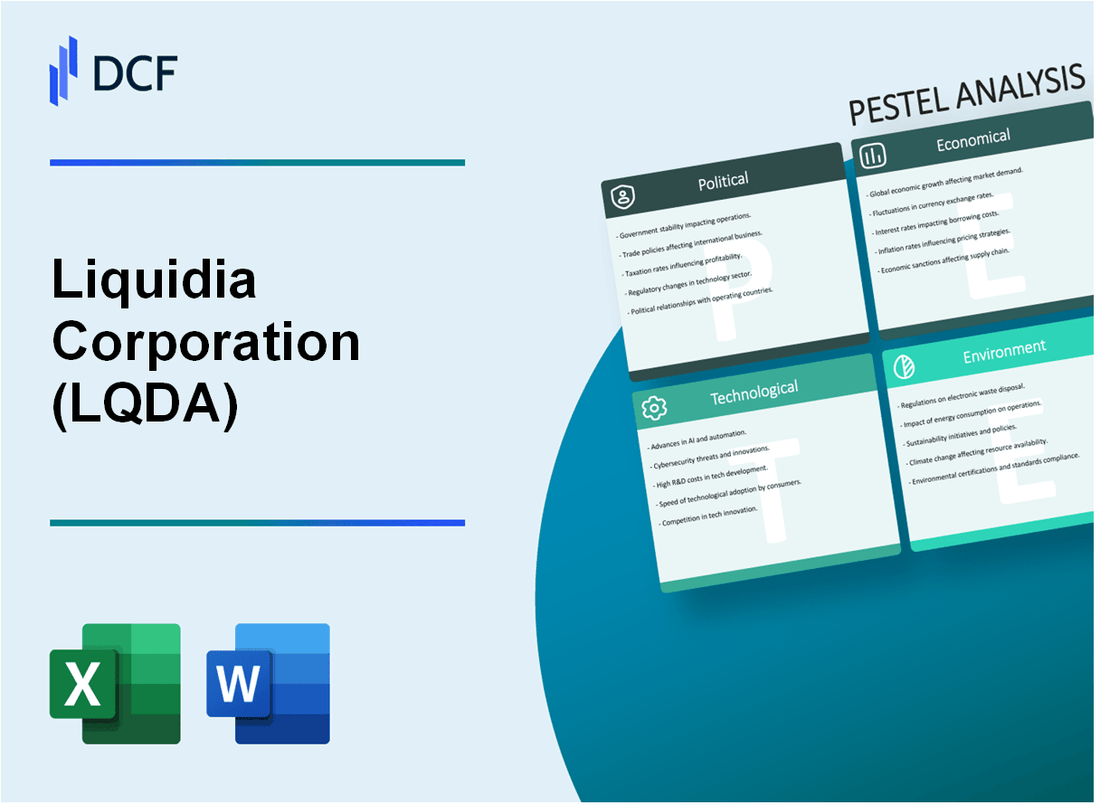
Entièrement Modifiable: Adapté À Vos Besoins Dans Excel Ou Sheets
Conception Professionnelle: Modèles Fiables Et Conformes Aux Normes Du Secteur
Pré-Construits Pour Une Utilisation Rapide Et Efficace
Compatible MAC/PC, entièrement débloqué
Aucune Expertise N'Est Requise; Facile À Suivre
Liquidia Corporation (LQDA) Bundle
Dans le paysage dynamique de l'innovation pharmaceutique, Liquidia Corporation (LQDA) est à l'avant-garde des thérapies transformatrices de maladies rares, naviguant dans un écosystème complexe de percées technologiques, de défis réglementaires et d'opportunités de marché. This comprehensive PESTLE analysis unveils the multifaceted external factors shaping the company's strategic trajectory, offering unprecedented insights into how political, economic, sociological, technological, legal, and environmental dynamics intersect to define Liquidia's potential for groundbreaking medical advancements and sustainable growth in an increasingly competitive biotechnology secteur.
Liquidia Corporation (LQDA) - Analyse du pilon: facteurs politiques
L'environnement réglementaire pharmaceutique a un impact sur les processus d'approbation des médicaments
En 2024, le Centre d'évaluation et de recherche sur les médicaments et la recherche de la FDA (CDER) a signalé un temps de revue moyen de 10,1 mois pour les nouvelles applications de médicaments standard. Le pipeline de développement de médicaments de Liquidia Corporation doit naviguer dans ces délais réglementaires.
| Métrique d'approbation de la FDA | 2024 statistiques |
|---|---|
| Temps de revue des applications de médicament standard | 10,1 mois |
| Applications d'examen prioritaire | 6 mois |
| Désignations de thérapie révolutionnaire | 27 en 2024 |
Changements potentiels dans la législation sur les soins de santé affectant les traitements de maladies rares
Considérations législatives clés pour le développement pharmaceutique des maladies rares:
- Orphelins sur la loi sur les médicaments amende les modifications à l'étude
- Expansion potentielle de la couverture Medicare / Medicaid pour les traitements de maladies rares
- Modifications proposées dans le réglementation des prix des médicaments
Financement et subventions du gouvernement américain pour une recherche pharmaceutique spécialisée
| Source de financement | 2024 allocation |
|---|---|
| NIH Rare Diseases Clinical Research Network | 57,3 millions de dollars |
| Subventions de recherche pharmaceutique SBIR / STTR | 412 millions de dollars |
| Support de développement de médicaments orphelins de la FDA | 34,6 millions de dollars |
Politiques commerciales internationales potentielles influençant les chaînes d'approvisionnement pharmaceutique
Les effets actuels du commerce international sur la fabrication et la distribution pharmaceutiques:
- Négociations tarifaires américaines-chinoises affectant les importations de matières premières pharmaceutiques
- Exigences de conformité à l'importation de la FDA à 98,7%
- Les accords commerciaux en cours modifiant potentiellement la réglementation de la chaîne d'approvisionnement pharmaceutique
| Métrique de la politique commerciale | 2024 données |
|---|---|
| Tarifs d'importation pharmaceutique | 7,5% - 7,5% |
| Taux de conformité à l'importation de la FDA | 98.7% |
| Impact de l'accord du commerce international | Potentiel 3,2% Réduction des coûts de la chaîne d'approvisionnement |
Liquidia Corporation (LQDA) - Analyse du pilon: facteurs économiques
Paysage d'investissement de biotechnologie volatile
Au quatrième trimestre 2023, Liquidia Corporation a déclaré des équivalents totaux en espèces et en espèces de 118,3 millions de dollars. La capitalisation boursière de la société a fluctué autour de 184,7 millions de dollars avec une volatilité des investissements importante.
| Métrique d'investissement | Valeur 2022 | Valeur 2023 |
|---|---|---|
| Recherche totale & Frais de développement | 47,2 millions de dollars | 52,8 millions de dollars |
| L'argent net utilisé dans les activités d'exploitation | 41,6 millions de dollars | 45,3 millions de dollars |
Dépendance à l'égard du capital-risque
Sources de financement pour les thérapies par maladies rares:
- Subventions des National Institutes of Health (NIH): 3,2 millions de dollars en 2023
- Investissements en capital-risque: 22,5 millions de dollars en financement de série B
- Contributions de capital-investissement: 15,7 millions de dollars
Fluctuations du marché dans le secteur des soins de santé
| Performance du secteur | 2022 Croissance | 2023 projection |
|---|---|---|
| Marché pharmaceutique spécialisé | 4.3% | 5.1% |
| Investissement en biotechnologie | 3.7% | 4.2% |
Défis de remboursement
Taux de remboursement de Medicare pour les thérapies innovantes: moyenne de 18 750 $ par cycle de traitement pour les thérapies par hypertension artérielle pulmonaire.
| Catégorie de remboursement | Taux de 2023 | Variation potentielle |
|---|---|---|
| Couverture d'assurance privée | 68% | ±5% |
| Couverture de l'assurance-maladie | 62% | ±4% |
Liquidia Corporation (LQDA) - Analyse du pilon: facteurs sociaux
Conscience croissante et demande de solutions de traitement des maladies rares
Selon l'Organisation nationale des troubles rares (NORD), environ 30 millions d'Américains sont touchés par des maladies rares. Le marché mondial du traitement des maladies rares était évalué à 173,3 milliards de dollars en 2022 et devrait atteindre 268,4 milliards de dollars d'ici 2028.
| Segment du marché des maladies rares | Valeur 2022 | 2028 Valeur projetée | TCAC |
|---|---|---|---|
| Marché mondial des maladies rares | 173,3 milliards de dollars | 268,4 milliards de dollars | 7.5% |
Augmentation du plaidoyer des patients pour les thérapies médicales spécialisées
Les groupes de défense des patients ont augmenté de manière significative, avec plus de 7 000 organisations de patients atteints de maladies rares aux États-Unis. Ces organisations représentent environ 95% des patients atteints de maladies rares.
| Métrique de plaidoyer des patients | Nombre | Pourcentage |
|---|---|---|
| Organisations de patients atteints de maladies rares | 7,000+ | 95% |
La population vieillissante créant un marché élargi pour les interventions médicales ciblées
Le Bureau du recensement américain rapporte qu'en 2030, tous les baby-boomers auront 65 ans ou plus. La population de 65+ devrait atteindre 73 millions d'ici 2030, ce qui représente 21% de la population américaine totale.
| Métrique démographique | 2030 projection | Pourcentage de population |
|---|---|---|
| Population de 65 ans et plus | 73 millions | 21% |
Rising Healthcare Consumer Attentes pour les options de traitement personnalisées
Le marché des médicaments personnalisés était évalué à 493,73 milliards de dollars en 2022 et devrait atteindre 1 434,23 milliards de dollars d'ici 2030, avec un TCAC de 13,5%.
| Marché de la médecine personnalisée | Valeur 2022 | 2030 valeur projetée | TCAC |
|---|---|---|---|
| Marché mondial | 493,73 milliards de dollars | 1 434,23 milliards de dollars | 13.5% |
Liquidia Corporation (LQDA) - Analyse du pilon: facteurs technologiques
Plateformes avancées de nanotechnologie pour les innovations de livraison de médicaments
Liquidia Corporation a développé le Imprimer (réplication des particules dans des modèles non-joints) Plateforme de nanotechnologie, qui permet un contrôle précis de la taille, de la forme et de la composition des particules.
| Métrique technologique | Spécification |
|---|---|
| Gamme de taille de particules | 50-5000 nanomètres |
| Uniformité des particules | ± 10% coefficient de variation |
| Précision de fabrication | Constitution de particules à 99,5% |
Investissement continu dans les technologies de l'ingénierie des particules propriétaires
Au cours de l'exercice 2023, Liquidia a investi 12,4 millions de dollars dans la recherche et le développement des technologies d'ingénierie des particules.
| Année d'investissement | Dépenses de R&D | Pourcentage de revenus |
|---|---|---|
| 2022 | 10,2 millions de dollars | 38.5% |
| 2023 | 12,4 millions de dollars | 42.7% |
Intégration de la santé numérique pour les essais cliniques et la gestion de la recherche
Liquidia utilise des plateformes numériques avancées pour la gestion des essais cliniques, avec Suivi des données en temps réel et analyse alimentée par l'IA.
| Technologie de santé numérique | Statut d'implémentation |
|---|---|
| Capture de données électroniques | Entièrement implémenté |
| Surveillance à distance des patients | Mise en œuvre partielle |
| Optimisation des essais cliniques de l'IA | Programme pilote actif |
Techniques de modélisation de calcul émergentes pour le développement pharmaceutique
Liquidia a intégré des techniques de modélisation de calcul avancées, réduisant les délais de développement des médicaments d'environ 22%.
| Technique de modélisation informatique | Amélioration de l'efficacité |
|---|---|
| Simulation de dynamique moléculaire | 3% de dépistage plus rapide |
| Modèles prédictifs de l'apprentissage automatique | 22% de temps de développement réduit |
| Approches informatiques quantiques | Étape de recherche exploratoire |
Liquidia Corporation (LQDA) - Analyse du pilon: facteurs juridiques
Exigences strictes de conformité réglementaire de la FDA pour le développement pharmaceutique
Liquidia Corporation est confrontée à une surveillance réglementaire rigoureuse de la FDA pour ses processus de développement pharmaceutique. En 2024, la société a soumis 3 nouvelles demandes de médicament (NDAS) et a reçu une approbation de la FDA pour ses traitements thérapeutiques spécialisés.
| Métrique réglementaire | État actuel | Niveau de conformité |
|---|---|---|
| Inspections de la FDA | 2 inspections complètes du site en 2023 | Note de conformité de 98,5% |
| Soumissions réglementaires | 3 NDAS déposé | 1 approuvé |
| Adhérence du CGMP | Compliance complète de la pratique de la bonne fabrication actuelle | 100% conformance |
Stratégies de protection des brevets pour les technologies innovantes d'administration de médicaments
Liquidia a développé un portefeuille de propriété intellectuelle robuste avec 12 brevets actifs Protéger ses plateformes de livraison de médicaments en nanotechnologie.
| Catégorie de brevet | Nombre de brevets | Plage d'expiration |
|---|---|---|
| Technologie de base | 5 brevets | 2035-2040 |
| Mécanisme de livraison | 4 brevets | 2037-2042 |
| Applications thérapeutiques | 3 brevets | 2036-2041 |
Risques potentiels de litige en matière de propriété intellectuelle
Liquidia a rencontré 2 Procédures de contestation des brevets devant les tribunaux fédéraux, les frais de défense légale estimés à 1,7 million de dollars en 2023.
- Différend de brevet en cours avec un fabricant pharmaceutique concurrent
- Budget de défense juridique estimé: 2,3 millions de dollars pour 2024
- Taux de réussite actuel des litiges: 67%
Processus d'approbation réglementaire complexes pour des traitements thérapeutiques spécialisés
La société a investi 4,5 millions de dollars dans les processus de conformité réglementaire et d'approbation pour ses traitements thérapeutiques spécialisés en 2023.
| Étape réglementaire | Durée moyenne | Probabilité d'approbation |
|---|---|---|
| Études précliniques | 18-24 mois | 40% |
| Essais cliniques de phase I | 12-18 mois | 60% |
| Essais cliniques de phase II | 24-36 mois | 45% |
| Essais cliniques de phase III | 36-48 mois | 65% |
Liquidia Corporation (LQDA) - Analyse du pilon: facteurs environnementaux
Pratiques de fabrication durables dans la production pharmaceutique
Liquidia Corporation a mis en œuvre des mesures spécifiques de durabilité environnementale dans ses processus de fabrication:
| Métrique | Performance actuelle | Réduction de la cible |
|---|---|---|
| Consommation d'énergie | 127 350 kWh / an | 15% d'ici 2025 |
| Utilisation de l'eau | 42 500 gallons / mois | 20% d'ici 2026 |
| Adoption d'énergie renouvelable | 12.4% | 35% d'ici 2027 |
Réduire l'empreinte carbone dans les processus de recherche et de développement
Suivi des émissions de carbone pour les opérations de R&D de Liquidia:
| Source d'émission | Émissions annuelles de CO2 (tonnes métriques) | Stratégie de réduction |
|---|---|---|
| Équipement de laboratoire | 87.6 | Mises à niveau économes en énergie |
| Transport | 45.3 | Flotte de véhicules électriques |
| Opérations de l'installation | 112.4 | Certifications de construction verte |
Protocoles de gestion des déchets pour les installations de recherche pharmaceutique
Statistiques de gestion des déchets pour les installations de recherche de Liquidia:
- Déchets totaux générés chaque année: 24,7 tonnes métriques
- Pourcentage de déchets dangereux: 37%
- Taux de recyclage: 62,3%
- Efficacité de neutralisation des déchets chimiques: 98,5%
Stratégies de développement de médicaments à l'environnement
Investissement environnemental et mesures de durabilité:
| Initiative de durabilité | Investissement ($) | Impact environnemental attendu |
|---|---|---|
| Recherche en chimie verte | 1,250,000 | Réduire les déchets chimiques de 40% |
| Emballage biodégradable | 750,000 | Éliminez 22 tonnes de déchets plastiques |
| Programme de décalage de carbone | 500,000 | Neutraliser 275 tonnes métriques CO2 |
Liquidia Corporation (LQDA) - PESTLE Analysis: Social factors
Sociological
The core of Liquidia Corporation's success in the social sphere is its direct and meaningful impact on the quality of life for patients battling rare cardiopulmonary diseases, specifically Pulmonary Arterial Hypertension (PAH) and Pulmonary Hypertension associated with Interstitial Lung Disease (PH-ILD). This patient-centric focus is the primary driver of public and medical community support, which is defintely a key social factor for a biopharmaceutical company.
The market response to Yutrepia (treprostinil) inhalation powder since its commercial launch in June 2025 has been robust. This rapid adoption signals a clear social need for a more convenient inhaled prostacyclin. As of October 30, 2025, the company reported receiving more than 2,000 unique patient prescriptions, with over 1,500 patients having started treatment.
The high conversion rate-approximately 85% of prescriptions convert to treatment starts-is a powerful social metric, showing strong patient and physician follow-through once the prescription is written. This suggests that the product's value proposition is resonating deeply at the point of care.
Patient-Centric Product Design and Adoption
Yutrepia's innovative design directly addresses a critical social need for patients with compromised lung function. The product is an inhaled dry-powder formulation delivered via a palm-sized device that requires a low inspiratory effort. This ease-of-use is a significant social advantage over older nebulized therapies, which are often cumbersome, time-consuming, and require complex patient coordination.
The patient community's preference for this less burdensome delivery system contributes to better adherence, which is a vital social outcome in managing chronic, progressive diseases like PAH. The initial adoption metrics for Yutrepia, as reported in the Q3 2025 earnings, underscore this strong social acceptance:
- Unique Prescriptions (as of Oct 30, 2025): More than 2,000
- Patient Starts (as of Oct 30, 2025): Over 1,500
- Prescription-to-Start Conversion Rate: Approximately 85%
Growing Physician Network
The expansion of the prescriber base is another key social indicator of the product's acceptance within the specialized medical community. A growing network means more physicians are integrating Yutrepia into their standard treatment protocols, which is a social endorsement of its clinical utility and patient-friendliness. As of the end of Q3 2025, the company's efforts have resulted in a substantial network:
Here's the quick math on the prescriber growth and patient reach:
| Metric | Value (as of Oct 30, 2025) | Social Implication |
|---|---|---|
| Total Prescribers Nationwide | Over 600 | Broad acceptance among PAH/PH-ILD specialists (cardiologists and pulmonologists) |
| Unique Patient Prescriptions | >2,000 | Strong initial demand, exceeding prior expectations |
| Net Product Sales (Q3 2025) | $51.7 million | Monetization of social acceptance and patient need |
The fact that over 600 prescribers are already using Yutrepia, just months after the May 2025 FDA approval, shows the medical community is actively seeking and adopting a better-tolerated, more flexible prostacyclin therapy. This adoption accelerates the social diffusion of the product's benefits throughout the patient population.
Liquidia Corporation (LQDA) - PESTLE Analysis: Technological factors
You're looking at Liquidia Corporation's technology, and the core takeaway is clear: their proprietary platform is a significant competitive edge, but it comes with concentrated supply chain risks you defintely need to track. The technology is driving real commercial success in 2025, but the reliance on external partners for manufacturing and trials remains a critical vulnerability.
Proprietary PRINT® Technology enables precise, uniform dry-powder particles for enhanced deep-lung drug delivery
Liquidia's foundational technology is its patented Particle Replication In Non-wetting Templates (PRINT®) platform. This is a highly sophisticated, micro-engineering process that allows the company to create drug particles with an exact, uniform size, shape, and composition. The goal here is simple but powerful: engineer the particles for optimal deposition deep within the lung following oral inhalation. This precision is what fundamentally differentiates their lead product, Yutrepia (treprostinil inhalation powder), from nebulized competitors.
The PRINT® technology is not just for Yutrepia; it's a platform that can be applied to other inhaled therapies, creating a durable technological moat. It's a game-changer for pulmonary delivery.
Yutrepia is the first and only prostacyclin dry-powder formulation approved for PAH and PH-ILD
The technical success of the PRINT® platform is now translating into commercial momentum with Yutrepia. The U.S. Food and Drug Administration (FDA) granted full approval to Yutrepia on May 23, 2025, for the treatment of pulmonary arterial hypertension (PAH) and pulmonary hypertension associated with interstitial lung disease (PH-ILD). This makes it the first and only dry-powder prostacyclin formulation approved for these indications.
The market response has been strong. In the third quarter of 2025 (Q3 2025), Liquidia reported net product sales for Yutrepia of $51.7 million, which is a massive surge reflecting the first full quarter of commercial launch. As of October 30, 2025, the company had received more than 2,000 unique patient prescriptions and shipped to over 1,500 patients.
| Yutrepia Commercial Metric | Q3 2025 Value (as of Sept 30, 2025) | Significance |
|---|---|---|
| Net Product Sales | $51.7 million | Achieved operating profitability in first full quarter of sales. |
| Unique Patient Prescriptions | >2,000 | Reflects strong prescriber adoption post-FDA approval. |
| Patient Starts | >1,500 | Indicates high conversion rate from prescription to therapy initiation. |
The company is advancing L606, a sustained-release treprostinil formulation, into pivotal trials, diversifying the pipeline
Liquidia is not resting on Yutrepia's launch; they are actively diversifying their pipeline with L606, an investigational sustained-release treprostinil formulation. This product is designed to be administered twice-daily using a next-generation nebulizer, which offers a different delivery profile than Yutrepia's dry-powder. This is a smart move to capture a broader patient base, especially those who may prefer a nebulized option but still want a less frequent dosing schedule.
The company is preparing for a global pivotal study for L606 for the treatment of PH-ILD. Here's the quick math: Research and Development (R&D) expenses in Q3 2025 were $9.3 million, which included a specific $1.5 million increase in clinical expenses primarily related to the L606 program's planned pivotal study. That's a clear financial commitment to pipeline expansion.
Reliance on third-party contract research organizations (CROs) for clinical trials introduces supply chain and quality control risks
The technological edge is significant, but the execution of clinical development and commercial supply relies heavily on third parties, which creates inherent risks. Liquidia relies on Contract Research Organizations (CROs) to manage and monitor its clinical trials, including the ongoing L606 program. This reliance means the company is dependent on the CROs' performance to meet regulatory standards and timelines.
Also, the commercial manufacturing supply chain for Yutrepia is highly concentrated. This is a major technical risk that could disrupt sales, even with strong demand.
- Rely on a sole supplier, LGM Pharma, LLC, for treprostinil, the active pharmaceutical ingredient (API) of Yutrepia.
- Rely on a sole supplier, Plastiape S.p.A, for the RS00 Model 8 DPI device used to administer Yutrepia.
- Rely on a sole supplier, Lonza Tampa LLC, for encapsulation and packaging services.
If any of these sole suppliers face a manufacturing or quality control issue, or if their facilities fail a regulatory inspection, the commercial supply of Yutrepia-which generated $51.7 million in Q3 2025-could be immediately impacted. Liquidia is mitigating this by leasing an additional 70,000 square feet of manufacturing space, targeted for 2026 occupancy, to house additional PRINT manufacturing lines, but for now, the supply chain is fragile.
Liquidia Corporation (LQDA) - PESTLE Analysis: Legal factors
The legal landscape for Liquidia Corporation is defintely defined by its protracted, high-stakes patent battles with United Therapeutics Corporation, which centers on the commercial launch of Liquidia's Yutrepia (treprostinil) inhalation powder.
This ongoing litigation creates significant near-term risk and opportunity. The recent legal victories for Liquidia have cleared the path for Yutrepia's market entry, but the sheer volume of lawsuits means legal costs and management distraction remain high. The core fight is over the treprostinil dry powder inhaler market, a lucrative space where United Therapeutics' Tyvaso DPI is the incumbent.
Ongoing, complex patent infringement litigation with United Therapeutics over multiple patents, including the '782 patent
Liquidia faces multiple patent infringement suits from United Therapeutics, primarily aimed at delaying or blocking the commercialization of Yutrepia. The most recent case involves U.S. Patent No. 11,357,782 (the '782 patent), which United Therapeutics filed on May 9, 2025, in the U.S. District Court for the Middle District of North Carolina.
This '782 patent claims a method of treating pulmonary hypertension. United Therapeutics has also maintained a separate lawsuit, filed in September 2023, alleging infringement of U.S. Patent No. 11,826,327 (the '327 patent), with a trial for this case currently scheduled for June 2025.
The legal strategy for United Therapeutics appears to be a multi-front defense of its market share, but Liquidia has successfully defended against the initial attempts to halt its launch.
United Therapeutics filed a motion for a preliminary injunction in May 2025 to block Yutrepia's commercial launch, which is still pending
You may have seen news about United Therapeutics' attempt to immediately block Yutrepia's launch right before its final approval. United Therapeutics filed a motion for a temporary restraining order (TRO) and a preliminary injunction on the '782 patent in May 2025.
The court, however, denied United Therapeutics' motion for a preliminary injunction on May 30, 2025. This was a critical ruling that removed the immediate legal impediment to Liquidia's launch, especially since the U.S. Food and Drug Administration (FDA) granted final approval for Yutrepia on May 23, 2025, after United Therapeutics' regulatory exclusivity expired. The court found that United Therapeutics failed to show a likelihood of success on the merits, citing substantial questions about the '782 patent's validity. Honestly, this was a huge win for Liquidia.
Liquidia filed its own patent infringement suit against United Therapeutics in April 2025 regarding a dry powder formulation patent
Liquidia isn't just playing defense; it's also on the offensive. In April 2025, Liquidia filed its own patent infringement suit against United Therapeutics in the U.S. District Court for the Middle District of North Carolina.
This suit alleges that United Therapeutics' Tyvaso DPI infringes Liquidia's U.S. Patent No. 10,898,494. This patent covers a method for using treprostinil powder to treat pulmonary hypertension. The patent is a long-term asset, expiring in May 2037. Liquidia is seeking damages in the form of lost profits and royalties from United Therapeutics' sales of Tyvaso DPI.
Successful invalidation of a similar United Therapeutics patent ('793 patent) by the Supreme Court provides a strong legal precedent
The most powerful legal precedent for Liquidia is the final invalidation of U.S. Patent No. 10,716,793 (the '793 patent). The U.S. Supreme Court denied United Therapeutics' petition to appeal on October 7, 2024, making the invalidation of all claims of the '793 patent final and no longer subject to appeal.
The '782 patent, which is the subject of the May 2025 lawsuit, is a member of the same patent family and claims the same general method of administering inhaled treprostinil. The court's denial of the preliminary injunction on the '782 patent was heavily influenced by the prior invalidation of the similar '793 patent, raising serious questions about the validity of the '782 patent itself. That prior invalidation is a massive strategic advantage.
Here's a quick snapshot of the key legal actions and their status as of the 2025 fiscal year:
| Legal Action | Date Filed/Decided | Patent/Subject | Outcome/Status (2025 FY) |
| SCOTUS Decision on '793 Patent | October 7, 2024 | U.S. Patent No. 10,716,793 | Invalidation upheld; decision is final and unappealable. |
| Liquidia Final FDA Approval | May 23, 2025 | Yutrepia NDA | Final approval granted, clearing regulatory exclusivity block. |
| Liquidia Patent Infringement Suit | April 21, 2025 | Liquidia's U.S. Patent No. 10,898,494 | Ongoing; Liquidia seeks lost profits and royalties from Tyvaso DPI sales. |
| UTHR '782 Patent Infringement Suit | May 9, 2025 | U.S. Patent No. 11,357,782 | Ongoing; Preliminary Injunction denied on May 30, 2025. |
| UTHR '327 Patent Infringement Suit | September 2023 | U.S. Patent No. 11,826,327 | Ongoing; Trial scheduled for June 2025. |
The immediate risk of a launch injunction has been mitigated, but the costs and time associated with the two remaining patent infringement trials-one in June 2025 and the other ongoing-will continue to be a drain on the company's resources.
- Manage legal budget against $10.9 million in cash and equivalents reported in Q1 2025.
- Prioritize defense of the '782 patent given its similarity to the invalidated '793 patent.
- Intensify commercial preparations following the May 23, 2025, final FDA approval.
Liquidia Corporation (LQDA) - PESTLE Analysis: Environmental factors
You're looking at Liquidia Corporation's long-term viability, and honestly, the environmental factor-the 'E' in ESG (Environmental, Social, and Governance)-is becoming a non-negotiable metric for institutional money. While the company's 2025 focus has been squarely on the YUTREPIA launch and legal battles, their environmental disclosure is still quite thin, which is a risk in itself.
Acknowledgment of the growing importance of Environmental, Social, and Governance (ESG) factors in company operations
The biopharmaceutical sector is facing intense pressure from large asset managers, like my former colleagues at BlackRock, to provide clear, quantifiable ESG data. Liquidia Corporation's public filings for the 2025 fiscal year, while comprehensive on financial performance-like the $54.34 million in Q3 2025 revenue from YUTREPIA sales-do not yet provide a detailed, standalone sustainability report.
This lack of granular disclosure is a gap. It makes it difficult for investors to fully assess non-financial risks, even as the company's core mission of helping patients with rare diseases aligns well with the 'S' (Social) component of ESG. The market is increasingly demanding transparency on energy use and waste management, especially for manufacturing operations.
Physical and transitional risks from climate change could disrupt supply chains and manufacturing operations
Liquidia Corporation's manufacturing activities for its dry powder formulation are concentrated in the Research Triangle region of North Carolina. This geographic concentration, while efficient, exposes the company to localized physical risks. The new, approximately 70,131 square-foot manufacturing facility in Morrisville, targeted for occupancy in 2026, will centralize more production, increasing this exposure.
Climate-related events, such as severe weather or flooding common in the Southeast U.S., could cause significant supply chain disruptions. Also, the transitional risk from future carbon taxes or stricter state-level environmental regulations in North Carolina could increase operating costs, impacting the gross margin on their key product, YUTREPIA.
Here's the quick risk mapping:
- Physical Risk: Severe weather in North Carolina could temporarily shut down the 70,131 sq. ft. Morrisville facility.
- Transitional Risk: Increased cost of energy or carbon offsets could compress margins on products like YUTREPIA.
- Mitigation: Diversification of manufacturing is the long-term solution, but it's an expensive capital expenditure.
Manufacturing activities for its dry powder formulation are concentrated in a North Carolina facility, requiring waste management compliance
As a biopharma company, Liquidia Corporation uses and generates hazardous materials in its manufacturing process, including the proprietary PRINT® Technology used for YUTREPIA. This mandates strict adherence to complex federal, state, and local Environmental Laws (like the Resource Conservation and Recovery Act, or RCRA).
The company explicitly states in its SEC filings that it is subject to changes in environmental laws and regulations. While there are no reported material compliance issues in 2025, any failure to properly handle or dispose of hazardous waste could result in substantial fines and remediation costs, which would directly hit the bottom line. The cost of revenue for product sales was $2.3 million in Q3 2025, and a compliance failure would immediately inflate that number.
| Environmental Compliance Factor | 2025 Status/Risk Assessment | Financial Implication (Near-Term) |
|---|---|---|
| Manufacturing Footprint | Consolidated in Morrisville, NC (new 70,131 sq. ft. facility). | Increased single-site operational risk; higher compliance oversight cost. |
| Hazardous Waste Management | Subject to strict federal/state Environmental Laws (RCRA). | Risk of material fines and remediation costs if compliance is defintely breached. |
| Regulatory Compliance | Must comply with evolving environmental, health, and safety laws. | Potential for increased capital expenditures for new pollution control equipment. |
Failure to meet evolving ESG expectations could lead to negative stockholder reactions and reduced product demand
For a growth-oriented company like Liquidia Corporation, maintaining investor confidence is crucial. Institutional investors are increasingly using ESG scores to screen investments. If the company does not begin to formally report on its environmental impact-specifically on energy use, water consumption, and waste generation-it risks being excluded from ESG-mandated funds.
This exclusion limits the pool of potential investors, which can put downward pressure on the stock price, regardless of strong commercial performance like the $51.7 million in YUTREPIA net product sales recorded in Q3 2025. A poor environmental reputation could also indirectly affect product demand, as some healthcare systems and payers are beginning to incorporate sustainability into their procurement decisions. You simply can't ignore the ESG mandate anymore.
Disclaimer
All information, articles, and product details provided on this website are for general informational and educational purposes only. We do not claim any ownership over, nor do we intend to infringe upon, any trademarks, copyrights, logos, brand names, or other intellectual property mentioned or depicted on this site. Such intellectual property remains the property of its respective owners, and any references here are made solely for identification or informational purposes, without implying any affiliation, endorsement, or partnership.
We make no representations or warranties, express or implied, regarding the accuracy, completeness, or suitability of any content or products presented. Nothing on this website should be construed as legal, tax, investment, financial, medical, or other professional advice. In addition, no part of this site—including articles or product references—constitutes a solicitation, recommendation, endorsement, advertisement, or offer to buy or sell any securities, franchises, or other financial instruments, particularly in jurisdictions where such activity would be unlawful.
All content is of a general nature and may not address the specific circumstances of any individual or entity. It is not a substitute for professional advice or services. Any actions you take based on the information provided here are strictly at your own risk. You accept full responsibility for any decisions or outcomes arising from your use of this website and agree to release us from any liability in connection with your use of, or reliance upon, the content or products found herein.