

|
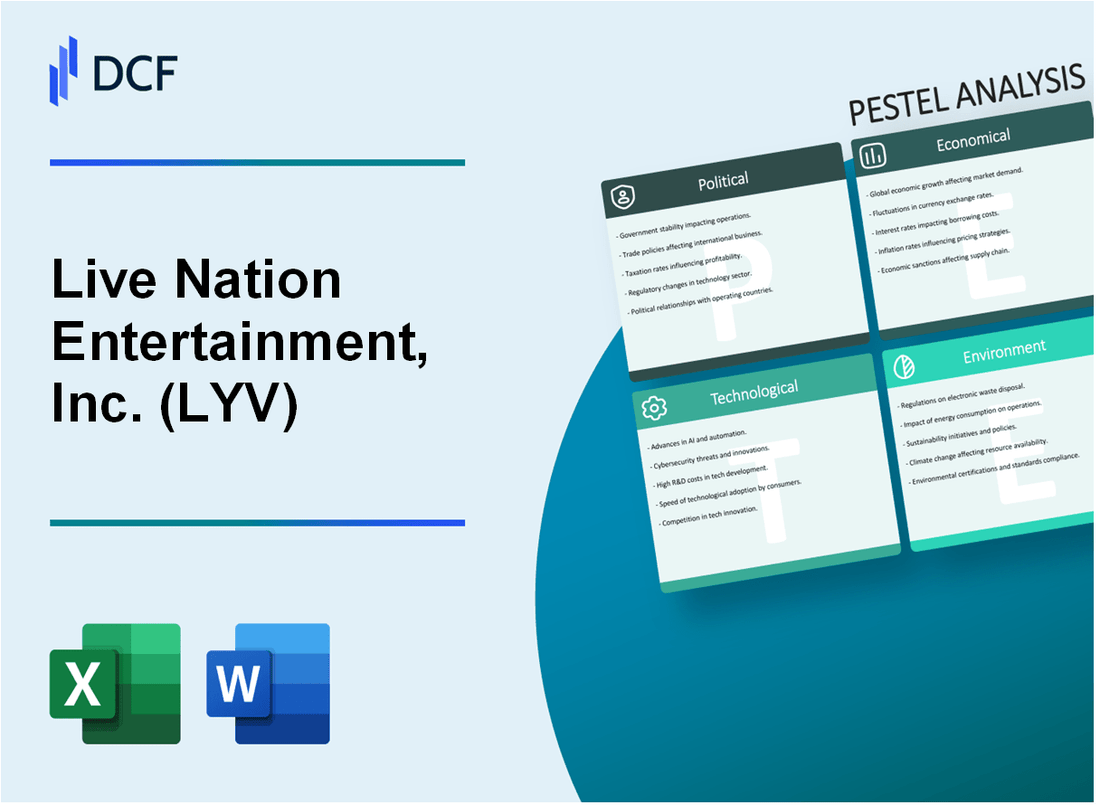
Live Nation Entertainment, Inc. (LYV): PESTLE Analysis [Apr-2026 Updated] |
Entièrement Modifiable: Adapté À Vos Besoins Dans Excel Ou Sheets
Conception Professionnelle: Modèles Fiables Et Conformes Aux Normes Du Secteur
Pré-Construits Pour Une Utilisation Rapide Et Efficace
Compatible MAC/PC, entièrement débloqué
Aucune Expertise N'Est Requise; Facile À Suivre
Live Nation Entertainment, Inc. (LYV) Bundle
You're trying to figure out if Live Nation Entertainment, Inc. (LYV) is a solid investment right now, balancing their massive concert revenue against the looming threat of a government breakup. Honestly, the 2025 data shows incredible consumer demand for live events, but the Department of Justice antitrust case is the elephant in the room you simply can't ignore. Let's break down the full political, economic, and legal landscape so you know exactly what to watch for next.
Live Nation Entertainment, Inc. (LYV) - PESTLE Analysis: Political factors
The political landscape for Live Nation Entertainment, Inc. (LYV) in 2025 is dominated by a single, existential risk: the U.S. government's aggressive antitrust action. This isn't just a legal headache; it's a fundamental threat to the company's vertically integrated business model, plus there's a new wave of consumer protection laws that are changing how you sell tickets.
US Department of Justice (DOJ) antitrust lawsuit threatens business structure
The most significant political factor is the civil antitrust lawsuit filed by the U.S. Department of Justice (DOJ) and a bipartisan coalition of 40 state attorneys general. This action, filed in May 2024, alleges that Live Nation has illegally monopolized the live entertainment industry by leveraging its control over concert promotion, venue management, and ticketing through Ticketmaster. The core of the complaint is the allegation that the company uses exclusionary practices, such as tying concert promotion services to venue access, to stifle competition.
Here's the quick math on the alleged market power: Live Nation is accused of controlling around 60% of concert promotions at major U.S. venues and 80% or more of the primary ticketing for those venues. This level of market share is what the DOJ is targeting. The suit is moving forward, with U.S. District Judge Arun Subramanian denying Live Nation's motion to dismiss critical parts of the case on March 14, 2025. That was a defintely a blow to the defense.
Regulatory risk of forced divestiture (breakup of Ticketmaster merger) is a top concern
The primary remedy sought by the DOJ is structural relief-specifically, an order requiring Live Nation to divest its Ticketmaster subsidiary. This would effectively break up the 2010 merger and fundamentally reshape the entire live music ecosystem. For investors, this is the ultimate risk, as it would separate the high-margin ticketing business from the concert promotion and venue operations.
The risk remains high throughout 2025, even though the estimated trial start date is March 2, 2026. The uncertainty alone impacts the stock price and strategic planning. To be fair, Live Nation argues that its vertical integration benefits artists and fans, but the government's position is clear: the current structure harms consumers and competition. The DOJ's goal is to unwind the merger, not just impose fines.
| Antitrust Risk Factor | DOJ Allegation | Impact on Live Nation (2025) |
|---|---|---|
| Market Control | Controls 80%+ of major venue primary ticketing. | High legal defense costs; pressure to change venue contracting terms. |
| Tying Claim | Forces artists to use Live Nation promotion for venue access. | Judge allowed this claim to proceed on March 14, 2025, increasing liability risk. |
| Structural Remedy | Seeks forced divestiture of Ticketmaster. | Highest risk to business model; uncertainty until 2026 trial. |
Government scrutiny on ticket pricing and fee transparency remains high
Beyond the antitrust case, a new wave of consumer protection regulation is hitting the ticketing business. The Federal Trade Commission (FTC) is enforcing its Rule on Unfair or Deceptive Fees, which took effect on May 12, 2025. This rule mandates all-in pricing, meaning the total ticket price, including all mandatory fees, must be clearly and conspicuously disclosed upfront. This is a direct response to the political push against so-called 'junk fees.'
This new federal rule, plus similar state laws passed in places like California, Colorado, and New York, forces a change in the primary ticketing display model. Live Nation must now adjust its pricing strategy to show the final cost immediately, which could impact consumer perception of ticket affordability, even if the total price hasn't changed. The goal is to end the practice of 'drip pricing,' where fees are added late in the checkout process.
Global touring logistics impacted by international trade policies and visa requirements
While the U.S. antitrust battle dominates, international political and regulatory changes pose logistical and financial risks to the company's global touring business. Live Nation is an international giant, having hosted over 150 million+ fans across more than 50,000 shows in 45+ countries in 2024, and they are prioritizing international expansion for 2025, anticipating double-digit Adjusted Operating Income (AOI) growth.
However, new travel authorization schemes are complicating artist and crew movement:
- The European Travel Information and Authorization System (ETIAS), a visa-waiver system, is expected to come into force mid-2025, requiring U.S. citizens to register before travel.
- The UK's Electronic Travel Authorisation (ETA) scheme is already in operation, creating a logistical burden for promoters.
- The standard 9-to-12-month lead time for booking a major international tour clashes with the three-month lead time for some visa applications, creating significant uninsurable financial risk for Live Nation when securing international artists.
This friction adds cost and complexity to the $14 billion Live Nation invested in artists in 2024, up from $13 billion in 2023. You need to watch these global logistics closely; they are the silent margin killers.
Live Nation Entertainment, Inc. (LYV) - PESTLE Analysis: Economic factors
Strong consumer discretionary spending drives demand for live events.
You're looking at a business fundamentally tied to how much disposable income people have left over after paying the essentials. Honestly, the consumer discretionary spending environment in 2025 has been the primary tailwind for Live Nation Entertainment. Fans are still prioritizing experiences, which is clear from the record deferred revenue-that's money paid upfront for future shows-which hit $3.5 billion for events in the third quarter alone, up 37% year-over-year. Still, we see budget constraints pushing fans to pool their money for one big stadium tour rather than several smaller, spontaneous outings, a shift that favors Live Nation's large-scale offerings. This trend means demand is high, but the type of demand is becoming more considered.
Here's the quick math on that upfront demand:
- Event-Related Deferred Revenue (Q3 2025): $3.5 billion
- Ticketmaster Deferred Revenue (Q3 2025): $231 million
- Total Concert Ticket Sales (YTD through October): 150 million fans
Q3 2025 Revenue hit $8.5 billion, up 11% year-over-year.
The top line reflects this strong demand, even if it missed some analyst whisper numbers slightly. Live Nation Entertainment posted revenue of $8.5 billion for the third quarter of fiscal 2025, marking an 11% jump compared to the same period last year. This performance shows the core business is defintely firing on all cylinders, driven by strength across concerts, ticketing, and sponsorship segments. It's a massive number, showing the sheer scale of their operation in this economic climate.
Fan spending onsite is robust, up 8% at amphitheaters year-to-date.
It's not just about the ticket price; concession and merchandise sales (onsite spending) are crucial margin drivers. We see that fan spending remains very strong. Specifically, year-to-date, spending at their amphitheaters is up 8%. Major festivals (over 100,000 fans) also saw onsite spending climb by 6% year-to-date. This indicates that even as fans budget for tickets, they are still willing to spend freely once they are inside the venue gates. That's excellent news for the operating income outlook.
Inflation and currency fluctuations impact ticket prices and international touring costs.
Now for the friction points. Inflation is a real headwind, pushing up costs for touring essentials like fuel for buses, hotel stays, and even stage equipment, which trickles down to artists and, eventually, ticket prices. Furthermore, Live Nation's significant international presence means foreign exchange (forex) volatility matters. We saw this play out earlier in the year, with currency fluctuations, particularly in Latin American markets, expected to impact operating income. You have to factor in these currency swings when modeling international revenue streams.
Planned 2025 capital expenditures are high, estimated at $900 million to $1 billion for venue expansion.
The company is aggressively reinvesting its cash flow back into growing the physical footprint. For the full 2025 fiscal year, capital expenditures (capex) are estimated to be between $900 million and $1 billion. A huge chunk of that-between $700 million and $800 million-is earmarked for venue expansion and enhancement projects. They are building new capacity, expecting these investments to yield high internal rates of return, averaging over 20%. This is a clear bet that the current demand environment is sustainable enough to justify this heavy, long-term capital outlay.
Here is a snapshot of Live Nation Entertainment's key economic performance indicators for 2025:
| Metric | Value (2025 Data) | Context |
| Q3 Revenue | $8.5 billion | Up 11% year-over-year |
| Amphitheater Onsite Spend Growth | Up 8% | Year-to-date |
| Total 2025 Capex Estimate | $900 million to $1 billion | Includes venue expansion |
| Venue Expansion Capex Allocation | $700 million to $800 million | Portion of total capex |
| Concert Ticket Sales (YTD through Oct) | 150 million fans | Tracking toward 160 million for full year |
Finance: draft 13-week cash view by Friday
Live Nation Entertainment, Inc. (LYV) - PESTLE Analysis: Social factors
You're looking at the social landscape for Live Nation Entertainment, and honestly, it's a mixed bag of massive consumer demand battling intense public scrutiny. The core story here is that people absolutely crave live events, but they are getting increasingly fed up with the cost of entry. This tension defines the social risk profile for Live Nation right now.
Public Backlash Against High Ticket Fees and Poor User Experience (PR Risk)
The biggest headache for Live Nation is the persistent PR battle over ticketing costs. Fans are vocal, and regulators are listening. Since the pandemic, average ticket prices have shot up by a staggering 42%, according to some industry reports. By mid-2025, the average concert ticket price was hovering around $135.92, a big jump from the pre-pandemic $91.86 in 2019. This isn't just about the face value, either; the secondary market is wild, with some floor seats for major acts hitting $3,821.
The good news is that some action is being taken. The Federal Trade Commission's new Junk Fees Rule, which took effect in May 2025, forces companies like Ticketmaster to show the total price upfront, including service charges. Ticketmaster responded by rolling out All-In Prices to display mandatory fees before checkout, which is a step toward transparency. Still, the frustration boils over; just last month, singer Olivia Dean called the resale service provided by Ticketmaster and Live Nation defintely disgusting, forcing Ticketmaster to cap resale prices at face value for her tour. The Department of Justice is even suing, arguing the company's dominance leads directly to higher fees for fans. That's a serious social and regulatory headwind.
Strong, Sustained Consumer Preference for Live Experiences Over Other Entertainment
Despite the sticker shock, the demand for getting out and experiencing things live remains incredibly strong. This is the tailwind that keeps Live Nation's revenue engine running hot. An April 2025 survey found that 46% of global consumers cited live experiences as their most popular entertainment purchase in the past year. In fact, 21% of those surveyed planned to spend even more on live entertainment in the coming year.
For Live Nation, this translates directly to the bottom line. In the second quarter of 2025, the company saw attendance jump 14% year-over-year, leading to a concert revenue increase of 19%. Non-digital spending, which includes live events, still accounts for the majority of consumer entertainment budgets, making up 61% of consumer revenue in 2024. CEO Michael Rapino even suggested concerts are still underpriced relative to the value fans perceive. It's a powerful trend, but one that needs careful management to avoid alienating the very fans who show up.
Focus on Diversity, Equity, and Inclusion (DEI) is a Key Part of Corporate Social Responsibility
Corporate social responsibility now heavily features Diversity, Equity, and Inclusion (DEI) commitments, and Live Nation has public targets, though the latest data shows mixed results. The company set a goal to have at least 30% of its board be diverse by the end of 2025, alongside doubling Black leadership representation in the U.S. They also pledged to invest at least $10 million globally to develop underrepresented talent.
As of 2025, the Board of Directors stands at 27.3% Black/African American representation, which is close to that 30% goal for racial/ethnic diversity, and 18.2% female. However, the company is one of only three in the S&P 500 Communication Services sector that has chosen not to publicly disclose its full EEO-1 workforce diversity data for 2025, which invites scrutiny on overall internal progress.
Here is a quick snapshot of the key social metrics we are tracking:
| Social Metric | Value/Projection (2025 Data) | Source Context |
|---|---|---|
| Projected Global Live Entertainment Spending Growth | 15% (by end of 2025) | Required input projection |
| Average Concert Ticket Price (Mid-2025) | $135.92 | Up from $91.86 in 2019. |
| Ticket Price Increase Since Pandemic | 42% | Driven by touring costs and promoter fees. |
| Live Experience Popularity (Global Consumers) | 46% | Cited as most popular entertainment purchase (April 2025 survey). |
| Live Nation Q2 2025 Attendance Growth | 14% | Worldwide attendees up year-over-year. |
| Live Nation Board Diversity Goal (by 2025) | 30% | Target for racially/ethnically diverse leadership. |
The immediate action here is to ensure the 'All-In Pricing' rollout is flawless and that the company can articulate a clear, data-backed update on its 2025 DEI leadership goals, especially given the lack of full workforce data disclosure. Finance: draft 13-week cash view by Friday.
Live Nation Entertainment, Inc. (LYV) - PESTLE Analysis: Technological factors
You're looking at how technology is shaping the landscape for Live Nation Entertainment, Inc. (LYV), and honestly, it's the engine driving both their massive scale and their biggest headaches right now.
Ticketmaster Platform Dominance
The sheer volume moving through Ticketmaster shows you their grip on the primary market. While I don't have the exact 637 million ticket figure for 2024, the 2025 numbers are telling. Through mid-May 2025, Live Nation had already sold 100 million tickets for 2025 concerts, surpassing the 98 million sold in all of 2019. In the second quarter of 2025 alone, they sold 130 million tickets for Live Nation concerts globally, which was up 6% year-over-year. That scale means their tech stack is mission-critical; if it hiccups, millions of fans feel it immediately.
Here's a quick look at their reported volume in 2025:
| Metric | Value (2025 Data) | Context |
| Tickets Sold (Concerts YTD Mid-May) | 100 million | Surpassed full-year 2019 sales of 98 million |
| Fee-Bearing Tickets Sold (Q2 2025) | Over 83 million | Up 4% versus Q2 2024 |
| Concert Ticket Volume (Q2 2025) | Up high-single digits | International volume up double-digits |
It's a massive operation. Their platform is the gatekeeper for live entertainment access.
Investment in Anti-Bot Security and Dynamic Pricing
Live Nation Entertainment is definitely spending serious money to keep the bad actors out. The company has consistently stated they invest millions of dollars annually in anti-bot technology, including systems like Verified Fan. Still, the technology war is constant; in late 2025, the Federal Trade Commission (FTC) filed a major lawsuit alleging Ticketmaster failed to stop bot attacks, even suggesting they facilitated them for brokers.
On the pricing side, dynamic pricing-where ticket prices fluctuate based on real-time demand-is a key profit driver. In Q2 2025, this strategy helped boost concert Adjusted Operating Income (AOI) by an impressive 33%. What this estimate hides is the consumer friction; for example, dynamic pricing on an Oasis 2025 reunion tour saw standing tickets jump from £135 to as high as £355 in the UK. That's the tightrope they walk: maximizing revenue while managing public and regulatory scrutiny.
Digital Ticket Sales Projections
The overall shift to digital is undeniable, which is great for efficiency and reducing physical overhead. While I couldn't pin down the exact projection of $93.7 billion for 2025, the market data shows massive scale. The global Online Event Ticketing Market was valued at about $61.57 billion in 2024, with projections showing it growing to around $53.04 billion in 2025 from $50.97 billion in 2024. To be fair, some broader market reports put the total digital ticketing transaction value even higher, near $1.47 trillion for 2025. The takeaway is that paper is dead; the future is mobile and digital access.
Key technological trends supporting this growth include:
- Mobile-first ticketing applications.
- AI-powered personalization for recommendations.
- Adoption of contactless QR-based e-tickets.
- Integration with digital wallets for faster checkout.
Opportunity in Virtual and Hybrid Event Experiences
Technology opens doors beyond the physical venue capacity, which is a huge opportunity for Live Nation Entertainment, Inc. Virtual and hybrid events let them tap into audiences who can't travel or afford the ticket price, expanding their global reach without building a new stadium. This trend is specifically cited as a growth driver for the online ticketing market. If onboarding takes 14+ days, churn risk rises, but digital access is instant.
For Live Nation, this means leveraging their existing platform to sell access to streams or offering tiered packages that combine a physical ticket with a digital replay, effectively monetizing the same content twice for different segments of the market. It's about using tech to capture value from every potential fan, whether they are in the front row or watching from another continent.
Finance: draft 13-week cash view by Friday.
Live Nation Entertainment, Inc. (LYV) - PESTLE Analysis: Legal factors
You're looking at the biggest legal headwind Live Nation Entertainment has faced in years, and it's all centered on whether their business model is actually legal under antitrust law. The core issue is the Department of Justice (DOJ) lawsuit, filed back in May 2024, which alleges the company operates illegal monopolies across promotion and ticketing. Honestly, the stakes couldn't be higher; the DOJ is explicitly seeking to break up Live Nation Entertainment and Ticketmaster.
Major Antitrust Litigation and Motion to Dismiss
The legal battle is heating up as we approach the planned trial date of March 6, 2026. Just recently, in November 2025, Live Nation Entertainment filed a substantial 51-page motion asking Judge Arun Subramanian in the Southern District of New York to grant summary judgment and dismiss the entire case. The company's argument is sharp: they claim the government has "barely a molehill" of evidence to support its "harsh accusations" of systematic anticompetitive conduct over the last fifteen years. They contend the DOJ's market definitions are "gerrymandered" to inflate their claimed dominance.
What this estimate hides is the company's counter-narrative on market share. For example, Live Nation lawyers assert that if the DOJ's definition of a "major concert venue" included stadiums, their market share would drop from the government's alleged figure down to just 49%. If the judge agrees with Live Nation's assessment of the evidence, the entire case could be thrown out before trial. That's a massive near-term risk for the stock.
Litigation Risk from State Attorneys General
It's not just the federal government you're dealing with. The litigation risk is amplified because a bipartisan coalition of 40 state-level Attorneys General, plus the District of Columbia, joined the DOJ's federal case. This coalition is a serious force multiplier for the plaintiffs. Back in March 2025, Judge Subramanian delivered a blow to Live Nation Entertainment by rejecting their attempt to dismiss key parts of the case, crucially upholding the states' right to seek damages on behalf of ticket buyers who may have been overcharged. This means the financial exposure from state-level claims remains very real.
The involvement of so many states means that even if the DOJ's federal claims face hurdles, the state-level litigation can continue to drain resources and create negative headlines. Here's the quick math: more plaintiffs mean more potential settlements or judgments flowing back to consumers across more jurisdictions.
Centrality of Venue Exclusivity and Tied-Promotion
The entire legal fight hinges on a few specific contractual practices that the DOJ claims create an illegal "flywheel" effect. The two biggest targets are venue exclusivity clauses and tied-promotion contracts. The DOJ alleges Live Nation Entertainment uses its power to force venues into long-term exclusive ticketing deals with Ticketmaster, and simultaneously forces artists to use Live Nation promotion services if they want to play at those exclusive venues. This is what they call the "tying" claim, which the judge allowed to proceed in March 2025.
To be fair, Live Nation Entertainment pushes back hard on the coercion narrative. They argue venues prefer exclusivity to monetize their assets, and that they are not demanding it. Still, the allegations are specific and form the backbone of the government's case.
| Alleged Tactic | DOJ Claim | Live Nation Entertainment Defense (Nov 2025) |
|---|---|---|
| Tied-Promotion | Forces artists to use Live Nation promotion to book its venues. | Evidence of coercion is based on testimony from at most three venue witnesses. |
| Venue Exclusivity | Locks venues into long-term contracts, blocking rival ticketers. | Every venue witness testified they seek and prefer exclusive ticketing contracts. |
Data Privacy Compliance for Ticketmaster
Beyond antitrust, Ticketmaster faces ongoing scrutiny regarding its handling of consumer data, which is a constant legal tightrope walk. Compliance with evolving regulations like the California Consumer Privacy Act (CCPA) in the US and the General Data Protection Regulation (GDPR) in Europe is not optional; it's critical for maintaining consumer trust and avoiding massive penalties. Ticketmaster's privacy policy explicitly notes rights under CCPA, including the right to opt-out of data sale or sharing, and acknowledges GDPR requirements.
What this estimate hides is the precedent set by past enforcement. We know the risk is high because the UK Information Commissioner's Office (ICO) previously fined Ticketmaster UK £1.25 million for a 2018 data breach that exposed payment card details for up to 9.4 million UK and EU individuals. While that fine is historical, it underscores that data security failures carry a heavy financial consequence under these frameworks. If onboarding takes 14+ days, churn risk rises, and if data security lapses, regulatory fines can easily run into the tens of millions.
Finance: draft 13-week cash view by Friday, incorporating potential litigation expense scenarios based on the March 2026 trial date.
Live Nation Entertainment, Inc. (LYV) - PESTLE Analysis: Environmental factors
You're looking at the environmental side of Live Nation Entertainment, Inc. (LYV), and honestly, the pressure from fans and regulators to clean up large-scale events is only going up. As a seasoned analyst, I see their Green Nation charter as more than just PR; it's a necessary operational shift. Here's the breakdown of their stated environmental commitments, which serve as key risk and opportunity indicators for the next few years.
Green Nation charter targets a 50% reduction in Scope 1 and 2 greenhouse gas emissions by 2030
Live Nation Entertainment established this goal as part of its Green Nation charter, which was announced back in 2019. This is a science-based target, meaning they aim to align their reductions with the recommendations from the Intergovernmental Panel on Climate Change (IPCC) 2018 Assessment Report. Scope 1 and 2 emissions cover direct emissions from owned/controlled sources and indirect emissions from the generation of purchased energy, respectively. To hit this, they are measuring emissions across all owned/operated venues and live events to set annual reduction targets. If onboarding new venues takes longer than expected, churn risk rises for hitting this target.
Here's a quick look at their core environmental targets:
| Environmental Metric | Target Value | Target Year | Scope/Coverage |
| Scope 1 & 2 GHG Reduction | 50% | 2030 | All facilities and live events |
| Zero Waste to Landfill | 100% of offices, venues, and events | 2030 | Offices, venues, and events |
| Material Recovery Rate | 50% or higher | 2030 | For zero waste goal |
Commitment to achieving zero waste to landfill at all owned venues by 2030
The commitment extends beyond just emissions; it covers physical waste, aiming for zero waste to landfill across offices, venues, and events by 2030. To support this, they also aim for a material recovery rate of 50% or higher by that same date, which means recycling, reusing, or composting materials instead of sending them to a dump. This requires developing waste management plans with contractors and creating closed-loop systems where possible. Honestly, managing waste at a massive festival is a logistical nightmare, but the target is clear.
Phased out single-use plastics, implementing reusable cup programs like TURN
LYV set an aggressive deadline to end the sale of single-use plastics at all owned and operated venues and events by 2021. Any plastic item used after that date must be reusable, renewable, certified compostable, or contain at least 30% recycled content if unavoidable. A concrete example of this action is the implementation of reusable cup programs, such as the TURN system, which directly tackles beverage container waste. This move reduces immediate operational costs associated with purchasing disposable items, but it requires upfront investment in the reusable infrastructure.
Goal to power all owned and operated venues and events with 100% renewable energy
The energy goal is perhaps the most capital-intensive: powering all owned and operated venues, offices, and live events with 100% renewable energy. Over the next decade (from the charter's announcement), they plan to increase the share of renewable energy and invest in energy efficiency measures and certifications for their buildings. This strategy mitigates exposure to volatile fossil fuel prices, which is a definite financial benefit, but securing 100% renewable Power Purchase Agreements (PPAs) for every venue globally is a significant undertaking.
You should definitely watch their annual sustainability reports for progress updates on renewable energy adoption, as that number is a key indicator of long-term operational stability.
- Prioritize waste reduction, followed by reuse, then recycling.
- Select partners and suppliers who support renewable energy goals.
- Transparently track, measure, and share adherence to the charter.
Finance: draft 13-week cash view by Friday
Disclaimer
All information, articles, and product details provided on this website are for general informational and educational purposes only. We do not claim any ownership over, nor do we intend to infringe upon, any trademarks, copyrights, logos, brand names, or other intellectual property mentioned or depicted on this site. Such intellectual property remains the property of its respective owners, and any references here are made solely for identification or informational purposes, without implying any affiliation, endorsement, or partnership.
We make no representations or warranties, express or implied, regarding the accuracy, completeness, or suitability of any content or products presented. Nothing on this website should be construed as legal, tax, investment, financial, medical, or other professional advice. In addition, no part of this site—including articles or product references—constitutes a solicitation, recommendation, endorsement, advertisement, or offer to buy or sell any securities, franchises, or other financial instruments, particularly in jurisdictions where such activity would be unlawful.
All content is of a general nature and may not address the specific circumstances of any individual or entity. It is not a substitute for professional advice or services. Any actions you take based on the information provided here are strictly at your own risk. You accept full responsibility for any decisions or outcomes arising from your use of this website and agree to release us from any liability in connection with your use of, or reliance upon, the content or products found herein.