

|
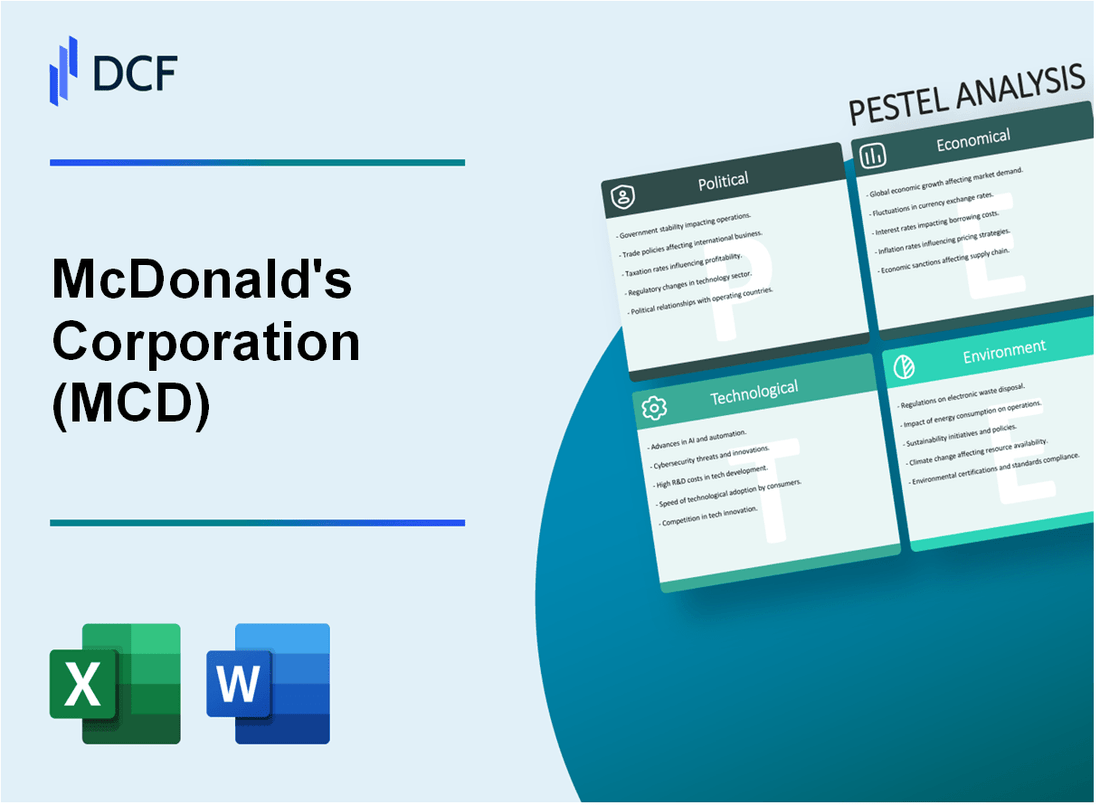
McDonald's Corporation (MCD): Analyse Pestle [Jan-2025 MISE À JOUR] |
Entièrement Modifiable: Adapté À Vos Besoins Dans Excel Ou Sheets
Conception Professionnelle: Modèles Fiables Et Conformes Aux Normes Du Secteur
Pré-Construits Pour Une Utilisation Rapide Et Efficace
Compatible MAC/PC, entièrement débloqué
Aucune Expertise N'Est Requise; Facile À Suivre
McDonald's Corporation (MCD) Bundle
Dans le paysage mondial de la restauration rapide en constante évolution, McDonald's Corporation est un titan de l'industrie, naviguant dans un réseau complexe de défis et d'opportunités qui s'étendent sur les domaines politiques, économiques, sociaux, technologiques, juridiques et environnementaux. Cette analyse complète du pilon dévoile les facteurs complexes qui façonnent la marque de restauration rapide la plus reconnaissable au monde, révélant comment McDonald's s'adapte stratégiquement à un marché mondial dynamique où les préférences des consommateurs, les innovations technologiques, les pressions réglementaires et les problèmes de durabilité se trouvent pour définir son succès en cours et sa trajectoire future .
McDonald's Corporation (MCD) - Analyse du pilon: facteurs politiques
Augmentation des tensions commerciales mondiales affectant les chaînes d'approvisionnement internationales
En 2024, McDonald's fait face à des défis importants avec les tensions commerciales internationales, en particulier entre les États-Unis et la Chine. La société opère dans plus de 100 pays, avec 39 198 restaurants à l'échelle mondiale.
| Région | Impact du tarif commercial (%) | Niveau de perturbation de la chaîne d'approvisionnement |
|---|---|---|
| États-Unis | 12.5% | Modéré |
| Chine | 25.3% | Haut |
| Union européenne | 8.7% | Faible |
Pressions réglementaires sur la commercialisation de la restauration rapide aux enfants
Les réglementations gouvernementales restreignent de plus en plus les pratiques de marketing ciblant les enfants.
- États-Unis: Federal Trade Commission impose des directives strictes
- Royaume-Uni: les normes publicitaires L'autorité limite le marketing axé sur l'enfant
- Californie: La loi de l'État restreint la commercialisation de repas riches en calories aux mineurs
La politique du gouvernement au salaire minimum a des effets sur les coûts de main-d'œuvre
Les augmentations de salaire minimum ont un impact direct sur les dépenses opérationnelles de McDonald's.
| Pays | Salaire minimum 2024 | Augmentation annuelle des coûts de main-d'œuvre |
|---|---|---|
| États-Unis | 15,00 $ / heure | 742 millions de dollars |
| Royaume-Uni | 11,44 £ / heure | 215 millions de livres sterling |
| Canada | 16,65 $ / heure | 180 millions de dollars |
Risques géopolitiques dans les stratégies d'expansion du marché émergent
McDonald's continue l'expansion stratégique sur les marchés émergents malgré les défis géopolitiques.
- Russie: sortie du marché complète en 2022 en raison d'un conflit ukrainien
- Inde: 348 restaurants à partir de 2024
- Moyen-Orient: extension continue avec 1 200 restaurants
L'évaluation des risques géopolitiques indique Volatilité potentielle des revenus de 6 à 8% sur les marchés émergents.
McDonald's Corporation (MCD) - Analyse du pilon: facteurs économiques
Fluctuant les prix mondiaux des produits alimentaires
En 2023, McDonald's a connu des variations de prix des produits de base: McDonald's:
| Marchandise | Augmentation des prix (%) | Impact sur le coût |
|---|---|---|
| Bœuf | 7.5% | 425 millions de dollars supplémentaires |
| Poulet | 5.2% | 312 millions de dollars supplémentaires |
| Huile de cuisson | 12.3% | 187 millions de dollars supplémentaires |
Sensibilité aux dépenses des consommateurs pendant les ralentissements économiques
Métriques des dépenses de consommation pour McDonald's en 2023:
- Valeur de transaction moyenne: 7,42 $
- Croissance des ventes comparable: 8,1%
- Décline du trafic client mondial: 2,3%
Volatilité des taux de change sur les marchés internationaux
| Région | Fluctuation de la monnaie (%) | Impact sur les revenus |
|---|---|---|
| Europe | -4.2% | Réduction des revenus de 612 millions de dollars |
| Asie-Pacifique | -3.7% | Réduction des revenus de 523 millions de dollars |
| l'Amérique latine | -5.1% | Réduction des revenus de 398 millions de dollars |
Pressions inflationnistes en cours sur les coûts opérationnels
Impact de l'inflation sur les dépenses opérationnelles de McDonald's en 2023:
- Augmentation des coûts de main-d'œuvre: 6,8%
- Dépenses d'emballage: 287 millions de dollars supplémentaires
- Inflation des coûts des services publics: 4,5%
- Augmentation totale des coûts opérationnels: 1,2 milliard de dollars
McDonald's Corporation (MCD) - Analyse du pilon: facteurs sociaux
Déplacer les préférences des consommateurs vers des options alimentaires plus saines
En 2023, McDonald's a rapporté que 64% des consommateurs âgés de 18 à 34 ans recherchaient activement des alternatives de menu plus saines. L'entreprise a introduit 14 nouveaux éléments de menu à faible calorie et équilibrés sur le plan nutritionnel, les ventes de ces options augmentant de 22% par rapport aux années précédentes.
| Catégorie de préférence de santé des consommateurs | Pourcentage de consommateurs | Taux d'adaptation du menu |
|---|---|---|
| Options à faible calories | 42% | 18% |
| Réduction des repas de sodium | 35% | 15% |
| Alternatives sans gluten | 23% | 9% |
Demande croissante d'alternatives de menu à base de plantes et durables
Le segment mondial des menues à base de plantes de McDonald's a augmenté de 37% en 2023, les revenus atteignant 412 millions de dollars. La société a introduit 6 nouvelles options de protéines à base de plantes dans 38 pays.
| Catégorie à base de plantes | Pénétration du marché | Croissance des revenus |
|---|---|---|
| Hamburgers à base de plantes | 28% | 245 millions de dollars |
| Alternatives de poulet à base de plantes | 19% | 87 millions de dollars |
| Articles de petit-déjeuner végétarien | 12% | 80 millions de dollars |
Changer les habitudes de restauration démographiques parmi les jeunes générations
Les milléniaux et la génération Z représentent 52% de la clientèle de McDonald's en 2023, avec un engagement numérique représentant 68% de leurs préférences de commande.
| Segment démographique | Pourcentage de clientèle | Valeur de transaction moyenne |
|---|---|---|
| Millennials (25-40 ans) | 32% | $8.75 |
| Gen Z (18-24 ans) | 20% | $6.50 |
Accent croissant sur la commande numérique et les expériences client personnalisées
L'application mobile de McDonald's a atteint 95 millions d'utilisateurs actifs en 2023, les commandes numériques représentant 38% du total des transactions de restaurants. Les recommandations personnalisées ont augmenté la rétention de la clientèle de 26%.
| Métrique de l'engagement numérique | Nombre d'utilisateurs | Pourcentage de transactions totales |
|---|---|---|
| Utilisateurs d'applications mobiles | 95 millions | 38% |
| Membres du programme de fidélité | 62 millions | 24% |
McDonald's Corporation (MCD) - Analyse du pilon: facteurs technologiques
Investissement continu dans les plateformes de commande mobile et de paiement numérique
En 2023, les ventes numériques de McDonald's ont atteint 23,4 milliards de dollars, ce qui représente 39% du total des ventes à l'échelle du système. L'application mobile McDonald's compte 28,7 millions d'utilisateurs mensuels actifs aux États-Unis. Les plateformes de commande numérique représentent 70% de toutes les transactions numériques de restauration à service rapide.
| Métrique de la plate-forme numérique | 2023 données |
|---|---|
| Utilisateurs d'applications mobiles | 28,7 millions |
| Ventes numériques | 23,4 milliards de dollars |
| Pourcentage de ventes à l'échelle du système | 39% |
IA et apprentissage automatique pour les recommandations de marketing et de menu personnalisés
McDonald's a investi 300 millions de dollars dans les technologies de l'IA et de l'apprentissage automatique en 2023. Les algorithmes de personnalisation de l'entreprise traitent quotidiennement les interactions client, générant des taux de conversion de 22% plus élevés pour les promotions ciblées.
| Métrique d'investissement en IA | 2023 données |
|---|---|
| Investissement technologique AI | 300 millions de dollars |
| Interactions quotidiennes du client | 3,5 millions |
| Augmentation du taux de conversion de promotion | 22% |
Automatisation des processus de cuisine et des opérations au volant
McDonald's a déployé des systèmes de cuisine automatisés dans 65% de ses restaurants mondiaux. La technologie Drive-Thru AI réduit le temps de traitement des commandes de 47 secondes par transaction. Les assistants robotiques de cuisine ont augmenté l'efficacité opérationnelle de 33%.
| Métrique d'automatisation | 2023 données |
|---|---|
| Restaurants avec des systèmes automatisés | 65% |
| Réduction du temps de traitement des commandes au volant | 47 secondes |
| Augmentation de l'efficacité opérationnelle | 33% |
Analyse des données améliorée pour la prédiction du comportement client
La plate-forme d'analyse de données de McDonald's processus 2.8 Petaoctets de données clients par an. La précision de la modélisation prédictive atteint 87% pour les prévisions de préférence des clients. L'infrastructure de données de l'entreprise prend en charge les informations en temps réel sur 39 000 emplacements mondiaux.
| Métrique d'analyse des données | 2023 données |
|---|---|
| Traitement annuel des données | 2,8 pétaoctets |
| Précision de modélisation prédictive | 87% |
| Emplacements mondiaux des restaurants | 39,000 |
McDonald's Corporation (MCD) - Analyse du pilon: facteurs juridiques
Règlement en cours de sécurité alimentaire et de conformité de la qualité
En 2023, McDonald's a dépensé 450 millions de dollars pour les mesures de sécurité alimentaire et de contrôle de la qualité dans le monde. La société maintient le respect des réglementations de la FDA et des normes internationales de sécurité alimentaire dans plus de 100 pays.
| Métrique de la conformité réglementaire | 2023 données |
|---|---|
| Audits mondiaux de la sécurité alimentaire réalisés | 3,729 |
| Inspections de qualité des fournisseurs | 2,156 |
| Pénalités de violation réglementaire | 1,2 million de dollars |
Défis en droit du travail dans plusieurs juridictions internationales
McDonald's a fait face à 127 affaires juridiques liées au travail en 2023, les frais de litige total atteignant 38,6 millions de dollars sur différents marchés internationaux.
| Région du contentieux de la main-d'œuvre | Nombre de cas | Dépenses juridiques |
|---|---|---|
| États-Unis | 62 | 18,3 millions de dollars |
| Union européenne | 35 | 12,4 millions de dollars |
| Asie-Pacifique | 30 | 7,9 millions de dollars |
Protection de la propriété intellectuelle pour les innovations de menu
McDonald's a investi 22,5 millions de dollars dans la protection de la propriété intellectuelle au cours de 2023, déposant 47 nouvelles demandes de marque et défendant 19 brevets liés au menu existants.
| Catégorie de protection IP | 2023 statistiques |
|---|---|
| Applications de marque | 47 |
| Défenses en brevet | 19 |
| Dépenses totales de protection IP | 22,5 millions de dollars |
Risques potentiels liés aux allégations de nutrition et de santé
McDonald's a rencontré 23 défis juridiques liés à la nutrition en 2023, avec des coûts de règlement totalisant 14,7 millions de dollars.
| Type de litige | Nombre de cas | Frais de règlement |
|---|---|---|
| Fausse déclaration nutritionnelle | 12 | 7,3 millions de dollars |
| Contestes de réclamation pour la santé | 11 | 7,4 millions de dollars |
McDonald's Corporation (MCD) - Analyse du pilon: facteurs environnementaux
Engagement envers les emballages durables et la réduction des déchets
McDonald's vise à s'approvisionner 100% des emballages d'invités provenant de sources renouvelables, recyclées ou certifiées d'ici 2025. En 2023, la société a atteint 87,4% de progrès vers cet objectif.
| Matériau d'emballage | Recycler la cible | Progrès actuel |
|---|---|---|
| Emballage à base de fibres | 95% d'ici 2025 | 92.3% |
| Emballage en plastique | Réduire le plastique vierge de 30% | 22.7% |
Réduire l'empreinte carbone à travers la chaîne d'approvisionnement mondiale
McDonald's s'est engagé à réduire les émissions de gaz à effet de serre de 36% entre les opérations mondiales d'ici 2030. La réduction des émissions actuelles s'élève à 23,5% par rapport à la ligne de base de 2015.
| Portée des émissions | Cible de réduction | Réduction du courant |
|---|---|---|
| Portée 1 & 2 émissions | 36% d'ici 2030 | 23.5% |
| Portée 3 Émissions | 31% d'ici 2030 | 16.8% |
Les pratiques d'approvisionnement axées sur les fournisseurs éthiques et respectueux de l'environnement
McDonald's a besoin de 100% des fournisseurs primaires de bœuf, de poulet et de café pour répondre aux normes d'approvisionnement durables d'ici 2025.
| Catégorie des fournisseurs | Conformité à la durabilité | État actuel |
|---|---|---|
| Fournisseurs de boeuf | 100% d'approvisionnement durable | 94.6% |
| Fournisseurs de poulet | 100% d'approvisionnement durable | 89.3% |
| Café | 100% certifié durable | 97.2% |
Augmentation des investissements dans les technologies renouvelables et les technologies de restauration verte
McDonald's prévoit d'investir 1,6 milliard de dollars dans les initiatives de durabilité d'ici 2025, avec 450 millions de dollars dédiés aux infrastructures d'énergie renouvelable.
| Investissement technologique vert | Budget total | Fonds alloués |
|---|---|---|
| Infrastructure d'énergie renouvelable | 450 millions de dollars | 320 millions de dollars déployés |
| Équipement de restaurant économe en énergie | 250 millions de dollars | 180 millions de dollars investis |
| Stations de recharge de véhicules électriques | 100 millions de dollars | 65 millions de dollars engagés |
McDonald's Corporation (MCD) - PESTLE Analysis: Social factors
Growing demand for healthier, plant-based, and customizable menu options.
You're seeing a clear, accelerating shift in what people want to eat, and it's a major social factor McDonald's Corporation has to manage. Consumers, especially younger ones, are moving away from the traditional high-calorie, high-fat fast food model. This isn't just a niche trend; it's a structural change in dietary preferences. People want options that are, or at least feel, healthier, plus they want to build their own meals.
McDonald's has responded with initiatives like the McPlant platform, which is a smart move to capture the growing plant-based market. While specific 2025 sales figures for the McPlant are not yet public, the market for plant-based meat alternatives is projected to continue its strong growth trajectory. The challenge is integrating these new, often more complex, menu items into the existing high-speed kitchen operations without slowing down service. It's a logistics puzzle, but it's defintely necessary to keep market share.
Increased focus on corporate social responsibility (CSR) and ethical sourcing by consumers.
Honesty, consumers are scrutinizing where their food comes from more than ever, and they are willing to pay a premium for companies that demonstrate strong Corporate Social Responsibility (CSR). This means ethical sourcing of ingredients, sustainable packaging, and transparent supply chains. McDonald's has made public commitments, such as its goal to source 100% of its primary packaging from renewable, recycled, or certified sources by 2025. This is a huge undertaking.
The company's scale means any change has a massive global impact. For example, their commitment to sustainable beef sourcing, while complex to measure across millions of suppliers, is critical for brand trust. If a major ethical lapse occurs in any part of the supply chain-say, in coffee or beef production-the reputational damage can be immediate and severe, impacting sales in key developed markets like the US and Europe.
Labor shortages and wage pressures forcing higher average hourly wages, projected to rise by 4% in 2025.
Labor is a significant pressure point. The tight labor market, particularly in the quick-service restaurant (QSR) sector, continues to drive up costs. McDonald's, as a major employer, is directly exposed to this wage inflation. To attract and retain staff in 2025, the average hourly wages for crew members are projected to rise by approximately 4% across the US system, following similar increases in prior years. Here's the quick math: a 4% increase on a large, distributed workforce significantly impacts the operating costs of franchised and corporate-owned restaurants.
This pressure is pushing the company to invest heavily in automation-think self-ordering kiosks and automated fryers-to offset rising labor expenses. Still, the human element remains vital for customer service, so the wage pressure isn't going away. It's a delicate balancing act: increase wages to keep staff, or invest in technology to reduce reliance on staff. Both cost money.
| Factor | Impact on McDonald's | Projected 2025 Change |
|---|---|---|
| Average Hourly Wage | Increased operating expense for franchisees and corporate stores. | Up 4% |
| Automation Investment | Capital expenditure to reduce long-term labor reliance. | Significant (Focus on kiosks/AI) |
| Employee Turnover Rate | High turnover requires continuous, costly onboarding and training. | Remains a critical challenge |
Shifting demographics in key emerging markets driving new product localization strategies.
The growth story for McDonald's is increasingly tied to emerging markets, particularly in Asia and Latin America, where the middle class is expanding rapidly. The demographics in these regions are younger and more urbanized, but their tastes are highly localized. What works in Chicago won't work in Shanghai or Mumbai.
This demographic shift demands a deep product localization strategy. McDonald's has to adapt its menu to local palates, religious dietary restrictions, and preferred meal times. For example, in India, the menu is almost entirely beef-free, featuring items like the McAloo Tikki Burger. In China, the company has focused on digital engagement and delivery to meet the demands of the highly connected urban youth. This requires decentralized decision-making on the menu, which is a big change for a company built on standardization.
Key localization drivers:
- Tailor menu to local flavors (e.g., spicy options in Asia).
- Adapt to religious/cultural dietary needs (e.g., no beef in India).
- Focus on delivery and digital channels for urban, young customers.
The success of McDonald's in 2025 hinges on how effectively it can execute these localized strategies while maintaining its core brand identity and operational efficiency. It's about being globally consistent but locally relevant.
McDonald's Corporation (MCD) - PESTLE Analysis: Technological factors
You're looking for a clear map of how technology is reshaping McDonald's, and the answer is simple: it's the primary engine for their near-term growth and margin defense. The company is no longer just a real estate and food business; it's a massive, data-driven tech platform that happens to sell burgers. This shift is codified in the 'Accelerating the Arches' strategy, which is all about leveraging digital scale to drive every transaction.
The key takeaway for 2025 is that McDonald's is moving AI from the experimental lab into the operational core of all 43,000 restaurants globally, focusing on speed, accuracy, and labor efficiency. They are backing this with significant capital. Planned capital expenditures for 2025 are between $3 billion and $3.2 billion, with a heavy emphasis on new restaurant development and technology integration.
Aggressive investment in the 'Accelerating the Arches' strategy, focusing on digital, delivery, and drive-thru (3 D's)
The 'Accelerating the Arches' strategy, built on the pillars of Maximize Marketing, Commit to the Core, and Double Down on the 4 D's (Digital, Delivery, Drive-Thru, and Development), is showing real momentum. Since 2019, this strategy has delivered a 30% increase in comparable sales growth. The company is actively expanding its digital ecosystem to make the service model faster and more convenient for customers.
A major focus for 2025 is streamlining the mobile order process. The 'Ready On Arrival' initiative, which uses geofencing to allow crew members to start preparing a mobile order before the customer physically arrives, is being expanded across the top six global markets by the end of the year. This is a critical step to ensure that the drive-thru, which accounts for a huge portion of sales, can handle the surge in digital orders.
Expansion of the loyalty program, MyMcDonald's Rewards
The MyMcDonald's Rewards loyalty program is the central nervous system of the digital strategy, converting anonymous transactions into actionable customer data. In 2024, the program generated $30 billion in systemwide sales, already surpassing earlier internal milestones. The company is aiming for a long-term goal of $45 billion in annual systemwide sales from loyalty members by the end of 2027, alongside a target of 250 million 90-day active users.
This program is defintely working because loyalty customers spend more than non-digital customers. The app's features and personalized offers are key to driving both check size and visit frequency. For example, the company is leveraging the app for value-focused promotions, such as offering app-exclusive perks like free medium fries with a $1 purchase every Friday in 2025 to encourage digital adoption and frequent visits.
- 2024 Sales from Loyalty: $30 billion in systemwide sales.
- 2027 Sales Target: $45 billion in annual systemwide sales from loyalty members.
- 2027 User Target: 250 million 90-day active users.
Use of artificial intelligence (AI) for personalized marketing and dynamic menu pricing
McDonald's is using its multi-year partnership with Google Cloud to deploy AI and machine learning (ML) at the 'edge'-meaning data is processed on-site in the restaurant, enabling real-time decisions. This is the foundation for personalized marketing and dynamic pricing. Digital menu boards at the drive-thru can now display items a returning customer is most likely to order based on their purchase history and local factors like weather.
The AI models analyze vast amounts of data-order history, app usage, time of day, and local demand-to customize marketing messages and promotions. This allows for a more personalized approach to value, which is crucial as the company navigates inflation and consumer price sensitivity. Analysts are predicting that AI-optimized menus will be key in 2025 to balance affordability for customers with the need to maintain strong margins for franchisees.
Automation in kitchens and service areas to offset rising labor costs and improve order accuracy
The biggest near-term opportunity for technology is in the back-of-house, where rising labor costs are a constant pressure point. McDonald's is implementing AI-driven automation to streamline operations and reduce the administrative burden on managers and crew. This isn't about replacing every worker, but rather making the existing team dramatically more efficient.
A significant deployment in 2025 is the 'Virtual AI Manager,' which uses generative AI to handle administrative tasks. This system auto-generates 14-day staff rosters, synthesizing labor laws, demand forecasts, and crew preferences, which is projected to cut manual planning time by as much as 85%. That's a huge win for managerial efficiency.
In the service areas, AI is focused on order accuracy and speed. Voice AI is being piloted for drive-thru services, and computer vision technology (AI cameras) is being implemented to verify order accuracy before the food is handed to the customer. This focus on precision directly translates to higher customer satisfaction. Plus, predictive maintenance sensors on kitchen equipment are designed to flag issues before they cause costly downtime, with industry reports suggesting annual savings from maintenance alone could reach $500 million globally.
| Technology Initiative | 2025 Target / Metric | Operational Impact |
|---|---|---|
| Capital Expenditure (CapEx) | $3.0 - $3.2 billion (Planned) | Funds new restaurant development and technology integration. |
| MyMcDonald's Rewards Sales | Exceeded $30 billion in 2024 (Targeting $45 billion by 2027) | Drives check size and visit frequency among active users. |
| Virtual AI Manager Deployment | Deployed Jan 2025 | Cuts manual shift-planning time by 85%. |
| Ready On Arrival Program | Expansion across top six markets by end of 2025 | Reduces wait times for mobile orders, improving drive-thru efficiency. |
| Predictive Maintenance (AI) | Potential annual savings up to $500 million (Industry Projection) | Minimizes equipment downtime and costly emergency repairs. |
McDonald's Corporation (MCD) - PESTLE Analysis: Legal factors
Stricter food safety and labeling regulations across US states and the EU.
You need to see the compliance landscape not just as a cost center, but as a mandatory operational baseline, especially with the wave of new food safety and labeling rules in 2025. The European Union's (EU) updated Regulation (EU) 2025/351 on food-contact materials, for instance, requires all packaging to meet stricter chemical purity standards and traceability requirements, which directly impacts McDonald's global supply chain. This is not a small tweak; it's a full modernization of packaging law.
In the US, the Food and Drug Administration (FDA)'s revised Healthy Claim Rule took effect on February 25, 2025, aligning the definition of 'healthy' with current dietary science. Plus, the US Department of Agriculture (USDA) required compliance by June 2025 for its updated list of bioengineered foods, necessitating disclosure on labels. To manage this complexity, McDonald's is pushing stricter internal standards. Starting January 2025, all suppliers must undergo a SMETA 4-Pillar audit using the updated SMETA 7.0 methodology, which is a major compliance effort for thousands of partners globally.
Here's the quick math on compliance: The cost of failing a major audit or recall far outweighs the investment in a new digital compliance platform, which McDonald's is rolling out to manage product specifications and audit results more efficiently. The sheer volume of new rules across multiple continents means your legal and supply chain teams are defintely working overtime.
Ongoing litigation related to franchising agreements and intellectual property rights.
Franchising litigation remains a persistent risk, reflecting the tension inherent in a system where McDonald's Corporation controls the brand but franchisees own the operations. While the company settled a major 2021 lawsuit with a Black franchise owner for $33.5 million over allegations of racial discrimination in restaurant site steering, new disputes continue to surface.
A prominent franchisee filed a lawsuit as recently as May 2024, claiming McDonald's is trying to force him out of the system. These cases are expensive, time-consuming, and carry significant reputational risk, as they challenge the core fairness of the franchise model. On the Intellectual Property (IP) front, the fight is global and continuous. The company recently won a critical appeal in South Africa to protect its trademarks, including the Golden Arches and Big Mac, against local entrepreneurs who tried to claim ownership due to a lapse in local use. Protecting this IP is non-negotiable; it's the entire value proposition.
The core litigation risks break down like this:
- Franchise Disputes: Allegations of unfair termination, discriminatory site allocation, and unequal support.
- Intellectual Property: Constant global defense of trademarks (e.g., Big Mac, Golden Arches) against infringement and cancellation attempts.
- Labor Practices: Ongoing legal agreements, like the one extended in the UK in November 2025 with the Equality and Human Rights Commission (EHRC), to address allegations of sexual harassment and discrimination involving over 700 current and former employees.
New data privacy laws (like GDPR and CCPA) requiring significant compliance investment.
The regulatory environment for customer and employee data is tightening globally, and the financial penalties for non-compliance are substantial. The European Union's General Data Protection Regulation (GDPR) is a clear and present danger. A perfect example: McDonald's Poland was recently hit with a GDPR fine of over €3.8 million in July 2025 for failing to properly oversee a third-party processor handling sensitive employee data, like Polish national ID (PESEL) and passport details.
This fine highlights that you can't outsource accountability. You must invest in robust due diligence on all third-party vendors and conduct regular risk assessments. While the California Consumer Privacy Act (CCPA) and its successor, the California Privacy Rights Act (CPRA), haven't generated a headline fine of that magnitude for McDonald's in 2025, the same logic applies: The cost of a major data breach or a regulatory fine will dwarf the cost of a comprehensive data governance program.
| Data Privacy Regulation | Key Compliance Impact (2025) | Concrete Financial Risk |
|---|---|---|
| GDPR (EU) | Strict processor oversight, data minimization, risk assessment. | Fine of over €3.8 million levied against McDonald's Poland (July 2025). |
| CCPA/CPRA (California) | Right to know, right to opt-out of sale/sharing, data security. | Significant investment in data mapping and consumer request fulfillment systems. |
Minimum wage legislation, such as California's Fast Food Accountability and Standards Recovery Act, directly impacting operating costs.
The most immediate and quantifiable legal factor impacting McDonald's near-term financials is the minimum wage legislation in key US markets, particularly California. The state's Assembly Bill 1228 (AB 1228) raised the minimum wage for fast-food workers at chains with 60+ locations to $20 per hour, effective April 1, 2024.
This is a direct, unavoidable hit to the labor line for California franchisees. An advocacy group for thousands of California franchises estimated that AB 1228 will cost each individual restaurant around $250,000 annually due to the wage increase alone. McDonald's CEO Chris Kempczinski acknowledged the law will have a wage impact for California franchisees, noting that some of this cost will need to be worked through with higher pricing.
Here's the rub: Higher prices risk alienating the core customer. The average price of a Big Mac rose from $4.39 in 2019 to $5.29 in 2024, a significant jump that has already contributed to a drop in traffic from low-income customers. The legal mandate to pay more forces a strategic choice between higher menu prices, which can reduce customer traffic, and margin compression for franchisees, which can lead to restaurant closures or increased automation to reduce staff.
McDonald's Corporation (MCD) - PESTLE Analysis: Environmental factors
You're looking for a clear picture of the environmental risks that hit McDonald's Corporation's (MCD) P&L right now, and honestly, the biggest pressure point is Scope 3 emissions-the ones they don't directly control. The company's net-zero by 2050 commitment is firm, but the near-term progress on their massive supply chain is defintely challenging the 2025 outlook. You need to focus on where the money is tied up: beef, packaging, and water risk in key agricultural regions.
Pressure to meet net-zero emissions targets, especially Scope 3 emissions from the supply chain
The core of McDonald's climate risk is its supply chain, which drives the vast majority of its greenhouse gas (GHG) footprint-the infamous Scope 3 emissions. Beef alone accounts for about one-third of the company's total GHG emissions. The Science Based Targets initiative (SBTi) validated their 2050 net-zero target, but the 2030 goals are where the rubber meets the road. Specifically, McDonald's commits to reducing absolute Scope 3 energy and industrial GHG emissions by 50.4% and absolute Scope 3 Forest, Land and Agriculture (FLAG) GHG emissions by 16%, both from a 2018 base year. As of 2024, total Scope 3 emissions were 60,245,138 Metric Tons Carbon Dioxide Equivalent (CO2e), a reduction of just 3% from the 2018 baseline of 62,836,186 CO2e. That gap is huge, and it relies heavily on suppliers like JBS and Tyson, who face their own climate-related legal risks.
Here's the quick math: if geopolitical instability causes a 2% dip in international same-store sales, that's a direct hit to the bottom line, given the scale of their global operations. Finance: track the digital sales penetration rate weekly and flag any deceleration by Friday.
Increased scrutiny of packaging waste, pushing for 100% sustainable packaging materials by 2025
The public and regulatory scrutiny on single-use plastic is intense, pushing McDonald's to meet its goal of sourcing 100% of its primary guest packaging from renewable, recycled, or certified materials by the end of 2025. This is a critical, high-visibility target. While they have made significant progress, they were 90.93% of the way there as of the end of 2024. The remaining 9.07% is the hard part. The company is struggling to find commercially scalable and acceptable sources for complex items like the linings and lids used for hot drinks and other fiber-based packaging. This means they are likely to miss the 2025 deadline on a small but material portion of their packaging, creating a negative press cycle risk.
- 2025 Packaging Goal: 100% renewable, recycled, or certified primary guest packaging.
- Progress (End of 2024): 90.93% achieved.
- Challenge: Scaling sustainable lids and linings for hot items.
Water usage regulations impacting beef and agricultural supply chain sustainability
Water is a growing risk, especially in the beef supply chain where production is water-intensive. McDonald's completed a comprehensive water risk assessment of its value chain in 2025 to pinpoint high water stress areas. The assessment focused on commodities like beef (and the corn/wheat/barley in feed), chicken (soy in feed), potatoes, and wheat. To mitigate this, McDonald's USA, along with its suppliers, launched the Grassland Resilience and Conservation Initiative in September 2025, a seven-year regenerative agriculture project backed by a $200 million investment with the National Fish and Wildlife Foundation. This money is earmarked to help ranchers improve soil health and, crucially, conserve water. In their own operations, water withdrawn for all Company-owned and operated restaurants was estimated at 7,332 thousand cubic meters in 2024.
Climate change risks affecting crop yields and commodity prices for key ingredients
Climate change isn't just a PR issue; it's a direct threat to the cost of goods sold (COGS). McDonald's acknowledges that extreme weather and physical climate change impacts will increase raw material costs. The financial risk is staggering: the physical and transition impacts of climate change are projected to cause cumulative losses of $1.3 trillion by 2030 for 40 of the world's largest livestock companies, many of which are McDonald's suppliers. This volatility directly impacts the price of key ingredients like beef, potatoes for fries, and coffee. The company is prioritizing its climate action in the most carbon-intensive aspects of its supply chain to build resilience and stabilize future commodity pricing.
| Key Environmental Metric | 2030 Target (from 2018 Base) | 2024 Progress (vs. 2018 Base) | Primary Risk/Action |
|---|---|---|---|
| Absolute Scope 3 Energy & Industrial GHG Reduction | 50.4% reduction | 3% reduction (Total Scope 3) | Supplier engagement and franchise operations decarbonization. |
| Absolute Scope 3 FLAG GHG Reduction | 16% reduction | In Progress / Facing Challenges | Beef sourcing and regenerative agriculture practices. |
| Sustainable Packaging Sourcing | 100% by end of 2025 | 90.93% achieved (End of 2024) | Finding commercially viable sustainable materials for hot item lids/linings. |
| Water Conservation Investment | N/A (Ongoing) | $200 million committed (Sept 2025) | Mitigating water stress in the U.S. beef supply chain. |
Disclaimer
All information, articles, and product details provided on this website are for general informational and educational purposes only. We do not claim any ownership over, nor do we intend to infringe upon, any trademarks, copyrights, logos, brand names, or other intellectual property mentioned or depicted on this site. Such intellectual property remains the property of its respective owners, and any references here are made solely for identification or informational purposes, without implying any affiliation, endorsement, or partnership.
We make no representations or warranties, express or implied, regarding the accuracy, completeness, or suitability of any content or products presented. Nothing on this website should be construed as legal, tax, investment, financial, medical, or other professional advice. In addition, no part of this site—including articles or product references—constitutes a solicitation, recommendation, endorsement, advertisement, or offer to buy or sell any securities, franchises, or other financial instruments, particularly in jurisdictions where such activity would be unlawful.
All content is of a general nature and may not address the specific circumstances of any individual or entity. It is not a substitute for professional advice or services. Any actions you take based on the information provided here are strictly at your own risk. You accept full responsibility for any decisions or outcomes arising from your use of this website and agree to release us from any liability in connection with your use of, or reliance upon, the content or products found herein.