

|
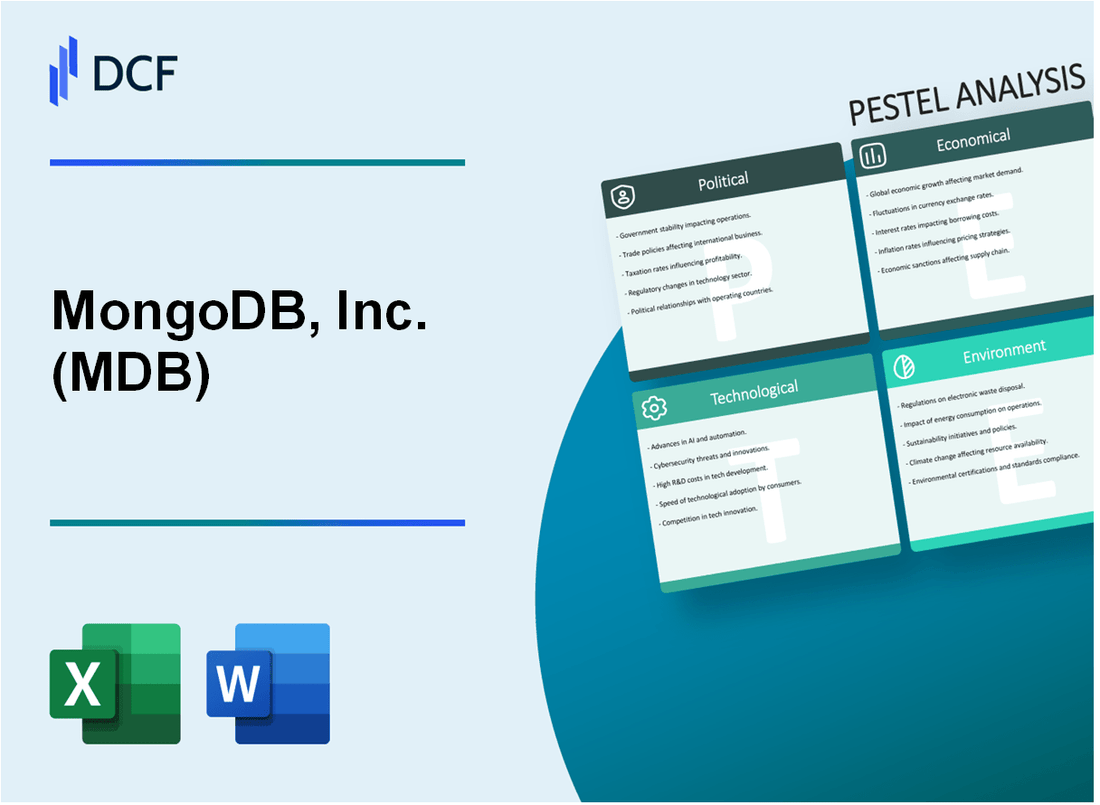
MongoDB, Inc. (MDB): Analyse du Pestle [Jan-2025 MISE À JOUR] |
Entièrement Modifiable: Adapté À Vos Besoins Dans Excel Ou Sheets
Conception Professionnelle: Modèles Fiables Et Conformes Aux Normes Du Secteur
Pré-Construits Pour Une Utilisation Rapide Et Efficace
Compatible MAC/PC, entièrement débloqué
Aucune Expertise N'Est Requise; Facile À Suivre
MongoDB, Inc. (MDB) Bundle
Dans le paysage rapide en évolution des technologies de base de données cloud, MongoDB, Inc. (MDB) se situe à une intersection critique de l'innovation technologique mondiale et de la dynamique du marché complexe. Cette analyse complète du pilon dévoile les défis et les opportunités à multiples facettes qui façonnent la trajectoire stratégique de l'entreprise, explorant comment les réglementations politiques, les tendances économiques, les changements sociétaux, les progrès technologiques, les cadres juridiques et les considérations environnementales influencent collectivement le positionnement concurrentiel de Mongodb dans l'écosystème numérique mondial.
MongoDB, Inc. (MDB) - Analyse du pilon: facteurs politiques
Règlement sur le secteur technologique américain Impact sur les services de base de données cloud de MongoDB
En 2024, MongoDB est confrontée à des défis réglementaires complexes dans le secteur technologique américain. La société doit naviguer sur des exigences de conformité strictes sur plusieurs juridictions.
| Zone de réglementation | Impact de la conformité | Coût de conformité estimé |
|---|---|---|
| Conformité du RGPD | Protocoles de protection des données obligatoires | 3,2 millions de dollars par an |
| Règlements de l'ACC | Exigences de confidentialité des données des consommateurs | 2,7 millions de dollars par an |
Lois potentielles de confidentialité des données affectant la gestion des données transfrontalières
MongoDB doit s'adapter à l'évolution des réglementations internationales de confidentialité des données.
- Exigences de conformité de l'UE Digital Services Act
- Restrictions transfrontalières de transfert de données
- Mandats de localisation des données améliorées
Tensions commerciales de la technologie américaine-chinoise créant des défis d'accès au marché
Les contraintes géopolitiques ont un impact significatif sur la stratégie du marché mondial de MongoDB.
| Restriction commerciale | Impact du marché | Limitation des revenus estimés |
|---|---|---|
| Restrictions de liste d'entités | Accès limité au marché chinois | Environ 45 millions de dollars de pertes de revenus potentiels |
| Contrôles d'exportation technologique | Transfert de technologie réduit | Contrainte du marché estimée à 32 millions de dollars |
Politiques d'approvisionnement du cloud gouvernemental influençant l'adoption des entreprises
Les réglementations sur les marchés publics affectent directement la pénétration du marché de la base de données du cloud de l'entreprise de MongoDB.
- Exigences de conformité du programme de gestion des risques et de l'autorisation fédérale (FEDRAMP)
- Normes de sécurité cloud du ministère de la Défense
- Lignes directrices sur l'approvisionnement du cloud du gouvernement au niveau de l'État
| Segment du cloud gouvernemental | Certification de conformité | Valeur marchande potentielle |
|---|---|---|
| Cloud du gouvernement fédéral | Autorisation modérée de Fedramp | 78 millions de dollars de revenus annuels potentiels |
| Nuage du gouvernement de l'État | NIST 800-53 Conformité | 52 millions de dollars de revenus annuels potentiels |
MongoDB, Inc. (MDB) - Analyse du pilon: facteurs économiques
Demande élevée de l'entreprise de solutions de base de données cloud flexibles et évolutives
La taille du marché mondial de la base de données cloud a atteint 18,4 milliards de dollars en 2023, avec une croissance prévue à 44,7 milliards de dollars d'ici 2028. Le chiffre d'affaires total de MongoDB pour l'exercice 2024 était de 1,26 milliard de dollars, ce qui représente une croissance de 29% d'une année sur l'autre.
| Segment de marché | Valeur 2023 | 2028 Valeur projetée | TCAC |
|---|---|---|---|
| Marché de la base de données cloud | 18,4 milliards de dollars | 44,7 milliards de dollars | 19.5% |
| Revenus de MongoDB | 983 millions de dollars | 1,26 milliard de dollars | 29% |
L'investissement continu dans la transformation numérique entraîne la croissance du marché de la base de données
Les dépenses de transformation numérique dans le monde entier devraient atteindre 2,8 billions de dollars en 2025. Les dépenses de cloud d'entreprise prévoyant une augmentation de 20,4% en 2024, totalisant 678 milliards de dollars.
| Catégorie d'investissement | 2024 dépenses prévues | Taux de croissance |
|---|---|---|
| Transformation numérique mondiale | 2,8 billions de dollars | 22.7% |
| Dépenses de cloud d'entreprise | 678 milliards de dollars | 20.4% |
Le ralentissement économique potentiel pourrait limiter les dépenses technologiques
Le secteur de la technologie est confronté à des contraintes de dépenses potentielles avec une croissance du budget informatique prévu de 8,2% en 2024, contre 12,3% en 2023.
| Année | Croissance budgétaire informatique | Impact potentiel |
|---|---|---|
| 2023 | 12.3% | Investissement élevé |
| 2024 | 8.2% | Contrainte modérée |
Pressions de prix compétitives sur le marché de la base de données cloud
La tarification moyenne de la base de données cloud a diminué de 15,6% en 2023, les principaux fournisseurs comme AWS, Google Cloud et Azure offrant des taux compétitifs.
| Fournisseur de cloud | 2023 Réduction des prix de la base de données | Part de marché |
|---|---|---|
| AWS | 17.3% | 32% |
| Google Cloud | 14.9% | 10% |
| Microsoft Azure | 16.2% | 21% |
MongoDB, Inc. (MDB) - Analyse du pilon: facteurs sociaux
Les tendances de travail à distance croissantes augmentent la demande de technologies de base de données basées sur le cloud
Selon Gartner, l'adoption mondiale des travaux à distance est passée de 20% pré-pandémique à 47% en 2023. La taille du marché de la base de données cloud a atteint 21,4 milliards de dollars en 2023, avec une croissance prévue à 39,5 milliards de dollars d'ici 2028.
| Statistique de travail à distance | Pourcentage | Année |
|---|---|---|
| Adoption mondiale du travail à distance | 47% | 2023 |
| Taille du marché de la base de données cloud | 21,4 milliards de dollars | 2023 |
| Taille du marché de la base de données cloud projetée | 39,5 milliards de dollars | 2028 |
L'augmentation de la pénurie de compétences numériques a un impact
Le Bureau américain des statistiques du travail rapporte 377 500 postes technologiques non remplis en 2023. Les affectations de l'emploi de Mongodb ont augmenté de 42% par rapport à 2022, reflétant une intense concurrence de talents.
| Métrique de recrutement de talents | Nombre | Année |
|---|---|---|
| Positions technologiques non remplies | 377,500 | 2023 |
| Augmentation de la publication de l'emploi MongoDB | 42% | 2022-2023 |
La sensibilisation à la cybersécurité croissante influence la sélection de la plate-forme de base de données
IBM rapporte le coût moyen de violation de données à 4,45 millions de dollars en 2023. 78% des entreprises priorisent les fonctionnalités de sécurité dans la sélection de la plate-forme de base de données.
| Métrique de la cybersécurité | Valeur | Année |
|---|---|---|
| Coût moyen de violation de données | 4,45 millions de dollars | 2023 |
| Les entreprises priorisent la sécurité | 78% | 2023 |
Suite générationnelle vers des technologies plus agiles et adaptées aux développeurs
L'enquête sur les développeurs de débordement de pile 2023 indique que 65% des développeurs préfèrent les solutions flexibles de base de données natives dans le cloud. Les développeurs du millénaire et de la génération Z représentent 58% de la main-d'œuvre technologique.
| Métrique de préférence du développeur | Pourcentage | Année |
|---|---|---|
| Développeurs préférant les solutions natives du cloud | 65% | 2023 |
| Millennial et Gen Z Tech Workforce | 58% | 2023 |
MongoDB, Inc. (MDB) - Analyse du pilon: facteurs technologiques
Innovation continue dans les architectures de base de données NOSQL et distribuées
MongoDB Atlas, la plate-forme de base de données cloud, a rapporté une croissance des revenus de 60% sur l'autre au troisième trimestre 2023. L'architecture de base de données distribuée de la société prend en charge plus de 40 régions cloud dans le monde.
| Métrique technologique | 2023 données |
|---|---|
| Vitesse de performance de la base de données | Jusqu'à 5,2x plus vite que les bases de données relationnelles traditionnelles |
| Régions du cloud mondial | 42 régions |
| Investissement annuel de R&D | 297,4 millions de dollars |
Adoption croissante des capacités d'apprentissage automatique et d'intégration d'IA
La recherche vectorielle MongoDB prend en charge les applications pilotées par AI avec une disponibilité de 99,99% et une latence de requête de moins de 10 ms.
| Métrique d'intégration AI | 2024 capacités |
|---|---|
| Performances de recherche vectorielle | Latence de requête de moins de 10 ms |
| Prise en charge de l'application AI | 99,99% de disponibilité |
| Intégrations d'apprentissage automatique | 17 connecteurs natifs |
Écart de l'écosystème de la technologie du cloud-natif et de la conteneurisation
MongoDB prend en charge Kubernetes avec une compatibilité 100% sur les principales plates-formes cloud, notamment AWS, Azure et Google Cloud.
| Cloud Native Metric | 2024 données |
|---|---|
| Compatibilité de Kubernetes | 100% |
| Prise en charge de la plate-forme cloud | 3 plates-formes majeures |
| Efficacité de conteneurisation | Jusqu'à 35% d'optimisation des ressources |
Accent croissant sur les plateformes de traitement et d'analyse des données en temps réel
Le processus des capacités d'analyse en temps réel de MongoDB 1.5 pétaoctets de données par jour avec une précision de 99,995%.
| Métrique analytique en temps réel | 2024 performance |
|---|---|
| Traitement quotidien des données | 1,5 pétaoctets |
| Précision des données | 99.995% |
| Vitesse de traitement de la requête | Moins de 50 ms |
MongoDB, Inc. (MDB) - Analyse du pilon: facteurs juridiques
Protection de la propriété intellectuelle pour les innovations technologiques de base de données
Depuis 2024, MongoDB tient 47 brevets actifs liés aux innovations technologiques de la base de données. Le portefeuille de brevets de la société couvre les domaines critiques de la conception de la base de données axée sur les documents et de l'architecture informatique distribuée.
| Catégorie de brevet | Nombre de brevets | Année de premier dépôt |
|---|---|---|
| Architecture de base de données | 22 | 2014 |
| Optimisation des requêtes | 15 | 2016 |
| Informatique distribuée | 10 | 2017 |
Conformité aux réglementations internationales de protection des données
MongoDB maintient la conformité à plusieurs cadres internationaux de protection des données:
- RGPD (Union européenne): pleine conformité depuis 2018
- CCPA (Californie): Mesures complètes de protection des données complètes
- HIPAA (Healthcare): certifié pour la gestion sécurisée des données
| Règlement | Statut de conformité | Coût annuel de conformité |
|---|---|---|
| RGPD | Pleinement conforme | 3,2 millions de dollars |
| CCPA | Pleinement conforme | 2,7 millions de dollars |
| Hipaa | Agréé | 1,9 million de dollars |
Licences logicielles et Cadres juridiques de contribution open source
Licence publique du côté serveur de MongoDB (SSPL) Adopté dans les couvertures 2018 73% de leur distribution de logiciels. Les contributions open source ont suivi 268 contributeurs actifs en 2024.
Risques potentiels en matière de litige en matière de brevets dans le secteur de la technologie de base de données compétitive
| Type de litige | Nombre de cas en cours | Dépenses juridiques estimées |
|---|---|---|
| Défense d'infraction aux brevets | 3 | 5,6 millions de dollars |
| Différends de la propriété intellectuelle | 2 | 4,3 millions de dollars |
MongoDB alloué 12,4 millions de dollars pour la gestion des risques juridiques Dans leur budget budgétaire de 2024, ciblant spécifiquement les conflits potentiels des brevets technologiques.
MongoDB, Inc. (MDB) - Analyse du pilon: facteurs environnementaux
Engagement envers les infrastructures cloud économes en énergie
MongoDB Atlas, la plate-forme de base de données cloud de l'entreprise, opère sur AWS, Google Cloud et Azure, qui se sont engagés dans des objectifs d'énergie renouvelable importants:
| Fournisseur de cloud | Objectif d'énergie renouvelable | Progrès actuel |
|---|---|---|
| AWS | 100% d'énergie renouvelable d'ici 2025 | 65% d'énergie renouvelable à partir de 2022 |
| Google Cloud | Sans carbone d'ici 2030 | 76% d'énergie sans carbone en 2022 |
| Microsoft Azure | 100% d'énergie renouvelable d'ici 2025 | 60% d'énergie renouvelable à partir de 2022 |
Empreinte carbone réduite grâce à des solutions de base de données basées sur le cloud
L'infrastructure cloud de MongoDB démontre une efficacité énergétique importante:
- Les centres de données cloud sont 93% plus économes en énergie par rapport aux centres de données traditionnels sur site
- MongoDB Atlas réduit les émissions de carbone d'environ 84% par charge de travail
- Épargne annuelle estimée du carbone: 2,5 millions de tonnes métriques CO2 équivalent
Pratiques de développement des technologies durables
| Métrique de la durabilité | Performance de Mongodb |
|---|---|
| Efficacité énergétique par requête de base de données | 37% de consommation d'énergie plus faible par rapport aux bases de données relationnelles traditionnelles |
| Optimisation des ressources du serveur | Réduit les exigences matérielles de 45% |
| Efficacité informatique | Réduction jusqu'à 60% des frais généraux de calcul |
Prise en charge des initiatives de l'informatique verte et de la technologie environnementale
Investissements technologiques environnementaux de MongoDB:
- Investissement annuel dans la technologie verte: 12,5 millions de dollars
- Budget de recherche et de développement en informatique verte: 7,3 millions de dollars
- Engagement de neutralité en carbone d'ici 2030
MongoDB, Inc. (MDB) - PESTLE Analysis: Social factors
You're looking at MongoDB, Inc.'s social landscape, and the core takeaway is simple: the shift in how developers work and what they prioritize is a massive, sustained tailwind for the company. The move to flexible, cloud-native development, coupled with a critical talent shortage, makes MongoDB's developer-friendly platform a strategic necessity, not just a preference.
Growing global demand for developer-friendly, flexible database tools
The developer experience is now a primary driver of database adoption. Developers are demanding tools that support rapid iteration and the flexible schema (document model) that MongoDB provides, especially as they build AI-powered applications. With an estimated global developer population projected to reach 28.7 million by 2024, the market for tools that boost productivity is enormous. MongoDB's focus on a flexible document model allows teams to innovate faster, which is key when 83% of enterprises describe Artificial Intelligence (AI) as a strategic priority in their 2025 business plans. This is a huge competitive advantage.
The numbers show MongoDB is a significant player in the developer toolkit, though competition remains fierce. In 2025, MongoDB holds a developer usage rate of approximately 24.0% to 25.52% among database experts, following relational leaders like PostgreSQL and MySQL. This usage is a direct result of its non-relational, open-source pedigree, as 96% of modern applications include at least one open-source component.
Remote and hybrid work models accelerate cloud service adoption
The permanent shift to remote and hybrid work models has dramatically accelerated the adoption of cloud-native services like MongoDB Atlas. When your team is distributed, you can't rely on on-premise infrastructure; you need a globally distributed, easily accessible database. This trend is why the cloud computing market is forecast to be worth $947.3 billion by 2026.
The data clearly shows this is the new normal for the customer base: 85%+ of enterprises will use cloud computing by 2025, and critically, around 95% of new digital workloads will occur in the cloud. For MongoDB, this translates directly to revenue growth in its flagship product, MongoDB Atlas, which saw its revenue climb 24% year-over-year in fiscal year 2025, accounting for 71% of total Q4 revenue. This is defintely a core strength.
- Cloud is where the data lives: 60% of business data is now stored in the cloud.
- Developers are remote: 41.41% of developers work remotely, and 42.18% are hybrid.
Increased public awareness of data privacy drives demand for secure solutions
Public awareness of data privacy and security is no longer a niche concern; it's a mainstream social and political issue. This increased vigilance, driven by a growing number of global regulations, is a strategic opportunity for providers of secure, compliant database solutions. By the end of 2024, approximately 79% of the global population was protected by modern privacy laws, creating a massive compliance burden for multinational companies.
This social pressure is quantifiable in dollars and customer behavior. The global data privacy software market is projected to grow from $5.37 billion in 2025, reflecting the required investment. The risk of non-compliance is high, as the average cost of a U.S. data breach climbed to $10.22 million in 2025. More importantly, 83% of consumers now factor in trust before making a purchase, meaning a strong privacy posture is a competitive differentiator, not just a cost center.
Talent shortage in specialized NoSQL database administration
The global talent shortage in the technology sector is a significant social factor that MongoDB's product design helps mitigate. Nearly 75% of employers globally report difficulty finding skilled talent in 2025, with the technology sector grappling with a staggering 76% shortage of skilled workers. The worldwide shortage of full-time software developers is expected to grow to 4.0 million by 2025.
This shortage, reflected in the U.S. median salary for a computer programmer being around $130,160 per year, forces companies to seek tools that require less specialized, manual administrative work. MongoDB Atlas, as a managed cloud service, abstracts away much of the traditional database administration (DBA) complexity, making it easier for generalist developers to manage data. This is a crucial value proposition for customers struggling to hire and retain highly specialized NoSQL administrators.
| MongoDB FY2025 Social Factor Impact | Metric | Value (FY2025) | Implication |
|---|---|---|---|
| Developer Demand (Adoption) | Developer Usage Rate (Approx.) | 24.0% | Strong position in the modern, flexible database stack. |
| Remote/Hybrid Work (Cloud Acceleration) | MongoDB Atlas Revenue Growth Y/Y | 24% | Direct evidence of cloud-native model capitalizing on remote work trend. |
| Data Privacy (Risk/Opportunity) | Average U.S. Data Breach Cost | $10.22 million | Drives demand for secure, compliant solutions like MongoDB's enterprise features. |
| Talent Shortage (Mitigation) | Global Tech Sector Talent Shortage | 76% | Increases the value proposition of MongoDB Atlas's managed, low-admin service. |
Finance: Review Q1 2026 guidance for Atlas revenue growth to confirm the sustained impact of these social trends.
MongoDB, Inc. (MDB) - PESTLE Analysis: Technological factors
The technological landscape for MongoDB is defined by a race to integrate generative AI and the constant pressure from the hyper-scale cloud providers. Your strategic focus must remain on the innovation speed of the core database and the seamless multi-cloud experience, because that's what keeps the 54,500+ customers you had at the end of fiscal year 2025 locked in.
Intense competition from hyperscalers like Amazon Web Services (DynamoDB) and Microsoft (Cosmos DB)
The biggest technological challenge you face is the sheer scale and platform integration of the hyper-scalers. Amazon Web Services (AWS) and Microsoft Azure don't just offer infrastructure; they offer competing database services that are deeply embedded in their cloud ecosystems. As of Q2 2025, AWS holds 30% of the global cloud infrastructure market, and Microsoft Azure holds 20%. This dominance means their native NoSQL offerings, DynamoDB and Cosmos DB, are often the default choice for developers already on their platforms.
In the Managed NoSQL Databases category, the competition is direct and quantifiable. As of November 2025, Microsoft Azure Cosmos DB holds a 16.8% mindshare, which is slightly ahead of Amazon DynamoDB's 12.6%. This forces MongoDB to continuously innovate and prove that the flexibility and developer experience of the document model are worth the extra step of adopting a third-party database, even one as cloud-native as MongoDB Atlas.
Here's the quick math on the competitive landscape in the NoSQL space:
| Managed NoSQL Database | Mindshare (November 2025) | Core Cloud Platform Share (Q2 2025) |
|---|---|---|
| Microsoft Azure Cosmos DB | 16.8% | Microsoft Azure: 20% |
| Amazon DynamoDB | 12.6% | Amazon Web Services: 30% |
| MongoDB Atlas (Independent) | (Not Directly Cited in Mindshare Data) | N/A (Multi-Cloud) |
Rapid integration of generative AI features into database platforms is a must-have
Generative AI (GenAI) is no longer a niche feature; it's a core data requirement. The document model is defintely a natural fit for the unstructured data that fuels large language models (LLMs). Your key strategic move here was the acquisition of Voyage AI in February 2025, a company focused on state-of-the-art embedding and reranking models. This integration aims to improve the accuracy of Retrieval-Augmented Generation (RAG) workflows, which is crucial for building trustworthy AI applications.
The market demand is clear: a 2025 IDC survey found that more than 74% of organizations plan to use integrated vector databases to store and query vector embeddings within their agentic AI workflows. MongoDB Atlas Vector Search directly addresses this, allowing you to combine operational data and vector embeddings in a single, unified platform. This simplifies the AI stack for developers, which is a massive selling point against fragmented, multi-system architectures.
Multi-cloud and hybrid-cloud strategies are becoming the standard enterprise architecture
Your multi-cloud strategy, which allows MongoDB Atlas to run on AWS, Microsoft Azure, and Google Cloud, is a major technological advantage that directly addresses enterprise needs. Data from 2025 confirms this is the standard: 89% of enterprises report having a multi-cloud strategy in place. Furthermore, the average organization now uses 3.4 different cloud providers, reflecting a clear desire to avoid vendor lock-in and use best-of-breed services.
Hybrid cloud adoption is also strong, with 54% of enterprises using it for mission-critical workloads, seeking a balance between public cloud agility and on-premises control. MongoDB's ability to offer a consistent developer experience across these disparate environments-public cloud, private cloud, and on-premises-is a core differentiator against the hyper-scalers whose databases are inherently tied to their own infrastructure.
Continued innovation in search, time-series, and vector database capabilities
Innovation in core database capabilities is how you maintain a technological lead. The focus has been on expanding the platform's utility beyond the traditional document store, turning it into a truly unified data platform.
Key recent product innovations as of 2025 include:
- Vector Search Expansion: In September 2025, MongoDB announced the public preview of search and vector search capabilities for the self-managed MongoDB Community Edition and MongoDB Enterprise Server. This moves a critical AI-enabling feature from the cloud-only Atlas offering to all deployment models.
- Unified Data Model: Integrating search, time-series, and vector database capabilities directly into the core database engine eliminates the need for developers to manage separate, single-purpose databases (like a dedicated vector store or a separate time-series database).
- Time-Series Data: The native time-series collection type continues to be a focus, optimizing storage and query performance for high-volume, sequential data, which is essential for IoT and financial applications.
The goal is to simplify the developer experience. One database for all your data types: that's the current technical mandate.
MongoDB, Inc. (MDB) - PESTLE Analysis: Legal factors
You're looking at the legal landscape for MongoDB, and the short answer is that compliance has become a major, non-optional investment in 2025. The core legal risks are not just about lawsuits, but about the high cost of navigating fragmented global data laws and defending the company's unique licensing model. The key action for MongoDB this year is the strategic pursuit of high-level government security authorizations, which validates the platform but comes with significant compliance overhead.
Compliance with fragmented global data localization laws (e.g., EU, India) is complex
The global shift toward data sovereignty is forcing MongoDB to manage a complex, fragmented compliance system. In 2025, this isn't a theoretical risk; it's a structural cost. While MongoDB Atlas is designed with features like 'Zones' and 'Global Clusters' to let customers isolate data to specific regions, the company still bears the burden of ensuring its platform and internal processes adhere to dozens of evolving, often conflicting, national and regional laws.
The complexity is best seen in key growth markets:
- European Union (EU): The General Data Protection Regulation (GDPR) remains the baseline, but the NIS 2 Directive is ramping up enforcement in 2025, imposing strict cybersecurity and supply chain risk management rules. Also, the Digital Operational Resilience Act (DORA) became fully applicable in January 2025, establishing a comprehensive ICT risk framework for the entire EU financial sector.
- India: The new Digital Personal Data Protection Rules, issued in November 2025, reaffirm the need for Sensitive Personal Data (SPD) to be stored and processed within India, creating a compliance challenge for cross-border data transfers.
Here's the quick math: Adhering to these diverse rules requires infrastructure investment and increased operational costs. For a global cloud database provider, this means duplicating infrastructure and dedicating legal and engineering resources to maintain compliance with non-standardized requirements, which is a significant drag on operating income, which was a loss of $216.1 million for the full fiscal year 2025.
Scrutiny over the Server Side Public License (SSPL) for open-source integrity
MongoDB's core intellectual property protection rests on the Server Side Public License (SSPL), which governs the MongoDB Community Server released after October 16, 2018. This license is a clear, defensive legal strategy designed to prevent large cloud vendors from taking the open-source code and offering a proprietary, hosted database-as-a-service (DBaaS) without contributing back to the community.
The SSPL is a strong copyleft license, but it remains a source of legal scrutiny because it is not approved by the Open Source Initiative (OSI), which views it as a 'fauxpen' source license that discriminates against a specific field of endeavor (offering the software as a service).
The risk here isn't a direct fine, but rather the potential for reduced adoption in highly regulated or open-source-purist environments, as major Linux distributors like Red Hat and Debian have previously dropped MongoDB due to SSPL concerns. This is a long-term legal risk that limits the 'open' perception of the brand. Still, the SSPL has successfully protected the company's revenue model from hyperscalers.
Increased enforcement of intellectual property rights in the database market
The database market is highly competitive, and intellectual property (IP) defense is a critical legal battleground in 2025. MongoDB has been aggressive in enforcing its patents and trademarks to protect its innovation, especially around its proprietary features.
A concrete example of this enforcement is the company's patent infringement claim against FerretDB in May 2025. MongoDB specifically alleged that FerretDB infringed on multiple patents covering core database functionality, including how aggregation pipelines are processed and optimized.
This action signals a clear intent to defend the company's IP against competitors attempting to re-implement MongoDB's commands and functionality. For an investor, this is a necessary cost of doing business in a high-growth, high-value sector, but it does expose the company to litigation costs and the risk of counterclaims.
Adherence to new international cybersecurity standards and reporting mandates
The legal focus on cybersecurity has shifted from simple compliance to mandatory, rapid incident reporting, significantly increasing legal and operational risk for cloud providers. MongoDB Atlas already meets a range of standards, including SOC 2, ISO 27001, PCI DSS, HIPAA, and GDPR.
However, 2025 introduces new, stringent mandates:
- US SEC Disclosure Rule: Now in full effect, requiring public companies to disclose material cybersecurity incidents within four business days.
- US FedRAMP High/IL5: MongoDB announced a commitment in June 2025 to pursue Federal Risk and Authorization Management Program (FedRAMP) High and Impact Level 5 (IL5) authorizations for its Atlas for Government workloads. This is a massive compliance effort, but it expands the addressable market to include highly sensitive U.S. public sector data, such as law enforcement and financial systems.
The cost of pursuing the FedRAMP High authorization alone requires a substantial investment in security controls, documentation, and third-party auditing. This commitment is defintely a strategic move to secure highly lucrative government contracts, but it means higher legal and compliance spend in the near term.
| Legal/Regulatory Factor | 2025 Impact & Status | MongoDB Response / Action |
|---|---|---|
| Global Data Localization (EU, India) | Increased operational costs due to fragmented laws (GDPR, NIS 2, DORA, India DPDP Rules). | MongoDB Atlas 'Zones' and 'Global Clusters' for data isolation; ongoing internal compliance audits. |
| SSPL License Scrutiny | Non-OSI approval creates friction with some open-source communities and distributors. | License remains the primary defense against cloud vendor exploitation of the core product. |
| IP Enforcement | Active defense of patents against competitors in the database market. | Patent infringement claim filed against FerretDB in May 2025 over features like aggregation pipelines. |
| Cybersecurity Mandates | New, strict incident reporting timelines (SEC 4-day rule) and high-level government security requirements. | Committed to pursuing FedRAMP High and IL5 authorization for Atlas for Government (announced June 2025). |
MongoDB, Inc. (MDB) - PESTLE Analysis: Environmental factors
The environmental factor is no longer a soft 'nice-to-have'; it's a hard financial and operational risk, especially for a cloud-native platform like MongoDB. By 2025, customer purchasing decisions are being driven by carbon footprint, so your efforts to optimize Atlas and report transparently are defintely a core business strategy.
Pressure from large enterprise customers for greener, low-carbon cloud infrastructure
You're seeing a significant shift in enterprise procurement, and it's hitting the database layer directly. Gartner predicted that by 2025, a cloud provider's carbon emissions will be a top three criterion in cloud purchasing decisions, right alongside cost and security. This means your customers, especially large corporations with aggressive net-zero targets, are scrutinizing their Scope 3 emissions-the indirect emissions from their supply chain, which is where MongoDB Atlas sits as a service.
This pressure translates into clear demands:
- Enterprises want carbon-aware deployment policies for high-intensity workloads like AI and HPC (High-Performance Computing).
- Customers are explicitly telling MongoDB that sustainability influences their purchasing decisions.
- Your customers' emissions targets are now your problem, so you must help them reduce their carbon impact through the database technology itself.
Data center energy consumption is a growing operational and reputational concern
The sheer scale of data center energy consumption is a massive headwind for the entire tech industry. Global data center energy usage climbed to an estimated 310.6 TWh in 2024, up from 178.5 TWh in 2019, and now accounts for more than 1.1% of global energy consumption. For MongoDB, this concern is amplified because your core product, Atlas, runs entirely on hyperscale cloud infrastructure.
Here's the quick math: MongoDB's Scope 3 emissions-which cover the electricity used by your customers' Atlas deployments on Amazon Web Services (AWS), Google Cloud (GCP), and Microsoft Azure-account for approximately 97.5% of your total carbon footprint. So, your environmental risk is almost entirely tied to the energy mix and efficiency of those three major partners. The good news is that both AWS and Microsoft Azure are committed to being 100% powered by renewable energy by 2025, and Google Cloud already boasts 100% renewable energy matching.
Optimization of Atlas cloud efficiency to reduce carbon footprint
You've taken direct action to address the efficiency of your own software, which is the most impactful lever you control. By re-architecting MongoDB Atlas, you've adopted a lower power consumption infrastructure that reduced cloud electricity intake by 30%. That's a huge operational win that you can pass directly to customers as a lower carbon footprint for their applications.
You're also making it easier for customers to make greener choices:
- Serverless Optimization: Atlas Serverless instances are designed to scale infrastructure as needed, which significantly reduces operational overhead and wasted energy use.
- Transparency: MongoDB has added a green leaf icon to indicate which of your 80+ cloud regions are powered by renewables, giving customers a clear signal for eco-friendly deployment.
Plus, your long-term commitment to be 100% powered by renewables by 2026 and achieve net-zero emissions by 2050 provides a clear roadmap for stakeholders.
Reporting on environmental, social, and governance (ESG) metrics is now standard for investors
ESG reporting is no longer voluntary window dressing; it's a mandatory part of the institutional investment screening process. Investors want to see auditable, verifiable data. MongoDB is meeting this standard, which is crucial for attracting and retaining capital from major asset managers.
To be fair, the standards are still evolving, but you are grounding your data in established frameworks. You adhere to the SASB (Sustainable Accounting and Standards Board) reporting framework and have an independent third party, Apex Companies LLC, audit your full scope of greenhouse gas emissions for Fiscal Year 2025 (FY25). This move to external verification is a signal of intellectual honesty to the market.
Here is a snapshot of your current ESG-related environmental metrics:
| Metric | Value / Status (FY25 Data) | Source / Framework |
|---|---|---|
| GHG Emissions Verification | Full scope of FY25 emissions audited by Apex Companies LLC | ISO 14064 |
| CDP Climate Score | B | Climate-related disclosures |
| EcoVadis Score | 60 | Sustainability management |
| Net Impact Ratio | 31.0% (overall positive sustainability impact) | The Upright Project |
What this estimate hides is the operational cost of compliance. Your Form 10-K filed in March 2025 notes that achieving these ESG goals may require considerable investment, and the evolving standards from regulators like the SEC could force significant revisions to current goals. Still, transparency is the best defense against reputational risk.
Next step: Product Engineering must draft a detailed report on the carbon-per-transaction savings from the Atlas re-architecture, quantifying the 30% reduction in a customer-facing metric by the end of the quarter.
Disclaimer
All information, articles, and product details provided on this website are for general informational and educational purposes only. We do not claim any ownership over, nor do we intend to infringe upon, any trademarks, copyrights, logos, brand names, or other intellectual property mentioned or depicted on this site. Such intellectual property remains the property of its respective owners, and any references here are made solely for identification or informational purposes, without implying any affiliation, endorsement, or partnership.
We make no representations or warranties, express or implied, regarding the accuracy, completeness, or suitability of any content or products presented. Nothing on this website should be construed as legal, tax, investment, financial, medical, or other professional advice. In addition, no part of this site—including articles or product references—constitutes a solicitation, recommendation, endorsement, advertisement, or offer to buy or sell any securities, franchises, or other financial instruments, particularly in jurisdictions where such activity would be unlawful.
All content is of a general nature and may not address the specific circumstances of any individual or entity. It is not a substitute for professional advice or services. Any actions you take based on the information provided here are strictly at your own risk. You accept full responsibility for any decisions or outcomes arising from your use of this website and agree to release us from any liability in connection with your use of, or reliance upon, the content or products found herein.