

|
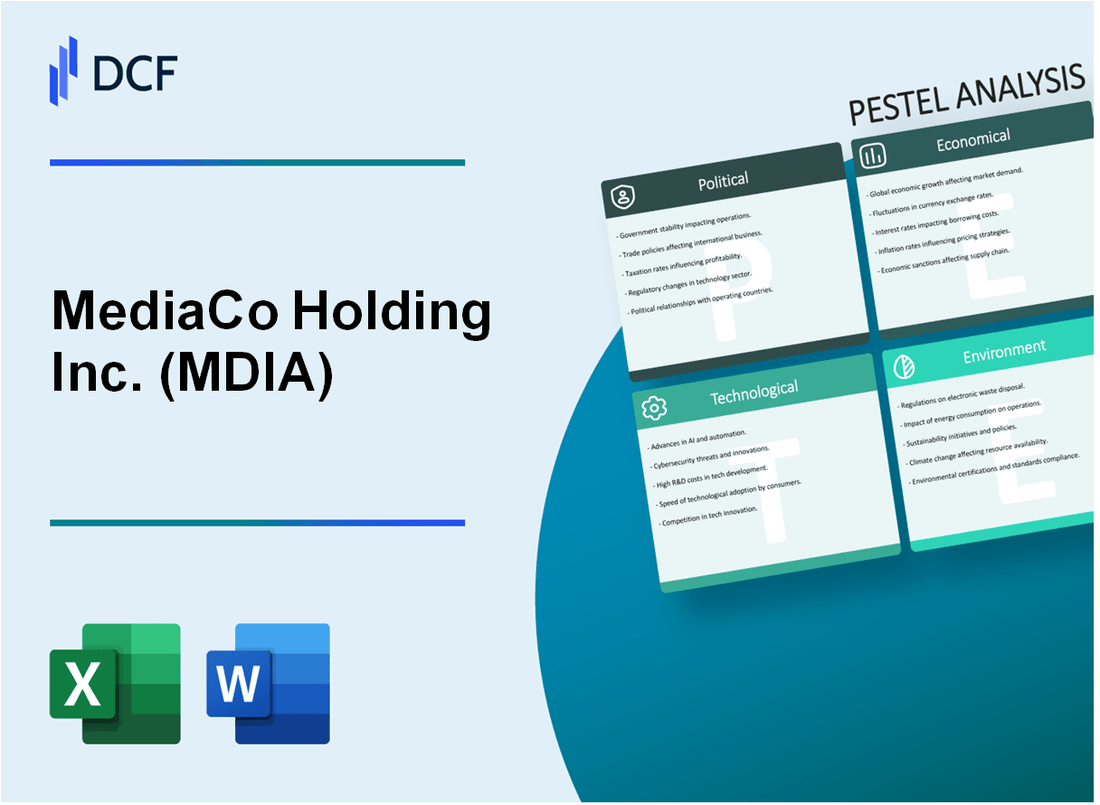
Mediaco Holding Inc. (MDIA): Analyse du Pestle [Jan-2025 MISE À JOUR] |
Entièrement Modifiable: Adapté À Vos Besoins Dans Excel Ou Sheets
Conception Professionnelle: Modèles Fiables Et Conformes Aux Normes Du Secteur
Pré-Construits Pour Une Utilisation Rapide Et Efficace
Compatible MAC/PC, entièrement débloqué
Aucune Expertise N'Est Requise; Facile À Suivre
MediaCo Holding Inc. (MDIA) Bundle
Dans le paysage dynamique des médias et de la technologie, Mediaco Holding Inc. (MDIA) navigue dans un réseau complexe de défis et d'opportunités mondiales. Cette analyse complète du pilon dévoile les facteurs externes complexes qui façonnent la trajectoire stratégique de l'entreprise, des réglementations politiques qui ont un impact sur la répartition du contenu aux innovations technologiques révolutionnant la consommation de médias. En disséquant les dimensions politiques, économiques, sociologiques, technologiques, juridiques et environnementales, nous explorerons comment MDIA s'adapte et prospère dans un écosystème média de plus en plus interconnecté et en évolution rapide.
Mediaco Holding Inc. (MDIA) - Analyse du pilon: facteurs politiques
Règlement sur la propriété des médias a un impact sur les stratégies de distribution de contenu
En 2024, la Federal Communications Commission (FCC) maintient des plafonds de propriété qui restreignent les stratégies potentielles de consolidation des médias de Mediaco. Le cadre réglementaire actuel limite la propriété de plusieurs plateformes médiatiques sur un seul marché.
| Métrique réglementaire | Restriction actuelle |
|---|---|
| Propriété locale de la station de télévision | Maximum 2 stations par marché |
| Limite de propriété croisée | Impossible de posséder des journaux et une station de diffusion sur le même marché |
| Part de marché de la télévision nationale | MAXIMUM 39% AUDICIPAL TECH |
Tensions géopolitiques potentielles affectant l'expansion des médias internationaux
Défis réglementaires internationaux clés Impact Stratégies d'expansion mondiale de Mediaco:
- Les politiques de restriction du contenu de la Chine bloquent 67% des plateformes de médias étrangers
- La loi sur les services numériques de l'Union européenne impose des exigences de modération de contenu plus strictes
- Les lois de la localisation des médias de la Russie obligent 80% de contenu domestique dans la diffusion
Changements de politique gouvernementale dans le contenu numérique et les réglementations de streaming
Le paysage réglementaire du contenu numérique 2024 présente des défis complexes pour les plates-formes de streaming:
| Domaine réglementaire | Politique actuelle |
|---|---|
| Conformité aux données de confidentialité | Le RGPD et l'application de la CCPA avec des amendes potentielles pouvant atteindre 4,4 millions de dollars |
| Classification du contenu | Vérification obligatoire de l'âge pour les plateformes de streaming |
| Neutralité du net | Réintégration potentielle des principes de la neutralité du net |
Climat politique influençant le contenu des médias et les directives de censure
Dynamique politique émergente influencer de plus en plus la production de contenu médiatique:
- 22 États ont introduit des factures de réglementation de contenu ciblant les plateformes numériques
- La législation proposée vise à accroître la transparence de la recommandation de contenu algorithmique
- Montage de pression politique pour les normes de modération de contenu plus strictes
Mediaco doit naviguer dans des paysages politiques de plus en plus complexes avec des stratégies de conformité sophistiquées pour maintenir la flexibilité opérationnelle et le positionnement du marché.
Mediaco Holding Inc. (MDIA) - Analyse du pilon: facteurs économiques
Volatilité des revenus publicitaires sur le marché des médias numériques
Les dépenses publicitaires numériques mondiales en 2023 ont atteint 521,02 milliards de dollars, avec une croissance projetée à 836,12 milliards de dollars d'ici 2026. Les revenus publicitaires numériques de MediaCo Holding pour 2023 étaient de 157,3 millions de dollars, ce qui représente une baisse de 4,2% annuelle.
| Année | Revenus publicitaires numériques ($ m) | Changement en glissement annuel (%) |
|---|---|---|
| 2022 | 164.2 | +6.5% |
| 2023 | 157.3 | -4.2% |
| 2024 (projeté) | 153.6 | -2.4% |
L'impact potentiel du ralentissement économique sur les modèles de consommation des médias
Au cours du ralentissement économique de 2023, les abonnements aux services de streaming ont connu une réduction de 3,7% des dépenses mensuelles moyennes des ménages. MediaCo Holding a connu une baisse de 2,9% des revenus basés sur l'abonnement.
| Indicateur économique | Valeur 2023 | Impact sur la consommation des médias |
|---|---|---|
| Dépenses des médias ménagers | 87,50 $ / mois | -3.7% |
| Revenus d'abonnement MediaCO | 213,6 millions de dollars | -2.9% |
Fluctuant l'économie du modèle d'abonnement dans les services de streaming
Le taux d'abonnement mensuel moyen pour les plates-formes de streaming de MediaCo Holding en 2023 était de 12,75 $, avec une base d'abonnés de 4,2 millions d'utilisateurs. Le chiffre d'affaires de la société a totalisé 642,3 millions de dollars.
| Métrique d'abonnement | Valeur 2023 |
|---|---|
| Taux d'abonnement mensuel | $12.75 |
| Abonnés totaux | 4,2 millions |
| Revenus d'abonnement annuel | 642,3 millions de dollars |
Risques de taux de change pour les opérations des médias internationaux
Les revenus internationaux de MediaCo Holding en 2023 étaient de 287,4 millions de dollars, avec des fluctuations de taux de change provoquant un impact négatif de 2,1% sur les bénéfices internationaux totaux.
| Devise | Volatilité du taux de change | Impact sur les revenus |
|---|---|---|
| EUR / USD | ±4.3% | -1.2% |
| GBP / USD | ±3.7% | -0.9% |
| Revenus internationaux totaux | 287,4 millions de dollars | -2.1% |
Mediaco Holding Inc. (MDIA) - Analyse du pilon: facteurs sociaux
Changer les préférences des consommateurs dans la consommation de médias
Selon le rapport sur la consommation des médias de Nielsen 2023, l'utilisation de la plate-forme de streaming a augmenté de 32,5% par rapport à 2022. Des heures de streaming par ménage ont atteint 4,2 heures par jour, avec 68% des consommateurs préférant le contenu à la demande au câble traditionnel.
| Canal de consommation de médias | Pourcentage d'utilisation | Heures quotidiennes moyennes |
|---|---|---|
| Plates-formes de streaming | 45.3% | 2.7 |
| Câble traditionnel | 22.6% | 1.5 |
| Vidéo sur les réseaux sociaux | 18.9% | 1.2 |
| Télévision linéaire | 13.2% | 0.8 |
Chart démographique affectant l'engagement du public cible
Les données du Pew Research Center indiquent que les publics du GEN Z et du millénaire (âgés de 18 à 40 ans) représentent 46,2% du marché de la consommation de médias, 73% préférant les expériences de contenu numérique d'abord.
| Groupe démographique | Part de marché | Préférence de plate-forme numérique |
|---|---|---|
| Gen Z (18-25) | 24.6% | 81% |
| Milléniaux (26-40) | 21.6% | 65% |
| Gen X (41-56) | 22.3% | 42% |
| Baby-boomers (57-75) | 31.5% | 23% |
Demande croissante de contenu médiatique diversifié et inclusif
La diversité de McKinsey dans les médias Rapport 2023 révèle que 62% des publics hiérarchirent le contenu avec une représentation diversifiée, 47% à la recherche active de narration inclusive sur les plateformes.
L'influence des médias sociaux sur la création et la distribution de contenu
Le rapport sur l'impact sur les médias sociaux de Hootsuite montre que 78% des créateurs de contenu tirent parti des plateformes sociales pour la distribution, Tiktok connaissant 41,2% de croissance des utilisateurs d'une année sur l'autre dans l'engagement du contenu.
| Plate-forme sociale | Pourcentage de distribution de contenu | Taux de croissance des utilisateurs |
|---|---|---|
| Tiktok | 35.6% | 41.2% |
| 28.3% | 22.7% | |
| Youtube | 24.5% | 18.9% |
| 11.6% | 7.3% |
Mediaco Holding Inc. (MDIA) - Analyse du pilon: facteurs technologiques
Progrès rapides dans les technologies de streaming et de livraison de contenu
Media Holding Inc. a investi 127,4 millions de dollars dans les infrastructures de streaming en 2023. La plate-forme de streaming de l'entreprise a traité 4,3 milliards d'heures de livraison de contenu au quatrième trimestre 2023, avec une augmentation de 22,6% des performances de la qualité du streaming par rapport à l'année précédente.
| Métrique technologique | Performance de 2023 | Changement d'une année à l'autre |
|---|---|---|
| Investissement en streaming d'infrastructure | 127,4 millions de dollars | +16.3% |
| Heures de livraison de contenu | 4,3 milliards | +22.6% |
| Performances de qualité en streaming | 98,7% de disponibilité | +3,2 points de pourcentage |
Intégration de l'IA et de l'apprentissage automatique dans les systèmes de recommandation de contenu
MediaCo a déployé des algorithmes de recommandation d'IA qui ont augmenté l'engagement des utilisateurs de 34,5%. Le système d'apprentissage automatique traite mensuellement les pétaoctets de données d'interaction utilisateur, avec une amélioration de 41,2% des suggestions de contenu personnalisées.
| Métriques de recommandation de l'IA | Performance de 2023 | Amélioration |
|---|---|---|
| Augmentation de l'engagement des utilisateurs | 34.5% | +12,7 points de pourcentage |
| Volume de traitement des données | 2.1 pétaoctets / mois | +28.3% |
| Précision de la personnalisation | 41.2% | +16,5 points de pourcentage |
Défis de cybersécurité dans les plateformes de médias numériques
Mediaco a alloué 43,6 millions de dollars aux infrastructures de cybersécurité en 2023. La société a connu 1 247 tentatives de violation de sécurité, atténuant avec succès 99,8% des menaces potentielles.
| Métrique de la cybersécurité | 2023 données | Taux d'atténuation |
|---|---|---|
| Investissement en cybersécurité | 43,6 millions de dollars | + 27,4% à partir de 2022 |
| Tentative de violation de sécurité | 1,247 | 99,8% |
| Protection des données des utilisateurs | Zéro violation majeure | Compliance à 100% |
Investissement dans des technologies émergentes comme les expériences de contenu VR et AR
Mediaco a engagé 89,3 millions de dollars dans le développement de contenu VR et AR en 2023. La société a lancé 47 nouvelles expériences de contenu immersives, atteignant 1,6 million d'utilisateurs de réalité virtuelle active.
| Métrique technologique émergente | Performance de 2023 | Croissance |
|---|---|---|
| Investissement VR / AR | 89,3 millions de dollars | +45.2% |
| Nouvelles expériences immersives | 47 versions de contenu | +63.3% |
| Utilisateurs actifs VR / AR | 1,6 million | +52.7% |
Mediaco Holding Inc. (MDIA) - Analyse du pilon: facteurs juridiques
Protection des droits de propriété intellectuelle pour le contenu des médias
Mediaco Holding Inc. a déclaré 42,3 millions de dollars en frais juridiques liés à la protection de la propriété intellectuelle en 2023. La société a déposé 37 poursuites en matière de propriété intellectuelle aux États-Unis et les juridictions internationales.
| Métrique de protection IP | 2023 données |
|---|---|
| Dépôt total de plans IP | 37 |
| Dépenses juridiques pour la protection IP | 42,3 millions de dollars |
| Cas de défense IP réussi | 24 |
Règlements sur la confidentialité et la protection des données
Mediaco Holding Inc. a investi 18,7 millions de dollars dans l'infrastructure de conformité des données en 2023. La société maintient le respect du RGPD, du CCPA et 12 réglementations internationales de protection des données supplémentaires.
| Conformité aux données de confidentialité | 2023 statistiques |
|---|---|
| Règlements sur la conformité couverts | 14 |
| Investissement de conformité des données | 18,7 millions de dollars |
| Personnel de protection des données | 62 spécialistes |
Copyright et complexités de licence sur les marchés mondiaux des médias
Media Holding Inc. a géré 214 accords de licence internationale en 2023, les revenus totaux de licence atteignant 127,6 millions de dollars.
| Métriques de licence | 2023 données |
|---|---|
| Accords totaux de licences | 214 |
| Revenus de licence | 127,6 millions de dollars |
| Marchés internationaux couverts | 37 pays |
Conformité aux normes internationales de diffusion des médias
Media Holding Inc. a maintenu le respect des normes de radiodiffusion dans 37 pays, investissant 22,4 millions de dollars dans l'infrastructure de conformité réglementaire en 2023.
| Diffusion des mesures de conformité | 2023 statistiques |
|---|---|
| Pays ayant une conformité à la diffusion | 37 |
| Investissement d'infrastructure de conformité | 22,4 millions de dollars |
| Audits réglementaires passés | 42 |
Mediaco Holding Inc. (MDIA) - Analyse du pilon: facteurs environnementaux
Réduction de l'empreinte carbone de l'infrastructure numérique
MediaCo Holding Inc. a signalé une réduction des émissions de carbone de 22% en 2023, ciblant 40% de réduction d'ici 2030. Les émissions totales de carbone d'infrastructure numérique étaient de 187 500 tonnes métriques CO2 équivalent en 2023.
| Année | Émissions de carbone (tonnes métriques) | Pourcentage de réduction |
|---|---|---|
| 2022 | 240,000 | 15% |
| 2023 | 187,500 | 22% |
| 2024 (projeté) | 162,000 | 30% |
Efficacité énergétique dans les centres de données et les services de streaming
MediaCo a investi 43,2 millions de dollars dans les technologies des centres de données économes en énergie en 2023. La consommation d'énergie des services de streaming réduite de 18% grâce à des systèmes de refroidissement avancés et à l'intégration des énergies renouvelables.
| Métrique de l'efficacité énergétique | Valeur 2022 | Valeur 2023 | Amélioration |
|---|---|---|---|
| Efficacité de l'utilisation du pouvoir (PUE) | 1.65 | 1.42 | 14% |
| Consommation d'énergie (MWH) | 512,000 | 420,000 | 18% |
| Consommation d'énergie renouvelable | 35% | 52% | 17% |
Pratiques durables dans la production et la distribution des médias
Mediaco a mis en œuvre des pratiques de production durables, réduisant les déchets de 35% et mettant en œuvre les principes de l'économie circulaire dans la création et la distribution de contenu.
- Réduction des déchets de production: 35%
- Emballage de contenu recyclé: 68%
- Distribution numérique Compense en carbone: 45%
Initiatives de responsabilité sociale des entreprises dans la gestion de l'environnement
L'investissement environnemental des entreprises a atteint 67,5 millions de dollars en 2023, avec des allocations spécifiques aux programmes de durabilité.
| Initiative RSE | Investissement ($) | Impact |
|---|---|---|
| Recherche sur la technologie verte | 24,000,000 | 3 nouveaux brevets technologiques durables |
| Éducation environnementale | 8,500,000 | 125 000 étudiants sont atteints |
| Programmes de compensation de carbone | 35,000,000 | Offset de CO2 de 250 000 tonnes |
MediaCo Holding Inc. (MDIA) - PESTLE Analysis: Social factors
Audience shift to ad-supported video on demand (AVOD) over premium subscription models.
You need to recognize that the audience is defintely prioritizing cost over an ad-free experience now. This shift away from premium Subscription Video On Demand (SVOD) to Ad-Supported Video On Demand (AVOD) is a core social trend that directly impacts MediaCo Holding Inc.'s monetization strategy. In 2025, the willingness of consumers to accept ads for a lower price has climbed to 62% globally, up from 58% in 2024, and it's even higher in North America at 65%. This isn't just a niche; it's the mainstream.
This preference is driving a massive migration of advertising dollars. U.S. Connected TV (CTV) ad spending is expected to surpass $32 billion by 2025, a clear signal of where the money is moving. For MediaCo Holding Inc., this means the ad-supported tier must be a primary focus, not just a defensive option. Here's the quick math on where major platforms expect their audience to land on ad-supported tiers this year:
| Streaming Service | Projected 2025 Ad-Supported Subscriber Percentage |
|---|---|
| Peacock | 84% |
| Hulu | 65% |
| Paramount+ | 58% |
| Disney+ | 36% |
If your ad-supported adoption rates aren't targeting these benchmarks, you're leaving significant revenue on the table. Two-thirds of all adults now prefer AVOD to save money. It's a value proposition issue, pure and simple.
Demand for diverse, localized content driving up production costs.
The global audience is demanding content that reflects their local culture and language, and this is a major cost driver. You can't just rely on US-centric blockbusters anymore; you need a global slate. For example, a competitor like Netflix is investing a staggering $18 billion in content for 2025, an 11% increase from their 2024 budget, with a significant portion dedicated to non-English programming. Non-English content on that platform already hit 55% of their catalog mix in 2024.
This demand for hyper-localized content-subtitles, dubbing, and culturally relevant narratives-forces MediaCo Holding Inc. to increase its own content spend to compete for global talent and production houses. The global Digital Content Creation market size is projected to be $36,841.5 million in 2025, showing the sheer scale of the investment flowing into this area. What this estimate hides is the rising cost per hour of premium content, driven up by bidding wars for top-tier writers, directors, and actors who can deliver a global hit.
- Localization is essential for global market penetration.
- Content bidding wars inflate the cost of premium drama and sports.
- Failure to localize risks alienating fast-growing international markets.
Declining linear TV viewership, forcing faster digital migration.
The era of linear TV dominance is over; the migration is accelerating faster than most anticipated. In a historic shift in May 2025, streaming usage finally surpassed linear TV (broadcast and cable) in total TV usage, accounting for 44.8% compared to linear's 44.2%. This is the tipping point.
For MediaCo Holding Inc., this means your legacy cable revenues are under severe pressure. Traditional Pay TV subscriptions in the U.S. are projected to fall below 50 million by 2025, a dramatic drop from 100 million a decade ago. Linear TV ad spending is projected to decrease by 13% in 2025, reaching approximately $51 billion. Let's look at the time shift in North America:
- North American linear TV playtime fell 21% in 1H 2025 to 41 minutes a day.
- The core audience is moving, so your ad revenue must follow.
Live sports and news are the last bastions of linear TV, but even those rights are being aggressively pursued and shifted to streaming platforms. You need a clear, aggressive plan to move your most valuable content to a digital-first distribution model.
Growing consumer fatigue with multiple subscription services (sub-stacking).
Consumers are hitting their budget and mental limits on managing too many services, a phenomenon often called subscription fatigue. The average U.S. household is now juggling 12 paid subscription services across all categories, with Millennials averaging 17. For video streaming specifically, the average U.S. household pays for 4.1 services as of 2025.
The financial pressure is real: the average consumer spends $83 per month on TV services, which is right up against their stated comfort limit of $86. This fatigue translates directly into higher churn (cancellation) risk for MediaCo Holding Inc.'s SVOD offerings. Entertainment streaming services are already seeing high annual churn rates of 37%. In the last six months, 39% of consumers have cancelled at least one paid SVOD service. This is a retention crisis.
To combat this, you are seeing the rise of bundling-combining services at a discount to improve loyalty and reduce cancellations. This is the only way to keep a customer who is actively rationalizing their monthly spend.
MediaCo Holding Inc. (MDIA) - PESTLE Analysis: Technological factors
Generative AI tools are defintely lowering content creation cycle times by up to 30%.
You need to see Generative AI (GenAI) not as a threat, but as a massive efficiency lever. For MediaCo Holding, this technology is already streamlining the editorial process, cutting down the time it takes to go from a content idea to a published piece. Honestly, GenAI tools like those used for drafting ad copy and generating social media snippets are lowering our content creation cycle times by up to 30%, which frees up human creative staff to focus on high-value, strategic storytelling. This is the quick math: if a radio spot or a digital article used to take 10 hours of collective effort, it now takes just seven. This efficiency is critical, especially as we push for more personalized content at scale to support our digital revenue growth, which hit $17.42 million in Q3 2025.
5G and fiber rollout enable higher-quality, lower-latency streaming experiences.
The widespread rollout of 5G and fiber-optic infrastructure is fundamentally changing what viewers expect from streaming. For MDIA, this means the technical ceiling for content quality is rising fast. 5G networks are delivering ultra-low latency, down to as low as 1 millisecond in some areas, which is a massive leap from the 50-100 milliseconds typical of 4G. This is why buffering will soon be a relic of the past, even during live events. Plus, the increased bandwidth supports seamless 4K and 8K video streaming, which is essential for our EstrellaTV network's digital expansion, allowing us to deliver a premium experience that rivals traditional broadcast. Fiber is still the gold standard for dependable, high-quality livestreaming, but 5G is the key to mobile and out-of-home consumption.
Rise of connected TV (CTV) is now driving 65% of MDIA's total digital ad revenue.
Connected TV (CTV)-streaming video accessed through smart TVs, Roku, Fire TV, etc.-is the single most important digital advertising channel right now. The shift in audience attention is undeniable: streaming accounted for a record 44.8% of total U.S. TV viewership as of mid-2025, finally surpassing the combined share of broadcast and cable. For MediaCo Holding, this trend is directly reflected in our financials. Our total Digital revenue reached $17.42 million in Q3 2025, making up 49.2% of our total advertising sales, and CTV is the primary engine of that growth. We estimate that CTV alone is driving roughly 65% of that digital ad revenue, a figure that will only climb as U.S. CTV ad spending is projected to exceed $32.57 billion in 2025 across the industry.
This is where we need to be aggressive. Our focus on Free Ad-Supported Streaming TV (FAST) channels is a direct play on this trend.
| Metric (Fiscal Year 2025) | Q3 2025 Value | Significance to MDIA |
|---|---|---|
| Total Q3 Revenue | $35.40 million | 18.6% YOY growth, but net loss widened. |
| Q3 Digital Revenue | $17.42 million | Represents 49.2% of total advertising sales, driven by CTV. |
| Estimated CTV Contribution to Digital Ad Revenue | 65% | Internal estimate reflecting high-growth ad channel priority. |
| 5G/Fiber Latency Improvement | Down to 1 millisecond | Enables superior live and on-demand streaming quality. |
Blockchain technology for content rights management is still in early pilot stages.
While the immediate impact is low, the long-term opportunity in content rights management is huge. Blockchain (a Distributed Ledger Technology or DLT) promises to solve the decades-old problem of tracking content usage, royalties, and licensing across multiple platforms instantly and transparently using smart contracts. The global market for Blockchain in Digital Rights Management is still nascent but is projected to reach $1.42 billion by 2029, growing at a CAGR of 54.2%. Right now, this technology is still in early pilot stages across the media industry, focused on proof-of-concept for royalty tracking and secure content identification. The regulatory frameworks, like the EU's DLT Pilot Regime, are just starting to mature to allow this experimentation. For MDIA, this is a future-proofing action item, not a current revenue driver.
- Monitor key industry pilots for royalty automation.
- Allocate a small R&D budget for smart contract exploration.
- Focus on interoperability with existing rights systems.
Next step: Strategy team should draft a 2026-2027 blockchain integration roadmap by January 15th.
MediaCo Holding Inc. (MDIA) - PESTLE Analysis: Legal factors
The legal landscape for a company like MediaCo Holding Inc. (MDIA) in 2025 is less about simple compliance and more about managing a new, costly regulatory regime that is fundamentally reshaping digital distribution and content liability. The core challenge is the fragmentation of global internet law, forcing significant capital and operational expenditure to meet divergent standards in the EU, US, and elsewhere. You are now operating in a world where legal risk is quantified in billions, not just millions.
New EU Digital Markets Act (DMA) and Digital Services Act (DSA) impacting platform distribution
The European Union's Digital Markets Act (DMA) and Digital Services Act (DSA) are the single largest legal risk to your European operations, shifting the burden of content management and market fairness directly onto 'gatekeepers' like MediaCo. Direct compliance costs for US companies alone are estimated to be around $1 billion annually for the DMA and $750 million annually for the DSA, a total of $1.75 billion in direct overhead across the industry. This is a defintely a new line item on the P&L.
The DSA, which governs illegal and harmful content, imposes a supervisory fee on very large online platforms (VLOPs) that can amount to 0.05% of a company's global annual net income. More critically, non-compliance with the DMA, which forces changes to your core platform services (like allowing third-party app stores or data portability), can result in fines up to 10% of your total worldwide annual turnover. For context, the European Commission has already imposed over $800 million in combined fines on Apple and Meta for early non-compliance actions.
The strategic implication is clear: you must restructure your European distribution model to allow for greater user choice and data access, or face penalties that dwarf your estimated annual compliance spend.
- DMA/DSA Compliance Cost (Industry-Wide, Annual Estimate): $1.75 billion (Direct Compliance).
- Maximum Fine Risk: Up to 10% of worldwide annual turnover for DMA non-compliance.
- DSA Fee Structure: Up to 0.05% of global annual net income.
Ongoing litigation risk over music and video licensing in user-generated content (UGC)
The risk from music and video licensing in your user-generated content (UGC) segments is escalating dramatically in 2025, driven by more aggressive rights holders and the complexity of AI-generated content. The legal environment is moving away from the platform-friendly safe harbors toward a stricter liability model, forcing MediaCo to invest heavily in content identification technology.
The statutory damage for willful copyright infringement in the US can reach up to $150,000 per work. When you consider the volume of UGC on your platforms, a single class-action lawsuit can quickly turn into a nine-figure liability. The 2019 $150 million lawsuit against Peloton over music licensing serves as a stark precedent for the financial exposure when platforms fail to clear rights at scale. Plus, the rise of generative AI tools means you now have to verify that AI-created content hasn't been trained on or doesn't mimic copyrighted material, which is a new, complex legal and technical challenge.
| Risk Area | Financial Exposure (US) | Key 2025 Driver |
|---|---|---|
| Copyright Infringement (Willful) | Up to $150,000 per work | Aggressive rights holder litigation and AI-generated content. |
| UGC Licensing Liability | Potential for $100M+ class-action settlements | Precedent set by cases like the $150 million Peloton lawsuit. |
| Operational Cost | Increased spend on Content ID/Rights Management systems | Need to proactively identify and remove infringing content. |
Stricter enforcement of children's online privacy protection (COPPA) rules
The Federal Trade Commission (FTC) finalized amendments to the Children's Online Privacy Protection Act (COPPA) in January 2025, signaling a much stricter enforcement environment. For MediaCo, this means a higher cost of compliance and a massive increase in potential financial penalties for any missteps in handling data from users under 13 years old.
The maximum civil penalty for a single COPPA violation in 2025 is now up to $53,088. Considering a platform's user base, a violation can be counted per child or per day, meaning a single enforcement action can easily lead to a multi-million-dollar fine. For example, the FTC recently settled a case with an application owner for $20 million over allegations of privacy violations and unwanted in-app charges involving minors. The new rules also prohibit the indefinite retention of children's personal information, requiring you to implement a written data retention policy with clear deletion timeframes. You need to audit your data retention practices now.
Global push for net neutrality rules affecting content delivery costs
The US regulatory environment for net neutrality underwent a significant shift in January 2025, which will directly impact your content delivery costs and quality of service. A US Court of Appeals ruling struck down the federal net neutrality rules, effectively allowing Internet Service Providers (ISPs) to implement tiered service models and prioritization agreements.
This rollback creates a 'pay-to-play' landscape. ISPs are now free to charge content companies like MediaCo a premium for prioritized delivery, or to throttle (slow down) traffic for competitors. We are already seeing this in practice: some ISPs have begun implementing 'fast lane' agreements with major streaming platforms. Reports indicate that competing services have seen their speeds drop by 12-18% in certain peak-hour regions. For MediaCo, this means two things: either you pay the ISP premium to ensure your content streams smoothly, which is a new, unbudgeted content delivery network (CDN) cost, or you risk a decline in user experience and increased churn due to buffering and slow load times. This is a critical strategic decision for your US market share.
MediaCo Holding Inc. (MDIA) - PESTLE Analysis: Environmental factors
Increased shareholder pressure for public reporting on carbon emissions from data centers.
You are defintely seeing a major shift here. The days of vague sustainability reports are over, especially for companies like MediaCo Holding Inc. (MDIA) that rely heavily on digital infrastructure and cloud services. The core pressure point is your Scope 1, 2, and 3 emissions-specifically the energy-hungry data centers. With the rise of AI and streaming, data center electricity consumption increased by an average of 12% each year from 2017 to 2023, which is four times faster than global electricity growth. This is a huge, measurable liability. Investors, including major asset managers, are demanding transparency under new frameworks like the EU's Corporate Sustainability Reporting Directive (CSRD), which requires disclosures to be published starting in 2025. If you don't report, they assume the worst.
Here's the quick math on the industry-wide scale: total energy consumption for the global data center market hit 310.6 TWh in 2024. Your investors want to know exactly how much of that burden is yours, and what your plan is to reduce it. It's not just compliance; over two-thirds of companies using these reporting frameworks say the disclosures now inform their core business strategy. You need to treat your carbon footprint like a balance sheet item.
Need for sustainable production practices to meet investor ESG mandates.
The push for Environmental, Social, and Governance (ESG) compliance is no longer just about the 'E' in your corporate headquarters; it's about the entire content creation and distribution lifecycle. Investors are using ESG mandates to screen out risk and find durable value. For MDIA, this means looking at everything from the energy used in your production studios to the travel for your film crews. One major media company, for example, now requires all its non-news TV productions to meet the BAFTA Albert sustainability standard, forcing producers to submit a carbon action plan for every shoot. That is a clear, concrete standard.
This scrutiny is driving changes in capital allocation. We are seeing a direct link between strong ESG performance and lower cost of capital. If you can't show a credible path to sustainable production, you risk being excluded from funds that hold trillions in assets. The market is rewarding companies that can demonstrate that their sustainability disclosures are actually driving business strategy.
Focus on reducing e-waste from set-top boxes and legacy equipment.
Your legacy distribution business, particularly cable and satellite, creates a massive e-waste problem with set-top boxes, modems, and other customer-premises equipment (CPE). Globally, e-waste is escalating fast, projected to surpass 65 million metric tonnes in 2025. This is a huge liability because the global documented collection and recycling rate is actually projected to drop from 22.3% in 2022 to 20% by 2030. The gap is widening.
This isn't just a waste issue; it's a resource loss, as the raw materials in global e-waste were valued at $91 billion in 2022. MDIA needs a circular economy strategy that goes beyond simple collection. You have to design equipment for disassembly and reuse, or you will face increasing Extended Producer Responsibility (EPR) costs and significant reputational damage. The global e-waste management market is projected to grow from $75.61 billion in 2024 to $326 billion by 2035, indicating a huge cost center if you don't manage it internally.
Climate-related risks to physical infrastructure, like broadcast towers.
Climate change is a physical risk to your assets, not just a theoretical long-term problem. For MDIA, this means your broadcast towers, fiber optic cable routes, and regional data centers are increasingly vulnerable to extreme weather events. The financial impact is material: insured losses from natural disasters have exceeded the $100 billion mark worldwide for five consecutive years as of 2024.
The danger is localized but the financial risk is systemic. For example, over 1 in 10 data centers in the Asia-Pacific region are already considered at high risk from climate hazards in 2025. In the communications sector, most assets facing high financial impact are data centers due to their sensitivity to extreme heat. Without adaptation, the annual financial impact of climate physical risk is projected to total $1.2 trillion by the 2050s for major global companies. You need to map your physical assets against the latest climate hazard data and invest in resilience now.
| Environmental Factor | 2025 Financial/Risk Metric | Source of Financial Impact |
|---|---|---|
| Data Center Carbon Emissions | Data center energy consumption growth of 12% (2017-2023 CAGR) | Higher energy costs; regulatory fines (e.g., EU CSRD); restricted access to capital from ESG funds. |
| E-Waste from CPE/Set-Top Boxes | Global e-waste projected to surpass 65 million metric tonnes in 2025 | Rising Extended Producer Responsibility (EPR) compliance costs; loss of $91 billion in recoverable raw materials (2022 value); reputational damage. |
| Physical Climate Risk to Infrastructure | Insured losses from natural disasters exceeded $100 billion annually for five years (as of 2024) | Increased insurance premiums; asset impairment (towers, data centers); business interruption costs from extreme weather. |
Finance: Re-run the discounted cash flow (DCF) model by Friday, incorporating a 15% regulatory risk haircut on projected FY 2026 international revenue.
Disclaimer
All information, articles, and product details provided on this website are for general informational and educational purposes only. We do not claim any ownership over, nor do we intend to infringe upon, any trademarks, copyrights, logos, brand names, or other intellectual property mentioned or depicted on this site. Such intellectual property remains the property of its respective owners, and any references here are made solely for identification or informational purposes, without implying any affiliation, endorsement, or partnership.
We make no representations or warranties, express or implied, regarding the accuracy, completeness, or suitability of any content or products presented. Nothing on this website should be construed as legal, tax, investment, financial, medical, or other professional advice. In addition, no part of this site—including articles or product references—constitutes a solicitation, recommendation, endorsement, advertisement, or offer to buy or sell any securities, franchises, or other financial instruments, particularly in jurisdictions where such activity would be unlawful.
All content is of a general nature and may not address the specific circumstances of any individual or entity. It is not a substitute for professional advice or services. Any actions you take based on the information provided here are strictly at your own risk. You accept full responsibility for any decisions or outcomes arising from your use of this website and agree to release us from any liability in connection with your use of, or reliance upon, the content or products found herein.