

|
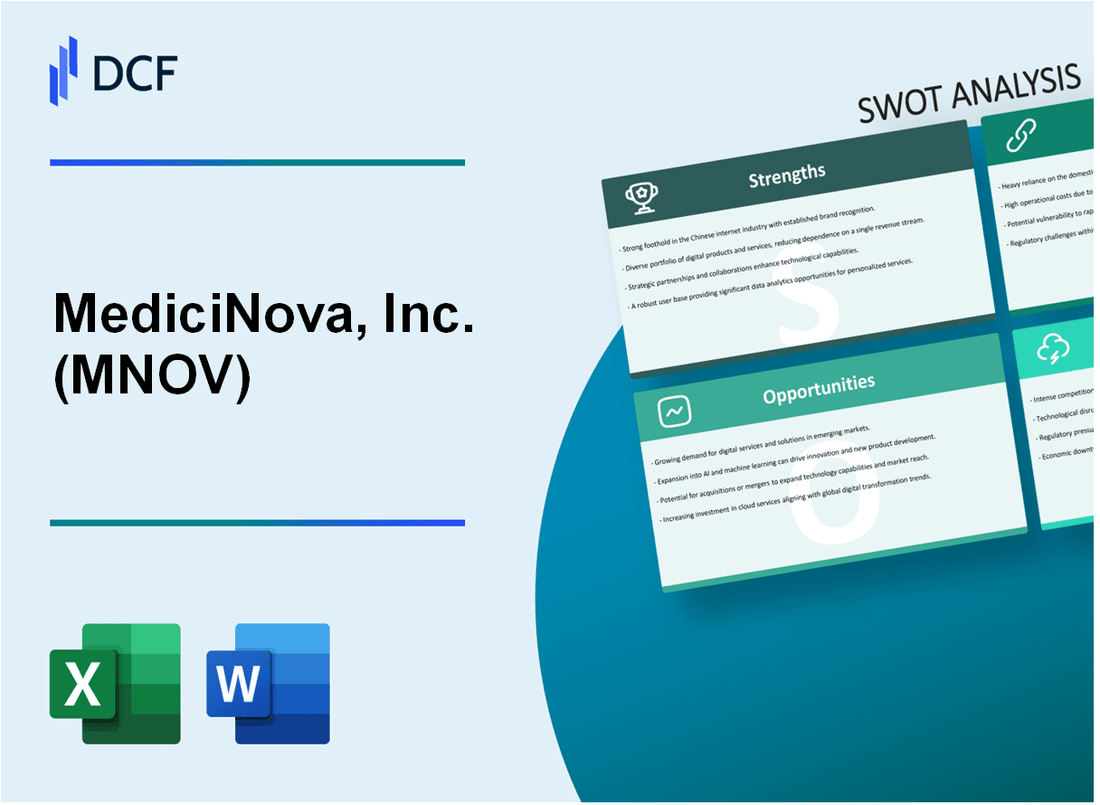
Medicinova, Inc. (MNOV): Analyse SWOT [Jan-2025 Mise à jour] |
Entièrement Modifiable: Adapté À Vos Besoins Dans Excel Ou Sheets
Conception Professionnelle: Modèles Fiables Et Conformes Aux Normes Du Secteur
Pré-Construits Pour Une Utilisation Rapide Et Efficace
Compatible MAC/PC, entièrement débloqué
Aucune Expertise N'Est Requise; Facile À Suivre
MediciNova, Inc. (MNOV) Bundle
Dans le monde dynamique de l'innovation biopharmaceutique, Medicinova, Inc. (MNOV) se tient à un moment critique, naviguant dans le paysage complexe des traitements neurologiques et inflammatoires. Cette analyse SWOT complète révèle le positionnement stratégique de l'entreprise, mettant en évidence son potentiel pour transformer la recherche médicale par des candidats thérapeutiques de pointe comme Ibudilast, tout en confrontant les réalités difficiles du développement biotechnologique. Plongez dans un examen détaillé des forces, des faiblesses, des opportunités et des menaces de Medicinova qui pourraient façonner son avenir dans l'écosystème pharmaceutique compétitif.
Medicinova, Inc. (MNOV) - Analyse SWOT: Forces
Stratégie de développement thérapeutique ciblé
Medicinova se concentre sur le développement de traitements biopharmaceutiques innovants spécifiquement pour les maladies neurologiques et inflammatoires, avec une approche de recherche ciblée.
Pipeline robuste de candidats thérapeutiques
La société maintient un solide pipeline de candidats thérapeutiques potentiels, avec Focus clé sur l'ibudilast pour la sclérose en plaques progressive.
| Drogue | Zone thérapeutique | Étape de développement |
|---|---|---|
| Ibudilast | Sclérose en plaques progressive | Essais cliniques de phase 3 |
| MN-166 | Troubles neurologiques | Essais cliniques de phase 2 |
| MN-001 | Maladies inflammatoires | Essais cliniques de phase 2 |
Équipe de gestion expérimentée
Le leadership de Medicinova démontre une expertise approfondie dans le développement de médicaments:
- Expérience de gestion moyenne de plus de 20 ans dans la recherche pharmaceutique
- Plusieurs dirigeants ayant des rôles de leadership antérieurs dans des sociétés pharmaceutiques de haut niveau
- Bouc-vous éprouvés du développement de médicaments et des approbations réglementaires réussies
Partenariats stratégiques
La société a établi des collaborations critiques pour améliorer les capacités de recherche:
| Type de partenaire | Nombre de partenariats | Focus de recherche |
|---|---|---|
| Établissements de recherche universitaire | 4 | Recherche de maladies neurologiques |
| Sociétés pharmaceutiques | 2 | Collaboration de développement de médicaments |
Indicateurs de performance financière
Depuis le quatrième trimestre 2023, Medicinova a rapporté:
- Dépenses de recherche et de développement: 12,4 millions de dollars
- Equivalents en espèces et en espèces: 37,6 millions de dollars
- Actif total: 45,2 millions de dollars
Medicinova, Inc. (MNOV) - Analyse SWOT: faiblesses
Ressources financières limitées et dépendance continue à l'égard du financement externe
Depuis le quatrième trimestre 2023, Medicinova a rapporté 24,7 millions de dollars en espèces et équivalents en espèces. Les états financiers de l'entreprise indiquent une dépendance continue à des sources de financement externes pour soutenir les activités de recherche et développement en cours.
| Métrique financière | Montant (USD) | Année |
|---|---|---|
| Perte nette | 20,3 millions de dollars | 2023 |
| Frais de recherche et de développement | 15,6 millions de dollars | 2023 |
| Dépenses d'exploitation | 22,1 millions de dollars | 2023 |
Pas de produits approuvés commercialement
Le pipeline de produits de Medicinova reste en phase d'essais cliniques, avec des candidats clés, notamment:
- MN-166 (ibudilast) pour la sclérose en plaques progressive
- MN-001 (Tipélukast) pour la maladie de Nash
- MN-221 (Bedoradrine) pour le syndrome de détresse respiratoire aiguë
Capitalisation boursière relativement petite
En janvier 2024, la capitalisation boursière de Medicinova se situe à environ 87,5 millions de dollars, significativement plus petit par rapport aux principaux concurrents pharmaceutiques.
| Entreprise | Capitalisation boursière | Comparaison |
|---|---|---|
| Medicinova | 87,5 millions de dollars | Biotechnologie à petite capitalisation |
| Pfizer | 170 milliards de dollars | Grand pharmaceutique |
| Moderne | 32 milliards de dollars | Biotechnologie |
Coûts de recherche et développement élevés
La stratégie de recherche et de développement de Medicinova implique un investissement financier substantiel sans succès sur le marché garanti:
- Les dépenses de R&D ont augmenté de 12% en 2023
- Plusieurs essais cliniques en cours simultanément
- Pas de revenus actuels des ventes de produits commerciaux
Les dépenses d'essai cliniques de la société pour 2023 ont totalisé 15,6 millions de dollars, représentant une partie importante de son budget opérationnel.
Medicinova, Inc. (MNOV) - Analyse SWOT: Opportunités
Marché croissant pour les traitements de maladies neurologiques
Le marché mondial de la sclérose en plaques devrait atteindre 35,97 milliards de dollars d'ici 2030, avec un TCAC de 5,8% de 2022 à 2030. Le segment progressif de la sclérose en plaques représente spécifiquement environ 10 à 15% de ce marché, indiquant un potentiel significatif de traitements ciblés.
| Segment de marché | Valeur projetée d'ici 2030 | TCAC |
|---|---|---|
| Marché mondial de la sclérose en plaques | 35,97 milliards de dollars | 5.8% |
| Part de marché Progressive MS | 3,6 à 5,4 milliards de dollars | 6.2% |
Extension potentielle des applications ibudilast
L'ibudilast montre un potentiel de traitement de plusieurs conditions neurodégénératives au-delà de la sclérose en plaques.
- Potentiel de recherche de la sclérose latérale amyotrophique (SLA)
- Applications potentielles dans la gestion des maladies de Parkinson
- Opportunités de traitement de la neuroinflammation émergentes
Médecine de précision et approches thérapeutiques ciblées
Le marché de la médecine de précision devrait atteindre 175,7 milliards de dollars d'ici 2028, avec un TCAC de 11,5%. Les thérapies ciblées des maladies neurologiques représentent un segment croissant sur ce marché.
| Segment de marché | Valeur projetée d'ici 2028 | TCAC |
|---|---|---|
| Marché mondial de la médecine de précision | 175,7 milliards de dollars | 11.5% |
Collaboration stratégique et potentiel d'acquisition
Le paysage de la collaboration pharmaceutique montre un intérêt croissant pour les traitements des maladies neurologiques:
- L'activité de fusion et d'acquisition de la thérapie neurologique a augmenté de 22% en 2022-2023
- Valeur d'acquisition moyenne pour les sociétés de traitement neurologique: 750 millions de dollars à 2,5 milliards de dollars
- L'investissement en capital-risque dans les startups de neurologie a atteint 4,1 milliards de dollars en 2023
La plate-forme ibudilast unique de Medicinova positionne la société en tant que partenaire potentiel attrayant ou cible d'acquisition sur le marché de la thérapie neurologique.
Medicinova, Inc. (MNOV) - Analyse SWOT: menaces
Paysage de recherche biopharmaceutique hautement compétitif
En 2024, le marché mondial biopharmaceutique est évalué à 1,3 billion de dollars, avec une concurrence intense parmi plus de 5 000 sociétés pharmaceutiques actives. Medicinova est confrontée à des défis importants des concurrents ayant des budgets de recherche plus importants.
| Concurrent | Budget de recherche 2024 ($ m) | Domaines d'intervention clés |
|---|---|---|
| Pfizer | 9,400 | Troubles neurologiques |
| Johnson & Johnson | 12,200 | Maladies inflammatoires |
| Medicinova | 42.5 | Thérapeutique spécialisée |
Processus d'approbation réglementaire rigoureux
Les taux d'approbation des médicaments de la FDA démontrent des défis importants:
- Seuls 12% des médicaments entrant dans les essais cliniques reçoivent l'approbation finale
- Temps de revue réglementaire moyen: 10-12 mois
- Coût estimé de la conformité réglementaire: 161 millions de dollars par médicament
Échecs potentiels des essais cliniques
Les taux d'échec des essais cliniques en 2024 restent élevés:
| Phase | Taux d'échec |
|---|---|
| Préclinique | 90% |
| Phase I | 66% |
| Phase II | 48% |
| Phase III | 32% |
Volatilité du marché des investissements biotechnologiques
Le paysage d'investissement en biotechnologie montre des fluctuations importantes:
- Le financement du capital-risque a diminué de 37% en 2023
- Volatilité moyenne des stocks de biotechnologie: 45% Variation annuelle
- Capitalisation boursière du secteur biotechnologique total: 1,2 billion de dollars
Technologies de traitement alternatives émergentes
Technologies émergentes remettant en question les approches pharmaceutiques traditionnelles:
| Technologie | Potentiel du marché 2024 ($ b) | Taux de croissance |
|---|---|---|
| Thérapie génique | 13.5 | 22.3% |
| traitements de l'ARNm | 8.7 | 18.6% |
| Médecine personnalisée | 6.2 | 15.9% |
MediciNova, Inc. (MNOV) - SWOT Analysis: Opportunities
Positive Phase 3 data for MN-166 would be a massive catalyst.
The biggest near-term opportunity for MediciNova is the successful outcome of its late-stage clinical trials for MN-166 (ibudilast). While top-line data from the Phase 2b/3 COMBAT-ALS trial is expected in late 2026, the company completed patient enrollment of 234 subjects in September 2025, which is a huge operational milestone. This completion de-risks the trial timeline and shifts the focus entirely to the results.
A positive data readout would immediately unlock access to a rapidly growing market. The global Amyotrophic Lateral Sclerosis (ALS) treatment market is valued at approximately $0.9 billion in 2025, and a first-in-class, disease-modifying oral therapy would capture a significant share of that. Also, MN-166 is 'Phase 3-ready' for Progressive Multiple Sclerosis (PMS). That's a much larger prize: the global Primary Progressive Multiple Sclerosis (PPMS) treatment market size is estimated at $29.8 billion in 2025. Here's the quick math: success in either indication is a company-maker.
Expanding the pipeline into new indications like Long COVID.
The company is smartly using its core asset, MN-166, to target new, high-growth indications, which is a great use of capital. You're not just betting on neurodegenerative diseases anymore. MN-166 is currently in Phase 2 trials for Long COVID (post-acute sequelae of SARS-CoV-2 infection), a condition with a massive, unmet patient need.
This is a high-upside play because the global Long COVID Syndrome Market is projected to see explosive growth, with a Compound Annual Growth Rate (CAGR) of 34.7% and a market size projected to reach $32.8 billion by 2031. The current Long COVID trial is being funded and conducted under the auspices of Health Canada, which is a non-dilutive way to advance a promising program. Honestly, government-backed trials are a defintely smart way to conserve cash while exploring new markets.
Securing a lucrative global development and commercialization partnership.
A small-cap biotech with a late-stage asset like MN-166 in two multi-billion dollar markets (ALS and PMS) is a prime target for a major pharmaceutical company seeking pipeline depth. MediciNova's strategy explicitly includes seeking strategic alliances to support further clinical development and eventual commercialization. This is the classic biotech monetization path.
The asset's credibility is already high, evidenced by the non-dilutive funding for its Expanded Access Program (EAP). The National Institutes of Health (NIH) is funding an EAP trial for MN-166 in ALS patients with a grant of approximately $22 million. That level of government-backed validation significantly strengthens MediciNova's negotiating position for any global partnership deal, potentially securing a substantial upfront payment, milestone payments, and a favorable royalty structure.
Potential for Priority Review Vouchers (PRV) upon approval.
The company holds Orphan Drug Designation (ODD) for MN-166 in both ALS and Glioblastoma. While ALS itself doesn't qualify for the most common PRV, the ODD for Glioblastoma-a rare, aggressive brain cancer-presents a path to a Priority Review Voucher (PRV) upon approval for a qualifying indication.
A transferable PRV is a valuable, liquid asset that can be sold to a larger pharmaceutical company looking to expedite the review of one of their own blockbuster drugs. The market value of a transferable PRV has been robust, with the average publicly disclosed sale price hovering around $105 million in the first half of 2024, and prices are anticipated to increase in 2025 due to scarcity. This cash injection is pure, non-dilutive revenue that could fund the entire development of their next-generation assets.
| Opportunity Driver | Key 2025 Status/Metric | Monetary Impact (Market Size/Value) |
|---|---|---|
| ALS Trial Success (MN-166) | Phase 2b/3 Enrollment Completed: 234 patients (September 2025) | Global ALS Market Value: Approx. $0.9 billion (2025) |
| Progressive MS (PMS) Launch | MN-166 is Phase 3-ready for PMS | Global PPMS Market Value: Estimated at $29.8 billion (2025) |
| New Indication Expansion | MN-166 in Phase 2 for Long COVID (Health Canada-funded) | Global Long COVID Market CAGR: 34.7% (Projected to 2031) |
| Priority Review Voucher (PRV) | Orphan Drug Designation for ALS and Glioblastoma | PRV Sale Value: Approx. $105 million (Average Publicly Disclosed) |
Finance: Track the MN-166 Glioblastoma program for any pediatric designation that would trigger PRV eligibility.
MediciNova, Inc. (MNOV) - SWOT Analysis: Threats
Clinical Trial Failure in a Pivotal Study
The single greatest threat to MediciNova, Inc. is the binary risk of failure in its lead asset's pivotal trial. The company is a clinical-stage entity, meaning its valuation is almost entirely tied to the success of MN-166 (ibudilast). The Phase 2b/3 COMBAT-ALS trial for Amyotrophic Lateral Sclerosis (ALS) completed enrollment in late Q3 2025, with top-line data expected in 2026. A negative outcome here would defintely halt the company's primary value driver, as it would severely diminish the commercial potential of their most advanced program.
Even a modest result, one that fails to meet the primary endpoint but shows a positive trend, could lead to significant market disappointment and a sharp decline in the company's market capitalization, which stood at approximately $81.42 million as of November 2025. For a company with a lean pipeline, this is an existential threat.
Regulatory Setbacks or Delays from the FDA or Other Agencies
While the company has received positive feedback from the U.S. Food and Drug Administration (FDA) regarding the Phase 3 clinical trial plan for MN-166 in ALS, the regulatory path remains long and fraught with risk. The FDA's stance can shift based on final data, and any requirement for additional studies would introduce immense costs and years of delay.
The core threat is the inherent uncertainty of the approval process, especially for neurodegenerative diseases where efficacy endpoints are notoriously difficult to meet. Any unforeseen safety signal or a request for a second, confirmatory Phase 3 trial would severely impact the timeline and capital requirements.
Intense Competition in the Neurodegenerative Disease Space
MediciNova operates in a highly competitive therapeutic area, facing off against major pharmaceutical companies with much deeper pockets and established commercial infrastructure. While MN-166 has a unique neuroinflammatory mechanism, its potential market share is threatened by both approved therapies and other late-stage pipeline candidates.
In ALS, the company competes with already approved drugs like Tofersen (Biogen/Ionis Pharmaceuticals) for a specific genetic subset of ALS (SOD1-ALS), as well as general treatments like Riluzole and Edaravone. In the Progressive Multiple Sclerosis (MS) space, the competition is also fierce.
Here is a snapshot of the late-stage competitive landscape:
| Disease Target | Key Competitor (Company) | Late-Stage Asset/Status | Threat to MN-166 |
|---|---|---|---|
| Amyotrophic Lateral Sclerosis (ALS) | Annexon, Inc. | ANX005 (Preparing for late-stage Phase 2b/3) | New mechanism (C1q/complement inhibition) that could be first-in-class for a broad ALS population. |
| Amyotrophic Lateral Sclerosis (ALS) | Ionis Pharmaceuticals / Biogen | ION363 (Phase 3 for FUS-ALS) | Targeted antisense oligonucleotide (ASO) approach for a specific genetic form, demonstrating high precision. |
| Progressive Multiple Sclerosis (MS) | Roche / Genentech | Ocrelizumab (Ocrevus) | Approved for all major MS subtypes, including Primary Progressive MS (PPMS), setting a high efficacy bar. |
| Progressive Multiple Sclerosis (MS) | Sanofi (via Principia) | Tolebrutinib (Late-stage BTK inhibitor) | Oral, highly anticipated late-stage competitor with a different mechanism (BTK inhibition) for progressive forms. |
Need for Significant Capital Raising, Leading to Shareholder Dilution
As a pre-revenue clinical-stage company, MediciNova has a high cash burn rate and relies on financing to sustain its operations. The company's financial performance through the first nine months of the 2025 fiscal year underscores this vulnerability.
Here's the quick math: For the nine months ended September 30, 2025, the company reported a Net Loss of approximately $9.2 million, with an Operating Loss of approximately $10.2 million. Revenue for the same period was negligible at only $0.257918 million. This negative operating cash flow necessitates external funding.
To manage this need, MediciNova signed a Standby Equity Purchase Agreement (SEPA) in September 2025, allowing it to sell up to $30 million worth of common stock over 36 months. This is a clear, planned mechanism for shareholder dilution. Every time the company draws on this agreement, it increases the number of outstanding shares, which reduces the value of existing shares.
- Net Loss (9 months ended Sep 30, 2025): $9.2 million.
- Q3 2025 Revenue: $0.123319 million.
- Dilution Risk: Up to $30 million in common stock sales via SEPA.
The company's ability to fund its ongoing programs without further significant dilution hinges on securing more non-dilutive grants, like the National Institutes of Health (NIH) grant for the Expanded Access Program (EAP), or securing a major partnership deal.
Disclaimer
All information, articles, and product details provided on this website are for general informational and educational purposes only. We do not claim any ownership over, nor do we intend to infringe upon, any trademarks, copyrights, logos, brand names, or other intellectual property mentioned or depicted on this site. Such intellectual property remains the property of its respective owners, and any references here are made solely for identification or informational purposes, without implying any affiliation, endorsement, or partnership.
We make no representations or warranties, express or implied, regarding the accuracy, completeness, or suitability of any content or products presented. Nothing on this website should be construed as legal, tax, investment, financial, medical, or other professional advice. In addition, no part of this site—including articles or product references—constitutes a solicitation, recommendation, endorsement, advertisement, or offer to buy or sell any securities, franchises, or other financial instruments, particularly in jurisdictions where such activity would be unlawful.
All content is of a general nature and may not address the specific circumstances of any individual or entity. It is not a substitute for professional advice or services. Any actions you take based on the information provided here are strictly at your own risk. You accept full responsibility for any decisions or outcomes arising from your use of this website and agree to release us from any liability in connection with your use of, or reliance upon, the content or products found herein.