

|
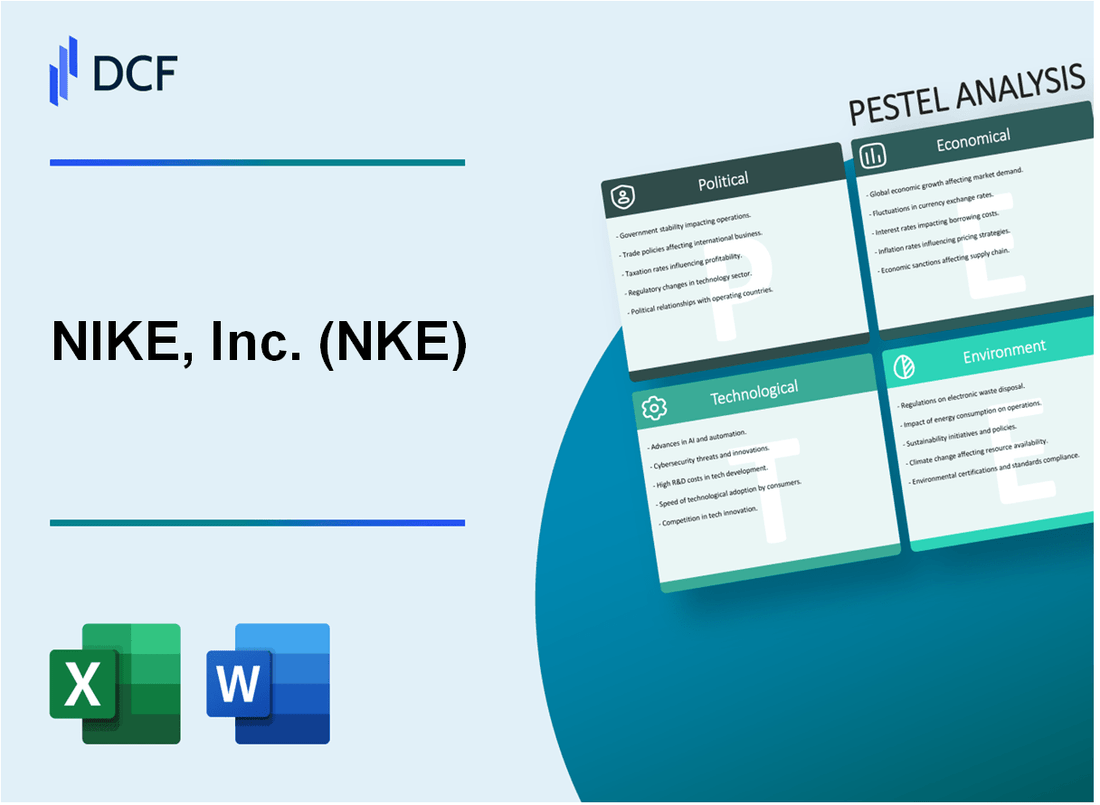
NIKE, Inc. (NKE): PESTLE Analysis [Apr-2026 Updated] |
Entièrement Modifiable: Adapté À Vos Besoins Dans Excel Ou Sheets
Conception Professionnelle: Modèles Fiables Et Conformes Aux Normes Du Secteur
Pré-Construits Pour Une Utilisation Rapide Et Efficace
Compatible MAC/PC, entièrement débloqué
Aucune Expertise N'Est Requise; Facile À Suivre
NIKE, Inc. (NKE) Bundle
You're looking at Nike, Inc. and seeing a mixed bag: a powerful brand facing serious headwinds. The core issue isn't demand, but the rising cost of doing business, especially in Asia, plus a serious competitive threat eroding their running shoe dominance. Fiscal 2025 saw revenue drop to US$46.3 billion-a 10% fall-while geopolitical tensions and new tech platforms are changing the game faster than their traditional design cycle can manage. We need to look past the swoosh and map the real risks and opportunities now.
Political Factors: Mapping Geopolitical Costs
The biggest near-term risk for Nike, Inc. is defintely political and it hits the balance sheet directly. U.S. tariffs on Chinese apparel are a massive headwind, estimated to cost Nike about $1 billion annually in 2025 alone. That's a huge, unavoidable tax on their supply chain.
To mitigate this, they are shifting production, aiming to source 29% of U.S. footwear from lower-tariff regions like Indonesia by 2026. Still, geopolitical tensions in key manufacturing hubs like China and Vietnam continue to disrupt the supply chain, adding complexity and cost. You can't outrun geopolitics.
Economic Factors: The Contraction and Competition
The economic reality for Nike, Inc. in fiscal 2025 was a sharp contraction. Revenue fell 10% to US$46.3 billion, down from US$51.4 billion in 2024. Here's the quick math: that's a $5.1 billion revenue hole.
Worse, gross margins declined by a massive 190 basis points. This wasn't just about high inflation hitting consumer discretionary spending; it was structural, driven by inventory clearance and intense competition. Emerging brands like On and Hoka are seriously eroding market share in core running categories. Nike needs to win back the serious runner.
Sociological Factors: Shifting Consumer Tastes
Consumer tastes are shifting away from classic Nike styles toward newer performance brands, which is a major sociological challenge. To stay relevant, Nike must target Millennials and Gen Z, a demographic that prioritizes fitness, innovation, and sustainability. This is a fast-moving target.
Navigating social media microtrends, like TikTok virality, is incredibly difficult when you have long, traditional design cycles. Plus, the focus on inclusivity is non-negotiable; the female market already represented 40% of its Membership as of 2023, and that focus must continue to grow. You have to be in the conversation, not just on the shelf.
Technological Factors: The Innovation Engine
Technology is Nike's long-term opportunity and where they are spending serious money. They launched Project Amplify, a new powered footwear system for running and walking, in late 2025, which shows they are still innovating at the top end. They also debuted AI-engineered sneakers, like Nike Adapt Link, using machine learning for real-time fit adjustment. That's a game changer for personalization.
Digital sales channels are a massive, necessary revenue stream, having already reached $23.4 billion in fiscal 2023. Also, manufacturing tech like Flyknit reduces material waste by an average of 60% compared to older methods. Digital is the new flagship store.
Legal Factors: IP and Digital Scrutiny
The legal landscape is getting messy, especially around new digital ventures and old intellectual property (IP). Nike is facing a $5 million class-action lawsuit from April 2025 over the collapse of its RTFKT NFTs, alleging they were unregistered securities. This sets a serious precedent for future Web3 projects.
They are also dealing with ongoing IP disputes, including a November 2025 trademark infringement lawsuit over the TOTAL 90 mark. Plus, increased scrutiny from EU regulations on sustainability due diligence and green claims means they are defending against consumer protection lawsuits over misleading claims. You have to be careful what you claim.
Environmental Factors: ESG and Executive Alignment
Environmental, Social, and Governance (ESG) targets are now directly tied to executive compensation, which tells you how serious Nike, Inc. is about this. They have aggressive 2025 goals:
- Achieve a 70% absolute reduction of GHG emissions in owned facilities.
- Commit to using 100% renewable electricity in owned or operated facilities.
- Aim to use environmentally preferred materials for 50% of all key materials.
Meeting these targets is crucial for brand image and supply chain resilience, plus it reduces 0.5 million tons of greenhouse gas (GHG) emissions. Sustainability is just good business now.
NIKE, Inc. (NKE) - PESTLE Analysis: Political factors
U.S. Tariffs on Chinese Apparel Hit 55%, Costing Nike an Estimated $1 Billion Annually
You need to understand the immediate, quantifiable cost of the current trade policy environment. The U.S. government's tariff strategy has created a massive financial headwind for NIKE, Inc. (NKE). Specifically, the elevated U.S. tariffs on Chinese-made apparel and footwear, which have reached up to 55%, are not just a theoretical risk; they are a direct cost. NIKE's Chief Financial Officer, Matt Friend, stated that these tariffs could add approximately $1 billion to the company's gross costs if they remain at their current levels. That is a new and meaningful cost headwind that directly pressures gross margins, which were already projected to contract by about 75 basis points for fiscal 2026 due to these factors.
To be fair, NIKE is a top payer of U.S. duties, so this isn't a new concept, but the scale is unprecedented. The company's average U.S. customs tax rate on imported footwear has historically hovered around 15%. The $1 billion hit forces immediate action, and honestly, it will be partially passed to consumers through surgical price increases starting in the fall of 2025.
Shifting Production to Lower-Tariff Regions
The political risk is forcing a fundamental, multi-year shift in NIKE's supply chain footprint, moving away from high-tariff exposure. China currently accounts for about 16% of the footwear NIKE imports into the United States. The company's clear action is to reduce this reliance to a 'high single-digit percentage range' by the end of fiscal 2026. This manufacturing capacity is being reallocated to other countries, with lower-tariff regions like Indonesia and Mexico being key beneficiaries.
Indonesia, for instance, is a rapidly growing hub, already accounting for 18% of NIKE's total global footwear production in 2025. Vietnam remains the largest single source, responsible for 50% of total NIKE brand footwear production in 2025, but it also faces significant tariff pressure, with U.S. tariffs on its goods reaching 46%.
Here's the quick math on the tariff mitigation strategy:
| Metric | Current (2025) | Target (End of Fiscal 2026) |
|---|---|---|
| Estimated Annual Tariff Cost Increase | $1 billion | Fully mitigated over time |
| China Footwear Import Share (to U.S.) | ~16% | High single-digit percentage range |
| Vietnam Footwear Production Share (Global) | 50% | Strategic diversification underway |
| Indonesia Footwear Production Share (Global) | 18% | Growing rapidly as a low-tariff alternative |
Geopolitical Tensions in Key Manufacturing Hubs Disrupt Supply Chains
Geopolitical tensions in core manufacturing regions are now a structural challenge, not a cyclical one. The reliance on Vietnam, which produces half of NIKE's shoes, makes the company highly vulnerable to shifting U.S. trade policy. The imposition of a 46% tariff on Vietnamese goods, announced in 2025, placed considerable strain on the supply chain, complicating operational strategy and leading to investor concern.
Plus, the tensions create non-tariff disruptions, including factory closures, labor shortages, and logistical bottlenecks that undermine the just-in-time inventory systems companies rely on. This political instability forces NIKE to maintain higher inventory levels-which stood at $7.5 billion as of May 31, 2025-to absorb potential shocks, a costly necessity.
The political landscape demands a more resilient, defintely multi-source supply chain.
Increased Regulatory Compliance Costs for a Multinational Corporation
Beyond trade tariffs, NIKE faces escalating regulatory compliance costs, particularly from the European Union, a major market. New environmental and social governance (ESG) regulations are moving from voluntary goals to mandatory compliance.
Key regulatory changes in 2025 include:
- The EU's textile collection mandate, which took effect in January 2025.
- Harmonized Extended Producer Responsibility (EPR) rules, which became effective in October 2025.
These rules force producers to bear the costs and obligations of textile waste management and mandate the use of recycled textiles. This creates a new, legally-mandated demand for recycled content, opening a projected $20 billion addressable market for recycled polyester in Europe's $400 billion apparel market. NIKE is responding by signing major multi-year agreements, such as the one with Loop Industries in November 2025, to secure the supply of recycled materials, a move driven by regulatory pressure. Also, the company faces ongoing legal scrutiny, including a 'greenwashing' class-action lawsuit filed against Nike USA, Inc. regarding its 'Sustainability Collection,' highlighting the high cost of compliance and reputation management in a politically sensitive environment.
NIKE, Inc. (NKE) - PESTLE Analysis: Economic factors
Fiscal 2025 Revenue Contraction
You need to look past the brand power for a moment and focus on the raw economics. The big takeaway for fiscal year 2025 (FY2025), which ended May 31, 2025, is a significant contraction in the top line. NIKE's full-year revenue fell to US$46.3 billion, a substantial drop of 9.8% compared to the prior year's US$51.36 billion.
This decline breaks a long-term growth narrative and signals that the macroeconomic headwinds and competitive pressures are hitting one of the world's most powerful brands hard. It's a clear sign that consumers are pulling back on high-priced, non-essential items, especially in key markets like Greater China, where sales declined sharply by 21% year-over-year in the fourth quarter. Here's the quick math on the revenue shift:
| Fiscal Year | Total Revenue (Reported) | Year-over-Year Change |
|---|---|---|
| FY 2024 | US$51.36 billion | +0.28% |
| FY 2025 | US$46.31 billion | -9.8% |
Gross Margin Erosion from Inventory and Channel Mix
The revenue drop is bad, but the margin compression is a structural problem. NIKE's gross margin for fiscal 2025 decreased by a massive 190 basis points (bps) to 42.7%. This wasn't just a minor blip; it was a result of necessary, aggressive inventory clearance and a challenging channel mix.
The company had to use deep discounting, particularly in its wholesale and factory stores, to clear out excess, older inventory, which directly bites into profitability. Plus, the strategic pivot away from the high-margin direct-to-consumer (DTC) digital channel, which saw a staggering 26% decrease in NIKE Brand Digital sales in Q4 2025, also contributed to the margin pressure. The margin compression is the lowest it has been since 2004, indicating a deep, defintely structural issue that will take time to reverse.
Intense Competition and Market Share Loss
The economic squeeze is amplified by a highly competitive landscape, especially in core running. NIKE is losing market share in the US$7.4 billion U.S. running shoe market to nimble, innovation-focused brands like On and Hoka. These competitors are capitalizing on a shift in consumer preference toward maximalist cushioning and faster product cycles.
The financial growth of these rivals underscores the threat:
- On: Expected to reach net sales of more than $3 billion in 2025, with projected revenue growth of 30.8% over the next twelve months.
- Hoka (Deckers Outdoor): Surpassed $2 billion in revenue in its last fiscal year, though its sales growth slowed to 10% in fiscal Q4 2025.
NIKE's reliance on classic footwear franchises, which declined more than 20% year-over-year in FY2025, created a near $1 billion revenue headwind, a stark contrast to the growth seen by its rivals.
Macroeconomic Headwinds on Consumer Spending
The broader economic environment of high inflation and elevated interest rates is the underlying current dragging down discretionary spending. Consumers are feeling the squeeze, which makes them think twice before buying a premium pair of sneakers.
For example, the core Personal Consumption Expenditures (PCE) reading-a key inflation metric-rose to 2.8% year-over-year in February 2025, keeping the pressure on the Federal Reserve to maintain a tight monetary policy. This economic uncertainty directly impacts NIKE because it is highly reliant on consumers being willing to spend on non-essential, premium athletic wear. The high cost of borrowing and persistent inflation temper the market's appetite for new footwear and apparel, forcing NIKE to increase promotional activity to move inventory.
NIKE, Inc. (NKE) - PESTLE Analysis: Social factors
The social landscape for NIKE, Inc. presents a dual challenge: retaining legacy brand dominance while rapidly adapting to the values and digital-first consumption habits of younger generations. You're seeing a clear shift where brand authenticity and social impact now directly translate into purchasing decisions, so this is not just a marketing issue-it's a core product and operational risk.
Consumer preferences are shifting rapidly, favoring new performance brands over classic Nike styles.
Consumers, particularly in the critical running segment, are moving toward specialized performance footwear from challenger brands like On Running and Hoka, which are perceived as offering superior, niche innovation. This preference shift has directly impacted the sales of NIKE's iconic, but older, lifestyle models. For instance, classic lines like the Air Force 1 and Dunk saw sales declines exceeding 20% year-over-year in the 2024-2025 period, contributing to an estimated $1 billion in lost revenue from these products alone.
To be fair, the brand still holds immense cultural weight, but the market is fragmenting. The company's response, the 'Win Now' action plan, includes phasing out these oversupplied classic lines to reduce inventory overhang and re-focus on new, performance-driven Air Max and other innovative models. This is a necessary, if painful, inventory correction.
| Metric (FY2025 Context) | Trend/Data Point | Implication |
|---|---|---|
| Classic Footwear Sales (YoY Change) | Declined by over 20% (Air Force 1 & Dunk) | Signifies a major loss of cultural relevance and market share to new styles. |
| Competitor Market Share | On Running and Hoka capturing share with performance-oriented designs. | NIKE must accelerate its 'sport offense' strategy with superior innovation. |
| NIKE Brand Digital Sales (Q4 FY25) | Decreased by 26%. | Indicates that the digital channel, which should be driving trend adoption, is struggling with product mix and over-reliance on promotions. |
Marketing must target Millennials and Gen Z, who prioritize fitness, innovation, and sustainability.
Millennials and Gen Z are the most critical target demographics, showing the highest brand favorability at around 66% in the U.S. Their purchasing power is enormous-Gen Z's U.S. spending power is around $860 billion. These consumers demand that brands align with their values: authenticity, diversity, and real social impact.
The European sportswear market's Gen Z segment is projected to grow at a Compound Annual Growth Rate (CAGR) of over 6% through 2025, underscoring the global opportunity. NIKE is attempting to meet this demand by tying executive compensation to its Purpose 2025 Targets, which include sustainability and diversity goals. They must defintely prioritize storytelling that connects performance with purpose.
Navigating social media microtrends (e.g., TikTok virality) is difficult with long, traditional design cycles.
The pace of fashion has been dramatically compressed by social media, where a trend cycle that once took decades can now peak and burn out in a matter of months due to virality on platforms like TikTok. This speed creates a significant risk for a company with a massive, complex supply chain and long design-to-shelf lead times.
The short-lived hype around microtrends like the Adidas Samba in 2024, which is already seeing a burnout in 2025, shows how quickly consumer attention shifts. NIKE's challenge is to inject speed into its product creation process to capitalize on these fleeting moments, which is why they are leveraging Artificial Intelligence (AI) and Machine Learning (ML) to improve demand forecasting and inventory optimization. You cannot afford a 12-month design cycle when a trend lasts six months.
Continued focus on inclusivity and the female market, which represented 40% of its Membership as of 2023.
The female consumer market is a strategic growth pillar, with women representing approximately 40% of NIKE's Membership as of 2025, and female apparel and footwear contributing an estimated 30-35% of North American revenues in Fiscal Year 2025. This segment is outperforming broader declines; for example, in Q4 2025, the women's apparel segment saw high single-digit growth, even as overall revenue fell by 12%.
The company has made concrete internal commitments to reflect this focus:
- Achieve 50% representation of women in the global corporate workforce by FY25 (already surpassed at 51% in FY23).
- Achieve 45% representation of women in leadership positions by FY25 (on track, at 44% in FY23).
- Maintain 100% pay equity across all employee levels annually through 2025.
High-profile collaborations, such as the instantly sold-out Caitlin Clark x Nike Kobe V Protro sneakers, demonstrate that strategic investment in female athletes and culturally relevant products can drive massive, premium demand. This segment is projected to outpace men's sportswear sales over the next five years, tapping into an 8-billion-person global market.
NIKE, Inc. (NKE) - PESTLE Analysis: Technological factors
Advanced Product Innovation: Powered and AI-Engineered Footwear
You're looking at a company that doesn't just make shoes; it's building a tech platform for the human body. The biggest near-term opportunity is in wearable robotics and artificial intelligence (AI).
In October 2025, NIKE unveiled Project Amplify, which they call the world's first powered footwear system for running and walking. This is a huge, bold move. It's essentially an exoskeleton for the everyday athlete, using a lightweight motor, drive belt, and rechargeable cuff battery to assist natural lower-leg movement. This technology is not for elite marathoners but for the mass market-the people who want to go farther and more often with less effort. Think of it as an e-bike for your feet.
Also, the debut of the Nike Adapt Link in March 2025 signals a major shift toward responsive design. This AI-engineered sneaker uses embedded machine learning and biometric sensors to analyze your foot structure and gait, dynamically adjusting its fit in real-time. That level of personalization, which evolves after the sale, is defintely a high barrier to entry for competitors.
- Project Amplify: Powered footwear system launched in late 2025.
- Adapt Link: AI-engineered for dynamic, real-time fit adjustment.
- Innovation Risk: Commercial launch for Amplify is still years away (expected around 2028).
Sustainable Manufacturing and Waste Reduction Technology
Technology is also the core driver of NIKE's sustainability goals, which is a major factor for younger, socially-conscious consumers. The Flyknit manufacturing process is a prime example of using tech to reduce environmental footprint. This method reduces material waste by an average of 60% compared to older cut-and-sew methods, which is a massive operational efficiency gain.
The broader Move to Zero initiative leverages advanced recycling and material science to meet aggressive Fiscal 2025 targets. By the end of FY2025, NIKE successfully diverted 100% of waste from landfills in its Tier 1 manufacturing facilities. Plus, they are recycling 80% of that waste back into new products. This closed-loop system is a technical and logistical advantage that translates directly to lower material costs over time.
| Sustainability Technology Metric | Fiscal 2025 Achievement / Target | Impact |
|---|---|---|
| Tier 1 Manufacturing Waste Diversion | 100% diverted from landfills | Eliminates manufacturing waste liability. |
| Recycling Rate of Diverted Waste | 80% recycled back into product | Reduces reliance on virgin materials. |
| Flyknit Waste Reduction (vs. traditional) | Average 60% less material waste | Boosts gross margin via material efficiency. |
Digital Sales Channel (NIKE Direct) and E-commerce Platform
The shift to NIKE Direct (Direct-to-Consumer or DTC) is fundamentally a technology play, relying on apps, websites, and data analytics to control the customer experience and margin. For the full Fiscal 2025, NIKE Direct revenue was $18.8 billion. That's a huge number, but honestly, the near-term risk is clear: the NIKE Brand Digital component saw a sharp 20% decrease in revenue for FY2025.
Here's the quick math: while the total digital ecosystem is still a powerhouse, the decline shows that the platform's innovation needs to keep pace. The company must use its data science capabilities to reverse this trend. What this estimate hides is the massive investment in supply chain technology required to support DTC, which has higher fixed costs than the wholesale model.
The core action for the company is to use its AI and personalization tech-like the Nike AirImagination platform, which lets consumers use text-to-image AI to design their own Air Max creations-to re-engage digital customers and drive that revenue figure back up.
NIKE, Inc. (NKE) - PESTLE Analysis: Legal factors
Facing a $5 million Class-Action Lawsuit Over RTFKT NFTs
You need to understand the legal risk in the digital asset space, and the class-action lawsuit over the RTFKT non-fungible tokens (NFTs) is a perfect example. A proposed class action was filed on April 25, 2025, in the U.S. District Court for the Eastern District of New York, alleging that NIKE, Inc. sold unregistered securities and violated consumer protection laws.
The plaintiffs, led by Australian investor Jagdeep Cheema, are seeking damages exceeding $5 million. This case revolves around the December 2024 shutdown of the RTFKT platform, which plaintiffs called a 'soft rug pull.' The core legal argument is that the value of the NFTs was tied directly to the promotional efforts and brand promises of NIKE, Inc., making them investment contracts that should have been registered with the U.S. Securities and Exchange Commission (SEC).
Here's the quick math: when you hype an asset with promises of exclusive rewards and then abruptly wind down the platform, you expose yourself to claims of misleading investors under consumer protection statutes in states like New York, California, Florida, and Oregon.
Ongoing Intellectual Property Disputes: The TOTAL 90 Trademark
Intellectual property (IP) is a cornerstone of a brand like NIKE, Inc., but even giants can stumble on trademark maintenance. A new and immediate IP dispute arose with a lawsuit filed on November 14, 2025, by Total90, LLC, a Louisiana-based sportswear company.
The smaller company is suing NIKE, Inc. for federal trademark infringement and unfair competition over the relaunch of the iconic TOTAL 90 soccer line. To be fair, NIKE, Inc. had the mark first, but allegedly abandoned its registration in 2019. Total90, LLC then secured two federal trademark registrations for the name and has been using it for apparel, soccer gear, and digital services since 2019.
Total90, LLC is not just looking for a settlement; they are seeking a court order to stop NIKE, Inc. from using the name, plus the destruction of infringing products and a hand-over of profits tied to the branding. This is a classic 'reverse confusion' case where a dominant market player's use of a mark overwhelms a smaller, legitimate trademark holder.
Increased Scrutiny from EU Regulations on Sustainability
The European Union (EU) is tightening the legal screws on environmental claims and supply chain responsibility, which directly impacts NIKE, Inc.'s operations and messaging. This is a regulatory trend you defintely need to map. The key legal developments are two-fold:
- Green Claims: There is increasing pressure to substantiate all environmental marketing claims, which is why accusations of greenwashing are mounting. This scrutiny is so high that NIKE, Inc. has reportedly begun dialing back the visibility of its public sustainability communications in late 2025, replacing glossy reports with low-profile 'impact data sheets' to reduce exposure to legal challenges.
- Extended Producer Responsibility (EPR): The EU has passed sweeping new rules, including the EPR law for textiles. This law shifts the financial burden of textile waste management-collection, reuse, and recycling-from taxpayers to the brands themselves, enforcing the 'polluter pays' principle. Member states are required to implement these schemes within 30 months.
This is a legal and financial risk that demands a strategic response. You must budget for the increased cost of compliance and waste management fees in the EU market. The era of vague 'eco-friendly' claims is ending.
Defending Against Consumer Protection Lawsuits Over Greenwashing
The risk from EU regulation is mirrored by consumer protection lawsuits in the US. NIKE, Inc. is actively defending against a class-action lawsuit alleging that its 'Sustainability' collection and 'Move To Zero' initiative are misleading.
The plaintiff, Maria Guadalupe Ellis, is arguing that the company is exploiting consumer preference for 'green' products. The lawsuit claims that of the 2,452 products listed in the 'Sustainability' collection, only about 10% (or 239 products) are actually made with recycled materials, with the rest being predominantly virgin synthetic materials like polyester and nylon.
While a federal judge initially dismissed the case in March 2024, the plaintiff asked the Eighth Circuit to revive the claims in April 2025, meaning the legal battle is ongoing in this fiscal year. This highlights a major risk area:
| Legal Risk Area (2025) | Core Allegation | Potential Financial Impact / Exposure |
|---|---|---|
| RTFKT NFT Class Action | Unregistered securities and consumer fraud (soft rug pull) | Damages sought exceeding $5 million, plus legal fees. |
| TOTAL 90 Trademark Infringement | Reverse confusion, infringing a federally registered mark | Injunction to halt sales, destruction of inventory, disgorgement of profits, and damages. |
| Greenwashing Lawsuit (US) | Misleading consumers on 'Sustainability' collection content | Class-action damages, potential for significant brand reputation harm, and forced relabeling. |
The sheer number of products involved-over 2,000 in the collection-shows the scale of the potential liability if the court finds the claims deceptive. Your legal and marketing teams need to align on a strategy that either proves the sustainability claims or drastically changes the labeling immediately.
NIKE, Inc. (NKE) - PESTLE Analysis: Environmental factors
You're looking at NIKE, Inc.'s environmental strategy, and the takeaway is clear: the company is on track to hit, and in some cases, significantly surpass its direct operational (Scope 1 and 2) climate goals for fiscal year 2025 (FY25). The challenge, as with any global giant, remains the massive supply chain (Scope 3) footprint, which accounts for over 90% of total emissions.
Goal to achieve a 70% absolute reduction of GHG emissions in owned facilities by 2025.
NIKE is defintely closing in on its direct emissions target, which is critical for corporate credibility. The goal is a 70% absolute reduction of Greenhouse Gas (GHG) emissions from its owned or operated facilities (Scope 1 and 2) compared to the Fiscal Year 2020 (FY20) baseline. As of the end of Fiscal Year 2024 (FY24), the company had already achieved a 69% reduction of absolute Scope 1 and 2 GHG emissions. This means the company is just 1 percentage point away from meeting the 2025 target, primarily through energy efficiency and the shift to renewable electricity.
Committed to using 100% renewable electricity in owned or operated facilities by 2025.
The commitment to 100% renewable electricity (RE100) in owned or operated facilities is a near-term win. By the end of FY24, NIKE was sourcing 96% of its total global electricity consumption from renewable sources. They've already hit the 100% mark in their North American and European facilities, which is a major step. The final push to cover the remaining 4% globally for the full FY25 period is a logistical, not a strategic, hurdle at this point.
Aiming to use environmentally preferred materials for 50% of all key materials, reducing 0.5 million tons of GHG.
This is where the company's innovation truly shines, but also where the scale of the supply chain becomes apparent. The goal is two-fold: reach 50% use of environmentally preferred materials (EPM) and, in doing so, reduce materials-related GHG emissions by 0.5 million metric tons of CO2e.
Here's the quick math: In FY24, the company was using EPM for 48% of its key materials, just under the 50% target. But, this effort already resulted in a reduction of 1.1 million metric tons of CO2e in materials-related GHG emissions. That means the actual GHG reduction achieved is more than double the 0.5 million metric tons target, showing that the EPMs they are using-like recycled polyester and Flyleather-have a greater carbon impact reduction than initially modeled.
| 2025 Environmental Target | FY24 Performance (Closest to FY25) | Status vs. Target |
|---|---|---|
| 70% absolute reduction of Scope 1 & 2 GHG emissions (Owned Facilities) | 69% reduction (vs. FY20 baseline) | On track (1 percentage point short) |
| 100% renewable electricity in owned or operated facilities | 96% of global electricity consumption from renewable sources | On track (4 percentage points short) |
| 50% of all key materials are Environmentally Preferred Materials (EPM) | 48% of key materials are EPM | On track (2 percentage points short) |
| Reduce 0.5 million metric tons of GHG emissions via EPM use | Reduced 1.1 million metric tons of CO2e | Surpassed (More than double the target) |
Tying executive compensation directly to the achievement of 2025 ESG targets.
The company has formalized accountability by linking executive compensation to the achievement of its Purpose 2025 Targets. This is a crucial move that signals to investors and the market that environmental performance is a financial priority, not just a public relations exercise. The compensation structure now includes metrics for 'protecting the planet,' alongside deepening diversity and inclusion, and advancing ethical manufacturing. This direct financial incentive ensures that leadership is deeply invested in the environmental outcomes, especially the difficult-to-manage Scope 3 reductions, which total about 8.2 million metric tons of CO₂e for FY24.
The environmental strategy is a strong point for NIKE, but still, the bulk of their carbon footprint is in the supply chain, making supplier engagement the real long-term battle.
- Electrify more of the NIKE-owned fleet.
- Scale sustainable biofuel in ocean transportation.
- Source over 60% of production volume from suppliers with science-aligned targets.
Next step: Strategy team should draft a memo detailing how the $46.3 billion in FY25 revenue is being reinvested to close the remaining 4% renewable energy gap by the end of FY25.
Disclaimer
All information, articles, and product details provided on this website are for general informational and educational purposes only. We do not claim any ownership over, nor do we intend to infringe upon, any trademarks, copyrights, logos, brand names, or other intellectual property mentioned or depicted on this site. Such intellectual property remains the property of its respective owners, and any references here are made solely for identification or informational purposes, without implying any affiliation, endorsement, or partnership.
We make no representations or warranties, express or implied, regarding the accuracy, completeness, or suitability of any content or products presented. Nothing on this website should be construed as legal, tax, investment, financial, medical, or other professional advice. In addition, no part of this site—including articles or product references—constitutes a solicitation, recommendation, endorsement, advertisement, or offer to buy or sell any securities, franchises, or other financial instruments, particularly in jurisdictions where such activity would be unlawful.
All content is of a general nature and may not address the specific circumstances of any individual or entity. It is not a substitute for professional advice or services. Any actions you take based on the information provided here are strictly at your own risk. You accept full responsibility for any decisions or outcomes arising from your use of this website and agree to release us from any liability in connection with your use of, or reliance upon, the content or products found herein.