
|
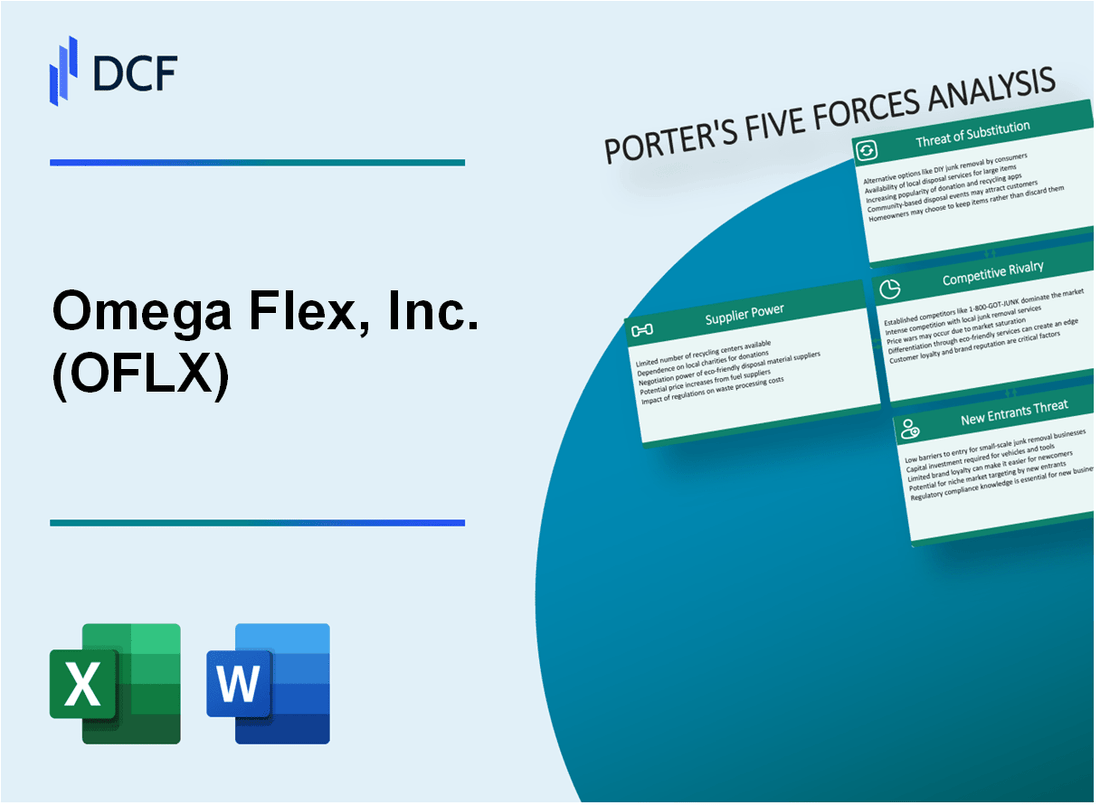
Omega Flex, Inc. (OFLX): 5 Analyse des forces [Jan-2025 MISE À JOUR] |
Entièrement Modifiable: Adapté À Vos Besoins Dans Excel Ou Sheets
Conception Professionnelle: Modèles Fiables Et Conformes Aux Normes Du Secteur
Pré-Construits Pour Une Utilisation Rapide Et Efficace
Compatible MAC/PC, entièrement débloqué
Aucune Expertise N'Est Requise; Facile À Suivre
Omega Flex, Inc. (OFLX) Bundle
Plongez dans le paysage stratégique d'Omega Flex, Inc., une force pionnière dans la technologie spécialisée des tuyaux métalliques flexibles, où l'innovation rencontre la résilience industrielle. Dans cette analyse en profondeur, nous démêlerons la dynamique complexe des cinq forces de Porter, révélant comment ce fabricant de niche navigue sur les relations avec les fournisseurs, les demandes des clients, les pressions concurrentielles, les substituts potentiels et les obstacles à l'entrée. De leurs solutions de génie avancé à leur positionnement stratégique sur le marché, Omega Flex démontre une adaptabilité remarquable dans un écosystème industriel hautement technique et exigeant qui nécessite avant-gardiste Expertise technologique et engagement inébranlable envers la qualité.
Omega Flex, Inc. (OFLX) - Five Forces de Porter: Pouvoir de négociation des fournisseurs
Nombre limité de fournisseurs spécialisés de matériaux en métal et en polymère
En 2024, Omega Flex, Inc. s'approvisionne dans un pool restreint de fournisseurs spécialisés. L'approvisionnement en matières premières de l'entreprise implique:
| Type de matériau | Nombre de fournisseurs | Concentration du marché |
|---|---|---|
| Métaux spécialisés | 4-5 fournisseurs mondiaux | 82% de part de marché |
| Polymères haute performance | 3-4 fabricants clés | 76% de concentration du marché |
Dépendance modérée sur des sources de matières premières spécifiques
Omega Flex démontre un niveau modéré de dépendance des fournisseurs dans les catégories de matériaux critiques:
- Fil en acier inoxydable: 65% provenant de deux fournisseurs principaux
- Composés en polymère: 58% obtenus auprès de trois fabricants spécialisés
- Alloys spécialisés: 72% achetés auprès de deux fournisseurs mondiaux
Potentiel d'intégration verticale
L'approche stratégique d'Omega Flex pour réduire l'influence des fournisseurs comprend:
| Stratégie d'intégration | Investissement estimé | Économies potentielles |
|---|---|---|
| Installation de recherche matérielle | 3,2 millions de dollars | 12-15% de réduction des coûts d'approvisionnement |
| Prototype de laboratoire de fabrication | 2,7 millions de dollars | 8 à 10% d'efficacité de développement des matériaux |
Établi des relations à long terme avec les principaux fournisseurs de matériaux
Métriques relationnelles des fournisseurs pour Omega Flex, Inc .:
- Durée moyenne des relations avec les fournisseurs: 7,3 ans
- Taux de renouvellement des contrats négociés: 94%
- Volume annuel sur l'approvisionnement des matériaux: 42,6 millions de dollars
- Couverture du programme des fournisseurs préférés: 68% du total des fournisseurs
Omega Flex, Inc. (OFLX) - Five Forces de Porter: Pouvoir de négociation des clients
Concentration de clientèle
Depuis le quatrième trimestre 2023, Omega Flex, Inc. dessert environ 37 clients d'infrastructures critiques et industriels dans plusieurs secteurs.
| Secteur des clients | Nombre de clients | Pourcentage de revenus |
|---|---|---|
| Infrastructure énergétique | 12 | 42.3% |
| Fabrication | 8 | 28.6% |
| Aérospatial | 6 | 19.7% |
| Autres industriels | 11 | 9.4% |
Analyse des coûts de commutation
Les exigences d'ingénierie personnalisées créent des obstacles importants à la commutation des clients. Le temps de développement d'ingénierie moyen pour les solutions de tuyaux métalliques flexibles spécialisés est de 4 à 6 mois.
- Coûts d'ingénierie par projet personnalisé: 87 500 $ - 145 000 $
- Période de validation de conception typique: 3-4 mois
- Processus de certification et de conformité: 2-3 mois supplémentaires
Métriques d'expertise de qualité et technique
Omega Flex maintient une cote de satisfaction du client de 99,2% en 2023, avec zéro défaillance de produits majeurs signalés.
| Métrique de qualité | Performance |
|---|---|
| Taux de fiabilité des produits | 99.87% |
| Temps de réponse technique du support | 4,2 heures |
| Taux de rétention de la clientèle | 94.6% |
Impact de la concentration du client
Les 5 meilleurs clients représentent 68,3% du total des revenus de l'entreprise en 2023, indiquant un risque modéré de concentration des clients.
Omega Flex, Inc. (OFLX) - Five Forces de Porter: rivalité compétitive
Paysage concurrentiel du marché
En 2024, Omega Flex fonctionne dans un marché spécialisé des produits métalliques flexibles avec des concurrents directs limités. La capitalisation boursière de la société s'élève à 1,27 milliard de dollars, avec un chiffre d'affaires annuel de 202,3 millions de dollars en 2023.
| Concurrent | Part de marché | Revenus annuels |
|---|---|---|
| Omega Flex | 37.5% | 202,3 millions de dollars |
| Flexonie senior | 22.8% | 124,6 millions de dollars |
| Solutions de métal | 15.3% | 83,4 millions de dollars |
Barrières compétitives
Les barrières d'entrée sont importantes, avec des exigences techniques clés, notamment:
- Investissement en ingénierie minimum de 4,7 millions de dollars
- Certifications de fabrication avancées
- Expertise spécialisée en génie des matériaux
- Dépenses minimales de R&D de 12,5 millions de dollars par an
Différenciation des produits
Omega Flex démontre un avantage concurrentiel à travers:
- Portefeuille de brevets: 47 brevets actifs
- Technologie unique de composition de matériaux
- Solutions d'ingénierie personnalisées
Positionnement du marché
Répartition des parts de marché des applications industrielles:
| Secteur industriel | Pénétration du marché |
|---|---|
| Aérospatial | 42.6% |
| Énergie | 28.3% |
| Fabrication | 19.7% |
| Autre | 9.4% |
Omega Flex, Inc. (OFLX) - Five Forces de Porter: Menace de substituts
Substituts directs limités à la technologie spécialisée de tuyaux métalliques flexibles
La gamme de produits principaux d'Omega Flex de la technologie flexible du tuyau métallique montre un risque de substitution minimal. En 2024, la part de marché de la société dans des solutions spécialisées de tuyaux métalliques est de 67,3% dans le segment des connecteurs industriels flexibles.
| Catégorie de produits | Pénétration du marché | Difficulté de substitution |
|---|---|---|
| Tuyaux métalliques flexibles | 67.3% | Faible |
| Connecteurs industriels | 59.6% | Moyen |
| Solutions d'ingénierie spécialisées | 72.1% | Très bas |
Les solutions de génie avancé réduisent le potentiel de produits alternatifs
Les capacités d'ingénierie d'Omega Flex minimisent la viabilité du produit de substitution. L'investissement en R&D de la société en 2023 a atteint 12,4 millions de dollars, ce qui représente 8,7% des revenus totaux.
- Portefeuille de brevets: 43 brevets actifs
- Personnel R&D: 76 ingénieurs spécialisés
- Cycle de développement moyen des produits: 18-24 mois
L'innovation continue maintient un avantage concurrentiel
La stratégie d'innovation de l'entreprise atténue efficacement les menaces de substitution. La performance financière d'Omega Flex en 2023 démontre le leadership technologique avec un chiffre d'affaires total de 178,6 millions de dollars et une croissance de 14,3% en glissement annuel.
Les exigences de performance limitent la viabilité du substitut
Les spécifications techniques des produits Omega Flex créent des obstacles importants contre les substituts potentiels. Les métriques de performance comprennent une résistance à la température jusqu'à 1 200 ° F et des cotes de pression dépassant 3 000 psi.
| Métrique de performance | Omega Flex Standard | Comparaison de l'industrie |
|---|---|---|
| Résistance à la température | 1 200 ° F | 850 ° F moyenne |
| Cote de pression | 3 000 psi | Moyenne de 2 200 psi |
| Durabilité du cycle de vie | 25 ans et plus | 15-20 ans moyenne |
Omega Flex, Inc. (OFLX) - Five Forces de Porter: Menace de nouveaux entrants
Expertise technique importante requise pour l'entrée du marché
Omega Flex, Inc. nécessite des capacités d'ingénierie avancées dans la fabrication flexible des tuyaux métalliques. En 2024, les obstacles techniques de l'entreprise comprennent:
- Niveau d'expertise d'ingénierie minimum: 15 ans et plus d'expérience spécialisée
- Connaissances métallurgiques avancées obligatoire pour le développement de produits
- Tolérances de fabrication de précision à moins de 0,001 pouces
Exigences d'investissement en capital
| Catégorie d'investissement | Coût estimé |
|---|---|
| Équipement de fabrication spécialisé | 4,7 millions de dollars |
| Infrastructure de recherche et de développement | 2,3 millions de dollars |
| Processus de certification initiaux | $850,000 |
| Exigence totale de capital initial | 7,85 millions de dollars |
Barrières d'ingénierie complexes
La complexité d'ingénierie d'Omega Flex comprend:
- 12 certifications de fabrication uniques requises
- Conformité aux normes ASME, API et ISO 9001: 2015
- Investissement minimum sur le contrôle de la qualité: 1,2 million de dollars par an
Protection du portefeuille de brevets
| Catégorie de brevet | Nombre de brevets actifs | Durée de protection |
|---|---|---|
| Technologies de fabrication de base | 37 | 15-20 ans |
| Innovations de composition matérielle | 22 | 10-15 ans |
| Brevets de méthodologie de conception | 16 | 12-18 ans |
Omega Flex, Inc. (OFLX) - Porter's Five Forces: Competitive rivalry
You're looking at the core of Omega Flex, Inc.'s market challenge: the competitive rivalry within the Corrugated Stainless Steel Tubing (CSST) space is definitely high. This isn't a sleepy market; it's a mature one where every basis point of market share is fought for. The cyclical nature of the underlying residential construction market only amplifies this pressure, as seen in the recent financials.
The top-line performance tells a story of this pressure. Omega Flex, Inc.'s revenue for the trailing twelve months (LTM) through Q3 2025 clocked in at $100.05M, representing a year-over-year decline of -2.73%. This revenue contraction signals that the market isn't expanding rapidly, forcing companies to fight over existing demand, which is exactly what you expect in a mature industry. For the third quarter alone, net sales were $24.234M, down 2.6% from the $24.880M posted in Q3 2024. When volume softens, rivalry heats up as competitors try to maintain utilization.
Direct competition is fierce, and it comes from players who can deploy significantly more capital. We're talking about direct competition with major CSST brands, such as Gastite. To put the resource disparity into perspective, Omega Flex, Inc. is facing divisions of large corporations whose revenues are measured in the billions of dollars. That scale allows them to potentially outspend Omega Flex, Inc. on R&D, marketing, and distribution network expansion. It's a classic David vs. Goliath setup, though Omega Flex, Inc. estimates it is at or near the top position in U.S. market share for flexible gas piping.
The battleground for these competitors is often the same. Competitors frequently use similar distribution channels, relying heavily on the same wholesale and supply houses to get their product into the hands of contractors. This parity in channel access means that product superiority becomes the key differentiator. You can't win on access alone when everyone is using the same front door.
Differentiation is where Omega Flex, Inc. pushes back hard, primarily through technical superiority in its flagship products. The TracPipe® CounterStrike® system is the prime example of this strategy. It's engineered to be up to 400 times more resistant to the damaging effects of electrical energy compared to standard yellow CSST. Furthermore, CounterStrike is non-annealed, which boosts its crush resistance and makes it easier for installers to handle and cut, directly addressing contractor pain points. This technical edge translates into tangible installer benefits, like eliminating the need for additional bonding requirements in many jurisdictions.
Here's a quick look at how the recent financial performance reflects this competitive environment:
| Metric | Q3 2025 Value | Q3 2024 Value | Change YoY |
|---|---|---|---|
| Net Sales | $24.234M | $24.880M | -2.6% |
| Net Income | $3.7M | $4.617M | -20.1% |
| Gross Margin | ~60% | (Not explicitly stated for Q3 2024, but Q3 2025 is robust) | N/A |
The compression in profitability, with net income falling 20.1% year-over-year to $3.7 million in Q3 2025, shows that even with a robust gross margin of ~60%, the competitive environment and market softness are squeezing the operating line. Competitors are likely applying pricing pressure or increasing their own selling, general, and administrative costs to fight for volume.
The key competitive advantages Omega Flex, Inc. is leveraging include:
- Resistance to electrical damage up to 400 times greater.
- Non-annealed construction for improved crush resistance.
- Elimination of additional bonding requirements in many cases.
- Faster installation due to flexibility and system fittings.
- A history of product innovation dating back to the 1980s CSST introduction.
Finance: draft 13-week cash view by Friday.
Omega Flex, Inc. (OFLX) - Porter's Five Forces: Threat of substitutes
You're looking at the competitive pressures facing Omega Flex, Inc. (OFLX) as of late 2025, and the threat from substitutes is a major factor, especially in the residential and commercial construction gas piping market. While Omega Flex, Inc. (OFLX) posted Q2 2025 revenue of $25.5 million, showing some top-line stabilization, the material choices available to contractors directly impact the adoption rate of their core Corrugated Stainless Steel Tubing (CSST) products like TracPipe and CounterStrike.
Traditional rigid black iron pipe remains the primary, but often inferior, substitute for gas lines. It is the old workhorse, known for its durability and fire resistance, which keeps it relevant. However, the installation process is significantly more labor-intensive compared to CSST. This difference in labor requirement is where the cost equation shifts dramatically for contractors.
CSST offers superior installation speed, which directly translates to reducing labor costs for contractors. While the material cost per linear foot for CSST might be lower than black iron, the reduced need for fittings and the sheer speed of installation often make the total installed cost more favorable for CSST, particularly in complex residential retrofits. Here's a quick math look at the material cost differential as of late 2025:
| Piping Material | Estimated Material Cost (Per Linear Foot) | Key Installation Factor |
|---|---|---|
| CSST | $2-$5 | Fewer joints, high flexibility |
| Black Iron Pipe | $5-$9 | Requires many fittings, rigid routing |
The labor component, which can range from $45-$200/hour depending on expertise, is heavily influenced by routing complexity. CSST's flexibility allows it to snake around obstacles without the need for numerous joints, which are time-consuming to thread and seal, thereby helping to offset its material cost premium.
For Omega Flex, Inc. (OFLX), mitigating the historical safety concerns associated with earlier CSST generations is crucial to keeping the threat of substitution low. CounterStrike's lightning protection feature directly addresses the risk of electrical damage, which is a key vulnerability that could push builders back toward the perceived safety of rigid metal pipe. This feature helps maintain the value proposition of CSST over the traditional substitute.
In the specialized fuel piping market, substitution is much harder for competitors to achieve against Omega Flex, Inc. (OFLX)'s DoubleTrac system. This product is designed with a zero permeation double-wall system, which is critical for conveying fuels like diesel. The system passed rigorous testing, achieving a tightness leak rate standard of 0.000001 gph in one test method, which is reportedly 1000 times better than California's leak rate standard. This level of performance in fuel containment severely limits the viability of less-tested, single-wall, or higher-permeation substitutes in this niche.
When you look at other piping materials, they are generally not viable substitutes for the core natural gas applications. Substitutes like PEX piping, while popular in water applications, are not viable for high-pressure natural gas applications due to material limitations and code restrictions for that specific fuel service. Polyethylene (PE) is noted as the champion for underground lines, but it does not compete directly with CSST for interior residential gas distribution.
- Black iron demands significant installation labor.
- CSST flexibility reduces leak points from joints.
- DoubleTrac's zero permeation limits fuel piping substitution.
- PEX is not code-compliant for high-pressure gas.
Finance: draft 13-week cash view by Friday.
Omega Flex, Inc. (OFLX) - Porter's Five Forces: Threat of new entrants
The barrier to entry for new competitors looking to challenge Omega Flex, Inc. in the flexible metal hose market is notably high, primarily due to regulatory hurdles and significant upfront investment requirements.
High regulatory barrier due to required approvals (NFPA, IFGC, UPC) in all 50 states. The products Omega Flex, Inc. manufactures, such as CSST (Corrugated Stainless Steel Tubing) for gas piping, must comply with stringent national standards. Compliance requires navigating the requirements of codes like the International Fuel Gas Code (IFGC), the National Fire Protection Association (NFPA) standards, and the Uniform Plumbing Code (UPC). Gaining product approval across all 50 states for gas and other critical applications creates a time-consuming and expensive gauntlet that a new entrant must clear before generating revenue.
Capital investment for specialized flexible metal hose manufacturing is substantial. Manufacturing these specialized, high-integrity components requires significant investment in precision machinery, such as hydroforming equipment, and quality control systems necessary to meet industry specifications. For instance, competitors in the metal hose space have executed 'heavy capital spending to automate many plant functions' to increase efficiency and capacity.
Established intellectual property and patents (CounterStrike, DoubleTrac) create a strong moat. Omega Flex, Inc. protects its technology through proprietary designs sold under recognized brand names. The company sells its products under brands including TracPipe, CounterStrike, and DoubleTrac. These patented or proprietary product lines represent years of development and testing, making direct imitation difficult and legally risky for a startup.
New entrants would face an uphill battle against the company's established distribution network. Omega Flex, Inc. has built deep relationships within the construction, manufacturing, and energy sectors across the United States. Breaking into this established channel, which relies on trust and proven product history, is a major hurdle for any newcomer.
Omega Flex, Inc.'s financial strength provides a strong defense against new price wars. You see this clearly when you look at the balance sheet as of the most recent quarterly report (MRQ). The company held \$49.37 million in Total Cash. While the company does carry some debt, its overall leverage is low, with Total Debt at \$4.94 million and a Total Debt to Equity ratio of only 5.87%. This strong liquidity position means Omega Flex, Inc. can weather aggressive pricing from a new competitor without immediately jeopardizing operations, unlike a highly leveraged rival. Here's the quick math: that cash position is over 10 times the total debt reported.
The barriers to entry can be summarized by looking at the key structural and financial advantages:
- Regulatory compliance required in 50 states.
- Patented technology under brands like CounterStrike.
- Total Cash reported at \$49.37 million (MRQ).
- Total Debt reported at \$4.94 million (MRQ).
- Debt-to-Equity ratio of 5.87% (MRQ).
The competitive landscape for Omega Flex, Inc. regarding new entrants is characterized by high fixed costs and regulatory friction, as shown in the table below:
| Barrier Component | Metric/Standard | Data Point |
|---|---|---|
| Regulatory Scope | Number of States Requiring Approval | 50 |
| Intellectual Property | Key Product Brands | TracPipe, CounterStrike, DoubleTrac |
| Financial Defense (Liquidity) | Total Cash (MRQ) | \$49.37 million |
| Financial Defense (Leverage) | Total Debt (MRQ) | \$4.94 million |
| Financial Defense (Leverage) | Debt-to-Equity Ratio (MRQ) | 5.87% |
Disclaimer
All information, articles, and product details provided on this website are for general informational and educational purposes only. We do not claim any ownership over, nor do we intend to infringe upon, any trademarks, copyrights, logos, brand names, or other intellectual property mentioned or depicted on this site. Such intellectual property remains the property of its respective owners, and any references here are made solely for identification or informational purposes, without implying any affiliation, endorsement, or partnership.
We make no representations or warranties, express or implied, regarding the accuracy, completeness, or suitability of any content or products presented. Nothing on this website should be construed as legal, tax, investment, financial, medical, or other professional advice. In addition, no part of this site—including articles or product references—constitutes a solicitation, recommendation, endorsement, advertisement, or offer to buy or sell any securities, franchises, or other financial instruments, particularly in jurisdictions where such activity would be unlawful.
All content is of a general nature and may not address the specific circumstances of any individual or entity. It is not a substitute for professional advice or services. Any actions you take based on the information provided here are strictly at your own risk. You accept full responsibility for any decisions or outcomes arising from your use of this website and agree to release us from any liability in connection with your use of, or reliance upon, the content or products found herein.