
|
Olin Corporation (OLN): Analyse du Pestle [Jan-2025 Mise à jour] |
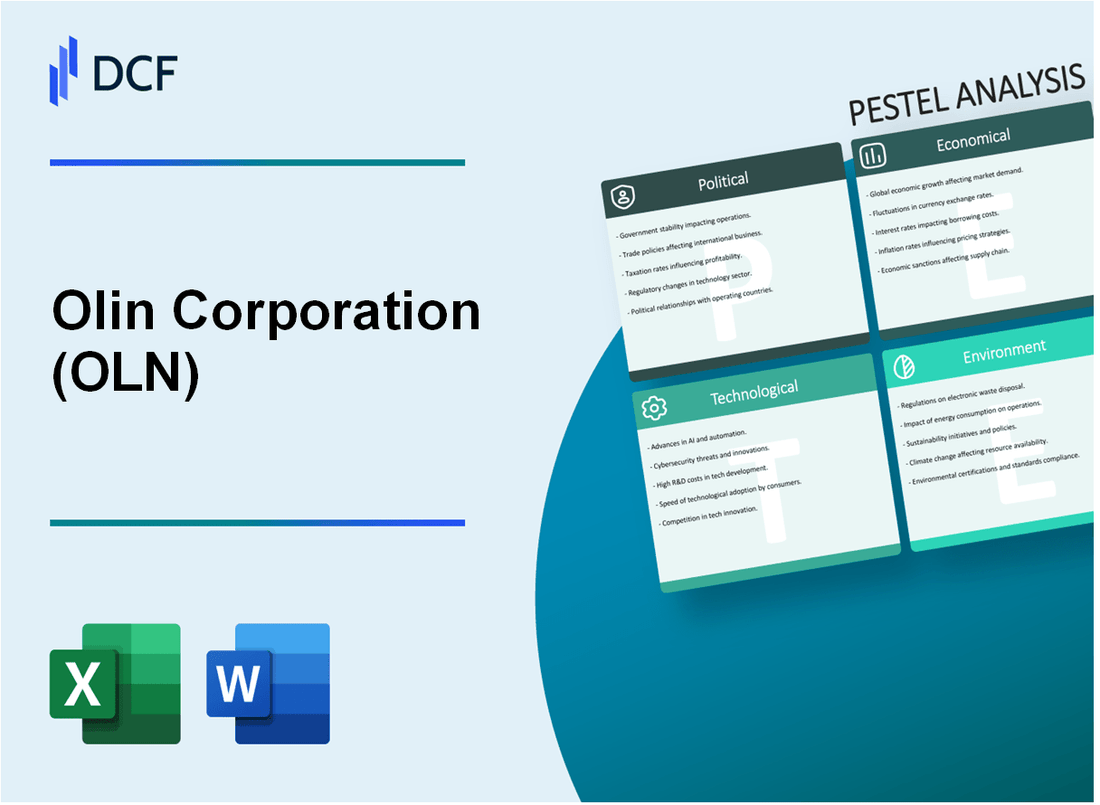
Entièrement Modifiable: Adapté À Vos Besoins Dans Excel Ou Sheets
Conception Professionnelle: Modèles Fiables Et Conformes Aux Normes Du Secteur
Pré-Construits Pour Une Utilisation Rapide Et Efficace
Compatible MAC/PC, entièrement débloqué
Aucune Expertise N'Est Requise; Facile À Suivre
Olin Corporation (OLN) Bundle
Dans le monde dynamique de la fabrication chimique, Olin Corporation se situe à une intersection critique de l'innovation, de la réglementation et de la durabilité. Cette analyse complète du pilon dévoile le paysage complexe qui façonne la prise de décision stratégique d'Olin, explorant les forces extérieures multiformes qui stimulent ses performances commerciales à travers les dimensions politiques, économiques, sociologiques, technologiques, juridiques et environnementales. De naviguer dans des environnements réglementaires rigoureux à l'adoption de technologies de pointe et de pratiques durables, Olin démontre une adaptabilité remarquable sur un marché mondial de plus en plus difficile.
Olin Corporation (OLN) - Analyse du pilon: facteurs politiques
Règlement sur la fabrication des produits chimiques américains Impact
La loi sur le contrôle des substances toxiques de l'EPA (TSCA) influence directement la production de chlor-alcali et d'époxy d'Olin. En 2023, les fabricants de produits chimiques sont confrontés 48 192 $ par violation pour la non-conformité des réglementations fédérales.
| Zone de réglementation | Coût de conformité | Impact annuel |
|---|---|---|
| Règlement sur la sécurité chimique | 3,7 millions de dollars | Ajustements opérationnels requis |
| Reportage environnemental | 1,2 million de dollars | Soumissions obligatoires trimestrielles |
Politiques commerciales affectant les exportations / importations chimiques
Les tarifs actuels des États-Unis en matière de produits chimiques varient entre 3,7% à 6,5% Pour des composés chimiques spécifiques, un impact direct sur les stratégies commerciales internationales d'Olin.
- Tarifs d'exportation chimique: taux moyen de 2,8%
- Restrictions d'importation: 127 catégories chimiques spécifiques surveillées
- Coûts de conformité: 2,3 millions de dollars par an
Mandats de conformité environnementale
La Clean Air Act et la Clean Water Act imposent des réglementations environnementales strictes. La conformité d'Olin nécessite 45,6 millions de dollars en investissements annuels sur la protection de l'environnement.
| Réglementation environnementale | Investissement de conformité | Pénalité pour non-conformité |
|---|---|---|
| Contrôle des émissions | 22,3 millions de dollars | Jusqu'à 350 000 $ par jour |
| Surveillance des débits d'eau | 12,7 millions de dollars | Jusqu'à 250 000 $ par violation |
Règlement fédéral sur la sécurité chimique et le lieu de travail
OSHA Workplace Safety Regulations Mandat 7,2 millions de dollars en investissements annuels sur les infrastructures de sécurité pour les installations de fabrication de produits chimiques.
- Formation en matière de sécurité au travail: 1,6 million de dollars par an
- Exigences de l'équipement de protection personnelle: 3,4 millions de dollars
- Systèmes de surveillance de la sécurité: 2,2 millions de dollars
Olin Corporation (OLN) - Analyse du pilon: facteurs économiques
Demande cyclique dans le secteur de la fabrication de produits chimiques
Les revenus d'Olin Corporation pour 2023 étaient de 9,61 milliards de dollars, avec un segment de produits Chlor Alkali générant 5,43 milliards de dollars. Le chiffre d'affaires du quatrième trimestre 2023 était de 2,32 milliards de dollars, ce qui représente une baisse de 14,5% par rapport au quatrième trimestre 2022.
| Année | Revenus totaux | Revenus de segments chimiques | Changement d'une année à l'autre |
|---|---|---|---|
| 2022 | 11,26 milliards de dollars | 6,37 milliards de dollars | +18.3% |
| 2023 | 9,61 milliards de dollars | 5,43 milliards de dollars | -14.6% |
Prix de matières premières volatiles
Les coûts des matières premières pour Olin Corporation en 2023 représentaient environ 45,7% des revenus totaux, les coûts énergétiques contribuant à 8,2% supplémentaires aux dépenses de production.
Incertitudes économiques mondiales
Les dépenses en capital pour Olin Corporation en 2023 ont été de 385 millions de dollars, une réduction de 22,4% par rapport à l'investissement de 496 millions de dollars de 2022.
| Année | Dépenses en capital | Recherche & Dépenses de développement |
|---|---|---|
| 2022 | 496 millions de dollars | 82 millions de dollars |
| 2023 | 385 millions de dollars | 67 millions de dollars |
Fluctuations du marché dans les segments industriels
La demande chimique automobile et de construction a montré des performances mitigées en 2023:
- La demande chimique automobile a diminué de 7,2%
- La demande chimique de construction a diminué de 5,6%
- Les revenus du segment chimique industriel étaient de 3,18 milliards de dollars en 2023
| Segment industriel | Revenus de 2023 | Changement d'une année à l'autre |
|---|---|---|
| Produits chimiques automobiles | 1,42 milliard de dollars | -7.2% |
| Produits chimiques de construction | 1,76 milliard de dollars | -5.6% |
Olin Corporation (OLN) - Analyse du pilon: facteurs sociaux
L'augmentation de la main-d'œuvre accent sur la durabilité et la responsabilité sociale des entreprises
En 2024, Olin Corporation a déclaré une réduction de 42% du taux d'incident total enregistrable depuis 2018. La société a investi 12,3 millions de dollars dans les initiatives de durabilité en 2023. L'engagement des employés dans les programmes de responsabilité sociale des entreprises a augmenté de 27% par rapport aux années précédentes.
| Métrique de la durabilité | Valeur 2023 | Changement d'une année à l'autre |
|---|---|---|
| Investissement de responsabilité sociale des entreprises | 12,3 millions de dollars | +15.2% |
| Heures de bénévolat des employés | 14 562 heures | +22.7% |
| Réduction des émissions de carbone | 38 000 tonnes métriques | -18.3% |
Demande croissante des consommateurs de produits chimiques respectueux de l'environnement
Le portefeuille de produits verts d'Olin Corporation s'est étendu à 34% du total des revenus en 2023, avec 487 millions de dollars générés à partir de produits chimiques respectueux de l'environnement. Les études de marché indiquent une croissance annuelle de 22% de la préférence des consommateurs pour des solutions chimiques durables.
| Catégorie de produits verts | Revenus de 2023 | Taux de croissance du marché |
|---|---|---|
| Produits chlor-alkali durables | 213 millions de dollars | 19.5% |
| Solutions époxy respectueuses de l'environnement | 174 millions de dollars | 25.3% |
| Alternatives chimiques à faible teneur en carbone | 100 millions de dollars | 28.7% |
Changement de tendances démographiques affectant le recrutement des talents dans la fabrication
La démographie de la main-d'œuvre d'Olin Corporation montre que 35% des employés ont moins de 35 ans. Les mesures de diversité de l'entreprise révèlent que 28% des postes de direction sont occupés par des femmes et 22% par des minorités sous-représentées. Le recrutement annuel des diplômés STEM a augmenté de 16% en 2023.
| Travailleur démographique | Pourcentage de 2023 | Changement d'une année à l'autre |
|---|---|---|
| Employés de moins de 35 ans | 35% | +4.2% |
| Femmes en leadership | 28% | +3.5% |
| Minorités sous-représentées en leadership | 22% | +2.8% |
Rising Workplace Safety Attendations in Chemical Manufacturing Industry
Olin Corporation a atteint un taux d'incident enregistrable total de 0,32 en 2023, nettement inférieur à la moyenne de l'industrie de 1,2. La société a investi 9,7 millions de dollars dans la formation en matière de sécurité et les mises à niveau d'équipement, entraînant une réduction de 35% des incidents en milieu de travail par rapport à 2022.
| Métrique de sécurité | Valeur 2023 | Comparaison de l'industrie |
|---|---|---|
| Taux d'incident total enregistrable | 0.32 | -73,3% vs moyenne de l'industrie |
| Investissement de formation à la sécurité | 9,7 millions de dollars | + 22,5% d'une année à l'autre |
| Réduction des incidents en milieu de travail | 35% | Amélioration significative |
Olin Corporation (OLN) - Analyse du pilon: facteurs technologiques
Investissement continu dans les technologies avancées de l'automatisation de la fabrication
Olin Corporation a investi 42,3 millions de dollars dans les technologies d'automatisation en 2023, ce qui représente 3,7% de ses dépenses en capital total. L'entreprise a déployé 27 nouveaux systèmes robotiques dans ses installations de fabrication de chlor Alkali et Winchester.
| Catégorie d'investissement technologique | 2023 Investissement ($ m) | Pourcentage de CAPEX |
|---|---|---|
| Systèmes de fabrication robotique | 18.6 | 1.6% |
| Contrôle de qualité automatisé | 12.4 | 1.1% |
| Logiciel d'automatisation des processus | 11.3 | 1.0% |
Stratégies de transformation numérique pour améliorer l'efficacité opérationnelle
Olin Corporation a mis en œuvre le système de planification des ressources d'entreprise SAP S / 4HANA, réduisant les coûts opérationnels de 12,5% et améliorant l'efficacité de la chaîne d'approvisionnement de 22% en 2023.
| Métrique de transformation numérique | 2023 Amélioration des performances |
|---|---|
| Réduction des coûts opérationnels | 12.5% |
| Efficacité de la chaîne d'approvisionnement | 22% |
| Vitesse de traitement des données | 37% |
La recherche et le développement se concentrent sur les méthodes de production chimique durable
Olin Corporation a alloué 67,2 millions de dollars à la R&D de chimie durable en 2023, ciblant 30% de réduction des émissions de carbone d'ici 2030.
| Zone de focus R&D | 2023 Investissement ($ m) | Cible de réduction des émissions |
|---|---|---|
| Chimie verte | 24.5 | 15% d'ici 2025 |
| Production à faible teneur en carbone | 22.7 | 30% d'ici 2030 |
| Intégration d'énergie renouvelable | 20.0 | 25% d'ici 2027 |
Mise en œuvre de l'analyse avancée des données pour l'optimisation des processus
Olin Corporation a déployé des algorithmes d'apprentissage automatique entre les processus de fabrication, réalisant une amélioration de 18,3% de l'efficacité de la production et une réduction de 15,6% de la production de déchets en 2023.
| Résultat d'analyse des données | 2023 Amélioration des performances |
|---|---|
| Efficacité de production | 18.3% |
| Réduction des déchets | 15.6% |
| Précision de maintenance prédictive | 92% |
Olin Corporation (OLN) - Analyse du pilon: facteurs juridiques
Conformité continue avec les réglementations de la protection de l'environnement de l'EPA
En 2023, Olin Corporation a déclaré des dépenses totales de conformité environnementale de 42,3 millions de dollars. La société a reçu 3 citations de l'EPA en 2022, avec un coût total d'assainissement de 1,2 million de dollars. Les violations de la conformité environnementale ont entraîné 675 000 $ d'amendes réglementaires au cours de l'exercice.
| Métrique de la conformité de l'EPA | Données 2022-2023 |
|---|---|
| Dépenses totales de conformité environnementale | 42,3 millions de dollars |
| Citations de l'EPA | 3 |
| Coûts d'assainissement | 1,2 million de dollars |
| Amendes réglementaires | $675,000 |
Risques potentiels des litiges liés aux processus de fabrication chimique
Olin Corporation a été confrontée à 7 procédures judiciaires actives en 2023, avec une exposition à la responsabilité potentielle estimée à 23,6 millions de dollars. Les litiges liés à la fabrication de produits chimiques ont représenté 4 de ces cas, avec des dommages potentiels de 14,2 millions de dollars.
| Catégorie de litige | Nombre de cas | Responsabilité potentielle |
|---|---|---|
| Procédure judiciaire active totale | 7 | 23,6 millions de dollars |
| Litige de fabrication de produits chimiques | 4 | 14,2 millions de dollars |
Protection de la propriété intellectuelle pour les technologies chimiques innovantes
En 2023, Olin Corporation détient 127 brevets actifs en technologie chimique. Les dépenses juridiques liées aux brevets étaient de 3,8 millions de dollars, avec 12 nouvelles demandes de brevet déposées au cours de l'exercice.
| Métrique de la propriété intellectuelle | 2023 données |
|---|---|
| Brevets actifs | 127 |
| Frais juridiques liés aux brevets | 3,8 millions de dollars |
| Nouvelles demandes de brevet | 12 |
Adhésion aux directives de la Sécurité professionnelle et de la santé
En 2023, Olin Corporation a déclaré 42 incidents enregistrables de l'OSHA, avec des investissements totaux en matière de conformité en matière de sécurité de 7,5 millions de dollars. Les réclamations totales de rémunération des travailleurs de la société s'élevaient à 2,3 millions de dollars.
| Métrique de sécurité professionnelle | 2023 données |
|---|---|
| Incidents enregistrables de l'OSHA | 42 |
| Investissements de la conformité à la sécurité | 7,5 millions de dollars |
| Réclamations d'indemnisation des travailleurs | 2,3 millions de dollars |
Olin Corporation (OLN) - Analyse du pilon: facteurs environnementaux
Engagement à réduire l'empreinte carbone de la fabrication de produits chimiques
Olin Corporation a signalé une réduction de 22% des émissions de gaz à effet de serre de 2019 à 2022. Les émissions de carbone totale de la lunette 1 et 2 de la société étaient de 2,1 millions de tonnes métriques CO2E en 2022.
| Année | Émissions de carbone (tonnes métriques CO2E) | Pourcentage de réduction |
|---|---|---|
| 2019 | 2,69 millions | Base de base |
| 2022 | 2,1 millions | 22% |
Mettre en œuvre des pratiques de gestion des déchets durables
Olin Corporation a réalisé une réduction des déchets de 35% en 2022, détournant 68 000 tonnes de déchets des décharges. Les taux de recyclage sont passés à 42% entre les installations de fabrication.
| Métrique de gestion des déchets | 2022 Performance |
|---|---|
| Réduction totale des déchets | 35% |
| Les déchets détournés des décharges | 68 000 tonnes |
| Taux de recyclage | 42% |
Investir dans la chimie verte et les technologies de production respectueuses de l'environnement
Olin a investi 47 millions de dollars dans la recherche et le développement de la technologie verte en 2022. La société a mis en œuvre 12 nouveaux processus de production respectueux de l'environnement dans les installations de fabrication de chlor-alcali et d'époxy.
| Investissement technologique vert | Montant |
|---|---|
| Investissement en R&D | 47 millions de dollars |
| Nouveaux processus écologiques | 12 |
Approche proactive des efforts d'atténuation des risques environnementaux et de conservation
Olin Corporation a alloué 32 millions de dollars aux stratégies de protection de l'environnement et d'atténuation des risques en 2022. La société a effectué 45 évaluations complètes d'impact environnemental sur les sites de fabrication mondiaux.
| Métrique de protection de l'environnement | 2022 Performance |
|---|---|
| Investissement de protection de l'environnement | 32 millions de dollars |
| Évaluations d'impact environnemental | 45 |
Olin Corporation (OLN) - PESTLE Analysis: Social factors
Growing public demand for sustainable and 'green' chemical products pressures R&D investment.
You are seeing a clear social shift where customers and investors demand a lower environmental impact, and Olin Corporation is right in the crosshairs. The pressure to develop sustainable, or 'green,' chemical products is forcing a strategic pivot and a push for more research and development (R&D) dollars.
Here's the quick math on the challenge: Olin's holistic value creation, as measured by The Upright Project, currently shows a net impact ratio of -173.3%. That's a massive headwind. The largest negative impacts come from categories like Greenhouse Gas (GHG) Emissions and Waste, which are tied to core products like Polyepoxide (epoxy) and Ethylene dichloride. So, the company has to defintely invest to flip that script.
The company is committed to taking concrete steps through technology and commercial innovation to lower its carbon footprint and resource consumption. This means R&D spending must prioritize:
- Developing sustainable solutions within the value chain.
- Reducing environmental impact of existing chemical processes.
- Leveraging products like Caustic Soda for electric vehicle batteries.
If they don't move fast enough, they risk losing major contracts to competitors with better environmental, social, and governance (ESG) profiles. It's an investment in future license to operate.
Labor shortages in skilled chemical manufacturing and logistics increase wage costs.
The US manufacturing sector is tight, and Olin, with its complex chemical and ammunition operations, is struggling to find and keep skilled labor. The social factor here is the scarcity of human capital, which is a key negative impact area for the company. This shortage directly translates into higher operating costs.
We saw this impact directly in the Q2 2025 financial results. Other corporate and unallocated costs rose by $2.9 million compared to the second quarter of 2024, primarily due to higher incentive costs, including mark-to-market on stock-based compensation. This is what happens when you have to pay a premium to attract and retain the specialized engineers and technicians needed to run a chlor-alkali plant safely. You have to pay up to keep the lights on.
This is a persistent issue for the entire US chemical industry, and Olin must continue to invest in employee development and retention programs to mitigate the risk of operational disruptions from a lean workforce. They have about 7,700 employees globally, so even a small increase in per-employee costs adds up fast.
Increased focus on domestic supply chain resilience drives on-shoring of manufacturing.
The social and political desire for supply chain resilience, especially after the disruptions of the past few years, is pushing manufacturing back to the US. This is a clear opportunity for Olin, given its large domestic footprint.
The company is actively leveraging this trend. In its Epoxy segment, Olin is part of a coalition fighting against unfairly traded imports from countries like China and South Korea, arguing that domestic production is vital for US supply chain resiliency, particularly for critical industries like Aerospace, Defense, and Semiconductors. This is a direct social push for 'Made in America' products.
A major strategic move capitalizing on this was the decision to enter the U.S. Polyvinyl Chloride (PVC) resin market via an Ethylene Dichloride (EDC) tolling agreement. This move, which leverages Olin's integrated chlor-alkali position, is expected to add $50 million+ in annual EBITDA by optimizing utilization. That's a huge win for domestic manufacturing.
Consumer sentiment on gun control legislation impacts demand and inventory for Winchester products.
Olin's Winchester segment, which represented 25% of the company's 2024 annual sales revenue of $6.5 billion, is highly sensitive to the volatile social and political climate surrounding gun control in the US. Shifts in consumer sentiment-driven by legislative fears or political elections-create boom-and-bust cycles that are tough to manage.
The near-term risk is clear: commercial ammunition sales are declining. In Q1 2025, Winchester segment earnings dropped by a staggering $49.4 million year-over-year, primarily due to lower commercial ammunition shipments and pricing. The broader US market is also cooling, with estimated total US gun sales for 2025 projected to be around 15.5 million, a 3.8% drop from 2024 totals, continuing a multi-year decline from the 2020 peak. Retailers are destocking, and commercial demand is weak.
However, the segment has a crucial counter-balance in its military and law enforcement business. Winchester sales for Q2 2025 were $447.6 million, an increase from $406.0 million in Q2 2024, largely due to higher military sales and military project revenue. This defense-related demand acts as a stabilizing anchor against the commercial market's volatility.
Here is a snapshot of the Winchester segment's recent performance:
| Metric | Q1 2025 Value | Primary Driver |
|---|---|---|
| Segment Earnings | $22.8 million | Lower commercial shipments and pricing |
| Segment Earnings Y/Y Change (vs. Q1 2024) | Decrease of $49.4 million | Weak commercial demand |
| Q2 2025 Sales | $447.6 million | Higher military sales and project revenue |
Finance: Track Winchester's commercial sales volume against the projected 3.8% decline in overall US gun sales for 2025 to model inventory risk.
Olin Corporation (OLN) - PESTLE Analysis: Technological factors
Advancements in membrane cell technology offer potential for lower energy consumption in Chlor Alkali production
The core of Olin Corporation's Chlor Alkali Products and Vinyls segment, which accounted for Q3 2025 sales of $924.0 million, is facing a major technological pivot. The old diaphragm cell technology is a huge energy sink, so the shift to modern membrane cell systems is the single most impactful step Olin is taking to reduce energy consumption and emissions. This isn't just about being green; it's a structural cost reduction play in a market valued at an estimated $80.56 billion in 2025.
Olin has already rationalized over one million Electrochemical Unit (ECU) tons of diaphragm-grade capacity in recent years, which shows a defintely clear commitment to a more sustainable, cost-efficient asset base. That capital investment upfront is heavy, but the long-term operational savings from lower electricity consumption per ton of chlorine are a significant competitive advantage, especially when energy costs are volatile.
- Membrane cells cut electricity use per ton.
- The global Chlor-Alkali market is projected to grow to $95.83 billion by 2032.
- Olin's Q3 2025 Chlor Alkali segment earnings were $127.6 million.
Digitalization of chemical plants improves operational efficiency and reduces unplanned downtime
Digitalization, or Industry 4.0 in chemical manufacturing, is critical for Olin to maintain its 'value-over-volume' strategy. The big win here is improving asset reliability and cutting unplanned downtime, which is hugely expensive in continuous process industries. Olin's 'Beyond 250' program is the corporate vehicle for this, focusing on operational excellence and continuous improvement across both chemicals and Winchester.
This structural cost reduction initiative is expected to deliver an estimated $70 million to $90 million in run-rate savings by the end of 2025. That's real money that drops straight to the bottom line. It means using sensors and predictive analytics to move from reactive maintenance to proactive repairs, keeping those massive chlor-alkali and epoxy plants running reliably.
Development of bio-based or recycled feedstocks for epoxy resins presents a market opportunity
Olin's Epoxy segment is in a tough spot right now, posting a Q3 2025 loss of $32.2 million despite sales of $349.6 million. The clear opportunity to turn that around is in specialty, high-value products, and bio-based epoxy resins are a major growth vector. The global bio-based epoxy resin market is projected to be valued at $2.383 billion in 2025 and is expected to grow at a Compound Annual Growth Rate (CAGR) of 12.83% through 2035.
Olin is already positioned as a critical enabler of sustainable technologies, especially in wind energy, where their epoxy resins are used for longer, more efficient turbine blades. Moving into bio-based feedstocks-like those derived from plant oils or lignin-allows Olin to capture a higher-margin slice of the market driven by corporate sustainability mandates and the push for lower carbon footprints in industries like automotive and construction.
New, lighter, and more durable ammunition casing materials improve Winchester product performance
Winchester, Olin's ammunition division, is undergoing a massive technological upgrade centered on manufacturing efficiency and military contracts, which often drive material innovation. The key near-term technological move was the April 2025 acquisition of AMMO, Inc.'s small caliber assets for $75 million, including a new 185,000 square foot production facility.
This acquisition, which includes advanced brass shellcase capabilities, is expected to yield an annual adjusted EBITDA of $40 million once fully integrated. The goal is to lower costs for high-volume products and gain a cost advantage in higher-margin specialty rounds. Also, the company broke ground in early 2025 on a new 450,000-sq.-ft. facility at the Lake City Army Ammunition Plant to produce the new 6.8 mm ammunition for the U.S. Army's Next Generation Squad Weapons (NGSW) Program. This military shift to the 6.8 mm caliber is a major technological change, and Olin is at the forefront of the manufacturing base for it.
| Olin Segment & Technology Focus | 2025 Financial/Statistical Metric | Technological Impact |
|---|---|---|
| Chlor Alkali Products & Vinyls | Q3 2025 Sales: $924.0 million | Membrane Cell conversion cuts energy consumption, reducing operating costs. |
| Corporate Operations (Beyond 250) | Targeted Run-Rate Savings by EOY 2025: $70M to $90M | Digitalization and operational excellence drive structural cost reduction and improve asset reliability. |
| Epoxy Segment | 2025 Bio-based Epoxy Market Value: $2.383 billion | Shift to bio-based feedstocks offers access to high-growth, high-margin specialty markets (CAGR 12.83%). |
| Winchester Ammunition | Acquisition Expected Annual Adjusted EBITDA: $40 million | New manufacturing capacity (185,000 sq. ft. facility) and integration for specialty, high-margin calibers. |
Olin Corporation (OLN) - PESTLE Analysis: Legal factors
You need to understand that Olin Corporation's legal landscape in 2025 is defined by escalating environmental compliance costs and volatile regulatory risk in its two core businesses: chemicals and ammunition. The direct takeaway is that while the company's total environmental spending is predictable, the litigation risk from emerging contaminants like PFAS and the revenue volatility from state-level firearm laws remain significant, unquantified headwinds.
Stricter enforcement of the Toxic Substances Control Act (TSCA) requires costly compliance updates.
The US Environmental Protection Agency (EPA) is aggressively enforcing the Toxic Substances Control Act (TSCA), which is directly increasing Olin's legal and operational costs, especially in its Chlor Alkali and Epoxy segments. For instance, the EPA finalized a rule in late 2024 to phase out nearly all uses of trichloroethylene (TCE), a solvent Olin has used. The company is actively challenging this new rule in the US Court of Appeals for the Eighth Circuit as of early 2025, which means significant legal costs are ongoing.
Here's the quick math on environmental exposure: Olin's total environmental liabilities carried over from 2024 stood at $156.5 million as of December 31, 2024. For the full year 2025, the company anticipates total environmental expenses in the $25 million to $35 million range. That's a sustained, non-discretionary annual spend. For the first six months of 2025 alone, charges to income for environmental investigatory and remedial activities totaled $9.8 million. This is a continuous operational cost that cuts into margin.
Increased scrutiny on per- and polyfluoroalkyl substances (PFAS) related to environmental litigation risk.
The growing regulatory and litigation focus on per- and polyfluoroalkyl substances (PFAS), often called forever chemicals, presents a major, though currently unquantified, legal risk for Olin. While the company's general environmental liability reserve of $156.5 million covers all matters, the specific exposure to PFAS-related lawsuits-particularly water contamination claims-is a clear, material risk factor that could force a large one-time reserve adjustment.
Global regulatory trends defintely signal future compliance costs will rise. The European Union (EU) is moving forward with a proposed ban on PFAS, and Canada is conducting a comprehensive PFAS survey, which will eventually affect Olin's international chemical sales and necessitate costly product reformulation or phase-outs. You must assume that US state-level action will follow these global trends, driving up future compliance capital expenditures.
Federal and state regulations on the storage and transport of hazardous materials (e.g., chlorine) raise operating costs.
Olin's core Chlor Alkali Products and Vinyls segment, which produces and ships large volumes of hazardous materials like chlorine and caustic soda, faces rising compliance costs from federal and state transport regulations. The US Department of Transportation (DOT) increased civil penalties for hazardous materials (Hazmat) transportation law violations for 2025, making compliance failure a much more expensive mistake.
The financial risk is real and immediate. For 2025, the adjusted DOT penalties for hazmat violations are substantial:
- Violation of hazardous materials transportation law: Up to $102,348.
- Violation resulting in death or serious injury: Up to $238,809.
- Minimum penalty for training violations: $617.
The company explicitly lists new regulations regarding the transportation of hazardous chemicals and the security of chemical manufacturing facilities as a key legal risk. In the first half of 2025, the Chlor Alkali segment's income decreased by $32.7 million, partly due to higher raw material and operating costs, which includes the increased expense of adhering to these stringent transport and security protocols.
Ammunition sales are subject to complex and frequently changing state-level firearm laws.
The Winchester segment's commercial ammunition sales are highly sensitive to the political and legal environment, especially the patchwork of complex and frequently changing state-level firearm laws. Uncertainty around new restrictions-such as magazine capacity limits, required background checks for ammunition, and bans on certain types of firearms-drives volatile demand, often leading to a surge before a law takes effect, followed by a sharp drop-off.
This legal volatility is clearly impacting Olin's top line. Winchester's segment income for the six months ended June 30, 2025, decreased by $94.7 million compared to the prior year period. A significant portion of this decline was directly attributable to lower sales to commercial customers, which fell by $142.1 million, plus an additional $6.4 million drop in sales to law enforcement agencies. This is a direct measure of the commercial market contraction, which is often exacerbated by legal uncertainty and a 'destocking' trend by retailers anticipating lower demand due to new laws.
The military side of the business provides a necessary hedge. Military sales and military project revenue increased by $168.7 million for the same six-month period, which is why the segment's overall sales only increased slightly, masking the deep legal/political risk in the commercial market.
Olin Corporation (OLN) - PESTLE Analysis: Environmental factors
Pressure to reduce Scope 1 and 2 greenhouse gas (GHG) emissions from energy-intensive chemical processes.
The core challenge for a major chemical producer like Olin Corporation is managing the massive energy demand of its chlor-alkali and epoxy production. Honestly, the market and regulators are demanding a clear path to decarbonization, and Olin is responding by significantly elevating its targets. The company has increased its 2030 Scope 1 and Scope 2 CO2 reduction goal from 25% to a more aggressive 35% against its 2018 baseline.
Here's the quick math: the 2018 baseline for these emissions was 6.8 million metric tons (MT) of CO2 equivalent. Hitting the new 35% target means a substantial reduction in operational carbon intensity, largely driven by high-return, energy-efficiency projects. For example, a new heating concept alone is already saving over 3,500 MT of CO2 annually by integrating heat across processes.
A key action Olin is taking is using the hydrogen generated as a byproduct of its own chlor-alkali production to fuel energy generation at its sites. This is a smart, capital-light way to reduce reliance on external, higher-carbon energy sources. It's about turning a waste stream into a valuable energy input.
Water usage restrictions in drought-prone regions impact large-scale chemical operations.
Water is a critical, and increasingly scarce, raw material for chemical manufacturing, especially in regions like the U.S. Gulf Coast where Olin has major facilities, such as the Freeport, Texas, plant. Chemical plants are often located at the end of watersheds, making them highly sensitive to drought and regulatory restrictions.
Olin has set a clear, measurable goal to reduce its freshwater consumption by 25% by 2030, using the 2018 baseline. This is a non-negotiable operational focus. What's encouraging is the progress already made; Olin's Water Management Team is currently saving 4.26 billion gallons of water each year through efficiency and conservation projects.
This isn't just a feel-good initiative; it's a financial hedge against future water scarcity and escalating costs. The company's 2018 freshwater consumption baseline was 9.6 billion gallons, so a 25% reduction is a major undertaking that requires continuous process optimization and capital investment in water recycling technology.
Increased costs for carbon capture and storage (CCS) initiatives to meet sustainability targets.
While Olin is focused on internal efficiency, the broader push toward decarbonization requires capital. Olin's strategy involves a mix of internal efficiency and strategic investments in low-carbon infrastructure. For instance, the company is involved in the Hidrogenii joint venture, which commissioned a 15-ton-per-day (TPD) hydrogen liquefaction plant in Louisiana in the second quarter of 2025. This facility is a major step in the low-carbon energy supply chain, reducing Olin's reliance on third-party logistics and lowering operational costs for hydrogen.
The company is also actively engaged in carbon offsetting initiatives, stating they are offsetting 100% of Olin employees' carbon footprint by capturing carbon dioxide in Freeport, Texas. While specific CCS capital expenditure figures are not isolated, the company's overall capital spending for 2025 is projected to be in the range of $200 million to $220 million, a figure that includes these high-return environmental and efficiency projects.
The key takeaway is that Olin is prioritizing projects with a high financial return that also reduce carbon emissions, making environmental investment a core part of its capital allocation strategy.
Waste disposal regulations for mercury and other byproducts require continuous process upgrades.
As a major chlor-alkali producer, Olin faces continuous and intense regulatory scrutiny over hazardous waste, especially legacy issues and byproducts like mercury and carbon tetrachloride (CTC). This is a persistent risk that requires ongoing capital and legal resources.
In January 2025, Olin Corporation was a party in an appellate case against the Environmental Protection Agency (EPA) regarding existing waste disposal requirements, highlighting the ongoing legal battleground for compliance.
The EPA is also finalizing rules on chemicals like carbon tetrachloride (a chlorinated organic that Olin produces) to address unreasonable risk, which will necessitate process changes and investment in new waste management protocols.
The requirement for continuous process upgrades is evident in the ongoing management of various waste streams. For example, a July 2025 record shows Olin disposing of 'Resin Beads' at the Axis Industrial Landfill in Alabama, indicating the constant need for compliant, permitted disposal of diverse chemical byproducts.
This regulatory environment means Olin must continually invest in its manufacturing footprint to meet stringent standards, particularly in its Chlor Alkali Products and Vinyls segment, which represented 55% of 2024 sales.
- Upgrade facilities to handle new CTC regulations.
- Allocate capital for ongoing mercury remediation and disposal.
- Maintain compliance to avoid legal costs and operational disruption.
| Environmental Metric | 2018 Baseline / Context | 2030 Target / 2025 Action | Impact / Status (2025) |
|---|---|---|---|
| Scope 1 & 2 GHG Emissions Reduction | 6.8 million MT CO2e | 35% Reduction (Increased from 25%) | Leveraging internal hydrogen for energy; one project saves 3,500 MT CO2 annually. |
| Freshwater Consumption Reduction | 9.6 billion gallons | 25% Reduction | Water Management Team saving 4.26 billion gallons each year. |
| Carbon Capture/Low-Carbon Investment | N/A | Strategic JVs and Efficiency Projects | Commissioned 15-TPD hydrogen liquefaction plant (Q2 2025); Offsetting 100% of employee carbon footprint. |
| Waste Disposal & Regulation | Legacy Mercury Issues | Continuous Process Upgrades & Legal Compliance | Involved in January 2025 EPA appellate case; new EPA rule on Carbon Tetrachloride (CTC) in 2025. |
Disclaimer
All information, articles, and product details provided on this website are for general informational and educational purposes only. We do not claim any ownership over, nor do we intend to infringe upon, any trademarks, copyrights, logos, brand names, or other intellectual property mentioned or depicted on this site. Such intellectual property remains the property of its respective owners, and any references here are made solely for identification or informational purposes, without implying any affiliation, endorsement, or partnership.
We make no representations or warranties, express or implied, regarding the accuracy, completeness, or suitability of any content or products presented. Nothing on this website should be construed as legal, tax, investment, financial, medical, or other professional advice. In addition, no part of this site—including articles or product references—constitutes a solicitation, recommendation, endorsement, advertisement, or offer to buy or sell any securities, franchises, or other financial instruments, particularly in jurisdictions where such activity would be unlawful.
All content is of a general nature and may not address the specific circumstances of any individual or entity. It is not a substitute for professional advice or services. Any actions you take based on the information provided here are strictly at your own risk. You accept full responsibility for any decisions or outcomes arising from your use of this website and agree to release us from any liability in connection with your use of, or reliance upon, the content or products found herein.