

|
Old Republic International Corporation (ORI): 5 Forces Analysis [Jan-2025 Mise à jour] |
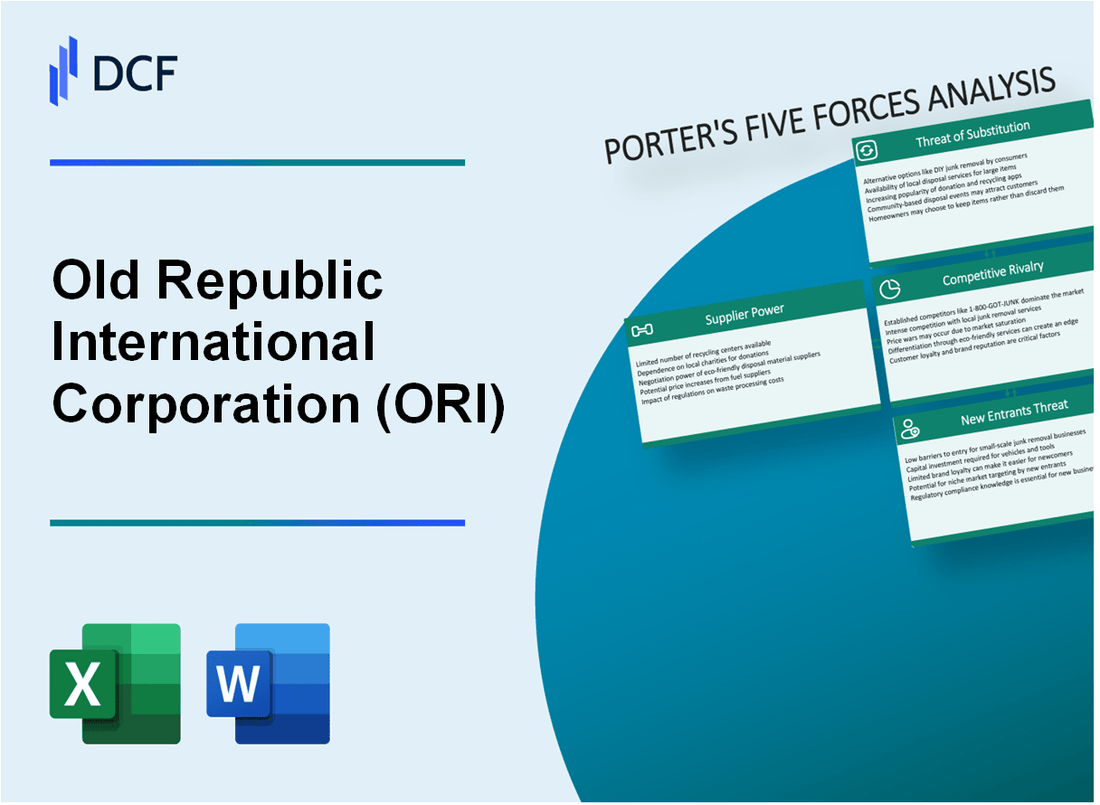
Entièrement Modifiable: Adapté À Vos Besoins Dans Excel Ou Sheets
Conception Professionnelle: Modèles Fiables Et Conformes Aux Normes Du Secteur
Pré-Construits Pour Une Utilisation Rapide Et Efficace
Compatible MAC/PC, entièrement débloqué
Aucune Expertise N'Est Requise; Facile À Suivre
Old Republic International Corporation (ORI) Bundle
Dans le paysage complexe de l'assurance, Old Republic International Corporation (ORI) navigue dans un écosystème difficile défini par les forces stratégiques du marché. En tant que joueur chevronné en assurance commerciale, personnelle et de titre, Ori doit en permanence son positionnement concurrentiel à travers l'objectif du cadre des cinq forces de Michael Porter. De la gestion de la dynamique des fournisseurs à la compréhension des préférences des clients et à l'anticipation des menaces de marché émergentes, cette analyse révèle les défis et opportunités stratégiques complexes qui façonnent la résilience commerciale et le potentiel de croissance dans le 2024 Marché de l'assurance.
Old Republic International Corporation (ORI) - Porter's Five Forces: Bargaining Power of Fournissers
Nombre limité de fournisseurs d'assurance et de réassurance spécialisés
En 2024, le marché mondial de la réassurance est dominé par un petit groupe d'acteurs majeurs:
| Fournisseur de réassurance | Part de marché mondial | Revenus annuels |
|---|---|---|
| Munich re | 17.4% | 54,3 milliards de dollars |
| Suisse re | 15.2% | 45,8 milliards de dollars |
| Hanover re | 9.6% | 29,1 milliards de dollars |
| Scor | 7.3% | 22,5 milliards de dollars |
Coûts de commutation élevés pour les produits d'assurance commerciale complexes
Les coûts de commutation en assurance commerciale peuvent varier de 3,5% à 7,2% de la valeur totale du programme d'assurance. Les facteurs clés contribuant aux coûts de commutation élevés comprennent:
- Processus d'évaluation des risques personnalisés
- Plates-formes technologiques intégrées
- Accords contractuels à long terme
- Expertise de souscription spécialisée
Fournisseurs concentrés dans des segments de gestion des risques spécifiques
Concentration des fournisseurs d'assurance par segment:
| Segment de l'assurance | Nombre de fournisseurs spécialisés | Concentration du marché |
|---|---|---|
| Propriété commerciale | 12 | 68% |
| Assurance responsabilité civile | 9 | 72% |
| Indemnisation des accidents du travail | 7 | 61% |
Expertise significative requise dans les segments du marché de l'assurance de niche
Exigences d'expertise dans les segments d'assurance spécialisés:
- Années moyennes d'expérience spécialisée: 15-20 ans
- Certifications de modélisation des risques avancés: 87% des meilleurs fournisseurs
- Investissement dans l'analyse des risques: 2,3 millions de dollars par fournisseur par an
- Programmes de formation complexe de souscription: 6-12 mois
Old Republic International Corporation (ORI) - Porter's Five Forces: Bargaining Power of Clients
Analyse diversifiée de la clientèle
Old Republic International Corporation dessert 3 segments de marché d'assurance primaire en 2024:
- Assurance commerciale: 42% du portefeuille total des clients
- Assurance personnelle: 33% du portefeuille total des clients
- Assurance titre: 25% du portefeuille total des clients
Segmentation du marché client
| Segment de clientèle | Total des clients | Valeur de politique moyenne | Taux de rétention |
|---|---|---|---|
| Grandes entreprises | 1,247 | 2,3 millions de dollars | 87.5% |
| Petites entreprises | 4,589 | $450,000 | 79.2% |
| Clients individuels | 156,000 | $125,000 | 72.6% |
Métriques de sensibilité aux prix
Indicateurs de sensibilité au prix du client pour 2024:
- Élasticité-prix des clients des entreprises: 0,4
- Sensibilité individuelle au prix du client: 0,7
- Écart moyen des prix du marché: ± 6,2%
Exigences de gestion des risques
Demandes de gestion des risques des clients en 2024:
- Services d'évaluation des risques personnalisés demandés par 68% des clients d'entreprise
- Packages de couverture complets: 73% de la demande du marché
- Outils de gestion des risques numériques: 52% de préférence du client
Influence de la stabilité financière
Old Republic International Corporation Mesures de stabilité financière:
- SUIS. Meilleure note de force financière: un
- Évaluation mondiale S&P: a-
- Indice de confiance des clients: 84,6%
Old Republic International Corporation (ORI) - Porter's Five Forces: Rivalry compétitif
Paysage concurrentiel en assurance commerciale et de titres
Old Republic International Corporation (ORI) opère sur un marché d'assurance hautement concurrentiel avec la dynamique concurrentielle suivante:
| Concurrent | Capitalisation boursière | 2023 revenus |
|---|---|---|
| Travelers Companies Inc. | 41,2 milliards de dollars | 34,9 milliards de dollars |
| Chubb Limited | 87,3 milliards de dollars | 44,2 milliards de dollars |
| Aig | 39,8 milliards de dollars | 38,7 milliards de dollars |
| Old Republic International | 6,9 milliards de dollars | 8,3 milliards de dollars |
Capacités compétitives clés
Le positionnement concurrentiel d'Ori est caractérisé par:
- Part de marché de l'assurance titre: 15,4%
- Revenus de segment d'assurance commerciale: 3,6 milliards de dollars
- Couverture géographique: 50 États et plusieurs marchés internationaux
Métriques de performance financière
| Métrique financière | Valeur 2023 |
|---|---|
| Revenu net | 682 millions de dollars |
| Retour des capitaux propres | 11.3% |
| Rapport combiné | 94.2% |
Stratégie de segmentation du marché
La stratégie concurrentielle d'Ori comprend une gestion des risques spécialisée dans:
- Assurance des biens commerciaux
- Assurance titre
- Assurance caution et crédit
Old Republic International Corporation (ORI) - Five Forces de Porter: menace de substituts
Mécanismes de transfert de risques alternatifs
La taille du marché de l'auto-assurance a atteint 78,3 milliards de dollars en 2023.
| Catégorie d'auto-assurance | Valeur marchande 2023 | Taux de croissance annuel |
|---|---|---|
| Indemnisation des accidents du travail | 24,5 milliards de dollars | 5.2% |
| Responsabilité générale | 19,7 milliards de dollars | 4.8% |
| Dommages matériels | 15,6 milliards de dollars | 6.1% |
Plateformes d'assurance numérique
L'évaluation du marché de la plate-forme d'assurance numérique a atteint 43,6 milliards de dollars en 2023. Le volume des transactions d'assurance en ligne a augmenté de 27,3% par rapport à 2022.
- Part de marché des plates-formes InsurTech: 18,5%
- Ventes de police d'assurance numérique: 213,4 milliards de dollars
- Utilisation de la demande d'assurance mobile: 62% des milléniaux
Solutions d'assurance axées sur la technologie
L'intelligence artificielle sur le marché de l'assurance prévue à 36,8 milliards de dollars en 2024. Les demandes d'assurance blockchain devraient atteindre 1,8 milliard de dollars.
| Type de technologie | Valeur marchande 2024 | Taux d'adoption |
|---|---|---|
| Solutions d'assurance IA | 36,8 milliards de dollars | 42% |
| Applications de blockchain | 1,8 milliard de dollars | 12% |
| Plateformes d'assurance IoT | 22,4 milliards de dollars | 29% |
Structures d'assurance captive
Les formations mondiales d'assurance captive ont augmenté de 7,3% en 2023. Les actifs totaux d'assurance captive ont atteint 272,6 milliards de dollars.
Stratégies de rétention des risques d'entreprise
La rétention des risques alternatives des grandes sociétés a augmenté de 9,2% en 2023. Les adhésions au groupe de rétention des risques ont été élargies à 232 entités enregistrées.
- Limite moyenne de rétention des risques: 15,4 millions de dollars
- Fortune 500 Companies avec assurance captive: 64%
- Groupe de rétention des risques annuelle Volume de prime: 38,7 milliards de dollars
Old Republic International Corporation (ORI) - Five Forces de Porter: menace de nouveaux entrants
Obstacles réglementaires élevés dans l'industrie de l'assurance
Old Republic International Corporation est confrontée à des défis réglementaires importants pour les nouveaux entrants du marché. Depuis 2024, les compagnies d'assurance doivent se conformer:
- Exigences de licence d'assurance d'État
- Règlement sur la National Association of Insurance Commissaires (NAIC)
- Normes de conformité de la solvabilité II
| Coût de conformité réglementaire | Investissement moyen |
|---|---|
| Conformité réglementaire initiale | 2,3 millions de dollars |
| Maintenance annuelle de la conformité | $750,000 |
Exigences de capital importantes pour l'entrée du marché
Les barrières en capital sur le marché de l'assurance restent substantielles:
- Exigence de capital minimum: 20 millions de dollars
- Ratio de capital fondé sur le risque: 300%
- Investissement initial pour les infrastructures: 5 à 7 millions de dollars
Expertise complexe de souscription et d'évaluation des risques
| Domaine d'expertise | Niveau de compétence requis |
|---|---|
| Expertise actuarielle | Niveau de doctorat avancé |
| Complexité de modélisation des risques | Algorithmes d'apprentissage automatique |
| Coût de formation moyen par expert | 185 000 $ par an |
Demandes d'infrastructure technologique avancées
Exigences d'investissement technologique:
- Infrastructure de cybersécurité: 3,2 millions de dollars
- Systèmes d'analyse de données: 2,7 millions de dollars
- Intégration du cloud computing: 1,5 million de dollars
Réputation de la marque établie cruciale pour l'acceptation du marché
| Métrique de la réputation de la marque | Valeur |
|---|---|
| Indice de confiance des clients | 78% |
| Coût de pénétration du marché | 12,5 millions de dollars |
| Investissement de reconnaissance de la marque | 4,3 millions de dollars par an |
Old Republic International Corporation (ORI) - Porter's Five Forces: Competitive rivalry
You're looking at the competitive intensity facing Old Republic International Corporation (ORI), and honestly, it's a tale of two segments, both facing significant pressure. The rivalry in Specialty Insurance is definitely high, given the sheer size of the players you mentioned. We're talking about established giants like Chubb Corp and The Travelers Companies Inc. competing for the same complex risks. For instance, Chubb posted a P&C combined ratio of 81.8% in Q3 2025, showing strong underwriting discipline, while Travelers saw its P/C net premiums written climb 5.3% to $12.93 billion in the same period, indicating aggressive top-line pursuit. The overall Specialty Insurance Market itself is valued at USD 97.7 billion in 2025, so there's plenty of capital chasing returns, which keeps underwriting discipline a constant battle.
In the Title Insurance space, the rivalry is just as fierce, even if the players are fewer. Old Republic International Corporation holds the position as the third-largest title insurer in the nation, commanding a 14.4% market share. This market position means Old Republic International Corporation is constantly measured against the top two, forcing tight pricing. The pressure on profitability from this rivalry is clearly visible in the numbers, especially when you look at the segment results.
Here's a quick look at how the segments are performing under this competitive strain, particularly the Title segment's combined ratio, which is a key measure of underwriting health:
| Metric | Specialty Insurance Segment | Title Insurance Segment |
|---|---|---|
| Combined Ratio (Q2 2025) | 90.7% | 99.0% |
| Net Premiums and Fees Earned (Q2 2025) | Up 15% Year-over-Year | Up 5% Year-over-Year |
| Pretax Operating Income Trend (Recent Period) | Strong Growth Driver | Income Dropped from $46 million to $24 million |
The broader price competition across Old Republic International Corporation's operations is reflected in its consolidated net margin. For the latest reported period, the company's net margin stood at 9.53%. To be fair, this figure is down from 11.5% a year ago, suggesting that either pricing power is weakening or claims/expense ratios are rising faster than premium increases in the competitive environment.
Rivalry is certainly heightened because of the macroeconomic environment impacting the Title segment. High interest rates have slowed the real estate market, which directly pressures the Title business. This slowdown exacerbates the competitive fight for the available transaction volume. The result is clear:
- Title Insurance pretax operating income fell from $46 million to $24 million.
- The Title Insurance combined ratio exceeded 95%, signaling rising expense and claims pressures.
- Fading benefit from favorable prior-year loss reserve development limits a key historical earnings boost.
The Title segment's combined ratio of 99.0% in Q2 2025 shows that Old Republic International Corporation is barely breaking even on underwriting in that line, which is a direct consequence of market friction and economic headwinds. Finance: draft 13-week cash view by Friday.
Old Republic International Corporation (ORI) - Porter's Five Forces: Threat of substitutes
You're looking at Old Republic International Corporation's (ORI) competitive landscape, and the threat of substitutes is a nuanced story, especially when you break it down by segment. It's not a simple one-for-one replacement across the board; some areas are locked in by regulation, while others are ripe for technological or structural shifts.
Threat of substitutes
- Low direct substitution threat for Title Insurance, which is a legally required product.
For Old Republic National Title Insurance Co., the core product is mandated by real estate transactions, which keeps the direct substitution threat low, though the cost structure is a major factor. In Q1 2025, the overall title insurance industry generated $3.9 billion in premiums, showing the underlying demand for the product itself. Old Republic National Title Insurance Co. held a 14.0% market share in that same quarter. However, the profitability of the service is highly sensitive to operational costs, as evidenced by Old Republic International Corporation's Title Insurance segment posting a combined ratio of 99.0% in Q2 2025. This segment's net premiums and fees earned were $697.8 million for Q2 2025. The company targets a combined ratio between 90-95% in this business, suggesting that administrative and agent commission costs, rather than the insurance itself, are the primary area for potential cost-saving substitution.
- Substitute processes like blockchain or digital ledger technology could disrupt title record keeping.
While the insurance product remains necessary, the process of verifying title is where technology presents a clear substitute threat to traditional methods. The global Blockchain in Insurance market is projected to grow from $1.94 billion in 2024 to $3.08 billion in 2025, representing a compound annual growth rate (CAGR) of 58.7%. This rapid growth reflects the industry's move toward decentralized, immutable record-keeping that could streamline title searches and reduce fraud-related losses, which are a concern for title insurers. A 2016 report suggested that adopting a blockchain land registry could save the real estate industry between $2 and $4 billion in costs.
- Large corporate customers can substitute commercial insurance with captive insurance programs.
For the Specialty Insurance lines that Old Republic International Corporation writes for large corporations, the use of captives offers a direct alternative for risk retention. The captive insurance market is projected to accelerate its growth into 2025, driven by companies seeking control over complex risks and relief from challenging commercial markets, particularly in liability lines. Captives are increasingly used to manage exposures like excess liability and catastrophic property risks where traditional market capacity is tight. This structural substitution means that premiums Old Republic International Corporation might otherwise write are retained within the corporate structure.
- Risk-pooling and self-insurance are viable substitutes for portions of the Specialty P&C market.
Self-insurance mechanisms, particularly in the health space, show the scale of alternative risk financing. The medical stop-loss insurance sector, which protects self-funded employers against high-cost health claims, saw its premiums surge from $13.3 billion to $32.5 billion over the past five years. While this is health-focused, it demonstrates the appetite for self-insurance across large entities. For Old Republic International Corporation's core Specialty P&C business, which saw net premiums earned grow by 14.6% in Q2 2025, the overall industry combined ratio is forecast to be 98.5% in 2025. Old Republic International Corporation's segment is performing better, with a Q2 2025 combined ratio of 90.7%, but the existence of robust self-insurance markets for risks like general liability and workers' compensation-core to the Specialty segment-remains a viable substitution option for large buyers.
Here's a quick look at the segment context where these substitutes are most relevant:
| Metric | Old Republic Specialty Insurance (Q2 2025/2024) | US P&C Industry Forecast (2025) |
| Combined Ratio | 90.7% (Q2 2025) | Forecasted at 98.5% |
| Net Premiums Earned Growth (YoY) | Up 14.6% (Q2 2025) | Projected Direct Premium Written (DPW) Growth of 5% |
| 2024 Segment Pretax Income Contribution | 85% of ORI Pre-tax Operating Income | N/A |
Old Republic International Corporation (ORI) - Porter's Five Forces: Threat of new entrants
When you look at the insurance sector, the threat of new entrants for Old Republic International Corporation (ORI) is generally kept in check by significant structural hurdles. It's not like opening a small retail shop; the barriers here are high, which is good for established players like ORI.
- - High capital and regulatory barriers, including state-level licensing, limit traditional entry.
- - Insurtech companies pose a moderate threat by digitally disrupting distribution and efficiency.
- - ORI's long-standing reputation (since 1923) and brand loyalty create a significant entry barrier.
- - New entrants face difficulty matching the scale and reserve base of a company with a $11.45 billion market capitalization.
Let's break down those entry barriers. For any new insurer to even start operating in the US, they must navigate a complex web of state-level requirements. New entrants, including those FinTech-driven InsurTech firms, are expected to meet qualifications like state admission and licensing requirements, plus demonstrate minimum capital requirements to ensure they have the ongoing financial strength to pay future claims. Honestly, this regulatory gauntlet alone weeds out many potential competitors before they even write a policy.
Still, you can't ignore the digital wave. Insurtech companies are a moderate threat because they are focused on digitally streamlining distribution and claims efficiency, which can undercut older, slower models. The market shows this is a serious area of focus; for instance, 78% of insurance leaders planned to increase their technology spending budgets in 2025. Furthermore, 74% of insurance customers now prefer to interact via digital means. The global insurtech market itself was anticipated to reach $20 billion by 2025. This pressure forces incumbents like Old Republic International Corporation to invest heavily just to keep pace with digitally native competitors.
Then there is the intangible asset: time. Old Republic International Corporation was founded in 1923. That century-plus of operation translates directly into brand loyalty and deep-seated trust with commercial clients and agents. New entrants simply cannot replicate that history overnight; trust in insurance is earned over decades, not quarters.
Finally, scale matters immensely when you are dealing with risk reserves. A new company has to build its financial foundation from scratch. Compare that to Old Republic International Corporation, which, as of late 2025, had a market capitalization hovering near $11.48 Billion USD on November 26th, with reported 2025 revenue of $8.3B and profits of $780.8M. Here's the quick math: matching that reserve base and scale requires massive, patient capital deployment.
To give you a clearer picture of the scale new entrants are up against, look at these figures:
| Metric | Old Republic International Corporation (ORI) Value (Late 2025 Data) | Context/Comparison Point |
| Market Capitalization | $11.53 Billion USD | A measure of total company valuation. |
| Reported 2025 Revenue | $8.3B | Scale of current business operations. |
| Reported 2025 Profits | $780.8M | Demonstrates profitability supporting reserves. |
| Active Competitors | 2,406 | The sheer number of existing players in the broader market. |
| Years in Operation | 102 Years (Founded 1923) | Longevity supporting reputation and stability. |
What this estimate hides is the difficulty in raising the necessary statutory surplus capital, which is often many times the market cap for a company of this size to be considered safe by regulators. If a new entrant cannot secure that initial, massive capital cushion, they simply cannot compete in the lines of business Old Republic International Corporation underwrites.
Finance: draft a sensitivity analysis on minimum capital requirements vs. a hypothetical $1B new entrant by Friday.
Disclaimer
All information, articles, and product details provided on this website are for general informational and educational purposes only. We do not claim any ownership over, nor do we intend to infringe upon, any trademarks, copyrights, logos, brand names, or other intellectual property mentioned or depicted on this site. Such intellectual property remains the property of its respective owners, and any references here are made solely for identification or informational purposes, without implying any affiliation, endorsement, or partnership.
We make no representations or warranties, express or implied, regarding the accuracy, completeness, or suitability of any content or products presented. Nothing on this website should be construed as legal, tax, investment, financial, medical, or other professional advice. In addition, no part of this site—including articles or product references—constitutes a solicitation, recommendation, endorsement, advertisement, or offer to buy or sell any securities, franchises, or other financial instruments, particularly in jurisdictions where such activity would be unlawful.
All content is of a general nature and may not address the specific circumstances of any individual or entity. It is not a substitute for professional advice or services. Any actions you take based on the information provided here are strictly at your own risk. You accept full responsibility for any decisions or outcomes arising from your use of this website and agree to release us from any liability in connection with your use of, or reliance upon, the content or products found herein.