

|
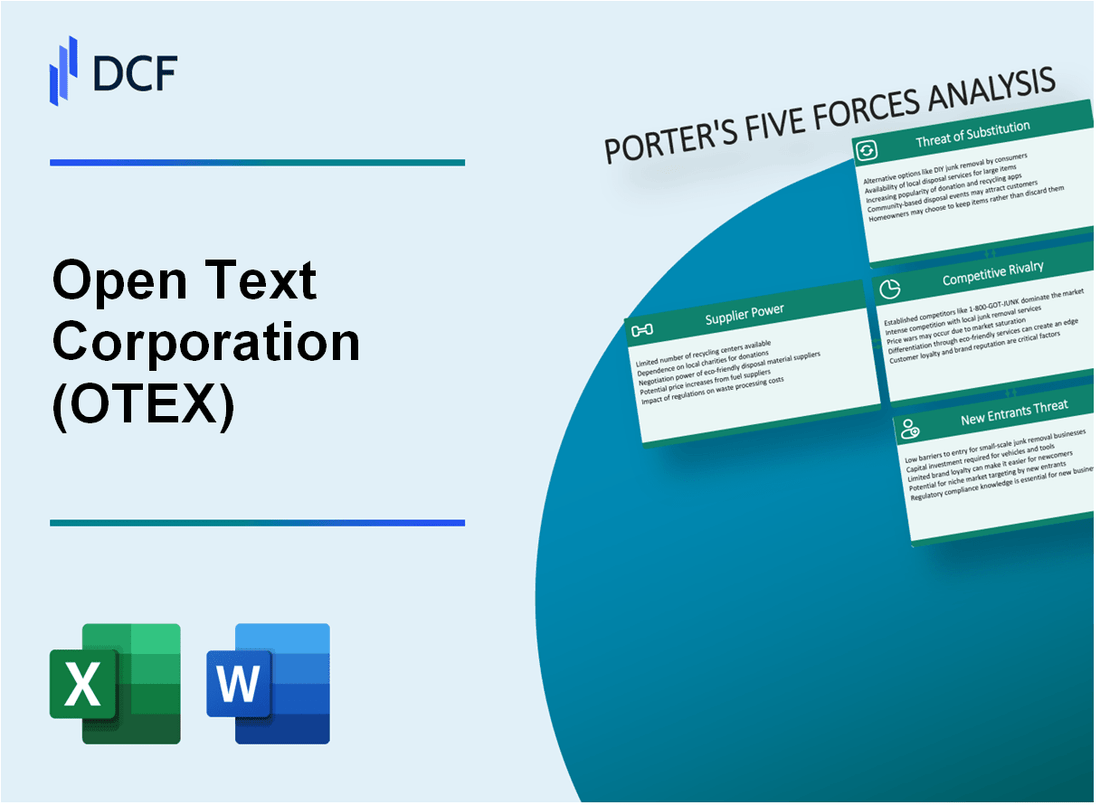
Open Text Corporation (OTEX): 5 Forces Analysis [Jan-2025 Mis à jour] |
Entièrement Modifiable: Adapté À Vos Besoins Dans Excel Ou Sheets
Conception Professionnelle: Modèles Fiables Et Conformes Aux Normes Du Secteur
Pré-Construits Pour Une Utilisation Rapide Et Efficace
Compatible MAC/PC, entièrement débloqué
Aucune Expertise N'Est Requise; Facile À Suivre
Open Text Corporation (OTEX) Bundle
Dans le paysage en évolution rapide de la gestion des contenus d'entreprise, Open Text Corporation (OTEX) navigue dans un écosystème complexe de défis technologiques et d'opportunités stratégiques. En disséquant le cadre des cinq forces de Michael Porter, nous dévoilons la dynamique complexe qui façonne le positionnement concurrentiel d'Otex en 2024 - révolutionnant de la façon dont les relations avec les fournisseurs, le pouvoir client, la rivalité du marché, les substituts technologiques et les nouveaux entrants potentiels créent un champ de bataille stratégique nuancé où l'innovation, l'expertise et L'adaptabilité détermine la survie et la croissance des entreprises.
Open Text Corporation (OTEX) - Five Forces de Porter: Pouvoir de négociation des fournisseurs
Nombre limité de logiciels d'entreprise et d'infrastructures cloud
Au quatrième trimestre 2023, le marché mondial des logiciels d'entreprise est dominé par quelques acteurs clés:
| Fournisseur | Part de marché | Revenus annuels |
|---|---|---|
| Microsoft | 21.5% | 211,9 milliards de dollars |
| Oracle | 14.3% | 44,7 milliards de dollars |
| SÈVE | 12.7% | 35,6 milliards de dollars |
| AWS | 32.4% | 80,1 milliards de dollars |
Technologie spécialisée de gestion de contenu d'entreprise (ECM)
Le texte ouvert repose sur des fournisseurs de technologies spécialisées ayant une expertise spécifique:
- Gartner n'estime que 3-4 fournisseurs de technologies ECM de haut niveau dans le monde entier
- Investissement moyen de R&D pour la technologie ECM: 87,3 millions de dollars par an
- Pool de talents spécialisé limité à environ 12 000 experts mondiaux
Coûts de commutation élevés pour l'infrastructure technologique de base
Infrastructure technologique Coûts de commutation pour la gestion des contenus des entreprises:
| Catégorie de coût de commutation | Dépenses estimées |
|---|---|
| Frais de migration | 1,2 million de dollars - 4,5 millions de dollars |
| Recyclage du personnel | 450 000 $ - 1,1 million de dollars |
| Perte de productivité potentielle | 3 à 6 mois de perturbation opérationnelle |
Dépendance à l'égard des partenaires technologiques clés
Ouvrez les principaux partenariats technologiques à partir de 2024:
- Microsoft: Azure Cloud Intégration, 50,2 milliards de dollars potentiel du marché conjoint
- AWS: Cloud Infrastructure Support, estimation de 42,7 milliards de dollars de valeur de collaboration
- IBM: Enterprise Solutions Partnership, 35,9 milliards de dollars de marché potentiel
Open Text Corporation (OTEX) - Five Forces de Porter: Pouvoir de négociation des clients
Les grands clients d'entreprise ont un effet de levier de négociation important
Open Text Corporation dessert 82% des sociétés Fortune 1000 au T2 2023. La valeur du contrat moyen pour les clients d'entreprise est de 1,2 million de dollars par an. Les clients de l'entreprise clé comprennent:
| Industrie | Nombre de clients d'entreprise | Valeur du contrat moyen |
|---|---|---|
| Services financiers | 237 | 1,5 million de dollars |
| Soins de santé | 186 | 1,3 million de dollars |
| Gouvernement | 129 | 1,1 million de dollars |
Base de clients diversifiés dans plusieurs industries
Distribution des clients OTEX dans les industries en 2024:
- Services financiers: 34%
- Santé: 22%
- Fabrication: 18%
- Gouvernement: 12%
- Technologie: 8%
- Autres industries: 6%
Solutions d'entreprise complexes et contrats à long terme
La durée moyenne du contrat d'entreprise du texte ouvert est de 3,7 ans. Le taux de renouvellement des contrats est de 92% en 2024.
Métriques de revenus du modèle basé sur l'abonnement
| Métrique | Valeur 2023 |
|---|---|
| Revenus récurrents | 1,08 milliard de dollars |
| Croissance des revenus de l'abonnement | 14.3% |
| Taux de rétention de la clientèle | 94% |
Open Text Corporation (OTEX) - Five Forces de Porter: rivalité compétitive
Paysage concurrentiel du marché
Open Text Corporation fait face à une rivalité concurrentielle importante dans la gestion de contenu de l'entreprise (ECM) et les marchés de transformation numérique.
Analyse des concurrents
| Concurrent | Position sur le marché | Revenus de 2023 |
|---|---|---|
| Microsoft | Solutions de grandes entreprises | 211,9 milliards de dollars |
| Ibm | Gestion de contenu d'entreprise | 60,53 milliards de dollars |
| Dropbox | Stockage cloud | 2,16 milliards de dollars |
| Texte ouvert | Gestion de l'information d'entreprise | 3,97 milliards de dollars |
Stratégies d'investissement compétitives
Dépenses de recherche et développement:
- Open Text R&D dépenses: 460,2 millions de dollars en 2023
- Microsoft R&D dépenses: 24,5 milliards de dollars en 2023
- Dépenses IBM R&D: 6,3 milliards de dollars en 2023
Fusions et acquisitions
| Entreprise | Total des transactions de fusions et acquisitions 2023 | Investissement total |
|---|---|---|
| Texte ouvert | 2 acquisitions stratégiques | 187,5 millions de dollars |
| Microsoft | 7 acquisitions majeures | 68,7 milliards de dollars |
| Ibm | 3 acquisitions stratégiques | 3,2 milliards de dollars |
Open Text Corporation (OTEX) - Five Forces de Porter: menace de substituts
Solutions de gestion de documents basées sur le cloud émergeant comme alternatives potentielles
Gartner rapporte que le marché mondial de la gestion des contenus du cloud a atteint 25,1 milliards de dollars en 2023, avec un TCAC projeté de 14,5% à 2026. Microsoft SharePoint Online détient 18,7% de part de marché, tandis que Google Workspace représente 12,3% des solutions de gestion des documents d'entreprise.
| Solution de nuage | Part de marché | Coût annuel d'abonnement |
|---|---|---|
| Microsoft SharePoint en ligne | 18.7% | 5 $ à 35 $ par utilisateur / mois |
| Google Workspace | 12.3% | 6 $ à 25 $ par utilisateur / mois |
| Business Dropbox | 7.5% | 15 $ à 25 $ par utilisateur / mois |
Plates-formes de collaboration open source présentant des substituts à faible coût
Les alternatives open source démontrent une pénétration importante du marché avec des solutions rentables.
- Alfresco Enterprise: 5,2% de part de marché
- NextCloud: 3,8% du taux d'adoption de l'entreprise
- OpenKM: 2,1% Présence du marché de la gestion des documents
Adoption croissante des technologies de gestion de contenu axées sur l'IA
Les prévisions IDC sur le marché de la gestion de contenu alimentée par AI atteindront 37,5 milliards de dollars d'ici 2025, avec 62% des entreprises planifiant l'intégration de l'IA dans les workflows de documents.
| Technologie de gestion de contenu AI | Pénétration du marché | Croissance attendue |
|---|---|---|
| IBM Watson Content Intelligence | 15.6% | 22% CAGR |
| Google Cloud Document AI | 12.4% | 19,5% CAGR |
Tendance croissante des solutions internes sur mesure par les grandes entreprises
Forrester Research indique que 47% des entreprises du Fortune 500 développent des systèmes de gestion de documents propriétaires, ce qui réduit la dépendance à l'égard des fournisseurs externes.
- Coût moyen de développement interne: 1,2 à 3,5 millions de dollars
- Maintenance annuelle estimée: 250 000 $ - 750 000 $
- Taux de personnalisation: 68% des solutions développées
Open Text Corporation (OTEX) - Five Forces de Porter: Menace des nouveaux entrants
Des obstacles élevés à l'entrée dans le secteur de la gestion de contenu des entreprises
Open Text Corporation fait face à des obstacles importants empêchant les nouveaux entrants du marché, avec des mesures spécifiques de l'industrie mettant en évidence la complexité:
| Type de barrière | Métrique quantitative |
|---|---|
| Investissement en capital initial | 50 à 75 millions de dollars requis pour l'infrastructure de gestion de contenu d'entreprise |
| Recherche & Coûts de développement | 22,3 millions de dollars d'investissement annuel pour le développement technologique |
| Certification de conformité | 3 à 5 ans pour obtenir des certifications complètes de sécurité des entreprises |
Exigences d'investissement initiales importantes
L'infrastructure technologique exige des engagements financiers substantiels:
- Configuration des infrastructures cloud: 15-25 millions de dollars
- Développement de logiciels d'entreprise: 12 à 18 millions de dollars
- Mise en œuvre de l'architecture de sécurité: 8 à 12 millions de dollars
Exigences complexes de conformité et de sécurité réglementaires
Le paysage réglementaire présente des défis d'entrée substantiels:
| Zone de conformité | Niveau de complexité |
|---|---|
| Conformité du RGPD | Haut |
| Règlements HIPAA | Critique |
| Certification SOC 2 | Obligatoire |
Acteurs du marché établis avec une forte propriété intellectuelle
Le portefeuille de propriété intellectuelle du texte ouvert montre les barrières d'entrée:
- Brevets totaux: 237
- Demandes de brevet actives: 52
- Investissement en brevet: 6,7 millions de dollars par an
Besoin d'une expertise approfondie de l'industrie
Les exigences de l'expertise sur le marché comprennent:
| Dimension d'expertise | Seuil de qualification |
|---|---|
| Années d'expérience en entreprise | Minimum 10 ans |
| Certifications techniques | Minimum 5 certifications spécialisées |
| Clientèle d'entreprise | Minimum 50 clients d'entreprise établis |
Open Text Corporation (OTEX) - Porter's Five Forces: Competitive rivalry
You're looking at the competitive landscape for Open Text Corporation (OTEX) as of late 2025, and honestly, the rivalry is fierce. When you're competing against the likes of Microsoft, especially with its Copilot integration across enterprise software, and a resurgent IBM in certain enterprise spaces, the pressure is definitely on.
The intensity of this rivalry is amplified by the company's recent top-line performance. While management is guiding for total revenue growth in Fiscal 2026 to be in the 1% to 2% range, the reality of Fiscal 2025 showed a tougher climb. Total revenues for the full Fiscal 2025 were $5.168 billion, which translated to a -3.0% year-over-year decline when adjusted for the AMC divestiture. That slow growth environment forces every dollar of spending and every product feature to fight harder for market share.
This competitive dynamic plays out across several distinct product areas where Open Text Corporation faces specialized rivals:
- Content management battles against players like Dropbox.
- Security offerings compete with focused vendors such as CyberArk.
- Observability tools are measured against Dynatrace.
- The core Information Management for AI space pits Open Text Corporation against hyperscalers.
Still, the operational efficiency is clear, which is a direct response to this rivalry. The non-GAAP Adjusted EBITDA margin for the full Fiscal 2025 stood strong at 34.5%. That margin shows management is driving cost discipline while trying to reinvest in growth areas like AI and Cloud.
Here's a quick look at how that profitability metric has tracked recently, which helps you see the operational discipline you mentioned:
| Period | Non-GAAP Adjusted EBITDA Margin | Total Revenues (in millions) |
|---|---|---|
| Q1 Fiscal 2026 (ended Sept 30, 2025) | 36.3% | $1,288 |
| Q4 Fiscal 2025 (ended June 30, 2025) | 34.5% | $5,168 (Annual) |
| Q3 Fiscal 2025 (ended March 31, 2025) | 31.5% | $1,254 |
| Q2 Fiscal 2025 (ended Dec 31, 2024) | 37.6% | $1,335 |
The variance in margins, from a high of 37.6% in Q2 FY2025 down to 31.5% in Q3 FY2025 before recovering to 34.5% for the full year, reflects the constant push and pull of integration, optimization, and competitive pricing pressures. The record capital return for Fiscal 2025 was $683 million, showing a commitment to shareholder value even while navigating this intense competitive field.
The competitive threat from AI is central. Open Text Corporation is positioning its Titanium X platform and Aviator AI to counter this, but the market is moving fast. For instance, in the security space, surveys show that while 92% of Managed Service Providers (MSPs) report business growth from AI interest, only about half feel ready to guide SMB customers in deploying AI tools, creating a gap OpenText must fill quickly. Finance: draft 13-week cash view by Friday.
Open Text Corporation (OTEX) - Porter's Five Forces: Threat of substitutes
You're looking at the competitive landscape for Open Text Corporation (OTEX) as of late 2025, and the threat of substitutes is definitely a major factor shaping strategy. Honestly, the sheer breadth of alternatives available today means Open Text has to work hard to keep its high-value customers locked in.
High threat from general-purpose cloud platforms offering content and data services
The hyperscalers-think Microsoft, Amazon Web Services, and Google Cloud-present a persistent, high-level threat. These platforms are not just infrastructure providers anymore; they are embedding content and data services directly into their core offerings, which can cannibalize Open Text Corporation's lower-to-mid-tier EIM (Enterprise Information Management) functionalities. For instance, Microsoft, a key competitor, is pushing its own integrated suite. The broader market context shows this is where the money is flowing:
- The global generative AI market is valued between $18.5 billion and $37.9 billion in 2025.
- Gartner reports 44% of organizations are piloting generative AI programs in 2025.
- Open Text Corporation's Q4 FY'25 Cloud Revenue stood at $475 million, about 36.2% of total revenue.
If a customer is already heavily invested in one of these general platforms, adding Open Text Corporation's specialized layer becomes a harder sell, especially if the platform's native tools meet 80% of the need.
Internal development of custom EIM solutions by large, well-resourced enterprises
For the very largest, most sophisticated enterprises, building their own content management or data governance layers is always an option, though it requires significant capital expenditure and specialized talent. This threat is less about cost and more about control and deep integration into proprietary systems. Still, Open Text Corporation's deep market penetration suggests this is a manageable threat for most; as of 2025, its platforms are trusted by 98 of the top 100 global companies. This high stickiness implies that while building custom solutions is possible, the sunk cost and proven reliability of Open Text Corporation's existing deployments act as a strong barrier to switching entirely.
Open-source content management systems offer a lower-cost, flexible substitution
Open-source content management systems (CMS) and related tools provide a lower-cost alternative, particularly attractive to smaller or mid-market firms looking to avoid subscription fees. While these often lack the enterprise-grade governance, security certifications, and deep integration that Open Text Corporation sells, the total cost of ownership (TCO) argument can be compelling. We don't have a precise market share number for open-source EIM adoption replacing Open Text Corporation deals specifically, but the general flexibility remains a constant pressure point on pricing for less complex use cases.
Generative AI tools from competitors like Microsoft Copilot can substitute for some EIM functions
The rapid evolution of generative AI is perhaps the most dynamic substitute threat right now. Tools like Microsoft Copilot are beginning to automate tasks traditionally requiring EIM workflow management, such as summarizing documents, drafting responses, or classifying unstructured data. This directly challenges the value proposition of certain Open Text Corporation modules. The speed of adoption is staggering:
- More than 80% of enterprises are projected to have deployed GenAI applications or used GenAI APIs by 2026.
- In Q4 FY'25, Open Text Corporation saw cloud bookings surge 32% year-over-year to $238 million, showing the market is moving toward AI-enabled cloud solutions, which competitors are also driving.
If a competitor's AI tool can handle document retrieval and basic governance with sufficient accuracy, it reduces the perceived need for a dedicated, comprehensive EIM suite. Here's a quick look at some relevant 2025 financial context:
| Metric | Value (FY 2025 or Latest Available) | Context |
| Total Revenues (FY 2025) | $5.168 billion | Total revenue for the fiscal year ended June 30, 2025. |
| Cloud Revenue (Q4 FY'25) | $475 million | Represents 36.2% of total Q4 revenue. |
| Cloud Bookings Growth (Q4 FY'25) | 32% Year-over-Year | Indicates strong demand for cloud-based offerings. |
| Enterprise GenAI Market Value (2025 Est.) | $3.8737 billion (to $43.7608 billion by 2033) | Shows the scale of the competing technology space. |
| Share Repurchased (FY 2025) | $411 million | Part of capital allocation strategy amid competitive pressures. |
The threat is real because the substitute technology is moving fast, and it's often bundled with existing, dominant platforms.
Open Text Corporation (OTEX) - Porter's Five Forces: Threat of new entrants
The barrier to entry for a new competitor aiming to build a comparable enterprise-grade, global Enterprise Information Management (EIM) platform is exceptionally high. A new player would need to match the sheer financial scale Open Text Corporation operates at, which for Fiscal Year 2025 included total revenues of $5.168 billion and an Adjusted EBITDA of $1.784 billion.
Regulatory and compliance hurdles present a significant deterrent. Open Text Corporation's solutions manage content and unstructured data for large companies and government agencies, meaning new entrants must immediately satisfy stringent global data management and security mandates. This is underscored by the company being named a Leader in the 2025 Gartner Magic Quadrant for Application Security Testing for the 11th consecutive year, signaling deep, proven compliance capabilities that take years to establish.
Serving a massive, entrenched customer base requires an equally vast go-to-market engine. Open Text Corporation supports over 120,000+ enterprise customers and has its solutions deployed in 99 of the top 100 global companies, according to the Forbes Global 1000 for 2025. To reach these clients effectively, a new entrant would need to rapidly build out a comparable sales and partner network, a process Open Text Corporation has refined over its 35-year history.
New entrants struggle to compete against Open Text Corporation's deep, integrated product portfolio, which is heavily bolstered by acquisition-led scale. The company's strategy has involved significant M&A activity, such as the acquisition of Micro Focus, which expanded its footprint in key areas. Furthermore, the continuous evolution of its platform, like the launch of the Titanium X platform in April 2025, requires sustained, massive R&D investment that new entrants often cannot fund initially.
Here's the quick math on the scale a new entrant faces:
| Metric | Open Text Corporation Value (FY 2025) | Implication for New Entrants |
|---|---|---|
| Total Revenues | $5.168 billion | Requires comparable initial funding for platform development and market penetration. |
| Annual Recurring Revenue (ARR) | $4.191 billion | Indicates massive installed base revenue that is difficult to displace. |
| Enterprise Customers | 120,000+ | Requires equivalent scale in customer acquisition and support infrastructure. |
| Product Portfolio Depth | Includes solutions across ECM, Cybersecurity, Business Network, and AI (e.g., 15 Aviator AI products) | New entrants must offer a similarly broad, integrated suite, not just a niche product. |
| Active Competitors | 145 active competitors | The market is already saturated with established players, increasing the cost of gaining share. |
The company's established position means switching costs for existing customers are inherently high, especially with deeply integrated, decade-plus deployments. If onboarding takes 14+ days, churn risk rises, but for Open Text Corporation's core base, the cost of migrating decades of governed information is a far greater hurdle than a simple subscription switch.
Disclaimer
All information, articles, and product details provided on this website are for general informational and educational purposes only. We do not claim any ownership over, nor do we intend to infringe upon, any trademarks, copyrights, logos, brand names, or other intellectual property mentioned or depicted on this site. Such intellectual property remains the property of its respective owners, and any references here are made solely for identification or informational purposes, without implying any affiliation, endorsement, or partnership.
We make no representations or warranties, express or implied, regarding the accuracy, completeness, or suitability of any content or products presented. Nothing on this website should be construed as legal, tax, investment, financial, medical, or other professional advice. In addition, no part of this site—including articles or product references—constitutes a solicitation, recommendation, endorsement, advertisement, or offer to buy or sell any securities, franchises, or other financial instruments, particularly in jurisdictions where such activity would be unlawful.
All content is of a general nature and may not address the specific circumstances of any individual or entity. It is not a substitute for professional advice or services. Any actions you take based on the information provided here are strictly at your own risk. You accept full responsibility for any decisions or outcomes arising from your use of this website and agree to release us from any liability in connection with your use of, or reliance upon, the content or products found herein.