

|
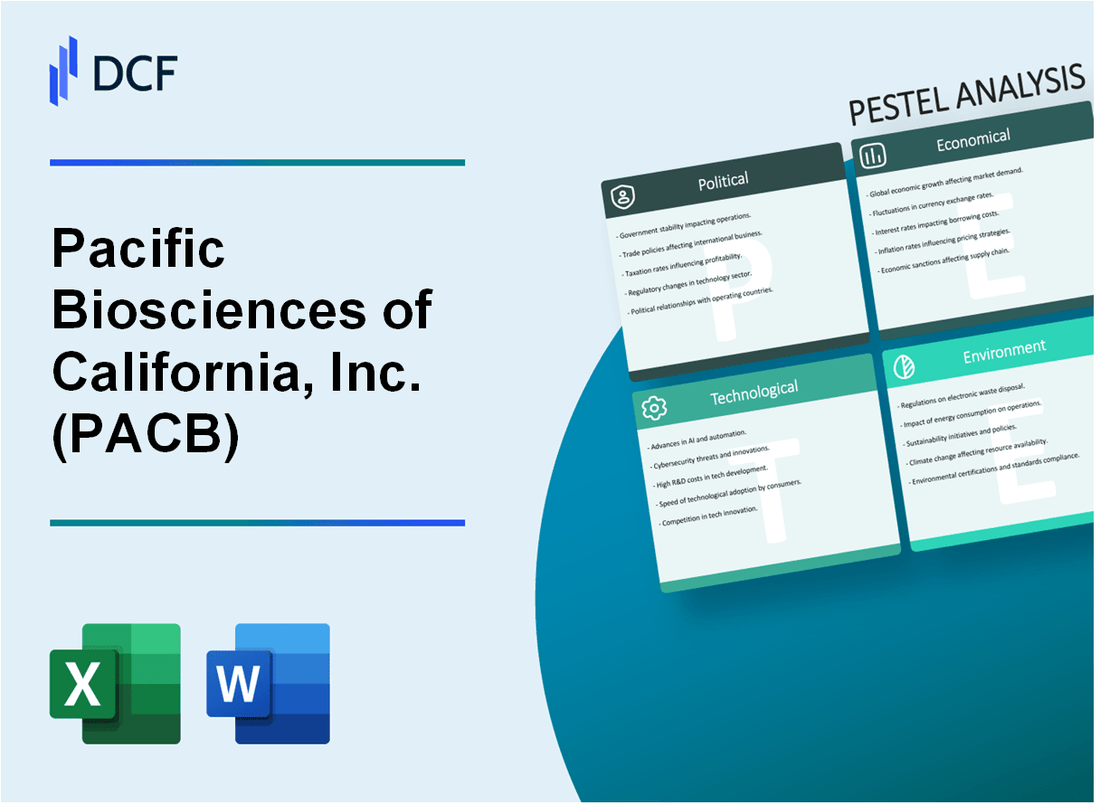
Pacific Biosciences of California, Inc. (PACB): Analyse du pilon [Jan-2025 MISE À JOUR] |
Entièrement Modifiable: Adapté À Vos Besoins Dans Excel Ou Sheets
Conception Professionnelle: Modèles Fiables Et Conformes Aux Normes Du Secteur
Pré-Construits Pour Une Utilisation Rapide Et Efficace
Compatible MAC/PC, entièrement débloqué
Aucune Expertise N'Est Requise; Facile À Suivre
Pacific Biosciences of California, Inc. (PACB) Bundle
Dans le paysage rapide du séquençage génomique en évolution, Pacific Biosciences of California, Inc. (PACB) est à l'avant-garde de l'innovation technologique, naviguant dans un réseau complexe de défis politiques, économiques, sociologiques, technologiques, juridiques et environnementaux. Des plates-formes de séquençage d'ADN révolutionnaires aux paysages régulateurs complexes, cette analyse complète du pilon dévoile l'écosystème à multiples facettes qui façonne la trajectoire stratégique de la PACB, offrant des informations sans précédent sur la façon dont les facteurs externes influencent le travail révolutionnaire de l'entreprise en médecine de précision et en recherche génétique.
Pacific Biosciences of California, Inc. (PACB) - Analyse du pilon: facteurs politiques
Paysage régulatrice de la FDA américaine pour les approbations de la technologie de séquençage génomique
En 2024, la FDA a un processus de dégagement de 510 (k) avec un temps de révision moyen de 166 jours pour les dispositifs médicaux. Le système IIE du Pacific Biosciences a reçu une autorisation de la FDA en 2019.
| Métrique réglementaire de la FDA | Statut 2024 |
|---|---|
| Temps de révision moyen de 510 (k) | 166 jours |
| Approbations de dispositifs de séquençage génomique en 2023 | 37 appareils totaux |
Financement fédéral de la recherche pour les secteurs de la biotechnologie
Les National Institutes of Health (NIH) sont alloués 47,1 milliards de dollars pour le financement de la recherche en 2024, la génomique recevant approximativement 1,3 milliard de dollars des allocations totales de recherche en biotechnologie.
- Budget de recherche en génomique NIH: 1,3 milliard de dollars
- Financement total de recherche en biotechnologie: 6,8 milliards de dollars
- Financement de l'initiative de médecine de précision: 380 millions de dollars
Politiques commerciales internationales pour les dispositifs médicaux et les équipements de recherche génomique
| Zone de politique commerciale | 2024 Impact |
|---|---|
| Tarifs d'importation des dispositifs médicaux | Taux de tarif moyen de 7,2% |
| Restrictions d'exportation des équipements de recherche | 12 pays avec des contrôles à l'exportation |
Soutien du gouvernement pour la médecine de précision et les initiatives de recherche génomique
L'initiative de médecine de précision de l'administration Biden continue de fournir 380 millions de dollars dans le financement direct des programmes de recherche génomique en 2024.
- Concessions de médecine fédérale de précision: 380 millions de dollars
- Financement de recherche génomique au niveau de l'État: 214 millions de dollars
- Crédits d'impôt pour la recherche génomique: 17% des dépenses de R&D
Pacific Biosciences of California, Inc. (PACB) - Analyse du pilon: facteurs économiques
Volatile Biotech Stock Market Performance Influencing Company Valuation
Performance des actions de Pacific Biosciences (PACB) en janvier 2024:
| Métrique | Valeur |
|---|---|
| Prix de l'action (janvier 2024) | $2.87 |
| Capitalisation boursière | 648,3 millions de dollars |
| Fourchette de cours des actions de 52 semaines | $1.52 - $4.62 |
| Performance des actions | -37.8% |
Investissement de recherche et développement dépendant du capital-risque et du sentiment des investisseurs
Détails d'investissement en R&D pour les biosciences du Pacifique:
| Exercice fiscal | Dépenses de R&D | Pourcentage de revenus |
|---|---|---|
| 2023 | 186,4 millions de dollars | 72.3% |
| 2022 | 214,7 millions de dollars | 68.5% |
Les pressions de confinement des coûts de santé affectant l'adoption de la technologie génomique
Indicateurs économiques du marché du séquençage génomique:
| Segment de marché | Taux de croissance projeté | Valeur marchande |
|---|---|---|
| Marché mondial de séquençage génomique | 15,2% CAGR (2023-2030) | 32,8 milliards de dollars d'ici 2030 |
| Séquençage génomique diagnostique | CAGR 18,5% | 14,6 milliards de dollars d'ici 2030 |
Fusions et acquisitions potentielles sur le marché des technologies de séquençage génomique
Transactions récentes de la technologie génomique:
| Société acquise | Entreprise cible | Valeur de transaction | Année |
|---|---|---|---|
| Illumina | Graal | 7,1 milliards de dollars | 2021 |
| Roche | Invitaires | 1,4 milliard de dollars | 2022 |
Pacific Biosciences of California, Inc. (PACB) - Analyse du pilon: facteurs sociaux
Intérêt public croissant pour la médecine personnalisée et les tests génétiques
Selon Global Market Insights, la taille du marché des médicaments personnalisés était évaluée à 493,73 milliards de dollars en 2022 et devrait atteindre 1 434,16 milliards de dollars d'ici 2032, augmentant à un TCAC de 11,2%.
| Segment de marché | Valeur 2022 | 2032 Valeur projetée | TCAC |
|---|---|---|---|
| Médecine personnalisée | 493,73 milliards de dollars | 1 434,16 milliards de dollars | 11.2% |
Augmentation de la conscience de la recherche génomique pour la prévention des maladies
Les National Institutes of Health ont indiqué que le volume des tests génétiques avait augmenté de 17,3% par an entre 2018-2022, avec 175 millions de tests génétiques effectués en 2022.
| Année | Tests génétiques effectués | Taux de croissance annuel |
|---|---|---|
| 2022 | 175 millions | 17.3% |
Chart démographique soutenant les technologies de dépistage génétique avancées
L'Organisation mondiale de la santé indique que 10% de la population mondiale souffre d'un trouble génétique rare, ce qui représente environ 800 millions de personnes dans le monde.
| Métrique de la population | Valeur |
|---|---|
| Population mondiale avec des troubles génétiques rares | 800 millions |
| Pourcentage de la population mondiale | 10% |
Considérations éthiques entourant la confidentialité des données génétiques et la recherche génomique
Une enquête du Pew Research Center en 2022 a révélé que 81% des Américains sont préoccupés par la confidentialité des données génétiques, 63% exprimant des réserves importantes sur le partage génétique des informations.
| Catégorie de préoccupation de confidentialité | Pourcentage |
|---|---|
| Américains préoccupés par la confidentialité des données génétiques | 81% |
| Américains avec des réservations de partage d'informations génétiques importantes | 63% |
Pacific Biosciences of California, Inc. (PACB) - Analyse du pilon: facteurs technologiques
Innovation continue dans les plates-formes de séquençage d'ADN à haut débit
Pacific Biosciences a développé le système SEQUEL II avec les spécifications suivantes:
| Paramètre | Spécification |
|---|---|
| Déborder | Jusqu'à 350 Go par cellule SMRT |
| Longueur de lecture | Moyenne de 10 à 15 Ko, avec quelques lectures dépassant 30 Ko |
| Précision | 99,8% avec des lectures de hifi |
| Temps de séquençage | Environ 2-4 heures |
Intégration de l'intelligence artificielle pour l'analyse des données génomiques
Pacbio a investi 22,3 millions de dollars dans l'IA et les technologies d'apprentissage automatique pour le traitement des données génomiques en 2023.
| Technologie d'IA | Montant d'investissement |
|---|---|
| Algorithmes d'apprentissage automatique | 8,7 millions de dollars |
| Plates-formes d'apprentissage en profondeur | 6,5 millions de dollars |
| Infrastructure informatique | 7,1 millions de dollars |
CRISPR et édition de gènes émergents avancées technologiques
Capacités technologiques de Pacbio dans l'édition de gènes:
- Développement de séquençage de HIFI pour une cartographie précise du génome
- Taux de précision de 99,9% dans la détection des variations génomiques
- Soutenu plus de 500 projets de recherche en édition de gènes en 2023
Cloud Computing et analyse des mégadonnées dans la recherche génomique
Métriques des infrastructures de cloud computing pour la recherche génomique:
| Service cloud | Capacité de stockage | Vitesse de traitement |
|---|---|---|
| Plate-forme de cloud de données génomiques | 2,7 pétaoctets | 350 téraflops |
| Gestion des données de recherche | 1,5 pétaoctets | 220 téraflops |
Pacific Biosciences of California, Inc. (PACB) - Analyse du pilon: facteurs juridiques
Protection de la propriété intellectuelle pour les technologies de séquençage génomique
Depuis 2024, le Pacific Biosciences tient 54 brevets actifs liés aux technologies de séquençage génomique. Le portefeuille de brevets de la société est évalué à approximativement 87,5 millions de dollars.
| Catégorie de brevet | Nombre de brevets | Plage d'expiration |
|---|---|---|
| Technologie de séquençage | 24 | 2029-2036 |
| Préparation des échantillons | 15 | 2030-2035 |
| Algorithmes d'analyse des données | 15 | 2032-2037 |
Conformité avec les réglementations HIPAA et de confidentialité des données
Pacific Biosciences a investi 3,2 millions de dollars dans l'infrastructure de conformité HIPAA en 2023. La société maintient Cryptage 256 bits pour toutes les transmissions de données génomiques.
| Métrique de conformité | Statut 2024 |
|---|---|
| Compliance de l'audit HIPAA | 100% |
| Violations de la confidentialité des données | 0 |
| Formation annuelle en matière de conformité | Obligatoire pour 100% des employés |
Risques des litiges en matière de brevets dans le secteur de la biotechnologie
En 2023, Pacific Biosciences a participé à 2 cas de litige en matière de brevets, avec des dépenses juridiques totales atteignant 1,7 million de dollars.
| Type de litige | Nombre de cas | Dépenses juridiques totales |
|---|---|---|
| Litige défensif | 1 | $850,000 |
| Litige offensant | 1 | $850,000 |
Exigences réglementaires pour les approbations des dispositifs médicaux et des technologies de diagnostic
Pacific Biosciences a 7 Dédisances actives de la FDA pour les technologies de diagnostic. Le délai moyen d'approbation réglementaire est 18 mois.
| Corps réglementaire | Dégagements | Temps d'approbation |
|---|---|---|
| FDA | 7 | 18 mois |
| CE Mark (Europe) | 4 | 12 mois |
Pacific Biosciences of California, Inc. (PACB) - Analyse du pilon: facteurs environnementaux
Pratiques de laboratoire durables et fabrication d'équipements
Pacific Biosciences a mis en œuvre une stratégie de durabilité complète pour les pratiques de laboratoire et la fabrication d'équipements. Le système de gestion environnementale de l'entreprise se concentre sur la réduction de l'impact environnemental grâce à des initiatives ciblées.
| Métrique de la durabilité | Performance actuelle | Année cible |
|---|---|---|
| Matériaux recyclés dans la fabrication d'équipements | 42.3% | 2025 |
| Compliance des achats durables | 87.6% | 2024 |
| Mise en œuvre de la chimie verte | 65.2% | 2026 |
Réduire l'empreinte carbone dans les processus de recherche génomique
Pacific Biosciences s'est engagé à réduire ses émissions de carbone grâce à des interventions stratégiques dans les processus de recherche.
| Stratégie de réduction du carbone | Réduction du courant | Investissement annuel |
|---|---|---|
| Optimisation du processus de recherche | Réduction de 23,7% de CO2 | 1,2 million de dollars |
| Adoption d'énergie renouvelable | 35,4% de consommation d'énergie renouvelable | 3,5 millions de dollars |
Gestion des déchets électroniques dans un équipement scientifique de haute technologie
La société a développé un protocole complet de gestion des déchets électroniques pour les équipements scientifiques.
| Métrique de gestion des déchets électroniques | Performance actuelle | Méthode d'élimination |
|---|---|---|
| Équipement électronique recyclé | 78.5% | Partenaires de recyclage certifiés |
| Réduction des matières dangereuses | 62.3% | Techniques d'élimination avancées |
Initiatives d'efficacité énergétique dans les installations de recherche et de production
Pacific Biosciences a mis en œuvre des stratégies avancées d'efficacité énergétique dans ses installations de recherche et de production.
| Initiative d'efficacité énergétique | Économies d'énergie | Réduction des coûts annuelle |
|---|---|---|
| Remplacement de l'éclairage LED | 45,6% de réduction d'énergie | $750,000 |
| Optimisation du système HVAC | 38,2% d'efficacité énergétique | 1,1 million de dollars |
| Technologies de construction intelligentes | 28,9% de conservation de l'énergie | $890,000 |
Pacific Biosciences of California, Inc. (PACB) - PESTLE Analysis: Social factors
Growing public and clinical demand for personalized medicine and early disease detection.
The societal shift toward personalized medicine (precision medicine) is a massive tailwind for Pacific Biosciences of California, Inc. (PacBio). People want healthcare tailored to their unique genetic makeup, not a one-size-fits-all approach. This is driving clinical and research adoption of high-fidelity (HiFi) long-read sequencing.
The global Personalized Medicine Market is estimated to reach approximately $654.46 billion in 2025, expanding at a Compound Annual Growth Rate (CAGR) of 8.10% through 2034. This isn't just a research trend; it's a clinical reality. The Diagnostics segment, where PacBio's technology plays a key role, is projected to account for a dominant 64.6% of the global market in 2025. Oncology remains the largest application, holding a substantial 42.36% market share in 2025, which is a key area for PacBio's comprehensive genomic profiling capabilities.
Here's the quick math: if the Diagnostics segment is over 60% of a $650+ billion market, the demand for foundational sequencing data is huge.
Increasing ethical and societal concern over the security and privacy of sensitive human genetic data.
As sequencing moves from the lab to the clinic, the societal concern over the security of sensitive human genetic data is rising, and rightly so. Genetic data is uniquely permanent and identifying, so any breach carries a massive lifelong risk. This concern translates directly into stricter regulatory and consumer demands for data security and anonymization.
In 2025, we're seeing a surge in new US state-level privacy laws like the Texas Data Privacy and Security Act (TDPSA) and the Florida Digital Bill of Rights (FDBR), which expand consumer rights and impose new obligations on businesses. Plus, the EU AI Act, which became effective in 2024, has provisions starting to apply in 2025 that regulate AI systems processing personal data, a crucial point since AI is increasingly used to analyze genomic data. Companies like PacBio must invest heavily in advanced encryption and anonymization techniques to maintain customer trust and avoid regulatory scrutiny.
Consumers defintely demand more control over their data now.
Shortage of highly skilled bioinformaticians needed to analyze the massive data output from HiFi sequencing.
PacBio's HiFi sequencing generates massive, high-quality datasets, but this creates a bottleneck: a severe shortage of the 'bilingual' scientists-bioinformaticians-needed to interpret the results. The annual growth rate of data stored in genomic databases is approximately 80%, far outpacing the supply of professionals skilled in computational biology and data science.
This talent gap is a major operational risk. The largest talent gaps in the biotech sector for 2025 are specifically in translational research and clinical bioinformatics. This shortage drives up salary costs and limits the speed at which PacBio's customers can turn raw data into actionable clinical insights. To offset this, the global bioinformatics consulting market is projected to reach $2 billion by 2025, indicating that many labs are outsourcing this critical function. PacBio's strategic move must be to simplify its data analysis pipelines and integrate AI-driven tools to reduce the reliance on scarce human expertise.
Public interest in direct-to-consumer genetic testing driving general awareness and acceptance.
The rise of direct-to-consumer (DTC) genetic testing has normalized the idea of genetic information for the average person, which is a net positive for the entire genomics ecosystem. This public interest drives general awareness and acceptance of genomic technologies, ultimately paving the way for clinical adoption of more advanced sequencing like PacBio's HiFi.
The global DTC Genetic Testing market is projected to reach approximately $2.27 billion in 2025, a market driven by consumer curiosity about ancestry and health risks. Over 26 million consumers worldwide had already taken an at-home genetic test as of 2024, with North America leading the adoption at over 60% market share. This creates a large, genetically aware consumer base that is more likely to ask their doctor for personalized diagnostics, increasing the pull-through demand for high-end sequencing platforms like the Revio and Onso systems in research and clinical labs.
| Social Factor Metric | 2025 Value/Trend | Implication for Pacific Biosciences of California, Inc. (PACB) |
|---|---|---|
| Global Personalized Medicine Market Size | ~$654.46 billion | Strong market pull for high-accuracy sequencing (HiFi) in clinical applications. |
| Diagnostics Segment Share of Personalized Medicine | 64.6% | Validates the importance of PacBio's core technology for clinical testing and screening. |
| Genomic Data Growth Rate | ~80% Annually | Increases demand for sequencing instruments but also exacerbates the bioinformatician shortage. |
| DTC Genetic Testing Market Size | ~$2.27 billion | Drives public acceptance and awareness of genetic data, creating future clinical demand. |
| Bioinformatician Talent Gap | Clinical bioinformatics identified as a major talent gap in 2025. | Operational bottleneck for customers; requires PacBio to focus on user-friendly, automated data analysis software. |
Pacific Biosciences of California, Inc. (PACB) - PESTLE Analysis: Technological factors
PACB's differentiated long-read HiFi sequencing technology maintains a technical edge in complex genome analysis.
You're looking for a sequencing technology that doesn't make you choose between read length and accuracy, and honestly, that's where Pacific Biosciences of California, Inc.'s (PacBio) High-Fidelity (HiFi) sequencing shines. It's the core of their technical edge. HiFi reads deliver an exceptional accuracy of 99.9%, which is on par with the gold-standard short-read sequencers, but with read lengths up to 25 kilobases (kb). This combination is defintely a game-changer.
This superior data quality is what allows researchers to resolve complex genomic regions that short-read technology simply can't see. For example, a 2025 study from the All of Us Research Program demonstrated that standard short-read sequencing only detected about half of the disease-associated structural variants (SVs) in their cohort. HiFi sequencing, on the other hand, captures the full spectrum of variants-from single nucleotide variants (SNVs) to large SVs and repeat expansions-all in a single run. Plus, it offers direct detection of epigenetic markers like 5-methylcytosine (5mC) and 5-hydroxymethylcytosine (5hmC), giving you a multiomic view of the sample.
Rapid adoption rate of the Revio system, with the installed base projected to approach 300 to 350 units globally by year-end 2025.
The market is clearly responding to this technical advantage, especially with the high-throughput Revio system. We saw the installed base reach nearly 200 Revio systems by the end of 2024, and the momentum has carried through 2025, driven by record consumable sales.
The annualized consumable pull-through per Revio system jumped to approximately $236,000 in the third quarter of 2025, up from about $219,000 in the second quarter of 2025. Here's the quick math: strong consumable usage means high system utilization, which validates the platform's value and drives more placements. Based on the strong Q3 2025 performance and expected stronger Q4 placements, the global installed base is projected to approach the 300 to 350 unit range by year-end 2025. That's a huge jump in capacity for long-read sequencing globally.
| Revio System Adoption & Utilization (2025) | Value / Metric | Source Quarter (2025) |
| Installed Base (Year-end 2024) | Nearly 200 units | Q4 2024 Report |
| Annualized Pull-Through per System | Approximately $236,000 | Q3 2025 Report |
| Consumables Revenue | Record $21.3 million | Q3 2025 Report |
| Projected Installed Base (Year-end 2025) | 300 to 350 units | Analyst Projection (Based on growth) |
Competition from short-read sequencing giants (Illumina) and emerging players in the long-read space.
The technological landscape is a battleground, still dominated by the short-read giant, Illumina. PacBio's primary challenge is to make the cost of a HiFi genome competitive with short-read sequencing at scale. The company is tackling this head-on with the new SPRQ-Nx chemistry, which is designed to bring the cost of a human genome down to less than $300 for customers operating at scale, a potential 40% reduction from current costs.
In the long-read segment, PacBio is the current leader, holding about 59.5% of the long-read sequencing market in 2025. However, the competition is fierce:
- Illumina: The short-read market leader is developing its own long-read solution, the upcoming Constellation platform, which could put pressure on PacBio's market share.
- Oxford Nanopore Technologies (ONT): The other major long-read player is growing aggressively, with a reported compound annual growth rate (CAGR) of 25.22%. ONT's technology offers ultra-long reads, which appeals to a different segment of the market.
Need for continuous investment in software and data analysis tools to simplify complex genomic data interpretation.
The raw sequencing data is only as good as the tools you have to interpret it, and HiFi data is complex. PacBio knows this, so they're continually investing in bioinformatics (computational analysis of biological data) to simplify the workflow and broaden adoption beyond expert labs.
The Revio system comes with onboard compute that runs sophisticated algorithms like Google DeepConsensus for highly accurate basecalling, plus integrated methylation calling. This is critical for making complex multiomic data actionable. They are also actively developing new computational pipelines, such as the Platinum Pedigree benchmark, which uses HiFi data to improve the accuracy of AI-based variant calling. This ongoing investment is essential to turn a technological edge into a market-wide standard.
Pacific Biosciences of California, Inc. (PACB) - PESTLE Analysis: Legal factors
Evolving Global Data Privacy Regulations
The regulatory landscape for genomic data is tightening fast, creating substantial compliance risk for companies like Pacific Biosciences of California, Inc. (PacBio) and its customers. You have to think beyond the Health Insurance Portability and Accountability Act (HIPAA) now, as new federal and state laws are specifically targeting genetic information, which is nearly impossible to truly anonymize.
A major new challenge is the U.S. Department of Justice's (DOJ) Bulk Data Rule, which took effect on April 8, 2025. This rule restricts or prohibits the transfer of large volumes of sensitive personal data, including human genomic data, to 'countries of concern.' Critically, the rule applies if the data involves more than 100 U.S. persons over a rolling 12-month period, and it applies even if the data is anonymized or de-identified. This directly impacts global research collaborations that use PacBio's sequencing platforms.
State-level actions in 2025 are also raising the compliance bar.
- Texas Genomic Act of 2025 (effective September 1, 2025): Prohibits the sale or transfer of Texas residents' genome sequencing data to a foreign adversary, including during a bankruptcy proceeding.
- Montana SB 163 (effective October 1, 2025): Expands the state's Genetic Information Privacy Act to strengthen protections and includes an express exemption for the use of deidentified genetic data for internal, medical, or scientific research.
- India's DPDP Rules 2025 (November 2025): Categorize diagnostics labs and other healthcare-related industry players as Data Fiduciaries, mandating a comprehensive compliance baseline for handling sensitive personal data, including genomics.
The cost of a major breach in this sector is immense, not just in fines-like the £14 million fine issued by the UK's Information Commissioner's Office (ICO) to Capita in late 2025 for a data breach-but in lost trust.
Ongoing Risk of Patent Infringement Lawsuits
The genomics sector is defintely one of the most litigious, and PacBio is consistently involved in protecting its Single Molecule, Real-Time (SMRT) sequencing technology. This is just the cost of doing business when you are a technology leader.
The risk is two-sided: defending your own IP and challenging competitors' patents to ensure freedom to operate. In early 2024, the U.S. Court of Appeals for the Federal Circuit affirmed a decision in Pacific Biosciences of California, Inc. v. Personal Genomics Taiwan, Inc., upholding the Patent Trial and Appeal Board's (PTAB) interpretation of a key patent claim related to 'identifying a single biomolecule.' This kind of back-and-forth is constant.
More recently, a significant dispute was resolved in the first quarter of the 2025 fiscal year.
| Case/Proceeding | Opposing Party | Patent Subject | Status (2025) |
|---|---|---|---|
| IPR2024-00028 | The Chinese University Of Hong Kong | Medical (Patent No. 11091794) | Terminated by Settlement on March 24, 2025 |
| No. 22-1410 (Fed. Cir. 2024) | Personal Genomics Taiwan, Inc. | Apparatus for identifying a single biomolecule | Federal Circuit Affirmed PTAB decisions in January 2024 |
Here's the quick math: each major patent dispute consumes millions in legal fees annually, plus the intangible cost of diverting executive and R&D time away from product development.
CLIA and CAP Regulations for Clinical Diagnostics
While PacBio's products are generally provided for Research Use Only (RUO), their adoption by Clinical Laboratory Improvement Amendments (CLIA)-certified and College of American Pathologists (CAP)-accredited labs for clinical diagnostics is a key growth vector. The regulatory burden on these labs directly affects the commercial viability of PacBio's systems in the clinical space.
CMS rolled out the first major set of CLIA updates in decades in 2025, raising the bar for lab compliance. Labs using PacBio's Revio or Sequel systems for clinical work face immediate operational changes:
- Digital Enforcement: CMS is transitioning to electronic-only communications for all CLIA notices, with a phase-in starting in 2025 and full enforcement by March 1, 2026. Labs must update their QualityNet contact information and establish auditable digital systems.
- Personnel Qualifications: New rules tighten requirements for lab directors and technical staff, meaning labs may incur additional costs for training or hiring personnel with specific, updated certifications.
- Inspections: CAP and other accrediting bodies can now announce inspections up to 14 days in advance, which is a slight softening, but still requires labs to be audit-ready at all times.
If onboarding PacBio's systems takes 14+ days due to a lab's internal struggle with these new personnel and documentation requirements, it slows down adoption.
Increased Intellectual Property (IP) Protection Focus
PacBio's core strategy relies on continuous innovation, particularly in novel sequencing chemistries and applications, making IP protection a front-burner issue. The company has aggressively pursued new patents in the 2025 fiscal year to protect its competitive advantage in long-read sequencing.
This focus is evidenced by specific patent grants and applications that solidify the company's position, especially around its HiFi long-read technology.
| Patent Activity | Title/Subject | Key Date (2025) |
|---|---|---|
| Patent Grant (D1071248) | Sequencing device (Design Patent) | April 15, 2025 |
| Patent Grant (12404549) | Methods and compositions for stabilizing nucleic acid-nucleotide-polymerase complexes | September 2, 2025 |
| Application Publication (20250290854) | ARRAYS OF INTEGRATED ANALYTICAL DEVICES | September 18, 2025 |
The September 2, 2025, patent grant on stabilizing enzyme complexes is a concrete example of protecting the underlying chemistry that gives PacBio its accuracy and read length advantage. Protecting the core technology is paramount.
Next Step: Legal/IP team: Conduct a quarterly review of the DOJ Bulk Data Rule's impact on all existing international research agreements by December 31, 2025.
Pacific Biosciences of California, Inc. (PACB) - PESTLE Analysis: Environmental factors
You're running a high-growth life science business, so your environmental footprint is a direct function of your commercial success. The more Revio systems you sell, the more reagents and plastic consumables you ship, and the greater the waste and energy load on your customers' labs. It's a classic scaling dilemma: your core product's success is tied to a material environmental cost.
High volume of plastic consumables and chemical reagents used by high-throughput sequencing instruments, creating significant lab waste.
The core challenge here is the sheer volume of single-use lab plastic and hazardous chemical waste generated by the high-throughput sequencing process. Each run on a Revio system, while highly efficient, still requires consumables like the sequencing plate, SMRT Cell tray, and pipette tips. However, Pacific Biosciences of California, Inc. (PACB) is defintely making smart design changes to mitigate this. The new SPRQ sequencing plate, for instance, consolidates what was previously five separate components-including the sequencing plate, tube septa, and mixing plate-into a single unit, directly reducing extraneous plastic waste.
The push for efficiency is also a push for less waste. The new SPRQ-Nx chemistry, which began beta testing in November 2025, is designed to enable multiple runs per SMRT Cell, which is a crucial step. More data from the same plastic SMRT Cell means a lower environmental cost per genome. This efficiency gain is a direct response to the waste problem.
Here's a look at how the new chemistry improves resource efficiency:
| Metric | Previous Chemistry (Sequel IIe/Original Revio) | SPRQ Chemistry (2025 Update) | Efficiency Gain |
|---|---|---|---|
| Data Output per SMRT Cell | 70-80 Gb | Up to 110 Gb | Approximately 33% increase |
| DNA Input Requirement | Higher | Lowered by 75% | Significant reduction |
| Consumable Components (Sequencing Plate) | Five separate parts | One consolidated plate | Reduction in plastic parts |
Growing pressure from institutional investors (ESG mandates) for PACB to report on its supply chain sustainability practices.
Institutional investors are not just talking about Environmental, Social, and Governance (ESG) anymore; they are demanding quantifiable action. Major asset managers like Vanguard Group Inc. and JPMorgan Chase & Co. continue to integrate sustainability factors into their investment decisions, focusing on material factors that drive long-term returns. PACB has responded by adopting the Sustainability Accounting Standards Board (SASB) framework and the United Nations Sustainable Development Goals to structure its reporting.
This pressure means you must have a clean supply chain. The company has a formal Supplier Code of Conduct policy and an internal, cross-functional ESG core team that reports to the Corporate Governance and Nominating Committee of the Board of Directors quarterly. This structured oversight is necessary to ensure that the manufacturing of instruments and reagents-much of which is outsourced-meets rigorous waste reduction and ethical standards.
Energy consumption of the massive data storage and computing infrastructure required for HiFi data analysis.
High-Fidelity (HiFi) sequencing data is massive, and processing it requires substantial computing power, which translates directly to energy consumption. The Revio system uses cutting-edge NVIDIA GPUs, delivering over 20 times the compute power of the older Sequel IIe system to process this data rapidly. That speed is a competitive advantage, but it comes with a significant energy load on the customer's data center.
On the flip side, the company is making smart design choices to reduce utility consumption at the lab level. The Revio SMRT Cell's new flowcell design eliminates the need for a nitrogen supply, simplifying lab requirements and reducing a constant utility draw. PACB also commits internally to energy best practices, including using LEED and California Title 24 standards in their facility construction and renovations. But still, the biggest energy footprint is downstream, in the customer's data infrastructure.
Focus on developing more environmentally friendly sequencing chemistries and less wasteful packaging.
The development of the SPRQ chemistry is the most concrete example of this focus. By increasing data output per SMRT Cell by 33% and reducing the required input DNA by 75%, the company has fundamentally improved the environmental efficiency of its product. This is a business decision that directly serves the environmental goal: efficiency is sustainability.
The company also states its commitment to a broader strategy:
- Seeking feasible alternatives for materials of concern in product development.
- Incorporating recyclable components into products.
- Evaluating options for reuse of consumables.
This is a long-term design imperative, not a one-off project. The consolidation of multiple consumable parts into the single SPRQ sequencing plate is a clear win for less wasteful packaging and easier lab management.
Here's the quick math: If Revio adoption hits the high end of that 350-unit projection, the recurring reagent revenue stream will accelerate, but that requires customers to fully fund and staff those machines. Finance: Track Revio utilization rates quarterly and report on any slowdowns by the 15th of the following month.
Disclaimer
All information, articles, and product details provided on this website are for general informational and educational purposes only. We do not claim any ownership over, nor do we intend to infringe upon, any trademarks, copyrights, logos, brand names, or other intellectual property mentioned or depicted on this site. Such intellectual property remains the property of its respective owners, and any references here are made solely for identification or informational purposes, without implying any affiliation, endorsement, or partnership.
We make no representations or warranties, express or implied, regarding the accuracy, completeness, or suitability of any content or products presented. Nothing on this website should be construed as legal, tax, investment, financial, medical, or other professional advice. In addition, no part of this site—including articles or product references—constitutes a solicitation, recommendation, endorsement, advertisement, or offer to buy or sell any securities, franchises, or other financial instruments, particularly in jurisdictions where such activity would be unlawful.
All content is of a general nature and may not address the specific circumstances of any individual or entity. It is not a substitute for professional advice or services. Any actions you take based on the information provided here are strictly at your own risk. You accept full responsibility for any decisions or outcomes arising from your use of this website and agree to release us from any liability in connection with your use of, or reliance upon, the content or products found herein.