

|
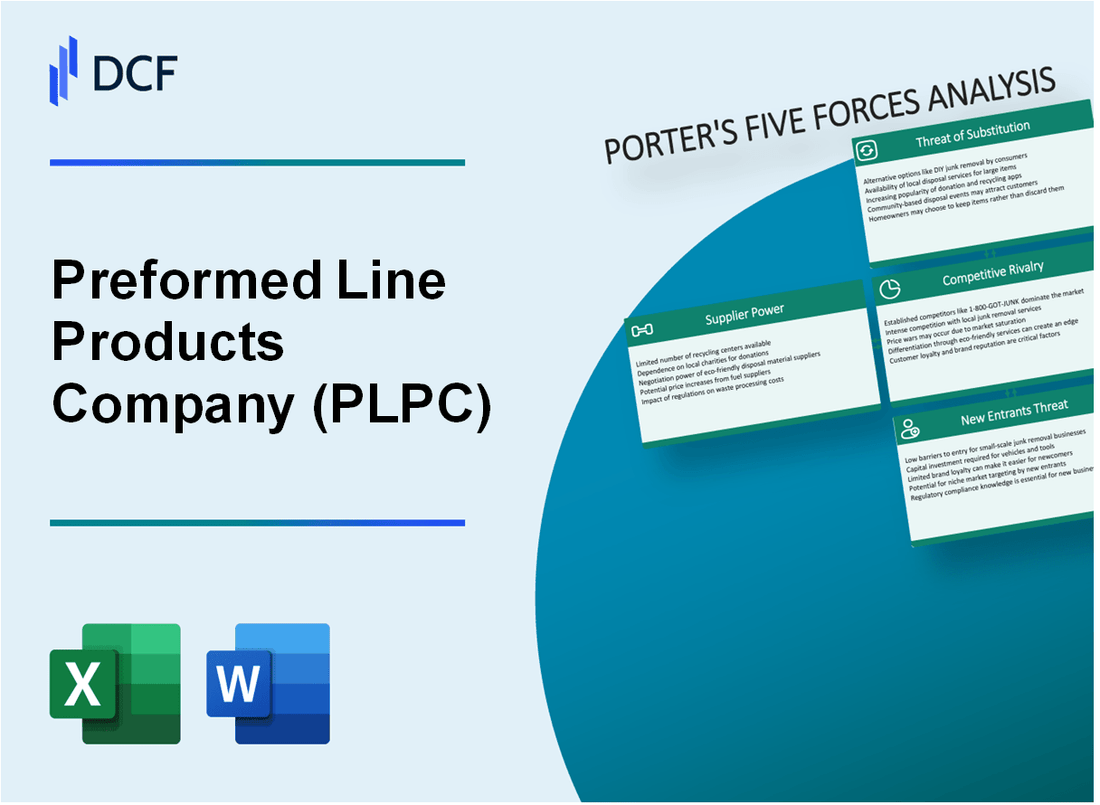
Préformed Line Products Company (PLPC): 5 Analyse des forces [Jan-2025 MISE À JOUR] |
Entièrement Modifiable: Adapté À Vos Besoins Dans Excel Ou Sheets
Conception Professionnelle: Modèles Fiables Et Conformes Aux Normes Du Secteur
Pré-Construits Pour Une Utilisation Rapide Et Efficace
Compatible MAC/PC, entièrement débloqué
Aucune Expertise N'Est Requise; Facile À Suivre
Preformed Line Products Company (PLPC) Bundle
Dans le monde dynamique de la transmission électrique et des infrastructures de télécommunications, la société de produits de ligne préformée (PLPC) navigue dans un paysage concurrentiel complexe façonné par les cinq forces stratégiques de Michael Porter. De la danse complexe des négociations des fournisseurs aux menaces en évolution des substituts technologiques, le PLPC doit se positionner stratégiquement pour maintenir son leadership sur le marché. Cette analyse révèle les facteurs externes critiques qui définiront la stratégie concurrentielle de l'entreprise en 2024, offrant un aperçu complet des défis et des opportunités qui façonneront son succès futur dans une industrie en transformation rapide.
Préformed Line Products Company (PLPC) - Porter's Five Forces: Bargaising Power of Fournissers
Nombre limité de fournisseurs de matières premières spécialisés
Depuis 2024, la chaîne d'approvisionnement de l'offre d'électricité de transmission et d'infrastructure de télécommunication démontre une structure de marché concentrée:
| Catégorie de matériel | Nombre de fournisseurs mondiaux | Concentration du marché |
|---|---|---|
| Acier à haute résistance | 7 principaux fournisseurs mondiaux | Indice CR4: 62% |
| Alliages en aluminium | 5 fabricants mondiaux primaires | Indice CR4: 58% |
| Polymères spécialisés | 4 producteurs mondiaux clés | Indice CR4: 55% |
Concentration du marché des fournisseurs
Dynamique clé du marché pour les matières premières critiques de PLPC:
- Fournisseurs en acier: les 3 meilleurs fabricants contrôlent 52% de la part de marché mondiale
- Fournisseurs en aluminium: les 4 meilleurs fabricants contrôlent 58% de la production mondiale
- Fournisseurs en polymère: les 5 meilleurs fabricants représentent 65% du marché des polymères d'infrastructure spécialisée
Coûts de commutation et exigences matérielles
Caractéristiques de l'approvisionnement des matériaux de PLPC:
| Type de matériau | Coût de commutation estimé | Temps de qualification |
|---|---|---|
| Acier à haute résistance | 1,2 million de dollars par transition du fournisseur | 12-18 mois |
| Alliages d'aluminium spécialisés | 950 000 $ par transition du fournisseur | 9-14 mois |
| Polymères techniques | 750 000 $ par transition du fournisseur | 6-12 mois |
Impact potentiel de consolidation des fournisseurs
Risques de consolidation du marché pour l'approvisionnement en matières premières de PLPC:
- Prévu à l'augmentation des prix potentielles: 7-12% par catégorie de matériaux
- Probabilité de perturbation de la chaîne d'approvisionnement: 18% au cours des 24 prochains mois
- Coûts d'achat supplémentaires estimés: 3,5 à 4,2 millions de dollars par an
Préformed Line Products Company (PLPC) - Five Forces de Porter: Pouvoir de négociation des clients
Composition de la clientèle
Les principaux segments de clientèle de PLPC comprennent:
| Segment de clientèle | Pourcentage de revenus |
|---|---|
| Sociétés de services publics | 62% |
| Entreprises de télécommunications | 28% |
| Autres secteurs d'infrastructure | 10% |
Power d'achat des clients
Indicateurs de puissance des clients clés:
- Les 5 meilleurs clients représentent 47% du chiffre d'affaires annuel total
- La valeur moyenne du contrat varie entre 1,2 million de dollars et 4,5 millions de dollars
- Le levier de négociation varie selon la complexité du projet
Dynamique des contrats
| Type de contrat | Durée moyenne | Mécanisme d'ajustement des prix |
|---|---|---|
| Projets d'infrastructure à long terme | 3-5 ans | Ajustements annuels liés au CPI |
| Accords d'alimentation standard | 1-2 ans | Remises de prix basées sur le volume |
Impact d'investissement mondial des infrastructures
Tendances d'investissement mondial sur les infrastructures:
- 2023 Investissement mondial d'infrastructure: 2,8 billions de dollars
- Dépenses d'infrastructure projetées jusqu'en 2030: 94 billions de dollars
- Taux de croissance des infrastructures d'énergie renouvelable: 12,4% par an
Facteurs de dépendance des clients
Positionnement unique du marché du PLPC:
- Ingénierie de produits spécialisés réduit les coûts de commutation des clients
- Nombre limité de fabricants spécialisés sur le marché
- La complexité technique des produits de ligne préformée crée la rétention de la clientèle
Préformed Line Products Company (PLPC) - Porter's Five Forces: Rivalry compétitif
Paysage compétitif Overview
En 2024, PLPC fonctionne sur un marché avec une concurrence modérée dans le matériel de transmission électrique et l'infrastructure de télécommunications. Le marché mondial du matériel de transmission électrique était évalué à 7,3 milliards de dollars en 2023.
Analyse des concurrents clés
| Concurrent | Présence du marché | Revenus (2023) |
|---|---|---|
| NKT A / S | Leader du marché européen | 1,2 milliard de dollars |
| Connectivité TE | Infrastructure mondiale de télécommunications | 15,8 milliards de dollars |
| Télécommunications AFL | Marché nord-américain | 2,5 milliards de dollars |
Stratégies de différenciation du marché
PLPC se concentre sur l'innovation technologique avec 42 millions de dollars investis dans la R&D en 2023.
- Portefeuille de brevets: 37 brevets actifs en technologie de transmission électrique
- Certifications de qualité du produit: ISO 9001: 2015
- Capacités de fabrication avancées
Extension géographique
Distribution des revenus géographiques de PLPC:
| Région | Contribution des revenus |
|---|---|
| Amérique du Nord | 62% |
| Europe | 22% |
| Asie-Pacifique | 16% |
Tendances de consolidation de l'industrie
Mésure de l'industrie et activité d'acquisition en 2023:
- Total des transactions de fusions et acquisitions: 17
- Valeur totale de la transaction: 3,6 milliards de dollars
- Taille moyenne des transactions: 212 millions de dollars
Préformed Line Products Company (PLPC) - Five Forces de Porter: menace de substituts
Technologies infrastructures de transmission et de télécommunications alternatives
En 2023, la taille du marché mondial des infrastructures de télécommunications a atteint 76,3 milliards de dollars. Les technologies de fibre optique représentaient 42,5% de la part de marché totale, avec un potentiel de substitution projeté pour les produits de ligne traditionnels.
| Technologie | Part de marché (%) | Taux de croissance annuel |
|---|---|---|
| Fibre optique | 42.5 | 8.7% |
| Infrastructure sans fil | 33.2 | 11.3% |
| Lignes de cuivre traditionnelles | 24.3 | -2.1% |
Technologies de communication sans fil
Le déploiement de la 5G a atteint le monde à l'échelle mondiale de 1,2 million de sites cellulaires à la fin de 2023, ce qui pourrait réduire la demande de produits de ligne traditionnels.
- Couverture du réseau 5G: 73 pays
- Investissement mondial d'infrastructure 5G: 31,7 milliards de dollars en 2023
- Marché d'infrastructures sans fil prévu d'ici 2027: 112,4 milliards de dollars
Matériaux composites avancés
Le marché des matériaux composites d'une valeur de 85,4 milliards de dollars en 2023, avec un taux de croissance annuel de 7,5% contestant les solutions matérielles traditionnelles.
| Type de matériau composite | Valeur marchande ($ b) | Potentiel de substitution |
|---|---|---|
| Fibre de carbone | 29.6 | Haut |
| Fibre de verre | 22.3 | Moyen |
| Polymères avancés | 33.5 | Haut |
Infrastructure d'énergie renouvelable
L'investissement mondial des infrastructures d'énergie renouvelable a atteint 366 milliards de dollars en 2023, créant d'importantes opportunités de marché alternatives.
- Investissement d'infrastructure solaire: 155,3 milliards de dollars
- Investissement des infrastructures éoliennes: 88,5 milliards de dollars
- Croissance des infrastructures renouvelables projetées: 12,4% par an
Avancées technologiques
Smart Grid Technologies Market d'une valeur de 32,8 milliards de dollars en 2023, ce qui remet directement des offres de produits traditionnelles.
| Segment technologique | Valeur marchande ($ b) | Taux de croissance |
|---|---|---|
| Matériel de grille intelligente | 14.6 | 9.2% |
| Logiciel de grille intelligente | 11.3 | 11.7% |
| Services de grille intelligente | 6.9 | 7.5% |
Préformed Line Products Company (PLPC) - Five Forces de Porter: Menace de nouveaux entrants
Exigences d'investissement en capital
La société de produits de ligne préformée nécessite environ 50 à 75 millions de dollars d'investissement en capital pour les infrastructures de fabrication spécialisées. Les dépenses en capital de 2023 de la société ont totalisé 14,2 millions de dollars pour les installations de production et les mises à niveau d'équipement.
| Catégorie d'investissement | Plage de coûts estimés |
|---|---|
| Installations de fabrication | 25 à 35 millions de dollars |
| Équipement spécialisé | 15-25 millions de dollars |
| Infrastructure de recherche | 10-15 millions de dollars |
Barrières d'expertise technique
La main-d'œuvre d'ingénierie de PLPC comprend 312 ingénieurs spécialisés titulaires d'un diplôme avancé. L'expérience d'ingénierie moyenne est de 14,6 ans dans le développement de produits d'infrastructure utilitaire.
Barrières relationnelles de l'industrie
- PLPC maintient des contrats avec 87 sociétés de services publics
- Durée du contrat moyen: 5-7 ans
- Couverture relationnelle existante: 62% du marché des services publics nord-américains
Exigences de certification
| Type de certification | Coût de conformité | Fréquence de renouvellement |
|---|---|---|
| ISO 9001: 2015 | $75,000-$125,000 | Annuel |
| Normes IEEE | $50,000-$90,000 | Biennal |
Investissements de recherche et développement
Les dépenses de R&D de 2023 de PLPC: 22,3 millions de dollars, représentant 7,4% du total des revenus de l'entreprise. Cycle de développement moyen des produits: 24 à 36 mois.
- Déposés annuels des brevets: 12-15 nouvelles technologies
- Taille de l'équipe R&D: 87 chercheurs dévoués
- Taux de réussite de l'innovation des produits: 64%
Preformed Line Products Company (PLPC) - Porter's Five Forces: Competitive rivalry
You're looking at the competitive landscape for Preformed Line Products Company (PLPC), and honestly, the rivalry force here is significant. It's not just a few small players; PLPC is fighting for share in a market that includes giants. This dynamic immediately puts pressure on margins and strategy.
The market structure itself is a key factor. While Preformed Line Products Company operates globally, it competes with much larger rivals, which creates an inherent imbalance in resources. Consider Amphenol, a major competitor in related component spaces; their Trailing Twelve Months (TTM) revenue as of September 30, 2025, stood at an imposing $20.974 Billion USD. That scale difference is stark when you look at Preformed Line Products Company's own TTM revenue for the same period, which was approximately $663.35 Million USD. Here's the quick math: Amphenol's revenue is roughly 31.6 times larger than Preformed Line Products Company's.
To counter this size disparity, Preformed Line Products Company leans heavily on differentiation and service quality. They don't just sell components; they sell engineered solutions built on proprietary technology. A prime example is their line of COYOTE® closures, which feature patented segmented end plate designs and flexible grommet sealing technology. This innovation helps them secure business in critical fiber-to-the-premises networks where reliability is paramount, allowing them to compete on performance rather than just price alone.
Furthermore, Preformed Line Products Company actively leverages its commitment to USA manufacturing as a competitive shield, especially given the current trade environment. This domestic base provides a distinct advantage against competitors facing high tariffs on imported goods. However, this strategy isn't without cost; Preformed Line Products Company has had to manage cost increases related to key commodity inputs, like steel and aluminum, due to Section 232 tariffs. The impact of these global pressures is visible in the financials; for instance, foreign currency translation reduced second quarter 2025 net sales by $0.5 million.
Rivalry remains intense, driven by structural industry characteristics. The core markets Preformed Line Products Company serves-energy and communications infrastructure-are characterized by slow, cyclical growth, meaning competitors must fight harder for every new project. This is compounded by the high fixed costs associated with maintaining global manufacturing and distribution footprints, like the one that supports Preformed Line Products Company's 3,401 employees. When revenue growth stalls, the pressure to keep those fixed assets running at capacity drives aggressive competitive behavior.
We can map out this competitive scale difference clearly:
| Metric (As of Late 2025 Data) | Preformed Line Products Company (PLPC) | Major Rival (Amphenol - APH) |
|---|---|---|
| TTM Revenue | $663.35 Million USD | $20.974 Billion USD |
| Market Capitalization (Approx.) | $1.11 Billion USD | Not directly comparable (Significantly larger) |
| Reported Q2 2025 Net Sales | $169.6 Million | Q2 2025 Sales: $5.7 Billion |
| Key Differentiator Focus | Proprietary technology (e.g., COYOTE closures) and USA manufacturing base | Scale, broad product portfolio, and global reach |
The intensity of this rivalry forces Preformed Line Products Company to focus on specific operational advantages:
- Maintaining patented technology like the COYOTE® segmented end plate system.
- Actively mitigating tariff impacts through domestic production and price increases.
- Focusing on global sales growth to offset localized currency headwinds.
- Managing high fixed costs against the backdrop of slow-growth end markets.
The competitive environment demands that Preformed Line Products Company continuously proves the value of its specialized products over the sheer volume offered by larger players.
Finance: draft 13-week cash view by Friday.
Preformed Line Products Company (PLPC) - Porter's Five Forces: Threat of substitutes
You're analyzing the competitive landscape for Preformed Line Products Company (PLPC), and the threat of substitutes is a nuanced area. The core function of PLPC's products-providing essential support, protection, and connection hardware for energy and communication cables-is fundamental to grid operation, making direct, immediate functional substitution very low. If you need to secure a splice case or anchor a conductor, you need a product that does that job reliably.
Still, the most significant long-term substitution threat comes from the shift in deployment strategy: moving from overhead lines to underground cabling. This isn't a product substitute for a PLPC component, but a substitute for the entire installed system where PLPC products are used. The initial capital outlay for undergrounding is the primary barrier to rapid adoption, which helps PLPC in the near term.
Here's the quick math on those installation cost differentials, which you should keep in mind when modeling long-term infrastructure spending:
| Installation Type Comparison | Cost Multiple vs. Overhead Line (OHL) | Specific Cost Data Point |
|---|---|---|
| Underground Cable (Open-Cut Trench) | On average, 4.52 times more expensive | For a 132kV network, OHL cost: £1,269 - £1,636 million per 1 km vs. UGC cost: £6,259 - £6,695 million per 1 km. |
| Underground Cable (Cable Plough) | On average, 5.13 times the cost | For a 132kV network, OHL cost: £1,269 - £1,636 million per 1 km vs. UGC cost: £7,236 - £7,882 million per 1 km. |
| Distribution Line Conversion (California PG&E Estimate) | Approximately 3.75 times more expensive | Conversion cost: approximately $3 million per mile vs. overhead build cost: $800,000 per mile. |
| General Estimate (Footage Basis) | Up to 10 times the expense | $750 per foot (underground) compared to $70 per foot (overhead). |
The high initial cost acts as a strong deterrent, though undergrounding is often favored in dense urban areas or for aesthetic reasons. For instance, in the Towy Usk project spanning 96 km, undergrounding using open-cut trench was estimated to cost between £532 - £569 million, compared to £107 - £139 million for overhead lines. That difference of over £400 million is substantial.
Material substitution is an active, ongoing process within the overhead segment itself, which directly impacts Preformed Line Products Company's product mix. You see a clear trend moving away from traditional materials toward advanced polymers, especially in high-demand areas:
- Ceramic and porcelain insulators held 46% of the electric insulator market share in 2024.
- Composite and polymer alternatives are projected to grow at a 7.9% CAGR through 2030.
- In 2024, ceramic insulators accounted for over 48% of global high-voltage insulator installations.
- Over 29% of global installations in 2024 used silicone rubber or epoxy resin (polymer-based materials).
- The global utility composite insulators market was valued at $1.8 billion in 2024, expected to grow at a 6.5% CAGR through 2034.
This material shift means Preformed Line Products Company must continually innovate its polymer-based offerings to maintain market share against legacy ceramic suppliers. The polymer segment, valued at $2.41 billion in 2023, is expected to reach $3.5 billion by 2032. This is a clear, measurable substitution trend you need to track in their product revenue breakdown.
Finally, you have the truly long-shot, high-cost alternatives. Technologies like microwave power transmission are discussed in academic and future-grid circles, but they are not a near-term threat to the established physical conductor infrastructure that relies on Preformed Line Products Company's hardware. These are high-cost, unproven at scale for widespread distribution, and definitely not a factor in your 2025 capital expenditure models. The immediate focus remains on the cost dynamics of undergrounding and the material science race in insulators.
Preformed Line Products Company (PLPC) - Porter's Five Forces: Threat of new entrants
The barrier to entry for Preformed Line Products Company's core markets-energy, communications, and critical infrastructure-is structurally high, which is a significant advantage for the incumbent. A new entrant doesn't just need capital; they need years of proven reliability in front of highly risk-averse customers.
Barriers are high due to the need for strong relationships with regulated utilities
Utility and telecom customers, who are the primary buyers of Preformed Line Products Company's hardware for transmission, distribution, and broadband networks, operate under strict regulatory oversight. This environment favors established suppliers with long track records. Preformed Line Products Company has been providing solutions to the electric power utility industry since 1947. Furthermore, the company serves clients in over 140 countries, indicating deep, established global relationships that take decades to cultivate. The sheer scale of their operation, with a trailing twelve-month revenue of $0.66 Billion USD as of late 2025, suggests that a new competitor would need to match this revenue base, which requires overcoming years of supplier qualification.
High capital expenditure is required for manufacturing and global distribution
Building the necessary manufacturing footprint to serve global infrastructure projects demands substantial, upfront capital investment. Preformed Line Products Company is actively demonstrating this requirement through its ongoing expansion. For example, construction has started on a new multi-purpose facility in Wieprz, Poland, which is set to become a key European hub. This single investment includes a planned 30% increase in production space and a 50% increase in warehouse space in that region alone. To put this in perspective against the company's overall size, the total trailing twelve-month revenue for Preformed Line Products Company as of Q3 2025 was $663.35 million. The financing for such large, strategic CapEx projects often relies on existing credit facilities; as of September 30, 2024, Preformed Line Products Company maintained a credit facility with a capacity of $90.0 million. A new entrant must secure similar, if not greater, financing to compete globally.
Products require rigorous testing and regulatory approvals
The products Preformed Line Products Company designs and manufactures, such as fiber optic splice closures, must meet exacting industry standards, creating a testing moat. For instance, many of their fiber optic closures are engineered and tested in accordance with the Telcordia GR-771-CORE Generic Requirements. This standard dictates comprehensive performance tests reflecting standard installation and operating conditions, including environmental criteria like freeze/thaw cycles for buried deployment. To maintain this quality edge, Preformed Line Products Company expanded its research and testing laboratory by 50%. Successfully navigating these requirements, which include optical monitoring and various mechanical tests, is a time-consuming and expensive process that new entrants must replicate.
Established brand loyalty and operational excellence are necessary to compete on reliability
In infrastructure, failure is not an option, which translates directly into brand loyalty for suppliers known for dependability. Preformed Line Products Company explicitly states they are respected around the world for quality, dependability, and market-leading customer service. Competing on anything other than proven reliability is nearly impossible when utility customers are dealing with multi-million dollar outages. The company's recent financial performance underscores operational capability; for the second quarter of 2025, net sales increased 22% year-over-year to $169.6 million, showing they can scale to meet demand.
New entrants face high switching costs for utility customers
Utility customers are locked in by the complexity and criticality of the installed base. Once a Preformed Line Products Company component is integrated into a power line or fiber network, replacing it with a competitor's product requires significant labor, system downtime, and re-qualification, resulting in high implicit switching costs. The company's product portfolio, which includes solutions for supporting, protecting, terminating, and splicing transmission and distribution lines, is embedded deep within essential infrastructure.
Here's a look at the scale of the incumbent's operations that a new entrant must challenge:
| Metric | Value (Late 2025 Data) | Context |
|---|---|---|
| Trailing Twelve Month Revenue | $0.66 Billion USD | Overall market presence to overcome. |
| Q3 2025 Net Sales | $178.1 million | Demonstrates current sales velocity. |
| Years in Electric Utility Industry | Since 1947 | Longevity creating relationship barriers. |
| Global Reach | Over 140 countries | Established distribution and relationship network. |
| Poland Facility Manufacturing Space Increase | 30% | Scale of required capital investment for expansion. |
| Testing Standard Compliance | Telcordia GR-771-CORE | Mandatory technical barrier for fiber optic closures. |
The investment in a new Polish facility, increasing manufacturing space by 30% and warehouse space by 50%, shows the level of CapEx required just to maintain competitive capacity, let alone enter the market.
Disclaimer
All information, articles, and product details provided on this website are for general informational and educational purposes only. We do not claim any ownership over, nor do we intend to infringe upon, any trademarks, copyrights, logos, brand names, or other intellectual property mentioned or depicted on this site. Such intellectual property remains the property of its respective owners, and any references here are made solely for identification or informational purposes, without implying any affiliation, endorsement, or partnership.
We make no representations or warranties, express or implied, regarding the accuracy, completeness, or suitability of any content or products presented. Nothing on this website should be construed as legal, tax, investment, financial, medical, or other professional advice. In addition, no part of this site—including articles or product references—constitutes a solicitation, recommendation, endorsement, advertisement, or offer to buy or sell any securities, franchises, or other financial instruments, particularly in jurisdictions where such activity would be unlawful.
All content is of a general nature and may not address the specific circumstances of any individual or entity. It is not a substitute for professional advice or services. Any actions you take based on the information provided here are strictly at your own risk. You accept full responsibility for any decisions or outcomes arising from your use of this website and agree to release us from any liability in connection with your use of, or reliance upon, the content or products found herein.