

|
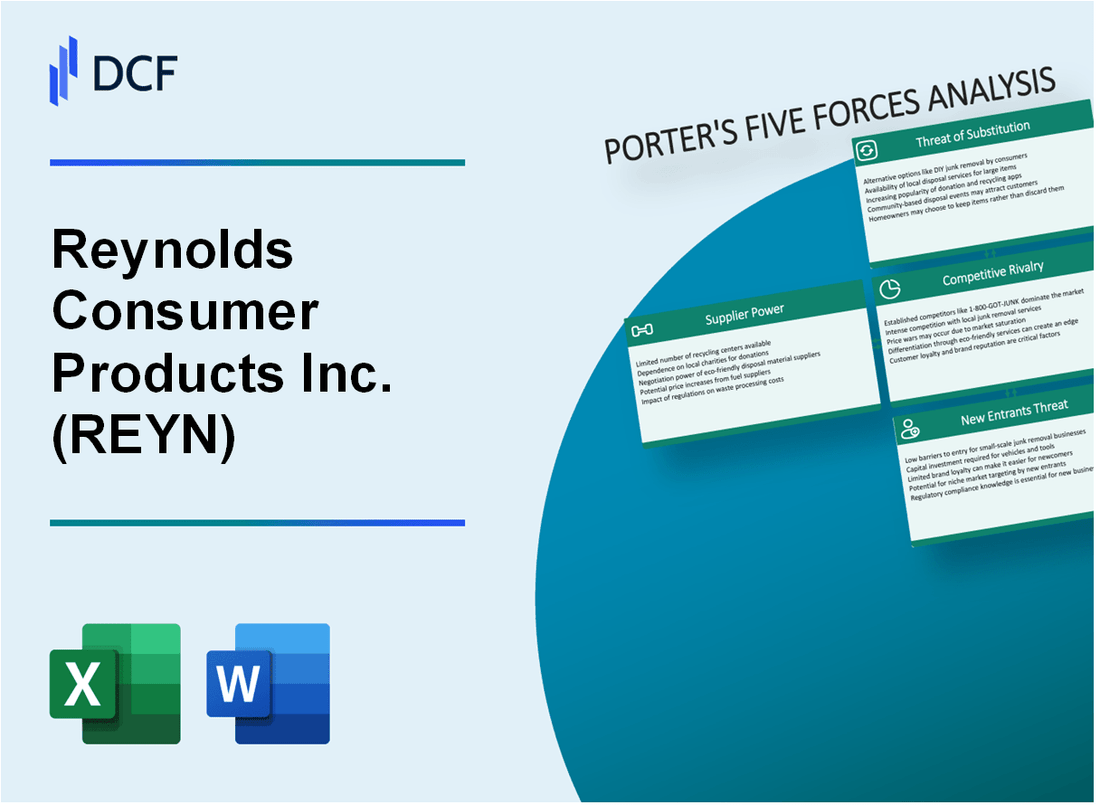
Reynolds Consumer Products Inc. (REYN): 5 FORCES Analysis [Apr-2026 Updated] |
Entièrement Modifiable: Adapté À Vos Besoins Dans Excel Ou Sheets
Conception Professionnelle: Modèles Fiables Et Conformes Aux Normes Du Secteur
Pré-Construits Pour Une Utilisation Rapide Et Efficace
Compatible MAC/PC, entièrement débloqué
Aucune Expertise N'Est Requise; Facile À Suivre
Reynolds Consumer Products Inc. (REYN) Bundle
You're looking at a classic CPG (Consumer Packaged Goods) situation with Reynolds Consumer Products Inc., and honestly, the pressure points are crystal clear right now. As a long-time observer of this space, I can tell you the five forces framework really highlights the squeeze: volatile commodity costs are hitting suppliers, while big retailers, seeing their volume drop 4% in Q1 2025 due to destocking, are pushing back hard on price. This intense rivalry and the threat of cheaper substitutes are directly impacting that $655 million to $665 million Adjusted EBITDA outlook you're tracking. Let's break down exactly how these forces are shaping the near-term strategy for Reynolds Consumer Products Inc. below.
Reynolds Consumer Products Inc. (REYN) - Porter's Five Forces: Bargaining power of suppliers
You're analyzing the supply side for Reynolds Consumer Products Inc. (REYN), and honestly, the picture here is one of significant exposure to external market forces. The bargaining power of suppliers for Reynolds Consumer Products Inc. is generally considered to be at a moderate to high level, primarily because of the nature of their key inputs and their purchasing strategy.
The core of this dynamic rests on two primary raw materials:
- Raw materials (aluminum, plastic resins) are volatile commodities.
- Prices fluctuate with crude oil and natural gas costs.
This volatility is real, and it directly impacts Reynolds Consumer Products Inc.'s cost of goods sold (COGS). For instance, as of November 27, 2025, the benchmark Crude Oil price stood at $58.80 USD/Bbl, representing a 14.70% drop compared to the same time last year. Plastic resins are directly tied to crude oil and natural gas prices. Conversely, natural gas, another key input cost driver, saw its Henry Hub spot price forecast to average around $3.70/MMBtu in late 2025, signaling upward pressure in that specific energy market. This mixed energy market environment means procurement teams are constantly managing cross-commodity risk.
The company's contractual approach further tips the scales toward the suppliers. Here's how their material purchasing strategy shapes supplier power:
| Contract Element | Reynolds Consumer Products Inc. Practice (as of 2025) | Impact on Supplier Power |
|---|---|---|
| Contract Duration/Quantity | Typically does not enter into long-term purchase contracts for fixed quantities or prices for principal raw materials. | Increases Power: Lack of long-term fixed commitments forces reliance on current market rates, giving suppliers more flexibility to adjust pricing based on spot market movements. |
| Pricing Mechanism | Purchases of most raw materials are based on negotiated rates linked to published indices. | Neutral to Moderate Power: Index-linked pricing means cost pass-through is somewhat structured, but suppliers still negotiate the base rate and index spread. |
| Cost Recovery in Sales | Sales contracts typically do not contain pass-through mechanisms for raw material, energy, and freight cost changes. | Increases Power: The inability to automatically pass on cost increases means Reynolds Consumer Products Inc. must absorb volatility or rely on slower, less certain price adjustments to customers. |
| Hedging Activity | From time to time, enters into hedging agreements, including commodity derivative contracts, primarily for aluminum, diesel, and benzene. | Mitigates Power (Selectively): Hedging provides cost predictability for specific commodities, but it is not a comprehensive solution for all inputs. |
The lack of long-term fixed-quantity contracts for principal raw materials is a major factor. It means Reynolds Consumer Products Inc. must manage its input costs through supplier negotiations and by using 'naturally established forecast cycles to influence the timing of purchases'. This is a reactive stance, not a proactive lock-in, which inherently strengthens the hand of the raw material providers.
Finally, the structure of the supply base itself presents a risk. While the company manages costs through various strategies, the potential for single-source dependency on key inputs creates a critical vulnerability. For example, the prompt highlights the specific risk from single-source production for key inputs like foil reroll. If a critical process like foil reroll relies on only one or a very limited number of specialized suppliers, that supplier gains substantial leverage, regardless of broader commodity price movements. This concentration risk can lead to severe operational disruptions if that single source faces an issue. The company is actively working to offset cost headwinds, projecting $100 million to $200 million in tariff-related cost offsets for fiscal 2025 through pricing and productivity, but this effort is a direct response to the cost pressure exerted by volatile inputs and supplier pricing power.
Reynolds Consumer Products Inc. (REYN) - Porter's Five Forces: Bargaining power of customers
The bargaining power of customers for Reynolds Consumer Products Inc. remains a significant force, largely driven by the structure of the U.S. retail landscape and evolving consumer economics. Major retailers hold substantial leverage due to ongoing consolidation within the grocery and mass merchandise channels. This concentration means fewer, larger buyers control access to shelf space, which directly translates into stronger negotiation positions when discussing pricing, promotional support, and product mix.
This power is amplified because Reynolds Consumer Products Inc. actively participates in the private label (PL) ecosystem, producing store brands for these major retailers. When a company supplies its competitor-the retailer's own brand-it inherently increases the retailer's leverage over the branded portfolio. This dynamic is playing out against a backdrop where private labels are gaining ground; in the United States, the PL value share has climbed to 21% across the CPG market. To be fair, this isn't just about the retailers; the end consumer is also driving this shift.
The immediate impact of this buyer power was evident in early 2025 performance. For the first quarter of 2025, Reynolds Consumer Products Inc. saw its Retail volume decrease by 4%, which management attributed in part to retailer destocking activities. Furthermore, Retail Net Revenues decreased 3% to $767 million in Q1 2025, down from the prior year's Q1 comparison. Even in Q2 2025, while Retail Net Revenues were flat at $887 million year-over-year, the underlying pressure from buyers and the need to manage inventory remained a key theme.
Here's a quick look at the recent retail performance metrics:
| Metric | Q1 2025 Value | Q2 2025 Value | Comparison to Prior Year Period |
|---|---|---|---|
| Net Revenues (Total) | $818 million | $938 million | Q1: Decreased from $833 million (Q1 2024) |
| Retail Net Revenues | $767 million | $887 million | Q1: Decreased 3%; Q2: Flat |
| Retail Volume Change | -4% | N/A (Q2 volume growth was 6% in some segments) | Q1: Impacted by destocking and later Easter |
The consumer side of the equation is equally important. You are dealing with a more value-conscious shopper base. U.S. consumer confidence dropped 15 points in the first half of 2025, which definitely pushes purchasing behavior toward lower-priced alternatives. This price sensitivity means that Reynolds Consumer Products Inc. must constantly balance necessary pricing actions to offset cost headwinds-like the expected $100 million to $200 million tariff-related cost impact for fiscal 2025-against the risk of alienating customers who are actively seeking value.
The consumer sentiment strongly favors value-seeking behavior, which reinforces buyer power:
- 53% of global consumers report they are increasingly buying more private label (PL) products.
- 60% of global consumers claim they would purchase even more PL if variety were broadened.
- Reynolds Consumer Products Inc. is responding by offering varied pack sizes and new opening price points.
- The company is seeing success in specific private label segments, such as gaining additional share in store brand food bags via the Presto Products portfolio.
The need to maintain share while navigating retailer demands and consumer price sensitivity means that customer bargaining power is high, forcing Reynolds Consumer Products Inc. to rely on innovation and productivity to protect margins. Finance: draft 13-week cash view by Friday.
Reynolds Consumer Products Inc. (REYN) - Porter's Five Forces: Competitive rivalry
You're looking at a market where established giants and agile store brands are constantly fighting for every shelf inch and every consumer dollar. Honestly, the rivalry for Reynolds Consumer Products Inc. is fierce, driven by market maturity and value-seeking shoppers.
The expected full-year 2025 Net Revenues outlook for Reynolds Consumer Products Inc. is flat to down 1% compared to 2024 Net Revenues of $3,695 million. This flat-to-down guidance signals a market that is definitely saturated, meaning growth must come directly from taking share, not from overall category expansion. For context, your Q3 2025 net revenues came in at $931 million, a 2% increase over Q3 2024, but that short-term lift doesn't change the long-term pressure.
The rivalry is high due to the presence of major branded competitors with significant scale. Kimberly-Clark Corp., for instance, reports revenues of $20.1B and employs 38,000 people, while The Clorox Co. has revenues of $7.1B and 7,600 employees. These companies are not standing still; Kimberly-Clark is increasing its advertising investment to support innovation, with its ad spend as a percent of sales ramping up to 7% in the second half of 2024.
Intense competition comes from private labels, which are no longer just a budget option. In the first half of 2025, own label dollar market share in the US hit 21.2%, an all-time high, with unit market share reaching 23.2%. Retailers are heavily backing these options, with over 50% of US retailers citing private labels as their number one growth driver in 2024. Private label dollar sales rose 4.4% in the first six months of 2025, outpacing the 1.1% dollar sales increase seen by national brands over the same period.
Rivalry concentration is clearly focused on the levers of pricing, marketing spend, and product innovation, as you see competitors trying to outmaneuver each other on value and new features. Reynolds Consumer Products Inc. itself is investing to keep pace, planning a $30 million to $40 million increase in capital spending for 2025, primarily for automation. Management noted that they gained share in household foil and waste bags in 2023 by exceeding the target of 20% of sales from products launched in the past three years.
Here's a quick look at how the competitive landscape stacks up across key metrics:
| Metric | Reynolds Consumer Products Inc. (REYN) | Major Branded Competitor (e.g., KMB) | Private Label Threat |
|---|---|---|---|
| Full Year 2025 Revenue Outlook | Flat to down 1% (vs. $3,695M in 2024) | Revenue $20.1B | Projected US Sales to approach $277bn in 2025 |
| H1 2025 Dollar Share Trend | Gained share in household foil/waste bags (2023 data) | Organic sales growth forecast trimmed to 3% to 4% | Dollar market share reached 21.2% (all-time high) |
| Investment Focus (Innovation/Marketing) | Capital spending increase of $30M to $40M for automation | Ad spend ramping up to 7% of sales in H2 2024 to support innovation | Retailers see PL as their #1 growth driver (Over 50% in 2024) |
The pressure points driving this rivalry include:
- Kimberly-Clark is absorbing tariff costs rather than raising prices.
- Reynolds Consumer Products Inc. is targeting $100 million to $200 million in tariff-related cost headwinds to offset via pricing and productivity.
- Kimberly-Clark launched campaigns supporting 16 new product lines in the last twelve months.
- Private label dollar sales grew 4.4% in H1 2025, while national brands grew 1.1%.
- The company's Q3 2025 Hefty Tableware segment saw net revenues decline by $22 million to $200 million.
Finance: draft 13-week cash view by Friday.
Reynolds Consumer Products Inc. (REYN) - Porter's Five Forces: Threat of substitutes
You're looking at the pressure from alternatives to Reynolds Consumer Products Inc.'s core offerings, and honestly, it's a significant headwind, especially in the tableware space. The shift away from single-use plastics and foam is a major driver here, forcing management to act fast.
The Hefty Tableware segment is clearly showing the strain of this substitution threat. For the third quarter ended September 30, 2025, net revenues for Hefty Tableware specifically fell by $22 million, landing at $200 million for the period. This follows an 8% decline reported in Q2 2025, which management tied to shifting consumer preferences and regulatory actions. To be fair, management noted that about 80% of that decline was a function of foam headwinds. Still, the volume drop was stark; in one recent quarter, retail volume decreased 13%, driven primarily by these continued foam declines.
| Segment | Q3 2025 Net Revenues (Millions USD) | Year-over-Year Change (Q3 vs Q3 2024) | EBITDA Change (Q3 vs Q3 2024) |
|---|---|---|---|
| Hefty Tableware | $200 | Down $22 million | Up $3 million |
| Hefty Waste & Storage | $266 | Up $13 million | Up $2 million |
| Reynolds Cooking & Baking | $308 | Up $14 million | Up $3 million |
Reynolds Consumer Products Inc. is actively working to counter this by leaning into sustainable alternatives. The company has a stated objective to offer sustainable options in each product line across its portfolio by the end of 2025. They are also targeting the use of recyclable or reusable packaging for all branded products by the end of 2025. As of the end of 2023, they had already achieved 88% of the goal for offering sustainable product alternatives across their U.S. product lines.
Beyond direct product substitution, the threat from lower-priced alternatives remains a constant pressure point. Analysts on the Q3 2025 call specifically raised concerns regarding private label risks. You see this pressure reflected in the overall retail environment, where Q1 2025 retail revenues saw a year-over-year drop of $28 million, partially attributed to retailer destocking. Still, the company is trying to hold its ground on price integrity, noting they gained market share in several categories without increasing promotional spending in Q1 2025.
Here are the key substitution-related strategic actions and risks:
- Offer sustainable options in all product lines by end of 2025.
- Goal to use recyclable/reusable packaging for all branded products by end of 2025.
- 88% of U.S. product lines offered a sustainable alternative as of 2023.
- Hefty Tableware revenue declined by $22 million in Q3 2025.
- Analysts flagged private label risks during the Q3 2025 earnings call.
Reynolds Consumer Products Inc. (REYN) - Porter's Five Forces: Threat of new entrants
The threat of new entrants for Reynolds Consumer Products Inc. is structurally low, primarily because the barriers to entry in the household essentials space, particularly for products like aluminum foil and plastic storage bags, are substantial. You don't just open a factory and start competing; you need massive, sustained investment from day one.
The immense capital required for manufacturing and distribution forms the first major hurdle. Setting up the necessary production lines for materials like aluminum foil, which is a mature but highly technical process, demands significant upfront investment. For context, the global aluminum foil packaging market itself was valued around USD 28.5 billion in 2025, indicating the sheer scale of the industry a new player would need to challenge. Reynolds Consumer Products Inc. itself is planning capital spending increases, earmarking $20 million to $40 million for 2025 alone, focused on automation and supply chain optimization, which shows the continuous investment required just to maintain a competitive edge, let alone enter the market.
Brand equity acts as a powerful moat. Established names like Hefty and Reynolds Wrap are deeply embedded in consumer purchasing habits. These brands are not just names; they represent decades of consumer trust in performance and reliability. Reynolds Consumer Products Inc. maintains a dominant position, holding a No. 1 or No. 2 spot in most of its product categories. This level of recognition is not bought overnight; it's earned through billions of transactions over time. Honestly, trying to displace that trust is a monumental task.
Achieving economies of scale in purchasing raw materials is difficult for a newcomer. The company's 2024 Net Revenues were $3,695 million, giving it significant leverage when negotiating prices for aluminum and plastic resins. New entrants face the immediate disadvantage of purchasing these commodities at higher spot rates until they can commit to volumes comparable to Reynolds Consumer Products Inc.'s scale. This raw material cost differential directly impacts the final shelf price, making it hard for a new brand to compete on price while maintaining acceptable margins. The company's Net Debt Leverage of 2.4x as of June 30, 2025, shows a stable financial footing to manage these commodity swings.
Finally, distribution access is nearly saturated. Reynolds Consumer Products Inc. already reaches an estimated 95% of U.S. households. Securing shelf space in major national retailers requires established relationships, proven sales velocity, and the ability to service massive, complex supply chains. A new entrant must convince retailers to displace existing, high-volume SKUs (Stock Keeping Units) for an unproven product, which is a tough sell when the incumbent is actively executing growth programs.
Here's a quick look at the primary barriers you'd face:
| Barrier Component | Quantifiable Metric/Data Point (Late 2025 Context) | Implication for New Entrant |
|---|---|---|
| Capital Intensity | Aluminum Foil Packaging Market Size: Approx. $28.5 Billion (2025) | Requires multi-million dollar investment in specialized machinery and infrastructure. |
| Brand Equity | Iconic Brands: Reynolds Wrap, Hefty | Consumer switching costs are high due to established trust and habit. |
| Economies of Scale | 2024 Net Revenues: $3,695 million | New entrants pay higher input costs for aluminum and plastic resins. |
| Distribution Reach | Household Penetration: 95% of U.S. Households | Securing national shelf space is extremely difficult and costly. |
The key deterrents for any potential competitor are clear:
- Immense upfront capital for manufacturing facilities.
- Established brand equity with high consumer recognition.
- Inability to match purchasing power for raw materials.
- Near-total saturation of retail distribution channels.
- The incumbent's ongoing investment in automation (e.g., $20M-$40M capex planned for 2025).
It's a tough nut to crack, frankly.
Disclaimer
All information, articles, and product details provided on this website are for general informational and educational purposes only. We do not claim any ownership over, nor do we intend to infringe upon, any trademarks, copyrights, logos, brand names, or other intellectual property mentioned or depicted on this site. Such intellectual property remains the property of its respective owners, and any references here are made solely for identification or informational purposes, without implying any affiliation, endorsement, or partnership.
We make no representations or warranties, express or implied, regarding the accuracy, completeness, or suitability of any content or products presented. Nothing on this website should be construed as legal, tax, investment, financial, medical, or other professional advice. In addition, no part of this site—including articles or product references—constitutes a solicitation, recommendation, endorsement, advertisement, or offer to buy or sell any securities, franchises, or other financial instruments, particularly in jurisdictions where such activity would be unlawful.
All content is of a general nature and may not address the specific circumstances of any individual or entity. It is not a substitute for professional advice or services. Any actions you take based on the information provided here are strictly at your own risk. You accept full responsibility for any decisions or outcomes arising from your use of this website and agree to release us from any liability in connection with your use of, or reliance upon, the content or products found herein.