
|
Rocky Mountain Chocolate Factory, Inc. (RMCF): Analyse SWOT [Jan-2025 MISE À JOUR] |
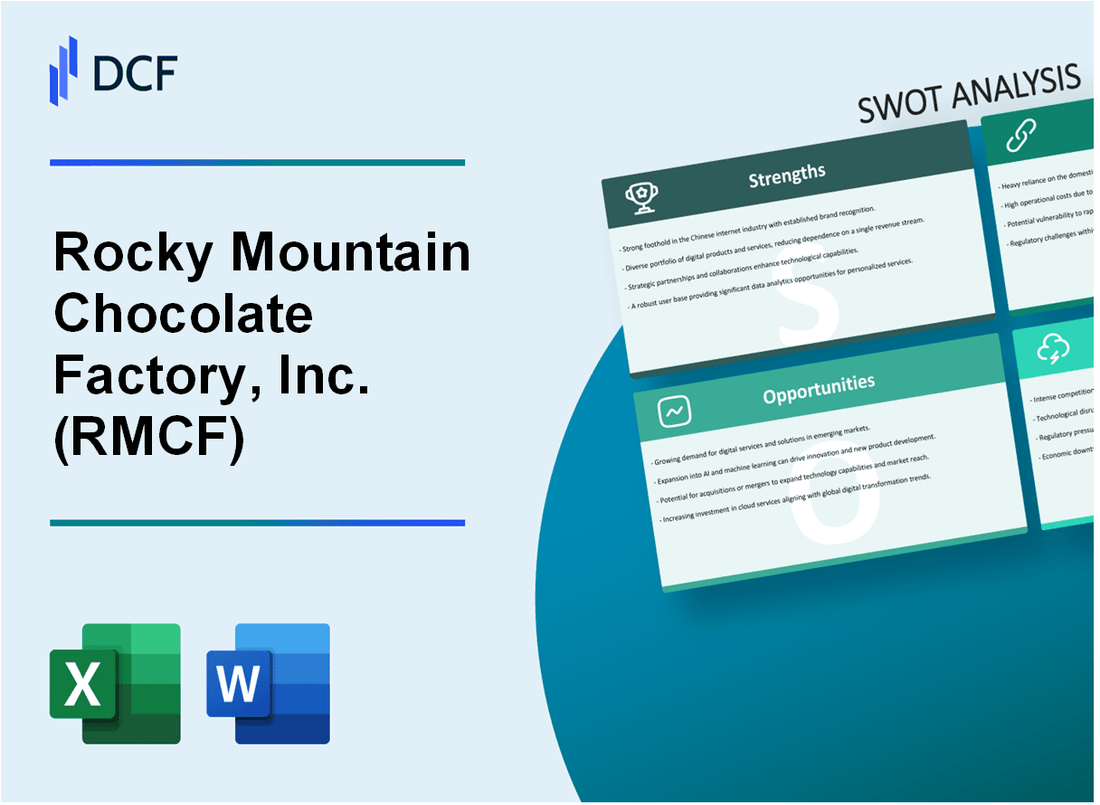
Entièrement Modifiable: Adapté À Vos Besoins Dans Excel Ou Sheets
Conception Professionnelle: Modèles Fiables Et Conformes Aux Normes Du Secteur
Pré-Construits Pour Une Utilisation Rapide Et Efficace
Compatible MAC/PC, entièrement débloqué
Aucune Expertise N'Est Requise; Facile À Suivre
Rocky Mountain Chocolate Factory, Inc. (RMCF) Bundle
Plongez dans le monde délicieux de Rocky Mountain Chocolate Factory, Inc., un 40 ans Fabricant de chocolat haut de gamme qui a réalisé des expériences douces à travers les États-Unis et au-delà. Cette analyse SWOT complète révèle le paysage complexe d'une marque de confiserie bien-aimée, explorant son positionnement stratégique, son potentiel caché et ses défis critiques sur le marché du chocolat compétitif. Que vous soyez un investisseur, un amateur de chocolat ou un stratège commercial, préparez-vous à déballer les couches de cette fascinante entreprise de chocolat gastronomique et à découvrir ce qui fait de Rocky Mountain Chocolate Factory un acteur unique dans l'industrie de la confiserie.
Rocky Mountain Chocolate Factory, Inc. (RMCF) - Analyse SWOT: Forces
Marque établie avec plus de 40 ans d'expérience
Fondée en 1981, Rocky Mountain Chocolate Factory a accumulé 43 ans d'histoire opérationnelle dans la fabrication de chocolat haut de gamme. En 2024, la société maintient une présence solide sur le marché de la confiserie.
| Métrique de l'entreprise | 2024 données |
|---|---|
| Années de travail | 43 ans |
| Total des lieux de vente au détail | 327 magasins |
| Revenus annuels (2023) | 48,3 millions de dollars |
Modèle commercial unique de vente au détail et de franchise
La société opère grâce à une stratégie de distribution diversifiée:
- Magasins de détail appartenant à des franchises
- Emplacements de vente au détail appartenant à l'entreprise
- Canaux de distribution en gros
- Plate-forme de commerce électronique
Ligne de produit fabriquée à la main de haute qualité
Rocky Mountain Chocolate Factory est spécialisée dans chocolats artisanaux haut de gamme en mettant l'accent sur les techniques de production artisanale.
| Catégorie de produits | Volume de production annuel |
|---|---|
| Barres de chocolat | 1,2 million d'unités |
| Pommes au caramel | 750 000 unités |
| Confections de spécialité | 500 000 unités |
Présence du marché géographique
La société maintient une empreinte de marché stratégique:
- Opérationnel dans 38 États américains
- Présence internationale dans 3 pays
- Forte concentration dans l'ouest des États-Unis
Portfolio de produits diversifié
Les offres de produits comprennent plusieurs catégories de confiseries:
- Barres de chocolat
- Truffes
- Pommes au caramel
- Articles spécialisés saisonniers
- Collections de cadeaux
Rocky Mountain Chocolate Factory, Inc. (RMCF) - Analyse SWOT: faiblesses
Présence géographique limitée
En 2024, Rocky Mountain Chocolate Factory exploite environ 80 magasins de détail, principalement situés dans 16 États à travers les États-Unis. L'empreinte géographique limitée de la société restreint l'expansion potentielle du marché et la génération de revenus par rapport aux concurrents nationaux.
| Métrique | Valeur |
|---|---|
| Total des magasins de vente au détail | 80 |
| États d'opération | 16 |
| Lieu de franchise | 55 |
| Magasins appartenant à l'entreprise | 25 |
Capitalisation boursière et ressources financières
En janvier 2024, la capitalisation boursière de Rocky Mountain Chocolate Factory est d'environ 15,2 millions de dollars, ce qui limite considérablement sa capacité financière pour des investissements à grande échelle, des campagnes de marketing et des stratégies d'expansion.
| Métrique financière | Valeur 2023 |
|---|---|
| Capitalisation boursière | 15,2 millions de dollars |
| Revenus annuels | 22,6 millions de dollars |
| Revenu net | 1,3 million de dollars |
Vulnérabilité des prix des matières premières
La société est confrontée à des défis importants avec la volatilité des coûts des ingrédients:
- Les prix du cacao ont fluctué entre 2 200 $ et 2 800 $ par tonne métrique en 2023
- Les prix du sucre ont augmenté d'environ 12% au cours de la même période
- Les coûts des ingrédients laitiers ont augmenté de 8 à 10% d'une année sur l'autre
Dépendance au détail basée sur le centre commercial
Rocky Mountain Chocolate Factory reste fortement dépendante des emplacements de vente au détail à base de centres commerciaux, qui ont connu une baisse de la circulation piétonne. En 2023, le trafic commercial a diminué de 15% par rapport aux niveaux pré-pandemiques, ce qui a un impact direct sur le potentiel de vente de l'entreprise.
| Type d'emplacement de vente au détail | Pourcentage de magasins |
|---|---|
| Emplacements du centre commercial | 68% |
| Magasins autonomes | 22% |
| Aéroport / emplacements de voyage | 10% |
Limitations de l'échelle opérationnelle
Par rapport aux principaux concurrents de l'industrie du chocolat, Rocky Mountain Chocolate Factory fonctionne à une échelle nettement plus petite:
- Capacité de production annuelle: environ 1 200 tonnes métriques de produits de chocolat
- Nombre d'installations de fabrication: 2
- SKUS de produits annuels: environ 150 variétés de chocolat différentes
| Comparaison des concurrents | Rmcf | Moyenne des concurrents majeurs |
|---|---|---|
| Revenus annuels | 22,6 millions de dollars | 450 à 500 millions de dollars |
| Capacité de production | 1 200 tonnes métriques | 50 000 à 75 000 tonnes métriques |
| Présence mondiale du magasin | 80 magasins | 500 à 1 000 magasins |
Rocky Mountain Chocolate Factory, Inc. (RMCF) - Analyse SWOT: Opportunités
Expansion du commerce électronique et canaux de vente directe aux consommateurs
Le marché du chocolat en ligne devrait atteindre 45,7 milliards de dollars d'ici 2027, avec un TCAC de 4,2%. Les revenus actuels du commerce électronique de Rocky Mountain Chocolate Factory représentent 12,7% des ventes totales, indiquant un potentiel de croissance important.
| Canal de commerce électronique | Part de marché actuel | Croissance projetée |
|---|---|---|
| Ventes directes du site Web | 7.3% | 15,6% d'ici 2025 |
| Plates-formes tierces | 5.4% | 11,2% d'ici 2025 |
Potentiel d'expansion du marché international
Le marché mondial du chocolat premium devrait atteindre 36,2 milliards de dollars d'ici 2026, les marchés émergents présentant des opportunités substantielles.
- Taux de croissance du marché du chocolat en Asie-Pacifique: 6,8% CAGR
- Valeur marchande du chocolat du Moyen-Orient: 2,3 milliards de dollars d'ici 2025
- Croissance projetée du marché du chocolat latino-américain: 5,5% par an
Intérêt croissant des consommateurs pour les produits de chocolat de qualité supérieure et artisanaux
Le segment de chocolat premium connaît une croissance robuste, les consommateurs désireux de payer des prix plus élevés pour la qualité.
| Segment de marché | Valeur marchande actuelle | Taux de croissance annuel |
|---|---|---|
| Chocolat de qualité supérieure | 14,6 milliards de dollars | 7.2% |
| Chocolat artisanal | 8,3 milliards de dollars | 9.1% |
Développement de nouvelles gammes de produits ciblant les consommateurs soucieux de leur santé
Le marché du chocolat de la santé et du bien-être se développe rapidement, avec des segments de consommateurs spécifiques montrant un intérêt accru.
- Valeur marchande du chocolat biologique: 3,7 milliards de dollars
- Croissance du segment du chocolat sans sucre: 6,5% par an
- Part de marché du chocolat noir: 22,4% du total des ventes de chocolat
Potentiel de partenariats stratégiques ou d'acquisitions
La consolidation de l'industrie du chocolat et les opportunités de partenariat présentent un potentiel d'expansion stratégique.
| Type de partenariat | Impact potentiel du marché | Valeur estimée |
|---|---|---|
| Partenariats de vente au détail | Augmentation des canaux de distribution | 5,6 millions de dollars de revenus potentiels |
| Collaborations de fabrication | Améliorations de l'efficacité de la production | Réduction des coûts de 12 à 15% |
Rocky Mountain Chocolate Factory, Inc. (RMCF) - Analyse SWOT: menaces
Concurrence intense sur le marché du chocolat et de la confiserie premium
La taille du marché du chocolat était évaluée à 130,56 milliards de dollars en 2022, avec un TCAC projeté de 4,6% de 2023 à 2030. Rocky Mountain Chocolate Factory fait face à une pression concurrentielle importante des principaux acteurs:
| Concurrent | Part de marché | Revenus annuels |
|---|---|---|
| Hershey | 43.8% | 9,6 milliards de dollars |
| Lindt & Sprüngli | 12.5% | 4,8 milliards de dollars |
| Godiva | 7.2% | 1,2 milliard de dollars |
En hausse des coûts d'ingrédient et de production
Les prix du cacao ont augmenté de 40% en 2022-2023, ce qui concerne directement les dépenses de production:
- Prix de cacao par tonne métrique: 2 600 $ en 2023
- Les prix du sucre ont augmenté de 15% en glissement annuel
- Le matériel d'emballage coûte de 22%
Changer les préférences des consommateurs et les tendances de santé
Consciences de la santé à la consommation Chart de conduite du marché:
| S'orienter | Impact du marché |
|---|---|
| Demande de chocolat à faible teneur en sucre | 37% de croissance en 2022-2023 |
| Alternatives au chocolat à base de plantes | Expansion du marché de 28% |
| Segment de chocolat biologique | 25% taux de croissance annuel |
Des ralentissements économiques affectant les dépenses discrétionnaires
Tendances de dépenses des aliments de luxe:
- Les dépenses alimentaires discrétionnaires ont diminué de 12% en 2022
- Les dépenses moyennes de chocolat à la consommation sont passées de 86 $ à 74 $ par an
- Le segment de chocolat premium a connu une contraction des ventes de 8,5%
Augmentation de la concurrence des marques de chocolat en ligne et artisanales
Dynamique du marché du chocolat en ligne:
| Canal | Part de marché | Taux de croissance |
|---|---|---|
| Ventes de chocolat du commerce électronique | 22% du marché total | Croissance annuelle de 18% |
| Marques de chocolat artisanal | 15% de pénétration du marché | Expansion de 26% sur l'autre |
Rocky Mountain Chocolate Factory, Inc. (RMCF) - SWOT Analysis: Opportunities
Expand direct-to-consumer (DTC) e-commerce channel to capture a larger share of online gifting.
The most immediate and high-margin opportunity for Rocky Mountain Chocolate Factory lies in aggressively expanding its direct-to-consumer (DTC) e-commerce channel, especially for gifting. You've already overhauled the e-commerce platform in fiscal year 2025, which is the necessary first step.
The premium chocolate market is moving online fast; the Online Retail distribution channel is projected to grow at an 8.31% Compound Annual Growth Rate (CAGR) between 2025 and 2030. For the broader US confectionery market, online channels are projected to grow by 23% by 2027. Honestly, that's a huge tailwind. Analysts project that increasing the online sales mix from the current low single digits to just 10% by 2027 could add an estimated $3 million to $5 million in annual revenue. That's a clear path to top-line growth without the capital expenditure of a new brick-and-mortar store.
- Focus on subscription boxes for recurring revenue.
- Optimize digital marketing for holiday gifting spikes.
- Use the new ERP system for real-time inventory visibility.
Strategic co-branding and licensing partnerships to grow product distribution beyond retail stores.
Rocky Mountain Chocolate Factory already has a solid foundation in co-branding, which is a great asset to build on. Your products are currently featured in 104 co-branded Cold Stone Creamery stores and 10 co-branded U-Swirl stores as of August 31, 2025. That existing network proves the product's portability and appeal beyond your own four walls.
The opportunity now is to expand this specialty market retail and co-brand partner channel, aligning it with your Durango production facility's throughput. This strategy diversifies revenue away from franchise royalties and leverages the manufacturing segment, which accounted for approximately 76% of total revenue in fiscal year 2025. Look for partnerships that offer counter-cyclical sales-like coffee chains or high-end grocery stores-to smooth out the seasonal spikes that traditionally plague the chocolate business.
Consolidate the franchise system by acquiring underperforming units or converting to corporate-owned stores.
You're already executing on this, which is defintely the right move for quality control and innovation. The strategy is moving away from simply closing underperforming units to emphasizing 'store transfers in place of store closures,' successfully transferring ownership of two legacy stores to new, better-capitalized operators.
Even more strategically, the company is selectively acquiring high-performing locations to use as innovation hubs. As of August 31, 2025, RMCF operates 3 company-owned stores, up from 2 at the end of fiscal 2025. This includes the August 2025 acquisition of the Camarillo, California store, which will serve as a testbed for the new store design and operational best practices before rolling them out to the broader franchise network of 136 domestic franchise stores.
Here's the quick math on the current store base and opportunity:
| Store Type | Count (as of 8/31/2025) | Strategic Purpose |
|---|---|---|
| Company-Owned Stores | 3 | Testbed for new products, design, and operations. |
| Domestic Franchise Stores | 136 | Core revenue driver (royalties and product sales). |
| International License Stores | 3 | Low-risk entry into foreign markets. |
| Co-Branded Locations (Cold Stone, U-Swirl) | 114 | Expanded brand reach and diversified sales. |
| Total Locations | 256 | Focus on quality over quantity for long-term growth. |
International expansion, particularly in markets with high demand for premium US-made chocolate.
The global premium chocolate market is a massive target, valued at $39.56 billion in 2025. Your current international footprint is small-only 3 international license stores as of August 31, 2025, operating in places like the Philippines and Panama.
The real opportunity lies in the high-growth markets of Asia-Pacific, where demand for premium, US-made goods is strong. The Asia-Pacific region is advancing at a 7.23% CAGR for premium chocolate, with markets like India and China showing even faster growth potential. India is projected to be the fastest-growing market globally, with a projected CAGR of 10.2%, and China is not far behind at 9.5%. That kind of growth trajectory makes the current international store count look like a huge untapped potential. The low-capital licensing model you currently use is the smart way to mitigate risk while accessing this explosive growth.
Rocky Mountain Chocolate Factory, Inc. (RMCF) - SWOT Analysis: Threats
Intense competition from large, well-funded confectioners like Hershey and Mars, plus local artisan shops.
Rocky Mountain Chocolate Factory operates in a US chocolate market projected to be worth $35.25 billion in 2024, but it faces a severe competitive disadvantage against the industry giants. The two largest players, Hershey and Mars, dominate the landscape with overwhelming scale and marketing budgets. Hershey alone commands approximately 24% of the US confectionery market share, while Mars captures more than a third of the total revenue in the US Chocolate Production industry. RMCF's total revenue for fiscal year 2025 was only $29.6 million, which is a fraction of the sales of a single major competitor's sub-brand. This is a scale problem, defintely.
The threat is dual-pronged because RMCF also competes with the premium, high-growth segment. The chocolate confectionery segment, which accounts for nearly 47% of the US confectionery market by value, is seeing a strong trend toward 'premiumization.' Local artisan shops and high-end brands like Ghirardelli and Lindt are capitalizing on the demand for craft, ethically sourced, and unique flavor propositions, which directly challenges RMCF's core offering and premium price point.
Rising commodity costs for key ingredients like cocoa, sugar, and dairy, squeezing manufacturing margins.
The most immediate and quantifiable threat to RMCF's profitability is the volatility and sharp increase in raw material costs, particularly for cocoa. This is not a theoretical risk; it has already decimated the company's gross profit. For the full fiscal year 2025, RMCF's Total product and retail gross profit plummeted to just $0.1 million, a massive drop from $1.4 million in the prior fiscal year. The company explicitly attributed this decline to a sharp increase in the cost of cocoa and other inflationary pressures.
The cocoa market has seen unprecedented turbulence, with prices soaring to historical highs of over $12,000/tonne at the end of 2024. While prices have since retreated to below $8,000/tonne by August 2025, J.P. Morgan Global Research still expects them to remain structurally higher for longer at around $6,000/tonne. This structural cost pressure is compounded by volatility in other key ingredients:
- Cocoa: Futures doubled in late 2024.
- Dairy: Volatility in specialized ingredients for chocolate production adds complexity.
- Sugar: Prices declined significantly in 2024, dropping 17% globally, but the market remains volatile and susceptible to rebalancing.
Here's the quick math on the margin squeeze: RMCF's Q1 Fiscal 2025 Total product and retail gross margin was a negative (5.8)%, a stark reversal from 5.1% in the year-ago quarter, driven by these higher raw material and labor costs.
Economic downturns that reduce discretionary consumer spending on premium-priced treats.
As a seller of premium, non-essential treats, RMCF is highly exposed to shifts in consumer discretionary spending (spending on non-essential goods and services). While the Consumer Discretionary sector in the S&P 500 showed robust positive movement in November 2025, indicating an optimistic forecast for the broader economy, this strength is uneven.
The real risk lies in the consumer's perception of value. A December 2024 survey showed that more than 75% of global consumers expected to either spend less or hold their personal spending flat in 2025. The plan for many consumers is to spend more on essentials, like groceries, at the expense of discretionary purchases, such as eating out and non-food retail. Although aggregate US discretionary spending was up about 2.6% month-to-date in May 2025, this growth is being driven disproportionately by higher-income and younger consumers (Gen Zs and Millennials), while lower-income consumers are feeling a greater pinch.
If the economy slows, RMCF's premium-priced gourmet caramel apples and truffles are among the first items consumers will cut. The fact that RMCF is operating at a net loss of $6.1 million for Fiscal 2025 means it has very little buffer to absorb a sudden drop in sales volume.
Potential for franchise disputes or failures that damage brand reputation and royalty revenue.
RMCF operates primarily as a franchisor, meaning its brand health and financial stability are directly tied to the success and satisfaction of its over 250 franchisees. The financial health of the franchise network is already showing strain. Franchise and royalty fees, which are a critical revenue stream, decreased from $5.928 million in Fiscal Year 2024 to $5.564 million in Fiscal Year 2025. This decline of over $360,000 suggests a combination of lower same-store sales and potential unit closures or underperformance.
A failed or poorly-run franchise location directly damages the brand's reputation in that local market, creating a negative ripple effect that is hard to contain. The company is aware of this, which is why they are deploying dedicated RMCF business consultants to work with existing franchisees on optimization strategies, but this is an investment that adds to operating expenses.
The financial impact of a struggling franchise base is clear in the numbers:
| Metric | Fiscal Year 2024 Amount | Fiscal Year 2025 Amount | Change (FY24 to FY25) |
| Franchise and Royalty Fees | $5.928 million | $5.564 million | Decrease of $0.364 million |
| Total Product and Retail Gross Profit | $1.4 million | $0.1 million | Decrease of $1.3 million |
The decline in royalty revenue, coupled with the massive drop in gross profit from product sales to franchisees, indicates a fundamental weakness in the core franchise-supplier relationship. If unit-level economics (the profitability of a single store) don't improve quickly, the risk of widespread franchise failure and brand erosion will accelerate.
Disclaimer
All information, articles, and product details provided on this website are for general informational and educational purposes only. We do not claim any ownership over, nor do we intend to infringe upon, any trademarks, copyrights, logos, brand names, or other intellectual property mentioned or depicted on this site. Such intellectual property remains the property of its respective owners, and any references here are made solely for identification or informational purposes, without implying any affiliation, endorsement, or partnership.
We make no representations or warranties, express or implied, regarding the accuracy, completeness, or suitability of any content or products presented. Nothing on this website should be construed as legal, tax, investment, financial, medical, or other professional advice. In addition, no part of this site—including articles or product references—constitutes a solicitation, recommendation, endorsement, advertisement, or offer to buy or sell any securities, franchises, or other financial instruments, particularly in jurisdictions where such activity would be unlawful.
All content is of a general nature and may not address the specific circumstances of any individual or entity. It is not a substitute for professional advice or services. Any actions you take based on the information provided here are strictly at your own risk. You accept full responsibility for any decisions or outcomes arising from your use of this website and agree to release us from any liability in connection with your use of, or reliance upon, the content or products found herein.