

|
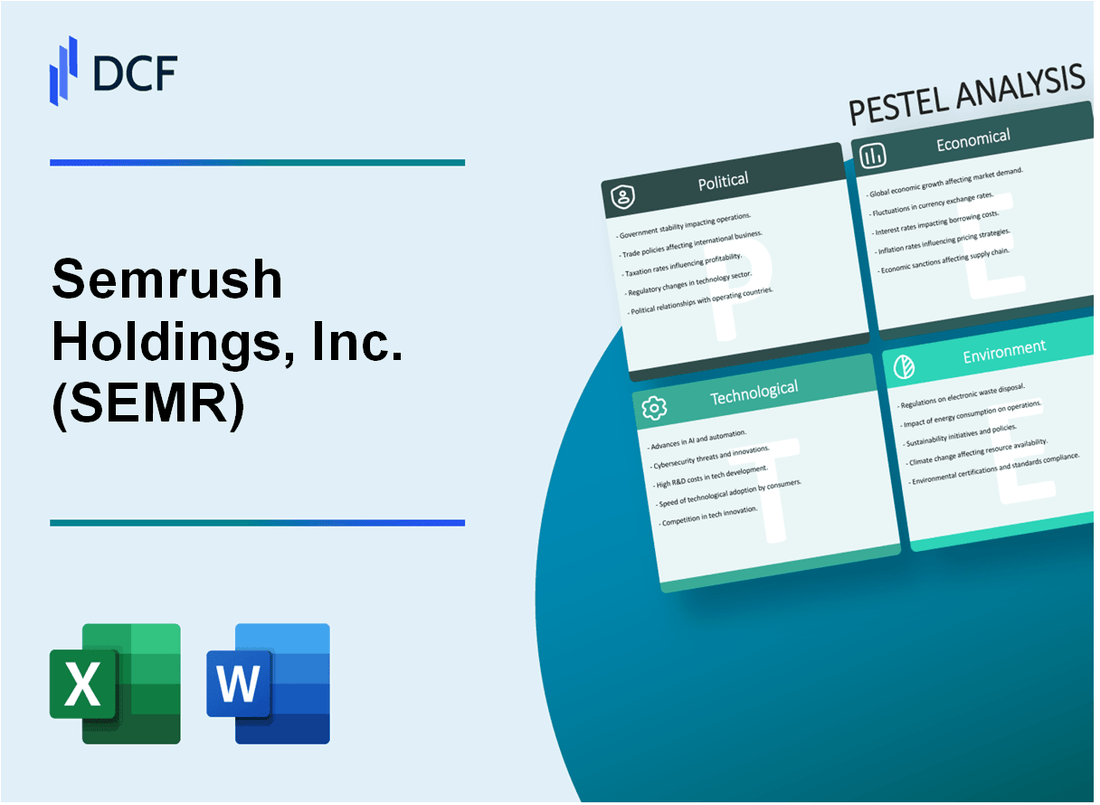
Semrush Holdings, Inc. (SEMR): Analyse de Pestle [Jan-2025 MISE À JOUR] |
Entièrement Modifiable: Adapté À Vos Besoins Dans Excel Ou Sheets
Conception Professionnelle: Modèles Fiables Et Conformes Aux Normes Du Secteur
Pré-Construits Pour Une Utilisation Rapide Et Efficace
Compatible MAC/PC, entièrement débloqué
Aucune Expertise N'Est Requise; Facile À Suivre
Semrush Holdings, Inc. (SEMR) Bundle
Dans le monde dynamique de la technologie de marketing numérique, Semrush Holdings, Inc. (SEMR) se dresse à une intersection critique de l'innovation mondiale et des forces externes complexes. Cette analyse complète du pilon dévoile le paysage multiforme qui façonne la trajectoire stratégique de l'entreprise, explorant comment les réglementations politiques, les tendances économiques, les changements sociétaux, les progrès technologiques, les cadres juridiques et les considérations environnementales influencent collectivement le modèle commercial de Semrush et le potentiel futur. Plongez dans cet examen complexe pour comprendre l'écosystème nuancé à l'origine de l'une des plates-formes d'intelligence de marketing numérique les plus convaincantes du marché technologique en évolution rapide d'aujourd'hui.
Semrush Holdings, Inc. (SEMR) - Analyse du pilon: facteurs politiques
Règlement sur les technologies de marketing numérique américain a un impact sur les opérations mondiales
En 2024, la Federal Trade Commission (FTC) américaine applique les réglementations sur le marketing numérique avec un budget annuel de 385 millions de dollars pour la technologie et la surveillance de la protection des consommateurs. Semrush doit se conformer aux cadres réglementaires suivants:
| Règlement | Exigences de conformité | Impact financier potentiel |
|---|---|---|
| Loi sur la transparence de la publicité numérique | Divulgation des méthodes de collecte de données | Amendes potentielles jusqu'à 43 792 $ par violation |
| California Consumer Privacy Act (CCPA) | Mécanismes de protection des données des utilisateurs et de désactivation | Pénalité maximale de 7 500 $ par violation intentionnelle |
Augmentation des lois sur la confidentialité des données affectant la collecte de données internationales
Les réglementations mondiales de confidentialité des données créent des défis de conformité importants:
- Le RGPD de l'Union européenne impose des pénalités jusqu'à 20 millions d'euros ou 4% du chiffre d'affaires annuel mondial
- La loi générale sur la protection des données du Brésil (LGPD) introduit des amendes pouvant atteindre 2% des revenus annuels
- La loi sur la protection des informations personnelles de la Chine oblige les exigences de localisation strictes
Tensions géopolitiques potentielles avec les marchés d'Europe de l'Est
Les origines russes de Semrush créent des défis géopolitiques potentiels:
| Pays | Niveau de tension politique | Impact potentiel de l'entreprise |
|---|---|---|
| États-Unis | Haut | Sanctions potentielles ou restrictions opérationnelles |
| Union européenne | Moyen | Augmentation des exigences de conformité et de vérification |
Exigences de cybersécurité du gouvernement
La conformité à la cybersécurité implique des investissements substantiels:
- Coûts de conformité du cadre de cybersécurité NIST: 1,2 million de dollars par an
- Soc 2 Type II Frais d'audit: environ 50 000 $ par certification
- Investissement annuel estimé aux infrastructures de cybersécurité: 3,5 millions de dollars
Mesures de conformité réglementaire clés pour Semrush en 2024:
| Catégorie de conformité | Dépenses annuelles | Pourcentage d'atténuation des risques |
|---|---|---|
| Conformité juridique et réglementaire | 2,7 millions de dollars | 87% de réduction des risques |
| Infrastructure de cybersécurité | 3,5 millions de dollars | Prévention des menaces à 92% |
Semrush Holdings, Inc. (SEMR) - Analyse du pilon: facteurs économiques
Les dépenses mondiales de marketing numérique continue de croître, bénéficiant à la position du marché de Semrush
Les dépenses publicitaires numériques mondiales ont atteint 626 milliards de dollars en 2023, avec une croissance projetée à 834 milliards de dollars d'ici 2026. Le chiffre d'affaires total de Semrush pour 2023 était de 236,4 millions de dollars, ce qui représente une augmentation de 22% d'une année sur l'autre.
| Année | Dépenses publicitaires numériques | Semrush Revenue | Croissance en glissement annuel |
|---|---|---|---|
| 2022 | 521 milliards de dollars | 194,4 millions de dollars | 27% |
| 2023 | 626 milliards de dollars | 236,4 millions de dollars | 22% |
| 2024 (projeté) | 712 milliards de dollars | 280 millions de dollars | 18% |
La récession économique potentielle pourrait réduire les investissements en technologie marketing
Attribution du budget de la technologie marketing: 26,6% des budgets marketing ont été alloués à la technologie en 2023, contre 33,2% en 2022, ce qui indique un impact potentiel de récession.
Les taux de change fluctuants ont un impact sur les revenus des marchés internationaux
Semrush fonctionne dans plusieurs devises. FLUCUATIONS DE TAUX DE COMMANDE EN 2023:
| Paire de devises | 2023 Fluctation | Impact sur les revenus |
|---|---|---|
| USD / EUR | -2.3% | 4,2 millions de dollars |
| USD / GBP | -1.7% | 3,6 millions de dollars |
Les évaluations du secteur technologique et les tendances d'investissement affectent les performances financières de l'entreprise
La capitalisation boursière de Semrush en janvier 2024: 1,87 milliard de dollars. Évaluation médiane du secteur technologique multiple: 6,5x revenus.
| Métrique financière | 2022 | 2023 | 2024 (projeté) |
|---|---|---|---|
| Capitalisation boursière | 1,42 milliard de dollars | 1,67 milliard de dollars | 1,87 milliard de dollars |
| Revenu multiple | 5.8x | 6.2x | 6.5x |
Semrush Holdings, Inc. (SEMR) - Analyse du pilon: facteurs sociaux
Demande croissante d'analyses marketing numériques et d'intelligence concurrentielle
La taille du marché mondial de l'analyse du marketing numérique a atteint 4,2 milliards de dollars en 2023, prévoyant une augmentation de 8,7 milliards de dollars d'ici 2028 avec un TCAC de 15,7%.
| Segment de marché | Valeur 2023 | 2028 Valeur projetée | TCAC |
|---|---|---|---|
| Analyse marketing numérique | 4,2 milliards de dollars | 8,7 milliards de dollars | 15.7% |
Tendances de travail à distance Augmentation du besoin d'outils de marketing numérique
L'adoption du travail à distance a atteint 28% dans le monde en 2023, ce qui stimule la demande d'outils de marketing numérique.
| Modèle de travail | Pourcentage |
|---|---|
| Travail à distance | 28% |
| Travail hybride | 32% |
| Travail sur place | 40% |
Importance croissante des stratégies de marketing basées sur les données
67% des leaders du marketing utilisent des stratégies basées sur les données, 82% des spécialistes du marketing signalant des capacités de ciblage améliorées.
| Métrique de la stratégie marketing | Pourcentage |
|---|---|
| Adoption de stratégie basée sur les données | 67% |
| Amélioration de l'efficacité du ciblage | 82% |
Augmentation de l'efficacité du marketing numérique parmi les petites et moyennes entreprises
Les petites et moyennes entreprises ont augmenté les dépenses de marketing numérique de 22,6% en 2023, totalisant 72,4 milliards de dollars.
| Taille de l'entreprise | Marketing numérique dépenser 2023 | Croissance d'une année à l'autre |
|---|---|---|
| Petites entreprises | 38,6 milliards de dollars | 19.3% |
| Entreprises moyennes | 33,8 milliards de dollars | 26.9% |
| Total | 72,4 milliards de dollars | 22.6% |
Semrush Holdings, Inc. (SEMR) - Analyse du pilon: facteurs technologiques
Intelligence artificielle et intégration d'apprentissage automatique dans l'analyse marketing
Semrush a investi 27,1 millions de dollars dans les dépenses de R&D en 2022, en se concentrant sur l'IA et les technologies d'apprentissage automatique. Les solutions alimentées par l'IA de l'entreprise ont traité plus de 25 milliards de mots clés et de 6,5 milliards de pages Web en 2023.
| Métrique technologique de l'IA | Performance de 2023 |
|---|---|
| Mots-clés traités | 25 milliards |
| Pages Web analysées | 6,5 milliards |
| Investissement en R&D | 27,1 millions de dollars |
Innovation continue de la plate-forme pour maintenir un avantage concurrentiel
Semrush a lancé 47 nouvelles fonctionnalités en 2023, avec un taux de satisfaction client de 92% pour les mises à jour de la plate-forme. Le portefeuille de brevets technologiques de la société est passé à 23 brevets enregistrés.
| Métriques d'innovation de plate-forme | 2023 données |
|---|---|
| De nouvelles fonctionnalités lancées | 47 |
| Taux de satisfaction client | 92% |
| Brevets technologiques | 23 |
Infrastructure de cloud computing permettant des solutions évolutives
SemRush utilise une infrastructure Amazon Web Services (AWS), traitant plus de 500 pétaoctets de données par an. Cloud Infrastructure prend en charge la disponibilité de 99,99% de la disponibilité de la plate-forme et permet le traitement des données en temps réel pour plus de 55 000 clients actifs.
| Métriques des infrastructures cloud | Performance de 2023 |
|---|---|
| Données traitées chaque année | Plus de 500 pétaoctets |
| Time de disponibilité de la plate-forme | 99.99% |
| Clients actifs | 55,000+ |
Les technologies de marketing numérique émergentes nécessitant une adaptation rapide
Semrush a alloué 18,5% des revenus totaux à l'adaptation technologique en 2023. La société a intégré des technologies avancées, notamment:
- Traitement du langage naturel (PNL)
- Analytique prédictive
- Moteurs de recommandation SEO en temps réel
| Métriques d'adaptation technologique | 2023 données |
|---|---|
| Revenus investis dans l'adaptation technologique | 18.5% |
| Intégrations de nouvelles technologies | 3 zones majeures |
Semrush Holdings, Inc. (SEMR) - Analyse du pilon: facteurs juridiques
Conformité aux réglementations du RGPD, du CCPA et de la protection des données internationales
Semrush Holdings, Inc. maintient le respect des réglementations clés de la protection des données dans le monde. Depuis 2024, la société a mis en œuvre des mesures complètes de protection des données portant sur plusieurs cadres juridiques internationaux.
| Règlement | Statut de conformité | Investissement annuel de conformité |
|---|---|---|
| RGPD | Compliance complète | 1,2 million de dollars |
| CCPA | Compliance complète | $850,000 |
| LGPD (Brésil) | Compliance complète | $650,000 |
Protection de la propriété intellectuelle pour les algorithmes et technologies propriétaires
Portefeuille de brevets: Semrush détient 37 brevets actifs en 2024, couvrant les innovations technologiques de base dans l'analyse du marketing numérique.
| Catégorie de brevet | Nombre de brevets | Dépenses annuelles de protection IP |
|---|---|---|
| Technologies d'algorithme | 22 | 1,5 million de dollars |
| Méthodes de traitement des données | 15 | 1,1 million de dollars |
Licences logicielles et accords contractuels avec des clients mondiaux
Semrush gère un portefeuille diversifié d'actions de licence de logiciels internationaux dans plusieurs régions.
| Région géographique | Contrats totaux de licence active | Valeur du contrat annuel |
|---|---|---|
| Amérique du Nord | 3,750 | 42,3 millions de dollars |
| Europe | 2,980 | 35,6 millions de dollars |
| Asie-Pacifique | 1,890 | 22,7 millions de dollars |
Défis juridiques potentiels liés aux pratiques de collecte de données et de confidentialité
Gestion des litiges juridiques: Semrush gère actuellement 4 défis juridiques en cours liés à la confidentialité des données, avec des coûts de défense juridique estimés totaux de 2,3 millions de dollars en 2024.
- Cas de litiges en attente de confidentialité: 4
- Dépenses de défense juridique estimées: 2,3 millions de dollars
- Conseil de conseiller juridique externe: 750 000 $ par an
Semrush Holdings, Inc. (SEMR) - Analyse du pilon: facteurs environnementaux
Engagement à réduire l'empreinte carbone grâce à des solutions basées sur le cloud
SemRush utilise l'infrastructure cloud Amazon Web Services (AWS), qui a rapporté une Réduction de 90% des émissions de carbone par rapport aux centres de données traditionnels sur site. La plate-forme basée sur le cloud de l'entreprise permet un Réduction de 64% de la consommation d'énergie par utilisateur.
| Métrique de réduction du carbone | Pourcentage |
|---|---|
| Efficacité énergétique des infrastructures nuages | 90% |
| Par réduction de la consommation d'énergie de l'utilisateur | 64% |
Les services numériques contribuant à la réduction du papier et du matériel de marketing physique
La plateforme de marketing numérique de Semrush élimine Environ 1,2 million de documents marketing imprimés par an. La solution numérique réduit la consommation de papier par 78% par rapport aux approches marketing traditionnelles.
| Métrique de réduction du papier | Montant |
|---|---|
| Documents de marketing imprimés annuels éliminés | 1,200,000 |
| Réduction de la consommation de papier | 78% |
Efficacité énergétique dans les opérations du centre de données
Les opérations du centre de données de Semrush via AWS réalisent un Évaluation de l'efficacité de la consommation de puissance (PUE) de 1,12, nettement inférieur à la moyenne de l'industrie de 1,57. Cela se traduit par 35% amélioré l'efficacité énergétique.
| Métrique de l'efficacité énergétique | Valeur |
|---|---|
| Efficacité de l'utilisation du pouvoir (PUE) | 1.12 |
| Pue moyen de l'industrie | 1.57 |
| Amélioration de l'efficacité énergétique | 35% |
Rapports de durabilité potentiels et initiatives de responsabilité sociale des entreprises
Semrush s'est engagé à Publication des rapports annuels de durabilité en mettant l'accent sur l'impact environnemental. La société suit et rapporte les mesures environnementales suivantes:
- Émissions totales de carbone: 2 450 tonnes métriques CO2E
- Utilisation d'énergie renouvelable: 42% de la consommation totale d'énergie
- Efforts de conservation de l'eau: 35% de réduction de la consommation d'eau
| Métrique de la durabilité | Valeur |
|---|---|
| Émissions totales de carbone | 2 450 tonnes métriques CO2E |
| Consommation d'énergie renouvelable | 42% |
| Réduction de l'utilisation de l'eau | 35% |
Semrush Holdings, Inc. (SEMR) - PESTLE Analysis: Social factors
Sustained high adoption of remote and hybrid work models drives tool dependency.
The enduring shift to flexible work models is a significant tailwind for Semrush Holdings, Inc. (SEMR), fundamentally changing how marketing and SEO teams operate. The need for a unified, cloud-based platform is no longer a convenience but a core operational requirement for distributed teams. By 2025, roughly 32.6 million Americans, or about 22% of the U.S. workforce, are working remotely, establishing a stable post-pandemic baseline far above pre-2020 levels. This is a massive, permanent market of users who need tools accessible from anywhere.
This trend means that marketing teams are no longer collaborating over a cubicle wall; they rely entirely on shared digital workspaces and tools. The multiplier effect is clear: the supply of remote job postings has roughly tripled since 2020, intensifying the competition for remote-capable talent and accelerating the maturation of tools that support distributed teams. Semrush's platform, designed for cloud access and team collaboration, is perfectly positioned to capture this demand. You simply cannot run a global SEO campaign without a single source of truth for your data.
- 83% of global workers prefer a hybrid arrangement.
- Remote work correlates with a 0.08% gain in total factor productivity.
- Flexibility is a measurable retention lever for talent.
Growing demand for integrated, all-in-one marketing platforms from SMBs.
Small and Medium Businesses (SMBs) are increasingly sophisticated in their digital marketing but are resource-constrained, creating a strong demand for integrated, all-in-one platforms that simplify complex workflows. More than three-quarters of SMBs agree that social media positively impacts their business performance, yet over half (54%) struggle to keep up with content needs across multiple channels. This struggle directly fuels the need for a consolidated platform like Semrush, which combines SEO, content, social media, and competitive research tools.
The market is moving away from a stack of single-point solutions toward unified experience platforms (UXP) that streamline operations. This is a crucial opportunity for Semrush, evidenced by the fact that 71% of SMB decision-makers are already using or would consider using Artificial Intelligence (AI) for their social media and marketing efforts. Semrush's focus on AI-powered toolkits, which contributed to its AI portfolio's Annual Recurring Revenue (ARR) more than doubling from Q2 2025, directly addresses this need for simplified, powerful, and integrated solutions.
Increased public awareness of data privacy, influencing tool trust.
Public skepticism and regulatory pressure around data privacy are now a critical social factor that directly impacts the credibility of any data-driven platform. This is not a niche concern; 79% of Americans are concerned about how companies use their data. For a company like Semrush, which relies on analyzing vast amounts of web data, demonstrating ethical and compliant data practices is paramount to maintaining user trust and attracting enterprise clients.
The skepticism is translating into concrete consumer behavior: 64% of consumers have opted not to work with a business because of privacy concerns, and 83% factor in trust before making a purchase. Furthermore, the rise of Generative AI (GenAI) has added a new layer of concern, with 59% of users feeling uncomfortable knowing their information is used to train AI algorithms. This means tools must be transparent about their data sourcing and usage. Semrush's ability to provide high-quality, compliant data insights without relying on intrusive personal data collection is a competitive advantage.
| Data Privacy Concern Metric (2025) | Value | Implication for Semrush |
|---|---|---|
| Consumers concerned about data use | 79% | Requires clear, transparent data policies to maintain trust. |
| Consumers who consider trust before purchase | 83% | Trust is a core competitive differentiator for the platform. |
| Users uncomfortable with data training AI | 59% | Must clearly communicate how AI tools are trained and what data is used. |
| Consumers who have stopped using a company over privacy | 64% | Direct risk to customer retention for non-compliant businesses. |
Talent shortage in SEO and content marketing drives demand for automation.
The persistent shortage of skilled professionals in specialized digital marketing roles-particularly SEO and content-is forcing businesses to turn to automation to maintain output. Marketing leaders consistently list competing priorities and limited bandwidth as their biggest challenges, affecting 29% of respondents in 2025 surveys. This gap in human capital is a direct driver of demand for Semrush's AI-powered tools.
The numbers show the clear value proposition of automation: marketers who use automation are 46% more likely to label their strategy as effective, and 80% of marketing automation users report generating more leads. AI adoption is accelerating, with 51% of marketers now using AI tools, especially for content repurposing and analytics. Automation is not just about efficiency; it's a cost-saving measure, with some reports showing it can reduce marketing overhead by 12.2%. Semrush's growth in its enterprise customer base, which saw a surge of 86% year-on-year in customers paying more than $50,000 annually in Q1 2025, validates this strategy of providing high-value, automation-rich solutions to fill the talent gap. The platform is essentially a productivity multiplier for stretched teams.
Semrush Holdings, Inc. (SEMR) - PESTLE Analysis: Technological factors
Generative AI (e.g., Google's Search Generative Experience) fundamentally changing SEO.
You need to understand this: Generative AI (GenAI) is not just another algorithm update; it's a foundational shift that threatens the core business model of traditional Search Engine Optimization (SEO) tools. Google's Search Generative Experience (SGE), which provides AI-generated summaries directly in the search results, is the primary catalyst here.
The immediate risk for all digital visibility platforms is the surge in zero-click searches, where users get their answer from the AI summary and never click through to a website. This phenomenon directly impacts the value proposition of Semrush, which is built on analyzing organic search rankings and traffic. For example, in March 2025, 13.14% of all queries triggered an AI Overview, up from 6.49% in January 2025, showing the rapid growth of this trend. The game is now Generative Engine Optimization (GEO), not just SEO.
Here's the quick math on the shift: If organic traffic declines by a predicted 50% by 2028 due to AI-powered search, as Gartner forecasts, a platform that only measures traditional SEO will become half as valuable. Semrush must prove its tools can optimize for being cited in the AI summary, not just ranking below it. That's the only way to retain customer value.
Need to rapidly integrate proprietary AI features into core product suite.
Semrush's response to the GenAI threat has been aggressive and focused on the enterprise segment, which is a smart move given the sequential decline in their total paying customers (down to approximately 114,000 as of Q3 2025). Their strategy is to embed proprietary AI to create new revenue engines. The results are already visible: the Annual Recurring Revenue (ARR) from their AI portfolio more than doubled from Q2 to Q3 2025, adding approximately $10 million in ARR in the third quarter alone.
Key proprietary AI features launched in 2025 include:
- AI Optimization (AIO): An Enterprise Solution providing tools to track, control, and optimize brand presence across AI-powered search platforms.
- AI Toolkits: All-in-one platform offering streamlined workflows and centralized marketing tools.
- Semrush One: A new product unifying SEO and AI visibility workflows, strengthening their competitive data moat.
This rapid innovation is defintely a high-cost strategy, but it's non-negotiable for survival. The full-year 2025 revenue outlook is between $443.5 million and $445.5 million, with a non-GAAP operating margin of approximately 12%, indicating that while growth continues, the margin is under pressure from these accelerated investments.
High competitive pressure from MarTech platforms and niche AI tools.
The competitive landscape is brutal. Semrush is not just competing with long-time SEO rivals; they face pressure from two new fronts: massive MarTech platforms and highly specialized, low-cost niche AI tools. The former offers a complete ecosystem (e.g., HubSpot), while the latter often provides a single, superior AI-driven function (e.g., an AI-only content generator).
The most significant competitive and strategic development in late 2025 is the announcement of Adobe's acquisition of Semrush for approximately $1.9 billion in an all-cash deal. This is a game-changer. The deal, announced on November 19, 2025, and expected to close in the first half of 2026, is a direct strategic move to integrate Semrush's SEO and GenAI visibility tools into the Adobe Experience Cloud. This immediately elevates Semrush's competitive standing, giving it the resources and distribution of a tech giant to compete with other large platforms.
The acquisition premium of approximately 77.5% over the prior closing price underscores the strategic value of Semrush's data and AI technology in the evolving market. This move validates their technology investments and positions the platform to compete at the highest enterprise level, especially since their enterprise customer segment (>$50,000 annual spend) grew by 72% year-over-year as of Q3 2025.
Continuous investment required for cloud infrastructure scalability and security.
Scaling a platform that processes billions of search queries and web pages daily, plus the massive computational load of training and running proprietary AI models, demands continuous, heavy investment in cloud infrastructure. While specific capital expenditure (CAPEX) on cloud infrastructure is not itemized, the overall financial picture confirms this high-investment necessity.
The need for scale is evident in the sheer volume of data processed, and this is compounded by the shift to AI. Running large language models (LLMs) and deep learning algorithms for features like the AI Visibility Toolkit requires exponentially more computing power than traditional keyword research. This is a capital-intensive race. Semrush's ability to generate strong cash flow is crucial for funding this: cash flow from operations for Q3 2025 was $21.9 million, representing a robust margin of 19.5%.
The table below summarizes the critical financial metrics that fund this technological push:
| Metric | Value (FY 2025 Outlook Midpoint) | Q3 2025 Actual | Significance |
|---|---|---|---|
| Full-Year Revenue | ~$444.5 million | $112.1 million | Funds R&D and AI development. |
| Non-GAAP Operating Margin (FY) | ~12% | 12.6% | Indicates profitability is maintained despite high tech investment. |
| Cash Flow from Operations (Q3) | N/A | $21.9 million | High cash generation capacity to fund cloud and AI infrastructure. |
| AI Portfolio ARR Added (Q3) | N/A | ~$10 million | Direct return on AI technology investment. |
The high cash generation is what allows Semrush to self-fund its ambitious scaling and AI integration without severe margin erosion, a key factor in their ability to remain a technological leader.
Semrush Holdings, Inc. (SEMR) - PESTLE Analysis: Legal factors
Fragmented global data privacy laws (GDPR, CCPA, new state laws) increase compliance costs.
You are operating a global Software-as-a-Service (SaaS) platform, so the patchwork of international data privacy regulations is a major, non-negotiable cost center. The most significant laws remain the European Union's General Data Protection Regulation (GDPR) and the various US state laws, notably the California Consumer Privacy Act (CCPA), now enhanced by the California Privacy Rights Act (CPRA). Compliance isn't a one-time fix; it's a continuous investment in legal counsel, technology, and internal processes.
To be fair, Semrush Holdings, Inc. is not a social media giant, but its global customer base of approximately 116,000 paying customers as of June 30, 2025, means it must adhere to these rules for every user in every jurisdiction. A single GDPR violation can result in fines up to €20 million or 4% of global annual turnover, whichever is higher. Considering Semrush's Q3 2025 revenue of $112.1 million, the financial downside of a major compliance failure is substantial.
Here's the quick math on the compliance risk:
- Average cost of a data subject access request (DSAR) is around $1,500.
- CCPA violations can cost up to $7,500 per incident with no total cap.
- The total sum of GDPR fines by early 2025 already exceeded €5.6 billion.
Risk of intellectual property disputes related to data scraping and analysis.
Semrush's core value proposition-providing competitive intelligence on search rankings, keywords, and traffic-rests on its ability to collect and analyze massive amounts of public web data. This practice, often called data scraping, is a legal gray zone that is getting defintely darker. The primary risk comes from the very search engines Semrush analyzes, like Google, which has been aggressively tightening its technical grip on web scrapers.
Intellectual property (IP) disputes here revolve around whether the compilation of data is protected by copyright or if the scraping violates a website's terms of service. For a company like Semrush, a successful IP lawsuit or a permanent technical block by a major search engine would directly impair its data accuracy, reduce the value of its platform, and increase its data acquisition costs dramatically. The ongoing legal battles surrounding the fair use defense for data used in training AI models are also relevant, as Semrush integrates AI into its tools.
New EU Digital Markets Act (DMA) and Digital Services Act (DSA) compliance obligations.
The EU's Digital Services Act (DSA) and Digital Markets Act (DMA) represent a significant regulatory hurdle, even if Semrush is not designated as a 'Gatekeeper' under the DMA like Alphabet or Meta. The DSA applies to all online intermediaries, but places the most stringent rules on Very Large Online Platforms (VLOPs), defined as having over 45 million average monthly active users in the EU. Semrush does not appear to meet this VLOP threshold, but it must still comply with the general DSA requirements for transparency, content moderation, and contact points for authorities.
The DMA, while targeting Gatekeepers, still impacts Semrush indirectly. The DMA forces Gatekeepers like Google to mitigate self-preferencing in their search results, which is intended to create a fairer playing field for competitors. This change in search engine behavior forces Semrush to constantly adapt its algorithms and data collection methods to ensure its SEO tools remain accurate and valuable to customers. The stakes are high for non-compliant companies, with potential DSA fines reaching up to 6% of annual worldwide turnover.
Evolving legal standards for AI-generated content and copyright.
Semrush is leaning into the AI trend, with its AI portfolio Annual Recurring Revenue (ARR) more than doubling from Q2 2025. This strategic pivot introduces new, complex copyright risks. As of 2025, the US Copyright Office and courts have been clear: purely AI-generated works without meaningful human input are not eligible for copyright protection. This means any content generated solely by Semrush's AI tools may be legally unprotected, creating a liability risk for customers who use it for branding or marketing without significant human editing.
The EU AI Act, with initial enforcement beginning in February 2025, further complicates matters by requiring providers of General-Purpose AI to adopt a copyright-compliance policy and publish a detailed summary of the data used for training. This is a new, costly transparency obligation.
This table shows the core AI-related legal risks and the required compliance actions:
| Legal Risk Area (2025 Focus) | Core Legal Standard | Impact on Semrush's AI Portfolio |
|---|---|---|
| Copyrightability of Output | US Copyright Office requires human authorship for protection. | Risk of customers' AI-generated content being unprotectable, leading to IP disputes. |
| Training Data IP | Ongoing lawsuits challenge 'fair use' for copyrighted data used in AI training. | Potential need to license training data or face litigation, increasing data costs. |
| EU AI Act Compliance | Requires a copyright-compliance policy and publishing a summary of training data. | New, mandatory transparency and legal audit costs in the EU market. |
Finance: Draft a 13-week cash view by Friday, explicitly modeling the cost of a 1% revenue fine under GDPR/DSA to quantify the catastrophic risk.
Semrush Holdings, Inc. (SEMR) - PESTLE Analysis: Environmental factors
You're running a Software-as-a-Service (SaaS) business, which means your direct environmental footprint is inherently small, but the indirect impact through your cloud providers is now a major investor and customer focus. The core takeaway is that Semrush Holdings, Inc. must aggressively translate its reliance on cloud giants like Amazon Web Services (AWS) and Microsoft Azure into transparent, quantifiable Scope 3 emissions reporting to meet 2025's heightened ESG standards.
Finance: Track Q4 2025 guidance for any revision to the full-year revenue estimate, which currently sits in the range of $443.5 million to $445.5 million, with the midpoint at $444.5 million.
Low Direct Carbon Footprint Due to SaaS Model
As a digital platform, Semrush Holdings, Inc. benefits from a structurally low direct carbon footprint (Scope 1 and 2 emissions), which is a key advantage over manufacturing or logistics companies. The business operates on a paperless model, which immediately positions it as a more sustainable solution for its customers.
Still, the reality is that the vast majority of your environmental impact is indirect, sitting with your cloud infrastructure partners. This is the definition of Scope 3 emissions (emissions from the value chain), and it's where the market is applying the most scrutiny in 2025. It's a clean business, but not a zero-impact one.
Reliance on Cloud Providers (AWS, Azure) and Indirect Impact
Your environmental performance is fundamentally tied to the sustainability efforts of your hyperscale cloud partners. This is a double-edged sword: you benefit from their massive efficiency gains, but you also inherit their reporting challenges. Migrating workloads from on-premises data centers to the cloud can reduce carbon emissions by up to 84%, which is a huge win.
However, investors are increasingly critical of the lack of granular transparency from these providers. For instance, while AWS is up to 4.1 times more energy-efficient than on-premises solutions, and Microsoft Azure is targeting 100% renewable energy by 2025, the methodology for calculating customer-specific carbon footprints is often criticized for excluding crucial upstream emissions.
Here's the quick math on the indirect impact opportunity:
| Cloud Provider Goal (2025) | Target | Significance for Semrush Holdings, Inc. |
| Microsoft Azure | 100% Renewable Energy by 2025 | Directly lowers Semrush's Scope 2 emissions (market-based) for Azure-hosted services. |
| Microsoft Azure | Carbon Negative by 2030 | Provides a long-term, high-ambition sustainability trajectory for Semrush's infrastructure. |
| Amazon Web Services (AWS) | Up to 4.1x More Energy-Efficient than on-premises | Quantifiable energy savings and carbon reduction for compute-heavy workloads. |
Increasing Investor and Customer Demand for Transparent ESG Reporting
The demand for transparent ESG (Environmental, Social, and Governance) data is no longer a nice-to-have; it's a baseline requirement for capital. By 2025, investors are demanding structured, financially relevant disclosures, not just a sustainability story.
- Investor Priority: Over 70% of global investors believe ESG and sustainability should be integrated into a company's core business strategy.
- Customer Scrutiny: Carbon emissions of cloud services are projected to be one of the top three factors users consider when selecting a cloud provider by 2025.
- Regulatory Push: New mandates like the U.S. Securities and Exchange Commission (SEC) Climate Disclosure Rules and Europe's CSRD are forcing public companies to provide audited emissions data.
If you can't report on your Scope 3 emissions credibly, you risk exclusion from major sustainable finance opportunities. It's that simple.
Opportunity to Position as a Sustainable, Paperless Business Solution
The opportunity for Semrush Holdings, Inc. is to move beyond being just a recipient of cloud sustainability and become an enabler of it for its own customers. The company has already started this by partnering with organizations like the Offset Foundation, providing its Trends API to help calculate large-scale data for carbon emission calculations with up to 95% accuracy.
This is a clear path to value creation: positioning the platform itself as a tool for customers to better manage their own digital environmental impact. The focus should be on:
- Quantifying the carbon savings a customer achieves by using Semrush's efficient digital tools instead of traditional, paper-heavy, or travel-intensive marketing methods.
- Promoting the platform's role in reducing digital waste through responsible data management and code efficiency.
What this estimate hides is the challenge of getting truly auditable Scope 3 data from the cloud providers themselves, which is the next frontier of ESG reporting for all SaaS companies.
Disclaimer
All information, articles, and product details provided on this website are for general informational and educational purposes only. We do not claim any ownership over, nor do we intend to infringe upon, any trademarks, copyrights, logos, brand names, or other intellectual property mentioned or depicted on this site. Such intellectual property remains the property of its respective owners, and any references here are made solely for identification or informational purposes, without implying any affiliation, endorsement, or partnership.
We make no representations or warranties, express or implied, regarding the accuracy, completeness, or suitability of any content or products presented. Nothing on this website should be construed as legal, tax, investment, financial, medical, or other professional advice. In addition, no part of this site—including articles or product references—constitutes a solicitation, recommendation, endorsement, advertisement, or offer to buy or sell any securities, franchises, or other financial instruments, particularly in jurisdictions where such activity would be unlawful.
All content is of a general nature and may not address the specific circumstances of any individual or entity. It is not a substitute for professional advice or services. Any actions you take based on the information provided here are strictly at your own risk. You accept full responsibility for any decisions or outcomes arising from your use of this website and agree to release us from any liability in connection with your use of, or reliance upon, the content or products found herein.