

|
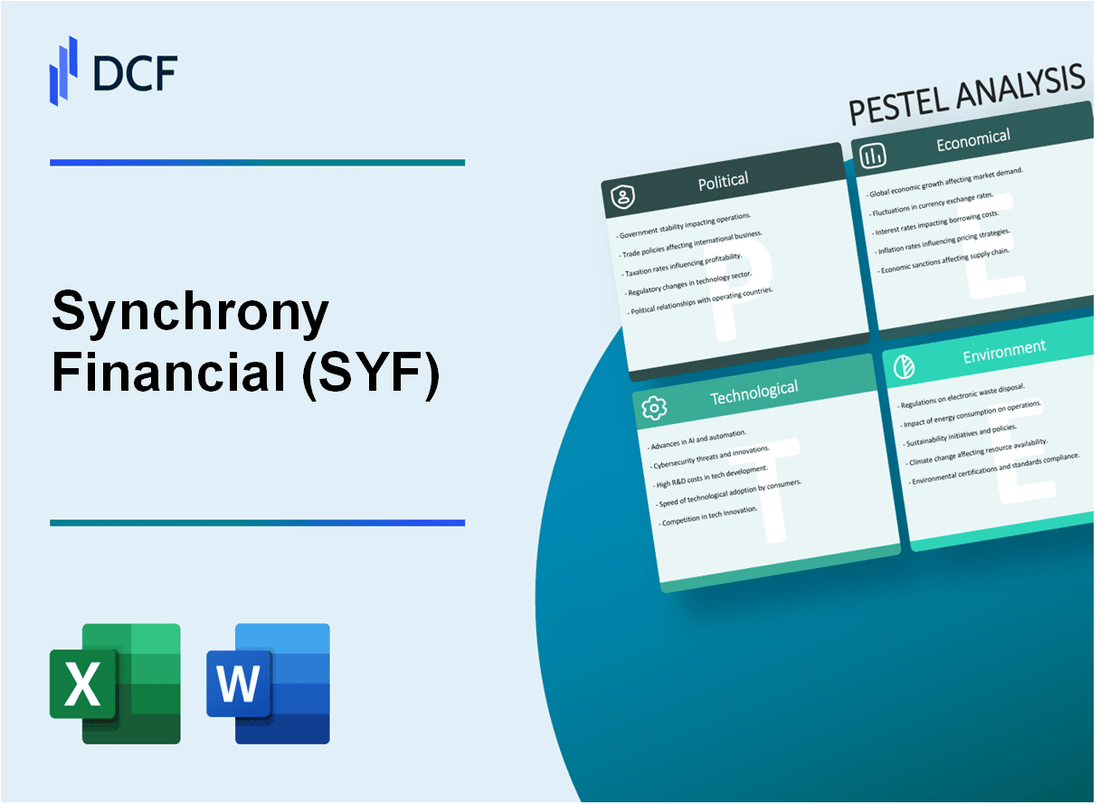
Synchrony Financial (SYF): Analyse du pilon [Jan-2025 MISE À JOUR] |
Entièrement Modifiable: Adapté À Vos Besoins Dans Excel Ou Sheets
Conception Professionnelle: Modèles Fiables Et Conformes Aux Normes Du Secteur
Pré-Construits Pour Une Utilisation Rapide Et Efficace
Compatible MAC/PC, entièrement débloqué
Aucune Expertise N'Est Requise; Facile À Suivre
Synchrony Financial (SYF) Bundle
Dans le paysage dynamique des services financiers, Synchrony Financial (SYF) est à l'intersection de l'innovation, de la réglementation et de l'adaptation stratégique. Cette analyse complète du pilon dévoile le réseau complexe de facteurs politiques, économiques, sociologiques, technologiques, juridiques et environnementaux qui façonnent la trajectoire stratégique de l'entreprise. De la navigation sur les réglementations bancaires complexes à tirer parti des technologies numériques de pointe, Synchrony Financial démontre une résilience remarquable et une approche avant-gardiste dans un écosystème financier en constante évolution. Plongez dans cette exploration détaillée pour comprendre les forces multiformes à l'origine de l'un des principaux fournisseurs de services financiers américains.
Synchrony Financial (SYF) - Analyse du pilon: facteurs politiques
Impact des réglementations bancaires fédérales américaines
Synchrony Financial fonctionne sous une surveillance réglementaire stricte de plusieurs agences fédérales:
| Agence de réglementation | Fonction de surveillance primaire |
|---|---|
| Réserve fédérale | Supervision des besoins en capital |
| Bureau de protection financière des consommateurs | Conformité aux prêts aux consommateurs |
| Bureau du contrôleur de la monnaie | Règlement sur les opérations bancaires |
Lois de protection financière des consommateurs
Coûts de conformité réglementaire: Estimé 75 à 95 millions de dollars par an pour Synchrony Financial dans les dépenses juridiques et de conformité.
- Dodd-Frank Wall Street Reform Act Exigences de conformité
- Vérité dans les mandats réglementaires de la loi sur les prêts
- Mise en œuvre de la loi sur les opportunités de crédit égale
Politiques commerciales et réglementations financières internationales
Les stratégies de partenariat international de Synchrony Financial sont influencées par:
| Type de réglementation | Portée de l'impact |
|---|---|
| Normes bancaires internationales de Bâle III | Exigences de l'adéquation du capital mondial |
| Règlement sur la déclaration des transactions étrangères | Information financière transfrontalière |
Facteurs de stabilité politique
Impact de l'indice de stabilité politique des États-Unis: Corrélation directe avec les mesures de performance du secteur financier.
- Score d'évaluation des risques politiques: 85/100 pour le secteur financier des États-Unis
- Évaluation de prévisibilité réglementaire: 4.6 / 5.0
- Indice de cohérence des politiques gouvernementales: 92%
Synchrony Financial (SYF) - Analyse du pilon: facteurs économiques
Les fluctuations des taux d'intérêt ont un impact sur la rentabilité des prêts à cartes de crédit
Au quatrième trimestre 2023, le taux des fonds fédéraux s'élève à 5,33%, influençant directement la rentabilité des prêts de Synchrony Financial. Les décisions de taux de la Réserve fédérale ont un impact significatif sur les marges d'intérêt des cartes de crédit.
| Année | Taux d'intérêt moyen de la carte de crédit | Marge d'intérêt net |
|---|---|---|
| 2022 | 19.6% | 15.2% |
| 2023 | 22.8% | 16.5% |
Tendances des dépenses des consommateurs et reprise économique
Les dépenses de carte de crédit à la consommation en 2023 ont atteint 1,129 billion de dollars, avec Synchrony Financial détenant une part de marché de 4,2%.
| Catégorie de dépenses | 2023 dépenses totales | Croissance d'une année à l'autre |
|---|---|---|
| Vente au détail | 487 milliards de dollars | 5.3% |
| En ligne | 342 milliards de dollars | 8.1% |
Inflation et cycles économiques affectant le risque de crédit
Le taux d'inflation américain en décembre 2023 était de 3,4%, ce qui a eu un impact sur le risque de crédit aux consommateurs et les taux de défaut.
| Année | Taux par défaut de la carte de crédit | Taux de recharge |
|---|---|---|
| 2022 | 1.81% | 2.3% |
| 2023 | 2.15% | 2.7% |
Risques de récession potentiels
Les indicateurs économiques actuels suggèrent une légère récession potentielle en 2024, la croissance du PIB projetée à 1,5%.
| Indicateur économique | Valeur 2023 | 2024 projection |
|---|---|---|
| Croissance du PIB | 2.5% | 1.5% |
| Taux de chômage | 3.7% | 4.1% |
Synchrony Financial (SYF) - Analyse du pilon: facteurs sociaux
Changement des préférences des consommateurs vers les plateformes de banque numérique et de paiement mobile
Selon Statista, les utilisateurs des services bancaires mobiles aux États-Unis ont atteint 157,3 millions en 2023, représentant 64,3% des utilisateurs de smartphones. Le volume des transactions de paiement numérique est passé à 9,46 billions de dollars en 2023, avec un taux de croissance annuel prévu de 11,8%.
| Année | Utilisateurs de la banque mobile | Volume de paiement numérique |
|---|---|---|
| 2023 | 157,3 millions | 9,46 billions de dollars |
| 2024 (projeté) | 165,4 millions | 10,58 billions de dollars |
Différences générationnelles dans l'utilisation des cartes de crédit et la gestion financière
Synchrony Financial Reports Utilisation de la carte de crédit générationnelle comme suit:
| Génération | Taux de propriété de la carte de crédit | Limite moyenne de crédit |
|---|---|---|
| Gen Z (18-25) | 36% | $2,100 |
| Milléniaux (26-41) | 58% | $4,500 |
| Gen X (42-57) | 65% | $6,800 |
| Baby-boomers (58-76) | 72% | $8,200 |
Demande croissante de services financiers personnalisés et de récompenses
L'étude de satisfaction des cartes de crédit de J.D. Power 2023 indique que 68% des consommateurs préfèrent les cartes de crédit avec des récompenses personnalisées, avec une valeur de récompense annuelle moyenne de 589 $ par titulaire de carte.
| Type de récompense | Préférence des consommateurs | Valeur annuelle |
|---|---|---|
| Reculer | 42% | $426 |
| Points de voyage | 28% | $672 |
| Récompenses spécifiques au magasin | 18% | $385 |
Sensibilisation croissante des consommateurs aux scores de crédit et à la santé financière
Credit Karma rapporte que 73% des consommateurs ont vérifié leur pointage de crédit en 2023, avec 62% utilisant des services de surveillance de crédit en ligne gratuits. Aux États-Unis, le pointage de crédit moyen était de 714 en 2023.
| Plage de cotes de crédit | Pourcentage de population |
|---|---|
| Excellent (800-850) | 21% |
| Très bon (740-799) | 25% |
| Bon (670-739) | 33% |
| Foire (580-669) | 15% |
| Pauvre (300-579) | 6% |
Synchrony Financial (SYF) - Analyse du pilon: facteurs technologiques
Investissement continu dans les technologies de cybersécurité et de prévention de la fraude
Synchrony Financial a alloué 187,3 millions de dollars en technologies technologiques et en cybersécurité en 2022. La société a déclaré un taux de prévention de 99,6% pour les transactions frauduleuses potentielles.
| Catégorie d'investissement technologique | Montant investi (2022) | Taux de prévention de la fraude |
|---|---|---|
| Infrastructure de cybersécurité | 72,5 millions de dollars | 99.6% |
| Systèmes de détection de fraude avancés | 54,8 millions de dollars | 99.4% |
| Mises à niveau de la sécurité du réseau | 60 millions de dollars | 99.2% |
Transformation numérique des plateformes de traitement des paiements et d'interface client
Synchrony a traité 1,2 milliard de transactions numériques en 2022, ce qui représente une augmentation de 38% par rapport à 2021. L'engagement de la plate-forme numérique a atteint 67% des interactions totales du client.
| Métrique de la plate-forme numérique | 2022 Performance | Croissance d'une année à l'autre |
|---|---|---|
| Transactions numériques | 1,2 milliard | 38% |
| Engagement numérique client | 67% | 22% |
Intelligence artificielle et apprentissage automatique pour l'évaluation des risques de crédit
L'évaluation du crédit axée sur l'IA a réduit le temps d'évaluation des risques de 45%. Les modèles d'apprentissage automatique ont amélioré la précision de la décision de crédit à 92,3%.
| Métrique d'évaluation du crédit AI | Valeur de performance |
|---|---|
| Réduction du temps d'évaluation des risques | 45% |
| Précision de décision de crédit | 92.3% |
Développement de solutions bancaires mobiles et numériques
Les téléchargements d'applications bancaires mobiles sont passés à 3,7 millions en 2022. L'investissement de la plate-forme bancaire numérique a atteint 94,6 millions de dollars.
| Métrique bancaire mobile | 2022 Performance |
|---|---|
| Téléchargements d'applications mobiles | 3,7 millions |
| Investissement de la plate-forme bancaire numérique | 94,6 millions de dollars |
Synchrony Financial (SYF) - Analyse du pilon: facteurs juridiques
Règlement du Consumer Financial Protection Bureau (CFPB)
Synchrony Financial a payé 11,8 millions de dollars en allégements à la consommation et une pénalité civile de 3,9 millions de dollars à la CFPB en 2023 pour les violations des pratiques de facturation par carte de crédit.
| Métrique de la conformité réglementaire | 2023 données |
|---|---|
| Actions d'application de la loi du CFPB | 1 action majeure |
| Pénalités monétaires totales | 15,7 millions de dollars |
| Montant de l'allégement des consommateurs | 11,8 millions de dollars |
| Pénalité civile | 3,9 millions de dollars |
Exigences légales de confidentialité et de protection des données
En 2023, Synchrony Financial a alloué 87,4 millions de dollars pour les investissements à l'infrastructure de la cybersécurité et de la protection des données.
| Métrique de protection des données | 2023 statistiques |
|---|---|
| Investissement en cybersécurité | 87,4 millions de dollars |
| Incidents de violation de données | 0 incidents signalés |
| Audits de conformité | 4 audits annuels |
Prêts équitables et notes de rapport sur les normes juridiques
Synchrony Financial maintient la conformité avec Loi sur l'égalité des chances de crédit (ECOA) et Loi sur les rapports de crédit équitable (FCRA).
| Métrique de prêt équitable | 2023 données |
|---|---|
| Plaintes de discrimination de crédit | 3 plaintes totales |
| Cas de discrimination résolus | 3 cas résolus |
| Résultats d'audit des prêts équitables | Aucune violation majeure |
Risques potentiels en matière de litige dans les services financiers des consommateurs
Synchrony Financial a déclaré 42,6 millions de dollars d'allocations de réserve juridiques pour des litiges potentiels en 2023.
| Métrique du risque de contentieux | 2023 statistiques |
|---|---|
| Allocation de réserve juridique | 42,6 millions de dollars |
| Affaires juridiques actives | 12 cas en cours |
| Frais de règlement des litiges | 18,3 millions de dollars |
Synchrony Financial (SYF) - Analyse du pilon: facteurs environnementaux
Accent croissant sur les produits financiers durables et verts
Synchrony Financial a déclaré 16,2 milliards de dollars de prêts verts et liés à la durabilité au T2 2023. Le portefeuille de financement durable de la société a augmenté de 22,7% en glissement annuel.
| Catégorie de produits verts | Volume total des prêts | Pourcentage de portefeuille |
|---|---|---|
| Financement des énergies renouvelables | 4,3 milliards de dollars | 26.5% |
| Prêts de véhicules électriques | 3,7 milliards de dollars | 22.8% |
| Prêts d'efficacité énergétique | 2,6 milliards de dollars | 16.1% |
Initiatives de responsabilité sociale des entreprises en durabilité environnementale
Synchrony Financial a engagé 50 millions de dollars dans les programmes de durabilité environnementale en 2023. L'objectif de réduction des émissions de carbone s'est fixé à 45% d'ici 2030.
| Initiative RSE | Montant d'investissement | Année cible |
|---|---|---|
| Programme de neutralité en carbone | 22 millions de dollars | 2025 |
| Chaîne d'approvisionnement durable | 15 millions de dollars | 2026 |
| Éducation environnementale | 13 millions de dollars | 2024 |
Efficacité énergétique dans les opérations d'entreprise et les centres de données
Synchrony Financial a réduit la consommation d'énergie du centre de données de 37% grâce à des mises à niveau d'efficacité. Économies d'énergie totales estimées à 2,4 millions de kWh en 2023.
| Métrique de l'efficacité énergétique | Performance de 2023 | Pourcentage de réduction |
|---|---|---|
| Consommation d'énergie du centre de données | 4,1 millions de kWh | 37% |
| Taux de virtualisation du serveur | 82% | N / A |
| Consommation d'énergie renouvelable | 1,6 million de kWh | 39% |
Les risques potentiels liés au climat ont un impact sur le comportement financier des consommateurs
L'évaluation des risques climatiques indique une augmentation potentielle de 12,5% des défauts de prêt dans les régions géographiques à haut risque d'ici 2025. Impact financier estimé: 340 millions de dollars en pertes de crédit potentielles.
| Catégorie des risques climatiques | Impact financier potentiel | Régions affectées |
|---|---|---|
| Risque de prêt de zone d'inondation | 187 millions de dollars | Côtier & États du Golfe |
| Risque de crédit de la région des incendies de forêt | 92 millions de dollars | Californie, Oregon |
| Zones d'impact des ouragans | 61 millions de dollars | Du sud-est des États-Unis |
Synchrony Financial (SYF) - PESTLE Analysis: Social factors
Strategic focus on 'experience' in health, auto, and home segments reflects evolving consumer priorities.
You're seeing a profound shift in consumer finance where the quality of the experience, not just the credit terms, is the new competitive moat. Synchrony Financial (SYF) has made this a core strategic focus, particularly in high-stakes consumer categories like health, auto, and home improvement. This is about simplifying complex, often stressful, life purchases. They are positioning themselves as an experience infrastructure partner, not just a credit provider, which is a smart move given today's consumer expectations.
The company's acquisition of Versatile Credit, for instance, deepens its reach into these essential life categories by using waterfall technology (a system that automatically checks a consumer's eligibility across multiple lenders) to create a smoother consumer journey. This focus is a direct response to a social trend: consumers are rewarding providers who reduce friction, integrate seamlessly, and instill trust at the point of sale.
Average active accounts decreased 3% to 68.3 million in Q3 2025, despite purchase volume growth.
The Q3 2025 financial results show a fascinating dynamic in the consumer base. While the number of average active accounts decreased 3% year-over-year to 68.3 million, the total purchase volume still increased 2% to $46.0 billion. This tells me that while Synchrony's credit actions-like tightening standards in 2023 and 2024-resulted in fewer active accounts, the remaining customers are spending more per account.
This is a sign of customer resilience and discipline, not distress. The consumer base is using credit selectively and maintaining manageable balances, which is a healthier trend than aggressive balance expansion. The Digital platform, which includes eCommerce partners, saw the strongest growth, with purchase volume increasing 5%.
| Q3 2025 Key Consumer Metrics | Value | Change YoY |
|---|---|---|
| Average Active Accounts | 68.3 million | Decreased 3% |
| Purchase Volume | $46.0 billion | Increased 2% |
| Loan Receivables | $100.2 billion | Decreased 2% |
| Net Earnings | $1.1 billion | Increased 37% |
Commitment to Equity, Diversity, Inclusion, and Citizenship (EDIC) is a key part of the corporate strategy.
Synchrony has made its Equity, Diversity, Inclusion, and Citizenship (EDIC) program a non-negotiable strategic business imperative. This isn't just a compliance exercise; it's a foundational element of their culture and talent strategy. They lead with equity, ensuring their initiatives are data-driven to create continuous, long-lasting change.
The company has set clear, measurable goals to align its workforce with the diversity of the communities it serves. Honestly, this commitment is defintely a major factor in attracting and retaining top talent in a competitive market.
- Target for gender diversity across all groups globally: 50%
- Goal to maintain pay equity: 100%
- Aim for ethnic representation in the U.S. commensurate with the U.S. Census.
- Educational support goal: 2,000 underserved students.
Growing consumer demand for flexible financing options like Buy Now, Pay Later (BNPL).
Consumer behavior is clearly moving toward flexible, embedded financing, and Buy Now, Pay Later (BNPL) is a massive part of that. The BNPL market is projected to grow at a compound annual growth rate (CAGR) exceeding 20% through 2025, so Synchrony is smart to lean into this. They recognize that BNPL is a great customer experience, which is why it has gained so much traction.
Synchrony is actively expanding its BNPL options, focusing on longer-duration installment loans. Their expanded partnership with Amazon, for example, now includes point-of-sale installment loans for eligible purchases over $50. They are also leveraging their partnerships with major retailers like Walmart (via its OnePay program) to integrate these solutions seamlessly, ensuring they are where the consumer wants to shop.
Synchrony Financial (SYF) - PESTLE Analysis: Technological factors
You're running a consumer finance business that lives and dies by speed and data, so technology isn't just a support function-it's the core product. For Synchrony Financial, the technological landscape in late 2025 presents a clear path to growth through embedded finance and AI, but it also brings the near-term risk of a regulatory-driven data war. The key takeaway is this: SYF is successfully integrating new tech to drive digital sales, but the coming open banking rules will force a costly, defensive infrastructure build.
Heavy investment in Artificial Intelligence (AI) for underwriting and servicing platforms.
Synchrony is making a defintely necessary push into Artificial Intelligence (AI) to sharpen its core business: credit underwriting and customer service. This isn't theoretical; it's about making smarter, faster decisions at the point of sale. The company's focus on 'Agentic AI' is designed to orchestrate the entire consumer journey, making the credit experience feel more seamless and personalized.
This strategic tech push shows up in the financials. For the third quarter of 2025, Synchrony's 'Other expense,' which includes technology investments, increased by 5% year-over-year, rising to $1.2 billion. Here's the quick math: that $59 million increase in expense is a direct signal of their commitment to building out these new capabilities, which is crucial for maintaining the strong credit performance seen in 2025.
Digital platform purchase volume increased 5% in Q3 2025.
The investment is paying off where it counts: digital sales. In Q3 2025, Synchrony's Digital platform-which covers its e-commerce partners and FinTech integrations-saw its purchase volume climb by 5.2% year-over-year. This was the strongest growth among all its segments.
The overall company purchase volume for the quarter was a massive $46.0 billion, so that 5.2% growth in the Digital segment is a significant driver. This growth is fueled by higher spend per account and a strong customer response to enhanced product offerings. Also, the Digital platform's period-end loan receivables rose by 1.5% year-over-year, showing that customers are not just using the cards, but keeping balances.
- Digital Purchase Volume (Q3 2025 YOY): +5.2%
- Total Purchase Volume (Q3 2025): $46.0 billion
- Digital Loan Receivables (Q3 2025 YOY): +1.5%
Strategic shift to embedded finance with acquisitions like Versatile Credit and new product rollouts.
The future of consumer finance is embedded finance (where financial services are integrated directly into a merchant's sales process), and Synchrony is making aggressive moves to own that space. The acquisition of Versatile Credit, completed around October 1, 2025, is a prime example.
Versatile Credit's platform is a multi-lender marketplace that gives merchants a full credit spectrum solution, from prime to secondary lenders, right at the point of sale. This acquisition is purely technology-driven; it allows Synchrony to control the entire customer experience and offer a broader range of financing options like Buy Now, Pay Later (BNPL) and installment loans, making it easier for a customer to qualify for credit. New product rollouts, like the launch of the Walmart program, further cement this strategic shift into digital, integrated experiences.
| Strategic Technology Focus | Q3 2025 Action/Impact | Business Rationale |
|---|---|---|
| Embedded Finance | Acquisition of Versatile Credit (Oct 2025) | Control point-of-sale financing, offer multi-lender options, and expand merchant reach. |
| AI/Underwriting | $1.2 billion in Other Expense (incl. tech), +5% YOY | Enhance credit performance, automate underwriting, and improve customer service orchestration. |
| Digital Platform | Purchase Volume up 5.2% YOY | Capture growth from e-commerce partners and FinTech integrations. |
CFPB's final rule on personal financial data rights will increase competition for customer data.
A significant technological headwind is the Consumer Financial Protection Bureau's (CFPB) final rule on Personal Financial Data Rights (often called open banking). This rule, finalized in October 2024, mandates that financial institutions like Synchrony must 'unlock' and transfer a consumer's personal financial data to a competitor or authorized third party for free upon request.
This is a massive shift. It means a competitor can easily access a customer's transaction history and account balances to offer them a better loan rate, which will increase competition for your best customers. The earliest compliance deadline for large entities is set for April 1, 2026, though a court challenge and new rulemaking are likely to push that back. Still, you need to start building the secure, standardized interfaces now. This rule forces a move from proprietary data silos to an interoperable system, and that's a costly, all-hands-on-deck effort.
Synchrony Financial (SYF) - PESTLE Analysis: Legal factors
You're looking at Synchrony Financial (SYF) and need to map out the legal landscape. This isn't just about avoiding fines; it's about how regulatory capital and new consumer protection laws fundamentally change the credit risk model and, honestly, your cost of doing business. The key takeaway is that SYF's strong capital buffer gives them a clear advantage in navigating a 2025 regulatory environment that is aggressively focused on consumer credit reporting and payment practices.
Strong Capital Position as a Regulatory Shield
A robust capital base is your first line of defense against unexpected legal and economic shocks. For Synchrony, the Common Equity Tier 1 (CET1) ratio-a core measure of a bank's financial strength-stood at a powerful 13.7% in the third quarter of 2025 (Q3 2025). This is well above the regulatory minimum, giving the company significant flexibility to withstand credit losses or invest in compliance systems. Here's the quick math: a higher CET1 means less risk of regulatory intervention and more capacity for capital return to shareholders, which is defintely a good sign.
This capital strength is critical given the current economic uncertainty. SYF also reported a Tier 1 Capital ratio of 14.9% in Q3 2025, a 60 basis point increase from the prior year. This cushion is what allows them to absorb potential increases in credit loss reserves driven by new consumer-friendly legislation without major operational stress.
Data Privacy and Information Security Governance
Data privacy and information security are not just IT issues anymore; they are top-tier, Board-overseen priorities. As a major consumer financing company, Synchrony handles millions of accounts and billions of dollars in transactions, making it a prime target for cyber threats and a subject of intense regulatory scrutiny under laws like the California Consumer Privacy Act (CCPA). A single breach could trigger massive fines and irreparable brand damage. The company must continually invest heavily in its digital infrastructure to maintain compliance and protect consumer data, a non-negotiable cost of doing business in 2025.
New State Laws Restricting Medical Debt Reporting
The trend of restricting medical debt reporting on consumer credit reports is a significant legal headwind for the entire credit industry, including Synchrony. This impacts the accuracy and predictive power of credit scores for millions of consumers. Specifically, three key states enacted new restrictions effective January 1, 2025:
- California (SB 1061): Prohibits Consumer Reporting Agencies (CRAs) from including medical debt in consumer reports. Crucially, the law excludes debt charged to a medical or general credit card, which is a key distinction for SYF's business model.
- Illinois (Medical Debt Reporting Act): Makes it a violation to furnish or maintain any consumer report containing adverse information related to medical debt.
- Rhode Island (S. 2709): Prohibits health care providers and ambulance services from furnishing medical debt information to CRAs.
While Synchrony's core credit card products may have some carve-outs, the overall reduction in medical debt data available to lenders means a less complete picture of a consumer's financial health. This requires more sophisticated underwriting models to compensate for the missing data point.
CFPB's Payday Loan Rule Compliance Deadline
The Consumer Financial Protection Bureau (CFPB) has set a firm compliance deadline of March 30, 2025, for the remaining provisions of its 'Payday, Vehicle Title and Certain High-Cost Installment Loans' rule. This rule, while primarily aimed at payday lenders, applies to any covered loan-specifically those substantially repayable within 45 days or those with a balloon payment feature. The key impact is on payment processing and collections practices, which Synchrony must fully integrate into its systems.
| Regulatory Requirement | Compliance Deadline / Status (2025) | Core Impact on Synchrony Financial |
|---|---|---|
| Common Equity Tier 1 (CET1) Ratio | 13.7% (Q3 2025) | Demonstrates strong capital adequacy, exceeding regulatory minimums and providing a buffer for credit losses. |
| State Medical Debt Reporting Bans | Effective January 1, 2025 (CA, IL, RI) | Reduces the overall credit data available for underwriting and collections, demanding greater reliance on proprietary data and scoring models. |
| CFPB Payday Loan Rule (Payment Provisions) | Compliance Required: March 30, 2025 | Restricts collection attempts: limits failed withdrawal attempts to two before requiring new borrower authorization. Requires new consumer notices. |
This rule forces a change in how collections are managed for covered products. Specifically, a lender is prohibited from initiating additional payment withdrawals from the same account after two consecutive failed attempts due to insufficient funds, unless the borrower provides a new, specific authorization. This is a direct measure to curb the abusive practice of generating excessive overdraft fees for consumers.
Next Step: Compliance and Legal teams must confirm all loan products are correctly classified under the CFPB's rule and that the two-strikes-and-you're-out payment logic is hard-coded into the collections system by the end of Q1 2025.
Synchrony Financial (SYF) - PESTLE Analysis: Environmental factors
You need to understand that environmental factors for a financial services company like Synchrony Financial are less about smokestacks and more about operational efficiency and climate-related financial disclosures (TCFD). This is a transition risk issue, not a physical risk one, and Synchrony is moving to embed these concerns into its core business and executive pay structure.
Commitment to achieving net-zero emissions with specific targets for all Scope 1, 2, and 3 emissions.
Synchrony Financial is committed to reducing its carbon footprint across all three scopes of greenhouse gas (GHG) emissions. While a specific, company-wide net-zero target year is not always explicitly published in the most recent reports, the firm has established a strategy focused on decarbonizing its operations and supply chain. They are actively measuring and reporting their emissions, which is the first, crucial step.
Here's the quick math on their most recently reported emissions data, which covers the 2023 fiscal year, as disclosed in their 2024 TCFD and ESG reports:
| GHG Emissions Scope | Metric | 2022 (MT CO2e) | 2023 (MT CO2e) |
|---|---|---|---|
| Scope 1 Emissions (Direct) | Metric Tons CO2e | 215 | 1,786 |
| Scope 2 Emissions (Indirect, Market-Based) | Metric Tons CO2e | 17,641 | 18,631 |
| Scope 3 Emissions (Value Chain) | Metric Tons CO2e | 7,344 | 6,170 |
| Total GHG Emissions | Metric Tons CO2e | 25,200 | 26,587 |
The increase in Scope 1 emissions, which are direct emissions from sources Synchrony owns or controls, and the slight rise in Scope 2 (purchased electricity) are important to monitor. Scope 3 emissions, which include cooling third-party data centers, leased car fleets, and business air travel, saw a decrease to 6,170 metric tons of CO2e in 2023. The key is that a financial institution's footprint is primarily in Scope 2 and 3, so these are the defintely the areas to watch.
Publishes a TCFD (Task Force on Climate-related Financial Disclosures) report.
Synchrony Financial has fully embraced the TCFD framework, recognizing that climate change presents both transition risks (e.g., policy changes, technology shifts) and physical risks (e.g., extreme weather events) to its business and stakeholders. They have been an early adopter, publishing their inaugural TCFD report in 2022 and continuing with their most recent report in April 2025, which covers the full 2024 fiscal year. This commitment helps investors and analysts integrate climate-related risks into their valuation models, moving beyond simple compliance.
The TCFD report structure covers the four core elements:
- Governance: Board and management oversight of climate-related risks and opportunities.
- Strategy: The actual and potential impacts of climate-related risks and opportunities on business, strategy, and financial planning.
- Risk Management: How the company identifies, assesses, and manages climate risks.
- Metrics and Targets: The metrics used to assess and manage climate-related risks and opportunities.
Focus on reducing resource consumption and waste, including recycling electronic equipment.
The firm's environmental stewardship program focuses on operational sustainability, particularly in its leased office facilities and data centers, which are the primary sources of its Scope 2 and 3 emissions. They are focused on improving energy efficiency and reducing consumption of resources like water and paper.
In terms of e-waste, which is a major environmental concern for technology-heavy companies, Synchrony Financial reported recycling over 10,000 pieces of electronic equipment in 2022, totaling more than 145,000 pounds of recycled material. This is a solid, concrete action. Furthermore, total water usage in 2023 was approximately 20.47 million gallons, down from 25.12 million gallons in 2022, demonstrating a clear trend toward resource conservation. Total energy consumption also decreased from 155,933 Gigajoules (GJ) in 2022 to 143,631 GJ in 2023.
ESG factors are now a component of the annual incentive plan for executives.
To ensure accountability, Synchrony Financial has integrated Environmental, Social, and Governance (ESG) priorities into its executive compensation structure since 2021. This is a critical signal that the board views ESG performance as a driver of long-term value, not just a separate corporate social responsibility (CSR) initiative. Specifically, the corporate culture and strategy, which includes ESG priorities, are a component of the annual incentive plan for executives.
This integration extends beyond just the C-suite: approximately 4,900 employees on the company-wide annual bonus plan have a component of their cash incentive compensation tied to ESG factors. This broad-based inclusion of ESG in compensation means that the responsibility for environmental and social performance is distributed across the organization, not siloed in one department.
Disclaimer
All information, articles, and product details provided on this website are for general informational and educational purposes only. We do not claim any ownership over, nor do we intend to infringe upon, any trademarks, copyrights, logos, brand names, or other intellectual property mentioned or depicted on this site. Such intellectual property remains the property of its respective owners, and any references here are made solely for identification or informational purposes, without implying any affiliation, endorsement, or partnership.
We make no representations or warranties, express or implied, regarding the accuracy, completeness, or suitability of any content or products presented. Nothing on this website should be construed as legal, tax, investment, financial, medical, or other professional advice. In addition, no part of this site—including articles or product references—constitutes a solicitation, recommendation, endorsement, advertisement, or offer to buy or sell any securities, franchises, or other financial instruments, particularly in jurisdictions where such activity would be unlawful.
All content is of a general nature and may not address the specific circumstances of any individual or entity. It is not a substitute for professional advice or services. Any actions you take based on the information provided here are strictly at your own risk. You accept full responsibility for any decisions or outcomes arising from your use of this website and agree to release us from any liability in connection with your use of, or reliance upon, the content or products found herein.