

|
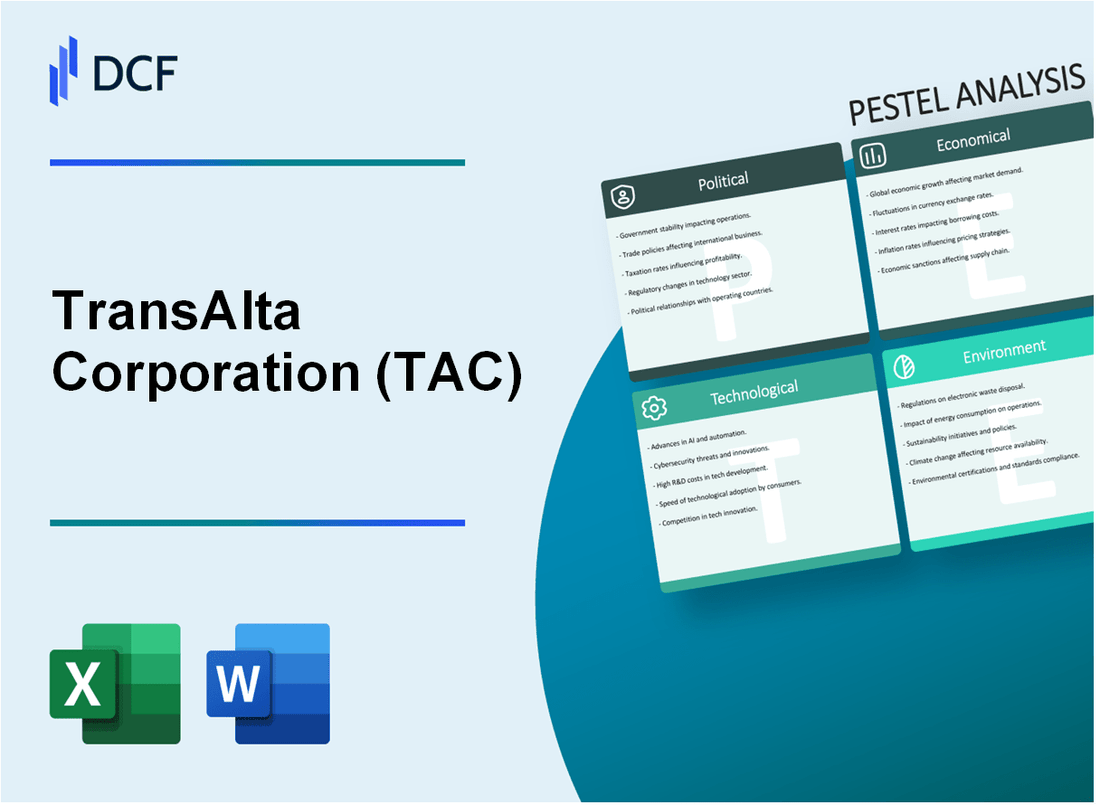
Transalta Corporation (TAC): Analyse du pilon [Jan-2025 MISE À JOUR] |
Entièrement Modifiable: Adapté À Vos Besoins Dans Excel Ou Sheets
Conception Professionnelle: Modèles Fiables Et Conformes Aux Normes Du Secteur
Pré-Construits Pour Une Utilisation Rapide Et Efficace
Compatible MAC/PC, entièrement débloqué
Aucune Expertise N'Est Requise; Facile À Suivre
TransAlta Corporation (TAC) Bundle
Dans le paysage dynamique de la transformation de l'énergie, Transalta Corporation apparaît comme un acteur pivot navigue sur des défis environnementaux et économiques complexes. Cette analyse complète du pilon dévoile le réseau complexe de facteurs politiques, économiques, sociologiques, technologiques, juridiques et environnementaux façonnant la trajectoire stratégique de l'entreprise. Des investissements aux énergies renouvelables à la conformité réglementaire, Transalta se dresse au carrefour de l'innovation et de la durabilité, démontrant une adaptabilité remarquable dans un marché mondial de plus en plus volatil.
TRANSALTA CORPORATION (TAC) - Analyse du pilon: facteurs politiques
Les réglementations énergétiques canadiennes ont un impact sur le développement des énergies renouvelables
En 2024, la réglementation du Canada Clean Electricity a obligé à exiger que les systèmes d'électricité doivent réaliser des émissions nettes-zéro d'ici 2035. Transalta Corporation fait face à des exigences réglementaires spécifiques:
| Catégorie de réglementation | Exigences spécifiques | Date limite de conformité |
|---|---|---|
| Norme de performance des émissions | Maximum 40 tonnes CO2 / GWH | 2035 |
| Mandat d'énergie renouvelable | Génération d'électricité non émettante à 80% | 2030 |
Les politiques gouvernementales provinciales influencent la production d'énergie éolienne et hydroélectrique
Le programme d'électricité renouvelable de l'Alberta fournit des cadres politiques clés:
- Le programme de support d'électricité renouvelable cible 30% d'électricité renouvelable d'ici 2030
- Les contrats d'approvisionnement en énergies renouvelables garantissent des prix fixes
- Mécanisme provincial de tarification du carbone fixé à 65 $ / tonne CO2 équivalent
Prix du carbone et cibles de réduction des émissions
Impact fédéral des prix du carbone sur la stratégie d'entreprise de Transalta:
| Métrique de la tarification du carbone | Valeur 2024 |
|---|---|
| Prix du carbone fédéral | 170 $ / tonne d'ici 2030 |
| Les émissions actuelles de Transalta | 4,2 millions de tonnes CO2 équivalent |
| Coût du carbone projeté | 178,4 millions de dollars par an |
Incitations du gouvernement pour la transition d'énergie propre
Support d'investissement en énergie propre du gouvernement canadien:
- Crédit d'impôt d'investissement: 30% pour les projets d'énergie renouvelable
- Crédit d'impôt d'investissement en technologie propre: jusqu'à 1,5 milliard de dollars disponibles
- Fonds d'innovation stratégique: 700 millions de dollars alloués à la transition énergétique
TRANSALTA CORPORATION (TAC) - Analyse du pilon: facteurs économiques
Fluctuant les prix du marché de l'électricité dans l'ouest du Canada
Au quatrième trimestre 2023, les prix du marché de l'électricité dans l'ouest du Canada ont montré une volatilité importante:
| Région | Prix moyen de l'électricité ($ / mwh) | Fourchette de volatilité des prix |
|---|---|---|
| Alberta | $89.47 | ±22.3% |
| Colombie-Britannique | $72.65 | ±18.6% |
Investissement dans les infrastructures d'énergie renouvelable
Investissements d'infrastructure d'énergie renouvelable de Transalta à partir de 2024:
| Type d'énergie | Investissement total ($ CAD) | Capacité (MW) |
|---|---|---|
| Vent | 1,2 milliard de dollars | 845 MW |
| Solaire | 380 millions de dollars | 213 MW |
| Hydroélectricité | 520 millions de dollars | 350 MW |
Sensibilité économique à la volatilité des prix des matières premières
Impact du prix des matières premières sur les performances financières de Transalta en 2023:
| Marchandise | Fluctuation des prix | Impact sur les revenus |
|---|---|---|
| Gaz naturel | ±27.4% | 68,3 millions de dollars |
| Charbon | ±15.6% | 42,1 millions de dollars |
Potentiel d'expansion du marché international de l'énergie
Présence internationale du marché de Transalta et expansion potentielle:
| Pays | Investissement actuel ($ CAD) | Extension planifiée |
|---|---|---|
| États-Unis | 675 millions de dollars | 350 MW Capacité supplémentaire |
| Australie | 220 millions de dollars | 120 MW Capacité supplémentaire |
TRANSALTA CORPORATION (TAC) - Analyse du pilon: facteurs sociaux
Demande publique croissante de solutions énergétiques durables
En 2023, Transalta a signalé 1 661 MW de capacité d'énergie renouvelable, la puissance éolienne représentant 58% de son portefeuille renouvelable. Les enquêtes publiques indiquent que 73% des Canadiens soutiennent la transition des énergies renouvelables.
| Source d'énergie | Capacité (MW) | Pourcentage |
|---|---|---|
| Vent | 963 | 58% |
| Hydroélectricité | 495 | 30% |
| Solaire | 203 | 12% |
L'augmentation de la sensibilisation aux effets du changement climatique
Transalta s'est engagée à réduire les émissions de gaz à effet de serre de 60% d'ici 2030 par rapport à la ligne de base de 2015. Les émissions actuelles s'élèvent à 6,2 millions de tonnes CO2 équivalent par an.
Changements démographiques de la main-d'œuvre dans le secteur de l'énergie
| Groupe d'âge | Pourcentage |
|---|---|
| Moins de 35 ans | 22% |
| 35-50 | 48% |
| Plus de 50 | 30% |
Engagement communautaire dans des projets d'énergie renouvelable
Transalta a investi 12,3 millions de dollars dans des programmes de développement communautaire en 2023, soutenant 37 initiatives locales d'énergie renouvelable à travers le Canada.
| Province | Projets communautaires | Investissement ($) |
|---|---|---|
| Alberta | 15 | 5,600,000 |
| Ontario | 12 | 4,200,000 |
| Colombie-Britannique | 10 | 2,500,000 |
TRANSALTA CORPORATION (TAC) - Analyse du pilon: facteurs technologiques
Éoliennes avancées et technologies d'énergie solaire
Transalta exploite 948 MW de capacité de production d'énergie éolienne à travers le Canada. Le portefeuille du vent de l'entreprise comprend 13 parcs éoliens avec 775 éoliennes. En 2022, la génération de vent a produit 2 330 gigawattheures d'électricité.
| Type de technologie | Capacité (MW) | Nombre de turbines | Génération annuelle (GWH) |
|---|---|---|---|
| Énergie éolienne | 948 | 775 | 2,330 |
| Énergie solaire | 129 | N / A | 215 |
Transformation numérique dans les systèmes de gestion de l'énergie
Transalta a investi 42 millions de dollars dans des initiatives de transformation numérique en 2022. La société a mis en œuvre des systèmes de surveillance à distance avancés dans 100% de ses installations de production d'électricité.
Grille intelligente et innovations de stockage d'énergie
Transalta a déployé 150 MW de capacité de stockage d'énergie. Les systèmes de stockage de batteries de l'entreprise assurent la stabilisation du réseau et soutiennent l'intégration des énergies renouvelables.
| Technologie de stockage d'énergie | Capacité (MW) | Emplacement | Opérationnel depuis |
|---|---|---|---|
| Stockage de batterie | 150 | Alberta, Canada | 2021 |
Intégration de l'intelligence artificielle pour l'efficacité opérationnelle
Transalta a déployé des systèmes de maintenance prédictive axés sur l'IA dans toute sa flotte de génération, réduisant les temps d'arrêt imprévus de 22% en 2022. La technologie d'IA de l'entreprise surveille 85% de son équipement de production d'électricité en temps réel.
| Application technologique AI | Couverture | Réduction des temps d'arrêt | Économies annuelles |
|---|---|---|---|
| Maintenance prédictive | 85% | 22% | 7,3 millions de dollars |
TRANSALTA CORPORATION (TAC) - Analyse du pilon: facteurs juridiques
Conformité aux réglementations sur la protection de l'environnement
Transalta Corporation a engagé 73,5 millions de dollars en coûts de conformité environnementale en 2022. La société opère en vertu de la loi sur la protection de l'environnement et de l'amélioration de l'Alberta, avec des exigences réglementaires spécifiques pour les installations de production d'électricité.
| Règlement | Coût de conformité | Risque de pénalité |
|---|---|---|
| Loi sur la protection de l'environnement de l'Alberta | 24,3 millions de dollars | Haut |
| Loi canadienne sur la protection de l'environnement | 31,2 millions de dollars | Moyen |
| Normes d'émissions provinciales | 18 millions de dollars | Faible |
Contrat d'énergie renouvelable et exigences de licence
Transalta détient 13 licences de production d'énergie renouvelable à travers le Canada, avec un investissement total de 1,2 milliard de dollars en infrastructures renouvelables. Les contrats en énergie renouvelable actuels représentent environ 325 millions de dollars de revenus annuels.
| Type de licence | Nombre de licences | Capacité totale |
|---|---|---|
| Énergie éolienne | 7 | 497 MW |
| Hydro-électrique | 4 | 223 MW |
| Solaire | 2 | 132 MW |
Cadres juridiques de réduction des émissions
Transalta a engagé 412 millions de dollars pour les stratégies de réduction des émissions d'ici 2030, ciblant une réduction de 60% des émissions de gaz à effet de serre par rapport aux niveaux de référence de 2015.
| Cible de réduction des émissions | Investissement | Date limite de conformité |
|---|---|---|
| Réduction des gaz à effet de serre | 412 millions de dollars | 2030 |
| Conformité aux prix du carbone | 87,6 millions de dollars | En cours |
Droits fonciers autochtones et processus de consultation
Transalta a établi 6 accords de consultation formels avec des communautés autochtones, représentant un investissement annuel de 4,2 millions de dollars d'initiatives d'engagement et de partenariat.
| Communauté autochtone | Contrat de consultation | Investissement annuel |
|---|---|---|
| Nation Stoney Nakoda | Partenariat d'énergie renouvelable | 1,3 million de dollars |
| Tribu de sang | Accord d'utilisation des terres | 1,1 million de dollars |
| Nation métis de l'Alberta | Collaboration économique | 1,8 million de dollars |
TRANSALTA CORPORATION (TAC) - Analyse du pilon: facteurs environnementaux
Engagement à réduire l'empreinte carbone
Transalta Corporation vise à réduire les émissions de gaz à effet de serre de 60% par rapport aux niveaux de 2015 d'ici 2030. En 2023, la société a déjà réduit les émissions de carbone de 45%. La réduction totale du carbone obtenue est de 5,2 millions de tonnes d'équivalent CO2.
| Année | Cible de réduction des émissions de carbone | Réduction réelle réalisée |
|---|---|---|
| 2015 (ligne de base) | 12,3 millions de tonnes CO2E | 12,3 millions de tonnes CO2E |
| 2023 | 7,1 millions de tonnes CO2E | 7,1 millions de tonnes CO2E |
Passer du charbon aux sources d'énergie renouvelables
Transalta a engagé 1,4 milliard de dollars dans le développement des infrastructures d'énergie renouvelable. La société a complètement supprimé la production d'électricité au charbon en Alberta d'ici 2021.
| Source d'énergie | Capacité installée (MW) | Pourcentage de la génération totale |
|---|---|---|
| Vent | 775 MW | 38% |
| Hydroélectricité | 353 MW | 17% |
| Solaire | 206 MW | 10% |
| Gaz naturel | 686 MW | 35% |
Investissement dans la production d'énergie éolienne et solaire
Transalta a investi 980 millions de dollars dans des projets d'énergie renouvelable entre 2020 et 2023. La société exploite 12 parcs éoliens à travers le Canada avec une capacité totale de 775 MW et 3 installations solaires générant 206 MW.
| Projet renouvelable | Emplacement | Capacité (MW) | Investissement ($) |
|---|---|---|---|
| Parc éolien de vent | Alberta | 206 | 350 millions |
| Projet de vent de Kent Breeze | Ontario | 99 | 230 millions |
| Projet solaire Ralston | Alberta | 42 | 75 millions |
Reporting de durabilité et gestion de l'environnement
Transalta publie des rapports annuels de durabilité alignés sur les normes de l'initiative de rapport mondiale (GRI). En 2023, la société a obtenu une note de changement climatique CDP de A-.
| Métrique de la durabilité | Performance de 2023 |
|---|---|
| Réduction de la consommation d'eau | Réduction de 22% par rapport à la ligne de base 2015 |
| Taux de recyclage des déchets | 68% |
| Incidents de conformité environnementale | 0 incidents significatifs |
TransAlta Corporation (TAC) - PESTLE Analysis: Social factors
Growing investor and public demand for Environmental, Social, and Governance (ESG) compliance
You and other investors are defintely paying closer attention to a company's Environmental, Social, and Governance (ESG) performance, and TransAlta Corporation (TAC) is responding to that pressure. This isn't just about good PR; it's a financial risk and opportunity, so the company's ESG profile is a critical component of its valuation. For instance, TransAlta has an upgraded MSCI ESG rating of AA.
This strong rating signals to large institutional investors, like BlackRock, that the company is managing its material ESG risks well. The S&P Global ESG Score, which measures performance relative to peers in the Electric Utilities sector, was 49 as of September 24, 2025. This score reflects their comprehensive approach to sustainability, which includes a target to reduce annual CO2e emissions by 75% over 2015 levels by 2026. That's a clear, measurable commitment. Transparency is key here, and TransAlta's commitment to reporting under frameworks like the Task Force on Climate-related Financial Disclosures (TCFD) helps build trust.
Community opposition to new transmission lines or large-scale wind farm developments
The social license to operate is getting harder to earn, especially for large-scale infrastructure projects. You see this challenge clearly in Alberta, where local opposition and new government regulations have directly impacted TransAlta's growth pipeline. The provincial government's introduction of a 35-kilometre buffer zone around 'pristine viewscapes' has been a major hurdle.
This regulatory change, partly driven by community concerns over visual impact, led TransAlta to permanently cancel the 300-megawatt (MW) Riplinger wind project near Cardston. Honestly, local opposition to the unsightly nature of new transmission lines and turbines in areas like Pincher Creek is a real-world constraint on renewable development. Furthermore, the regulatory uncertainty caused the company to put three other developments on hold: the 100-MW Tempest wind project, the 44-MW Pinnacle gas-fired generator, and the 180-MW WaterCharger battery storage facility.
Here's the quick math on the impact of social and regulatory headwinds:
| Project Name | Capacity (MW) | Status (2025) | Primary Reason for Change |
|---|---|---|---|
| Riplinger Wind Project | 300 MW | Cancelled | New 35km 'pristine viewscape' buffer zone and local opposition |
| Tempest Wind Project | 100 MW | On Hold | Regulatory uncertainty/electricity market redesign |
| Pinnacle Gas Generator | 44 MW | On Hold | Regulatory uncertainty/electricity market redesign |
| WaterCharger Battery Storage | 180 MW | On Hold | Regulatory uncertainty/electricity market redesign |
Labor force transition challenges as coal plants retire and new skills are needed for renewables
The shift from coal to gas and renewables creates a significant workforce transition challenge. You can't just swap a coal plant operator for a wind technician; the skills are different, and the jobs are often in different locations. TransAlta has done a lot of the heavy lifting already: the company is on track for no further coal generation by the end of 2025, with its last remaining coal unit in the US set to retire on December 31, 2025.
Since 2018, they have retired a massive 4,064 MW of coal-fired generation capacity, converting 1,659 MW of that to natural gas. The Canadian transition was completed in 2021, nine years ahead of the government mandate. The challenge now is ensuring the existing workforce, which has deep operational expertise, is retrained for the new fleet of gas, wind, solar, and battery storage assets. The company's ability to leverage its existing skill set is a competitive advantage, but it requires continuous, targeted investment in training.
Increased focus on Indigenous partnerships for resource and land use in Canada
In Canada, resource and land use development is inextricably linked to Indigenous relations, and a failure to secure meaningful partnerships can stall a project indefinitely. TransAlta recognizes that positive Indigenous, Stakeholder, Customer, and Employee Relationships is one of its key strategic sustainability pillars. This is a business imperative, not just a social one.
The company's Indigenous Relations policy focuses on five key areas, which include business development and employment. To foster a respectful environment, all TransAlta employees have been required to complete Indigenous Cultural Awareness Training since 2023. Furthermore, the company backs this commitment with financial support: in 2024, TransAlta provided over $320,000 to support Indigenous youth, education, and employment programs. This amount represented 11% of the company's total community investment of approximately $2.9 million that year.
- Community engagement and consultation builds trust.
- Business development creates mutual economic benefit.
- Community investment provides direct support.
- Employment offers long-term career opportunities.
- Training and awareness ensures cultural respect.
The next step is for the Indigenous Relations team to secure a new, large-scale joint venture agreement by the end of Q1 2026 to de-risk a major growth project.
TransAlta Corporation (TAC) - PESTLE Analysis: Technological factors
Rapid decline in battery energy storage system (BESS) costs improves grid stability offerings.
The plummeting cost of Battery Energy Storage Systems (BESS) is a game-changer for TransAlta Corporation, making grid stability offerings more financially viable. BloombergNEF (BNEF) data shows the global average turnkey BESS price fell by 40% from 2023 to 2024, dropping to approximately $165 per kilowatt-hour ($165/kWh) in 2024. This trend is accelerating, with BNEF projecting battery prices will cross the $100 per megawatt-hour ($100/MWh) watershed in 2025. This massive cost reduction directly supports TransAlta's strategy to integrate intermittent renewable energy sources like wind and solar.
For example, TransAlta's existing 10 MW/20 MWh WindCharger BESS project in Alberta, Canada, and the proposed 180 MW/360 MWh WaterCharger BESS project near the Ghost Hydro-electric facility, are now much more cost-competitive. The WaterCharger project, which was estimated to cost C$120 million ($95 million) in 2022, is now being evaluated against a much lower cost curve, making its role in providing ancillary services and grid resilience much more compelling.
This is defintely a key enabler for the company's Clean Electricity Growth Plan.
- BESS cost reduction: 40% drop from 2023 to 2024.
- Projected 2025 cost: Below $100/MWh for batteries.
- Key BESS project: 180 MW/360 MWh WaterCharger for grid support.
Digitization of power plant operations improves efficiency and predictive maintenance.
TransAlta is actively using digital solutions, including predictive analytics and artificial intelligence (AI), to optimize its diversified fleet-hydro, wind, solar, and gas. This focus on digital transformation is translating into measurable operational improvements. For the first quarter of 2025, the company achieved a strong operational availability of 94.9% across its fleet, representing a 2.6 percentage point increase compared to the same period in 2024. Similarly, in the second quarter of 2025, fleet availability was 91.6%, up from 90.8% in the previous year.
Operational excellence is a core competitive advantage. Here's the quick math: higher availability means more production and more revenue, especially in volatile merchant markets like Alberta. The use of advanced analytics helps predict equipment failure (predictive maintenance), allowing for scheduled, less costly outages instead of unplanned, expensive ones. This digital edge is also a factor in TransAlta's ability to offer 'speed to power' solutions for high-demand customers, such as the growing data center sector in Alberta.
| Metric | Q1 2025 Value | Year-over-Year Change (from Q1 2024) |
|---|---|---|
| Operational Availability | 94.9% | Up 2.6 percentage points |
| Adjusted EBITDA (Q1) | $270 million | Down from $342 million (Q1 2024) |
| Total Production (Q1) | Increased by 654 GWh | Up 11% |
Advancements in carbon capture, utilization, and storage (CCUS) remain a long-term option for gas assets.
While TransAlta's near-term focus is on transitioning away from coal-achieving 100% of its owned net generation capacity from renewables and gas by the end of 2025-CCUS remains a long-term technological option for its natural gas fleet. The company has already completed the conversion of all its Canadian coal units to natural gas, spending $295 million since 2019 on conversions at Keephills, Sheerness, and Sundance. This conversion significantly reduces emissions intensity, but the remaining natural gas assets will eventually require further decarbonization.
TransAlta is not currently committing large-scale capital to CCUS for its gas assets in the 2025 fiscal year. Instead, the company is actively monitoring CCUS, alongside hydrogen and other storage technologies, for future deployment. The immediate priority is meeting the target of a 75% reduction in Scope 1 and 2 greenhouse gas (GHG) emissions by 2026 from 2015 levels. CCUS for gas is a technology that will become critical for achieving the company's ultimate goal of carbon neutrality by 2050.
Grid modernization investments are required to integrate intermittent wind and solar generation.
Integrating large-scale, intermittent sources like wind and solar requires substantial grid modernization, and TransAlta is making significant capital commitments to address this. The company's Clean Electricity Growth Plan targets delivering 2 GW of incremental renewables capacity with a planned investment of approximately $3 billion by the end of 2025. This investment is essential for managing the variability of new generation assets like the Heartland gas facilities and the White Rock and Horizon Hill wind facilities, which were added in late 2024 and early 2024, respectively.
The need for grid modernization is also driven by new, concentrated load demand, particularly from data centers. TransAlta is leveraging its existing land positions and interconnection-ready sites to provide 'speed to power' for these customers, which necessitates grid upgrades to handle the new, large-scale, and reliable power needs. Looking further out, the company is also advancing multi-billion-dollar projects like the 900-megawatt Brazeau pumped hydro storage facility, a major grid-scale storage solution designed to provide 24/7 clean power for the 2030s grid.
TransAlta Corporation (TAC) - PESTLE Analysis: Legal factors
You need to focus on compliance costs and litigation risks right now, especially as the coal-to-gas transition hits its final deadlines. The legal environment for TransAlta Corporation (TAC) in 2025 is a complex web of environmental compliance, cross-border regulatory hurdles, and rising cybersecurity mandates. The key takeaway is that while the company is actively managing its legal transition risks, the sheer volume of decommissioning and regulatory change requires constant, dedicated capital allocation.
Compliance costs for stringent environmental permits on remaining thermal assets.
The transition away from coal by the end of 2025 is the single biggest driver of legal and environmental compliance costs. While TransAlta has successfully converted most of its Canadian thermal fleet to natural gas, the remaining assets still fall under stringent emissions and permit requirements, like the Alberta provincial carbon pricing system.
The company's hedging and environmental credits have actually created a net recovery on compliance costs for the first half of the year. Here's the quick math on the carbon compliance line item from the first half of 2025 (in millions of Canadian dollars):
| Period Ended | Carbon Compliance (Recovery) Costs |
|---|---|
| Q1 2025 (3 months ended March 31) | $49 million (Cost) |
| Q2 2025 (3 months ended June 30) | $(74) million (Recovery) |
| Total H1 2025 | $(25) million (Net Recovery) |
This net recovery of $25 million for the first six months of 2025 shows the financial benefit of the clean energy transition and effective use of environmental credits to offset the gas fleet's carbon price obligation. Still, the regulatory clock is ticking loudly on the last unit: the Centralia Unit 2 coal-fired facility in Washington State is scheduled for retirement on December 31, 2025, per agreement with the State of Washington, which will trigger a final wave of legal and permitting work for its conversion or decommissioning. [cite: 4, 1, 3 in previous thought, 9 in previous thought]
Potential litigation risk related to asset retirement obligations (AROs) for decommissioned coal sites.
The long-term liability for cleaning up decommissioned coal sites-the Asset Retirement Obligations (AROs)-remains a substantial legal risk, even if the company has planned for it. These are multi-decade obligations, and the estimates are constantly scrutinized by regulators and subject to potential litigation if cleanup standards change or costs balloon.
As of June 30, 2025, TransAlta Corporation reported its current portion of decommissioning and other provisions as $101 million (in millions of Canadian dollars). What this estimate hides is the potential for cost overruns and legal disputes over the scope of environmental remediation, especially at former coal mine and plant sites. You defintely need to track the legal outcomes for any changes in the estimated cash flows for these long-term decommissioning and restoration provisions. [cite: 6 in previous thought, 4]
Cross-border (US-Canada) trade and energy regulations create complex compliance layers.
Operating a diversified fleet across Canada and the United States means TransAlta Corporation must navigate two distinct and often conflicting regulatory regimes, adding significant compliance complexity and cost. This isn't just about trade tariffs; it's about competition law and grid integration.
The most concrete example in 2025 is the fallout from the Heartland Generation acquisition:
- The acquisition required a consent agreement with the federal Competition Bureau for Canada. [cite: 1 in previous thought, 1]
- This agreement legally mandated the divestiture (sale) of two assets: the 48 MW Poplar Hill facility and the Rainbow Lake facilities. [cite: 1, 3 in previous thought]
Also, the company's new data center strategy in Alberta requires a Demand Transmission Service contract with the Alberta Electric System Operator (AESO) for a 230 MW allocation, a process that is highly regulated and subject to specific provincial rules. This dual-country operation means every major strategic move is a multi-jurisdictional legal project.
Evolving cyber-security laws require increased investment in critical infrastructure protection.
Cybersecurity is no longer just an IT issue; it's a critical regulatory compliance matter for any utility operating critical infrastructure. TransAlta Corporation is legally required to adhere to strict standards in both countries, especially those governing the North American electric grid.
The company must comply with the NERC CIP (North American Electric Reliability Corporation Critical Infrastructure Protection) standards in the US and Canada. This compliance requires continuous investment to meet evolving security mandates. The company also adopts the NIST (National Institute of Standards and Technology) framework to manage its cybersecurity program, which covers:
- Identifying and documenting all critical assets.
- Protecting control systems from external threats.
- Ensuring the reliability of the bulk electric system.
While specific 2025 capital expenditure on cybersecurity is not publicly itemized, the ongoing legal requirement to maintain NERC CIP compliance means this is a non-discretionary, increasing operational cost. Failure to comply can result in substantial regulatory fines, so this is a cost of doing business you cannot cut.
Next Step: Legal and Finance teams should finalize the legal and financial provision for the Centralia Unit 2 retirement on December 31, 2025, by the end of Q4 2025.
TransAlta Corporation (TAC) - PESTLE Analysis: Environmental factors
Company goal to achieve net-zero emissions by 2050 requires substantial near-term capital.
You need to see the net-zero goal not just as a long-term aspiration, but as a massive, near-term capital allocation decision. TransAlta Corporation (TAC) has publicly committed to achieving net-zero greenhouse gas (GHG) emissions for 100% of its Scope 1 and 2 emissions by 2045, though the broader industry benchmark you're likely tracking is 2050. The real pressure point is right now, through the Clean Electricity Growth Plan, which is the engine for this transition.
This plan dictates a targeted capital investment of $3.6 billion by the end of 2025 to deliver an additional 2 gigawatts (GW) of clean generation capacity. That's a significant financial lift, largely funded from cash flow and asset-level financing. For instance, the company successfully raised $450 million via a green note offering in the first quarter of 2025. This immediate CapEx is crucial because the goal is to shift the company's financial profile, targeting 70% of its Earnings Before Interest, Taxes, Depreciation, and Amortization (EBITDA) to come from renewables and storage by the end of 2025. Here's the quick math on the Q1 2025 performance, showing the scale of the operation:
| Financial Metric | Q1 2025 Value | Q1 2024 Value | Context |
|---|---|---|---|
| Adjusted EBITDA | $270 million | $342 million | Partially impacted by softer Alberta power prices. |
| Free Cash Flow (FCF) | $139 million | $221 million | Reflects the heavy investment cycle and market volatility. |
| Operational Availability | 94.9% | 92.3% | Strong performance, crucial for reliable cash flow to fund CapEx. |
What this estimate hides is the potential for a major, unforeseen regulatory shift in Alberta, where a large part of their transition is centered. Still, the path is clear: transition capital to renewables and storage. Finance: track Q4 2025 CapEx on BESS projects by next week.
Water usage restrictions in drought-prone regions affect hydro and thermal operations.
Water scarcity is no longer a fringe risk; it's a core operational constraint, especially for TransAlta's hydro and thermal fleet in drought-prone regions like Alberta and the US West. In Alberta, where a large portion of their hydro capacity operates on the Bow River system, the government's Modified Operations Agreement is a direct financial and operational impact. This agreement, which is active through the 2025 fiscal year, allows the government to adjust reservoir levels at four key facilities-Ghost Reservoir, Barrier Lake, Upper Kananaskis Lake, and Lower Kananaskis Lake-to prioritize flood and drought mitigation over power generation.
The operational modification directly affects the dispatch of their hydro assets, but TransAlta receives $5.5 million in annual compensation from the Alberta government to offset the lost generation capacity. This compensation is a predictable revenue stream that mitigates the immediate financial risk of the drought-related curtailment. Plus, in the US, new state-level regulations, like California's Making Conservation a California Way of Life rule effective January 1, 2025, and Arizona's new law targeting a 20% reduction in urban water use, signal a permanent tightening of water availability that will increase the operating cost and complexity for any thermal assets that rely on water cooling.
Biodiversity impact assessments are crucial for new wind and solar farm siting.
As TransAlta accelerates its clean energy build-out-adding 2 GW of capacity by the end of 2025-the biggest non-financial risk is project delay due to environmental permitting, specifically around habitat and species. Poorly-sited wind and solar farms can cause significant negative impacts, from habitat fragmentation to bird and bat mortality.
To mitigate this risk, the company's development process must rigorously follow the Mitigation Hierarchy (Avoid, Minimize, Restore, Offset), with the most value placed on the first step: avoidance. This means front-loading the project development with comprehensive biodiversity impact assessments (BIAs) and Strategic Environmental Assessments (SEAs) to steer clear of sensitive areas.
- Avoid: Use sensitivity mapping to exclude sites near critical habitat or migratory corridors.
- Minimize: Adjust turbine placement or solar panel layout to reduce collision and habitat alteration.
- Restore: Commit to post-construction land reclamation and habitat enhancement.
Honesty, a single lawsuit over a threatened species can halt a multi-hundred-million-dollar project for years. So, getting the siting right is defintely a capital preservation strategy.
Increased physical climate risk (e.g., severe weather) threatens transmission and generation assets.
The growing frequency and severity of extreme weather events-acute physical climate risk-is a direct threat to TransAlta's geographically diversified portfolio across Canada, the US, and Australia. This risk is managed through the Enterprise Risk Management (ERM) framework, which must translate climate hazards into financial impact.
The most immediate and material risks include:
- Wildfire: Threatens transmission lines and can force shut-down of generation facilities in Western North America, impacting availability (which was 94.9% in Q1 2025) and increasing unplanned outage costs.
- Drought: Already affecting hydro generation volumes, as seen in the Alberta water-sharing agreements.
- Severe Storms: Can cause structural damage to wind turbines and solar arrays, increasing insurance premiums and sustaining capital expenditure requirements.
The company's commitment to cease all coal-fired generation in the US by the end of 2025 is a key de-risking move, as the older thermal assets are often the most vulnerable to both physical damage and chronic risks like water stress.
Disclaimer
All information, articles, and product details provided on this website are for general informational and educational purposes only. We do not claim any ownership over, nor do we intend to infringe upon, any trademarks, copyrights, logos, brand names, or other intellectual property mentioned or depicted on this site. Such intellectual property remains the property of its respective owners, and any references here are made solely for identification or informational purposes, without implying any affiliation, endorsement, or partnership.
We make no representations or warranties, express or implied, regarding the accuracy, completeness, or suitability of any content or products presented. Nothing on this website should be construed as legal, tax, investment, financial, medical, or other professional advice. In addition, no part of this site—including articles or product references—constitutes a solicitation, recommendation, endorsement, advertisement, or offer to buy or sell any securities, franchises, or other financial instruments, particularly in jurisdictions where such activity would be unlawful.
All content is of a general nature and may not address the specific circumstances of any individual or entity. It is not a substitute for professional advice or services. Any actions you take based on the information provided here are strictly at your own risk. You accept full responsibility for any decisions or outcomes arising from your use of this website and agree to release us from any liability in connection with your use of, or reliance upon, the content or products found herein.