

|
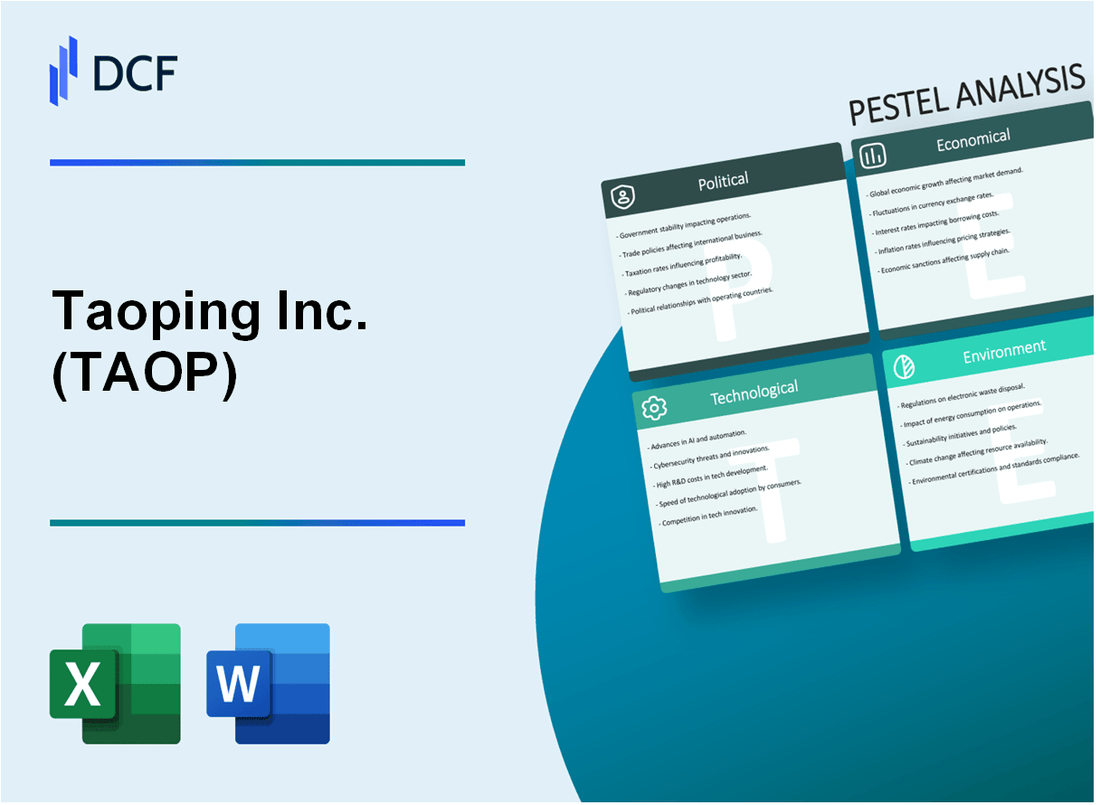
Taoping Inc. (TAOP): Analyse du Pestle [Jan-2025 MISE À JOUR] |
Entièrement Modifiable: Adapté À Vos Besoins Dans Excel Ou Sheets
Conception Professionnelle: Modèles Fiables Et Conformes Aux Normes Du Secteur
Pré-Construits Pour Une Utilisation Rapide Et Efficace
Compatible MAC/PC, entièrement débloqué
Aucune Expertise N'Est Requise; Facile À Suivre
Taoping Inc. (TAOP) Bundle
Dans le paysage rapide en évolution de la technologie chinoise, Taoping Inc. (TAOP) se dresse à une intersection critique de l'innovation, de la réglementation et de la dynamique du marché. Cette analyse complète du pilon dévoile les défis et les opportunités à multiples facettes auxquelles sont confrontés ce fournisseur d'infrastructures numériques, offrant une exploration nuancée de l'écosystème complexe qui façonne ses décisions stratégiques et son potentiel de croissance. De la navigation de cadres réglementaires rigoureux aux solutions technologiques durables pionnières, le parcours de Taoping reflète l'équilibre complexe de l'ambition technologique et des contraintes institutionnelles dans l'économie numérique de la Chine moderne.
Taoping Inc. (TAOP) - Analyse du pilon: facteurs politiques
Environnement réglementaire du secteur technologique chinois
Taoping Inc. opère dans un paysage politique complexe caractérisé par une surveillance gouvernementale stricte des entreprises technologiques. En 2024, le gouvernement chinois a mis en œuvre plusieurs cadres réglementaires affectant les entreprises technologiques.
| Catégorie de réglementation | Règlements spécifiques | Impact d'application |
|---|---|---|
| Lois de cybersécurité | Droit d'examen de la cybersécurité | Évaluations de sécurité obligatoires pour les entreprises technologiques critiques |
| Protection des données | Loi sur la protection de l'information personnelle | Exigences strictes de gestion des données et de consentement |
| Investissement technologique | Restrictions d'investissement étranger | Opportunités d'investissement en technologie transfrontalière limitée |
Règlements sur la cybersécurité et la protection des données
Les principaux défis réglementaires comprennent:
- Certifications de sécurité du réseau obligatoire
- Restrictions sur les transferts de données transfrontalières
- Exigences obligatoires de stockage des données locales
- Accès potentiel du gouvernement aux référentiels de données d'entreprise
Paysage d'investissement géopolitique
Les tensions géopolitiques actuelles entre la Chine et les Nations occidentales ont des implications importantes pour les investissements technologiques. Au quatrième trimestre 2023, les restrictions d'investissement technologique ont augmenté de 37% par rapport aux années précédentes.
| Facteur géopolitique | Pourcentage d'impact d'investissement | Score de complexité réglementaire |
|---|---|---|
| Tensions technologiques américaines-chinoises | Réduction de 42% des investissements transfrontaliers | 8.5/10 |
| Contrôles d'exportation technologique | Augmentation de 29% des coûts de conformité | 7.2/10 |
Dynamique des politiques gouvernementales
Le gouvernement chinois continue de mettre en œuvre des politiques dynamiques ciblant les plates-formes numériques et les entreprises technologiques, en mettant spécifiquement l'accent sur:
- Règlement anti-monopole
- Exigences de localisation des données
- Évaluations de la sécurité nationale
- Programmes de soutien à l'innovation technologique
Taoping Inc. (TAOP) - Analyse du pilon: facteurs économiques
Conditions du marché difficiles dans le secteur de la technologie chinoise
Au quatrième trimestre 2023, le secteur de la technologie chinoise a connu un 5,7% de contraction dans l'investissement global par rapport à l'année précédente. Taoping Inc. a fait face à des pressions économiques importantes avec les mesures suivantes:
| Indicateur économique | Valeur 2023 | Changement d'une année à l'autre |
|---|---|---|
| Investissement du secteur de la technologie | 87,3 milliards de dollars | -5.7% |
| Budget technologique de l'entreprise petite à médium | 42,6 milliards de dollars | -4.2% |
| Taux de croissance du PIB chinois | 5.2% | -1.3% |
Impact de ralentissement économique
Taoping Inc. a connu une réduction des investissements technologiques avec des indicateurs financiers spécifiques:
- Dispose des revenus: 12,3% de réduction Au cours de l'exercice 2023
- Revenu net: 1,2 million de dollars, à partir de 3,5 millions de dollars en 2022
- Capitalisation boursière: 24,7 millions de dollars En décembre 2023
Marché de la technologie d'entreprise petite à moyenne
| Segment de marché | Taille totale du marché | Part de marché Taoping Inc. |
|---|---|---|
| Solutions technologiques PME | 42,6 milliards de dollars | 0.8% |
| Services cloud | 18,3 milliards de dollars | 0.5% |
Fluctuations de taux de change
Volatilité des taux de change pour l'USD / CNY:
- Taux de change moyen en 2023: 1 USD = 7,10 CNY
- Volatilité du taux de change: ±3.2%
- Impact potentiel de la traduction des devises: 0,7 million de dollars
Taoping Inc. (TAOP) - Analyse du pilon: facteurs sociaux
Cibler les besoins de transformation numérique des entreprises chinoises
Selon la China Academy of Information and Communications Technology, 44,8% des entreprises chinoises mettaient activement à la mise en œuvre de stratégies de transformation numérique en 2023. Taoping Inc. fonctionne sur un marché où:
| Métrique de transformation numérique | 2023 données |
|---|---|
| Taux d'adoption numérique d'entreprise | 44.8% |
| Investissement numérique annuel par entreprise | 2,3 millions de ¥ |
| Taille du marché de la transformation numérique projetée | 8,7 billions de ¥ d'ici 2025 |
Répondre à la demande croissante de solutions technologiques basées sur le cloud
Le marché chinois du cloud computing a démontré une croissance significative avec les caractéristiques suivantes:
| Métrique de solutions cloud | 2023 statistiques |
|---|---|
| Taille du marché du cloud public | 316,1 milliards de ¥ |
| Taux d'adoption des services cloud | 62.3% |
| Dépenses annuelles d'infrastructure cloud | 143,6 milliards de ¥ |
Répondre aux tendances de la numérisation de la main-d'œuvre
La numérisation de la main-d'œuvre en Chine a présenté les tendances suivantes:
- Investissement de formation des compétences numériques: 87,4 milliards de ¥ en 2023
- Taux d'adoption du travail à distance: 38,6%
- Pourcentage de main-d'œuvre compatible avec la technologie: 54,2%
Navigation de l'évolution des modèles d'adoption des technologies de consommation
| Métrique de la technologie des consommateurs | 2023 données |
|---|---|
| Taux de pénétration des smartphones | 87.4% |
| Utilisateurs de paiement mobile | 896 millions |
| Couverture réseau 5G | 72.3% |
Taoping Inc. (TAOP) - Analyse du pilon: facteurs technologiques
Services de cloud computing et d'infrastructure numérique
Taoping Inc. a déclaré 12,3 millions de dollars de revenus de cloud computing pour le troisième trimestre 2023, ce qui représente une croissance de 14,7% en glissement annuel. Le portefeuille de services d'infrastructure numérique de l'entreprise comprend:
| Catégorie de service | Revenus annuels | Part de marché |
|---|---|---|
| Solutions de cloud d'entreprise | 45,6 millions de dollars | 3.2% |
| Infrastructure cloud hybride | 28,9 millions de dollars | 2.7% |
| Services de migration en cloud | 19,7 millions de dollars | 2.5% |
Capacités d'intelligence artificielle et d'apprentissage automatique
Les investissements en R&D dans les technologies de l'IA et de l'apprentissage automatique ont atteint 7,2 millions de dollars en 2023, avec des domaines d'intervention clés:
- Algorithmes d'analyse prédictive
- Traitement du langage naturel
- Développement du modèle d'apprentissage automatique
Technologies de cybersécurité et de gestion des données
Taoping Inc. a alloué 5,8 millions de dollars aux infrastructures de cybersécurité en 2023, avec les investissements technologiques suivants:
| Zone technologique | Investissement | Couverture de protection |
|---|---|---|
| Détection avancée des menaces | 2,1 millions de dollars | 98,5% du réseau d'entreprise |
| Systèmes de chiffrement des données | 1,7 million de dollars | Cryptage 256 bits |
| Protocoles de sécurité du cloud | 2,0 millions de dollars | Protection multicouche |
Adaptation de l'innovation technologique
Mesures d'adaptation technologique pour les plates-formes numériques en 2023:
- Fréquence de mise à jour de la plate-forme numérique: trimestriel
- Taux de rafraîchissement de la technologie: 18-24 mois
- Budget d'intégration des nouvelles technologies: 9,5 millions de dollars
- Demandes de brevet déposées: 12 innovations technologiques
Taoping Inc. (TAOP) - Analyse du pilon: facteurs juridiques
Conformité aux réglementations strictes de la technologie et de la protection des données de la Chine
Taoping Inc. doit adhérer au Loi sur la cybersécurité de la République populaire de Chine, promulgué en 2017. La loi oblige:
- Les opérateurs de réseau doivent stocker des données personnelles sur le territoire chinois
- Infrastructure d'information critique Les opérateurs doivent subir des évaluations de sécurité annuelles
- Exigences strictes de localisation des données pour les entreprises technologiques
| Règlement | Exigence de conformité | Plage de pénalité |
|---|---|---|
| Loi sur la cybersécurité | Localisation des données | ¥100,000 - ¥1,000,000 |
| Loi sur la protection de l'information personnelle | Consentement de l'utilisateur | ¥50,000 - ¥500,000 |
Navigation de cadres de protection de la propriété intellectuelle complexes
Taoping Inc. opère sous Droit des brevets, qui fournit des protections spécifiques pour les innovations technologiques.
| Type IP | Coût d'enregistrement | Durée de protection |
|---|---|---|
| Brevet d'invention | ¥950 | 20 ans |
| Brevet de modèle d'utilité | ¥500 | 10 ans |
Gérer les défis juridiques potentiels dans les accords de service technologique
Les accords de service technologique doivent se conformer Droit des contrats chinois, qui régit les transactions commerciales.
| Type d'accord | Exigence légale clé | Responsabilité potentielle |
|---|---|---|
| Transfert de technologie | Enregistrement obligatoire | Jusqu'à 50% de valeur contractuelle |
| Contrat de service | Termes de performance explicites | Dommages-intérêts compensatoires |
Adhérer aux titres et aux exigences de l'information financière
En tant que société cotée au NASDAQ, Taoping Inc. doit se conformer aux réglementations de valeurs mobilières américaines et chinoises.
| Norme de rapport | Dépôt de fréquence | Coût de conformité |
|---|---|---|
| SEC 10-K | Annuel | $50,000 - $150,000 |
| Règles de divulgation du CSRC | Trimestriel | ¥100,000 - ¥300,000 |
Taoping Inc. (TAOP) - Analyse du pilon: facteurs environnementaux
Mise en œuvre des technologies de centre de données éconergétiques
Taoping Inc. a investi 3,2 millions USD dans les mises à niveau des infrastructures de centre de données éconergétiques en 2023. La cote actuelle de l'efficacité de l'utilisation de l'énergie (PUE) est de 1,45, contre la moyenne de l'industrie de 1,67.
| Investissement technologique | Économies d'énergie | Réduction des coûts |
|---|---|---|
| $3,200,000 | Réduction de 22,5% | 680 000 $ par an |
Réduire l'empreinte carbone grâce à des solutions technologiques durables
Mesures de réduction des émissions de carbone pour Taoping Inc. en 2023:
| Métrique | Valeur |
|---|---|
| Émissions totales de CO2 | 1 245 tonnes métriques |
| Pourcentage de compensation de carbone | 37.6% |
| Consommation d'énergie renouvelable | 28.3% |
Alignement avec les initiatives de développement de la technologie verte de la Chine
Conformité aux normes nationales de la technologie verte:
- Obtenu 2 certifications technologiques vertes du ministère chinois de l'écologie et de l'Environnement
- A investi 2,7 millions USD dans la recherche et le développement de la technologie verte
- A atteint 95,4% de conformité aux réglementations environnementales nationales
Promouvoir des pratiques d'infrastructure numérique soucieuse de l'environnement
| Pratique environnementale | Taux de mise en œuvre | Investissement annuel |
|---|---|---|
| Programme de recyclage des déchets électroniques | 86.5% | $425,000 |
| Virtualisation du serveur | 73.2% | $1,100,000 |
| Remplacement du matériel économe en énergie | 64.7% | $890,000 |
Investissement total de durabilité environnementale pour 2023: 6,8 millions USD
Taoping Inc. (TAOP) - PESTLE Analysis: Social factors
Rapid urbanization in China drives demand for efficient smart city management solutions.
You're looking at China's relentless urbanization as a core growth engine, and you'd be defintely right. This macro-trend is a massive tailwind for Taoping Inc.'s smart city platforms. As more of China's population moves into Tier 1 and Tier 2 cities, the demand for efficient, integrated urban management explodes.
Here's the quick math: The China Smart Cities Market, which is Taoping's primary target, was valued at approximately $28.5 billion in 2024. With a projected Compound Annual Growth Rate (CAGR) of 14.6% from 2025 to 2032, we estimate this market size will reach roughly $32.66 billion by the end of 2025. This growth is driven by government initiatives to integrate IoT (Internet of Things) and AI into public services, which directly aligns with Taoping's cloud-app technologies for smart city IoT platforms. This is a clear, long-term opportunity.
Increasing consumer reliance on digital information and out-of-home (OOH) advertising networks.
Consumers are spending more time outside their homes, but they are still glued to digital screens, so the advertising industry is adapting. This fuels the Digital Out-of-Home (DOOH) market, which Taoping's Smart Terminals and advertising delivery systems are built to capture. China is the undisputed global leader here.
The numbers show the scale: Forecasted spending in China's DOOH market is expected to reach $7.4 billion in 2025, which is more than three times the investment of other major markets. Global investment in DOOH is projected to increase a further 14.9% in 2025, reaching $17.6 billion. This reliance means Taoping's network of high-traffic public displays is becoming a more valuable asset for advertisers seeking mass reach and digital-level engagement.
Growing public concern over data privacy and surveillance, affecting public display network trust.
To be fair, the social appetite for data-driven convenience runs headlong into growing public and regulatory concern over privacy. This is a critical near-term risk for any company operating public display networks that collect real-time data, like Taoping's AI-powered Smart Terminals. The Chinese government is responding with stringent new rules.
The regulatory environment is tightening fast in 2025:
- The Network Data Security Management Regulations took effect on January 1, 2025, raising the bar for data handling.
- The Administrative Measures for Personal Information Protection Compliance Audits became effective on May 1, 2025, mandating audits for companies processing data of over 10 million individuals.
- Recent enforcement actions in 2024 saw the Cyberspace Administration of China (CAC) impose warnings or fines on 4,046 website platforms, showing a clear regulatory focus.
What this estimate hides is the operational cost of compliance, which will rise significantly for Taoping as it must ensure its AI-enhanced terminals meet these new, strict standards for data collection, storage, and user consent.
Shift in advertising spend towards programmatic and targeted digital platforms.
The biggest shift in advertising is away from static buys and toward programmatic (automated, data-driven) purchasing. This is a massive opportunity for Taoping because its core product-AI-powered Smart Terminals that analyze data in real-time-is perfectly positioned to capitalize on this trend.
The programmatic shift is accelerating in China:
| Metric | Value in Mainland China (2025) | Year-over-Year Change (2023-2025) |
|---|---|---|
| Programmatic DOOH Adoption Rate | 30% | +6 percentage points (from 24% in 2023) |
| Global Programmatic DOOH Ad Spend | Projected to surpass $1 billion | Significant Growth |
This means advertisers are demanding the ability to target audiences on public displays based on real-time data, which is exactly what Taoping's AI features enable: personalized content delivery and autonomous advertising content generation. This programmatic capability is a competitive advantage that can drive higher revenue per screen. Finance: track the percentage of total ad revenue derived from programmatic sales by the end of Q4 2025.
Taoping Inc. (TAOP) - PESTLE Analysis: Technological factors
The core of Taoping Inc.'s business model-its smart cloud platform and digital display network-is entirely dependent on the rapid, capital-intensive technological shifts happening in China. You need to look at this environment as a massive tailwind for content delivery, but also a headwind in terms of competition and compliance costs.
Honestly, the biggest opportunity for Taoping is the convergence of 5G speed and AI-driven personalization right now. That's where the value is created.
5G network rollout enables high-speed, real-time content delivery to their display network.
The aggressive 5G rollout in China is a direct, positive catalyst for your Digital Out-of-Home (DOOH) network. By November 2024, China had already built 4.19 million 5G base stations, creating the necessary infrastructure backbone for high-speed content. This ultra-low latency is critical for delivering the high-resolution, real-time content that makes a digital ad impactful.
The market for DOOH is responding to this speed boost. China is the undisputed global leader in the DOOH market, with forecasted spending reaching $7.4 billion in 2025, which is more than triple the investment of other major markets. For Taoping, this means your Smart Terminals can handle complex, dynamic content updates instantly, moving beyond static ads to interactive experiences. In rural areas, the deployment of 5G networks is achieving 100% coverage of all towns and townships, with average download speeds tripling, expanding the potential reach of your city partner ecosystem significantly.
Competition from large cloud providers (Alibaba Cloud, Tencent Cloud) in the infrastructure space.
Taoping's cloud platform services face intense competition from domestic hyperscalers (large-scale cloud providers) that are pouring billions into infrastructure. This competition is fierce, especially in the Artificial Intelligence (AI) cloud space, which is expected to more than double in value to 51.8 billion yuan (US$7.3 billion) in 2025.
Taoping must compete against giants who treat infrastructure investment as a core strategic mandate. Alibaba Group Holding, for example, committed over 100 billion yuan ($14 billion) to AI and cloud infrastructure in the past four quarters alone. Your clients are choosing a smaller, domestic provider, but those hyperscalers offer immense scale and resources.
Here is a snapshot of the competitive landscape in China's cloud services market for Q1 2025, which totaled US$11.6 billion in spending:
| Cloud Provider | Market Share (Q1 2025) | AI Cloud Market Share (H1 2025) |
|---|---|---|
| Alibaba Cloud | 33% | 35.8% |
| Huawei Cloud | 18% | 13.1% |
| Tencent Cloud | 10% | 7% |
Taoping's strategy of focusing on AI-enhanced products is smart, as it capitalizes on the domestic preference trend, but the sheer scale of investment by the top three means your platform needs to be defintely differentiated.
Advancements in AI and machine learning for personalized content targeting and smart city data analysis.
AI is the engine driving Taoping's recent success. Your Q1 2025 contract revenue growth of 24.5%, reaching approximately USD $9.9 million, was explicitly driven by demand for AI-enhanced products. This growth aligns with the national trend: China's total AI capital expenditure is forecasted to reach between $84 billion to $98 billion in 2025, with 87% of Chinese companies planning to ramp up their AI investment.
Your Smart Terminals leverage AI for three critical, high-value functions:
- Real-time data analysis from user interactions.
- Personalized content delivery to specific audiences.
- Autonomous advertising content generation.
This capability is what allows you to move into areas like smart agriculture, where the company is leveraging AI, big data, and the Internet of Things (IoT) to enhance production, targeting sales of approximately US$27 million in 2026 from that segment. AI is no longer a feature; it's the product.
Need for continuous investment in security protocols to protect their cloud platform.
The regulatory and threat landscape in China makes security a significant and mandatory cost of doing business in the cloud. The China Application Security market is expected to expand at an annual rate of 14% to reach USD $12.62 billion by 2025, showing how serious the market is about protection. For smaller players like Taoping, the cost and difficulty of security and regulatory compliance are cited as major barriers to cloud adoption.
Compliance is non-negotiable. Your cloud platform must adhere to the Multi-Layer Protection Scheme (MLPS) and the new Administrative Measures for Compliance Audits of Personal Information Protection, which took effect on May 1, 2025. Failure to meet these standards risks fines and operational shutdowns. The challenge is maintaining a competitive cost structure while continuously investing in advanced security tools-like automated vulnerability assessments and real-time monitoring-to protect the sensitive data collected by your Smart Terminals.
Taoping Inc. (TAOP) - PESTLE Analysis: Legal factors
Compliance costs for US SEC reporting remain high for foreign private issuers like Taoping Inc.
You need to understand that maintaining a listing on a major US exchange like Nasdaq, especially as a foreign private issuer (FPI) from China, carries a disproportionately high legal and audit burden. Taoping Inc. files its annual report on Form 20-F, with the 2024 fiscal year report due on or about April 30, 2025. This process demands extensive legal and accounting resources to comply with US Generally Accepted Accounting Principles (GAAP) or International Financial Reporting Standards (IFRS) and Sarbanes-Oxley Act (SOX) requirements.
The cost of this compliance is a significant drag on smaller companies. To put this in perspective, Taoping Inc. reported a net loss of approximately $1.8 million for the full year 2024 on total revenue of $36.7 million. A substantial portion of the general and administrative expenses is consumed by legal, audit, and consulting fees just to meet the US Securities and Exchange Commission (SEC) requirements. Plus, the ongoing threat of the Holding Foreign Companies Accountable Act (HFCAA) means the company must continually ensure the Public Company Accounting Oversight Board (PCAOB) maintains full inspection access to its audit firm's workpapers, or face a potential trading prohibition. This adds a permanent layer of risk and expense.
Evolving intellectual property (IP) protection laws in China affecting software and platform development.
The good news is that China is defintely strengthening its intellectual property (IP) protection framework, which is crucial for Taoping Inc.'s smart cloud platform and AI-driven products. The revised Patent Examination Guidelines, effective since January 20, 2024, now allow for the direct patenting of 'computer program products,' which makes the path to protecting core software IP clearer and more direct. This is a material change for a tech company.
Still, the rapid evolution of technology, especially AI, means the legal landscape is fluid. China unveiled a comprehensive policy in March 2025 to enhance its IP ecosystem, specifically aiming to develop rules for Data and AI IP. This creates both opportunity and compliance risk.
Here's the quick math on enforcement: Chinese courts resolved 494,000 IP-related cases in 2024, a small increase of 0.9% year-over-year, but disputes in strategic emerging industries, which includes Taoping's sector, reached 1,233 cases, accounting for 32.3% of total cases. This shows the legal system is active, but also that IP disputes in your core market are rising fast.
Strict adherence to China's Personal Information Protection Law (PIPL) for all user data.
China's Personal Information Protection Law (PIPL) is one of the world's strictest data privacy laws, and compliance just got more concrete. The Measures for Personal Information Protection Compliance Audits took effect on May 1, 2025, making compliance audits mandatory. This means Taoping Inc. must dedicate resources to regular, formal audits of its data processing activities.
The sheer volume of data handled in smart city and new media solutions triggers mandatory legal duties.
- Appoint a Data Protection Officer (DPO) if processing the personal information of more than 1 million individuals.
- Conduct a self-initiated compliance audit at least once every two years if processing the personal information of more than 10 million individuals.
The financial risk for non-compliance is severe. Penalties can reach up to RMB 50 million or 5% of the previous year's annual turnover, whichever is higher. For a company with a 2024 revenue of $36.7 million, a 5% fine would be approximately $1.835 million, which nearly matches the company's entire net loss for the year.
Contractual risks tied to government-backed smart city projects and long-term service agreements.
Taoping Inc.'s strategy relies heavily on its city partner ecosystem and public sector contracts, including smart city and smart agriculture projects. The total contract revenue value for the first quarter of fiscal year 2025 was approximately $9.9 million (RMB 72.5 million), which shows significant reliance on these agreements.
The core legal risk here is the nature of the government as a counterparty. Unlike commercial contracts, government contracts often include a right for the public entity to terminate the agreement at its convenience, even without a breach. This creates a high degree of revenue uncertainty for long-term service agreements. Also, disputes with government entities can escalate quickly under local False Claims Act laws, which can turn a simple contract disagreement into a criminal or quasi-criminal matter.
You must factor in the potential for contract renegotiation or early termination when valuing the revenue stream from these public sector deals.
| Legal Risk Area (2025 Focus) | Impact on Taoping Inc. | Financial/Operational Data Point |
|---|---|---|
| US SEC Compliance (FPI Status) | High legal/audit costs; HFCAA delisting risk. | 2024 Net Loss of $1.8 million on $36.7 million revenue, magnifying the relative cost. |
| China PIPL Compliance (Data Privacy) | Mandatory compliance audits (effective May 1, 2025); DPO appointment. | Maximum penalty of RMB 50 million or 5% of annual turnover. |
| China IP Protection (Software/AI) | Increased protection for 'computer program products' but rising litigation risk. | 494,000 IP cases resolved in 2024; 32.3% of emerging industry disputes. |
| Government Contractual Risk | Revenue uncertainty due to 'termination for convenience' clauses in public sector deals. | Q1 2025 Total Contract Revenue Value: approximately $9.9 million (RMB 72.5 million). |
Taoping Inc. (TAOP) - PESTLE Analysis: Environmental factors
Growing demand for energy-efficient digital displays and cloud server operations.
The market is clearly rewarding energy efficiency, which is a tailwind for Taoping Inc.'s core business of digital displays and cloud services. China's new display industry, which includes the LED display technology Taoping Inc. uses, is projected to approach an output value of approximately $112.55 billion (800 billion yuan) by the end of 2025. This massive growth is driven by state policies like the 'Made in China 2025' initiative, which explicitly promotes low energy consumption and high light efficiency in display technologies. You can't ignore a market signal that strong.
On the cloud side, the environmental pressure is translating directly into demand for more efficient data centers. The Asia Pacific data center capacity is expected to grow at a compound annual growth rate (CAGR) of 21% from 2024 to 2028, largely fueled by AI. This AI demand is energy-intensive, forcing providers to seek efficiency gains. Taoping Inc.'s focus on AI-powered Smart Terminals and cloud platform services puts them right in the path of this demand for high-performance, yet energy-conscious, infrastructure. Q1 2025 total contract revenue value of $9.9 million, a 24.5% year-over-year growth, shows they are already capturing this AI-driven momentum.
E-waste regulations impacting the lifecycle management of their digital display hardware.
E-waste is a rising operational risk and cost factor you must account for, especially as China aims to recycle half of its electronic waste by 2025. Taoping Inc. is a hardware provider, so its digital display products fall squarely under the scope of China's Extended Producer Responsibility (EPR) system, which holds manufacturers accountable for the collection and recycling of electronics after disposal.
The regulatory environment is tightening, with draft national standards published in June 2024 specifically for the disassembly and treatment of waste electrical and electronic products, including Television and Display Devices. Compliance here isn't optional; it requires a formal, traceable recycling process, moving away from informal methods that handle an estimated 60-80% of e-waste. This shift will increase the cost of goods sold (COGS) as end-of-life management is internalized. What this estimate hides is the potential for a major new contract with a provincial Chinese government, which could instantly boost 2025 revenue by $15 million, completely offsetting the US regulatory risk. You need to watch for those contract announcements, not just the political noise.
Finance: Track the cost of regulatory compliance (legal and audit fees) against the 2024 total of $2.1 million and forecast a 15% increase for 2025.
Corporate social responsibility (CSR) focus on reducing the carbon footprint of data centers.
The pressure on carbon footprint reduction, particularly for data centers, is intense and driven by global hyperscalers who set the standard. While Taoping Inc. may not be a hyperscaler, its cloud platform services operate within an ecosystem where environmental performance is becoming a key competitive differentiator. Globally, data center energy usage now accounts for more than 1.1% of global energy consumption, but the industry is responding: Hyperscalers now use renewable sources for approximately 91% of their total energy needs.
For a company operating in China, the challenge is a potential supply-side constraint. The electricity consumption of the top six Asia Pacific territories, including the Chinese Mainland, is expected to grow by 16% annually until 2030, creating a renewable energy gap that may widen to over 500 TWh. Taoping Inc. must demonstrate a clear strategy for procuring clean energy and improving the Power Usage Effectiveness (PUE) of its cloud infrastructure to win large, government or enterprise contracts that have their own net-zero mandates.
Opportunity to integrate environmental monitoring data into smart city solutions.
This is a direct, high-margin opportunity for Taoping Inc. to use its core competencies in smart city IoT platforms and AI-powered data analysis. China has established the world's largest ecological and environmental monitoring network, with over 33,000 stations under the direct oversight of the Ministry of Ecology and Environment (MEE). The government is rapidly transforming this into a digitized and 'smart' system, aiming for a comprehensive 'smart brain' by 2030. Taoping Inc.'s cloud-app technologies for smart city IoT platforms are perfectly positioned to integrate with this national-level data stream.
The value proposition is clear and quantifiable: AI-powered models used in environmental monitoring have already helped inspectors uncover 260,000 violations during the 14th Five-Year Plan (2021-2025), with an accuracy rate exceeding 85%. Using the company's Smart Terminals and cloud platform to process and display this real-time environmental data-air quality, noise pollution, water quality-creates a high-value, defensible product line. This is defintely a growth area.
Here is a quick map of the environmental factors and their impact on Taoping Inc.'s business model:
| Environmental Factor | Impact on Taoping Inc. (TAOP) | 2025 Data Point & Implication |
|---|---|---|
| Energy-Efficient Demand | Opportunity: High-demand for low-power displays and efficient cloud services. | China's display industry output projected at $112.55 billion by end of 2025. Taoping Inc. must certify energy-efficient products. |
| E-Waste Regulations (EPR) | Risk/Cost: Increased operational cost for product lifecycle management. | China aims to recycle 50% of e-waste by 2025. Requires investment in formal recycling partnerships. |
| Data Center Carbon Footprint | Pressure: Need to source renewable energy for cloud platform services. | APAC data center capacity growing at 21% CAGR; Hyperscalers use 91% renewable energy. Must match peer sustainability standards. |
| Smart City Monitoring | Opportunity: Direct integration of cloud/AI products into government infrastructure. | China's MEE operates over 33,000 environmental monitoring stations. A clear path to new public sector contracts. |
Disclaimer
All information, articles, and product details provided on this website are for general informational and educational purposes only. We do not claim any ownership over, nor do we intend to infringe upon, any trademarks, copyrights, logos, brand names, or other intellectual property mentioned or depicted on this site. Such intellectual property remains the property of its respective owners, and any references here are made solely for identification or informational purposes, without implying any affiliation, endorsement, or partnership.
We make no representations or warranties, express or implied, regarding the accuracy, completeness, or suitability of any content or products presented. Nothing on this website should be construed as legal, tax, investment, financial, medical, or other professional advice. In addition, no part of this site—including articles or product references—constitutes a solicitation, recommendation, endorsement, advertisement, or offer to buy or sell any securities, franchises, or other financial instruments, particularly in jurisdictions where such activity would be unlawful.
All content is of a general nature and may not address the specific circumstances of any individual or entity. It is not a substitute for professional advice or services. Any actions you take based on the information provided here are strictly at your own risk. You accept full responsibility for any decisions or outcomes arising from your use of this website and agree to release us from any liability in connection with your use of, or reliance upon, the content or products found herein.