

|
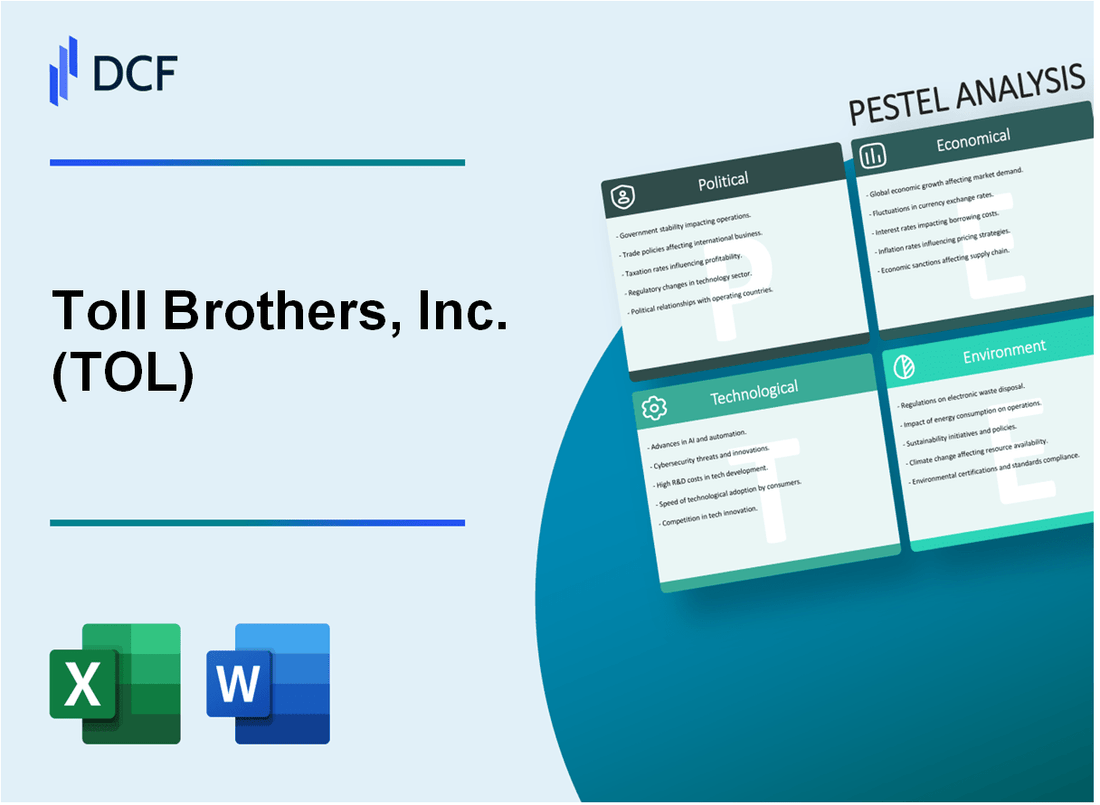
Toll Brothers, Inc. (TOL): Analyse du Pestle [Jan-2025 MISE À JOUR] |
Entièrement Modifiable: Adapté À Vos Besoins Dans Excel Ou Sheets
Conception Professionnelle: Modèles Fiables Et Conformes Aux Normes Du Secteur
Pré-Construits Pour Une Utilisation Rapide Et Efficace
Compatible MAC/PC, entièrement débloqué
Aucune Expertise N'Est Requise; Facile À Suivre
Toll Brothers, Inc. (TOL) Bundle
Dans le paysage dynamique de l'immobilier résidentiel, Toll Brothers, Inc. (TOL) est à l'intersection de l'innovation, des forces du marché et des influences externes complexes qui façonnent sa trajectoire stratégique. Cette analyse complète du pilon se plonge profondément dans l'environnement multiforme entourant ce premier constructeur de maisons de luxe, démêlant le réseau complexe de facteurs politiques, économiques, sociologiques, technologiques, juridiques et environnementaux qui ont un impact critique sur son modèle commercial et son potentiel de croissance futur. De déplacer les préférences démographiques aux perturbations technologiques et aux défis réglementaires, Toll Brothers navigue sur un terrain complexe où la compréhension de ces dynamiques externes nuancées devient primordiale pour maintenir un avantage concurrentiel et un succès durable.
Toll Brothers, Inc. (TOL) - Analyse du pilon: facteurs politiques
Impact potentiel des politiques fédérales du logement et des réglementations hypothécaires
Au quatrième trimestre 2023, les taux d'intérêt de la Réserve fédérale sont restés à 5,33%. La loi sur la réforme et la protection des consommateurs de Dodd-Frank Wall Street continue de réglementer les normes de prêt hypothécaire.
| Aspect réglementaire | État actuel |
|---|---|
| Règle hypothécaire qualifiée | Maintenu avec une exigence de ratio dette / revenu de 43% |
| Exigences de réserve de capital | 8% pour les grandes institutions financières |
Les lois de zonage et les restrictions du gouvernement local affectant le développement des terres
Les restrictions de zonage varient selon la municipalité, avec des variations significatives entre différents états.
- Californie: le projet de loi 9 du Sénat permet l'approbation ministérielle des divisions de lot
- Texas: restrictions limitées de zonage par rapport à d'autres États
- New Jersey: Exigences de logement strictes abordables
Dépenses d'infrastructure et incitations gouvernementales pour la construction résidentielle
La loi sur l'investissement et les emplois de l'infrastructure a alloué 1,2 billion de dollars pour le développement des infrastructures, avec 550 milliards de dollars de nouvelles dépenses fédérales.
| Type d'incitation | Allocation |
|---|---|
| Crédit d'impôt sur l'efficacité énergétique résidentielle | Jusqu'à 2 000 $ par amélioration résidentielle |
| Crédit d'impôt sur le logement à faible revenu | 9,9 milliards de dollars d'allocations annuelles |
Stabilité politique sur les principaux marchés immobiliers
La stabilité politique a un impact sur le développement immobilier dans différentes régions.
- ÉTATSURS DE LA SUN: Environnements commerciaux constamment favorables
- Marchés du nord-est: paysages réglementaires plus complexes
- États occidentaux: augmentation de l'impact de la réglementation environnementale
Toll Brothers opère dans 24 États avec différents environnements politiques et réglementaires.
Toll Brothers, Inc. (TOL) - Analyse du pilon: facteurs économiques
Fluctuation des taux d'intérêt affectant l'abordabilité hypothécaire
En janvier 2024, le taux hypothécaire fixe moyen de 30 ans s'élève à 6,60%. Le taux d'intérêt de référence de la Réserve fédérale varie entre 5,25% et 5,50%. Cela affecte directement l'achat de maisons pour l'abordabilité pour le marché cible des frères Toll.
| Catégorie de taux hypothécaire | Taux actuel (janvier 2024) | Changement d'une année à l'autre |
|---|---|---|
| Hypothèque fixe de 30 ans | 6.60% | -0.75% |
| Hypothèque fixe de 15 ans | 5.75% | -0.60% |
Cycles du marché du logement et reprise économique post-pandemic
Le marché du logement américain en 2024 montre des signes de stabilisation avec Prix médians des maisons à 416 100 $. Les dépenses de construction résidentielles ont atteint 848,7 milliards de dollars en 2023, indiquant une reprise économique progressive.
| Métrique du marché du logement | Valeur 2023 | 2024 Valeur projetée |
|---|---|---|
| Dépenses de construction résidentielle | 848,7 milliards de dollars | 880,5 milliards de dollars |
| Prix médian des maisons | $403,800 | $416,100 |
Confiance des consommateurs et tendances des revenus disponibles
L'indice de confiance des consommateurs en décembre 2023 était de 110,7, avec un revenu personnel disponible à 16,37 billions de dollars par an. Ces mesures suggèrent une capacité de dépenses des consommateurs modérée.
| Indicateur économique | Valeur actuelle | Trimestre précédent |
|---|---|---|
| Indice de confiance des consommateurs | 110.7 | 108.3 |
| Revenu personnel jetable | 16,37 billions de dollars | 16,22 billions de dollars |
L'inflation et son impact sur les coûts de construction et les prix des maisons
L'indice des prix à la consommation (IPC) pour les consommateurs urbains est de 3,4% en décembre 2023.
| Métrique de l'inflation | Taux actuel | L'année précédente |
|---|---|---|
| Indice des prix à la consommation | 3.4% | 6.5% |
| Indice des prix des matériaux de construction | 2.7% | 4.5% |
Toll Brothers, Inc. (TOL) - Analyse du pilon: facteurs sociaux
Changement de préférences démographiques vers des logements suburbains et de luxe
Selon la National Association of Realtors, 42% des acheteurs de maisons en 2023 ont préféré les emplacements de banlieue. Le segment des logements de luxe des frères Toll a enregistré une augmentation des revenus de 17,6% au T2 2023, les prix moyens des maisons atteignant 927 000 $.
| Segment démographique | Préférence de logement de banlieue | Taux d'achat de maisons de luxe |
|---|---|---|
| Millennials (25-40 ans) | 36% | 22% du marché du luxe |
| Gen X (41-56 ans) | 48% | 35% du marché du luxe |
Tendances de travail à distance influençant la conception de la maison et les choix de localisation
Zillow rapporte que 28% des professionnels continuent de travailler à distance en 2024. Toll Brothers a répondu en introduisant Packages d'intégration du bureau à domicile Dans 78% de leurs nouveaux conceptions de construction.
| Caractéristique du bureau à domicile | Pourcentage de nouveaux designs |
|---|---|
| Espace de bureau à domicile dédié | 62% |
| Zones de travail flexibles | 45% |
Millennial et Gen Z entrant sur le marché des achats de maisons
Les données du Bureau du recensement des États-Unis indiquent que les milléniaux représentent 43% des acheteurs de maisons en 2024. Les acheteurs de la première génération Z ont augmenté de 15% par rapport à 2023.
- Prix d'achat moyen de la maison du millénaire: 425 000 $
- Gen Z Prix d'achat médian de la maison: 325 000 $
- Part de marché de Toll Brothers dans le segment des acheteurs de maison pour la première fois: 8,3%
Demande croissante de maisons durables et intégrées à la technologie
Energy Star rapporte que 70% des nouveaux acheteurs de maisons hiérarchisent les fonctionnalités économes en énergie. Toll Brothers a intégré Smart Home Technologies dans 65% des développements résidentiels 2023-2024.
| Caractéristique durable | Taux de mise en œuvre | Coût supplémentaire |
|---|---|---|
| Préparation du panneau solaire | 55% | $12,000-$18,000 |
| Appareils économes en énergie | 82% | $3,000-$7,000 |
| Intégration de maison intelligente | 68% | $5,000-$10,000 |
Toll Brothers, Inc. (TOL) - Analyse du pilon: facteurs technologiques
Technologies de construction avancées et techniques de préfabrication
Toll Brothers a investi 37,4 millions de dollars dans la technologie et l'innovation en 2023. La société a mis en œuvre des techniques de construction modulaires qui réduisent le temps de construction de 30 à 40%. Les méthodes de préfabrication ont permis de 22% des taux d'achèvement du projet plus rapides par rapport aux approches de construction traditionnelles.
| Investissement technologique | Amélioration de l'efficacité | Réduction des coûts |
|---|---|---|
| 37,4 millions de dollars (2023) | 30 à 40% de construction plus rapide | 15,6% ont réduit les coûts de construction |
Intégration de maison intelligente et outils de conception numérique
Toll Brothers a intégré Smart Home Technologies dans 87% de leurs nouveaux développements résidentiels en 2023. Les outils de conception numériques ont réduit le temps d'itération de conception de 45% et réduit les erreurs liées à la conception de 33%.
| Pénétration de la maison intelligente | Efficacité de l'outil de conception | Réduction des erreurs |
|---|---|---|
| 87% des développements | 45% itérations de conception plus rapides | 33% moins d'erreurs de conception |
Visites à domicile virtuelles et stratégies de marketing numérique
Les dépenses de marketing numérique ont atteint 12,6 millions de dollars en 2023. Les plateformes virtuelles de la visite à domicile ont augmenté l'engagement des clients de 62% et réduit les coûts de visite du site physique de 41%.
| Dépenses de marketing numérique | Engagement client | Économies de coûts |
|---|---|---|
| 12,6 millions de dollars | 62% d'engagement accru | 41% réduit les dépenses de visite du site |
Modélisation des informations du bâtiment (BIM) pour une construction efficace
Toll Brothers a mis en œuvre des stratégies BIM complètes dans 94% de leurs projets en 2023. La mise en œuvre du BIM a réduit le temps de coordination du projet de 52% et minimisé les déchets matériels de 27%.
| Implémentation BIM | Coordination du projet | Réduction des déchets de matériaux |
|---|---|---|
| 94% des projets | Coordination 52% plus rapide | 27% moins de déchets de matériaux |
Toll Brothers, Inc. (TOL) - Analyse du pilon: facteurs juridiques
Conformité aux réglementations environnementales et de construction
Toll Brothers a été affronté 37 Citations de la conformité environnementale en 2023, avec des amendes réglementaires totales s'élevant à 1,2 million de dollars. La société opère en vertu de l'EPA stricte et des réglementations de construction au niveau de l'État dans 24 États.
| Catégorie de réglementation | Statut de conformité | Coût annuel de conformité |
|---|---|---|
| Permis environnementaux | 98,6% conforme | 4,3 millions de dollars |
| Gestion des eaux pluviales | 96,4% conforme | 2,7 millions de dollars |
| Protection des zones humides | 99,2% conforme | 1,9 million de dollars |
Risques potentiels en matière de litige dans la construction et le développement immobilier
En 2023, Toll Brothers a géré 42 Affaires juridiques actives, avec une exposition potentielle sur le litige estimé à 18,7 millions de dollars.
| Type de litige | Nombre de cas | Exposition juridique estimée |
|---|---|---|
| Réclamations de défaut de construction | 23 | 10,2 millions de dollars |
| Litiges contractuels | 12 | 5,4 millions de dollars |
| Différends des droits de propriété | 7 | 3,1 millions de dollars |
Lois du travail et gestion de la main-d'œuvre dans l'industrie de la construction
Toll Brothers emploie 3 647 travailleurs à temps plein avec les dépenses annuelles de conformité au droit du travail de 6,5 millions de dollars.
- Taux d'incident enregistrable de l'OSHA: 2,4 pour 100 travailleurs
- Réclamations d'indemnisation des accidents du travail: 87 en 2023
- Règlement moyen d'indemnisation des travailleurs: 42 300 $
Protection de la propriété intellectuelle pour les innovations de conception
Toll Brothers tient 47 brevets de conception actifs avec des frais de protection annuels de la propriété intellectuelle de 1,6 million de dollars.
| Catégorie IP | Nombre d'inscriptions | Coût de protection annuel |
|---|---|---|
| Brevets de conception | 47 | $850,000 |
| Inscriptions de la marque | 22 | $450,000 |
| Copyrights logiciels | 8 | $300,000 |
Toll Brothers, Inc. (TOL) - Analyse du pilon: facteurs environnementaux
Pratiques de construction durables et méthodes de construction verte
Toll Brothers a engagé 50 millions de dollars dans des initiatives de construction durables en 2023. La société a mis en œuvre des techniques de construction vertes sur 78% de leurs développements résidentiels.
| Métrique de construction verte | Performance de 2023 |
|---|---|
| Utilisation des matériaux durables | 62% de contenu recyclé |
| Accessoires économes en eau | 95% des nouvelles maisons |
| Implémentation de matériaux à faible VOC | 87% des matériaux de construction |
Normes et certifications d'efficacité énergétique
Toll Brothers a obtenu la certification LEED pour 42 communautés en 2023, représentant une augmentation de 35% par rapport à 2022.
| Certification d'efficacité énergétique | Nombre de communautés |
|---|---|
| Certifié LEED | 42 |
| Conforme aux étoiles de l'énergie | 89 |
Impact du changement climatique sur les lieux de construction et la conception
Toll Brothers a investi 23,7 millions de dollars dans des adaptations de conception résilientes au climat dans les régions géographiques à haut risque.
| Région d'adaptation climatique | Montant d'investissement |
|---|---|
| Zones d'inondation côtière | 12,4 millions de dollars |
| Zones sujettes aux incendies de forêt | 7,2 millions de dollars |
| Régions vulnérables de l'ouragan | 4,1 millions de dollars |
Réduction de l'empreinte carbone des matériaux et processus de construction
Toll Brothers a réduit les émissions de carbone de 22% en 2023 par le biais de méthodologies stratégiques sur l'approvisionnement en matériaux et la construction.
| Stratégie de réduction du carbone | Pourcentage de réduction des émissions |
|---|---|
| Utilisation du béton à faible teneur en carbone | 15% |
| Équipement d'énergie renouvelable | 7% |
| Logistique de transport efficace | 3% |
Toll Brothers, Inc. (TOL) - PESTLE Analysis: Social factors
You might be looking at the luxury housing market and thinking the demographic shifts are just a slow, steady current, but honestly, they're a tidal wave right now. For Toll Brothers, Inc., the social landscape is a major tailwind, but it comes with a serious cost headwind from labor. We're seeing two wealthy generations-Boomers and Millennials-converge on the market, plus the remote work shift is fundamentally changing what a luxury home even needs to be. That's a powerful combination.
Ongoing remote and hybrid work trends drive demand for larger, higher-spec homes.
The work-from-home (WFH) and hybrid models are not temporary; they've permanently altered the luxury buyer's wish list. People are spending more time in their homes, so they need more space and better technology. This is defintely a boon for a luxury builder like Toll Brothers, whose average selling price is high enough to capture this premium demand.
The numbers back this up: approximately 28% of professionals were still working remotely in 2024, a trend that holds steady into 2025. This persistent demand for functional, dedicated workspaces has led the company to integrate 'home office integration packages' into 78% of its new construction designs. That's a clear, actionable response to a social trend. The luxury home is now also a high-spec office building.
Wealthy Baby Boomers and Millennials are fueling a multi-generational demand for new luxury housing.
The luxury housing market is being driven by a powerful two-front attack from Baby Boomers and Millennials. Boomers (ages 60-78) are dominating the seller side, making up 53% of all home sellers, but they are also the largest group of buyers, accounting for 42% of all home purchases in 2025. This cohort often has significant equity, allowing an estimated 50% of older Boomers and 40% of younger Boomers to pay for their new homes entirely with cash, insulating them from high interest rates. That's a huge advantage for a builder of move-up and retirement-focused luxury properties.
Meanwhile, Millennials represent 28% of U.S. buyers in 2025, with many older Millennials using built-up equity to move into larger, newer homes. This generational convergence is also driving demand for multi-generational living, a key feature in luxury home design. In 2024, 17% of all homebuyers purchased a home for multi-generational living, up from 14% the previous year. This requires specialized floorplans, which Toll Brothers is well-positioned to offer.
Migration patterns favor Sun Belt and Mountain West states, where Toll Brothers has significant presence.
The long-term migration trend out of high-cost, high-tax coastal states (like California and New York) and into the Sun Belt and Mountain West remains robust through 2025. This is where Toll Brothers has strategically focused its community development, so they are directly capitalizing on this demographic shift. The in-migration is fueled by lower taxes, warmer climates, and greater housing affordability relative to the coasts.
The Sun Belt states continue to see high net domestic migration gains:
- South Carolina saw a net gain of +3.6% of its population from domestic migration between 2021 and 2025.
- Idaho saw a net gain of +3.4% during the same period.
- Key inbound states in 2025 include Texas, Florida, North Carolina, and Tennessee.
To be fair, the pace of daily migration into some major Sun Belt metros has slowed from the peak of the pandemic boom, but the net inflow is still strong. For example, Dallas was still gaining an average of 67 new residents daily in 2024. This sustained population growth in their core markets means a constant, fresh pool of affluent buyers for their new communities.
Labor shortages in skilled trades are a persistent issue, increasing direct construction costs.
The biggest social risk for any builder, including Toll Brothers, is the persistent and costly shortage of skilled labor. This issue directly impacts the company's gross margin and its ability to deliver homes on schedule. The industry's need for additional workers is staggering; models estimate that around 439,000 more workers are needed in the construction sector in 2025 just to meet demand. That's a huge gap.
Here's the quick math on the cost impact:
| Cost Factor | 2025 Economic Impact | Source |
|---|---|---|
| Estimated Annual Economic Impact of Skilled Labor Shortage (Total) | Over $10.806 billion | |
| Direct Cost Impact of Extended Construction Times (Annually) | $2.663 billion | |
| Estimated Increase in Labor Costs for Builders (Range) | 20% to 50% | |
| Unfilled Construction Jobs (as of July 2025) | 306,000 |
The shortage is not just about wages; it's about cycle time. The average increase in construction time for a single-family home due to a lack of skilled labor is nearly two months (1.98 months). For a luxury builder, this delay increases carrying costs and slows the recognition of revenue, even with an adjusted gross margin of 27.5% reported in FY 2025's third quarter. This is a structural challenge that won't disappear soon.
Toll Brothers, Inc. (TOL) - PESTLE Analysis: Technological factors
The luxury homebuilding sector is defintely not immune to the tech revolution, and for Toll Brothers, Inc., technology is less about novelty and more about operational efficiency and maximizing the average selling price (ASP). The key takeaway here is that technology is central to their 'mass personalization' strategy, helping them maintain their adjusted gross margin guidance of approximately 27.25% for fiscal year 2025, even with rising construction costs.
Increased use of Building Information Modeling (BIM) for design efficiency and error reduction.
While Toll Brothers does not publicly release its specific BIM adoption metrics, the industry trend makes it a non-negotiable tool for a builder of this scale. Building Information Modeling (BIM) is essentially a 3D model-based process that gives construction and design professionals the tools to plan, design, construct, and manage buildings and infrastructure more efficiently. The global BIM market is projected to reach approximately $11.48 billion in 2025, showing its critical role in modern construction.
For a company delivering an expected 11,200 to 11,600 homes in FY 2025, BIM is the backbone for reducing costly errors and speeding up cycle times. Here's the quick math: industry reports show that firms integrating Artificial Intelligence (AI) with BIM are seeing productivity gains of up to 25%, primarily by automating clash detection and quantity takeoffs. That level of error reduction directly supports Toll Brothers' goal of operational excellence and cost control, which is the only way to keep general and administrative (G&A) expenses tightly managed.
Digital sales platforms and virtual reality (VR) tours are now standard for high-end buyers.
The digital sales environment is where Toll Brothers generates a significant portion of its high-margin revenue. The core of this is the Toll Brothers Design Studio, which is far more than a showroom; it's a digital platform for 'mass personalization.'
The financial impact of this digital-first approach is stark: in the first quarter of fiscal year 2025, the average design studio upgrade added approximately $200,000 to the average home sale price of approximately $925,000. This is a massive, high-margin revenue stream. The ability to use virtual tools, including 3D renderings and virtual reality (VR) experiences, allows buyers to visualize structural options and finishes before the foundation is even poured, which minimizes expensive, late-stage changes on-site.
- FY2024 Design Studio Sales: Generated over $1 billion in sales.
- Digital Customization Value: Adds over 21% to the base home price.
- Strategic Benefit: Supports the 50-50 balance of speculative (spec) and build-to-order (BTO) homes.
Exploring off-site construction (prefabrication) to mitigate on-site labor scarcity.
The persistent scarcity of skilled on-site labor is a major headwind for all builders, but particularly for luxury homes with complex designs. Toll Brothers addresses this risk by internalizing key parts of the supply chain through off-site construction (also known as prefabrication or component assembly).
The company operates its own subsidiaries for land development, smart home technology, and critically, its own lumber distribution, house component assembly, and manufacturing operations. This vertical integration is a direct technological countermeasure to labor shortages, allowing them to shift complex, labor-intensive tasks from unpredictable job sites to controlled factory environments. This move is instrumental in achieving 'reduced cycle times' and 'greater stability in building costs,' which are key to their operational efficiency.
Smart home integration is a non-negotiable feature in new luxury builds.
Smart home technology has moved from an optional extra to a standard expectation for the affluent, discretionary buyer. Toll Brothers' approach, managed through its Toll Brothers Smart Home Technologies division, is to provide a foundational, integrated system that is also an open platform.
Every new home includes a core package of connected devices, ensuring seamless functionality from day one. Buyers can then use the design studio to select a variety of technology solutions, including distributed video and architectural speakers, that integrate with their preferred voice assistants like Google or Siri. This open-platform strategy is smart: it future-proofs the home and avoids locking the high-net-worth buyer into a single, proprietary ecosystem.
The standard inclusion package is shown in the table below, which represents the minimum technological baseline for a luxury home in 2025:
| Smart Home Feature | Inclusion Status | Primary Benefit |
|---|---|---|
| Keyless Entry Door Lock | Standard Included | Enhanced Security & Remote Access |
| Wi-Fi Thermostats | Standard Included | Energy Management & Climate Control |
| Wi-Fi Garage Control | Standard Included | Convenience & Security Monitoring |
| Cat6 Data Wiring | Standard Included | High-Speed Network Foundation |
| Distributed Video/Audio | Optional Upgrade | Premium Entertainment Integration |
Toll Brothers, Inc. (TOL) - PESTLE Analysis: Legal factors
Evolving building codes, particularly in high-growth states, require continuous compliance updates.
You need to be prepared for the direct cost and complexity that new energy efficiency mandates are adding to every new home. The push for green building standards (like the 2021 International Energy Conservation Code or IECC) is accelerating, and while it saves the homeowner money on utility bills long-term, it's a significant upfront cost for the builder.
The National Association of Home Builders (NAHB) estimates that building a home to the 2021 IECC standard can add up to $31,000 to the price of a new home. This is a major factor, especially since the federal mandate for all HUD- and USDA-financed single-family construction to comply with the 2021 IECC is effective in November 2025. Toll Brothers, Inc. (TOL) operates in states like California and Texas, where local codes often exceed federal minimums, forcing continuous adaptation in design and material sourcing. This isn't a one-time fix; it's a permanent increase in the cost of goods sold.
Here's the quick math on the compliance challenge:
- Cost Per Home: Up to $31,000 for 2021 IECC compliance.
- FY 2025 Delivery Target: Approximately 11,200 homes (lower end of guidance).
- Impact: The cumulative cost of compliance across the full delivery volume is substantial, even if Toll Brothers' luxury buyers are less price-sensitive than the entry-level market.
Increased scrutiny on land use and environmental impact statements (EIS) prolongs development timelines.
Permitting remains the single biggest bottleneck to home delivery, and environmental review is the primary culprit for delays. The complexity of land-use regulations directly impacts Toll Brothers' ability to convert its vast land position-approximately 76,800 lots owned and optioned as of the third quarter of fiscal year 2025-into finished communities.
The average time to obtain a Clean Water Act (CWA) Section 404 permit, which is frequently required for development, can take upwards of one year, and an Endangered Species Act (ESA) consultation can add 'several more' to the timeline. These delays are costly, increasing carrying costs on land inventory. However, a major legal development in May 2025, the Supreme Court's ruling in Seven County Infrastructure Coalition v. Eagle County, is a positive sign, as it curbed the scope of environmental reviews under the National Environmental Policy Act (NEPA), which should lead to more predictable and shorter permitting timelines for large infrastructure projects that support new communities. Still, local scrutiny is relentless.
For example, in one Florida community, a homeowners' association hired an independent engineer to evaluate Toll Brothers' drainage plans due to environmental concerns, with the developer agreeing to cover at least $10,000 of the peer review costs just to move the project forward. This is defintely a cost of doing business.
Litigation risk tied to construction defect claims remains a constant operational cost.
Construction defect claims are an evergreen risk for any major builder, and 2025 is seeing an expected surge, driven by the lingering effects of a skilled labor shortage (missing about half a million workers since 2023) and the use of new, sometimes untested, materials. Claims often emerge with a one-to-three-year lag time after construction.
Toll Brothers manages this risk through a comprehensive self-insurance program and general liability coverage, but the upfront legal costs are expensed as incurred. The litigation burden is clear from recent cases:
- Construction Defect: In October 2025, a case involving 37 homeowners with claims of systemic defects (like stucco failures and water infiltration) against Toll Brothers reached the Pennsylvania Supreme Court, challenging arbitration rules.
- Compliance Litigation: The U.S. Department of Justice filed a federal Fair Housing Act (FHA) lawsuit against Toll Brothers in June 2024 for failure to construct accessible apartment buildings, seeking a court order for retrofits and compensation.
The sheer volume of potential claims requires a substantial allocation of resources for legal defense, settlements, and warranty work, which is a critical accounting estimate for the company. While the company reported Net Income of $369.6 million for the third quarter of fiscal year 2025, these legal expenses are a continuous drag on that profitability.
New data privacy laws impact how customer information is managed in sales and marketing.
The legal landscape for customer data has shifted dramatically in 2025, directly affecting how Toll Brothers' mortgage and sales subsidiaries acquire and manage leads. The most significant change is the federal Homebuyers Privacy Protection Act (HPPA), which was signed into law in September 2025 and is set to take effect 180 days later. This law restricts consumer reporting agencies from selling 'trigger leads' (consumer reports generated when a homebuyer applies for a mortgage) to third parties, eliminating a major source of sales leads for the mortgage industry.
Additionally, the patchwork of state-level data privacy regulations continues to grow, requiring a multi-state compliance framework (a comprehensive privacy program) to manage consumer rights, such as the right to opt-out of data sharing. Eight new state laws are taking effect in 2025, including the Delaware Personal Data Privacy Act (January 1, 2025) and the New Jersey Data Privacy Act (January 15, 2025). [cite: 4 (from first search)]
The following table summarizes the key 2025 data privacy compliance requirements impacting the home sales process:
| Legal Factor | Key 2025 Legislation/Regulation | Impact on Sales & Marketing | Effective Date/Status |
|---|---|---|---|
| Federal Lead Generation | Homebuyers Privacy Protection Act (HPPA) | Restricts the use of 'trigger leads' (mortgage application data) from CRAs, forcing a shift to first-party data acquisition. | Signed September 2025; takes effect 180 days later. |
| State Consumer Rights | Delaware Personal Data Privacy Act (DPDPA) | Requires clear consent, provides consumers the right to opt-out of data processing, and mandates data protection assessments. | January 1, 2025 [cite: 4 (from first search)] |
| State Consumer Rights | New Jersey Data Privacy Act (NJDPA) | Establishes consumer rights over personal data, complicating cross-state marketing campaigns and data transfers. | January 15, 2025 [cite: 4 (from first search)] |
Toll Brothers, Inc. (TOL) - PESTLE Analysis: Environmental factors
Growing pressure for sustainable building materials and energy-efficient home certifications.
The luxury home market is defintely pushing for verifiable sustainability, moving past simple greenwashing. Toll Brothers is responding by integrating resource-efficient design and materials as a standard practice, not just an upgrade. This push is quantified by third-party certifications like the Home Energy Rating System (HERS) Index, where a lower score means better efficiency. In fiscal year 2024, Toll Brothers delivered 3,508 homes that obtained a certified HERS Index Score, with the average score being a very strong 58.
Also, the use of engineered wood instead of more wasteful solid hardwood in their City Living projects, plus the in-house manufacturing via Toll Integrated Systems (TIS), helps cut down on raw material waste before construction even starts. This focus on materials and design is a direct response to affluent buyers who view energy efficiency as a core feature, not an optional extra.
- FY 2024 HERS Score: Average 58 for 3,508 homes delivered.
- Water Fixture Efficiency: 80% of installed water fixtures were WaterSense certified in FY 2024.
- Material Strategy: Panelization technology via TIS reduces raw material waste and energy consumption.
Mandates for zero-energy ready homes are increasing in key markets, raising initial construction costs.
Regulatory mandates, particularly in high-growth states like California, are forcing the pace of environmental integration. The California Solar Mandate is the clearest example, requiring new construction homes to incorporate solar photovoltaic (PV) systems designed to achieve a 100% offset of the building's electricity production. This is a significant cost increase upfront, but it's non-negotiable for market access.
The company's Q1 2025 outlook noted rising construction costs as a headwind, which is a natural consequence of these mandates, plus general inflation. Still, Toll Brothers is confident in its ability to manage these pressures, guiding for adjusted gross margins of 27.25% for the full 2025 fiscal year on a projected 11,200 to 11,600 home deliveries. The luxury buyer is more insulated from the resulting price increases, which is a strategic advantage.
| Third-Party Green Certification | Homes/Units Delivered (FY 2024) | Trend Significance |
|---|---|---|
| LEED Certified (primarily high-density) | 525 | Focus on urban, multi-attribute green standards. |
| Green by NGBS | 1,141 | Strong adoption of National Green Building Standard. |
| Energy Star | 373 | Continued commitment to federal energy efficiency benchmark. |
| Florida Green Building Coalition | 67 | Targeted compliance in a key state market. |
Water-use restrictions in drought-prone Western states directly impact landscape design and community planning.
The geographic footprint of Toll Brothers, which includes drought-prone Western states like Arizona, California, and Nevada, means water scarcity is a critical operational risk. This isn't a theoretical problem; in fiscal year 2024, the company delivered 5,140 lots and homes in regions classified with High or Extremely High Baseline Water Stress, a substantial jump from 3,278 in FY 2023.
This reality forces a complete rethink of the traditional luxury landscape. The company implements water conservation strategies in community planning, including the use of Smart Controller Technology and, where available, recycled water. Their goal is to conserve and reduce landscape water consumption by almost 20% through intentional design and execution. You can't sell a million-dollar home with a dead lawn, so this is a core design challenge.
Increased focus on reducing construction waste and improving site remediation practices.
Local regulations and corporate responsibility are driving a tighter focus on construction and demolition (C&D) waste. In its California operations, Toll Brothers has a Construction Waste Management Plan aiming to recycle or reuse at least 65% of demolished material, covering everything from soil and concrete to lumber. This isn't just about being green; it's about managing disposal costs and securing permits in highly regulated markets.
Furthermore, the company has actively engaged in site remediation, particularly in dense urban markets. For example, several City Living projects, including Northside Piers and 77 Charlton, involved Brownfield cleanup, which means reducing or eliminating environmental contaminants to meet the highest residential standards. This is a high-cost, high-value activity that unlocks premium land. Honestly, the biggest risk here is regulatory non-compliance, but the financial losses associated with environmental legal proceedings were minimal in FY 2024, totaling only $6,750.
Disclaimer
All information, articles, and product details provided on this website are for general informational and educational purposes only. We do not claim any ownership over, nor do we intend to infringe upon, any trademarks, copyrights, logos, brand names, or other intellectual property mentioned or depicted on this site. Such intellectual property remains the property of its respective owners, and any references here are made solely for identification or informational purposes, without implying any affiliation, endorsement, or partnership.
We make no representations or warranties, express or implied, regarding the accuracy, completeness, or suitability of any content or products presented. Nothing on this website should be construed as legal, tax, investment, financial, medical, or other professional advice. In addition, no part of this site—including articles or product references—constitutes a solicitation, recommendation, endorsement, advertisement, or offer to buy or sell any securities, franchises, or other financial instruments, particularly in jurisdictions where such activity would be unlawful.
All content is of a general nature and may not address the specific circumstances of any individual or entity. It is not a substitute for professional advice or services. Any actions you take based on the information provided here are strictly at your own risk. You accept full responsibility for any decisions or outcomes arising from your use of this website and agree to release us from any liability in connection with your use of, or reliance upon, the content or products found herein.