

|
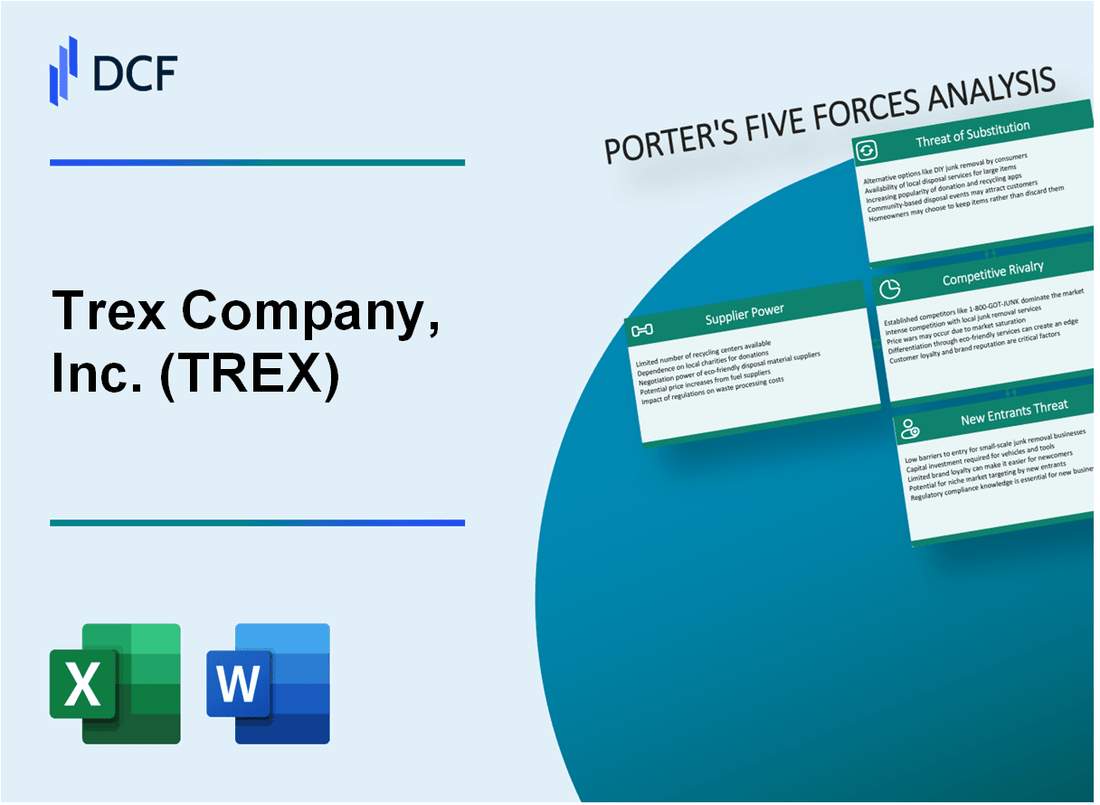
Trex Company, Inc. (TREX): 5 Analyse des forces [Jan-2025 Mise à jour] |
Entièrement Modifiable: Adapté À Vos Besoins Dans Excel Ou Sheets
Conception Professionnelle: Modèles Fiables Et Conformes Aux Normes Du Secteur
Pré-Construits Pour Une Utilisation Rapide Et Efficace
Compatible MAC/PC, entièrement débloqué
Aucune Expertise N'Est Requise; Facile À Suivre
Trex Company, Inc. (TREX) Bundle
Plongez dans le paysage stratégique de Trex Company, Inc., un leader de l'innovation de terrasse composite, alors que nous démêles la dynamique concurrentielle façonnant sa position de marché en 2024. Grâce à l'objectif du cadre des cinq forces de Michael Porter, nous explorerons comment les fournisseurs, les clients , les rivaux, les substituts et les nouveaux entrants potentiels créent un écosystème complexe qui remet en question et stimule la stratégie commerciale de Trex. Des matériaux durables à la fabrication de pointe, découvrez les forces complexes qui définissent le succès dans l'industrie de la vie en plein air et des termes.
Trex Company, Inc. (TREX) - Porter's Five Forces: Bargaining Power des fournisseurs
Paysage du fournisseur de matières premières
Trex s'appuie sur un réseau de fournisseurs spécialisé pour les matériaux de terrasse composites. En 2024, la société Sources:
- Plastique en polyéthylène haute densité recyclé (HDPE) d'environ 12 à 15 fournisseurs régionaux
- Les déchets de bois récupérés des installations de transformation du bois d'oeuvre aux États-Unis
- Additifs polymères spécialisés de 3 à 4 entreprises de fabrication de produits chimiques
Analyse de la concentration des fournisseurs
| Type de matériau | Nombre de fournisseurs | Niveau de concentration | Volatilité des prix |
|---|---|---|---|
| Plastique recyclé | 12-15 | Modéré | ± 7-10% par an |
| Bois récupéré | 8-10 | Faible | ± 5-8% par an |
| Additifs en polymère | 3-4 | Haut | ± 12-15% par an |
Implications des coûts de la chaîne d'approvisionnement
Répartition des coûts des matériaux pour la production de Trex en 2023:
- Plastique recyclé: 42 à 45% du coût total des matériaux
- Déchets de bois récupérés: 35 à 38% du coût total des matériaux
- Additifs en polymère: 17-20% du coût total des matériaux
Impact de la réglementation environnementale
Les perturbations potentielles de la chaîne d'approvisionnement des réglementations environnementales comprennent:
- Augmentation des coûts de conformité du recyclage: estimé à 2,3 à 2,7 millions de dollars par an
- Modifications du règlement du traitement des déchets: augmentation potentielle des coûts de la chaîne d'approvisionnement de 6 à 8%
- Exigences de suivi des émissions de carbone: coût de mise en œuvre estimé de 1,5 à 1,9 million de dollars
Trex Company, Inc. (TREX) - Porter's Five Forces: Bargaining Power of Clients
Segments du marché de la construction résidentielle et commerciale
Trex Company dessert deux segments de clientèle principaux avec des caractéristiques d'achat distinctes:
| Segment de marché | Taille du marché (2023) | Taux de croissance |
|---|---|---|
| Terrasse résidentiel | 7,2 milliards de dollars | 4.3% |
| Terrassement commercial | 1,5 milliard de dollars | 3.8% |
Analyse de la sensibilité aux prix
Prix moyen pour le matériel de terrasse:
| Type de matériau | Coût par pied linéaire |
|---|---|
| Terrasse en bois | $5 - $15 |
| Disking composite (TREX) | $15 - $35 |
| Terrasse en PVC | $20 - $40 |
Demande de terrasse durable
Préférences des clients pour les matériaux durables:
- 62% des propriétaires préfèrent des solutions de terrasse respectueuses de l'environnement
- Le contenu recyclé est important pour 78% des consommateurs
- Matériaux à faible entretien préférés par 85% des acheteurs
Options de matériel de terrasse alternatif
Paysage concurrentiel des matériaux de terrasse:
| Concurrent | Part de marché | Matériau primaire |
|---|---|---|
| Timbertech | 18% | Composite |
| Fibreon | 12% | Composite |
| Fournisseurs de bois | 35% | Bois traditionnel |
| Triche | 25% | Composite recyclé |
Trex Company, Inc. (TREX) - Porter's Five Forces: Rivalry compétitif
Concurrence intense sur le marché des termes composites
En 2024, le marché des termes composites démontre une intensité concurrentielle importante. Trex Company fait face à une concurrence directe de plusieurs acteurs clés avec une présence substantielle sur le marché.
| Concurrent | Part de marché | Revenus annuels |
|---|---|---|
| Timbertech | 18.5% | 475 millions de dollars |
| Fibreon | 12.3% | 312 millions de dollars |
| Trex Company | 35.7% | 915 millions de dollars |
Analyse des concurrents établis
Les caractéristiques clés du paysage concurrentiel comprennent:
- Taille totale du marché des terrasses composites: 2,8 milliards de dollars
- Taux de croissance du marché: 6,2% par an
- Nombre de concurrents importants: 7-9 marques nationales
Stratégies de différenciation des produits
Investissement de la recherche et du développement: Trex a alloué 52,3 millions de dollars en R&D pour 2023, ce qui représente 5,7% des revenus totaux.
| Zones de mise au point R&D | Montant d'investissement |
|---|---|
| Innovations sur le développement durable | 22,1 millions de dollars |
| Performance matérielle | 18,5 millions de dollars |
| Technologie de conception | 11,7 millions de dollars |
Positionnement concurrentiel
- Trex Market Leadership: 35,7% de part de marché
- Utilisation des matériaux recyclés: 95% de la composition du produit
- Durée de vie moyenne du produit: 25-30 ans
Trex Company, Inc. (TREX) - Five Forces de Porter: menace de substituts
Disking en bois traditionnel comme alternative principale
En 2023, le marché des termes en bois était évalué à 5,8 milliards de dollars. Les termes de bois traités à la pression coûtent environ 15 $ à 25 $ par pied carré installés. Le cèdre et le séquoia varient de 30 $ à 40 $ par pied carré.
| Matériel de terrasse | Coût par sq ft | Durée de vie (années) | Niveau d'entretien |
|---|---|---|---|
| Bois traité à la pression | $15-$25 | 10-15 | Haut |
| Bois de cèdre | $30-$40 | 15-20 | Moyen |
Matériaux alternatifs émergents
Le marché de terrasse en aluminium prévoyait de atteindre 1,2 milliard de dollars d'ici 2027. Le marché des termes en PVC devrait augmenter à 6,5% de TCAC de 2022 à 2027.
| Matériel | Coût par sq ft | Durée de vie (années) | Niveau d'entretien |
|---|---|---|---|
| Terrasse en aluminium | $25-$45 | 30-50 | Faible |
| Terrasse en PVC | $20-$35 | 25-35 | Faible |
Alternatives naturelles en pierre et en béton
Le marché du patio en béton d'une valeur de 3,4 milliards de dollars en 2022. Les coûts d'installation de terrasse en pierre naturelle varient de 35 $ à 70 $ par pied carré.
Comparaisons de prix et de performance
- Le platelage composite (TREX) est en moyenne de 30 $ à 45 $ par pied carré
- L'entretien des termes en bois coûte 5 à 10% de l'installation initiale par an
- Les matériaux composites ont une garantie de 25 à 30 ans par rapport à 10-15 ans pour le bois
Trex Company, Inc. (TREX) - Five Forces de Porter: Menace de nouveaux entrants
Exigences de capital initial élevées pour les infrastructures de fabrication
L'infrastructure manufacturière de Trex Company nécessite des investissements en capital substantiels. En 2023, la propriété, l'usine et l'équipement de la société (PP&E) étaient évaluées à 316,9 millions de dollars. Le processus de fabrication de terrasse composite exige un équipement spécialisé avec des coûts de configuration initiaux estimés allant entre 10 et 15 millions de dollars pour une nouvelle installation de production.
| Catégorie d'investissement en capital | Plage de coûts estimés |
|---|---|
| Construction des installations de fabrication | 5-8 millions de dollars |
| Machines spécialisées | 3 à 5 millions de dollars |
| Systèmes d'approvisionnement en matières premières | 1 à 2 millions de dollars |
La réputation de marque établie crée des barrières d'entrée
Trex détient une part de marché de 40% dans l'industrie des termes composites. La reconnaissance de la marque de l'entreprise crée des obstacles à l'entrée importants pour les concurrents potentiels.
- Leadership du marché dans le secteur des termes composites
- 2023 Revenus: 1,02 milliard de dollars
- Marque reconnue avec plus de 30 ans de présence de l'industrie
Expertise technologique et protection contre les brevets
Trex détient 47 brevets actifs protégeant ses processus de fabrication et ses compositions de matériaux. La société a investi 23,4 millions de dollars dans la recherche et le développement en 2023.
Économies d'échelle Avantage concurrentiel
Le volume de production de Trex permet des avantages importants sur les coûts. La société a fabriqué environ 250 millions de pieds linéaires de produits de terrasse en 2023, permettant des réductions de coûts par unité.
| Métrique de production | 2023 données |
|---|---|
| Volume de production annuel | 250 millions de pieds linéaires |
| Installations de fabrication | 3 emplacements de production primaires |
| Efficacité de production | Utilisation de la capacité de 92% |
Trex Company, Inc. (TREX) - Porter's Five Forces: Competitive rivalry
You're looking at a market where Trex Company, Inc. absolutely dominates its niche, but the overall competitive landscape is still a tough fight. Honestly, the rivalry within the composite segment is high, but Trex Company, Inc. has built a moat around its core business.
Trex Company, Inc. holds a commanding position, sitting at around 50-60% market share within the composite decking industry itself. This leadership scale is reflected in its full-year 2025 net sales guidance, which management set between $1.15 billion to $1.16 billion, showing the sheer volume of business that comes with being the market leader.
Still, you can't ignore the broader competition. Trex Company, Inc. is fighting a two-front war: against other established composite players and, more significantly, against traditional wood suppliers. The opportunity to grow comes from converting those wood users; after all, 76% of the current decking market still relies on traditional wood. Here's a quick look at where Trex Company, Inc. stands against the total decking opportunity as of late 2025:
| Market Segment | Estimated Share of Total Decking Market |
| Trex Company, Inc. (Composite Leader) | Approximately 14% |
| Traditional Wood Decking | Approximately 76% |
To manage this intense rivalry, Trex Company, Inc. leans heavily on continuous innovation. It's not just about having the best product from five years ago; it's about keeping the pipeline fresh. This strategy is working well, as new product introductions are a major sales driver.
For the trailing twelve-month period ending in the third quarter of 2025, products launched within the last 36 months accounted for 25% of total sales. That's a substantial chunk of revenue coming from recent R&D efforts, which helps keep competitors on their heels. The company also sees the railing category as a key area for growth, tracking for double-digit year-on-year growth in 2025.
You can see the financial scale of this leadership when you look at the recent quarterly performance, even amid a soft Repair and Remodel market. For instance, Trex Company, Inc. reported third quarter 2025 net sales of $285 million and maintained a gross margin of 40.5% in that period. The full-year adjusted EBITDA margin guidance remains above 28.0% to 28.5%. The market capitalization as of October 2025 was $5.04 billion.
The way Trex Company, Inc. manages this rivalry boils down to a few core actions:
- Maintain dominant composite market share of 50-60%.
- Drive wood conversion, targeting the 76% wood segment.
- Ensure new products contribute 25% of trailing twelve-month sales.
- Leverage scale to support the $1.15 billion to $1.16 billion 2025 sales guidance.
Finance: review the Q4 2025 sales forecast implied by the full-year guidance by next Tuesday.
Trex Company, Inc. (TREX) - Porter's Five Forces: Threat of substitutes
You're looking at the core challenge Trex Company, Inc. faces from substitutes-primarily traditional wood decking. This threat is constant because wood is the established, familiar choice, even as composite technology advances.
Traditional wood decking still commands the majority share of the total decking market, holding about 76% of the market. This large installed base means that for every new deck sold, Trex Company, Inc. is fighting against a deeply entrenched, lower-initial-cost alternative. To be fair, composite decking is gaining ground, with some data suggesting 70% of new decks installed in 2025 are composite, showing a clear shift in purchasing behavior for new construction or replacement projects.
The primary hurdle for Trex Company, Inc. is the initial sticker shock. Composite's higher upfront cost is the main barrier to adoption. For comparison, pressure-treated wood material cost can range from $2 to $7 per square foot, or even $3 to $8 per square foot. This contrasts sharply with composite materials, where even entry-level Trex Enhance® boards cost between $5 to $7 per square foot for materials alone.
Still, the threat is significantly mitigated when you look past the initial purchase price and factor in the total cost of ownership. Wood decking requires substantial ongoing investment in time and money. A wood deck can require annual maintenance costs ranging from $400 to $600, involving staining, sealing, and repairs. Furthermore, wood decks often need replacement boards or a full replacement sooner, sometimes within 10 to 20 years. Trex Company, Inc. products, conversely, boast lifespans of 25 to 50 years with maintenance costs near zero-often just soap and water cleaning. Over a 50-year horizon, this difference in upkeep is what allows the composite premium to potentially be offset, aligning with the idea that wood can cost 40% more over that long period when factoring in all expenses.
Trex Company, Inc. actively works to lower this initial barrier by offering tiered products. Trex offers tiered products, like Enhance, to compete closer to wood on initial price. The Trex Enhance® line is specifically positioned as the most budget-friendly option, with material costs around $5 to $7 per square foot, and professional installation costs estimated between $15 to $20 per square foot. This tier is designed to capture customers sensitive to the initial price point, offering a 25-year warranty as a long-term value proposition against cheaper wood.
Here's a quick math comparison on the cost dynamics:
| Factor | Traditional Wood (Pressure-Treated) | Composite (Trex) |
| Initial Material Cost (Per Sq. Ft.) | $2 to $7 | $5 to $12 (Entry Level) |
| Trex Enhance Material Cost (Per Sq. Ft.) | N/A | $5 to $7 |
| Annual Maintenance Cost Estimate | $400 to $600 | Negligible (Cleaning only) |
| Expected Lifespan Before Major Replacement | 10 to 25 years | 25 to 50 years |
| Warranty Period (Typical) | Minimal/None on material integrity | Up to 25 years for Enhance |
The threat of substitution remains high because of wood's low entry cost, but Trex Company, Inc. is effectively narrowing the gap through product segmentation and emphasizing the total cost of ownership:
- Wood holds about 76% of the total decking market.
- Pressure-treated wood material cost is as low as $2 per square foot.
- Trex Enhance material cost starts near wood, at $5 per square foot.
- Wood maintenance can cost $400 annually, plus significant labor hours.
- Composite products like Trex offer warranties up to 50 years.
Trex Company, Inc. (TREX) - Porter's Five Forces: Threat of new entrants
The threat of new entrants for Trex Company, Inc. remains relatively low, primarily due to substantial upfront investment needs and deeply entrenched competitive advantages built over decades.
Capital intensity acts as a significant hurdle. Trex Company, Inc. projected capital expenditures of approximately $200 million for the full year 2025, largely dedicated to the development of its Arkansas campus.
Replicating Trex Company, Inc.'s market penetration requires massive scale and brand equity. The company is the world's #1 brand of wood-alternative decking and railing, having been named America's Most Trusted® Outdoor Decking for 5 Years in a Row (2021-2025).
This market presence is supported by an extensive footprint. Trex Company, Inc. sells products through more than 6,700 retail outlets across six continents.
The difficulty for a newcomer to match the existing profitability profile is another barrier. New entrants would face the challenge of achieving Trex Company, Inc.'s revised full-year 2025 adjusted EBITDA margin guidance, which ranges from 28.0% to 28.5%.
The barriers to entry can be summarized with these key figures:
| Barrier Component | Metric/Value | Source Year/Period |
| Required Capital Investment (Trex Capex) | $200 million | 2025 Full Year Projection |
| Distribution Reach | Over 6,700 retail outlets | Late 2025 |
| Target Profitability (Adjusted EBITDA Margin) | 28.0% to 28.5% | 2025 Full Year Guidance |
| Brand Trust Recognition (Consecutive Years) | 5 Years (2021-2025) | Late 2025 |
The proprietary nature of the manufacturing base also deters competition. Trex Company, Inc. has been defining the composite decking category for over 30 years. The company's operational scale is further evidenced by its year-to-date capital expenditures in 2025 totaling $188 million, mostly for the Arkansas facility.
The established advantages include:
- High capital outlay, with Trex Company, Inc. planning $200 million in 2025 capex.
- Dominant brand recognition and a network of over 6,700 outlets.
- Proprietary processes built over 30+ years of operation.
- Struggling to match the projected 28.0-28.5% adjusted EBITDA margin.
Also, new entrants would need to overcome the established consumer preference, as new products accounted for 25% of Trex Company, Inc.'s trailing twelve-month sales as of Q3 2025.
Disclaimer
All information, articles, and product details provided on this website are for general informational and educational purposes only. We do not claim any ownership over, nor do we intend to infringe upon, any trademarks, copyrights, logos, brand names, or other intellectual property mentioned or depicted on this site. Such intellectual property remains the property of its respective owners, and any references here are made solely for identification or informational purposes, without implying any affiliation, endorsement, or partnership.
We make no representations or warranties, express or implied, regarding the accuracy, completeness, or suitability of any content or products presented. Nothing on this website should be construed as legal, tax, investment, financial, medical, or other professional advice. In addition, no part of this site—including articles or product references—constitutes a solicitation, recommendation, endorsement, advertisement, or offer to buy or sell any securities, franchises, or other financial instruments, particularly in jurisdictions where such activity would be unlawful.
All content is of a general nature and may not address the specific circumstances of any individual or entity. It is not a substitute for professional advice or services. Any actions you take based on the information provided here are strictly at your own risk. You accept full responsibility for any decisions or outcomes arising from your use of this website and agree to release us from any liability in connection with your use of, or reliance upon, the content or products found herein.