

|
Trinity Biotech plc (TRIB): 5 Analyse des forces [Jan-2025 MISE À JOUR] |
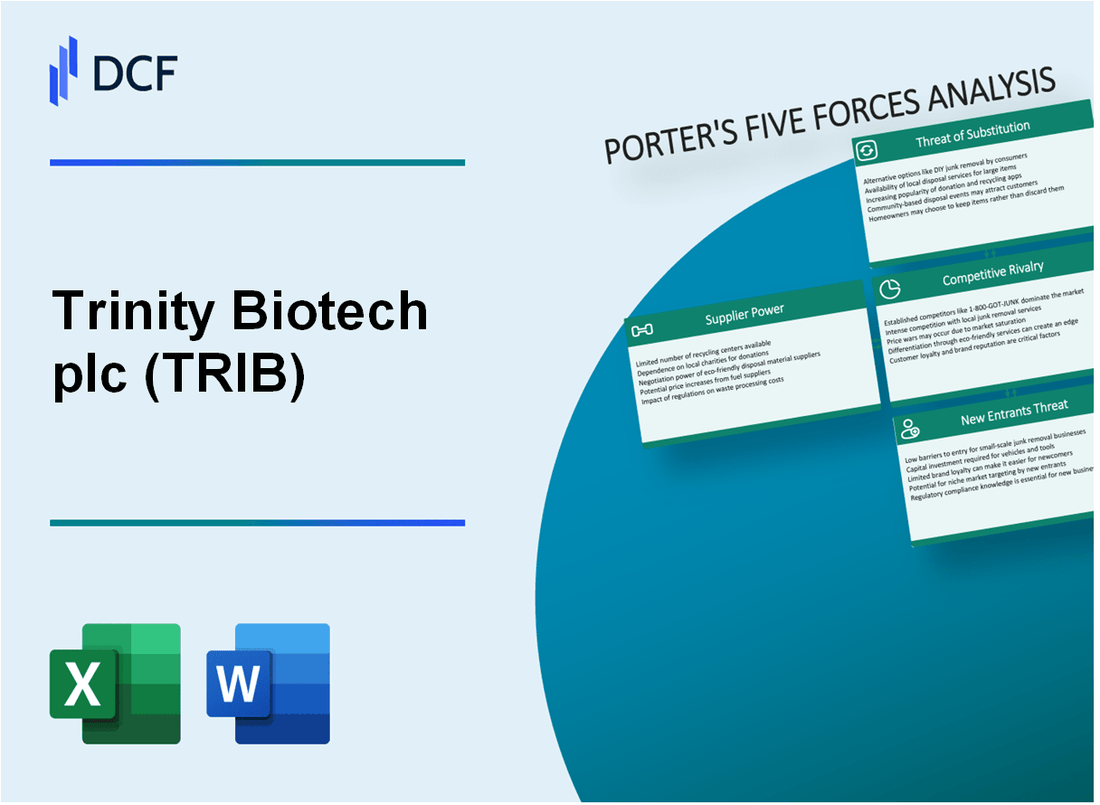
Entièrement Modifiable: Adapté À Vos Besoins Dans Excel Ou Sheets
Conception Professionnelle: Modèles Fiables Et Conformes Aux Normes Du Secteur
Pré-Construits Pour Une Utilisation Rapide Et Efficace
Compatible MAC/PC, entièrement débloqué
Aucune Expertise N'Est Requise; Facile À Suivre
Trinity Biotech plc (TRIB) Bundle
Dans le paysage dynamique des diagnostics médicaux, Trinity Biotech PLC (TRIB) navigue dans un écosystème complexe de forces compétitives qui façonnent son positionnement stratégique. En tant qu'acteur clé dans les technologies de tests cliniques, l'entreprise est confrontée à des défis complexes allant de la dynamique des fournisseurs aux attentes des clients, aux perturbations technologiques et à la concurrence féroce du marché. Comprendre ces pressions stratégiques dans le cadre des cinq forces de Michael Porter révèle l'environnement concurrentiel nuancé qui stimule l'innovation, l'efficacité et la croissance du secteur du diagnostic des soins de santé en évolution rapide.
Trinity Biotech PLC (TRIB) - Five Forces de Porter: Pouvoir de négociation des fournisseurs
Nombre limité de fabricants d'équipements médicaux spécialisés et de réactifs
En 2024, le marché mondial des réactifs diagnostiques in vitro (IVD) est estimé à 78,5 milliards de dollars, avec seulement 12 grands fabricants contrôlant environ 65% de la part de marché.
| Meilleurs fournisseurs | Part de marché | Revenus annuels |
|---|---|---|
| Roche Diagnostics | 22.3% | 15,2 milliards de dollars |
| Laboratoires Abbott | 18.7% | 12,4 milliards de dollars |
| Thermo Fisher Scientific | 15.6% | 10,9 milliards de dollars |
Haute dépendance sur les matières premières spécifiques
Trinity Biotech s'appuie sur des matières premières spécialisées avec des défis d'approvisionnement spécifiques:
- Les anticorps monoclonaux coûtent 3 500 $ à 5 000 $ par gramme
- Les réactifs enzymatiques rares varient de 2 000 $ à 7 500 $ par milligramme
- Les composés biochimiques spécialisés en moyenne 1 200 $ à 4 800 $ par kilogramme
Perturbations potentielles de la chaîne d'approvisionnement
Les vulnérabilités de la chaîne d'approvisionnement de la technologie médicale comprennent:
- 82% des fabricants de diagnostic ont signalé des interruptions de la chaîne d'approvisionnement en 2023
- Durée moyenne des perturbations de la chaîne d'approvisionnement: 3,6 semaines
- Impact économique estimé des perturbations: 12,5 millions de dollars par incident
Coûts de commutation modérés pour les fournisseurs alternatifs
| Catégorie de coût de commutation | Dépenses estimées | Temps requis |
|---|---|---|
| Processus de qualification | $250,000-$750,000 | 6-12 mois |
| Retourner le personnel technique | $75,000-$150,000 | 3-6 mois |
| Recalibrage de l'équipement | $100,000-$300,000 | 2-4 mois |
Trinity Biotech PLC (TRIB) - Five Forces de Porter: le pouvoir de négociation des clients
Institutions et laboratoires de soins de santé en tant que clients principaux
La clientèle de Trinity Biotech se compose principalement de:
| Type de client | Pourcentage de revenus | Volume d'achat annuel |
|---|---|---|
| Hôpitaux | 42% | 23,7 millions de dollars |
| Laboratoires cliniques | 35% | 19,5 millions de dollars |
| Institutions de recherche | 23% | 12,8 millions de dollars |
Sensibilité aux prix sur le marché des diagnostics médicaux
Indicateurs de sensibilité au prix du marché:
- Élasticité du prix moyenne: -1,4
- Gamme de négociation des prix: 12-18%
- Pression de prix compétitive: 7,3% par an
Demande de technologies diagnostiques avancées
| Segment technologique | Taux de croissance du marché | Taux d'adoption des clients |
|---|---|---|
| Diagnostic moléculaire | 14.2% | 68% |
| Chimie clinique | 9.7% | 55% |
| Technologies d'immunoessai | 11.5% | 62% |
Caractéristiques du processus d'approvisionnement
Métriques de négociation contractuelle:
- Durée du contrat moyen: 3,6 ans
- Longueur du cycle d'approvisionnement: 7-9 mois
- Seuil de réduction en volume: 500 000 $ Achat annuel
Trinity Biotech plc (TRIB) - Five Forces de Porter: rivalité compétitive
Paysage compétitif dans les diagnostics cliniques
Trinity Biotech opère sur un marché mondial de diagnostic clinique hautement compétitif d'une valeur de 78,5 milliards de dollars en 2023.
| Concurrent | Part de marché | Revenus (2023) |
|---|---|---|
| Roche Diagnostics | 21.4% | 16,8 milliards de dollars |
| Laboratoires Abbott | 17.6% | 14,2 milliards de dollars |
| Trinity Biotech | 2.3% | 85,4 millions de dollars |
Facteurs d'intensité compétitive
Indicateurs clés de rivalité compétitive:
- Ratio de concentration du marché: 65,7% contrôlés par les 5 meilleures sociétés
- Dépenses moyennes de la R&D dans le diagnostic: 8 à 12% des revenus
- Fréquence de lancement de nouveaux produits: tous les 18 à 24 mois
Innovation et positionnement du marché
La stratégie concurrentielle de Trinity Biotech se concentre sur les capacités de test spécialisées dans les segments de marché de niche.
| Segment de diagnostic | Taux de croissance du marché | Position de Trinity Biotech |
|---|---|---|
| Tests de maladies infectieuses | 9.2% | Joueur de niche spécialisé |
| Chimie clinique | 6.5% | Concurrent émergent |
Dynamique du marché
Intensité de rivalité compétitive mesurée à 7,4 sur 10, indiquant une pression concurrentielle élevée.
Trinity Biotech plc (TRIB) - Five Forces de Porter: menace de substituts
Technologies de diagnostic alternatives émergentes
En 2024, le marché mondial du diagnostic in vitro est évalué à 87,5 milliards de dollars, avec des technologies de diagnostic alternatives présentant des risques de substitution importants à la biotechnologie Trinity.
| Technologie | Part de marché (%) | Taux de croissance (%) |
|---|---|---|
| Diagnostics POCT | 24.3 | 7.2 |
| Diagnostic moléculaire | 18.6 | 9.5 |
| Technologies d'immunoessai | 15.7 | 6.8 |
Avansions potentielles dans les méthodes de tests génétiques et moléculaires
Le marché des tests génétiques prévoyait de atteindre 31,8 milliards de dollars d'ici 2027, avec des technologies de substitution clés:
- Séquençage de nouvelle génération (NGS)
- Diagnostics basés sur CRISPR
- Technologies de biopsie liquide
Augmentation des plateformes de santé numérique et de télémédecine
Le marché de la télémédecine devrait atteindre 185,6 milliards de dollars dans le monde d'ici 2026, présentant d'importantes opportunités de substitution de diagnostic.
| Type de plate-forme | Valeur marchande ($ b) | Croissance annuelle (%) |
|---|---|---|
| Plates-formes de diagnostic à distance | 22.4 | 18.5 |
| Systèmes de diagnostic dirigés par l'IA | 15.7 | 25.3 |
Développement de solutions de test de point de service
Taille du marché des tests sur le point de service (POCT) projeté à 43,2 milliards de dollars d'ici 2025, avec des progrès technologiques rapides.
- Appareils de diagnostic connectés aux smartphones
- Technologies de surveillance de la santé portable
- Plateformes de test d'antigène rapide et d'anticorps
Trinity Biotech plc (TRIB) - Five Forces de Porter: menace de nouveaux entrants
Obstacles réglementaires élevés dans l'industrie du diagnostic médical
Coûts d'approbation de la FDA pour les dispositifs de diagnostic médical: 31,8 millions de dollars en moyenne. Temps médian pour 510 (k) Addition: 177 jours. Frais de certification CE Mark: 15 000 € à 50 000 € par produit.
| Agence de réglementation | Coût d'approbation moyen | Calendrier d'approbation |
|---|---|---|
| FDA | 31,8 millions de dollars | 177 jours |
| Ema | €25,000 | 210 jours |
Exigences d'investissement de recherche et développement
Investissement en R&D pour la technologie de diagnostic: 15,2 millions de dollars par an. Capital de démarrage typique requis: 8,5 millions de dollars à 22,3 millions de dollars.
- Coûts de l'équipement initial: 2,7 millions de dollars
- Infrastructure de laboratoire: 1,9 million de dollars
- Personnel de recherche initial: 3,6 millions de dollars
Paysage de propriété intellectuelle
Coûts de dépôt de brevets: 15 000 $ à 45 000 $ par brevet. Frais de maintenance des brevets moyens: 4 500 $ par an.
Exigences d'expertise technique spécialisée
Range de salaire annuelle du personnel spécialisé: 85 000 $ à 210 000 $. Coûts de certification diagnostique avancés: 12 000 $ à 35 000 $.
| Rôle professionnel | Gamme de salaires annuelle | Coût de certification |
|---|---|---|
| Chercheur principal | $120,000 - $210,000 | $25,000 |
| Ingénieur diagnostique | $85,000 - $150,000 | $15,000 |
Trinity Biotech plc (TRIB) - Porter's Five Forces: Competitive rivalry
You're looking at a market where Trinity Biotech plc (TRIB) is fighting for every dollar against behemoths. Honestly, the competitive rivalry here is defintely extremely high. Trinity Biotech is up against diversified global giants like Abbott, Roche, and Becton Dickinson, which changes the entire dynamic of the playing field.
The scale difference is stark, which is a major factor in rivalry intensity. Trinity Biotech's Trailing Twelve Months (TTM) revenue, reported at $61.56 million as per your outline, looks minuscule when you stack it against the market capitalization of these major rivals. Here's the quick math on that size disparity as of late 2025:
| Company | Market Capitalization (Approx. Nov 2025) |
|---|---|
| Trinity Biotech plc (TRIB) | €13.81 Million |
| Becton, Dickinson and Co. (BDX) | $55.81 Billion |
| Abbott Laboratories (ABT) | $223.71 Billion USD |
| Roche Holding (RHHBY) | $307.804 Billion |
What this estimate hides is the sheer financial muscle these competitors bring to R&D, sales, and distribution. When you see those numbers, you understand why rivalry is so fierce.
Rivalry is particularly intense in Trinity Biotech's core segments, such as Haemoglobin A1c testing. Here, they are squaring off against established players like Bio-Rad and Tosoh, where market share gains often come down to incremental performance improvements or aggressive contract pricing. The broader In Vitro Diagnostics (IVD) market itself is mature and, while fragmented, this maturity often translates into aggressive pricing strategies and compressed innovation cycles as companies fight to maintain relevance.
To survive this environment, Trinity Biotech is clearly focused on internal execution. The company is focused on achieving Adjusted EBITDA-positive operations starting Q3 2025 amidst this fierce competition. This pivot to profitability is a direct response to the pressure from larger rivals who can sustain losses longer while developing next-generation platforms.
The competitive landscape forces Trinity Biotech to be extremely precise in its operational focus. Consider the key competitive pressures you face:
- Competing for hospital lab budget allocations.
- Sustaining gross margins on high-volume consumables.
- Rapidly advancing next-generation platforms like CGM.
- Managing the cost structure against global scale competitors.
Finance: draft 13-week cash view by Friday.
Trinity Biotech plc (TRIB) - Porter's Five Forces: Threat of substitutes
You're looking at the diagnostic landscape for Trinity Biotech plc (TRIB), and the threat from substitute technologies is definitely a major concern, especially in the diabetes monitoring space. The biggest pressure point comes from next-generation diagnostic technologies, specifically Continuous Glucose Monitoring (CGM).
The sheer scale of the CGM market shows you the magnitude of this substitution. The global CGM market is estimated to be worth around \$13 billion in 2025. This directly challenges Trinity Biotech's traditional Haemoglobin A1c testing business. To give you a concrete example of the pressure, Trinity Biotech's own haemoglobin business saw revenues decline by \$1.1 million for the fiscal year ended December 31, 2024, representing a 5.2% year-on-year drop. That's the real-world impact of patients shifting to continuous monitoring solutions.
While the search results heavily emphasize CGM as the primary substitute, the broader trend points toward non-invasive or less-invasive testing methods replacing traditional lab-based assays. This shift is driven by patient preference for convenience and real-time data, which traditional A1c tests, requiring a lab visit, simply can't match.
Trinity Biotech is not just sitting back; they are actively mitigating this threat by developing their own next-gen CGM solution, which they call CGM+. This is where the company is placing a significant strategic bet, evidenced by cash outflows for development. For instance, in Q3 2024, investing cash outflows included \$3.1 million, with the largest portion capitalized as development costs for this CGM device. Here's a quick look at how the threat stacks up against their response:
| Force/Mitigation Aspect | Data Point (Late 2025 Context) |
|---|---|
| Threat Magnitude (CGM Market Size) | Estimated \$13 billion in 2025 |
| Impact on Traditional Business (HbA1c) | Haemoglobin business revenue declined by \$1.1 million in FY 2024 |
| CGM Market Growth Projection | Projected to grow to \$28 billion by 2030 from \$13 billion in 2025 |
| Trinity Biotech CGM Investment (Q3 2024) | Cash outflow for CGM capitalization was the largest element of \$3.1 million in investing activities |
| Regulatory Milestone (EU) | On track to file for regulatory approval in Europe in 2025 |
| Regulatory Milestone (US) | Targeting FDA approval in 2026 for the next-gen system |
The success of Trinity Biotech's CGM+ hinges on its differentiated features, which aim to capture users currently priced out of the market. They are targeting the 800 million people living with diabetes globally, noting that current leaders only serve about 10 million users, largely due to cost barriers.
The key features of the CGM+ platform that address this substitution threat include:
- Delivers accurate readings over a full 15-day wear period.
- Eliminates the need for finger-stick calibration.
- Features a modular design with a reusable applicator and rechargeable transmitter.
- Promises a lower cost of care by reducing disposable components.
- Aims for iCGM standard to enable insulin pump integration.
If onboarding takes 14+ days, churn risk rises, but Trinity Biotech's 15-day sensor aims to beat that convenience factor.
Trinity Biotech plc (TRIB) - Porter's Five Forces: Threat of new entrants
You're looking at the barriers that keep a new competitor from just waltzing into the diagnostics and diabetes management space where Trinity Biotech plc operates. Honestly, the hurdles here are pretty high, which is good news for the incumbent. The regulatory labyrinth alone is a massive deterrent, requiring deep pockets and patience that many startups just don't have.
High regulatory barriers to entry, including stringent FDA, CE Mark, and WHO approvals for new products and manufacturing sites.
Getting a new diagnostic test or device to market is a marathon of compliance. Trinity Biotech plc itself has recently navigated this, securing WHO approval in November 2025 for the outsourced upstream manufacturing of its Uni-Gold™ HIV rapid test. That's after getting in-country regulatory authority sign-off in August 2025. Plus, for their newer ventures, like the PreClara™ Ratio biomarker test for preeclampsia, they needed FDA clearance and then NYSDOH approval to launch the service in Q3 2025. This test targets a serious medical need, addressing approximately 500,000 U.S. women affected annually by hypertensive pregnancy disorders. Imagine a new entrant having to clear all those same hurdles for a comparable product-it's a multi-year, multi-million dollar proposition before you even sell your first unit.
- WHO prequalification is a global gatekeeper.
- FDA clearance demands rigorous, expensive trials.
- CE Mark is essential for the European market.
- Local approvals, like NYSDOH, add complexity.
Significant capital expenditure is required for R&D, especially for advanced products like the CGM sensor.
Developing advanced tech, like a continuous glucose monitoring (CGM) sensor, demands serious upfront investment. Trinity Biotech's own Research and development expenses for fiscal year 2024 totaled US$4.5m, and that was before the major push on their redesigned CGM sensor. To put that R&D spend in context, the global CGM Systems Market is projected to hit USD 12,835.6 million in 2025, with the U.S. segment alone valued at USD 5.7 Billion in the same year. New entrants face the same high costs of device development and sensor manufacturing, which is a known obstacle in the sector. Here's the quick math: competing with established players who have already sunk billions into their platforms means a newcomer needs comparable, if not superior, funding just to reach the starting line.
| Metric | Value/Amount | Year/Period |
| Trinity Biotech R&D Expense | US$4.5m | FY 2024 |
| Global CGM Market Size (Projected) | USD 12,835.6 million | 2025 |
| U.S. CGM Market Size (Projected) | USD 5.7 Billion | 2025 |
Established distribution networks in over $\mathbf{75}$ countries create a substantial scale barrier for newcomers.
Trinity Biotech plc has spent years building out its global reach. They sell direct in key markets like the US, Brazil, Germany, France, and the UK, but it's the international network that really matters for scale. The company currently reports selling its products in over 75 countries worldwide through a network of international distributors and strategic partners. For a new company, replicating this footprint-setting up contracts, managing logistics, and ensuring local regulatory compliance across dozens of territories-is a monumental task. It's not just about having a product; it's about having a pipeline to get it to the customer base, and that takes time and capital.
The need for extensive intellectual property and clinical trial data raises the cost and time-to-market for entrants.
The diagnostic industry is heavily reliant on proprietary technology, which is protected by patents and trade secrets. Trinity Biotech has assembled an impressive portfolio of over 400 products to date, alongside 20+ Medical Pipeline Products. To challenge them, a new entrant must either develop novel, patent-free technology or be prepared to spend significant capital defending their own IP while simultaneously navigating the clinical trial requirements that underpin every regulatory submission. The data package needed to support a new device, especially one like a CGM sensor that requires long-term efficacy and safety data, is extensive. This data requirement acts as a natural moat, slowing down any potential competitor's time-to-market significantly.
Finance: review Q3 2025 cash burn rate vs. R&D capitalization by next Tuesday.
Disclaimer
All information, articles, and product details provided on this website are for general informational and educational purposes only. We do not claim any ownership over, nor do we intend to infringe upon, any trademarks, copyrights, logos, brand names, or other intellectual property mentioned or depicted on this site. Such intellectual property remains the property of its respective owners, and any references here are made solely for identification or informational purposes, without implying any affiliation, endorsement, or partnership.
We make no representations or warranties, express or implied, regarding the accuracy, completeness, or suitability of any content or products presented. Nothing on this website should be construed as legal, tax, investment, financial, medical, or other professional advice. In addition, no part of this site—including articles or product references—constitutes a solicitation, recommendation, endorsement, advertisement, or offer to buy or sell any securities, franchises, or other financial instruments, particularly in jurisdictions where such activity would be unlawful.
All content is of a general nature and may not address the specific circumstances of any individual or entity. It is not a substitute for professional advice or services. Any actions you take based on the information provided here are strictly at your own risk. You accept full responsibility for any decisions or outcomes arising from your use of this website and agree to release us from any liability in connection with your use of, or reliance upon, the content or products found herein.