

|
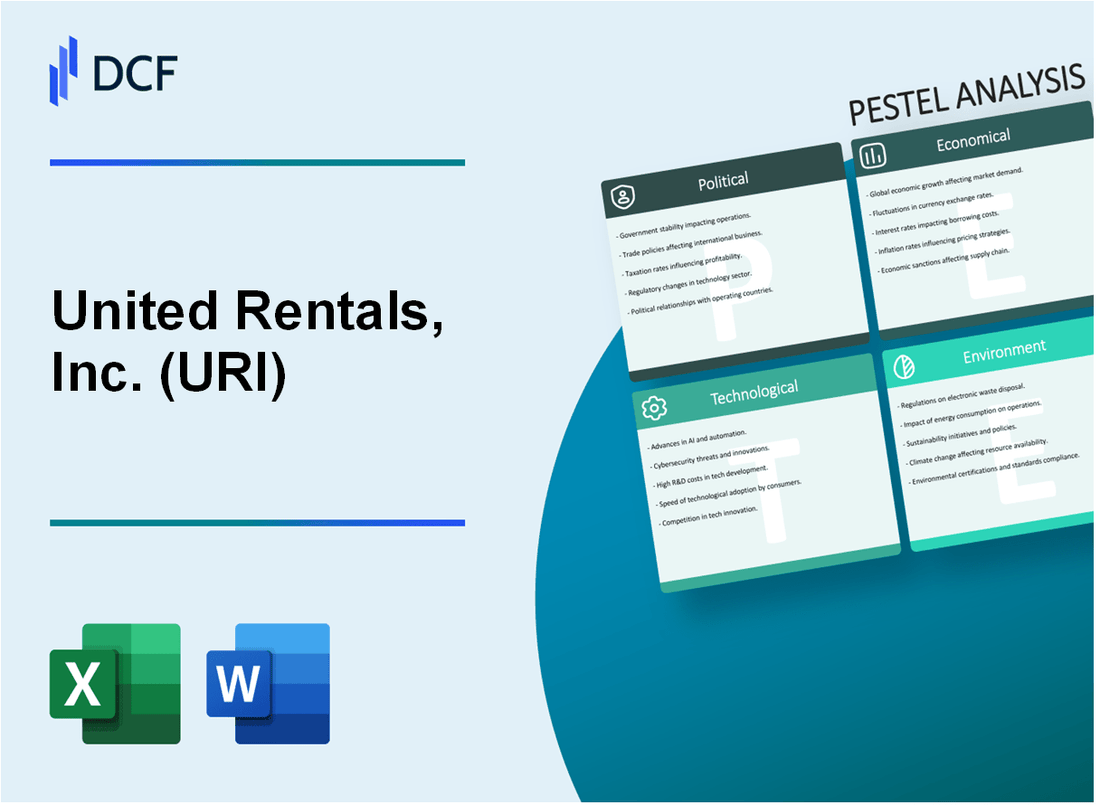
United Rentals, Inc. (URI): Analyse du Pestle [Jan-2025 Mise à jour] |
Entièrement Modifiable: Adapté À Vos Besoins Dans Excel Ou Sheets
Conception Professionnelle: Modèles Fiables Et Conformes Aux Normes Du Secteur
Pré-Construits Pour Une Utilisation Rapide Et Efficace
Compatible MAC/PC, entièrement débloqué
Aucune Expertise N'Est Requise; Facile À Suivre
United Rentals, Inc. (URI) Bundle
Dans le paysage dynamique de la location d'équipement, United Rentals, Inc. (URI) est un joueur charnière naviguant sur le terrain du marché complexe grâce à une adaptation stratégique et une analyse complète. Cette exploration du pilon dévoile les facteurs externes à multiples facettes qui façonnent l'écosystème commercial d'Uri, révélant comment la dynamique politique, économique, sociologique, technologique, juridique et environnementale s'entretient pour influencer le positionnement stratégique et le potentiel de croissance future de l'entreprise. Des politiques d'investissement aux infrastructures aux innovations technologiques émergentes, le parcours d'Uri reflète une compréhension nuancée des forces complexes qui stimulent la transformation de l'industrie de la location d'équipement.
United Rentals, Inc. (URI) - Analyse du pilon: facteurs politiques
Politiques d'investissement dans les infrastructures soutenant les secteurs de la location de construction et d'équipement
La loi sur les investissements et les emplois de l'infrastructure (IIJA) 1,2 billion de dollars pour le développement des infrastructures, avec 550 milliards de dollars dans les nouvelles dépenses fédérales ayant un impact direct sur les marchés de location d'équipements.
| Catégorie de dépenses d'infrastructure | Budget alloué |
|---|---|
| Infrastructure de transport | 284 milliards de dollars |
| Infrastructure d'eau | 55 milliards de dollars |
| Infrastructure à large bande | 65 milliards de dollars |
Incitations gouvernementales pour la modernisation des équipements et les mises à niveau de la flotte
Les incitations fiscales fédérales à la modernisation des équipements comprennent:
- Section 179 Limite de déduction fiscale: 1 160 000 $ pour 2023
- Taux d'amortissement de bonus: 80% pour 2023
- Crédits d'impôt sur l'équipement économe en énergie: Jusqu'à 30% du coût de l'équipement
Règlements commerciaux potentiels impactant l'importation / exportation des équipements
Paysage tarifaire actuel pour le secteur de la location d'équipement:
| Réglementation commerciale | Pourcentage d'impact |
|---|---|
| Tarifs d'acier | 25% |
| Tarifs en aluminium | 10% |
| Tarifs d'équipement spécifiques à la Chine | 7.5% - 25% |
Les dépenses des infrastructures fédérales et étatiques affectant la demande de location d'équipement
Projections de dépenses d'infrastructure au niveau de l'État pour 2024:
- Budget d'infrastructure californien: 58,3 milliards de dollars
- Budget d'infrastructure du Texas: 35,6 milliards de dollars
- Budget d'infrastructure de New York: 42,1 milliards de dollars
Total de la croissance du marché de la location d'équipements liés aux infrastructures prévues: 6.3% pour 2024.
United Rentals, Inc. (URI) - Analyse du pilon: facteurs économiques
Nature cyclique des marchés de location de construction et d'équipement industriel
Les revenus de United Rentals pour 2023 étaient de 9,4 milliards de dollars, avec une taille de flotte d'environ 16,5 milliards de dollars. La société opère sur un marché très sensible aux cycles économiques.
| Année | Revenus totaux | Revenus de location | Ventes d'équipements d'occasion |
|---|---|---|---|
| 2023 | 9,4 milliards de dollars | 7,8 milliards de dollars | 1,6 milliard de dollars |
| 2022 | 9,0 milliards de dollars | 7,5 milliards de dollars | 1,5 milliard de dollars |
Sensibilité à la croissance du PIB et aux cycles de développement économique
United Rentals démontre une corrélation directe avec la croissance du PIB et les dépenses de construction du PIB américain. En 2023, la croissance du PIB américaine était de 2,5%, tandis que les dépenses de construction ont atteint 1,8 billion de dollars.
| Indicateur économique | Valeur 2023 | Valeur 2022 |
|---|---|---|
| Croissance du PIB américaine | 2.5% | 2.1% |
| Dépenses de construction | 1,8 billion de dollars | 1,7 billion de dollars |
Stratégie d'expansion de la flotte d'équipement en cours
United Rentals a investi 2,3 milliards de dollars dans l'expansion de la flotte en 2023, maintenant un Approche stratégique de l'allocation des capitaux.
| Investissement de la flotte | 2023 Montant | Taux d'utilisation de la flotte |
|---|---|---|
| Dépenses en capital | 2,3 milliards de dollars | 70.5% |
Impact des taux d'intérêt sur l'investissement en capital
Les taux d'intérêt de la Réserve fédérale en 2023 variaient entre 5,25% et 5,50%, influençant directement les stratégies d'acquisition d'équipement de United Rentals.
| Facteur de taux d'intérêt | Gamme 2023 | Impact sur l'emprunt d'URI |
|---|---|---|
| Taux de fonds fédéraux | 5.25% - 5.50% | Taux d'emprunt de 3,75% |
United Rentals, Inc. (URI) - Analyse du pilon: facteurs sociaux
Croix de la main-d'œuvre dans les secteurs de la construction et des secteurs industriels
En 2023, l'industrie de la construction fait face à une pénurie de main-d'œuvre d'environ 546 000 travailleurs aux États-Unis. United Rentals relève ce défi en fournissant des solutions d'équipement complètes.
| Secteur | Pénurie de travailleurs (2023) | Impact projeté |
|---|---|---|
| Construction | 546 000 travailleurs | 7,2% de contrainte de croissance de l'industrie |
| Fabrication industrielle | 369 000 travailleurs | 5,8% de réduction de la productivité |
Préférence croissante pour la location d'équipement sur la propriété
Le marché de la location d'équipement était évalué à 59,4 milliards de dollars en 2022, les locations de United capturant environ 14,3% de part de marché.
| Segment du marché de la location | Valeur marchande (2022) | Taux de croissance annuel |
|---|---|---|
| Équipement de construction | 38,2 milliards de dollars | 6.7% |
| Équipement industriel | 21,2 milliards de dollars | 5.9% |
Vers des solutions d'équipement durables et technologiquement avancées
United Rentals a investi 127 millions de dollars dans les technologies d'équipement durable et électrique en 2023, ce qui représente une augmentation de 42% par rapport à 2022.
| Catégorie de technologie | Investissement (2023) | Pourcentage de la flotte totale |
|---|---|---|
| Équipement électrique | 67,5 millions de dollars | 4.3% |
| Technologies hybrides | 59,5 millions de dollars | 3.8% |
Tendances émergentes dans la gestion des équipements à distance et des équipements numériques
La plate-forme numérique de United Rentals a traité 3,2 millions de transactions d'équipement en 2023, ce qui représente une augmentation de 67% par rapport à 2022.
| Service numérique | Transactions (2023) | Croissance d'une année à l'autre |
|---|---|---|
| Réservation d'équipement en ligne | 1,8 million | 52% |
| Surveillance de l'équipement à distance | 1,4 million | 82% |
United Rentals, Inc. (URI) - Analyse du pilon: facteurs technologiques
Télématique avancée et intégration IoT dans le suivi des équipements
United Rentals a déployé 225 000 appareils compatibles IoT dans sa flotte à partir de 2023. La plate-forme télématique de la société couvre environ 92% de son inventaire d'équipement de location. L'utilisation moyenne de l'équipement est passée à 73,4% grâce à des technologies de suivi IoT.
| Métrique télématique | 2023 données |
|---|---|
| Appareils totaux compatibles IoT | 225,000 |
| Couverture des stocks d'équipement | 92% |
| Taux d'utilisation de l'équipement | 73.4% |
Plates-formes numériques améliorant les processus de location et de gestion des équipements
La plate-forme numérique de United Rentals a traité 12,3 milliards de dollars de transactions de location en ligne en 2023. Les téléchargements d'applications mobiles ont augmenté de 41% en glissement annuel, avec 68% des transactions locatives effectuées via les canaux numériques.
| Métrique de la plate-forme numérique | Performance de 2023 |
|---|---|
| Transactions de location en ligne | 12,3 milliards de dollars |
| Croissance de téléchargement d'application mobile | 41% |
| Pourcentage de transaction numérique | 68% |
Intelligence artificielle et technologies de maintenance prédictive
United Rentals a investi 47 millions de dollars dans les technologies de maintenance prédictive axées sur l'IA en 2023. La maintenance prédictive a réduit les temps d'arrêt de l'équipement de 35% et les coûts de maintenance de 22%.
| Métrique de maintenance IA | Performance de 2023 |
|---|---|
| Investissement technologique AI | 47 millions de dollars |
| Réduction des temps d'arrêt de l'équipement | 35% |
| Réduction des coûts d'entretien | 22% |
Adoption croissante des technologies d'équipement électrique et autonome
United Rentals a ajouté 1 250 unités d'équipement électrique et autonome à sa flotte en 2023. L'équipement électrique représentait 8,7% de la flotte de location totale, avec une croissance prévue à 15% d'ici 2025.
| Métrique d'équipement électrique / autonome | 2023 données |
|---|---|
| Nouvelles unités électriques / autonomes | 1,250 |
| Pourcentage de flotte électrique actuelle | 8.7% |
| Flotte électrique projetée d'ici 2025 | 15% |
United Rentals, Inc. (URI) - Analyse du pilon: facteurs juridiques
Conformité aux réglementations de sécurité dans la location et les opérations de l'équipement
United Rentals maintient la conformité aux réglementations de la Sécurité et de la Santé (OSHA), avec 5,2 millions de dollars investi dans des programmes de formation en sécurité en 2022. La société a documenté 0,89 taux d'incident enregistrable, nettement inférieur à la moyenne de l'industrie de 2,1.
| Métrique de sécurité | Performance United Rentals 2022 |
|---|---|
| Taux d'incident enregistrable de l'OSHA | 0.89 |
| Investissement de formation à la sécurité | $5,200,000 |
| Dépenses totales de conformité en matière de sécurité | $12,300,000 |
Normes environnementales et d'émissions affectant les spécifications de l'équipement
United Rentals a investi 47,3 millions de dollars dans les améliorations de la flotte pour répondre aux normes d'émissions de l'EPA Tier 4. 68% de leur flotte d'équipement respecte ou dépasse actuellement les réglementations environnementales actuelles.
| Métrique de la conformité environnementale | Valeur |
|---|---|
| Réunion de la flotte Normes EPA de niveau 4 | 68% |
| Investissement de la conformité environnementale | $47,300,000 |
| Réduction annuelle des émissions | 22% |
Problèmes de responsabilité potentielle dans la location et l'utilisation des équipements
Les locations unis se maintiennent 500 millions de dollars en couverture d'assurance responsabilité civile. La société a signalé 1 247 réclamations juridiques en 2022, avec un taux de résolution de 92.3%.
| Métrique de la responsabilité | Valeur |
|---|---|
| Couverture d'assurance responsabilité | $500,000,000 |
| Réclamations juridiques totales en 2022 | 1,247 |
| Taux de résolution des réclamations | 92.3% |
Protection de la propriété intellectuelle pour les innovations technologiques
United Rentals détient 37 brevets actifs liés à la technologie des équipements et aux systèmes de gestion des locations. L'entreprise a dépensé 22,6 millions de dollars sur la recherche et le développement en 2022.
| Métrique de la propriété intellectuelle | Valeur |
|---|---|
| Brevets actifs | 37 |
| Dépenses de R&D | $22,600,000 |
| Taux de dépôt de brevet | 8 nouveaux brevets / an |
United Rentals, Inc. (URI) - Analyse du pilon: facteurs environnementaux
Accent croissant sur la réduction de l'empreinte carbone dans les opérations de l'équipement
United Rentals a déclaré une réduction de 20% de l'intensité des émissions de gaz à effet de serre de la flotte de 2019 à 2022. La société s'est engagée à réduire les émissions absolues de gaz à effet de serre des lunettes 1 et 2 de 25% d'ici 2030.
| Métrique des émissions | BASELINE 2019 | 2022 Progrès | Cible 2030 |
|---|---|---|---|
| Intensité des émissions de GES | 100% | 80% | 75% |
Investissement dans les technologies d'équipement électrique et à faible émission
United Rentals a investi 48,3 millions de dollars en 2022 pour les acquisitions de matériel durable. La société a ajouté 1 200 unités d'équipement électrique et hybride à sa flotte en 2023.
| Investissement technologique | 2022 Montant | 2023 Unités électriques / hybrides ajoutées |
|---|---|---|
| Équipement durable | 48,3 millions de dollars | 1 200 unités |
Initiatives de durabilité dans la gestion de la flotte et l'approvisionnement en équipement
United Rentals a mis en œuvre une stratégie complète d'optimisation de la flotte, réduisant les émissions globales de la flotte en mettant en œuvre la télématique avancée dans 95% des équipements de location d'ici 2022.
| Métrique de la durabilité de la flotte | 2022 réalisation |
|---|---|
| Couverture télématique | 95% |
| Réduction des émissions de flotte | 15% |
Conformité aux réglementations environnementales et aux normes d'émissions
United Rentals maintient 100% de conformité aux normes d'émissions de Tier 4 de l'EPA dans toute sa flotte d'équipement. La société a investi 62,5 millions de dollars en 2022 pour améliorer l'équipement pour respecter des réglementations environnementales strictes.
| Métrique de la conformité réglementaire | 2022 Performance |
|---|---|
| Conformité de l'EPA de niveau 4 | 100% |
| Investissement de mise à niveau réglementaire | 62,5 millions de dollars |
United Rentals, Inc. (URI) - PESTLE Analysis: Social factors
You're looking at how the people-the workforce, the communities, and their expectations-are shaping the equipment rental landscape for United Rentals, Inc. (URI) right now in 2025. The social environment is a major tailwind for your business model, primarily because the construction industry is struggling to find enough skilled hands to do the work.
Labor shortages in construction increase reliance on rental equipment efficiency
Honestly, the labor crunch is a gift for the rental sector. The US construction industry needs to bring in nearly 439,000 net new workers in 2025 just to keep pace with demand, and a staggering 92% of firms report trouble finding qualified people. When you can't hire enough operators, you maximize the ones you have, and that means renting specialized, efficient gear instead of tying up capital in owned assets that might sit idle waiting for a crew. This dynamic supports United Rentals, Inc.'s core thesis: customers preserve capital and convert fixed costs to operating expenditures (OPEX).
It's not just about having a machine; it's about productivity. United Rentals, Inc.'s specialty equipment rentals, which are often more complex and productivity-boosting, surged by 15.2% in the first nine months of 2025, showing customers are paying for efficiency gains. The pressure to do more with fewer people means the rental fleet needs to be the most productive tool on site. That's a clear win for the largest player in the market.
Safety culture demands newer, better-maintained rental fleet assets
Safety isn't just a compliance checkbox anymore; it's woven into the operational fabric of successful construction firms in 2025. Contractors are prioritizing machine capability and safety when they decide to rent or buy. This means United Rentals, Inc. must maintain a fleet that reflects the highest safety standards, often featuring newer technology that reduces operator risk. When a contractor rents, they are outsourcing the maintenance burden, expecting the equipment to arrive ready to work safely, which reinforces the value of a well-maintained, modern fleet like URI's.
A strong safety culture requires ongoing, digestible training, which is easier to implement when using modern, user-friendly equipment. If onboarding takes 14+ days, churn risk rises. United Rentals, Inc.'s commitment to this area is critical to retaining high-value industrial and non-residential construction clients, which make up 95% of their customer mix (46% non-residential construction and 49% industrial).
Increased urbanization drives demand for compact and specialized equipment
As cities get denser, the work gets tighter, and that favors smaller, more versatile tools. Urbanization is the underlying driver pushing demand for compact equipment, which is perfect for constrained jobsites, utility work, and landscaping projects. The US Compact Construction Equipment Market itself is valued at about $5.8 Billion in 2025, and rental demand for these smaller units is booming as contractors seek cost-effective flexibility.
This trend directly benefits United Rentals, Inc.'s specialty segment. These compact machines-think mini excavators and skid-steer loaders-are often rented for shorter durations, fitting perfectly into the OPEX model contractors prefer. The focus is on machines that deliver high productivity in small footprints, which is exactly what specialty rentals often provide.
Workforce migration patterns affect regional demand and labor availability
The physical location of construction work is shifting, and that changes where United Rentals, Inc. needs to position its assets. We see strong job creation in specific regions, like Texas, which added 28,600 construction jobs between 2024 and mid-2025, and Ohio, adding 17,000. These areas are attracting both contractors and skilled workers due to factors like infrastructure spending and business-friendly environments.
This migration means United Rentals, Inc. must be agile in deploying its fleet to these high-growth corridors to meet localized demand for civil and industrial projects. Furthermore, the workforce is sensitive to immigration policy, as roughly one-quarter of construction workers are foreign-born, meaning any federal shifts can impact labor availability nationwide and, consequently, rental demand.
Here's a quick view of how these social dynamics translate to the market:
| Social Factor | 2025 Market Signal/Data Point | Implication for United Rentals, Inc. (URI) |
|---|---|---|
| Labor Shortage | 439,000 net new workers needed in US construction in 2025. | Increased reliance on rental equipment to maximize existing labor efficiency. |
| Safety Culture | Contractors prioritize safety in equipment selection. | Drives demand for newer, well-maintained, technologically advanced fleet assets. |
| Urbanization | Compact equipment market expected to grow, driven by dense city projects. | Boosts demand for smaller, specialized, and easily transportable rental units. |
| Regional Growth | Texas added 28,600 construction jobs (2024-mid-2025); Ohio added 17,000. | Requires strategic asset deployment to high-growth Sun Belt and Midwest regions. |
Finance: draft 13-week cash view by Friday.
United Rentals, Inc. (URI) - PESTLE Analysis: Technological factors
You're looking at how United Rentals, Inc. is using technology to pull ahead of the pack, and honestly, the pace of change is what separates the leaders from the laggards in this sector right now.
The core takeaway is that United Rentals is aggressively embedding digital tools and electrification across its massive fleet, which is translating directly into better asset utilization and higher revenue capture from digital channels.
Telematics adoption provides real-time utilization and maintenance data
United Rentals has been a leader here for years, and that investment is paying off with actionable intelligence. They boast the industry's largest number of telematics-enabled equipment, having fitted the technology to over 375,000 units as of early 2024, a number they are certainly growing in 2025.
This data flows into their cloud-based worksite management solution, Total Control, giving customers remote visibility into usage, location, and performance. This isn't just about tracking; it lets customers right-size their rented fleet on the project, which is key to productivity. For maintenance, remote diagnostics mean service technicians can pull engine codes without being physically on site, reducing downtime-a huge win for uptime and customer satisfaction.
Digital platforms and apps streamline the rental, service, and payment process
The digital push is clearly working, as evidenced by their Q2 2025 results. As of Q2 2025, a massive 76% of revenue is now coming from customers actively using digital tools. This digital engagement is driving tangible financial results, with online revenue increasing 22% year-over-year in Q2 2025.
The process is getting smoother, too. They recently rolled out new features in August 2025, like Smart Suggestions, which uses machine learning to recommend equipment based on history and trends. Early results show this slashes the time customers spend identifying and ordering equipment by 27%. Plus, the Equipment Fit Augmented Reality (AR) tool lets you virtually place a 3D model on your jobsite to confirm it fits before you even rent it. The math is simple: less friction means faster transactions.
Here are the key digital performance indicators as of mid-2025:
| Metric | Value (as of Q2 2025) | Context |
|---|---|---|
| Revenue from Digital Tool Users | 76% | Up from 70% in 2023. |
| Year-over-Year Online Revenue Growth | 22% | Driven by online marketplace and tools. |
| Year-over-Year Online Payments Growth | 31% | Streamlining the final step of the rental cycle. |
| Order Fulfillment Time Reduction (Smart Suggestions) | 27% | Impact of new machine learning feature. |
Electrification of smaller equipment (e.g., scissor lifts) is a growing trend
The move toward lower-emission equipment is a clear trend, and United Rentals is actively participating. As of Q1 2025, about 31% of their rental fleet is composed of electric or hybrid units. This aligns with broader market projections, as the global compact electric equipment market is expected to see significant annual growth.
This isn't just about sustainability goals; it's about meeting customer demand for cleaner job sites, especially in urban areas or indoor industrial settings. They are adding these units to their telematics program, too, showing a unified approach to managing the new fleet assets. If onboarding takes 14+ days, churn risk rises, so having readily available, modern electric options is a competitive advantage.
Adoption of AI for dynamic pricing and inventory management is defintely underway
You are right to focus on AI; it's the engine behind maximizing returns on their roughly $22.09 billion original equipment cost (OEC) fleet as of August 2025. United Rentals uses AI algorithms for dynamic pricing, which means they analyze market conditions, demand shifts, and competitor rates in real-time to adjust rental prices. This is how they maximize revenue yield on assets that are in high demand.
Beyond pricing, AI-driven analytics are key for Fleet Optimization and Automated Inventory Management. This technology helps them decide where to deploy capital-like their updated 2025 gross rental CapEx guidance of $4 billion to $4.2 billion-to ensure the right equipment is in the right branch to meet anticipated demand. They are using data to think ahead, not just react.
- AI analyzes market conditions for real-time rate adjustments.
- Machine learning powers the new 'Smart Suggestions' tool.
- AI supports predictive maintenance and asset management.
- Fleet productivity was up 2.0% year-over-year in Q3 2025.
Finance: draft 13-week cash view by Friday.
United Rentals, Inc. (URI) - PESTLE Analysis: Legal factors
You're managing a fleet that spans nearly every state and multiple countries, so the sheer volume of legal compliance is a constant, non-trivial cost center. For United Rentals, the legal landscape isn't just about contracts; it's about operationalizing safety, navigating antitrust scrutiny on growth, and securing the massive amounts of data generated by your connected assets. Honestly, this is where the rubber meets the road for a company with a fleet valued at over $22.09 billion as of mid-2025.
Compliance with complex state-by-state equipment registration and licensing laws
Navigating the patchwork of state and local laws for equipment registration and licensing is a persistent administrative burden. While much of the direct licensing responsibility falls on the customer, as noted in the Rental Service Terms, United Rentals must ensure its own fleet, especially road-registered vehicles, meets every jurisdiction's specific requirements. This means maintaining meticulous records across its 1,615+ North American locations to avoid fines or operational halts. If a piece of equipment is leased out in a state requiring specific local permits that aren't automatically bundled, the risk of a stop-work order falls back on the customer, but the reputational hit lands on you.
Strict OSHA and safety regulations necessitate fleet upgrades and inspections
Safety regulation compliance, particularly with the Occupational Safety and Health Administration (OSHA), directly impacts your capital planning. You have to invest to keep that massive fleet compliant, which ties directly into your gross rental capital expenditures, which hit $3.760 billion year-to-date through Q3 2025. United Rentals actively mitigates this by selling compliance solutions, like engineered trench safety systems that meet OSHA standards, and by pushing training through United Academy. That Academy has trained over 730,000 people in the last decade, showing the scale of the required safety education just to keep customers operating legally. Failure to keep up with evolving safety standards means higher insurance premiums and, worse, potential liability in the event of a jobsite incident.
Acquisition-related antitrust reviews (e.g., Ahern Rentals) require careful navigation
Your growth-by-acquisition strategy, a core driver of shareholder value, means you must constantly manage antitrust risk. The sheer size of United Rentals means any significant M&A activity draws scrutiny from the Federal Trade Commission (FTC) and the Department of Justice (DOJ). While the acquisition of Ahern Rentals for approximately $2.0 billion in 2022 was completed, the more recent, though terminated, attempt to acquire H&E Equipment Services, Inc. in early 2025 required refiling the Hart-Scott-Rodino (HSR) Act notification. This signals that even in 2025, providing the FTC extra time for review is a necessary cost of doing big deals, ensuring you don't face costly legal challenges down the line.
Data privacy laws impact the collection and use of telematics data
The increasing value of telematics data-tracking equipment location and usage-is a competitive edge, but it's also a legal minefield. United Rentals explicitly collects geolocation data from rental equipment and devices, as detailed in its November 2025 Privacy Notice. This data collection, alongside customer payment information and driver's license scans for certain products, puts you squarely under the microscope of evolving data privacy laws, both in the U.S. (state-level) and internationally (like GDPR). Non-compliance risks substantial fines and reputational damage, meaning you must dedicate resources to system updates and legal counsel to harmonize data handling across your entire digital footprint.
Here's a quick look at the scale of the legal and compliance environment you operate within:
| Metric | Value / Detail (as of 2025) | Relevance to Legal/Compliance |
|---|---|---|
| Total Fleet Original Cost | $22.09 billion (as of July 2025) | Scale of assets subject to safety/inspection regulations. |
| Recent M&A Regulatory Action | H&E Equipment Services tender offer refiled HSR Act notification (Jan/Feb 2025). | Demonstrates ongoing antitrust/regulatory review for major transactions. |
| United Academy Trained Users | Over 730,000 in the last decade. | Indicates massive effort to meet OSHA training mandates for customers. |
| Data Collection Mentioned | Geolocation data from rental equipment/devices. | Direct exposure to evolving data privacy and security laws. |
If the legal team flags a new state-level telematics disclosure requirement in Q4 2025, we need to model the IT spend required to update the data ingestion platform immediately. Finance: draft 13-week cash view by Friday.
United Rentals, Inc. (URI) - PESTLE Analysis: Environmental factors
You're looking at how the planet's shifting priorities are directly hitting your balance sheet and operational playbook at United Rentals. The environmental push isn't just PR; it's a hard cost of doing business and a major driver of new revenue streams right now in 2025.
Transition to lower-emission Tier 4 Final engines is a capital expenditure necessity
Sticking with older, dirtier equipment isn't an option anymore; it's a compliance risk and a customer turn-off. To meet the most stringent U.S. Environmental Protection Agency (USEPA) mandates, United Rentals must continuously refresh its fleet with Tier 4 Final certified diesel engines, which incorporate advanced emission control tech. This isn't optional spending; it's the price of entry to keep the core fleet viable. For the full 2025 fiscal year, United Rentals is guiding total gross rental capital expenditures (CapEx) between $3.65 billion and $3.95 billion, a significant outlay needed to maintain fleet age and meet these environmental baselines, especially as Q3 2025 total revenue hit $4.229 billion.
Customer demand for sustainable and electric equipment is rising fast
Customers, especially those working on large infrastructure or corporate-mandated green projects, are actively seeking cleaner tools. You see this demand reflected in the growth of your Specialty segment, which includes Power & HVAC, soaring 22% year-over-year in Q1 2025. United Rentals is responding by adding specific zero-emission assets, like electric forklifts, e-dumpsters, and even deploying hydrogen power generators from Generac to offer customers zero-emissions power for charging EVs on site. Renting, frankly, lets contractors try before they buy, making your low-emission fleet a key competitive advantage.
Fuel efficiency standards pressure fleet management and logistics
Even for the diesel equipment you still rent, efficiency matters because it ties directly to your Scope 1 and 3 emissions targets. The company has a clear goal: a 35% reduction in greenhouse gas (GHG) emissions intensity across Scopes 1, 2, and third-party hauling within Scope 3 by 2030, based on a 2018 baseline. This commitment forces rigorous fleet management, optimizing logistics routes to cut fuel burn, and prioritizing the replacement cycle to push the average fleet age down. Every mile saved on a delivery truck or every hour a more efficient generator runs on a job site directly contributes to hitting that 2030 number.
Waste management and recycling of old equipment are key operational concerns
The environmental footprint extends beyond tailpipe emissions; it includes what you do with assets at the end of their useful life. United Rentals has set concrete, near-term operational targets to manage this. For the 2025 fiscal year, the company is targeting to divert 70% of its waste from landfills. Also, a major internal project, the lighting retrofit across North American operations, is slated for 95% completion by 2025. These aren't abstract goals; they are measurable actions that reduce operational waste and energy use across your 1,700+ global locations.
Here's a quick view of some key environmental metrics and context as of mid-to-late 2025:
| Environmental Metric/Financial Context | Value/Target | Source Year/Period |
| Full-Year Gross Rental CapEx Guidance | $3.65B to $3.95B | 2025 Fiscal Year |
| GHG Intensity Reduction Goal | 35% reduction | By 2030 (from 2018 baseline) |
| Waste Diversion Target | 70% from landfills | By 2025 |
| North American Lighting Retrofit Completion | 95% | By 2025 |
| Q3 2025 Total Revenue | $4.229 billion | Q3 2025 |
| Specialty Segment Growth Rate | 22% | Q1 2025 Year-over-Year |
If onboarding new, cleaner equipment takes longer than planned due to supply chain snags, your ability to meet customer sustainability requests in the busy season definitely gets strained.
Finance: draft 13-week cash view by Friday.
Disclaimer
All information, articles, and product details provided on this website are for general informational and educational purposes only. We do not claim any ownership over, nor do we intend to infringe upon, any trademarks, copyrights, logos, brand names, or other intellectual property mentioned or depicted on this site. Such intellectual property remains the property of its respective owners, and any references here are made solely for identification or informational purposes, without implying any affiliation, endorsement, or partnership.
We make no representations or warranties, express or implied, regarding the accuracy, completeness, or suitability of any content or products presented. Nothing on this website should be construed as legal, tax, investment, financial, medical, or other professional advice. In addition, no part of this site—including articles or product references—constitutes a solicitation, recommendation, endorsement, advertisement, or offer to buy or sell any securities, franchises, or other financial instruments, particularly in jurisdictions where such activity would be unlawful.
All content is of a general nature and may not address the specific circumstances of any individual or entity. It is not a substitute for professional advice or services. Any actions you take based on the information provided here are strictly at your own risk. You accept full responsibility for any decisions or outcomes arising from your use of this website and agree to release us from any liability in connection with your use of, or reliance upon, the content or products found herein.