
|
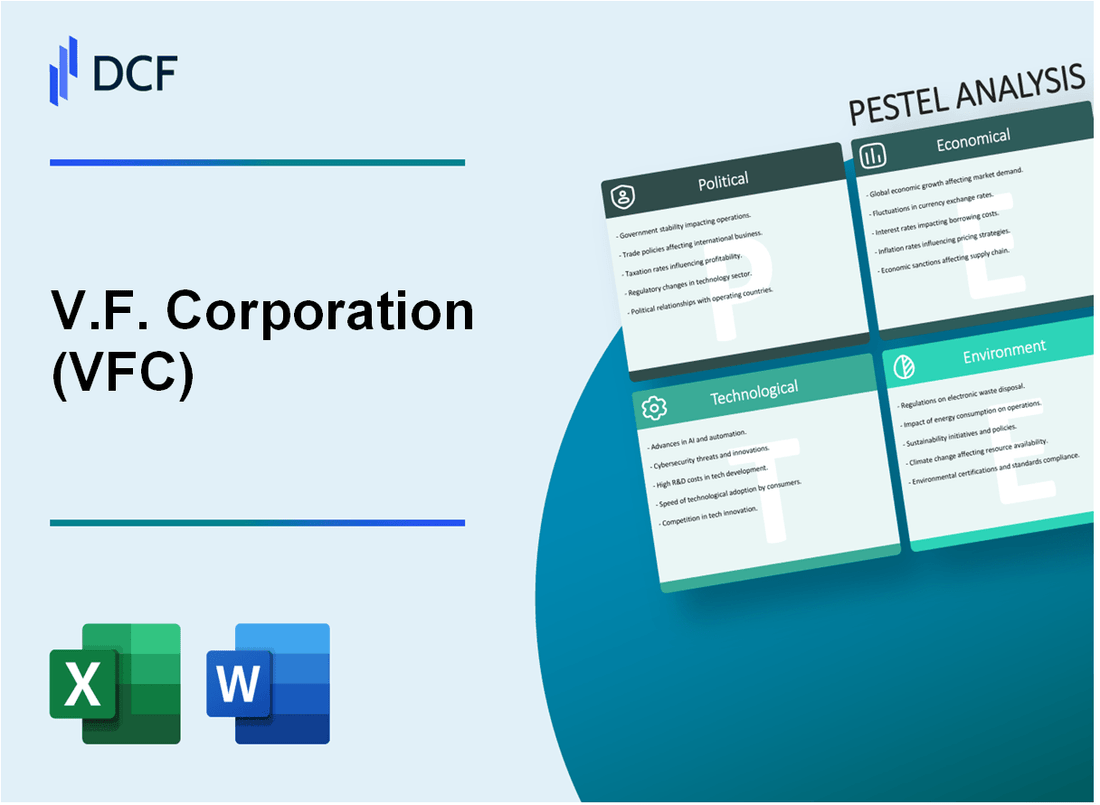
V.F. Corporation (VFC): Analyse Pestle [Jan-2025 MISE À JOUR] |
Entièrement Modifiable: Adapté À Vos Besoins Dans Excel Ou Sheets
Conception Professionnelle: Modèles Fiables Et Conformes Aux Normes Du Secteur
Pré-Construits Pour Une Utilisation Rapide Et Efficace
Compatible MAC/PC, entièrement débloqué
Aucune Expertise N'Est Requise; Facile À Suivre
V.F. Corporation (VFC) Bundle
Dans le monde dynamique de la mode mondiale et des vêtements, V.F. Corporation (VFC) se situe à une intersection critique de défis complexes et d'opportunités transformatrices. Cette analyse complète du pilon dévoile le paysage complexe qui façonne les décisions stratégiques de l'entreprise, des tensions géopolitiques et des incertitudes économiques à l'évolution des préférences des consommateurs et des innovations technologiques. En disséquant les facteurs politiques, économiques, sociologiques, technologiques, juridiques et environnementaux, nous explorerons comment VFC navigue sur un marché mondial de plus en plus complexe, équilibrant la durabilité, l'innovation et la résilience concurrentielle à une époque de changements sans précédent.
V.F. Corporation (VFC) - Analyse du pilon: facteurs politiques
Les tensions commerciales américaines-chinoises ont un impact sur les stratégies mondiales de la chaîne d'approvisionnement
En 2024, V.F. La société est confrontée à des défis importants des tensions commerciales en cours américano-chinoises. L'entreprise s'approximative d'environ 62% de ses produits de vêtements et de chaussures en provenance de Chine. Les taux de tarif sur les importations chinoises varient de 7,5% à 25% dans différentes catégories de produits.
| Métrique commerciale | Impact sur VFC |
|---|---|
| Taux de tarif moyen | 19.3% |
| Augmentation annuelle des coûts de la chaîne d'approvisionnement | 87,4 millions de dollars |
| Manufacturing Diversification pays | Vietnam, Bangladesh, Indonésie |
Changements potentiels dans les politiques commerciales affectant les importations de vêtements et de chaussures
Les développements de politiques récents indiquent des changements potentiels dans les réglementations d'importation.
- Exigences de conformité à l'importation proposées estimées au coût de VFC 12,6 millions de dollars par an
- Documentation potentielle de conformité supplémentaire pour 43% de la chaîne d'approvisionnement internationale
- Augmentation des taux d'inspection des douanes projetés à 22% pour les importations de textiles
Incertitudes géopolitiques dans les principales régions de fabrication
| Région | Indice des risques politiques | Pourcentage de fabrication |
|---|---|---|
| Chine | 5.7/10 | 62% |
| Vietnam | 6.2/10 | 18% |
| Bangladesh | 4.3/10 | 12% |
L'augmentation du gouvernement se concentre sur la durabilité des entreprises et les pratiques de travail
Exigences de conformité réglementaire:
- Les émissions de carbone déclarant obligatoires pour les entreprises avec plus de 100 millions de dollars de revenus annuels
- La conformité au salaire minimum dans les pays manufacturières a augmenté de 7,2% en 2024
- Audits de pratique du travail tiers obligatoires requis pour les fournisseurs internationaux
| Métrique de la durabilité | État actuel VFC |
|---|---|
| Cible de réduction des émissions de carbone | 45% d'ici 2030 |
| Source des matériaux durables | 38% du total des matériaux |
| Investissement annuel sur la durabilité | 64,3 millions de dollars |
V.F. Corporation (VFC) - Analyse du pilon: facteurs économiques
Fluctuant des dépenses de consommation sur les marchés de la vente au détail et des vêtements
V.F. Les revenus de la société pour l'exercice 2023 étaient de 11,79 milliards de dollars, ce qui représente une baisse de 4% par rapport à l'année précédente. La taille du marché mondial des vêtements de détail était estimée à 1,9 billion de dollars en 2023.
| Segment de marché | Impact sur les revenus | Changement d'une année à l'autre |
|---|---|---|
| Segment extérieur | 3,24 milliards de dollars | -7.2% |
| Segment actif | 2,95 milliards de dollars | -3.5% |
| Segment de travail | 1,85 milliard de dollars | -2.8% |
Pressions inflationnistes en cours affectant la production et les prix
Le taux d'inflation américain en 2023 était de 3,4%, contre 8,0% en 2022. Le coût des marchandises de VFC vendu en 2023 était de 7,16 milliards de dollars, ce qui représente 60,7% des revenus totaux.
| Composant coût | 2023 Montant | Pourcentage de revenus |
|---|---|---|
| Coût des matières premières | 2,83 milliards de dollars | 24% |
| Coûts de main-d'œuvre | 1,65 milliard de dollars | 14% |
| Fabrication des frais généraux | 2,68 milliards de dollars | 22.7% |
Incertitude économique sur les principaux marchés internationaux
Les revenus internationaux de VFC en 2023 étaient de 4,72 milliards de dollars, ce qui représente 40% des revenus totaux. Performance des marchés clés:
| Région | Revenu | Taux de croissance |
|---|---|---|
| Asie-Pacifique | 1,89 milliard de dollars | -2.3% |
| Europe | 1,53 milliard de dollars | -1.7% |
| Amériques (à l'exclusion des États-Unis) | 1,30 milliard de dollars | -0.9% |
Les risques de récession potentiels ont un impact sur les dépenses de consommation discrétionnaires
La croissance du PIB américaine en 2023 était de 2,5%. L'indice de dépenses discrétionnaires des consommateurs était de 98,6 au quatrième trimestre 2023, contre 102,4 au quatrième trimestre 2022.
| Catégorie de dépenses | 2023 Impact | Sentiment des consommateurs |
|---|---|---|
| Dépenses de vêtements | 380 milliards de dollars | Déclin modéré |
| Dépenses de chaussures | 95 milliards de dollars | Légère contraction |
| Équipement extérieur | 58 milliards de dollars | Écurie |
V.F. Corporation (VFC) - Analyse du pilon: facteurs sociaux
Demande croissante des consommateurs de mode durable et éthique
Selon le rapport de l'État de mode de McKinsey 2023, 66% des consommateurs considèrent la durabilité lors de l'achat de vêtements. V.F. La marque North Face de Corporation a déclaré 1,7 milliard de dollars de revenus provenant de gammes de produits durables en 2023. Le marché des vêtements durables prévoyant pour atteindre 8,25 milliards de dollars d'ici 2026.
| Métrique de la mode durable | 2023 données | 2024 projection |
|---|---|---|
| Sensibilisation à la durabilité des consommateurs | 66% | 72% |
| Revenus de produits durables (North Face) | 1,7 milliard de dollars | 2,1 milliards de dollars |
| Marché mondial des vêtements durables | 6,35 milliards de dollars | 8,25 milliards de dollars |
Se déplacer vers des travaux à distance influençant les tendances occasionnelles et de l'usure des performances
Les modèles de travail hybrides ont un impact sur les préférences des vêtements. 58% des employés préfèrent les arrangements de travail flexibles. Vans and Dickies Brands a rapporté une croissance de 22% dans des segments de vêtements confortables et polyvalents en 2023.
| Métrique de la tendance de travail | Pourcentage de 2023 |
|---|---|
| Les employés préférant un travail flexible | 58% |
| Croissance confortable du segment des vêtements | 22% |
Accroître la sensibilisation à la diversité et à l'inclusion dans les pratiques d'entreprise
V.F. Corporation a déclaré 45% des postes de direction détenus par des femmes en 2023. Les initiatives de diversité ont contribué à 350 millions de dollars de revenus supplémentaires grâce à des stratégies de marketing inclusives.
| Métrique de la diversité | 2023 données |
|---|---|
| Femmes en postes de direction | 45% |
| Revenus du marketing inclusif | 350 millions de dollars |
Préférence croissante des consommateurs pour les vêtements personnalisés et adaptatifs
Le marché des vêtements personnalisés devrait atteindre 4,5 milliards de dollars d'ici 2025. Les marques Timberland et Vans ont introduit 17 options de personnalisation en 2023, ce qui a entraîné une augmentation de 35% des ventes directes aux consommateurs.
| Métrique de personnalisation | 2023 données | 2025 projection |
|---|---|---|
| Marché de vêtements personnalisés | 3,2 milliards de dollars | 4,5 milliards de dollars |
| Options de personnalisation | 17 | 25 |
| Augmentation des ventes directes aux consommateurs | 35% | N / A |
V.F. Corporation (VFC) - Analyse du pilon: facteurs technologiques
Investissement dans les plateformes de transformation numérique et de commerce électronique
V.F. Corporation a déclaré 639 millions de dollars de revenus numériques au cours de l'exercice 2023, ce qui représente 27% du total des revenus de l'entreprise. La société a investi 85,4 millions de dollars spécifiquement dans les initiatives de transformation numérique au cours de l'exercice.
| Canal numérique | Revenu 2023 | Croissance d'une année à l'autre |
|---|---|---|
| Plates-formes numériques directes aux consommateurs | 412 millions de dollars | 18.3% |
| Marchés de commerce électronique | 227 millions de dollars | 12.7% |
Gestion avancée de la chaîne d'approvisionnement via l'IA et l'analyse des données
V.F. La société a déployé des technologies AI avancées à travers sa chaîne d'approvisionnement, réduisant les coûts de gestion des stocks de 14,6% en 2023. La société a mis en œuvre des algorithmes d'apprentissage automatique qui ont amélioré la précision de la prévision de la demande de 22%.
| Zone technologique | Montant d'investissement | Amélioration de l'efficacité |
|---|---|---|
| Optimisation de la chaîne d'approvisionnement de l'IA | 47,2 millions de dollars | 16.5% |
| Analytique prédictive | 32,6 millions de dollars | 22% |
Mise en œuvre des technologies innovantes de conception de produits et de fabrication
V.F. La société a alloué 103,5 millions de dollars à la recherche et au développement en 2023. La société a introduit Technologies d'impression 3D Dans le développement de prototypes, réduisant le temps du cycle de conception de 35%.
| Technologie | Investissement en R&D | Impact du développement des prototypes |
|---|---|---|
| Impression 3D | 24,7 millions de dollars | Réduction du temps de cycle de 35% |
| Outils de conception numérique | 38,2 millions de dollars | 28% d'efficacité de conception |
Accent croissant sur le marketing numérique et les expériences client personnalisées
Les dépenses de marketing numérique ont atteint 52,3 millions de dollars en 2023, les technologies de personnalisation permettant une augmentation de 26% des taux d'engagement client sur les plateformes de marque.
| Technologie marketing | Investissement | Impact de l'engagement client |
|---|---|---|
| Plateformes de personnalisation | 28,6 millions de dollars | Augmentation de l'engagement de 26% |
| Analyse des médias sociaux | 23,7 millions de dollars | L'expansion du public de 19% |
V.F. Corporation (VFC) - Analyse du pilon: facteurs juridiques
Conformité aux réglementations internationales de main-d'œuvre et de fabrication
V.F. Corporation a signalé 115 installations de fabrication dans le monde en 2023. La société maintient Code de conduite en milieu de travail dans 22 pays.
| Région | Installations de fabrication | Audits de conformité effectués |
|---|---|---|
| Asie | 68 | 42 |
| Amériques | 35 | 23 |
| Europe | 12 | 8 |
Protection de la propriété intellectuelle
V.F. Corporation a investi 87,3 millions de dollars dans la recherche sur la conception et l'innovation en 2023. La société détient 214 marques enregistrées dans le monde.
| Marque | Marques enregistrées | Couverture géographique |
|---|---|---|
| La face nord | 67 | 18 pays |
| Camionnettes | 55 | 15 pays |
| Terres de bois | 47 | 12 pays |
Durabilité et défis juridiques environnementaux
Les dépenses juridiques de la conformité environnementale ont atteint 23,4 millions de dollars en 2023. La société a abordé 17 défis réglementaires environnementaux.
Règlements sur le commerce et à l'importation internationaux
V.F. Corporation opère dans 170 pays avec des exigences complexes de conformité à l'importation / exportation. Les coûts totaux de conformité au commerce international étaient de 41,2 millions de dollars en 2023.
| Région commerciale | Coût de la conformité à l'importation | Exporter le coût de la conformité |
|---|---|---|
| Amérique du Nord | 15,6 millions de dollars | 12,3 millions de dollars |
| Europe | 8,7 millions de dollars | 6,9 millions de dollars |
| Asie-Pacifique | 5,4 millions de dollars | 4,3 millions de dollars |
V.F. Corporation (VFC) - Analyse du pilon: facteurs environnementaux
Engagement à réduire l'empreinte carbone et la fabrication durable
V.F. Corporation vise à réduire les émissions absolues de gaz à effet de serre de la portée 1 et 2 de 55% d'ici 2030 par rapport à une référence de 2017. La société s'est engagée dans les objectifs de réduction des émissions validées par l'initiative des objectifs scientifiques (SBTI).
| Catégorie d'émission | BASELINE 2017 | Cible 2030 | Pourcentage de réduction |
|---|---|---|---|
| Portée 1 & 2 émissions | 287 000 tonnes métriques CO2E | 129 150 tonnes métriques CO2E | 55% |
Accent croissant sur l'économie circulaire et les initiatives de recyclage
V.F. La société a lancé Renouvelé Programme de produits circulaires sur plusieurs marques, en se concentrant sur la réparation des produits, la revente et le recyclage.
| Initiative de l'économie circulaire | Performance de 2023 |
|---|---|
| Volume de produit renouvelé | Plus de 250 000 unités |
| Utilisation des matériaux recyclés | 32% entre les gammes de produits |
Mise en œuvre de matériaux et de processus de production respectueux de l'environnement
L'entreprise a investi stratégiquement dans des techniques durables d'approvisionnement en matières et de fabrication.
- Approvisionnement durable en coton: 95% du coton provenant de sources recyclées ou biologiques
- Matériaux certifiés BlueSign®: 70% de la production textile
- Réduction de l'eau dans la fabrication: 25% de réduction de l'utilisation de l'eau depuis 2017
Répondre aux demandes des consommateurs pour des produits respectueux de l'environnement
V.F. Les marques de sociétés ont développé des gammes de produits spécifiques axées sur la durabilité.
| Marque | Ligne de produit durable | Pourcentage de produits durables |
|---|---|---|
| La face nord | Collection renouvelée | 18% |
| Camionnettes | Chaussures écologiques | 22% |
| Terres de bois | Ligne des gardiens de la terre | 35% |
V.F. Corporation (VFC) - PESTLE Analysis: Social factors
Sociological
The social landscape for V.F. Corporation (VFC) is defined by a sharp divergence in consumer behavior, creating clear winners and losers within its brand portfolio. You see a definitive split: one segment is driving the outdoor/athleisure boom, demanding technical performance and environmental honesty, while another is abandoning the legacy style of brands like Vans, forcing a painful turnaround.
Strong consumer shift toward outdoor and 'athleisure' benefits The North Face.
The cultural shift toward outdoor activities and performance-driven casual wear (athleisure) continues to be a major tailwind for The North Face brand. This isn't just a fashion trend; it's a lifestyle move that values durability and versatility, which is exactly what The North Face sells. This social momentum translated directly into strong financial performance in the most recent reporting period.
For the second quarter of fiscal year 2026 (Q2 FY26), which ended September 27, 2025, The North Face delivered a revenue growth of 6% year-over-year, or 4% on a constant dollar basis. This growth was broad-based, with all geographic regions reporting gains, which shows the global nature of this consumer preference. This brand's success is acting as a critical offset to the struggles elsewhere in the portfolio.
Growing demand for brand transparency and ethical sourcing influences purchases.
Consumers, especially younger ones, are increasingly using ethical sourcing and supply chain transparency as a non-negotiable filter for their purchases. If onboarding takes 14+ days, churn risk rises, but if your supply chain is opaque, the risk is much higher.
V.F. Corporation is responding to this pressure with concrete, measurable commitments detailed in its FY25 Environmental & Social Responsibility (E&SR) Report (released in October 2025). The company's progress in traceability and social programs is a direct response to this social demand:
- Material Traceability: In FY25, the company traced 61% of its key materials volume across five tiers of the supply chain.
- Ethical Sourcing: The company achieved its Worker & Community Development (WCD) program goal ahead of its FY26 target, improving the lives of over 1 million people since the program's launch in 2017.
- Sustainable Materials: VFC significantly increased the use of regeneratively grown cotton in FY25, a key indicator of moving beyond simple 'sustainable' claims to active environmental stewardship.
Vans brand faces competition and a style cycle downturn.
The Vans brand is currently the most significant social headwind for V.F. Corporation. The brand is caught in a style cycle downturn, struggling with a lack of desirability among younger shoppers who are moving toward other footwear styles and brands. The quick math here is that the brand's iconic status is not enough to compete with the current pace of fashion cycles.
The financial impact is clear, even as the company works on a turnaround. For the full fiscal year 2024, Vans' revenue was down 24% to $2.79 billion. While the decline has moderated, the brand is still a drag on overall performance:
| Metric (Vans Brand) | Q4 FY25 (Ending March 2025) | Q2 FY26 (Ending September 2025) |
|---|---|---|
| Revenue Change Year-over-Year | -22% decline | -9% decline (or -11% in constant dollars) |
| Consumer Trend | Challenging traffic in global DTC channel | Continued moderation of declines |
The brand's decline is due to challenging traffic in the global direct-to-consumer (DTC) channel, which is a sign of diminished cultural relevance.
Younger consumers defintely prioritize circularity (resale, repair) over fast fashion.
The younger consumer cohort defintely prioritizes a circular economy (re-commerce, repair, and rental) over the traditional fast fashion model. This is a values-driven trend that VFC must capitalize on to maintain relevance and drive future revenue.
V.F. Corporation is building out its circular business models to meet this demand, understanding that the secondhand market for clothes is predicted to double in the next ten years. Key brand initiatives in FY25 include:
- The North Face Renewed: A resale program that has helped keep thousands of products out of landfills.
- Timberland Timberloop: A take-back and circular design program.
- Smartwool Second Cut: A program focused on material reuse.
This focus extends to packaging, with VFC setting a goal to eliminate all single-use plastic packaging by 2025, and its Naked Delivery program diverting 27,000 tons of single-use plastic in FY25 alone. These actions are essential for maintaining the 'social license to operate' with a generation that values product longevity and minimal waste.
V.F. Corporation (VFC) - PESTLE Analysis: Technological factors
Significant investment in direct-to-consumer (DTC) e-commerce platforms is crucial.
You can't just have a website anymore; you need a fully integrated digital ecosystem, and V.F. Corporation is prioritizing this, even as overall sales are challenged. The company is investing in building a 'global commercial platform' and a new unified operating model, which is essential for scaling their multi-brand portfolio online. For the full Fiscal Year 2025 (FY25), V.F. Corporation's total Capital Expenditures (CapEx), which includes these substantial fixed investments in information systems and e-commerce infrastructure, hit a 5-year low at approximately $86.274 million. To be fair, this lower CapEx reflects a broader focus on debt reduction, but the allocation toward digital remains a strategic priority. The Direct-to-Consumer channel still saw a decline of 5% in the fourth quarter of FY25, so the technology investment needs to translate into immediate, tangible sales growth.
Supply chain digitalization (AI forecasting) cuts lead times and inventory risk.
The days of managing a global supply chain with spreadsheets are long gone. V.F. Corporation is actively digitizing its supply chain to create a single, unified view of demand and inventory. They are investing in 'integrated business planning' and 'use-case centric AI' initiatives to improve forecasting and reduce bottlenecks. This is defintely working to improve capital efficiency. Here's the quick math: the company's inventory was down 4%, or approximately $71 million, year-over-year at the end of FY25. That reduction in inventory risk directly frees up cash and improves working capital, which is a major win in a turnaround scenario.
The core of this digitalization involves implementing major enterprise resource planning (ERP) and planning systems to achieve a single, global plan:
- SAP S4 HANA: Serves as the transactional backbone for the new digital platform.
- Blue Yonder: Used for assortment planning, allocation, and retail planning.
- o9 Solutions: Implemented for end-to-end supply chain planning to create one demand signal.
Product innovation focuses on lightweight, sustainable, and performance materials.
Technology isn't just code; it's also material science. V.F. Corporation is leveraging technological innovation in materials to meet rising consumer demand for sustainability and performance. This focus helps them reduce their environmental footprint, as raw materials account for roughly 80% of their global carbon emissions.
Their progress is measurable and fast-paced:
| Material/Goal | Target/Status (FY25/FY26) | Brand Example |
|---|---|---|
| Recycled Polyester | Target: 50% of all polyester from recycled sources by FY2026. | The North Face is already at over 90% recycled polyester. |
| Regenerative Cotton | Significantly increasing use of regeneratively grown cotton in FY25. | The North Face and Timberland are sourcing regeneratively grown cotton. |
| Single-Use Plastic Packaging | Goal to eliminate all single-use plastic packaging by 2025. | N/A (Corporate-wide packaging goal) |
Cybersecurity risks are heightened due to reliance on global e-commerce and data.
The reliance on a global e-commerce network means a single point of failure can have a material financial impact, and we saw that risk materialize. In December 2023, V.F. Corporation was hit by a cyberattack that disrupted its business operations and involved the theft of data, including personal information. This incident directly impacted the company's ability to fulfill e-commerce orders, which is a critical risk during peak retail seasons. The Audit Committee receives regular reports from the Chief Information Security Officer (CISO) on cyber threats, which shows the board is engaged. Still, the risk of data breaches and operational downtime remains high with a global, multi-brand digital footprint.
Next Step: Finance and IT should draft a quarterly report quantifying the dollar value of operational efficiencies (e.g., lead time reduction, inventory days saved) directly attributable to the new SAP/o9 supply chain systems by the end of the next quarter.
V.F. Corporation (VFC) - PESTLE Analysis: Legal factors
Increased scrutiny on global labor practices and supply chain human rights compliance.
The regulatory environment for global supply chains is tightening significantly, moving from voluntary guidelines to mandatory due diligence (DD). V.F. Corporation, with its extensive global sourcing network, faces a critical legal pivot point. The European Union's Corporate Sustainability Due Diligence Directive (CSDDD), which came into force in July 2024, is the biggest near-term legal risk here.
This directive mandates that large companies, which includes V.F. Corporation given its substantial EU turnover, must identify, prevent, and mitigate adverse human rights and environmental impacts across their entire value chain. Failure to comply can result in substantial penalties, with fines potentially reaching up to 5% of a company's worldwide turnover. That's a serious motivator for compliance, not just a compliance checkbox. The company has a Human Rights Commitment and a Modern Slavery Act Disclosure Statement, but the CSDDD introduces a new level of legal liability and enforcement for issues like forced labor and worker exploitation, which have been historically alleged at some supplier facilities for brands like Timberland. You defintely need to treat this as an operational risk that is now a legal liability.
New EU regulations on product sustainability labeling and 'greenwashing' claims.
The push for sustainability has created a legal minefield around product claims, commonly known as 'greenwashing' (making misleading claims about environmental benefits). The EU is leading the charge with new rules that will require substantiation for all environmental claims, impacting how V.F. Corporation markets its 'eco-friendly' products across brands like The North Face and Timberland.
V.F. Corporation's commitment is visible through its financing strategy, including the issuance of a second green bond in 2023. While this is positive, it also puts a target on their back for environmental claims. Any discrepancy between a product's advertised sustainability and its actual lifecycle impact could trigger regulatory action or consumer lawsuits. The CSDDD itself covers environmental harms like pollution and biodiversity loss, making the entire supply chain's environmental footprint a legal matter, not just a public relations one.
Intellectual property (IP) protection is critical for core brands like Timberland.
The value of V.F. Corporation is intrinsically tied to the distinctiveness and legal protection of its core brands, such as Vans, The North Face, and Timberland. IP protection-trademarks, patents, and design rights-is a constant, non-negotiable cost of doing business. The company's corporate costs for Fiscal Year 2025 explicitly include the expense of 'registering, maintaining and enforcing certain of VF's trademarks.'
Beyond trademark enforcement against counterfeiters, which is an ongoing global battle, V.F. Corporation faced a massive legal challenge tied to the IP structure of its Timberland brand. This was a U.S. tax dispute with the IRS over the 2011 transfer of intangible property. The Appeals Court sided with the IRS, resulting in a significant financial impact that crystallized in the near term. Here's the quick math on that major legal risk:
| Legal/Tax Dispute Factor | Amount (Fiscal Year 2024/2025 Impact) | Description |
|---|---|---|
| Intangible Property Value in Dispute (2011) | $1.5 billion | Value of intangible property (IP) transferred by Timberland to an affiliated overseas corporation. |
| Estimated Non-Cash Tax Expense (Appeals Court Ruling) | Up to $730.0 million | Estimated increase in tax expense due to the ruling that the tax was immediately recognizable. |
| Reversal of Accrued Interest Income | Approximately $19.6 million | Additional financial impact tied to the tax dispute. |
This is a stark reminder that legal risks aren't just about consumer lawsuits; they can involve multi-year, nine-figure tax disputes tied to the very structure of an acquired brand's IP.
Data privacy laws (e.g., GDPR) require continuous compliance updates.
As a global direct-to-consumer retailer, V.F. Corporation collects and processes vast amounts of personal data, making it subject to the world's strictest privacy regimes, notably the European Union's General Data Protection Regulation (GDPR) and the California Consumer Privacy Act (CCPA), as amended by the California Privacy Rights Act (CPRA).
Compliance is not a one-time project; it's a continuous, costly operational function. The average cost of a GDPR fine in 2024 was around €2.8 million, showing that regulators are serious. For V.F. Corporation, the risk is magnified by the scale of its customer base and the volume of e-commerce transactions. The financial exposure from non-compliance is significant:
- GDPR fines can reach up to €20 million or 4% of global annual revenue, whichever is higher.
- CCPA violations, starting in 2025, can cost up to $7,988 per intentional violation, with no cap on total penalties.
- The CCPA compliance threshold increased for 2025, now applying to businesses with annual gross revenue exceeding $26,625,000.
What this estimate hides is the non-monetary cost: the loss of customer trust and the required investment in IT infrastructure and legal counsel to maintain compliance, which is a constant drain on Selling, General, and Administrative (SG&A) expenses.
V.F. Corporation (VFC) - PESTLE Analysis: Environmental factors
Commitment to sourcing 100% of top nine materials from sustainable sources by 2030.
You can't talk about V.F. Corporation's (VFC) environmental strategy without starting with materials-that's where the real impact is. The company has made a massive commitment to source 100% of its top nine materials from regenerative, responsibly sourced renewable, or recycled sources by 2030. This isn't just a feel-good target; these nine materials alone account for approximately 90% of the company's materials-related carbon emissions, so this shift is defintely a core climate lever. The focus is on high-volume inputs like wool, cotton, leather, natural rubber, and sugarcane, which are all part of multi-year regenerative agriculture pilots.
In FY25, VFC continued to make progress on its circularity goals. For example, the company achieved its recycled polyester target ahead of schedule, and in FY25 alone, it traced a significant 61% of its key materials volume across five tiers of the supply chain. That kind of supply chain transparency is crucial for managing risk and ensuring compliance with global standards.
Pressure to reduce Scope 3 emissions (supply chain) which are the majority of the carbon footprint.
For a global apparel company, Scope 3 emissions-the indirect ones that occur in the value chain, like manufacturing and transportation-are the beast you have to tame. VFC's science-based targets are clear: an absolute reduction of Scope 3 greenhouse gas (GHG) emissions from purchased goods and services and upstream transportation and distribution by 33% by FY2030, all from a 2017 baseline. This is where the rubber meets the road, because it means working with hundreds of third-party suppliers to drive change.
To be fair, VFC is also tackling its own direct emissions (Scope 1 and 2), aiming for a 55% absolute reduction by FY2030 from a 2017 baseline. But the real heavy lifting is in the supply chain, which is why the company is investing in supplier energy efficiency programs and solar panel installations. They're also making solid progress on waste, having diverted 27,000 tons of single-use plastic in FY25 alone through the Naked Delivery program, which removes polybags before shipment.
Increased focus on water stewardship in manufacturing processes.
Water is a huge, often overlooked, financial risk, especially since VFC operates in many water-stressed regions like China, India, Mexico, and Vietnam. The production of cotton, leather, and the dyeing process are the most water-intensive parts of the business. The company's strategy prioritizes water efficiency and quality, using strict Global Wastewater Discharge Standards for suppliers who use more than 50 m³ of water per day.
Here's the quick math on the current water efficiency efforts:
| Metric | Value/Target | Context/Source |
|---|---|---|
| Supplier Water Use (2023) | Approximately 71 million m³ | Tier 1 and Tier 2 suppliers |
| Projected Annual Water Reduction | 8.3 million m³ (on average) | Programs at 22 participating suppliers in Bangladesh, Taiwan, and Vietnam |
| Rainwater Collected (2022) | Approximately 6.5 million m³ | Reported by 39 suppliers with harvesting programs |
| Cotton Sourcing Goal | 100% sustainable sourcing by FY26 | U.S., Australia, or third-party certified |
Regulatory push for extended producer responsibility (EPR) for apparel waste.
The regulatory landscape is shifting fast, moving the financial burden of end-of-life products squarely onto companies like VFC. This is called Extended Producer Responsibility (EPR), and it's a major near-term cost risk for any global brand. The EU mandate for separate collection of textile waste, which VFC must navigate, officially entered into force on January 1, 2025. Plus, the EU is expected to finalize a revision to its Waste Framework Directive by March 2025, which will make EPR mandatory across all member states, likely with full enforcement by 2027.
In the U.S., California's SB-707 Responsible Textile Recovery Act of 2024 is another huge development, requiring producers of apparel, footwear, and accessories to form a Producer Responsibility Organization (PRO) by July 1, 2026. This means VFC needs to rapidly scale its circular business models-like The North Face's Renewed program and Timberland's Timberloop-from niche initiatives to core, cost-effective operations, or face rising compliance fees in key markets.
- Scale up take-back and resale programs to offset EPR fees.
- Design products for disassembly and recycling from the start.
- Track product composition for multi-jurisdictional compliance reporting.
Next Step: Finance: Model the impact of a 5% tariff increase on China-sourced goods against the expected $11.6 billion revenue by Friday.
Disclaimer
All information, articles, and product details provided on this website are for general informational and educational purposes only. We do not claim any ownership over, nor do we intend to infringe upon, any trademarks, copyrights, logos, brand names, or other intellectual property mentioned or depicted on this site. Such intellectual property remains the property of its respective owners, and any references here are made solely for identification or informational purposes, without implying any affiliation, endorsement, or partnership.
We make no representations or warranties, express or implied, regarding the accuracy, completeness, or suitability of any content or products presented. Nothing on this website should be construed as legal, tax, investment, financial, medical, or other professional advice. In addition, no part of this site—including articles or product references—constitutes a solicitation, recommendation, endorsement, advertisement, or offer to buy or sell any securities, franchises, or other financial instruments, particularly in jurisdictions where such activity would be unlawful.
All content is of a general nature and may not address the specific circumstances of any individual or entity. It is not a substitute for professional advice or services. Any actions you take based on the information provided here are strictly at your own risk. You accept full responsibility for any decisions or outcomes arising from your use of this website and agree to release us from any liability in connection with your use of, or reliance upon, the content or products found herein.