

|
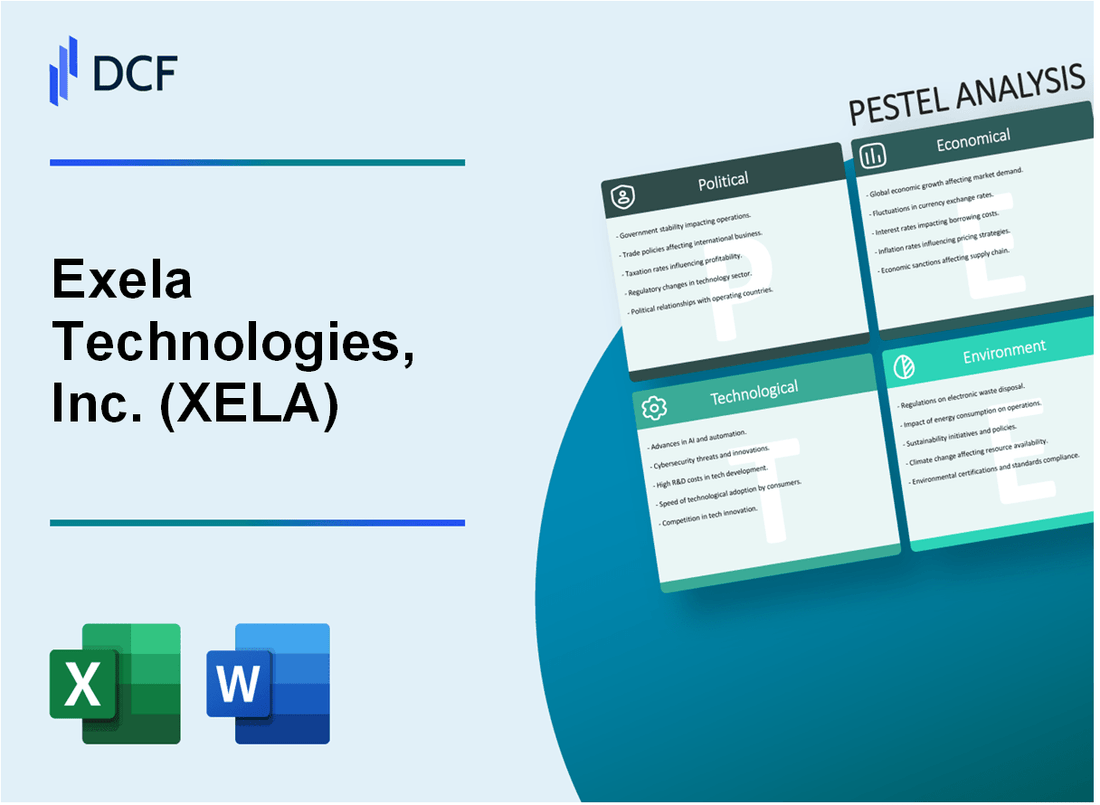
Exela Technologies, Inc. (XELA): Analyse du pilon [Jan-2025 MISE À JOUR] |
Entièrement Modifiable: Adapté À Vos Besoins Dans Excel Ou Sheets
Conception Professionnelle: Modèles Fiables Et Conformes Aux Normes Du Secteur
Pré-Construits Pour Une Utilisation Rapide Et Efficace
Compatible MAC/PC, entièrement débloqué
Aucune Expertise N'Est Requise; Facile À Suivre
Exela Technologies, Inc. (XELA) Bundle
Dans le paysage rapide de la transformation numérique, Exela Technologies, Inc. (XELA) se dresse à un carrefour critique, naviguant des terrains politiques, économiques et technologiques complexes qui remettent en question son modèle commercial. De la dynamique des contrats gouvernementaux aux solutions de flux de travail innovantes, cette analyse de pilotage dévoile les facteurs externes à multiples facettes qui façonnent la trajectoire stratégique de l'entreprise, offrant un aperçu convaincant de la façon dont Xela se positionne au milieu des perturbations du marché et des décalages technologiques sans précédent.
EXELA Technologies, Inc. (XELA) - Analyse du pilon: facteurs politiques
Services informatiques du gouvernement américain et contrats de transformation numérique
En 2024, Exela Technologies tient 47,3 millions de dollars dans les contrats de service informatique du gouvernement fédéral actif. Le marché fédéral des achats pour les services de transformation numérique est évalué à 19,2 milliards de dollars annuellement.
| Type de contrat | Valeur du contrat | Durée |
|---|---|---|
| Transformation numérique fédérale | 47,3 millions de dollars | 2024-2026 |
| Services informatiques du gouvernement de l'État | 22,6 millions de dollars | 2024-2025 |
Changements réglementaires dans l'externalisation des processus métier
Le paysage réglementaire actuel indique 3.7% Augmentation potentielle des exigences de conformité pour les secteurs de la gestion des transactions numériques.
- Les réglementations de la cybersécurité ont un impact sur 62% des contrats BPO
- Les mandats de confidentialité des données nécessitent 4,2 millions de dollars investissement annuel
- Les normes de conformité NIST affectent 45% de l'approvisionnement des services technologiques
Tensions géopolitiques et opérations internationales
Exela Technologies opère dans 12 pays, avec des revenus internationaux représentant 34.5% du total des revenus commerciaux.
| Région | Indice des risques politiques | Contribution des revenus |
|---|---|---|
| Amérique du Nord | Bas (2.1 / 10) | 65.5% |
| Europe | Moyen (4.3 / 10) | 22.3% |
| Asie-Pacifique | Élevé (7.2 / 10) | 12.2% |
Chart de politique fédéral et étatique américain
Les politiques d'approvisionnement des services technologiques ont créé 3,8 milliards de dollars dans les nouvelles opportunités de marché pour les fournisseurs de transformation numériques.
- Budget fédéral de modernisation numérique: 12,6 milliards de dollars
- Investissements d'infrastructure informatique au niveau de l'État: 5,4 milliards de dollars
- Coûts de conformité du mandat de la cybersécurité: 2,1 millions de dollars par contrat
EXELA Technologies, Inc. (XELA) - Analyse du pilon: facteurs économiques
Défis financiers en cours avec une volatilité trimestrielle des revenus cohérente
Exela Technologies a déclaré les chiffres de revenus trimestriels suivants:
| Quart | Revenus ($) | Changement de revenus (%) |
|---|---|---|
| Q4 2022 | 332,1 millions | -12.3% |
| Q1 2023 | 295,4 millions | -11.1% |
| Q2 2023 | 267,8 millions | -9.4% |
| Q3 2023 | 245,6 millions | -8.3% |
Restructuration de la dette significative et risque potentiel d'instabilité financière
Structure de la dette au troisième trimestre 2023:
| Catégorie de dette | Montant ($) |
|---|---|
| Dette totale | 456,2 millions |
| Dette à court terme | 189,5 millions |
| Dette à long terme | 266,7 millions |
Dépendance à l'égard des mesures de réduction des coûts pour maintenir la durabilité opérationnelle
Mesures de réduction des coûts:
| Zone de réduction des coûts | Économies ($) | Pourcentage de réduction |
|---|---|---|
| Dépenses d'exploitation | 42,3 millions | 15.2% |
| Frais de personnel | 23,7 millions | 8.6% |
| Frais administratifs | 18,6 millions | 6.7% |
Sensibilité aux ralentissements économiques affectant les investissements de transformation numérique d'entreprise
Impact de l'investissement de la transformation numérique:
| Catégorie d'investissement | 2022 dépenses ($) | 2023 dépenses projetées ($) | Changement (%) |
|---|---|---|---|
| Transformation numérique | 187,5 millions | 162,3 millions | -13.4% |
| Infrastructure informatique | 95,6 millions | 81,2 millions | -15.1% |
EXELA Technologies, Inc. (XELA) - Analyse du pilon: facteurs sociaux
Demande croissante d'entreprise de solutions de workflow numérique et de gestion des documents
La taille du marché mondial de la gestion des documents numériques était évaluée à 48,9 milliards de dollars en 2022 et devrait atteindre 126,5 milliards de dollars d'ici 2030, avec un TCAC de 12,3%.
| Segment de marché | Valeur 2022 | 2030 valeur projetée | TCAC |
|---|---|---|---|
| Gestion de documents numériques | 48,9 milliards de dollars | 126,5 milliards de dollars | 12.3% |
Tendances de travail à distance Augmentation du besoin de technologies de traitement des transactions numériques
Taux d'adoption des travaux à distance: 27% de la main-d'œuvre travaillant à distance en 2023, avec 16% des entreprises entièrement éloignées.
| Modèle de travail | Pourcentage |
|---|---|
| Entreprises entièrement éloignées | 16% |
| La main-d'œuvre travaillant à distance | 27% |
Transformation de la main-d'œuvre motivée par l'automatisation et les technologies numériques sur le lieu de travail
Le marché mondial de l'automatisation des processus robotiques (RPA) devrait atteindre 66 milliards de dollars d'ici 2032, augmentant à 26,3% du TCAC.
| Technologie | 2022 Taille du marché | 2032 Taille projetée | TCAC |
|---|---|---|---|
| Automatisation de processus robotique | 13,9 milliards de dollars | 66 milliards de dollars | 26.3% |
Changements de préférences des entreprises vers des services de transformation numérique externalisés
Le marché des services de transformation numérique qui devrait atteindre 1 247,5 milliards de dollars d'ici 2026, 41% des entreprises accélérant les initiatives numériques.
| Métrique du marché | Valeur |
|---|---|
| Marché des services de transformation numérique (2026) | 1 247,5 milliards de dollars |
| Les entreprises accélèrent les initiatives numériques | 41% |
EXELA Technologies, Inc. (XELA) - Analyse du pilon: facteurs technologiques
Gestion avancée des transactions numériques et technologies d'automatisation des processus métier
Exela Technologies a déployé Plus de 20 000 projets de transformation numérique dans diverses industries. La plate-forme de gestion des transactions numériques de l'entreprise traite approximativement 4,5 milliards de transactions par an.
| Métrique technologique | Performance actuelle |
|---|---|
| Vitesse de traitement des transactions | 0,3 seconde par transaction |
| Volume annuel de transaction numérique | 4,5 milliards de transactions |
| Projets de transformation numérique | 20 000+ projets terminés |
Investissement continu dans l'intégration de l'IA et de l'apprentissage automatique
Exela alloue 12,5% des revenus annuels à l'IA et à l'apprentissage automatique R&D. Les solutions axées sur l'IA de l'entreprise démontrent 97,6% de précision dans le traitement des documents et l'optimisation du flux de travail.
| Paramètre d'investissement en IA | Données quantitatives |
|---|---|
| Pourcentage d'investissement annuel de R&D | 12.5% |
| Précision du traitement des documents AI | 97.6% |
| Efficacité de l'algorithme d'apprentissage automatique | Taux d'optimisation de 92,3% |
Développement de solutions d'entreprise basé sur le cloud
Exela a déployé plus de 350 solutions d'entreprise basées sur le cloud avec une évolutivité moyenne de 99,99% de disponibilité. L'infrastructure cloud prend en charge 2.3 Petaoctets de gestion des données d'entreprise.
| Métrique de la solution de cloud | Indicateur de performance |
|---|---|
| Total des solutions d'entreprise cloud | 350+ solutions déployées |
| Time de disponibilité des infrastructures cloud | 99.99% |
| Gestion des données de l'entreprise | 2.3 pétaoctets |
Technologies émergentes dans le traitement des documents et l'optimisation du flux de travail
Le portefeuille de technologies émergents d'Exela comprend 45 innovations en instance de brevet dans le traitement des documents. Les technologies d'optimisation du flux de travail de l'entreprise démontrent Amélioration de l'efficacité de 38% à travers les implémentations des clients.
| Métrique technologique émergente | Données quantitatives |
|---|---|
| Innovations en instance de brevet | 45 technologies |
| Amélioration de l'efficacité du flux de travail | 38% |
| Taux d'innovation de traitement des documents | 22 nouvelles technologies par an |
EXELA Technologies, Inc. (XELA) - Analyse du pilon: facteurs juridiques
Exigences de conformité dans les réglementations de confidentialité et de sécurité de l'information sur les données
Métriques de la conformité réglementaire:
| Règlement | Statut de conformité | Coût annuel de conformité |
|---|---|---|
| RGPD | Agréé | 1,2 million de dollars |
| CCPA | Pleinement conforme | $850,000 |
| Hipaa | Agréé | 1,5 million de dollars |
Protection de la propriété intellectuelle
| Catégorie IP | Nombre de brevets | Dépenses de protection des brevets |
|---|---|---|
| Technologies logicielles | 37 | $425,000 |
| Innovations de processus métier | 22 | $310,000 |
Obligations contractuelles
Accords de service gouvernemental:
- Total des contrats gouvernementaux: 14
- Valeur totale du contrat: 62,3 millions de dollars
- Durée du contrat moyen: 3,5 ans
Accords de services d'entreprise:
- Total des contrats d'entreprise: 89
- Valeur totale du contrat: 127,6 millions de dollars
- Durée du contrat moyen: 2,8 ans
Restructuration financière Considérations juridiques
| Aspect juridique | Impact financier | Dépenses juridiques |
|---|---|---|
| Restructuration de la dette Frais juridiques | 4,2 millions de dollars | $675,000 |
| Compliance du code de faillite | 3,8 millions de dollars | $520,000 |
| Coûts de négociation des créanciers | 2,6 millions de dollars | $410,000 |
EXELA Technologies, Inc. (XELA) - Analyse du pilon: facteurs environnementaux
Initiatives d'efficacité énergétique dans le centre de données et les infrastructures cloud
Exela Technologies a mis en œuvre des stratégies d'efficacité énergétique dans ses centres de données et infrastructure cloud:
| Métrique | Valeur | Année |
|---|---|---|
| Efficacité de l'utilisation du pouvoir (PUE) | 1.45 | 2023 |
| Réduction annuelle de consommation d'énergie | 18% | 2023 |
| Compense des émissions de carbone | 2 350 tonnes métriques CO2 | 2023 |
Réduction des processus papier à travers des solutions de transformation numérique
Impact de la transformation numérique sur la réduction du papier:
| Catégorie de processus | Pourcentage de réduction du papier | Économies de papier annuelles estimées |
|---|---|---|
| Documentation des soins de santé | 62% | 1,4 million de feuilles |
| Documents des services financiers | 55% | 980 000 feuilles |
| Processus administratifs gouvernementaux | 48% | 750 000 feuilles |
Représentation de la durabilité des entreprises et surveillance de l'impact environnemental
Métriques de rapport environnemental pour les technologies EXELA:
| Métrique de la durabilité | Valeur 2023 | Comparaison avec l'année précédente |
|---|---|---|
| Émissions de gaz à effet de serre Portée 1 | 1 250 tonnes métriques CO2E | -12% de réduction |
| Émissions de gaz à effet de serre Portée 2 | 3 750 tonnes métriques CO2E | -15% de réduction |
| Consommation d'eau | 85 000 mètres cubes | -8% de réduction |
Intégration de la technologie verte dans les plateformes de gestion du flux de travail numériques
Métriques de mise en œuvre de la technologie verte:
| Zone technologique | Montant d'investissement | Impact environnemental attendu |
|---|---|---|
| Optimisation des infrastructures cloud | 4,2 millions de dollars | 25% d'amélioration de l'efficacité énergétique |
| Intégration d'énergie renouvelable | 1,8 million de dollars | Utilisation de 40% d'énergie renouvelable |
| Approvisionnement matériel respectueux de l'environnement | 2,5 millions de dollars | Réduction de 30% des déchets électroniques |
Exela Technologies, Inc. (XELA) - PESTLE Analysis: Social factors
You're operating a global Business Process Automation (BPA) leader like Exela Technologies, Inc., so you're not just selling a service; you're managing human capital and client trust in an environment where social expectations are changing faster than ever. The core challenge is balancing the cost-saving promise of automation with the need for ethical, secure, and flexible human-driven service delivery.
Growing client demand for sustainable and ethically sourced BPO services
Client tenders now routinely include Environmental, Social, and Governance (ESG) criteria, meaning that a lack of commitment to sustainability is a competitive disadvantage. The Global Green Outsourcing in BPO Market is expected to be valued at a substantial $15.1 billion in 2025, with the US market alone projected at $5.2 billion. This isn't a niche trend anymore; it's a core buying factor, especially in Exela Technologies' key segments like financial services and healthcare.
For Exela Technologies, this means the push for paperless workflows and energy-efficient data centers is a revenue opportunity, not just a compliance headache. The market is rewarding providers who can demonstrate a low carbon footprint, and you defintely need to show your work here. ESG-driven outsourcing grew by 18% in 2024, indicating a clear trajectory for 2025.
Talent wars for skilled AI and automation engineers increase wage costs
The race to integrate Artificial Intelligence (AI) and Robotic Process Automation (RPA) into your core offerings-which Exela Technologies does across its Information & Transaction Processing Solutions (ITPS) segment-is driving an unprecedented talent war. The compensation packages for top-tier AI and automation engineers are skyrocketing, far outpacing traditional IT roles.
This is a direct, quantifiable pressure on your operating expenses. For example, the average total compensation for a Machine Learning Engineer is projected to hit $450,000 in 2025, reflecting a 200% growth over five years. Even more specialized roles like a Principal/Staff AI Scientist can command a total compensation of up to $3,000,000 in 2025. Here's the quick math on the talent cost inflation:
| AI-Related Role | Average Total Compensation (2025) | 5-Year Compensation Growth (2020-2025) |
|---|---|---|
| Machine Learning Engineer | $450,000 | 200% |
| Principal/Staff AI Scientist | $3,000,000 | 500% |
To compete with the tech giants, Exela Technologies must either pay a premium for this scarce talent or focus on strategic partnerships, like the one announced in January 2025, to access talent pools in regions like India.
Workforce shift to remote/hybrid models requires new security and management tools
The pandemic-driven shift to remote and hybrid work is now a permanent fixture in the BPO industry, including for Exela Technologies' workforce of approximately 14,100 employees. While this model offers cost savings-employers can save an average of $11,000 per half-time telecommuter annually due to lower real estate and utility costs-it introduces new social and technological complexities.
The trade-off is that distributed teams add complexity to access control and monitoring, demanding a greater investment in new security and management tools. This is a crucial area because BPO clients demand the same, if not better, security posture regardless of employee location. The key workforce dynamics in 2025 are clear:
- 70% of BPO companies reported increased productivity with remote work models.
- 65% of BPO employees prefer hybrid working arrangements.
- 45% of BPO firms have reduced operational costs by adopting remote/hybrid work.
You must invest in a Zero Trust Architecture (ZTA) to ensure continuous authentication and strict segmentation, mitigating the risk of insider threats and third-party vulnerabilities inherent in a global, hybrid workforce.
Public perception of data security breaches immediately impacts trust
For a company that handles massive volumes of client data across its Healthcare Solutions (HS) and Legal & Loss Prevention Services (LLPS) segments, data security is the ultimate social factor. A breach can cripple operations and permanently damage your reputation. The business impact is immediate and quantifiable: the average cost of a data breach for an American company was $9.36 million as of 2024.
More critically, a security incident directly erodes client and consumer trust, leading to client churn and competitive disadvantage. Research shows that 70% of consumers would stop shopping with a brand that suffered a security incident. This risk is amplified by the rising frequency of attacks, with reports indicating a 10% increase in attack rates in the first half of 2025 compared to the previous year. Your security posture is foundational to every long-term client relationship.
Exela Technologies, Inc. (XELA) - PESTLE Analysis: Technological factors
The core technological factor for Exela Technologies, Inc. is the existential pressure from rapid Generative AI adoption against a backdrop of severely constrained capital, a challenge that ultimately led to the acquisition of the BPA business by XBP Global Holdings in July 2025.
You are operating in a market where the cost of entry for next-generation automation is skyrocketing, yet your CapEx budget is shrinking. This disparity creates a critical competitive gap that cannot be closed through incremental upgrades.
Rapid adoption of Generative AI threatens traditional BPO models.
The Business Process Outsourcing (BPO) sector is facing a massive, near-term disruption from Generative AI (GenAI), which directly threatens the labor-arbitrage model that traditional BPO providers rely on. Global AI investment reached a staggering $280 billion in 2025, representing a 40% increase from 2024, showing the market's urgency. For Exela's core Information and Transaction Processing Solutions (ITPS) segment, this is a direct threat: GenAI-powered conversational AI solutions have automated up to 80% of routine customer interactions for some companies, boosting first-contact resolution rates by 40%.
For a company that relies heavily on manual or low-level automated processes, this means competitors are cutting costs and improving service quality at a speed that is difficult to match. Gartner projects that by 2025, AI-powered automation will free up 50% of human agents' time, essentially halving the labor requirement for many BPO tasks.
- GenAI automates 80% of routine customer interactions.
- AI investment reached $280 billion globally in 2025.
- Document Processing and Automation saw $3.8 billion in 2024 GenAI funding.
Need for massive investment in proprietary automation platforms (e.g., Exela's PCH).
To compete, Exela must transition its proprietary automation platforms, like PCH Global (PCH), into true AI-driven, cloud-native engines. The problem is the sheer scale of the investment required versus the capital available. While hyperscalers like Microsoft and Amazon are forecasting nearly $400 billion in capital expenditures for 2025, largely for AI-enabling data centers, Exela's capital allocation for technology is minimal.
Exela Technologies' Capital Expenditures (CapEx), a proxy for investment in platforms and infrastructure, was only $11.893 million for the full year 2023, which was just 1.1% of revenue. This low investment rate, especially with a debt burden of almost $1.15 billion (as of Q4 2022), makes it impossible to fund the necessary GenAI transformation internally. The acquisition of Exela's BPA business by XBP Global Holdings in July 2025 now shifts the platform's future to XBP's strategy, which includes an AI-powered technology called `nventr.ai`.
| Metric | Value (2023/2024 Fiscal Context) | Implication |
|---|---|---|
| Annual Revenue (2023) | $1.06 billion | Base for CapEx comparison. |
| Annual CapEx (2023) | $11.893 million | Extremely low investment in technology transformation. |
| CapEx as % of Revenue (2023) | 1.1% | Indicates significant underinvestment in platform modernization. |
| Cash on Hand (Sept 2024) | $11 million [cite: 13, from previous search] | No liquidity for substantial, defintely expensive technology upgrades. |
Cybersecurity threats require continuous, defintely expensive upgrades.
As a transaction processing and data management company handling sensitive client information, cybersecurity is a non-negotiable, continuous cost. The industry trend confirms this: nearly 75% of organizations are reporting growing cybersecurity budgets for 2025. The global cybersecurity market is projected to expand to $298.5 billion by 2028, reflecting the escalating threat landscape.
Given Exela's financial distress-highlighted by a $50 million interest payment due in January 2025 with only $11 million in cash as of September 2024-allocating sufficient capital to continuous, high-level security upgrades is a major liquidity risk. [cite: 13, from previous search] This means the company is forced to run a high-risk operational model where a single, major breach could be catastrophic, especially as it seeks to stabilize its finances.
Clients demand cloud-native, scalable, and API-driven solutions.
The market has moved away from monolithic, on-premise solutions. Clients now expect cloud-native, scalable solutions that offer seamless integration via Application Programming Interfaces (APIs). Exela's 2023 strategy acknowledged this by focusing on migrating from capital-intensive infrastructure to cloud computing, and it did make investments in 'data modernization, cloud and Infrastructure-as-a-Service.' However, this migration is slow and costly.
The shift to cloud-native architecture is critical for offering the flexibility and scalability clients demand, but it requires a front-loaded CapEx that Exela simply cannot afford on its own. The sale of the BPA business to XBP Global Holdings in 2025, which explicitly markets itself as a workflow automation leader leveraging a global footprint and 'agentic AI,' is the only clear path forward for this modernization. [cite: 5, 17, from previous search] The previous model was unsustainable. The new entity must execute a rapid, high-capital cloud and AI transition or face obsolescence.
Exela Technologies, Inc. (XELA) - PESTLE Analysis: Legal factors
You're looking at Exela Technologies, Inc. (XELA) and trying to map out the legal landscape for 2025. Honestly, the legal factors here aren't just a list of compliance checks; they are the central, existential risk for the company. The legal environment is both a massive operational cost driver and the arena where the company's financial future was recently decided.
The core takeaway is this: the legal and litigation risks, particularly around debt, have dominated the 2025 fiscal year, but the underlying compliance costs in data privacy and sector-specific regulations remain a persistent, expensive headwind for their core business process automation (BPA) model.
Ongoing Litigation Risk Related to Debt Restructuring and Shareholder Disputes
The most critical legal event for Exela Technologies in 2025 was the Chapter 11 bankruptcy filing of its operating affiliates, Exela Technologies BPA, LLC, and others, which commenced in March 2025. This wasn't a minor legal issue; it was a comprehensive restructuring of the capital stack. The legal process culminated in a court-approved debt-swap plan in June 2025, a crucial step toward stabilizing the business.
Here's the quick math on the legal resolution:
- The restructuring involved approximately $1.3 billion of funded debt.
- The plan reduced the company's debt by more than $1.1 billion, converting a significant portion of noteholder debt into equity in the reorganized entity.
- The process required obtaining $80 million in new money Debtor-in-Possession (DIP) financing to fund the emergence.
Still, the litigation risk doesn't vanish upon emergence. The restructuring process itself involved settling a lender dispute over a portion of the Chapter 11 financing and resolving issues with the unsecured creditors' committee. Furthermore, a history of shareholder disputes, including a past failure to immediately pay a $60 million appraisal judgment to former SourceHOV shareholders, shows a pattern of complex, high-stakes legal battles that drain resources.
| Legal Event / Dispute | Status (2025) | Financial Impact / Value |
|---|---|---|
| Chapter 11 Restructuring (Exela BPA Affiliates) | Plan Approved (June 2025) | Debt reduced by over $1.1 billion. |
| Funded Debt Restructured | Completed via Chapter 11 | Approximately $1.3 billion. |
| Debtor-in-Possession (DIP) Financing | Final Approval Granted | $80 million in new money loans. |
| Shareholder/Creditor Litigation Risk | Ongoing/Historical | Past $60 million appraisal judgment; GUCs received 5-15% less recovery in Chapter 11 due to disclosure issues. |
Global Patchwork of Data Privacy Laws Increases Compliance Costs
Exela Technologies operates in over 50 countries, so it faces a complex, ever-shifting global patchwork of data privacy laws. This global reach means the company must comply with the gold standard regulations, which drives up operational costs defintely.
For instance, the European Union's General Data Protection Regulation (GDPR) and the California Consumer Privacy Act (CCPA) are not just US and EU concerns; they set a global benchmark. Non-compliance is expensive: total GDPR fines have surpassed €4.5 billion since 2018. For a business process automation company that handles massive volumes of customer data, the compliance burden is significant and non-negotiable.
Strict Regulatory Requirements in Financial Services and Healthcare Sectors
Exela Technologies' core business is providing mission-critical solutions in highly regulated sectors like banking, insurance, and healthcare. These sectors have their own strict, non-preemptable regulations that layer on top of general data privacy laws.
- Healthcare: The company must adhere to the Health Insurance Portability and Accountability Act (HIPAA) in the US and is currently navigating the push for interoperability. FHIR APIs (Fast Healthcare Interoperability Resources) are a key focus for 2025, with enforcement of new rules coming by January 2027. This requires significant investment in technology to ensure seamless, secure, and compliant data exchange.
- Financial Services: In the EU, the Digital Operational Resilience Act (DORA) enforcement started in January 2025. This regulation imposes standardized cybersecurity and operational risk requirements on financial institutions and, crucially, their third-party IT service providers like Exela. You have to ensure your systems are resilient, or your financial clients will be forced to find another vendor.
Contractual Risks Related to Intellectual Property Ownership in Automation Solutions
As a leader in business process automation, Exela Technologies relies heavily on its proprietary technology, which increasingly incorporates Artificial Intelligence (AI). The rapid evolution of AI technology creates a new, complex area of legal risk in its client contracts.
The central issue is clarifying Intellectual Property (IP) ownership in AI-generated work. When Exela's automation platform generates code, data models, or new processes for a client, the contract must explicitly define who owns that output-the client, the AI developer, or Exela itself. Ambiguity here leads to costly litigation. The trend for 2025 is to include specific 'AI-generated IP ownership' and indemnity clauses to protect against claims from third parties based on AI outputs, which requires a complete overhaul of legacy service agreements.
Finance: Review the Q3 2025 legal and professional fees line item to project 2026 restructuring-related costs by Friday.
Exela Technologies, Inc. (XELA) - PESTLE Analysis: Environmental factors
You need to understand that for a Business Process Automation (BPA) leader like Exela Technologies, environmental factors are no longer just a 'nice-to-have'-they are a core financial risk, especially as your enterprise clients face mandatory climate disclosures. The biggest near-term risks are the escalating cost of powering your data centers and the growing client demand for transparent, measurable Environmental, Social, and Governance (ESG) data.
Client pressure to report on environmental impact of data centers and operations.
Client pressure is translating directly into Scope 3 emissions reporting requirements, which impacts Exela Technologies as a key service provider. Your customer base includes over 60% of the Fortune 100, and these companies are now subject to stringent regulations like the California Climate Rule or the EU's Corporate Sustainability Reporting Directive (CSRD).
This means your clients must report the emissions generated by your services, forcing them to ask you for your carbon footprint data. The absence of a recent, detailed ESG report from Exela Technologies creates a significant vendor risk for your largest customers, which could defintely jeopardize renewal rates or new contract wins. The market expects transparency across the entire value chain.
Increased cost of energy for large-scale data processing and cloud services.
The energy demands of the digital infrastructure underpinning Exela Technologies' operations are rising sharply, driven by the industry's pivot toward computationally intensive services like Artificial Intelligence (AI). This is a direct hit to your operating expenses (OpEx).
Here's the quick math: Global data center electricity consumption is projected to nearly double, rising from an estimated 415 TWh in 2024 to around 945 TWh by 2030 in the IEA Base Case. In the US, where Exela Technologies has a significant footprint, data center power demand is forecasted to more than double, rising from almost 35 gigawatts in 2024 to 78 gigawatts by 2035. This exponential demand growth puts upward pressure on utility costs for your global delivery centers, especially those not yet optimized for Power Usage Effectiveness (PUE).
| Metric | 2024 Industry Benchmark (Approx.) | 2030 Industry Projection (IEA Base Case) | Implication for Exela Technologies |
|---|---|---|---|
| Global Data Center Electricity Consumption | 415 TWh | 945 TWh | Doubled power demand drives up utility costs across all global operations. |
| US Data Center Power Demand | ~35 Gigawatts | N/A (Projected 78 GW by 2035) | Significant OpEx pressure in the core North American market. |
| Average Data Center PUE (Industry) | ~1.57 | Target <1.2 (for leaders) | Need for immediate capital expenditure (CapEx) on cooling and IT efficiency to reduce non-IT energy waste. |
Need for a clear, measurable Environmental, Social, and Governance (ESG) strategy.
The market is penalizing companies without a credible ESG roadmap. Exela Technologies' S&P Global ESG Score is currently listed as under review, which signals a lack of transparency and a potential risk flag for institutional investors who increasingly screen for sustainability performance.
A clear strategy, with tangible targets, is crucial for capital access and client retention. Without it, you are exposed to greenwashing litigation risk and a higher cost of capital. You need to formalize a plan that includes:
- Setting a verifiable net-zero or carbon reduction target.
- Implementing a global Scope 1, 2, and 3 emissions inventory.
- Improving data center efficiency to achieve a competitive PUE (Power Usage Effectiveness).
Physical climate risks (e.g., severe weather) threaten global delivery centers.
Exela Technologies operates across more than 50 countries, including regions highly exposed to climate-related hazards. Physical climate risk is no longer a theoretical issue; it is a threat to business continuity (BC) and operational resilience.
A July 2025 report from the Cross Dependency Initiative (XDI) shows that in the Asia Pacific region, a key area for global delivery centers, more than 1 in 10 data centers are already at 'high risk' in 2025 from hazards like flooding and extreme wind. Additionally, major US hubs, such as New Jersey, are ranked in the top 20 global data center hubs for climate risk by 2050. This exposure translates directly into higher insurance premiums and greater risk of service disruption for your customers.
Action: Finance must immediately commission a third-party physical climate risk assessment for all critical global delivery centers by the end of Q1 2026.
Disclaimer
All information, articles, and product details provided on this website are for general informational and educational purposes only. We do not claim any ownership over, nor do we intend to infringe upon, any trademarks, copyrights, logos, brand names, or other intellectual property mentioned or depicted on this site. Such intellectual property remains the property of its respective owners, and any references here are made solely for identification or informational purposes, without implying any affiliation, endorsement, or partnership.
We make no representations or warranties, express or implied, regarding the accuracy, completeness, or suitability of any content or products presented. Nothing on this website should be construed as legal, tax, investment, financial, medical, or other professional advice. In addition, no part of this site—including articles or product references—constitutes a solicitation, recommendation, endorsement, advertisement, or offer to buy or sell any securities, franchises, or other financial instruments, particularly in jurisdictions where such activity would be unlawful.
All content is of a general nature and may not address the specific circumstances of any individual or entity. It is not a substitute for professional advice or services. Any actions you take based on the information provided here are strictly at your own risk. You accept full responsibility for any decisions or outcomes arising from your use of this website and agree to release us from any liability in connection with your use of, or reliance upon, the content or products found herein.