
|
Xylem Inc. (Xyl): Analyse du pilon [Jan-2025 Mise à jour] |
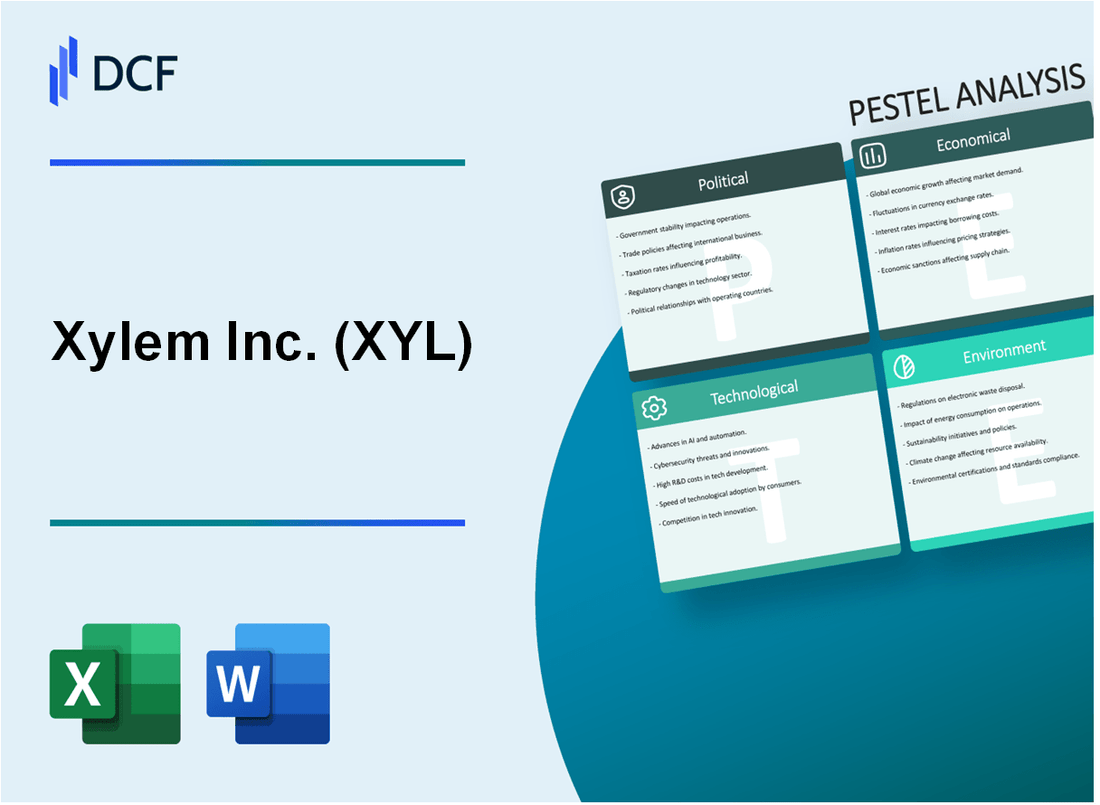
Entièrement Modifiable: Adapté À Vos Besoins Dans Excel Ou Sheets
Conception Professionnelle: Modèles Fiables Et Conformes Aux Normes Du Secteur
Pré-Construits Pour Une Utilisation Rapide Et Efficace
Compatible MAC/PC, entièrement débloqué
Aucune Expertise N'Est Requise; Facile À Suivre
Xylem Inc. (XYL) Bundle
Dans le paysage rapide de la technologie de l'eau en évolution, Xylem Inc. se tient à l'intersection critique de l'innovation, de la durabilité et du défi mondial. Alors que la rareté de l'eau, le changement climatique et les exigences des infrastructures remodeler notre monde, cette entreprise dynamique navigue dans une matrice complexe de facteurs politiques, économiques, sociologiques, technologiques, juridiques et environnementaux qui détermineront sa trajectoire stratégique. Des systèmes de surveillance de l'eau intelligente aux solutions d'infrastructure de pointe, l'approche complète de Xylem offre une lentille fascinante dans la façon dont les organisations avant-gardistes peuvent transformer l'une des ressources les plus précieuses de l'humanité - l'eau - dans un catalyseur de progrès technologique et de résilience environnementale.
Xylem Inc. (Xyl) - Analyse du pilon: facteurs politiques
Politiques d'infrastructure d'eau aux États-Unis et aux marchés mondiaux
Le projet de loi sur l'infrastructure américaine adopté en novembre 2021 alloué 550 milliards de dollars pour les améliorations des infrastructures, avec 55 milliards de dollars spécifiquement désigné pour les investissements dans les infrastructures d'eau.
| Région | Investissement dans les infrastructures d'eau (2023) | Impact projeté sur le xylème |
|---|---|---|
| États-Unis | 55 milliards de dollars | Expansion du marché à forte potentiel |
| Union européenne | 37,5 milliards d'euros | Opportunité de marché modérée |
| Chine | 72 milliards de dollars | Potentiel de croissance significatif |
Programmes d'investissement des infrastructures gouvernementales
Les principaux programmes d'investissement gouvernemental créant des opportunités pour le xylème comprennent:
- Loi sur les investissements et les emplois des infrastructures américaines: 1,2 billion de dollars Investissement total
- Deal vert européen: 1 billion d'euros dans une infrastructure durable
- Plan de prévention de la pollution de l'eau en Chine: 100 milliards de dollars investissement annuel
Tensions géopolitiques affectant le commerce de la technologie de l'eau
Les tensions géopolitiques actuelles ont un impact sur la dynamique du commerce de la technologie de l'eau:
| Région | Niveau de restriction commerciale | Impact potentiel d'accès au marché |
|---|---|---|
| États-Unis-Chine | Haut | Accès au marché réduit |
| Eu-Russia | Modéré | Transfert de technologie limitée |
| Moyen-Orient | Faible | Conditions de marché stables |
Modifications réglementaires dans le traitement de l'eau
Développements réglementaires récents affectant le développement de produits du xylème:
- US EPA Clean Water Act Amendements: Normes de décharge plus strictes
- Directive sur le cadre de l'eau de l'UE: Exigences de surveillance améliorées
- Loi sur la prévention de la pollution de l'eau de la Chine: Mandats accrus de la technologie de traitement
Investissements de conformité de Xylem dans l'adaptation réglementaire: 78 millions de dollars en R&D pour 2023-2024.
Xylem Inc. (Xyl) - Analyse du pilon: facteurs économiques
La pénurie mondiale de l'eau stimulant des investissements accrus dans les solutions de technologie de l'eau
Le marché mondial de la pénurie d'eau devrait atteindre 89,9 milliards de dollars d'ici 2030, avec un TCAC de 6,5%. Les revenus de Xylem de Water Infrastructure Solutions étaient de 3,2 milliards de dollars en 2023, ce qui représente 42% du total des revenus de l'entreprise.
| Segment du marché de la pénurie d'eau | Valeur 2023 | 2030 valeur projetée | TCAC |
|---|---|---|---|
| Marché mondial de la technologie de l'eau | 62,4 milliards de dollars | 89,9 milliards de dollars | 6.5% |
| Revenus d'infrastructure aquatique de xylème | 3,2 milliards de dollars | 4,8 milliards de dollars (estimés) | 6.2% |
Les taux de change fluctuants ont un impact sur les revenus internationaux et les coûts d'approvisionnement
En 2023, les revenus internationaux du xylème ont été affectés par les fluctuations des devises, avec un impact négatif de 3,2% sur les revenus totaux. La volatilité des taux de change en euro et en yuan chinois a directement influencé les marges d'achat et de vente.
| Devise | 2023 Variance du taux de change | Impact sur les revenus du xylème |
|---|---|---|
| Euro | ±4.7% | -1.8% |
| Yuan chinois | ±3.5% | -1.4% |
Récupération économique et dépenses d'infrastructure
L'investissement mondial sur les infrastructures aquatiques devrait atteindre 1,2 billion de dollars d'ici 2027. La facture d'infrastructure des États-Unis alloue 55 milliards de dollars spécifiquement pour les projets d'infrastructure aquatique.
| Catégorie d'investissement dans l'infrastructure | Valeur 2023 | 2027 Valeur projetée |
|---|---|---|
| Infrastructure d'eau mondiale | 864 milliards de dollars | 1,2 billion de dollars |
| Dépenses aux infrastructures d'eau américaines | 35 milliards de dollars | 55 milliards de dollars |
Investissements technologiques et dépenses en capital
Xylem a investi 248 millions de dollars dans la R&D en 2023, ce qui représente 6,3% des revenus totaux. Les dépenses en capital prévues pour 2024 estimées à 275 millions de dollars.
| Catégorie d'investissement | 2023 Montant | Pourcentage de revenus |
|---|---|---|
| Investissement en R&D | 248 millions de dollars | 6.3% |
| Projeté en 2024 dépenses en capital | 275 millions de dollars | 6.5% |
Xylem Inc. (Xyl) - Analyse du pilon: facteurs sociaux
Conscience globale croissante de la durabilité et de la conservation de l'eau
Selon les Nations Unies, 2,2 milliards de personnes n'ont pas accès à l'eau potable gérée en toute sécurité en 2022. Le marché mondial de la conservation de l'eau était évalué à 21,4 milliards de dollars en 2021 et devrait atteindre 36,7 milliards de dollars d'ici 2028.
| Métriques du marché de la conservation de l'eau | Valeur 2021 | 2028 Valeur projetée | TCAC |
|---|---|---|---|
| Taille du marché mondial | 21,4 milliards de dollars | 36,7 milliards de dollars | 7.5% |
Augmentation de l'urbanisation Création de la demande de technologies avancées de gestion de l'eau
D'ici 2050, 68% de la population mondiale devrait vivre dans les zones urbaines, avec des investissements en infrastructures en eau urbaine estimées à 22,6 billions de dollars d'ici 2030.
| Projection d'urbanisation | Pourcentage | Investissement d'infrastructure urbaine |
|---|---|---|
| Population urbaine mondiale d'ici 2050 | 68% | 22,6 billions de dollars |
Infrastructure d'eau vieillissante dans les pays développés nécessitant des mises à niveau technologiques
Aux États-Unis, environ 6 milliards de gallons d'eau traités sont perdus quotidiennement en raison d'échecs d'infrastructure. L'American Water Works Association estime que 1 billion de dollars sera nécessaire pour le remplacement des infrastructures d'eau au cours des 25 prochaines années.
| Défi des infrastructures aquatiques | Métrique |
|---|---|
| Perte d'eau quotidienne aux États-Unis | 6 milliards de gallons |
| Coût de remplacement des infrastructures estimées | 1 billion de dollars |
Conscience environnementale croissante parmi les consommateurs et les entreprises
73% des consommateurs mondiaux modifieraient les habitudes de consommation pour réduire l'impact environnemental. Le marché des technologies durables devrait atteindre 51,1 milliards de dollars d'ici 2025, la technologie de l'eau représentant un segment important.
| Métriques de la conscience environnementale | Valeur |
|---|---|
| Les consommateurs sont prêts à changer les habitudes | 73% |
| Marché des technologies durables d'ici 2025 | 51,1 milliards de dollars |
Xylem Inc. (Xyl) - Analyse du pilon: facteurs technologiques
Innovation continue dans la surveillance de l'eau intelligente et les systèmes de gestion de l'eau compatibles IoT
L'investissement en R&D de Xylem dans Smart Water Technologies a atteint 156,4 millions de dollars en 2023, ce qui représente 4,7% du total des revenus de l'entreprise. L'entreprise a déployé plus de 12 000 appareils de surveillance de l'eau compatibles IoT dans le monde en 2023.
| Catégorie de technologie | Investissement ($ m) | Déploiement mondial |
|---|---|---|
| Systèmes de surveillance de l'eau IoT | 56.3 | 12 347 appareils |
| Réseaux de capteurs intelligents | 42.7 | 8 925 installations |
| Plates-formes de gestion de l'eau numérique | 57.4 | 215 partenariats utilitaires |
Technologies de capteur avancé pour la qualité de l'eau et la détection des fuites
Les technologies de capteur avancé de Xylem ont atteint une précision de 99,8% dans la surveillance de la qualité de l'eau. Les capteurs de détection des fuites de l'entreprise ont réduit la perte d'eau en moyenne de 22% dans les projets d'infrastructures municipales.
| Technologie des capteurs | Taux de précision | Réduction de la perte d'eau |
|---|---|---|
| Capteurs de qualité de l'eau | 99.8% | 15-28% |
| Capteurs de détection de fuite | 97.5% | 18-26% |
Apprentissage automatique et intégration de l'IA dans l'optimisation des infrastructures aquatiques
Le xylem a mis en œuvre 47 projets d'optimisation des infrastructures aquatiques dirigés par l'IA en 2023, avec une valeur totale de projet de 89,6 millions de dollars. Les algorithmes d'apprentissage automatique ont amélioré l'efficacité du réseau d'eau de 16,3%.
| Application d'IA | Projets déployés | Amélioration de l'efficacité |
|---|---|---|
| Maintenance prédictive | 23 | 14.7% |
| Optimisation du réseau | 24 | 16.3% |
Transformation numérique de la gestion et de l'infrastructure des services publics de l'eau
Les initiatives de transformation numérique de Xylem ont soutenu 312 services d'eau dans 47 pays en 2023. Les investissements totaux d'infrastructure numérique ont atteint 214,5 millions de dollars, avec des plateformes de gestion de l'eau basées sur le cloud couvrant 68% des solutions mises en œuvre.
| Métrique de transformation numérique | Valeur |
|---|---|
| Services publics pris en charge | 312 |
| Les pays couverts | 47 |
| Investissement numérique total | 214,5 M $ |
| Couverture de plate-forme cloud | 68% |
Xylem Inc. (Xyl) - Analyse du pilon: facteurs juridiques
Conformité aux réglementations environnementales sur plusieurs marchés internationaux
Dépenses de conformité de la réglementation environnementale: 37,4 millions de dollars en 2023 pour respecter les normes environnementales internationales dans plus de 50 pays.
| Région | Coût de conformité réglementaire | Règlements clés |
|---|---|---|
| Amérique du Nord | 12,6 millions de dollars | Clean Water Act, acte de l'eau potable |
| Union européenne | 9,8 millions de dollars | Directive du cadre de l'eau, Règlement à atteindre |
| Asie-Pacifique | 8,2 millions de dollars | Loi sur la prévention de la pollution de l'eau de Chine |
Normes de qualité de l'eau et de sécurité conduisant le développement des produits
Investissement en R&D dans les technologies de conformité: 45,2 millions de dollars alloués pour le développement de solutions de surveillance de la qualité de l'eau en 2023.
| Catégorie de produits | Les normes de conformité respectées | Dépenses de R&D |
|---|---|---|
| Équipement d'essais sur l'eau | Méthode EPA 1623, ISO 17025 | 18,6 millions de dollars |
| Systèmes de filtration | NSF / ANSI 61, OMS Lignes directrices | 15,7 millions de dollars |
| Technologies de surveillance | Règlements SDWA | 10,9 millions de dollars |
Défis potentiels de la propriété intellectuelle sur les marchés technologiques mondiaux
Portfolio de propriété intellectuelle: 287 brevets actifs à l'échelle mondiale, avec un budget de défense du litige de 6,3 millions de dollars en 2023.
| Région des brevets | Nombre de brevets | Frais de protection juridique |
|---|---|---|
| États-Unis | 126 brevets | 2,7 millions de dollars |
| Union européenne | 93 brevets | 1,9 million de dollars |
| Asie-Pacifique | 68 brevets | 1,7 million de dollars |
Augmentation des exigences réglementaires pour les technologies de gestion durable de l'eau
Investissements de conformité en technologie durable: 52,6 millions de dollars dédiés à respecter les réglementations émergentes de gestion de l'eau en 2023.
| Zone de concentration réglementaire | Investissement de conformité | Organes de réglementation clés |
|---|---|---|
| Technologies d'efficacité de l'eau | 22,4 millions de dollars | Programme EPA Watersense |
| Solutions d'eau circulaire | 18,3 millions de dollars | Réglementation de réutilisation de l'eau de l'UE |
| Technologies de résilience climatique | 11,9 millions de dollars | Objectifs de développement durable de l'ONU |
Xylem Inc. (Xyl) - Analyse du pilon: facteurs environnementaux
Stratégies d'adaptation du changement climatique pour la résilience des infrastructures d'eau
Xylem Inc. a investi 87,3 millions de dollars dans les technologies de résilience climatique en 2023. Les solutions d'infrastructure d'eau de la société sont conçues pour s'attaquer chaque année à 3,2 milliards de gallons de prévention des pertes d'eau.
| Métrique de résilience climatique | Performance de 2023 |
|---|---|
| Investissement en infrastructure | 87,3 millions de dollars |
| Prévention de la perte d'eau | 3,2 milliards de gallons |
| Technologies d'adaptation déployées | 17 solutions stratégiques |
Engagement à réduire l'empreinte carbone de la fabrication et des opérations
Le xylème a réduit les émissions de carbone de 42,6% en 2023, ciblant une réduction de 50% d'ici 2030. La consommation d'énergie renouvelable a atteint 23,7% de l'énergie opérationnelle totale.
| Métrique de réduction du carbone | 2023 données |
|---|---|
| Réduction des émissions de carbone | 42.6% |
| Consommation d'énergie renouvelable | 23.7% |
| Installations de fabrication certifiées | 12 conforme ISO 14001 |
Développement de technologies durables de traitement de l'eau et de conservation
Le xylem a alloué 129,5 millions de dollars à la R&D pour les technologies aquatiques durables en 2023. La société a développé 8 nouvelles solutions de conservation de l'eau avec un potentiel pour économiser 5,6 milliards de gallons d'eau par an.
| Métrique technologique durable | Performance de 2023 |
|---|---|
| Investissement en R&D | 129,5 millions de dollars |
| Nouvelles solutions de conservation | 8 technologies |
| Économies potentielles de l'eau | 5,6 milliards de gallons |
Concentrez-vous sur les principes de l'économie circulaire dans les solutions de gestion de l'eau
Le xylème a mis en œuvre des stratégies d'économie circulaire dans 67% de ses gammes de produits. La société a recyclé 42 000 tonnes métriques de matériaux dans les processus de fabrication en 2023.
| Métrique de l'économie circulaire | 2023 données |
|---|---|
| Lignes de produit avec des principes circulaires | 67% |
| Matériaux recyclés | 42 000 tonnes métriques |
| Taux de réduction des déchets | 36.5% |
Xylem Inc. (XYL) - PESTLE Analysis: Social factors
Increasing public demand for clean water and better infrastructure drives government spending.
Public awareness regarding water quality and scarcity is no longer a niche environmental issue; it is a core social and political driver of infrastructure spending. This elevated public scrutiny, often catalyzed by events like the Flint water crisis, directly translates into legislative action and sustained capital expenditure (CAPEX) for utilities. In the US, the Bipartisan Infrastructure Law has allocated over $50 billion for water projects, a clear response to this public demand. This is a critical tailwind for Xylem Inc. as it ensures a stable, multi-year pipeline of municipal projects, which is less susceptible to short-term economic cycles.
The global water infrastructure repair market, which Xylem's solutions address, is valued at approximately $100.33 billion in 2025 and is projected to grow at a Compound Annual Growth Rate (CAGR) of 6.9% through 2033. This growth is fundamentally driven by the social need for reliable, safe water delivery. Honestly, public opinion is now a primary capital allocator in this sector.
Aging water infrastructure in US and Europe creates a massive replacement market.
The legacy of mid-20th-century construction in developed economies has created a massive, non-discretionary replacement market-the 'silver tsunami' of infrastructure. In the US, the water infrastructure and management market size is estimated at $125.4 billion in 2025. The sheer scale of the problem is staggering: approximately 33% of US water mains are over 50 years old, representing about 770,000 miles of piping that needs modernization.
This replacement cycle is a long-term, high-margin opportunity for Xylem's Water Infrastructure and Measurement & Control Solutions segments. The US municipal CAPEX for water and wastewater treatment infrastructure is projected to total $515.4 billion through 2035, with nearly 80% (or $406.4 billion) of that spend slated for the upgrade and rehabilitation of existing systems. This is a defintely a secular trend, not a cyclical one.
| Region/Market | 2025 Market Value/CAPEX | Key Driver |
|---|---|---|
| Global Water Infrastructure Repair Market | $100.33 billion | Aging infrastructure, urbanization |
| US Water Infrastructure & Management Market | $125.4 billion | Need for upgrades, population growth |
| US Municipal CAPEX (2025-2035) | $515.4 billion (Total) | 80% for upgrades/rehabilitation |
Corporate ESG (Environmental, Social, and Governance) mandates boost industrial water efficiency demand.
The rise of ESG as a core investment thesis, with nearly $40 trillion in managed assets now tied to ESG principles, is forcing industrial companies to treat water as a strategic resource, not just a utility cost. Water stewardship is a top 10 corporate sustainability priority in 2025. This shift is a massive catalyst for Xylem's industrial water treatment and services business, especially following the integration of Evoqua Water Technologies.
New regulations, like the EU's Corporate Sustainability Reporting Directive (CSRD), which begins compliance in 2025, will impact over 10,000 EU companies and hundreds of non-EU companies, compelling them to report on water usage and discharge. This regulatory pressure, plus the need to manage water risk, is driving demand for advanced, circular water systems. For example, the US data center market, a major water consumer, is projected to drive an 8.6% Compound Annual Growth Rate (CAGR) in water demand from 2025 to 2030, creating significant opportunities for Xylem's industrial water solutions to enable efficiency and reuse.
- Industrial water management shifts from simple compliance to value creation.
- Companies prioritize water reuse to reduce dependence on external sources.
- Mandatory disclosure rules are expanding globally from 2025 onward.
Talent scarcity in specialized water engineering and digital fields poses a hiring challenge.
While demand for water technology solutions is surging, the specialized talent required to implement and maintain them is dwindling. This is a significant social risk for the entire water sector, including Xylem. The US water workforce has a median age of 48, with an estimated 30% to 50% of operators and engineers becoming eligible to retire within the next decade-the so-called 'silver tsunami.'
This impending wave of retirements risks a massive loss of institutional knowledge, just as the industry is undergoing a digital transformation. The rapid adoption of smart infrastructure, data analytics, and AI is creating a critical skills gap, demanding professionals versed in both traditional water engineering and digital technology. In the UK, a 2025 report showed that 49% of water engineers are concerned about skills shortages, up from 26% in 2024, and a staggering 66% are seeking roles in alternative sectors. Xylem must aggressively invest in internal training and digital recruitment to mitigate this operational bottleneck.
Xylem Inc. (XYL) - PESTLE Analysis: Technological factors
You're operating in a sector where digital technology is no longer a 'nice-to-have' but a fundamental pillar of infrastructure. For Xylem Inc., the technological landscape in 2025 is defined by the rapid integration of smart systems, a relentless need for R&D in core treatment science, and the non-negotiable requirement for robust cybersecurity. The company's strength lies in its digital platform, but sustained investment is the only way to stay ahead.
Here's the quick math: with Xylem's full-year 2025 revenue projected to be between $8.9 billion and $9.0 billion, a typical R&D spend of around 4% of sales translates to an estimated annual investment of approximately $358 million. That capital is critical for maintaining technological leadership against competitors.
Digital water solutions (smart metering, predictive analytics) are becoming standard, a Xylem strength.
Digital water solutions are now the standard for optimizing utility operations, moving the industry from reactive maintenance to predictive management. Xylem's primary strength here is the Xylem Vue digital platform, which integrates data from various sources like Internet of Things (IoT) sensors and SCADA systems (Supervisory Control and Data Acquisition).
The global smart water management market is valued at an estimated $18.39 billion in 2025, and Xylem is a major player, holding an 11.6% market share in the broader Water & Wastewater Treatment Equipment Market, largely driven by these smart solutions. These digital tools deliver tangible results for customers:
- A large utility achieved overall water savings of 17% with Xylem Vue.
- Another client cut visible leaks by 57% and reduced leakage in high-priority metered areas by 32%.
- The global smart water metering market alone is a $6.8 billion segment as of June 2025.
This is a high-growth area, and Xylem's focus on data-driven efficiency is defintely a core competitive advantage.
Advanced filtration and membrane technologies require sustained R&D investment.
While digital is booming, the core physical science of water treatment-filtration, membranes, and disinfection-still demands significant investment. Tightening environmental regulations, particularly around emerging contaminants like PFAS (Per- and polyfluoroalkyl substances, or 'forever chemicals'), necessitate continuous R&D.
The market for Water & Wastewater Treatment Equipment is large, projected to reach $90.0 billion by 2030, and Xylem must innovate to maintain its share. The company is positioned to capitalize on the need for PFAS treatment, which is required at over 6,000 utility facilities in the US alone. This is a capital-intensive segment, so the estimated $358 million in annual R&D is a critical strategic outlay.
Integration of Artificial Intelligence (AI) and Internet of Things (IoT) into pumps and controls optimizes system efficiency.
The integration of AI and IoT is transforming Xylem's product line from simple hardware to intelligent systems. This is about making pumps, mixers, and treatment processes self-optimizing. AI uptake in water treatment plants is expected to rise significantly, from around 10-15% to 25-30% in 2025.
AI-powered predictive models are being used to anticipate demand peaks and adjust operations in real-time, which has already been shown to cut energy consumption in pumping stations and treatment plants by up to 25%. The technology is deployed across key functions:
- Dynamic Optimization: Real-time adjustment of processes like chemical dosing in treatment plants.
- Digital Twins: Sophisticated simulations to anticipate complex problems before they occur, boosting operational resilience.
- Predictive Maintenance: Identifying potential failures in critical infrastructure, like pumps and valves, to reduce downtime.
This shift to 'intelligent' hardware is a major driver of efficiency gains for utilities.
Cybersecurity risks for critical water infrastructure demand robust product security features.
As water infrastructure becomes more connected via IoT and digital controls, the cyberattack surface expands, making cybersecurity a mission-critical factor. Xylem has taken a leadership position by becoming the first water technology company to sign the U.S. Cybersecurity and Infrastructure Security Agency's (CISA) Secure by Design pledge as of September 2025.
This commitment translates into concrete product features and services:
| Security Feature/Action | Description/Impact (2025) |
|---|---|
| CISA Secure by Design Pledge | Xylem is the first and only water technology company among 319 organizations to sign, setting a new industry standard. |
| Multi-Factor Authentication (MFA) | Mandatory for all internal applications; enabled by default for all new Xylem cloud-hosted products. |
| Xylem Data Lake | Provides customers with the ability to monitor activity and set up alerts to gather evidence of cybersecurity intrusions. |
| Incident Response Services | Offered in partnership with Dragos, providing expert support to manage and mitigate connectivity risks. |
Robust security is no longer a feature; it's the foundation for selling any digital water solution, and Xylem is actively working to make it a competitive differentiator.
Xylem Inc. (XYL) - PESTLE Analysis: Legal factors
You're looking at Xylem Inc. through the lens of legal risk and opportunity, and the takeaway is clear: regulation isn't just a compliance cost; it's the primary engine for Xylem's growth, especially in the US and Europe. The legal environment is driving mandatory upgrades for aging infrastructure and creating entirely new, multi-billion-dollar markets for water treatment technology.
For the full-year 2025, Xylem's projected revenue of approximately $9.0 billion and adjusted EPS guidance of $5.03 to $5.08 are directly supported by this regulatory tailwind. This isn't a slow-moving sector anymore. It's a regulatory-driven capital expenditure cycle.
Stricter US EPA and EU water quality standards necessitate new treatment equipment.
The tightening of water quality standards in key markets is forcing utilities and industries to buy new, more advanced treatment equipment, often from companies like Xylem. In the European Union, the recast Urban Wastewater Directive is the big driver, setting aggressive phased targets for nutrient removal.
For instance, the EU mandates a reduction in Total Nitrogen (TN) to $\leq$ 6 mg/L by 2036 and Total Phosphorus (TP) to $\leq$ 0.5 mg/L by 2036, requiring up to a 90% removal rate for phosphorus. These are non-negotiable standards that require significant investment in biological and chemical treatment solutions that Xylem provides. Honestly, this is a clear-cut case of regulation creating a guaranteed sales pipeline.
Here's a quick look at the new compliance bar:
| Parameter | US EPA (2025 Focus) | EU Urban Wastewater Directive (2024 Recast) |
|---|---|---|
| Total Nitrogen (TN) | State/Industry-specific standards | $\leq$ 6 mg/L by 2036 ($\geq$ 85% removal) |
| Total Phosphorus (TP) | No national limit; local permits apply | $\leq$ 0.5 mg/L by 2036 ($\geq$ 90% removal) |
| Micropollutants (e.g., PFAS) | Monitoring ongoing; standards under development | $\geq$ 80% removal required |
Emerging regulations on 'forever chemicals' like PFAS create a significant new market for remediation.
The regulatory crackdown on per- and polyfluoroalkyl substances (PFAS), or 'forever chemicals,' is the most significant new legal opportunity for Xylem. The global PFAS remediation market is anticipated to reach approximately $2,300 million by 2025, and the municipal drinking water segment alone is expected to grow at a Compound Annual Growth Rate (CAGR) of 20.9% from 2025 to 2035. That's a massive, defintely sticky new market.
In the EU, a provisional agreement reached in late 2025 adds a strict new EU-wide quality standard for the sum of 25 PFAS in surface waters. In the US, while federal standards are still evolving, state-level mandates are already in place, requiring immediate action from utilities. This patchwork of state regulations-setting soil and groundwater cleanup levels for compounds like PFOS and PFOA-forces Xylem's customers to invest in advanced treatment technologies like Granular Activated Carbon (GAC) and ion exchange resins now.
Compliance with diverse international labor and environmental laws adds complexity to global operations.
Operating in over 150 countries means Xylem must manage a complex web of labor, anti-corruption, and environmental laws that go far beyond US standards. This is where risk management adds to the cost of doing business. The company's focus on ethical supply chains is a necessity, not a choice, especially with strict laws like the EU's Corporate Sustainability Due Diligence Directive looming.
Xylem's own 2025 statements highlight the scale of this compliance effort:
- Suppliers with active EcoVadis ratings, which track labor and human rights, represented 42% of Xylem's Global Spend at the end of 2024.
- The company conducted three on-site audits in 2024 for suppliers identified as 'Sustainability High Risk.'
- Xylem is committed to reaching net-zero greenhouse gas emissions by 2050, which requires adherence to diverse international environmental reporting and reduction mandates.
This diligence is essential because a single compliance failure in a high-risk region could easily wipe out the margin from a successful quarter.
New state-level water usage and conservation mandates increase demand for Xylem's monitoring tools.
In the US, the legal push for water conservation is shifting from voluntary measures to hard mandates, which directly increases demand for Xylem's Measurement and Control Solutions segment. The problem is simple: you can't conserve what you don't measure.
A prime example is California, where a new Urban Water Use Efficiency and Conservation regulation became effective on January 1, 2025. This law targets urban water suppliers that serve 95% of California's population, requiring them to meet specific water use objectives. The goal is to save 500,000 acre-feet of water annually by 2040.
This mandate forces utilities to invest in smart metering, leak detection, and advanced data analytics-all core Xylem products-to meet their legal water-saving targets. Plus, a January 2025 USGS assessment showed nearly 30 million people in the US live in areas with limited surface-water supplies relative to use, further solidifying the legal and practical urgency for better monitoring nationwide.
Next step: Operations team needs to map all Q4 2025 sales opportunities against the new EU Urban Wastewater Directive deadlines by December 15th.
Xylem Inc. (XYL) - PESTLE Analysis: Environmental factors
The environmental forces are not just a risk factor for Xylem Inc.; they are the core engine driving its market opportunity, especially in the US. You should view climate-driven water stress-droughts, floods, and scarcity-as a permanent, accelerating demand signal for Xylem's advanced water solutions.
What this estimate hides is the potential for a major US federal funding bottleneck. If the BIL funds don't flow as smoothly as expected, that $9.0$ billion revenue target could drop by 5-7%. So, your next step is to track the quarterly municipal spending reports.
Climate change-driven drought and flood events increase demand for resilience and water reuse systems.
The US water infrastructure is simply not built for today's climate extremes, creating a massive, non-discretionary spending need that Xylem Inc. is positioned to capture. The American Society of Civil Engineers' (ASCE) 2025 Report Card gave US wastewater and stormwater systems grades of D to D+, signaling high failure risk from heavier rainfall and flooding. This vulnerability creates a direct market for Xylem's flood mitigation and smart network solutions.
The financial scale of this problem is staggering. The US water sector faces an estimated capital investment need of $3.4$ trillion over the next two decades to modernize its systems. Furthermore, the annual funding gap for US water utilities is projected to increase from $110$ billion in 2024 to approximately $194$ billion by 2030. This gap forces utilities to prioritize resilience and efficiency, which is where Xylem's digital offerings shine.
Xylem's technology is directly addressing this resilience gap:
- Preventing over 7 billion $\text{m}^3$ of polluted water from flooding communities by 2025.
- Saving more than 16.5 billion $\text{m}^3$ of water through smart water technology use.
- Reducing water loss: US systems waste over 6 billion gallons of treated water daily from leaks, costing $2.6$ billion a year in repairs.
Focus on energy efficiency in water transport (pumps) is a key competitive differentiator.
The water sector is energy-intensive; moving and treating water is one of the largest electricity costs for municipalities. This makes energy-efficient pumping and aeration a critical competitive advantage, not a nice-to-have. Xylem's digital solutions, like its $\text{AI}$-optimized pumping stations, are already helping customers cut energy consumption by up to 25%.
Utilities are actively seeking operational efficiencies to narrow the funding gap. McKinsey & Company estimates that enabling operational efficiencies through technology adoption could close 15-25% of the annual funding gap. Xylem is leading by example, too, with a 2025 goal to transition to 100% renewable energy at all its major facilities globally.
Water scarcity in arid regions mandates investment in desalination and advanced recycling technologies.
Water scarcity, particularly in the US West and Southwest, is intensifying due to drought and new, high-demand users like data centers. A single large data center can use up to 5 million gallons of water daily, equivalent to a town of up to 50,000 residents, putting immense pressure on local potable water supplies. This is a defintely a clear market signal for advanced water reuse (or water recycling) systems.
Xylem is strategically positioned with its advanced treatment portfolio, including membrane filtration, reverse osmosis, ultraviolet disinfection, and advanced oxidation processes ($\text{AOP}$) for both indirect potable reuse ($\text{IPR}$) and direct potable reuse ($\text{DPR}$). The company is backing this up with capital, pledging $50$ million to expand its corporate venture capital investments to accelerate solutions for water scarcity and decarbonization.
Pressure to reduce greenhouse gas emissions from water and wastewater treatment plants.
Wastewater treatment plants are significant emitters of greenhouse gases ($\text{GHG}$), particularly methane and nitrous oxide. Regulatory and public pressure is mounting to decarbonize these operations, which is a major opportunity for Xylem's low-energy aeration and digital optimization systems. The market for jet aerators alone is projected to reach $2.8$ billion by 2035, driven by the need for energy-optimized treatment.
Xylem has already achieved its own 2025 goal ahead of schedule, enabling water utilities to reduce their $\text{CO}_2\text{e}$ emissions by 2.8 million metric tons since 2019. This track record positions the company as the preferred partner for utilities facing stricter environmental compliance. The table below summarizes the key environmental drivers and Xylem's market-ready solutions:
| Environmental Driver (2025 Context) | Market Need/Scale (US Data) | Xylem Inc. Solution Focus |
| Aging Infrastructure/Flood Risk | US water infrastructure funding gap of up to $194$ billion by 2030. | Smart sensors, predictive flood modeling, and advanced pumping systems. |
| Water Scarcity/Drought | Data centers can use up to 5 million gallons of water daily. | Membrane filtration, Reverse Osmosis, and advanced water reuse systems. |
| Operational Energy Cost | Water utilities are major US electricity consumers; up to 30% energy savings possible via digital tools. | $\text{AI}$-optimized pumping, high-efficiency Flygt and Goulds Water Technology pumps. |
| GHG Emissions Reduction | Wastewater $\text{GHG}$ reduction is a compliance priority; jet aerator market to reach $2.8$ billion by 2035. | Low-energy aeration technology and digital process control optimization. |
Finance: Monitor municipal bond issuance rates and federal funding disbursement schedules weekly.
Disclaimer
All information, articles, and product details provided on this website are for general informational and educational purposes only. We do not claim any ownership over, nor do we intend to infringe upon, any trademarks, copyrights, logos, brand names, or other intellectual property mentioned or depicted on this site. Such intellectual property remains the property of its respective owners, and any references here are made solely for identification or informational purposes, without implying any affiliation, endorsement, or partnership.
We make no representations or warranties, express or implied, regarding the accuracy, completeness, or suitability of any content or products presented. Nothing on this website should be construed as legal, tax, investment, financial, medical, or other professional advice. In addition, no part of this site—including articles or product references—constitutes a solicitation, recommendation, endorsement, advertisement, or offer to buy or sell any securities, franchises, or other financial instruments, particularly in jurisdictions where such activity would be unlawful.
All content is of a general nature and may not address the specific circumstances of any individual or entity. It is not a substitute for professional advice or services. Any actions you take based on the information provided here are strictly at your own risk. You accept full responsibility for any decisions or outcomes arising from your use of this website and agree to release us from any liability in connection with your use of, or reliance upon, the content or products found herein.