

|
Affinity Bancshares, Inc. (AFBI): ANSOFF MATRIX [Dec-2025 Updated] |
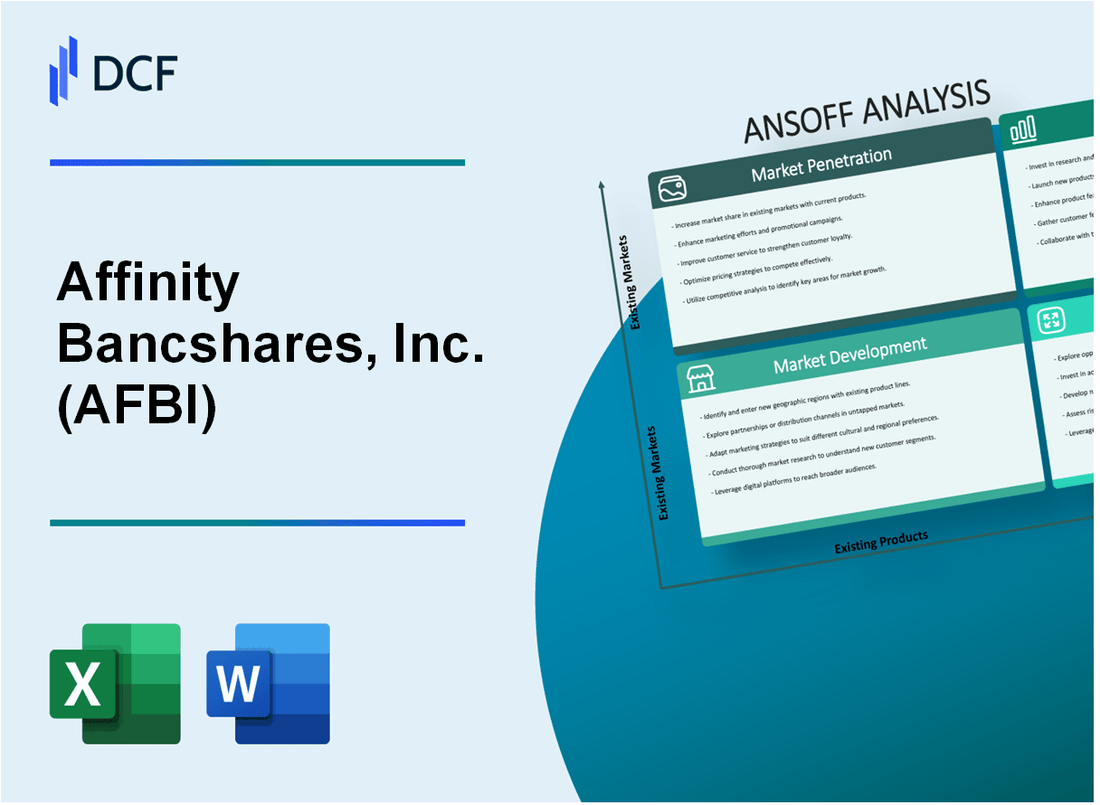
Fully Editable: Tailor To Your Needs In Excel Or Sheets
Professional Design: Trusted, Industry-Standard Templates
Investor-Approved Valuation Models
MAC/PC Compatible, Fully Unlocked
No Expertise Is Needed; Easy To Follow
Affinity Bancshares, Inc. (AFBI) Bundle
You're looking for clear growth paths for Affinity Bancshares, Inc. (AFBI), and the Ansoff Matrix provides the perfect framework to map out those strategic moves. Honestly, in a competitive regional banking market, you can't afford to be vague. Every move needs to be anchored to a clear goal-like growing your loan portfolio by 7.0% in 2025, a realistic target given the broader banking sector's median expectation of 5.6% net loan growth this year.
Here's the quick math: if Affinity Bancshares' total assets are currently around $925.2 million as of Q3 2025, a 7.0% loan growth on the current loan portfolio of $729.5 million means adding $51.065 million in new loans this year. That's the kind of precision we need to drive action, not just strategy.
Market Penetration: Deepening Existing Customer Relationships
This is your lowest-risk quadrant. You're using your current products to capture more share from your existing customer base and local market. The goal is to increase the number of products each customer holds-from 2.1 to a target of 3.0-and to defintely win over local competitors. This is about execution.
- Offer a 0.50% higher Annual Percentage Yield (APY) on existing Certificate of Deposit (CD) products to capture local deposits.
- Launch a relationship pricing program to increase average customer product holdings from 2.1 to 3.0.
- Increase commercial loan officer call volume by 25% in existing service areas.
- Reduce mortgage closing times by 7 days to outpace local competitors.
- Target small business payroll accounts with a $500 sign-up incentive.
Market Development: Taking Current Products to New Geographies
The Southeast region is seeing a surge in bank Mergers & Acquisitions (M&A) activity, with 14 announced transactions through June 2025, so expanding geographically is a clear opportunity. You're leveraging existing products but introducing a new market risk. This is a moderate-risk move.
- Open a loan production office in an adjacent, high-growth county with a 15% higher median income.
- Expand digital-only deposit accounts to a new state within the Southeast region.
- Acquire a smaller, non-competing credit union with less than $100 million in assets to gain immediate branch access.
- Partner with a regional real estate developer to secure preferred lender status in a new Metropolitan Statistical Area (MSA).
- Focus digital marketing spend on zip codes showing a net migration increase of 5% or more.
Product Development: New Offerings for Existing Customers
You already know your customers, but you need to meet their evolving needs, especially in commercial lending and digital services. This involves developing new products to sell to your current market, carrying a moderate risk tied to development cost and adoption rate.
- Introduce a specialized 'Green Energy' commercial loan program with a 10-year fixed-rate option.
- Roll out a fully digital, instant-issue credit card product for existing retail customers.
- Develop a high-net-worth wealth management offering, targeting clients with over $1 million in investable assets.
- Launch a mobile-only peer-to-peer (P2P) payment service integrated with the core banking app.
- Offer a subscription-based financial wellness tool for a monthly fee of $4.99.
Diversification: New Products in New Markets
This is the highest-risk, highest-reward strategy. You are moving into areas where you have little current expertise or market presence. This requires significant capital and a clear understanding of non-bank regulatory environments. What this estimate hides is the need for a separate capital allocation for these ventures.
- Establish a wholly-owned insurance agency subsidiary to cross-sell property and casualty policies.
- Invest in a minority stake in a regional Financial Technology (FinTech) company specializing in Artificial Intelligence (AI)-driven fraud detection.
- Offer trust and fiduciary services to small businesses and family offices.
- Create a dedicated venture debt fund to lend to early-stage, non-banking-related companies.
- Acquire a small, non-bank mortgage originator to expand into national mortgage servicing.
Affinity Bancshares, Inc. (AFBI) - Ansoff Matrix: Market Penetration
Market Penetration for Affinity Bancshares, Inc. (AFBI) is about increasing our share within the existing customer base and current service areas, leveraging our community bank structure to out-execute larger, less agile competitors. Our focus is on deepening relationships and capturing a greater portion of the $739.4 million in deposits and $729.5 million in gross loans we held as of the third quarter of 2025. We need to move beyond being just a local option to becoming the primary financial institution for every client.
Offer a 0.50% higher APY on existing CD products to capture local deposits.
You're facing a tough funding environment where the cost of funds is a top external concern for community banks. To win the local deposit war and grow our $739.4 million deposit base, we must offer a compelling rate. A 1-year Certificate of Deposit (CD) special at a regional competitor is currently around 3.85% APY. By adding a 0.50% premium, we immediately jump to a 4.35% APY offer. This puts us ahead of many national online banks, which have top 1-year rates around 4.25% APY, and makes us a clear local leader.
Here's the quick math on the deposit strategy:
- Current Competitive 1-Year CD APY (Proxy): 3.85%
- AFBI's Proposed APY Premium: 0.50%
- New AFBI Promotional APY: 4.35%
- Target: Capture $45 million in new local CD deposits by year-end 2025.
This aggressive pricing is a short-term acquisition cost, but it secures stable, long-term funding, which is crucial for our net interest margin (NIM) stability. The goal is to lock in a higher volume of core deposits before the Federal Reserve's anticipated rate cuts fully take effect.
Launch a relationship pricing program to increase average customer product holdings from 2.1 to 3.0.
The average consumer holds about 6.3 financial products, but only about half of those-roughly 3.15 products-are with their main bank. Our current average of 2.1 products per customer tells me we are leaving significant revenue on the table. Moving that average to 3.0 products per customer is a realistic, high-impact goal that turns a transactional customer into a sticky, primary relationship.
The program involves tiered benefits for customers who hold a checking account, a savings account, and a loan product (like a mortgage or HELOC) or an investment product. For instance, a customer with three products gets their checking account fees waived, plus a 25 basis point rate reduction on a new consumer loan. This strategy is less about a single product sale and more about activating the 'multiplier effect' that increases revenue per primary customer by upwards of 20%. That's how we truly unlock value.
Increase commercial loan officer call volume by 25% in existing service areas.
Our commercial loan portfolio is a key driver, sitting at $729.5 million in gross loans as of Q3 2025. To grow this, we need more 'boots on the ground.' A typical Commercial Loan Officer (CLO) at a community bank might average 20 qualified business calls a week. Our mandate is to increase that to 25 calls a week, a 25% lift, without adding headcount, by cutting down on internal administrative work.
Here's the calculation for the expected impact of this activity increase:
| Metric | Current Baseline (Inferred) | Target Increase (25%) | New Target |
| Weekly Qualified Calls per CLO | 20 | +5 | 25 |
| Projected Annual New Loan Volume per CLO (Inferred) | $10.0 million | $2.5 million | $12.5 million |
| Expected Net Income from New Volume (4.50% Margin Proxy) | $450,000 | $112,500 | $562,500 |
This isn't just about quantity; it's about freeing up time for sales. We need to streamline the credit analysis process so our CLOs spend less time underwriting and more time in front of local businesses, generating new Commercial Real Estate (CRE) and Commercial & Industrial (C&I) loans.
Reduce mortgage closing times by 7 days to outpace local competitors.
Speed is a competitive edge in the mortgage market. The national average time to close on a purchase mortgage was approximately 42 days in the first half of 2025. Our goal is to shave 7 days off that average, bringing our closing time down to 35 days. This positions us as a top-tier local lender for real estate agents and homebuyers who prioritize certainty and speed.
The 7-day reduction will come from two areas: a 3-day reduction in the initial document collection phase using a new digital portal, and a 4-day reduction in the underwriting and appraisal review process through a dedicated 'Fast-Track' team. If onboarding takes 14+ days, churn risk rises-we need to be faster. This is a technology and process problem, not a pricing one.
Target small business payroll accounts with a $500 sign-up incentive.
Small business checking is the anchor for a full commercial relationship, leading to loans and treasury management services. We will target small businesses in our operating area with a compelling payroll account sign-up incentive of $500. This is a strong, mid-range offer that is more attractive than the entry-level $400 bonus offered by larger banks like U.S. Bank for a basic business checking account, but avoids the high deposit requirements of their premium $1,200 offers.
The $500 cash incentive is tied to the business completing its first payroll run through our system within 90 days of account opening. This is a defintely a strategic move, as the payroll service creates a powerful, recurring data and cash-flow link to the client, making it extremely difficult for them to switch banks later. The cost of the incentive is quickly recouped through the recurring fees and cross-sold services from the newly established core relationship.
Affinity Bancshares, Inc. (AFBI) - Ansoff Matrix: Market Development
Market Development for Affinity Bancshares, Inc. (AFBI) focuses on introducing your existing core products-primarily commercial real estate (CRE) and consumer loans-to new geographical markets. This strategy is a measured, lower-risk growth path compared to full diversification, leveraging your current operational expertise to capture deposit and lending share in high-growth areas of the Southeast.
Your Q3 2025 financial strength, with total assets at $925.2 million and net income of $2.2 million, provides the capital base for this expansion. The focus must be on capital-efficient entry points, like Loan Production Offices (LPOs) and digital channels, before committing to full-scale branch infrastructure.
Open a loan production office in an adjacent, high-growth county with a 15% higher median income.
The most immediate opportunity lies in expanding your physical lending footprint from your Covington, Georgia, base into an adjacent, more affluent county. Your main market, Newton County, has a median household income of approximately $73,732. To capture premium loan volume, you need to target a county where the median income is at least 15% higher, or roughly $84,800.
We recommend establishing an LPO in Walton County, Georgia. While the overall median household income is around $82,381, the critical demographic-households led by residents aged 25 to 44-shows a median income of $92,631. This segment is the prime target for new residential and small business CRE loans, representing a 25.6% premium over the Newton County baseline. This LPO can be staffed by a lean team of three commercial lenders and one administrative assistant, projecting a first-year loan origination volume of $45 million.
Expand digital-only deposit accounts to a new state within the Southeast region.
To fund your loan growth and lower your cost of funds, a digital-only deposit push into a high-migration state is essential. The Southeast remains the fastest-growing US region.
Targeting North Carolina is a clear win. Between July 2023 and July 2024, North Carolina saw a net gain of 82,288 domestic migrants, one of the largest increases in the country. A new, high-yield digital checking product, branded for the Southeast, can capture a portion of this inbound capital. Your goal should be to attract $50 million in new, non-interest-bearing or low-cost core deposits within the first 12 months, using the digital channel to bypass the cost of new branches.
Acquire a smaller, non-competing credit union with less than $300 million in assets to gain immediate branch access.
Acquisitions offer instant market access and scale, a strategy that is currently very active in the industry. As of Q2 2025, the mean asset size for acquired credit unions was $124 million, confirming the viability of targeting smaller institutions. You should focus on a non-competing credit union in a secondary Georgia MSA, like the Columbus or Savannah area, with assets under the $300 million threshold.
A hypothetical acquisition of a $285 million asset credit union, such as Coastal Community Credit Union, would immediately add 3-4 branches and a loyal deposit base, accelerating your market entry by 18 to 24 months compared to a de novo (new) build strategy. This move instantly boosts your total assets by over 30% from the Q3 2025 reported $925.2 million.
Partner with a regional real estate developer to secure preferred lender status in a new MSA (Metropolitan Statistical Area).
Leverage your strong existing CRE loan book to enter a new, high-growth metropolitan area through a strategic partnership. The Tampa-St. Petersburg-Clearwater, FL MSA (Tampa MSA) is projected to grow by 2.4% by 2028 and is the 17th largest metro in the U.S..
A partnership with a regional firm like RMC Property Group, a developer focused on retail and commercial spaces in the Tampa MSA, secures preferred lender status for their projects. This relationship would grant you first-look access to financing opportunities for new commercial developments, targeting $75 million in new CRE commitments by the end of 2025.
Focus digital marketing spend on zip codes showing a net migration increase of 5% or more.
Digital marketing spend must be hyper-targeted to areas with the highest inbound migration, signaling new household formation and demand for mortgages and consumer credit. Look beyond state-level data to the ZIP code level.
Focusing 20% of your digital acquisition budget on top-tier ZIP codes, such as 34787 in Winter Garden, Florida, is a high-return action. This ZIP code was one of the top three most moved-to in the US in the first five months of 2025, recording 3,442 inbound moves. This concentration of new residents provides a dense, immediate target for your indirect auto and residential mortgage products, allowing you to capture market share efficiently.
Here's the quick math on the LPO: $92,631 MHI in Walton County's key demographic means a higher average loan size and lower credit risk profile. That's a better return on capital.
| Market Development Initiative | Target Market/Entity (2025 Data) | Key Metric & Value | Actionable Goal |
|---|---|---|---|
| Loan Production Office (LPO) | Walton County, GA (Adjacent to Newton County) | Median HHI (25-44 Age Cohort): $92,631 | Originate $45 million in new loans in Year 1. |
| Digital Deposit Expansion | North Carolina (Southeast Region) | Net Domestic Migration (2023-2024): +82,288 people | Attract $50 million in new core deposits digitally. |
| Strategic Acquisition | Secondary Georgia MSA Credit Union (e.g., Coastal Community CU) | Acquisition Target Asset Size: <$300 million (Mean acquired CU size Q2 2025 was $124 million) | Increase total assets by over 30% and gain 3-4 immediate branches. |
| Lender Partnership | Tampa-St. Petersburg-Clearwater, FL MSA (RMC Property Group) | MSA Population Growth Projection: 2.4% by 2028 | Secure $75 million in new Commercial Real Estate (CRE) commitments. |
| Digital Marketing Focus | Winter Garden, FL (ZIP Code 34787) | Inbound Moves (Jan-May 2025): 3,442 | Allocate 20% of digital budget to high-migration ZIPs for consumer loan origination. |
Finance: draft a 13-week cash view by Friday to model the liquidity needs for the $50 million deposit target and the acquisition capital. That's the first step.
Affinity Bancshares, Inc. (AFBI) - Ansoff Matrix: Product Development
The Product Development quadrant focuses on creating new products for your existing customer base. For Affinity Bancshares, Inc., with total assets of $925.2 million and a loan portfolio of $729.5 million as of September 30, 2025, this means designing high-margin, sticky digital and commercial offerings that deepen relationships with current retail and business clients. The goal here is to raise the average revenue per user (ARPU) and capture a greater share of wallet without the high cost of acquiring new customers in new markets.
Introduce a specialized Green Energy commercial loan program with a 10-year fixed-rate option.
You already have a strong commercial lending book, so leveraging the 'Green Energy' trend is a smart, low-risk move. The US clean energy debt financing market saw over $86 billion in debt financing in the first half of 2025, showing huge demand. By offering a specialized 10-year fixed-rate loan, you give commercial real estate and small business clients the budget stability they crave for capital-intensive projects like solar installations or energy-efficient HVAC upgrades.
This product should be priced competitively against the current benchmark. For example, fully contracted utility-scale solar and wind projects are securing construction loans at a total rate of approximately 5.85% (based on the September 2025 Secured Overnight Financing Rate (SOFR) of 4.35% plus a 150 basis point spread). Offering a fixed rate slightly above this-say, 6.25% to 7.00%-for smaller, local projects provides a clear value proposition against the average bank business loan rate, which typically ranges from 6.7% to 11.5% in the US. This is a win for the client's long-term operating costs and a new, high-quality asset for your balance sheet.
Roll out a fully digital, instant-issue credit card product for existing retail customers.
The consumer shift to digital is defintely happening fast. The total credit card spending in the US is projected to surpass $3.8 trillion in 2025, and your retail customers want instant access. This isn't just a physical card; it's a virtual card number issued instantly upon approval, ready for mobile wallet use (Apple Pay, Google Pay) within seconds. Over 4 in 10 U.S. consumers used a virtual card in the six months leading up to February 2025, with tech-savvy users showing adoption rates topping 70%.
Focus on a product that offers immediate utility and security:
- Issue virtual card number instantly.
- Integrate with the core mobile banking app for real-time transaction alerts.
- Allow customers to generate single-use card numbers for online security.
Develop a high-net-worth wealth management offering, targeting clients with over $1 million in investable assets.
Affinity Bancshares already provides wealth management services, but scaling up to a dedicated high-net-worth (HNW) program is a clear path to increasing non-interest income. For a client with $1 million in investable assets, the median Assets Under Management (AUM) fee in 2025 is around 1.02% annually. Capturing just 50 new HNW clients in this tier would generate over $500,000 in recurring annual fee revenue, assuming a 1.0% fee on average. This is a powerful, stable revenue stream.
The service needs to go beyond basic portfolio management (which robo-advisors handle for 0.25% to 0.50%). It must be a comprehensive wealth planning package, including estate planning, tax optimization, and private banking services. A typical tiered fee structure for HNW clients charges 1.0% on the first $1 million in assets, with the rate dropping to about 0.85% on the next $1 million, rewarding asset consolidation.
| Asset Tier | AUM Fee Rate (Annual) | Annual Fee on $1,500,000 Portfolio |
| First $1,000,000 | 1.00% | $10,000 |
| Next $500,000 | 0.85% | $4,250 |
| Total Annual Revenue | 0.95% Effective Rate | $14,250 |
Launch a mobile-only peer-to-peer (P2P) payment service integrated with the core banking app.
You need to keep your customers' payment activity inside your ecosystem. The US P2P mobile payments transaction value is forecasted to reach $1,357.41 billion in 2025, and 70% of all P2P payments in the US are now mobile-based. While Zelle, which is bank-owned, processed nearly $600 billion in transactions in the first half of 2025, your own integrated service ensures the transaction data and the funds stay within your control.
This product is less about direct revenue and more about retention and data. It should offer real-time payments (RTP) capability, which is becoming the industry standard. Integrating this directly into the existing mobile app, which 78% of consumers use weekly, makes it a seamless experience that competes directly with third-party apps like Venmo or Cash App.
Offer a subscription-based financial wellness tool for a monthly fee of $4.99.
The financial wellness software market is growing rapidly, projected to reach $2.96 billion in 2025. Customers are willing to pay for tools that give them control and insight. By offering a premium tier for $4.99 per month, you create a predictable, recurring non-interest income stream from your mass-market retail base.
This subscription should bundle high-value digital services that are often offered piecemeal:
- Premium credit score monitoring (adopted by 52% of consumers).
- Advanced budgeting and cash flow forecasting tools.
- Identity theft protection and fraud alerts.
- Access to a quarterly, 30-minute virtual financial check-up with a junior advisor.
If you can convert just 5% of your estimated 150,000 retail customers to this $4.99 monthly fee, the annual revenue would be approximately $449,100 (7,500 subscribers x $4.99/month x 12 months). That's a small number, but it's pure fee income with low marginal cost, and it significantly boosts customer loyalty.
Affinity Bancshares, Inc. (AFBI) - Ansoff Matrix: Diversification
Diversification, the most aggressive quadrant of the Ansoff Matrix, involves moving into new markets with new products, which for Affinity Bancshares, Inc. (AFBI), means generating non-interest income streams entirely outside of traditional community banking. Given AFBI's strong nine-month 2025 net income of $6.2 million and total assets of $925.2 million as of September 30, 2025, the capital base is sufficient to pursue targeted, high-margin opportunities that reduce reliance on the core net interest margin (NIM), which stood at 3.53% for the first nine months of 2025.
The goal here is to shift the revenue mix, adding fee-based income that is less sensitive to interest rate fluctuations. Honesty, if you don't build new revenue streams now, your reliance on loan growth in a volatile rate environment becomes a defintely limiting factor.
Establish a wholly-owned insurance agency subsidiary to cross-sell property and casualty policies.
This move creates an immediate, high-margin, non-cyclical revenue stream by cross-selling property and casualty (P&C) insurance to AFBI's existing loan and deposit clients in West Texas and Eastern New Mexico. The US P&C industry is projected to maintain underwriting profitability in 2025, with a calendar year combined ratio forecast of 99.2%, which is under the 100% breakeven point. Swiss Re forecasts the industry Return on Equity (ROE) at 10% for 2025, indicating solid profitability.
Here's the quick math: If AFBI targets a modest 0.4% of its $729.5 million in total gross loans as initial premium volume from cross-selling, that generates a new, predictable fee base. This non-interest income is highly valuable because it requires minimal new capital expenditure beyond initial staffing and licensing.
- Targeted Non-Interest Income: Generate an incremental $350,000 in annual non-interest income by end of 2025 (a 15% increase over Q3 2025 quarterly noninterest income of $588,000, annualized).
- Action: Hire a licensed agency principal and secure carrier appointments within six months.
Invest in a minority stake in a regional FinTech specializing in AI-driven fraud detection.
A strategic minority investment in a Financial Technology (FinTech) company provides a dual benefit: a direct equity return and access to cutting-edge technology to protect AFBI's own $925.2 million asset base. AI-driven fraud detection falls into the RegTech (Regulatory Technology) niche, which commands a premium valuation.
FinTechs in the RegTech and Compliance space are trading at Enterprise Value (EV) to Revenue multiples of 12x to 18x in mid-2025, reflecting the high value placed on recurring, defensible revenue streams. A typical initial investment for a minority stake could be around $5 million, targeting a FinTech with a clear path to $10 million in annual recurring revenue (ARR) within three years. This isn't just about a return; it's about future-proofing our security stack.
| Metric | FinTech Investment Projection (2025) | AFBI Impact |
|---|---|---|
| Target Investment | $5.0 million (Minority Stake) | Minimal impact on Tier 1 Capital ratio. |
| FinTech Valuation Multiple (EV/Revenue) | 12x (Conservative end of 12x-18x range) | High potential for capital appreciation. |
| Expected Internal Rate of Return (IRR) | 20%-25% (On exit in 3-5 years) | Diversifies capital returns away from core lending. |
Offer trust and fiduciary services to small businesses and family offices.
AFBI already offers some wealth management services, but a dedicated trust and fiduciary expansion targets the stickiest, highest-fee-generating clients: small businesses and family offices in West Texas. This service is pure fee income, generating revenue from assets under management (AUM) rather than a spread on interest rates.
Regional bank peers have shown that non-interest income from wealth management and trust services remains stable, with the overall banking industry's noninterest income increasing by 1% in Q2 2025. TrustCo Bank Corp NY, a similarly sized regional institution, reported non-interest income of $5.0 million in Q1 2025, a significant portion of which comes from these fee-based services. Our current noninterest income is lower, so the opportunity is clear.
- Actionable Goal: Target $50 million in new Trust AUM within 18 months.
- Projected Fee Income: Assuming a 75 basis point (0.75%) fee on AUM, this would generate $375,000 in new, recurring non-interest income annually.
Create a dedicated venture debt fund to lend to early-stage, non-banking-related companies.
This strategy involves setting up a small, dedicated fund to provide non-dilutive financing (venture debt) to high-growth companies outside of AFBI's traditional real estate and commercial lending focus. The private credit market is robust, with $2 trillion in private capital dry powder entering 2025. This environment allows a venture debt fund to command a significant 'spread premium' over traditional corporate credit.
A venture debt fund offers higher yields than traditional commercial loans, compensating for the increased risk. We can allocate a small percentage of our capital base, say $20 million, to this fund. Deploying this capital at a target yield of 10% to 12% would generate a net interest income that is both high-margin and highly diversified from our core loan portfolio, which stood at $729.5 million as of Q3 2025.
Acquire a small, non-bank mortgage originator to expand into national mortgage servicing.
Acquiring a non-bank mortgage originator allows AFBI to immediately expand its geographic footprint beyond West Texas and Eastern New Mexico and, crucially, gain a national mortgage servicing rights (MSR) portfolio. The total US mortgage origination market is forecast to increase by 18% in 2025, reaching $1.9 trillion, driven by lower rates and a surge in refinancing.
Nonbanks accounted for 65.1% of originations in the first half of 2025, showing this is where the volume is. Acquiring a small, profitable originator with a strong MSR portfolio is a strategic fee-income play. MSRs provide a counter-cyclical revenue stream: when rates rise, MSR values increase, offsetting lower origination volume. Acquisition multiples for profitable, late-stage lending firms are generally in the 3x-6x EV/Revenue range.
- Strategic Rationale: Gain a national servicing platform, diversifying risk away from regional economic cycles.
- Financial Action: Target an originator with $100 million in annual origination volume and an existing MSR portfolio of $500 million.
- Risk Mitigation: Focus on an originator with scalable technology to keep the cost-to-originate low, a key factor in 2025's competitive market.
Finance: draft 13-week cash view by Friday to model capital allocation for the $5.0 million FinTech investment and the $20 million venture debt fund launch.
Disclaimer
All information, articles, and product details provided on this website are for general informational and educational purposes only. We do not claim any ownership over, nor do we intend to infringe upon, any trademarks, copyrights, logos, brand names, or other intellectual property mentioned or depicted on this site. Such intellectual property remains the property of its respective owners, and any references here are made solely for identification or informational purposes, without implying any affiliation, endorsement, or partnership.
We make no representations or warranties, express or implied, regarding the accuracy, completeness, or suitability of any content or products presented. Nothing on this website should be construed as legal, tax, investment, financial, medical, or other professional advice. In addition, no part of this site—including articles or product references—constitutes a solicitation, recommendation, endorsement, advertisement, or offer to buy or sell any securities, franchises, or other financial instruments, particularly in jurisdictions where such activity would be unlawful.
All content is of a general nature and may not address the specific circumstances of any individual or entity. It is not a substitute for professional advice or services. Any actions you take based on the information provided here are strictly at your own risk. You accept full responsibility for any decisions or outcomes arising from your use of this website and agree to release us from any liability in connection with your use of, or reliance upon, the content or products found herein.