

|
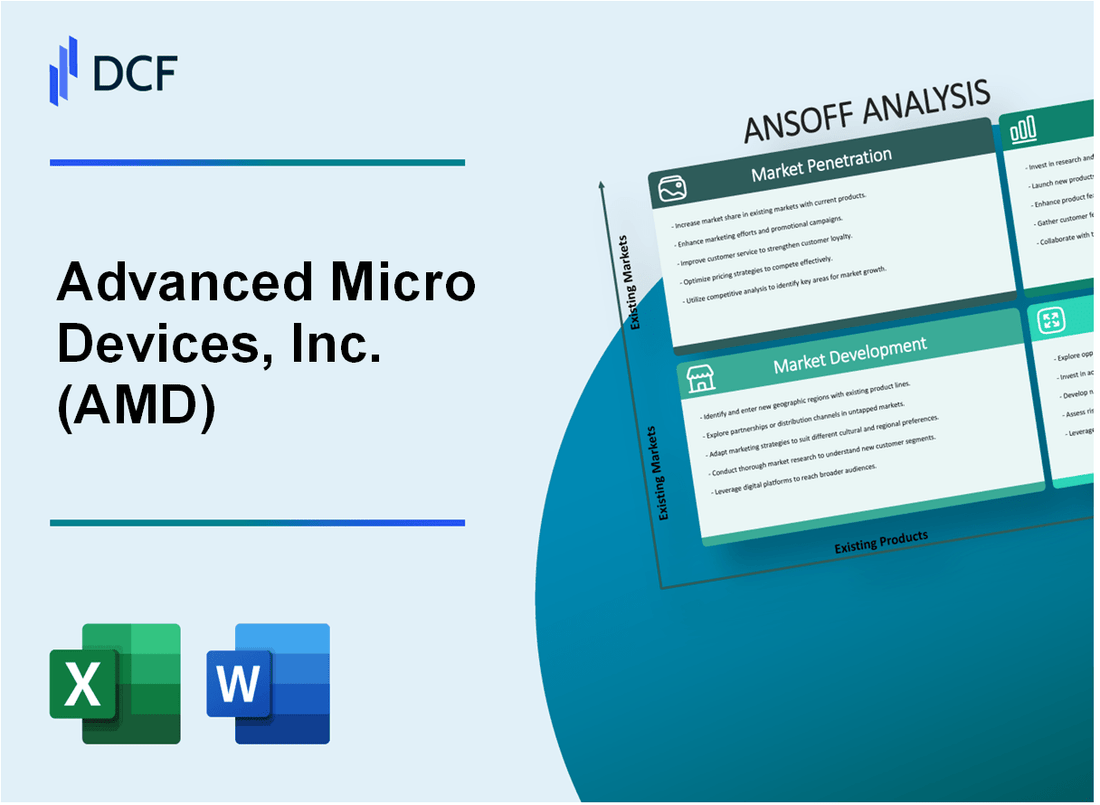
Advanced Micro Devices, Inc. (AMD): ANSOFF MATRIX [Dec-2025 Updated] |
Fully Editable: Tailor To Your Needs In Excel Or Sheets
Professional Design: Trusted, Industry-Standard Templates
Investor-Approved Valuation Models
MAC/PC Compatible, Fully Unlocked
No Expertise Is Needed; Easy To Follow
Advanced Micro Devices, Inc. (AMD) Bundle
You're looking at Advanced Micro Devices, Inc.'s growth playbook right now, and honestly, the AI gold rush makes this a fascinating, high-stakes exercise in speed. As someone who's mapped out tech giants for decades, I see a clear path here: they're using the momentum from a $9.2 billion Q3 2025 revenue base to aggressively defend market share-think pushing for over 50% server CPU share-while simultaneously developing next-gen products like the 'Helios' AI systems for a Q3 2026 launch. It's a tightrope walk between maximizing current client revenue, which hit $2.8 billion that quarter, and making big, necessary bets in new areas like agentic AI systems. Below, I've broken down exactly how Advanced Micro Devices, Inc. plans to execute across all four Ansoff quadrants, giving you the precise actions to watch for over the next 18 months.
Advanced Micro Devices, Inc. (AMD) - Ansoff Matrix: Market Penetration
Market Penetration for Advanced Micro Devices, Inc. (AMD) in the near term is heavily reliant on capitalizing on existing product momentum across its core segments, using recent financial strength to secure deeper customer commitments.
The Data Center segment, which remains the growth core, delivered $4.34 billion in revenue for Q3 2025, representing 47% of the total quarterly revenue. This performance was driven by strong demand for fifth-gen EPYC processors and AMD Instinct MI350 Series GPUs. AMD's x86 server CPU market share reached 36.5% in Q3 2025, with management projecting a clear path toward a market share in excess of 50% in the long run. The company is on track to end 2025 with a 40% revenue share of the server CPU market.
The Client and Gaming divisions showed exceptional year-over-year growth, jointly contributing $4 billion in Q3 2025, a 73% increase over the prior year. This momentum is being used to solidify leadership in the PC space.
You're looking at the immediate impact of recent product launches on the top line; here's the quick math on the Client segment's record performance:
- Client revenue hit a record $2.8 billion in Q3 2025.
- This represented a 46% year-over-year increase, fueled by Ryzen processor sales.
- AMD believes it achieved a record OEM PC sell-through share in the fourth quarter on the Ryzen AI 300 Series ramp.
The Gaming segment's channel marketing efforts are paying off with significant revenue acceleration. Gaming revenue alone reached $1.3 billion in Q3 2025, marking a massive 181% year-over-year jump.
Deepening strategic partnerships in AI is a key penetration tactic, ensuring future volume for the Instinct accelerators. Oracle Cloud Infrastructure (OCI) is set as the first hyperscaler to deploy the new AMD Instinct MI355X GPUs via their OCI Supercluster. Furthermore, OCI will be a launch partner for the first publicly available AI supercluster powered by AMD Instinct MI450 Series GPUs, with an initial deployment of 50,000 GPUs starting in calendar Q3 2026. The strategic partnership with OpenAI involves a 6 gigawatt deployment agreement.
The overall financial results provide the leverage for further market penetration efforts:
| Metric | Q3 2025 Value | Year-over-Year Change |
| Total Revenue | $9.2 billion | Up 36% |
| Data Center Revenue | $4.3 billion | Up 22% |
| Client and Gaming Revenue | $4 billion | Up 73% |
| Gaming Revenue | $1.3 billion | Up 181% |
Leveraging the record $9.2 billion Q3 2025 revenue momentum is about translating financial success into better commercial terms. The Data Center segment saw its EPYC processors adopted by all 10 major hyperscalers. More than 1,350 public EPYC cloud instances are now available globally, up roughly 50% year over year.
Advanced Micro Devices, Inc. (AMD) - Ansoff Matrix: Market Development
You're looking at how Advanced Micro Devices, Inc. (AMD) can take its existing technology portfolio and push it into new customer bases or geographies. This Market Development quadrant is about finding new homes for proven silicon, like taking server-grade tech and adapting it for smaller enterprises.
Targeting Small-to-Medium Businesses (SMBs) with EPYC 4005 Series
Advanced Micro Devices, Inc. (AMD) started pushing the EPYC 4005 Series processors specifically at small and medium-sized businesses and hosted IT service providers. This move targets a market segment that needs enterprise features without the typical enterprise price tag. For example, the 16-core EPYC 4565P is priced at only $589, which is less than the competitor's 8-core Xeon 6300P, listed at $606 as of June 19, 2025. Benchmarks suggest the 16-core EPYC 4565P model outperformed that same Intel 8-core processor by 83% in Phoronix suite tests. This is happening while the global web hosting market revenue itself hit $196.62 billion in 2025, with projections to reach $372 billion by 2030. The EPYC 4005 Series uses the AM5 socket, which helps with easier integration into existing platforms.
The value proposition for this market segment includes:
- Up to 16 "Zen 5" cores for demanding workloads.
- Memory speed at 5600MT/s versus the competition at 4800MT/s.
- Optimized Windows Server Licensing, as the Standard and Datacenter editions include 16-core base licenses, maximizing investment where competitor offerings max out at 8 cores.
Expanding Data Center Sales in Emerging Markets
The push into emerging markets is heavily focused on the AI infrastructure buildout. Advanced Micro Devices, Inc. (AMD) has a landmark agreement with Saudi Arabia's HUMAIN enterprise. This collaboration involves an investment of up to $10B over five years to deploy 500 megawatts of AI compute capacity. Initial deployments are already underway, with multi-exaflop capacity expected to activate by early 2026. This strategy builds on the existing strength of the Data Center segment, which reported revenue of $4.3 billion in Q3 2025, marking a 22% year-over-year increase. The joint venture, which also involves Cisco Systems, plans to build up to one gigawatt of new data centers by 2030.
Here's a look at the recent Data Center performance versus the new market focus:
| Metric | Q3 2025 Actual | HUMAIN Partnership Target |
| Data Center Revenue | $4.3 billion | Part of the $10B investment over five years. |
| Year-over-Year Growth | 22% | Multi-exaflop capacity by early 2026. |
| Compute Capacity | Not specified | 500 megawatts deployment planned. |
Diversifying Semi-Custom Silicon Deals
To counteract the softness in the traditional Embedded segment, which saw revenue decline by 8% year-over-year to $857 million in Q3 2025, Advanced Micro Devices, Inc. (AMD) is focusing on securing semi-custom deals outside of the console cycle. The Gaming revenue, which includes semi-custom chips, did see a significant boost, increasing 181% year-over-year to $1.3 billion in Q3 2025, driven by higher semi-custom revenue. More broadly, the company closed a number of design wins in aerospace & defense, automotive, data center, and communications for its semi-custom chips, all valued at $45b, with revenue from this market expected to start ramping up in 2026.
Pushing Adaptive Compute to New Edge Segments
The adaptive compute portfolio, stemming from the Xilinx acquisition, is being pushed into new industrial and automotive edge AI segments globally. This strategy capitalizes on the need for low-latency, on-site AI inferencing. The overall AI accelerator infrastructure market is projected to reach $500 billion by 2028. Advanced Micro Devices, Inc. (AMD) is executing a growth strategy that includes 'Leading the embedded AI market' and leveraging its flexible architecture combining x86, Arm, GPU, and FPGA for sectors like automotive and robotics. This is a direct play to capture market share in the rapidly expanding edge AI space.
Advanced Micro Devices, Inc. (AMD) - Ansoff Matrix: Product Development
Launch the next-gen 'Helios' rack-scale AI systems with MI450 Series GPUs into the Data Center market by Q3 2026. Each MI450 GPU deployed in the Helios system will have access to up to 432GB of HBM4 memory, providing a total bandwidth of 19.6 TB/s per GPU. This initiative is underpinned by a multi-year agreement with OpenAI to purchase and deploy up to 6 gigawatts of AMD Instinct GPUs, starting with the MI450 series in the second half of 2026, with potential sales well over $100 billion over the multi-generational partnership.
Introduce Ryzen 9000 desktop and mobile CPUs to maintain the Client segment's record Q3 2025 revenue of $2.8 billion. These new desktop chips, based on the Zen 5 architecture, promise an average 16% improvement in instructions per clock (IPC) over Zen 4. The top-of-the-line Ryzen 9 9950X matches the previous generation flagship with a 170-watt (W) thermal design power (TDP).
| Ryzen 9000 SKU | Cores / Threads | Max Boost Clock | Total Cache | TDP |
| Ryzen 9 9950X | 16c / 32t | 5.7 GHz | 80MB | 170W |
| Ryzen 9 9900X | 12c / 24t | 5.6 GHz | 76MB | 120W |
| Ryzen 7 9700X | 8c / 16t | 5.5 GHz | 40MB | 65W |
| Ryzen 5 9600X | 6c / 12t | 5.4 GHz | 38MB | 65W |
Roll out the Radeon RX 9060 XT and Radeon AI PRO R9700 GPUs for mainstream gaming and professional workstations. The Radeon RX 9060 XT GPUs, built on the AMD RDNA 4 architecture, are expected to be available later this year, with the 8GB model having a Suggested Etailer Price (SEP) of $299 USD and the 16GB model at $349 USD. The Radeon AI PRO R9700, also based on RDNA 4, is slated for availability starting in July 2025.
- Radeon RX 9060 XT (8GB/16GB): 32 RDNA 4 Compute Units (CUs).
- Radeon AI PRO R9700: 32GB of graphics memory.
- AI PRO R9700 showed close to a 500% improvement in some AI workloads against the RTX 5080.
Accelerate ROCm 7 software ecosystem development to improve developer experience for Instinct MI350 users. ROCm 7.0, which is available now, delivers significant performance gains, showing up to 4.6x improvement in training and 3x improvement in inference over prior versions. The number of ROCm software downloads has increased 10x year-over-year.
Tape out the next-gen 'Venice' EPYC CPUs on TSMC's 2nm process for future server performance. The successful tape-out of the core complex die (CCD) for 'Venice,' which features a Zen 6-based architecture, marks it as the industry's first HPC product on the TSMC N2 process, with a planned launch in 2026. Demand for general-purpose compute is expected to stay strong into 2026 because of AI workloads.
Advanced Micro Devices, Inc. (AMD) - Ansoff Matrix: Diversification
You're looking at the hard numbers behind Advanced Micro Devices, Inc. (AMD)'s push into new territory, which is all about building out the full AI stack and securing future process technology leadership.
For agentic AI systems and purpose-built rack deployments, the Data Center division brought in $4.3 billion in revenue for Q3 2025, marking a 22% year-over-year increase. Advanced Micro Devices, Inc. (AMD) projects an 80% compound annual growth rate in AI-related revenue over the next five years. The company believes its data center business could generate well over $100 billion in revenue over the next few years. The MI350 Series accelerators are set for broad availability in 2H 2025 in hyperscaler deployments. Looking further out, the Helios rack-scale system, featuring MI400 Series GPUs, is previewed for 2026 deployment. Advanced Micro Devices, Inc. (AMD) has a commitment with OpenAI to deliver up to 6 gigawatts of GPU capacity by 2030.
Targeting specialized markets like drug discovery is tied to this broader AI momentum. The company's long-term plan targets a data center business revenue CAGR of greater than 60%. You should note the collaboration between the AMD CTO and the Absci CEO on generative AI's role in drug discovery.
The introduction of the Pollara 400 programmable AI NIC directly addresses network infrastructure needs. This adapter delivers a maximum bandwidth of 400 Gbps Ethernet. It supports configurations including 1 x 400G, 2 x 200G, or 4 x 100G ports. Benchmarks show it achieves 1.2x the performance of Thor2 on a 128 GPU cluster using standard RoCEv2 workloads. The Pollara 400 is Ultra Ethernet Consortium (UEC) ready.
Heavy investment in process technology underpins future high-performance computing (HPC) contracts. The upcoming EPYC "Venice" CPUs, which power the "Helios" rack, are confirmed as TSMC's first 2nm product. Zen 6 products are confirmed for launch in 2026. The successor, Zen 7, is planned for 2027 and may align with TSMC's planned rollout of its A16 (1.6 nm) process in late 2026. At the corporate level, Advanced Micro Devices, Inc. (AMD) outlined a goal for a greater than 35% revenue CAGR for the next three to five years.
Here's a quick look at the key product specifications and targets supporting this diversification strategy:
| Metric/Product | Specification/Target | Timeline/Context |
| Data Center Revenue (Q3 2025) | $4.3 billion | Year-over-year growth of 22% |
| AI Revenue CAGR Projection | 80% | Over the next five years |
| Pollara 400 Max Bandwidth | 400 Gbps | RDMA Ethernet NIC |
| Zen 6 CPU Process Node | TSMC 2nm | Launch in 2026 |
| Helios Rack Deployment | Previewed for 2026 | Features MI400 GPUs |
The overall corporate revenue CAGR target is greater than 35% through 2030.
The Client segment revenue for Q3 2025 was $2.75 billion, up 46% year-over-year. The Gaming division contributed $1.3 billion in Q3 2025, showing a 181% jump.
The Embedded segment reported $857 million in Q3 2025, an 8% softening.
The company's non-GAAP gross margin for Q3 2025 was 54%.
Finance: draft 2026 capital expenditure forecast based on 2nm commitments by Friday.
Disclaimer
All information, articles, and product details provided on this website are for general informational and educational purposes only. We do not claim any ownership over, nor do we intend to infringe upon, any trademarks, copyrights, logos, brand names, or other intellectual property mentioned or depicted on this site. Such intellectual property remains the property of its respective owners, and any references here are made solely for identification or informational purposes, without implying any affiliation, endorsement, or partnership.
We make no representations or warranties, express or implied, regarding the accuracy, completeness, or suitability of any content or products presented. Nothing on this website should be construed as legal, tax, investment, financial, medical, or other professional advice. In addition, no part of this site—including articles or product references—constitutes a solicitation, recommendation, endorsement, advertisement, or offer to buy or sell any securities, franchises, or other financial instruments, particularly in jurisdictions where such activity would be unlawful.
All content is of a general nature and may not address the specific circumstances of any individual or entity. It is not a substitute for professional advice or services. Any actions you take based on the information provided here are strictly at your own risk. You accept full responsibility for any decisions or outcomes arising from your use of this website and agree to release us from any liability in connection with your use of, or reliance upon, the content or products found herein.