
|
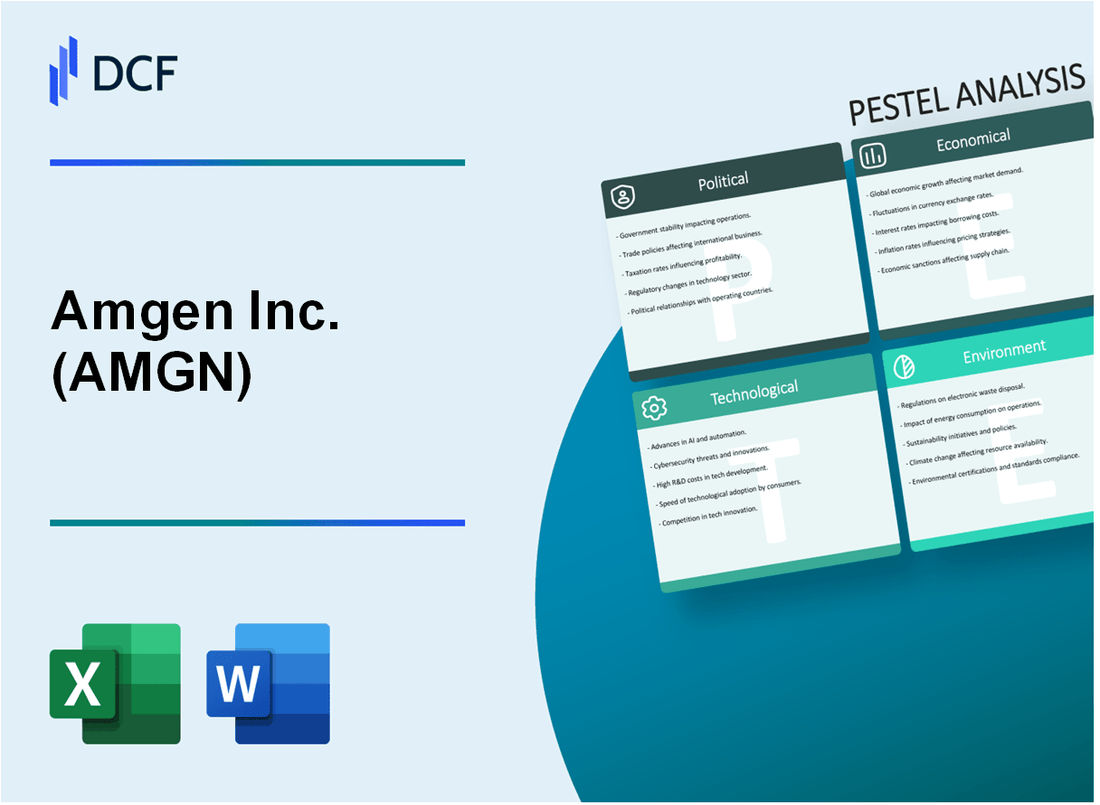
Amgen Inc. (AMGN): PESTLE Analysis [Nov-2025 Updated] |
Fully Editable: Tailor To Your Needs In Excel Or Sheets
Professional Design: Trusted, Industry-Standard Templates
Investor-Approved Valuation Models
MAC/PC Compatible, Fully Unlocked
No Expertise Is Needed; Easy To Follow
Amgen Inc. (AMGN) Bundle
You're looking at Amgen Inc. (AMGN) right now, and the critical tension is clear: Can the growth from the Horizon Therapeutics integration and a massive R&D pipeline outrun the political and legal headwinds? Honestly, the regulatory environment, specifically the Inflation Reduction Act (IRA), is the single biggest wild card for a company projecting 2025 revenue near $32.5 billion. We see Amgen aggressively integrating to realize approximately $400 million in synergy savings, but you need to know exactly how the legal challenges and technological shifts-like the $5.5 billion R&D focus-map to near-term risk. Let's break down the macro forces that will defintely shape your investment decision.
Amgen Inc. (AMGN) - PESTLE Analysis: Political factors
Inflation Reduction Act (IRA) price negotiation creates revenue uncertainty.
The Inflation Reduction Act (IRA) of 2022 is the single largest political risk factor for Amgen Inc. right now. The law's Medicare Drug Price Negotiation Program shortens the effective commercial life of key products, which directly compresses their lifetime value. The Centers for Medicare & Medicaid Services (CMS) has already selected two of Amgen's major products for negotiation.
The first drug, Enbrel, was selected in the initial round for price cuts that will take effect on January 1, 2026. This is a big deal because a 2023 Moody's report indicated that Amgen had the largest revenue exposure among the first group of companies, with U.S. sales of Enbrel accounting for an estimated 15% of the company's total revenue exposed to the 2026 price negotiations. The company's U.S. sales from Enbrel were approximately $4 billion in 2022.
Plus, the second round of selections announced on January 17, 2025, included Amgen's psoriasis and psoriatic arthritis treatment, Otezla. The negotiation for Otezla is happening throughout 2025, with the new Maximum Fair Price (MFP) taking effect in 2027. Beyond the negotiation, the IRA's Part D redesign is already creating a financial headwind in 2025 by increasing the manufacturer's share of costs in the catastrophic phase, with some companies estimating net impacts up to $2 billion this year. That's a massive, immediate cash flow pressure.
Increased political scrutiny on US drug pricing and PBM practices.
You're seeing intense, bipartisan political focus on the entire drug pricing ecosystem, not just manufacturers. The scrutiny is laser-focused on Pharmacy Benefit Managers (PBMs) like CVS Caremark, OptumRx, and Express Scripts, which collectively control nearly 80% of all US prescription claims.
The core issue is the opaque rebate system, where manufacturers like Amgen must offer substantial rebates to PBMs to ensure their drugs are covered on the formulary (the list of covered drugs). This dynamic incentivizes higher list prices, which is what lawmakers are trying to fix. In a significant move, an Executive Order was signed on April 15, 2025, directing the Department of Labor (DOL) to propose regulations by mid-October 2025 to improve fiduciary transparency into PBM compensation. Any legislation that successfully delinks PBM revenue from a drug's list price will defintely alter Amgen's commercial strategy overnight.
Global trade tensions affecting supply chain stability and costs.
Global trade volatility, driven by escalating US-China trade tensions, is a near-term cost risk for Amgen's global supply chain. The pharmaceutical industry relies heavily on overseas sourcing, with up to 82% of the active pharmaceutical ingredient (API) building blocks for vital drugs coming from China and India.
In April 2025, the U.S. imposed a 10% global tariff on nearly all imports, including APIs. Furthermore, in July 2025, the administration announced plans for new tariffs, effective August 1, 2025, which could see pharmaceutical import tariffs rise as high as 200% over time, though a one-year grace period was offered for companies to relocate production to the U.S. This trade uncertainty is a material risk given Amgen's significant foreign exposure; the company generated $8.79 billion in sales from the Rest of the World in Q1 2025 alone.
Here's the quick math on the tariff risk:
| Trade Tension Factor | 2025 Impact/Proposed Rate | Amgen's Exposure |
|---|---|---|
| Global Tariff on Imports (April 2025) | 10% on nearly all goods, including APIs | Increased input costs for U.S. manufacturing. |
| Proposed High Tariffs on Pharma Imports (July 2025) | Potential to rise up to 200% (with 1-year grace period) | Risk to $8.79 billion in Q1 2025 Rest of the World sales, plus increased cost for US-bound foreign-sourced components. |
| API Sourcing Reliance | Up to 82% of API building blocks from China/India | Supply chain disruption and cost inflation. |
Government funding for NIH and FDA impacting drug development speed.
A less visible but long-term political factor is the funding for the National Institutes of Health (NIH) and the Food and Drug Administration (FDA). These agencies are the engine and gatekeeper of the U.S. drug pipeline, and their funding directly affects Amgen's future product flow.
The NIH has already rescinded over $3.2 billion in research funding in 2025, terminating 2,548 grants. Furthermore, the proposed Fiscal Year 2026 budget would slash NIH funding by $18 billion, from $46.4 billion to $27.5 billion. Reduced public funding for basic research slows the early-stage discovery that feeds the entire biopharma pipeline.
On the regulatory side, a July 2025 Congressional Budget Office (CBO) analysis warned that a nine-month increase in FDA New Drug Application (NDA) review times would not only delay market entry but also increase development costs, ultimately reducing drug approvals by 2% annually. Slower reviews mean delayed revenue for Amgen's pipeline assets.
The long-term effects are stark:
- A permanent 10% cut to NIH funding is estimated to result in 20 fewer new drug approvals per year by the third decade.
- A nine-month FDA review delay would increase development costs, resulting in 10 fewer drugs entering the market in both the second and third decades.
Finance: Model the impact of a 15% reduction in Enbrel's U.S. net price on your 2026 revenue projections by the end of this quarter.
Amgen Inc. (AMGN) - PESTLE Analysis: Economic factors
You're looking at Amgen Inc.'s economic landscape for 2025, and the core takeaway is a story of strong internal growth and synergy realization running head-on into a persistent high-rate environment and intense payer scrutiny. The company's latest guidance shows significant momentum, but the cost of capital and global economic stability are real headwinds that demand a sharp focus on capital allocation.
Projected 2025 revenue consensus is approximately $32.5 billion.
Forget the old consensus: Amgen has raised its full-year 2025 total revenue guidance to a range of $35.8 billion to $36.6 billion, reflecting strong volume growth, particularly from key products like Repatha and EVENITY. This projected growth, driven by a 14% volume increase across its portfolio, signals that demand for their innovative medicines is holding up well against biosimilar competition and pricing pressure.
This revenue is not just volume-driven; it includes the first full year of contribution from the Horizon Therapeutics acquisition, which is a major accelerator. For context, the consensus revenue estimate before the raised guidance was already at $35.7 billion.
High interest rates increase the cost of capital for future R&D and M&A.
The current interest rate environment, even with recent cuts, is still a significant factor in Amgen's capital structure. The Federal Reserve's target range for the federal funds rate was at 3.75%-4.00% as of October 2025, which translates directly to a higher cost of debt.
Amgen entered 2025 with a substantial debt load-net debt was approximately $48.6 billion at the end of March 2025-largely due to the Horizon acquisition. While the company has been focused on deleveraging, retiring $4.3 billion of debt year-to-date by the second quarter of 2025, the higher rate makes future financing for large-scale R&D programs or further M&A defintely more expensive. This isn't a crisis, but it means the hurdle rate for new projects is higher, forcing more discipline.
Global economic slowdown pressures payer ability to fund specialty drugs.
The pharmaceutical sector is generally recession-resistant, but a global economic slowdown, coupled with political pressure on drug pricing, creates friction for high-cost specialty drugs. US specialty drug spending is projected to see a dramatic 13.3% increase in trend for 2025, a figure that puts immense strain on payers (insurance companies, government programs).
This pressure means payers will double down on utilization management, like prior authorizations and step therapy, for Amgen's rare disease and oncology portfolio. Lower economic growth in key markets like the US and Europe also intensifies price sensitivity and could lead to slower adoption of new, expensive therapies.
Integration of Horizon Therapeutics acquisition drives synergy savings of $400 million.
The integration of Horizon Therapeutics is delivering financial benefits ahead of schedule. Amgen is on track to achieve greater than $500 million in pre-tax cost synergies in 2025 from the acquisition, exceeding initial projections. This is a crucial financial lever, as these savings boost the non-GAAP operating margin, which was reported at 48.9% in the second quarter of 2025.
These synergies come from streamlining operations, reducing redundant costs in areas like selling, general, and administrative (SG&A) expenses, and optimizing manufacturing. This table shows the financial impact of the acquisition and the synergy target for 2025:
| Metric | Value (FY 2025) | Source/Context |
| Total Revenue Guidance | $35.8B - $36.6B | Company Guidance (Nov 2025) |
| Pre-Tax Cost Synergies | > $500 Million | Horizon Acquisition Target Achievement |
| Q2 2025 Non-GAAP Operating Margin | 48.9% | Reflecting synergy benefits |
| Year-to-Date Debt Retired (Q2 2025) | $4.3 Billion | Deleveraging post-acquisition |
Amgen Inc. (AMGN) - PESTLE Analysis: Social factors
Aging US population increases demand for Amgen's core therapeutic areas.
The demographic shift in the United States is a powerful, non-cyclical tailwind for Amgen. The number of Americans aged 65 and older is set to nearly double by 2060, a huge jump from the 56 million recorded in 2020. This trend directly fuels demand for treatments in Amgen's key therapeutic areas, like oncology, cardiovascular disease, and bone health, which are all age-related chronic conditions.
Look at the Q1 2025 sales data: Amgen's General Medicine portfolio, which includes bone and cardiovascular drugs, generated over $2 billion in sales. Specifically, the bone franchise products, Prolia and EVENITY, are seeing major demand. Prolia sales were $1.1 billion in Q1 2025, and EVENITY sales grew 29% year-over-year to $442 million in the same quarter. Repatha, a cardiovascular drug, saw sales increase 27% year-over-year to $656 million. That's a clear map of where the demographic demand is landing.
This aging population is a stable foundation for revenue growth. It's a simple equation: more older people mean more patients needing chronic disease management.
Growing public demand for drug price transparency and affordability.
The social contract between pharmaceutical companies and the public is under severe strain, and the core issue is cost. A broad majority of Americans view prescription drug costs as unreasonably high, pushing for government intervention. This public pressure has translated into rapid political action in 2025.
This year, the US government has actively pursued 'radical transparency and competition' in drug markets through executive orders, including one in May 2025 seeking to align branded drug prices with Most-Favored-Nation (MFN) prices-the lowest prices paid by peer countries. The reality is that patients abandon prescribed medications a staggering 70% of the time due to cost concerns, according to recent studies. This is a critical headwind.
For Amgen, this means navigating a complex political and social environment where high-volume, high-price products are a constant target. The company's projected full-year 2025 revenue range of $35.80 billion to $36.60 billion is impressive, but sustaining that growth requires demonstrating value and affordability to a skeptical public, not just to payers.
Increased focus on health equity and diverse clinical trial representation.
The push for health equity-ensuring everyone has a fair chance at health-is now a core social and regulatory expectation for biopharma. The FDA is driving this, and Amgen is responding with concrete programs.
Amgen's dedicated Representation in Clinical Research (RISE) team is focused on improving diversity in trials, which is a scientific imperative to ensure drug safety and efficacy across all patient populations. The company has specific, measurable ambitions, such as working to reduce disparities in early access to biomarker and diagnostic test utilization for lung cancer in Black Americans in Georgia over the next 3-5 years.
The financial commitment is also tangible:
- Amgen pledged a total of $8 million over four years to the Robert A. Winn Diversity in Clinical Trials Award Program.
- The goal is to move trials closer to underserved communities and use remote visits to ease the burden on participants.
Ignoring this trend is not just bad public relations; it's a scientific and regulatory risk that could slow down product development.
Public perception of biotechnology is crucial for gene therapy adoption.
Amgen is a biotechnology leader, but public acceptance of the next generation of therapies, like cell and gene therapies (CGTs), is still tenuous. While the science is undeniable-the CGT pipeline has over 4,000 candidates-the social hurdles remain high.
A key finding from a 2025 report shows that 66% of oncologists report their patients view CGTs as too experimental or risky. This skepticism, combined with systemic access issues, creates a real headwind for commercialization.
Here's the quick map of the perception gap:
| Stakeholder Group | Perception of CGTs (2025 Data) | Primary Barrier to Adoption |
|---|---|---|
| Payers (e.g., Insurers) | 80% believe they are safe and effective. | High upfront costs; limited long-term data. |
| Patients (via Oncologists) | 66% view them as 'too experimental or risky.' | Perceived risk; lack of infrastructure for delivery. |
| Providers (e.g., Physicians) | Over 80% report persistent payer-related coverage issues. | Restrictive payer policies; insufficient care infrastructure. |
The science is ready, but the public and the healthcare system are not fully there yet. Amgen must invest in public education and work with payers to create innovative reimbursement models to truly scale its advanced pipeline.
Amgen Inc. (AMGN) - PESTLE Analysis: Technological factors
Significant R&D Investment Focused on Oncology and Inflammation
You can see Amgen's commitment to innovation directly in their R&D spending, which is the engine for future growth. For the twelve months ending September 30, 2025, Amgen's research and development expenses hit approximately $6.854 billion. [cite: 1, 4 in first search] This is a substantial increase, reflecting a strategic pivot toward complex, high-value areas like oncology and inflammation, which are two of their core therapeutic categories.
This investment is crucial because it funds late-stage clinical programs, such as the advancement of the bispecific T-cell engager IMDELLTRA (tarlatamab) in oncology, which generated $81 million in sales in Q1 2025 and is showing strong volume growth. [cite: 2, 4 in second search, 8 in second search] They are also pouring money into inflammation, where their key product Otezla saw sales of $437 million in Q1 2025. [cite: 15 in first search] You need to invest big to stay ahead in biologics, and Amgen is defintely doing that.
Advancements in AI and Machine Learning Accelerate Drug Discovery and Trial Design
Amgen is moving past traditional trial-and-error R&D by embedding Artificial Intelligence (AI) and machine learning (ML) across the entire value chain. This isn't just a buzzword; it's a structural change to how they find and test new medicines. They are leveraging AI to quickly analyze vast omics data (genomics, proteomics, etc.) to identify novel drug targets with higher confidence. [cite: 3 in first search, 10 in second search]
Here's the quick math: AI-driven protein language models allow their scientists to simulate and refine billions of potential candidates on a computer, dramatically reducing the need for costly, time-consuming lab experiments. [cite: 1 in first search, 5 in first search] They've even built a massive NVIDIA DGX SuperPOD system, named Freyja, to train generative AI models on one of the world's largest human datasets, aiming to create a human diversity atlas for biomarker discovery. [cite: 7 in first search] This technology is also used to select clinical trial sites and participants more efficiently, speeding up the path to regulatory review. [cite: 2 in first search]
Biosimilar Competition for Key Products Intensifies
The technological maturity of the biosimilar market presents a clear, near-term financial risk, but also an opportunity. Amgen is facing significant sales erosion for their legacy brands, while simultaneously launching their own biosimilars to capture market share from competitors.
The biggest near-term threat is the launch of biosimilars for Prolia (denosumab) and XGEVA (denosumab) in the U.S. market in the second half of 2025. [cite: 1, 3 in second search] This competition is already impacting sales, with Prolia sales decreasing 4% year-over-year to $1.1 billion in Q2 2025, driven by lower net selling prices. [cite: 1 in second search]
Conversely, Amgen is a major player in the biosimilar space, which is a structural hedge against their own patent cliffs. Their biosimilar product AMJEVITA (adalimumab-atto) is a prime example of the competitive pressure, with Q1 2025 sales of $136 million decreasing 19% year-over-year, primarily due to a 33% lower net selling price, even as volume grew. [cite: 4, 6 in second search] They are also successfully launching new biosimilars, such as WEZLANA (ustekinumab-auub), which generated $150 million in sales in Q1 2025 alone. [cite: 4, 6 in second search]
| Product Category | 2025 Financial Impact (Q1/Q2) | Technological Trend |
|---|---|---|
| Legacy Biologic (Risk) | Prolia sales down 4% YOY in Q2 2025 to $1.1 billion, due to biosimilar launch. [cite: 1 in second search] | Patent expiration and manufacturing maturity enable low-cost rivals. |
| Amgen Biosimilar (Opportunity/Risk) | AMJEVITA sales decreased 19% YOY in Q1 2025 to $136 million, due to 33% lower net selling price. [cite: 4, 6 in second search] | Volume growth is offset by extreme price competition in the adalimumab market. |
| New Biosimilar Launch (Opportunity) | WEZLANA generated $150 million in Q1 2025, launching in the U.S. [cite: 4, 6 in second search] | Leveraging advanced manufacturing and regulatory expertise to enter new markets. |
Gene Editing and Cell Therapy Platforms Offer High-Risk, High-Reward Growth Avenues
Amgen is making calculated bets on the next generation of therapeutics: gene editing and cell therapy. These modalities are high-risk because they are complex and expensive to develop, but they offer the potential for one-time, curative treatments, translating to massive reward and long patent protection. This is where the long-term value is being built.
The company is strategically pivoting its R&D budget, with roughly 60% now targeting rare diseases, [cite: 7 in second search] a therapeutic area that heavily utilizes these advanced technologies. A concrete example of this high-reward pipeline is their gene therapy candidate, AMG 901, for sickle cell disease, which has shown early-stage data demonstrating 100% reduction in hemoglobin S. [cite: 7 in second search] Plus, they are utilizing the T-cell engager platform acquired through Teneobio to develop bispecific and multispecific antibodies, which are foundational to next-gen cell therapies. [cite: 11 in first search]
This is a long game, but the potential for a cure in a rare disease space means high margins and market exclusivity for decades.
Amgen Inc. (AMGN) - PESTLE Analysis: Legal factors
Ongoing litigation challenging the constitutionality of the IRA drug negotiation provisions.
You need to understand that the legal battle against the Inflation Reduction Act (IRA) is a systemic risk for all of Big Pharma, including Amgen. While Amgen was not part of the initial group of manufacturers whose drugs were selected for the first negotiation round, the outcome of the ongoing constitutional challenges will defintely shape the company's entire pricing model for its future blockbusters.
As of late 2025, the industry's legal campaign has hit some roadblocks. The U.S. Court of Appeals for the Third Circuit, for instance, upheld the Medicare Drug Price Negotiation Program in September 2025, dismissing claims from other manufacturers that the program amounted to an uncompensated taking or compelled speech. This affirms the government's stance that the program is voluntary because manufacturers can technically choose not to participate in Medicare and Medicaid.
Still, Amgen is actively fighting similar state-level measures, which are often a bellwether for federal policy. For example, Amgen is a plaintiff in a lawsuit challenging the Colorado Prescription Drug Affordability Board, arguing that state-level price-setting violates the U.S. Constitution's Due Process and Dormant Commerce Clauses and is preempted by federal patent law. This is a high-stakes fight because a loss at the state level legitimizes a patchwork of price controls that complicate national sales strategies.
Patent cliff risks on blockbuster drugs necessitate aggressive IP defense strategies.
The core legal challenge for Amgen in the near term is the patent cliff, which is a massive revenue threat. Your IP defense strategy here is a race against time, using every legal tool-secondary patents, exclusivity extensions, and litigation settlements-to delay biosimilar entry.
Amgen faces one of the highest revenue exposures in the industry, with an estimated 42% of its 2025 revenue at risk from Loss of Exclusivity (LOE) on key products by the end of the decade. The patent settlements are buying time, but the erosion is starting now.
Here is the quick math on the near-term patent cliff exposure:
| Blockbuster Drug | Indication | LOE/Biosimilar Launch Timing (Post-Settlement) | Legal Strategy |
|---|---|---|---|
| Prolia / Xgeva (denosumab) | Osteoporosis / Oncology | Mid-2025 to 2026 | Settlements with multiple biosimilar makers (e.g., Sandoz) to delay launch. |
| Enbrel (etanercept) | Autoimmune Diseases | Highly protected until ~2029 (via secondary patents) | Aggressive litigation to enforce secondary patents, delaying biosimilar entry for years. |
| Otezla (apremilast) | Psoriasis / Psoriatic Arthritis | LOE on composition of matter patent passed | Faces generic pressure; intangible asset impairment charges of $800 million in Q1 2025 and $400 million in Q3 2025 reflect competitive impact. |
The company's goal is to mitigate the revenue drop, not avoid it entirely. The settlements on Prolia and Xgeva, for example, allow Amgen to manage the decline and retain a larger market share through 2027 than would be possible with an immediate, uncontrolled launch.
Increased FDA scrutiny on accelerated approval pathways and post-marketing data.
The Food and Drug Administration (FDA) is absolutely tightening its oversight of the Accelerated Approval (AA) pathway, especially for oncology drugs, following the 2022 Food and Drug Omnibus Reform Act (FDORA). This means the legal and regulatory bar for post-marketing commitments is higher, so you must commit sufficient resources upfront to confirmatory trials.
New FDA draft guidance released in early 2025 clarifies that confirmatory trials must be 'underway,' with active patient enrollment, before AA is granted. This is a crucial legal change that impacts R&D timelines and risk assessment for pipeline assets.
Amgen recently navigated this scrutiny successfully. In November 2025, the FDA granted full approval to IMDELLTRA® (tarlatamab-dlle) for extensive stage small cell lung cancer, converting its prior accelerated approval. This full approval was based on the successful Phase 3 DeLLphi-304 study, which showed IMDELLTRA reduced the risk of death by 40% compared to chemotherapy. This outcome validates Amgen's ability to execute on its post-marketing commitments under the new, stricter regulatory environment.
Global anti-trust review of large M&A deals like Horizon sets future precedent.
The $27.8 billion acquisition of Horizon Therapeutics, which closed in late 2023, set a significant legal precedent for future non-horizontal mergers (deals between companies that are not direct competitors). The Federal Trade Commission (FTC) sued to block the deal, alleging Amgen could use its portfolio of blockbuster drugs to bundle or foreclose rivals to Horizon's monopoly drugs, Tepezza and Krystexxa, from favorable formulary placement.
The settlement, a Consent Order agreed to in September 2023, was behavioral, not structural. This means Amgen did not have to divest any assets, but it is legally prohibited from engaging in the alleged anticompetitive behavior. Specifically, the order states Amgen cannot:
- Condition price concessions on any of its non-Horizon products in exchange for favorable formulary placement of Tepezza or Krystexxa.
- Exclude or disadvantage rival products to Tepezza or Krystexxa on formularies in exchange for discounts on other Amgen drugs.
This consent order establishes a clear, high-profile legal boundary for all major biopharma M&A activity in 2025 and beyond. It signals that the FTC is willing to challenge mergers based on the potential for future anticompetitive behavior, even without direct product overlap. It means your deal due diligence must now include a much deeper analysis of formulary leverage risk.
Amgen Inc. (AMGN) - PESTLE Analysis: Environmental factors
Pressure from investors and regulators to meet aggressive carbon neutrality goals.
You are seeing a massive shift where environmental performance is now a core financial metric, not just a corporate social responsibility (CSR) footnote. Amgen is responding with a clear, aggressive target: achieving carbon neutrality for its Scope 1 (direct) and Scope 2 (indirect from power) emissions by 2027.
This isn't cheap talk; it's backed by a planned investment of over $200 million to drive efficiency and source renewable energy. In fact, the company is already well ahead of schedule on its 2027 plan. As of the end of the 2024 fiscal year, Amgen had achieved 69% of its targeted carbon reduction, measured from a 2019 baseline. That's a strong indicator of execution, which investors defintely notice.
To keep the pressure on internal teams, Amgen uses a smart, internal carbon fee: any capital project that increases carbon dioxide emissions by more than 500 metric tons is charged $1,000 per metric ton.
Strict regulations on pharmaceutical manufacturing waste and water usage.
Biologics manufacturing is notoriously resource-intensive, especially concerning water and waste. Regulators, particularly in the EU with rules like the REACH regulation (Registration, Evaluation and Authorisation of Chemicals), are tightening their grip, forcing companies to innovate.
Amgen's 2027 plan addresses this with two major targets, and their 2024 progress shows they are over halfway there:
- Reduce water consumption by 40% from a 2019 baseline. (Achieved 57% of this target by 2024).
- Reduce waste disposed by 75% from a 2019 baseline. (Achieved 66% of this target by 2024).
This efficiency is a competitive advantage. For example, Amgen's next-generation biomanufacturing plants, like the one in Rhode Island, are designed to generate 70% less carbon and use 54% less water compared to traditional facilities, cutting both environmental risk and operating costs.
Assessing climate change impact on clinical trial logistics and supply chain.
Climate change is not just a long-term risk; it's a near-term operational threat to the cold chain. Extreme weather events-unexpected heat spikes, severe storms-can lead to temperature excursions, which spoil temperature-sensitive biologics and disrupt clinical trial supply.
Amgen recognizes this explicitly, classifying climate-related risks, including disruptions to clinical trials and market interruptions, with a potential 'Severe' financial impact defined as revenue loss or additional expenses exceeding $20 million in a 12-month period. This is a critical risk for a company with a deep pipeline of temperature-sensitive therapies.
Here is the quick math on climate risk severity:
| Financial Impact Level | Potential Revenue Loss/Additional Expenses (12 Months) | Relevance to Supply Chain |
|---|---|---|
| Insignificant | < $500K | Minor local transport delays. |
| Moderate | $1M - $10M | Regional supply chain interruption; minor clinical trial delay. |
| Severe | > $20M | Major clinical trial disruption; product spoilage of large biologics batch. |
Focus on sustainable packaging and reducing the environmental footprint of biologics.
The rise of biologics and specialty medicines means more complex, temperature-controlled packaging, which often translates to more waste. The industry is moving toward smart, sustainable packaging in 2025, and Amgen is aligning with this trend.
Their strategy focuses on materials and logistics:
- Use a Green Packaging Assessment Tool to develop secondary packaging that is 100% recyclable.
- Source nearly 100% of paper used in secondary packaging from certified-sustainable forests.
- Reduce waste and carbon emissions by shipping medicines in reusable thermal shippers whenever possible.
- Offer an environmentally responsible mail-back program for the safe disposal of medical waste from certain home-administered combination products.
What this estimate hides is the potential for a major legal win or loss against the IRA, which could swing the 2026 outlook by billions. To be fair, Amgen is defintely positioned to navigate this, but it requires a sharp focus on execution.
Next Step: Finance: Model a scenario analysis for 2026 revenue with a 10% and 20% IRA price cut impact on the selected drugs by end of next week.
Disclaimer
All information, articles, and product details provided on this website are for general informational and educational purposes only. We do not claim any ownership over, nor do we intend to infringe upon, any trademarks, copyrights, logos, brand names, or other intellectual property mentioned or depicted on this site. Such intellectual property remains the property of its respective owners, and any references here are made solely for identification or informational purposes, without implying any affiliation, endorsement, or partnership.
We make no representations or warranties, express or implied, regarding the accuracy, completeness, or suitability of any content or products presented. Nothing on this website should be construed as legal, tax, investment, financial, medical, or other professional advice. In addition, no part of this site—including articles or product references—constitutes a solicitation, recommendation, endorsement, advertisement, or offer to buy or sell any securities, franchises, or other financial instruments, particularly in jurisdictions where such activity would be unlawful.
All content is of a general nature and may not address the specific circumstances of any individual or entity. It is not a substitute for professional advice or services. Any actions you take based on the information provided here are strictly at your own risk. You accept full responsibility for any decisions or outcomes arising from your use of this website and agree to release us from any liability in connection with your use of, or reliance upon, the content or products found herein.