

|
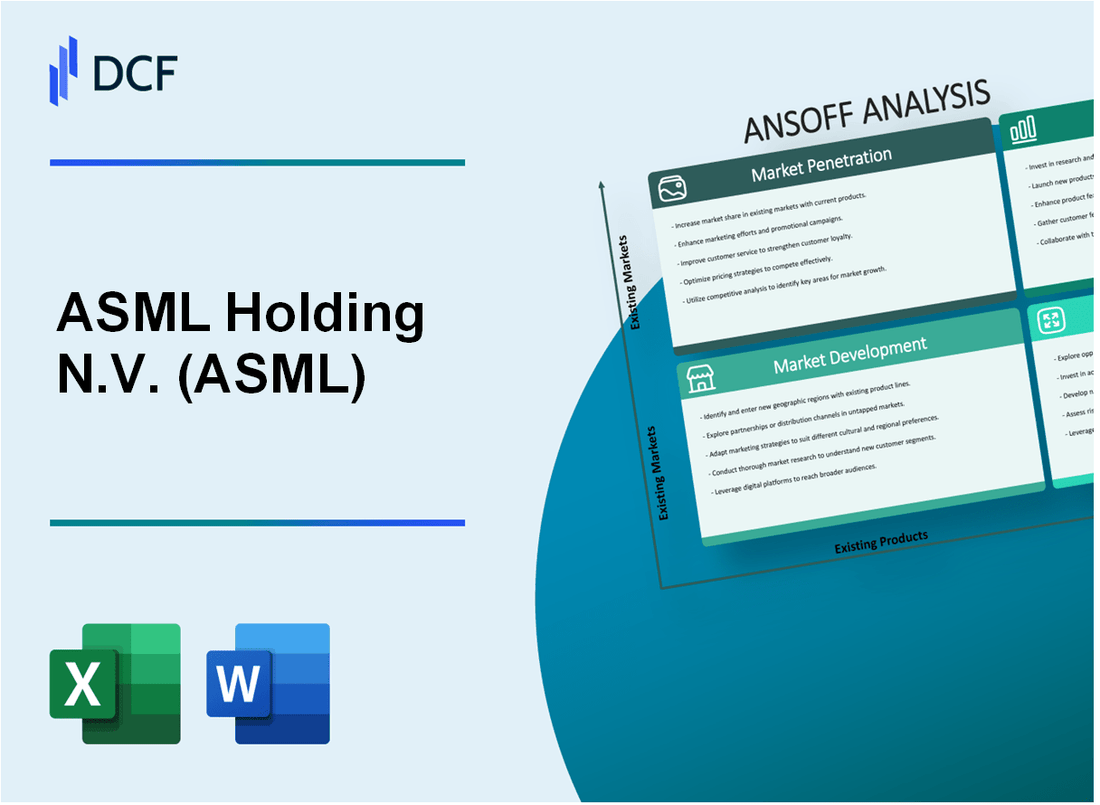
ASML Holding N.V. (ASML): ANSOFF MATRIX [Dec-2025 Updated] |
Fully Editable: Tailor To Your Needs In Excel Or Sheets
Professional Design: Trusted, Industry-Standard Templates
Investor-Approved Valuation Models
MAC/PC Compatible, Fully Unlocked
No Expertise Is Needed; Easy To Follow
ASML Holding N.V. (ASML) Bundle
You're looking for the playbook behind ASML Holding N.V.'s (ASML) projected €30 billion to €35 billion revenue for 2025, and honestly, it's more nuanced than just selling more Extreme Ultraviolet (EUV) machines. As someone who's spent two decades mapping tech giants, I see four distinct, actionable growth vectors laid out in the Ansoff Matrix below-from maximizing current system utilization, which already brought in €2 billion in Installed Base Management sales last quarter, to aggressively developing the next Hyper-NA EUV roadmap. This isn't just about market share; it's about cementing their indispensable role in the entire semiconductor supply chain, and you need to see exactly where they are placing their bets now.
ASML Holding N.V. (ASML) - Ansoff Matrix: Market Penetration
You're looking at how ASML Holding N.V. (ASML) maximizes sales from its current product portfolio within its established customer base, which is the core of market penetration. This strategy leans heavily on the installed base and the relentless demand for leading-edge technology, especially Extreme Ultraviolet (EUV) systems.
The focus on the Installed Base Management (IBM) segment shows strong traction. For the third quarter of 2025, IBM sales, which covers service and field options, contributed exactly €2 billion. This recurring revenue stream is a bedrock for stability. Looking ahead, the expectation for the fourth quarter of 2025 IBM sales is around €2.1 billion. This steady service revenue helps offset any near-term volatility in system shipments.
System sales in Q3 2025 totaled €5.6 billion, with EUV systems bringing in €2.1 billion of that, corresponding to the shipment of nine EUV units in the quarter. The overall momentum is clearly with EUV, as EUV net bookings reached €3.6 billion out of total net bookings of €5.4 billion for the quarter. That means EUV represented about 66.7% of all new orders taken in Q3 2025.
Here's a quick look at the Q3 2025 financial breakdown supporting this penetration:
| Metric | Q3 2025 Value | Context/Split |
| Total Net Sales | €7.5 billion | Full Year 2025 expected growth: around 15% vs 2024 |
| Installed Base Management Sales | €2 billion | Q4 2025 expected: around €2.1 billion |
| Net System Sales | €5.6 billion | Logic systems accounted for 65% of net system sales |
| EUV System Sales (Revenue) | €2.1 billion | Nine EUV units shipped in Q3 2025 |
| Total Net Bookings | €5.4 billion | |
| EUV Net Bookings | €3.6 billion | |
| Cash & Investments (End Q3 2025) | €5.1 billion | Indicates financial flexibility for customer support |
Driving adoption of holistic lithography software is a key lever to boost current system yield and throughput. ASML Holding N.V. is actively embedding AI across its entire holistic portfolio through partnerships, for example, with Mistral AI, specifically to increase system performance and customer yield. This software layer is crucial for extracting maximum value from the installed base of DUV and EUV systems.
For accelerating system deployment, the financial capacity is certainly there. ASML Holding N.V. ended the third quarter with cash, cash equivalents, and short-term investments totaling €5.1 billion. This strong balance sheet helps support strategic financing options for key customers needing to deploy current-generation EUV systems for 3nm and 5nm nodes. Furthermore, the company shipped its first product for Advanced Packaging, the TWINSCAN XT:260, an i-line scanner offering up to 4x productivity compared to existing solutions, showing new avenues for current-gen system extension.
The market penetration efforts are clearly focused on maximizing the installed base while securing high-value EUV orders. The expected total net sales for the full year 2025 are set for an increase of around 15% over 2024, with a gross margin around 52%. The near-term outlook for Q4 2025 total net sales is projected to be between €9.2 billion and €9.8 billion, which would be a very strong quarter.
The success in this quadrant relies on several operational metrics:
- Maximize utilization of existing DUV and EUV systems at major fabs.
- Installed Base Management sales reached €2 billion in Q3 2025.
- EUV systems accounted for 65% of net system sales revenue in Q3 2025.
- Nine EUV units were sold in Q3 2025.
- Holistic lithography software integration to boost yield.
ASML Holding N.V. (ASML) - Ansoff Matrix: Market Development
You're looking at how ASML Holding N.V. expands its existing product lines-DUV and Metrology systems-into new geographic territories. This is about taking what you know works and selling it in new places or increasing sales where you already have a foothold, like the US and Japan.
The overall expectation for ASML Holding N.V. total net sales in 2025 is between €30 billion and €35 billion. This growth relies on capturing new market segments and deepening penetration in established, growing regions.
Expand DUV and Metrology system sales into emerging markets like India and Southeast Asia.
ASML Holding N.V. signaled its commitment to the Indian semiconductor industry by attending SEMICON India 2025 for the first time. This focus aligns with the projected growth of the Indian semiconductor market, which is expected to exceed USD 55 billion by 2026 and reach USD 100 billion by 2030. The demand for cost-optimized DUV clusters is noted as an opportunity in emerging semiconductor hubs like India.
Increase presence and service hubs in the US and Japan to capitalize on new fab openings.
The need for increased local support is clear given the expansion of advanced manufacturing in these regions. ASML Holding N.V. currently employs around 400 people across its eight sites in Japan and plans to grow that headcount by around 40%. This expansion supports new EUV deployments, such as the one at Rapidus, which welcomed its first ASML NXE:3800E EUV lithography machine in December. In 2024, the United States accounted for $4.52B in ASML Holding N.V. revenue, representing 16.8% of the total. Japan contributed $1.16B, or 4.3% of the total revenue in 2024.
The service and installed base management revenue for ASML Holding N.V. was €6.494 billion in 2024. Growing the service footprint directly supports this recurring revenue stream.
Target new, non-leading-edge foundry customers with mature DUV technology.
Geopolitical restrictions are shifting demand dynamics, making the market for mature technology more critical for certain regions. Chinese chipmakers, facing export controls on advanced systems, are reportedly 'snapping up ASML Holding N.V.'s older DUV machines'. This supports the continued relevance of mature technology sales outside the leading-edge race.
Here's a quick look at the revenue contribution split in 2024, showing the relative scale of the advanced versus mature segments:
| Product/Technology Category (2024 Revenue Basis) | Amount (Approximate) | Notes |
| Total Net Sales (2024) | €28.3 billion | Full Year 2024 Result |
| Argon Fluoride Immersion (DUV) | €9.67 billion | Highest performing source in 2024 |
| Installed Base Management (Service) | €6.494 billion | Net service and field option sales for FY 2024 |
| China System Sales Share (2024) | 36% | Of total revenue |
The global DUV Lithography Systems market itself is projected to reach USD 2.63 Billion by 2025.
Leverage government subsidies in regions like the US to accelerate local system sales.
The CHIPS and Science Act in the US is a direct catalyst for local system sales acceleration, particularly for customers building new fabs. The Act set aside $52.7 billion to strengthen domestic semiconductor manufacturing. This includes $39 billion in subsidies for making chips on US soil. Furthermore, the law adds a 25% tax credit for manufacturing equipment costs. By August 2024, $30 billion of this funding had been allocated toward 23 projects across 15 states. Intel, for example, was awarded $8.76 billion.
The impact of these incentives is visible in customer investment plans:
- The CHIPS Act has catalyzed over $540 billion in private investments across 25 states.
- Intel purchased two of ASML Holding N.V.'s latest fabs, the HA EUV lithography systems.
- One HA EUV system sells for $380 million.
- ASML Holding N.V. expects 2025 total net sales between €30 billion and €35 billion.
Finance: draft 13-week cash view by Friday.
ASML Holding N.V. (ASML) - Ansoff Matrix: Product Development
You're looking at ASML Holding N.V.'s (ASML) aggressive push into new product capabilities, which is the heart of the Product Development quadrant in the Ansoff Matrix. This isn't just about incremental updates; it's about delivering the next generation of lithography tools that define the industry's roadmap for the next decade. Honestly, the capital expenditure required for this development is immense, but the monopoly position in EUV makes it a necessary investment.
The immediate focus is on accelerating the ramp of the High-NA EUV (EXE:5200) platform, which has a numerical aperture (NA) of 0.55, a significant jump from the standard EUV's 0.33 NA. ASML confirmed shipping the first High-NA EUV system modules to Intel in December 2023. For high-volume manufacturing readiness, the delivery of the first EXE:5200B marks a key shift, with the first unit being installed now. Intel, your first High-NA EUV customer, plans to use this technology for its 14A process, targeting mass production in 2025-2026. Samsung deployed its first High-NA EUV machine, the EXE:5000, for R&D at its Hwaseong Campus in March 2025. This technology is essential for enabling geometric chip scaling into the next decade, starting at the 2 nm Logic node.
Regarding productivity targets, the goal to reach 220 wafers per hour (wph) in 2025 is ambitious, but we have concrete numbers for the next steps. The first High-NA system, the EXE:5000, had an initial productivity target of more than 200 wph mentioned in an earlier purchase order framework. More recently, the CEO noted that the first EXE:5200B being installed is expected to deliver a 60% productivity boost over its predecessor, the EXE:5000, amounting to 175 wafers per hour (wph). The older EXE:5000 cost approximately $370 million, while the newer High-NA Twinscan EXE systems are priced around $380 million or over €300M.
Here's a quick look at the system evolution and associated costs:
| System Generation | Numerical Aperture (NA) | Approximate Cost | Targeted HVM Start |
|---|---|---|---|
| NXE (Standard EUV) | 0.33 | Up to €200 million (for NXE:3600D) | 7 nm, 5 nm, 3 nm Logic nodes |
| EXE (High-NA EUV) | 0.55 | Around $380 million | 2025-2026 |
| HXE (Hyper-NA EUV) | 0.75 | Not yet specified | Around 2030 |
ASML is also ensuring the workhorses of the mature nodes remain competitive. You see, Deep Ultraviolet (DUV) lithography systems are still critical, especially for customers like those in China who are restricted from acquiring the latest EUV tools. ASML continues to innovate its immersion systems, with the latest NXT machines showing the ability to run in excess of 6,000 wafers per day. Still, the financial weighting is shifting; EUV revenue as a percentage of total sales hit a record 56% recently, while revenue generated in China from DUV shipments fell from 47% in Q1 FY24 to 27% in the latest quarter.
Looking further out, ASML is heavily investing in the next frontier: Hyper-NA EUV research. This technology, which would succeed High-NA, is targeted for introduction around 2030 and aims for a 0.75 NA. This research is crucial to support process nodes beyond what High-NA can achieve, potentially enabling nodes below 0.2 nm (2 angstroms). The roadmap suggests that by 2035, these new High-NA EUV lithography machines could achieve a production capacity of 300 wph. This long-term vision supports the company's overall financial outlook, with management reaffirming previous guidance for total net sales between €30 billion and €35 billion for 2025 and a projection to reach EUR 44-66 billion by 2030.
The development of High-NA EUV necessitates complementary tools, so ASML is simultaneously working on new metrology and inspection solutions optimized for the tighter specifications these advanced systems impose. While I don't have specific dollar amounts for these new tool lines, the technological requirement is clear: the High-NA machines offer better overlay and contrast, which means the supporting metrology must match that precision.
- The High-NA platform (EXE) features a novel optics design and significantly faster reticle and wafer stages.
- The EXE:5000 system enables an 8 nm resolution, compared to 13 nm for the older NXE systems.
- The industry relies on ASML's technology to continue Moore's Law, with analysts forecasting a compound annual earnings growth rate of 16% over the next five years.
- The company has a gross margin target of 58%.
Finance: draft the capital allocation plan for the Hyper-NA research phase by next Tuesday.
ASML Holding N.V. (ASML) - Ansoff Matrix: Diversification
You're looking at how ASML Holding N.V. (ASML) is pushing beyond its core EUV monopoly, which is smart given the cyclical nature of the industry. The push into adjacent markets and technologies is clear in their recent moves.
Aggressively market the TWINSCAN XT:260 i-line scanner for Advanced Packaging and 3D integration. ASML shipped its first TWINSCAN XT:260 in the third quarter of 2025. This system is specifically for advanced packaging and 3D integration processes, like creating interposers for chiplets. The productivity gain here is substantial; the XT:260 offers up to 4x the productivity compared to previous packaging solutions. This move extends ASML Holding N.V.'s moat from just front-end patterning into the back-end of semiconductor manufacturing.
Deepen the strategic partnership with Mistral AI to embed AI into system diagnostics and optimization. ASML Holding N.V. made a significant investment, leading Mistral AI's Series C funding round with €1.3 billion. This investment secures an approximately 11% ownership stake on a fully diluted basis. The goal is to embed AI across the entire product portfolio to boost system performance and customer yield.
Acquire or co-develop new process control tools outside of core lithography, like advanced deposition or etch. While direct acquisition/co-development figures aren't public, ASML Holding N.V. already generates substantial revenue from its existing metrology and inspection tools under the Installed Base Management (IBM) segment. For instance, IBM sales were reported at €2 billion in the third quarter of 2025, and also €2 billion in the second quarter of 2025. This existing segment supports the holistic lithography approach, which includes computational lithography software and metrology tools like YieldStar and HMI e-beam solutions.
Offer integrated software and hardware solutions that manage the entire wafer flow, not just patterning. This is the essence of ASML Holding N.V.'s 'holistic lithography' strategy, combining hardware, software, and metrology. The consistent Installed Base Management revenue, which was €2 billion in Q1 2025, shows the financial commitment to servicing and optimizing the installed base, moving beyond just the initial system sale.
Target new industrial sectors that require high-precision manufacturing outside of traditional semiconductors. Growth drivers cited for the long term include 5G, edge computing, and industry digitalization. Furthermore, demand from China, which is expected to account for over 25% of 2025 sales, is significantly fueled by the expansion of the electric car industry.
Here's a quick look at the financial context surrounding these diversification efforts, based on the latest available data:
| Metric | Q3 2025 Actual | FY 2025 Guidance |
| Total Net Sales | €7.5 billion | Around €32.5 billion (15% growth vs 2024) |
| Gross Margin | 51.6% | Around 52% |
| Net System Bookings | €5.4 billion | Q4 Expected Net Sales: €9.2 billion to €9.8 billion |
| EUV Bookings Share | €3.6 billion (of total bookings) | High-NA EUV Sales Projected to Triple from €465 million in 2024 to €1.7 billion in 2025 |
| Installed Base Management Sales | €2 billion | Long-Term Revenue Target (2030): €44 billion to €60 billion |
The strategic vectors for this diversification are centered on leveraging existing technological strengths into new application spaces. You can see the focus areas clearly:
- Expand into 3D integration via the TWINSCAN XT:260.
- Integrate frontier AI expertise through the Mistral AI investment.
- Grow the high-margin Installed Base Management services revenue, which was €2 billion in Q2 2025.
- Address non-traditional semiconductor markets like the electric car industry via China sales.
- Maintain R&D spending, with Q4 2025 R&D costs expected around €1.2 billion.
The company is definitely moving to capture value in adjacent, high-growth areas, even while managing the near-term risk of a potential decline in China sales in 2026. Finance: draft 13-week cash view by Friday.
Disclaimer
All information, articles, and product details provided on this website are for general informational and educational purposes only. We do not claim any ownership over, nor do we intend to infringe upon, any trademarks, copyrights, logos, brand names, or other intellectual property mentioned or depicted on this site. Such intellectual property remains the property of its respective owners, and any references here are made solely for identification or informational purposes, without implying any affiliation, endorsement, or partnership.
We make no representations or warranties, express or implied, regarding the accuracy, completeness, or suitability of any content or products presented. Nothing on this website should be construed as legal, tax, investment, financial, medical, or other professional advice. In addition, no part of this site—including articles or product references—constitutes a solicitation, recommendation, endorsement, advertisement, or offer to buy or sell any securities, franchises, or other financial instruments, particularly in jurisdictions where such activity would be unlawful.
All content is of a general nature and may not address the specific circumstances of any individual or entity. It is not a substitute for professional advice or services. Any actions you take based on the information provided here are strictly at your own risk. You accept full responsibility for any decisions or outcomes arising from your use of this website and agree to release us from any liability in connection with your use of, or reliance upon, the content or products found herein.