
|
Axalta Coating Systems Ltd. (AXTA): PESTLE Analysis [Nov-2025 Updated] |
Fully Editable: Tailor To Your Needs In Excel Or Sheets
Professional Design: Trusted, Industry-Standard Templates
Investor-Approved Valuation Models
MAC/PC Compatible, Fully Unlocked
No Expertise Is Needed; Easy To Follow
Axalta Coating Systems Ltd. (AXTA) Bundle
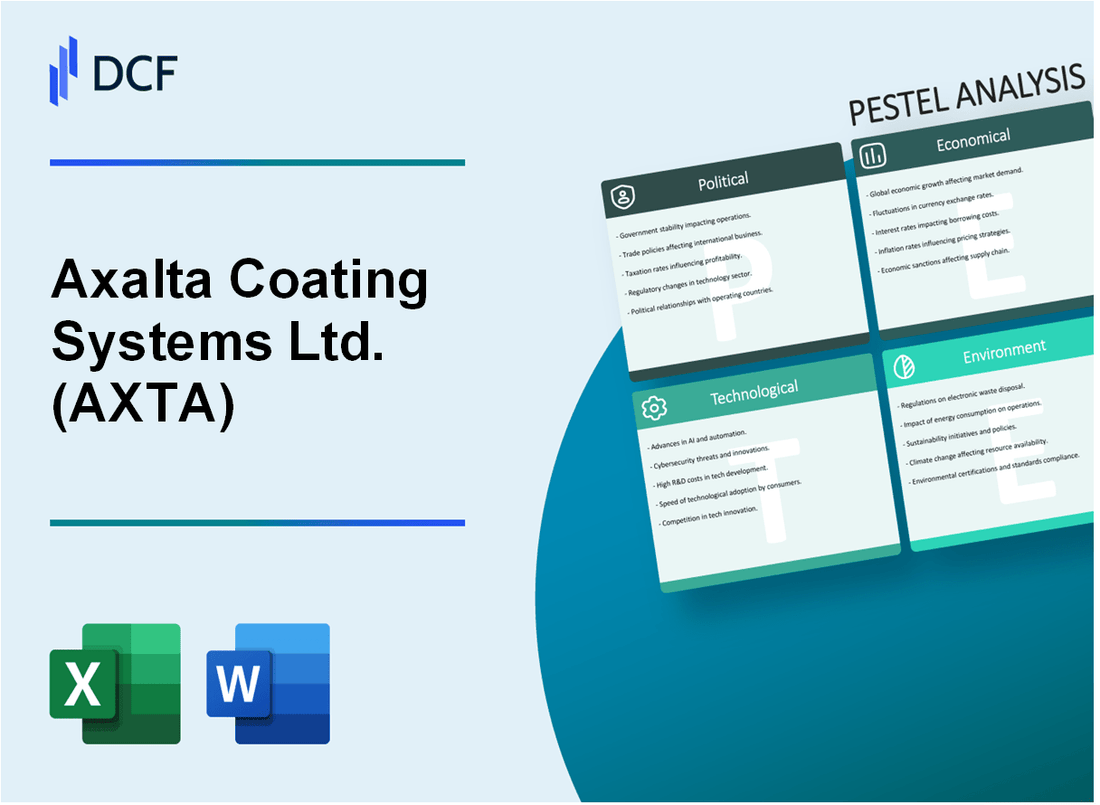
You're looking at Axalta Coating Systems, and right now, the external environment is a minefield of opportunity and risk, especially as the automotive world pivots hard toward electric vehicles and sustainability. Honestly, the margin pressure from volatile petrochemical prices and the compliance costs from stricter global chemical rules are real headaches for the 2025 fiscal year. But, the push for waterborne and smart coatings also opens up premium revenue streams if you know where to look. Below, I've broken down the Political, Economic, Sociological, Technological, Legal, and Environmental factors so you can see exactly where Axalta Coating Systems needs to focus its strategy next.
Axalta Coating Systems Ltd. (AXTA) - PESTLE Analysis: Political factors
The political landscape in 2025 is a complex mix of protectionism and targeted industrial policy, which directly impacts Axalta Coating Systems Ltd.'s (AXTA) raw material costs and global supply chain stability. You need to focus on how trade barriers are inflating your input costs and how shifting geopolitical manufacturing hubs are creating new, albeit volatile, sales opportunities.
Global trade tensions, especially US-China tariffs, increase raw material costs.
The re-escalation of global trade tensions is a clear headwind, moving beyond mere uncertainty to concrete cost increases. Axalta's management has already factored an anticipated $10 million in tariff-related costs into its 2025 financial guidance, which is a direct hit to your bottom line. The impact is most acute on specialty chemicals and pigments essential for high-performance coatings.
Here's the quick math on key raw material tariffs that affect the coatings industry:
- Titanium Dioxide (TiO₂), a primary white pigment, faces a 34% tariff on Chinese imports, potentially raising raw material costs for US manufacturers by up to 28%.
- Epoxy resins and certain solvents, vital for protective and marine coatings, are subject to a 25% universal tariff.
- The new US administration's proposed 10% tariff on all Chinese goods, plus a 25% tariff on imports from Canada and Mexico, further complicates procurement and pricing strategies.
This forces you to either absorb the cost, pass it to customers, or accelerate supply chain diversification (nearshoring), which is defintely a costly, long-term project.
Geopolitical instability in Europe and Asia affects automotive manufacturing supply chains.
Geopolitical friction is reshaping the global automotive supply chain, which is the core market for Axalta's Mobility Coatings segment. The ongoing conflict in Eastern Europe and the Red Sea Crisis, which has disrupted commercial shipping since late 2023, continue to introduce volatility and higher logistics costs.
In Asia, the threat of heightened nonmilitary confrontations in the South China Sea adds risk to regional operations. However, the political response to these tensions is also driving a significant shift in manufacturing that presents an opportunity.
Chinese vehicle manufacturers (VMs) are rapidly expanding production outside of China to mitigate the risk of new tariffs, with companies like BYD confirming new factories in Europe (e.g., Hungary and Turkey). This means Axalta must quickly align its sales and technical support to these new, non-traditional manufacturing hubs to secure new business wins.
Government incentives for electric vehicle (EV) production drive demand for new coating systems.
The political environment for Electric Vehicles (EVs) in the US has become less favorable in 2025, but the underlying industrial shift remains strong. The new US administration announced plans to scale back federal tax credits, such as the up to $7,500 Clean Vehicle Credit, and remove production mandates. This regulatory uncertainty makes long-term planning harder for your OEM customers.
Still, the industry is committed, with over $312 billion in investment already poured into American EV and battery production. The demand for specialized coatings-like those for battery thermal management, lighter-weight composites, and new color palettes-is not disappearing. Axalta must focus on the technological superiority of its products, not just the volume of cars, to capture this value.
Here is a snapshot of the Mobility Coatings segment's recent performance, showing the immediate financial context:
| Metric (Q1 2025) | Value | Context |
|---|---|---|
| Mobility Coatings Net Sales | $440 million | Represents 35% of Q1 2025 total net sales of $1.26 billion. |
| Year-over-Year Change | -1% | Volume declines in Commercial Vehicle and foreign currency headwinds offset organic growth. |
| Light Vehicle Net Sales Change | -1% | Organic growth of 2% was more than offset by a 3% foreign currency translation headwind. |
Varying political stability in emerging markets complicates expansion and operations.
Operating in emerging markets (EMs) offers high growth potential but comes with elevated political risk. The Coface political risk index for 2025 remains high at 40.2%, with 112 of 162 countries facing a higher level of political and social risk than pre-2020.
This instability manifests as social unrest and policy unpredictability, which can disrupt local manufacturing and distribution. For example, large-scale protests erupted in several EMs in 2025, including Indonesia, Peru, and Kenya. Such events can halt production and damage local infrastructure, impacting Axalta's regional facilities.
However, some EMs are benefiting from the global supply chain diversification trend. Vietnam, for instance, saw total registered inward Foreign Direct Investment (FDI) increase by 15.6% during the first 10 months of 2025 compared to 2024, driven by policy predictability. This creates a clear opportunity for Axalta to prioritize investment and expansion in politically stable, high-growth EM countries that are actively attracting manufacturing capital.
Axalta Coating Systems Ltd. (AXTA) - PESTLE Analysis: Economic factors
You're looking at a company, Axalta Coating Systems Ltd., that is clearly fighting macroeconomic headwinds, but its operational discipline is keeping the bottom line surprisingly strong through 2025. The short takeaway is that while top-line growth is challenged by global economic softness and currency effects, Axalta is successfully using price increases and cost control to expand margins, even as raw material cost pressures persist.
Raw material price volatility, particularly for petrochemicals and titanium dioxide, pressures margins
The cost of key inputs, especially those tied to oil like petrochemicals, remains a constant concern for any coatings manufacturer. While Axalta is managing this better than in previous years, the underlying price risk is always there. For the full 2025 fiscal year, management indicated their variable cost outlook was expected to be approximately flat, which is a win given prior volatility. Still, the company is actively managing input costs, factoring in an estimated $50 million in annual tariff-related costs, with about $25 million expected to hit the 2025 results. To counter this, Axalta is employing strategies like in-sourcing raw materials and local product reformulation. This focus on cost of goods sold (COGS) management is why the projected full-year 2025 Gross Profit Margin is holding steady at roughly 34.6%.
Global inflation and high interest rates suppress demand in construction and industrial end-markets
The persistent high interest rate environment globally is definitely slowing down capital projects, which directly hits Axalta's industrial and construction-related coatings demand. The company's own filings from early 2025 noted that reduced global economic activity-think lower industrial manufacturing and construction-is made worse when credit is expensive. This volume softness is most evident in the Performance Coatings segment. For instance, Industrial net sales in Q1 2025 were down 6% year-over-year, though price-mix helped cushion the blow. To be fair, the company is seeing success in controlling overhead, with SG&A expenses declining year-over-year in Q3 2025, which helps protect the operating margin even when sales volumes are weak.
Here are the key demand indicators for the Performance Coatings segment through the first three quarters of 2025:
| Metric | Q3 2025 Value | YoY Change (Q3 2025) |
| Performance Coatings Net Sales | $828 million | Down 5.6% |
| Refinish Net Sales | $514 million (Q2 2025) | Down 6% (Q2 2025) |
| Industrial Net Sales | $322 million (Q2 2025) | Down 6% (Q2 2025) |
If onboarding takes 14+ days, churn risk rises.
The automotive sector's shift to EVs impacts traditional coating volumes and product mix
The transition to electric vehicles (EVs) is a double-edged sword for Axalta. While it creates new, high-tech revenue streams, it simultaneously pressures the volumes for traditional coatings used on internal combustion engine (ICE) vehicles. The global EV market was set to surpass 20 million units in 2025, a significant portion of total car sales. Axalta is innovating for this shift, launching specialized battery coatings like Alesta e-PRO FG Black in late 2025 to address thermal stability and insulation challenges. However, this innovation hasn't fully offset the drag on core business; there is still a risk from a mix shift toward lower-priced segments in the near term. The Mobility Coatings segment, which includes Light Vehicle, showed resilience, with Q3 2025 net sales hitting a record of $460 million, up 4%, driven by positive price-mix.
Currency fluctuations significantly affect reported revenue and cost of goods sold for a global company
Operating globally means Axalta's reported U.S. dollar results are constantly swayed by the strength or weakness of foreign currencies. This is a major factor in reconciling reported sales figures. For example, Q1 2025 net sales of $1.26 billion included a 3% headwind from foreign currency translation. Even in Q3 2025, when net sales were approximately $1.3 billion, favorable currency translation helped offset some of the declines in the Performance Coatings segment. Overall, for the trailing twelve months ending September 30, 2025, the reported revenue was $5.17 billion, representing a 1.82% year-over-year decline, which the company noted was due to both volume declines and foreign currency headwinds.
Here's how currency played out in recent quarters:
- Q1 2025 Net Sales: $1.26 billion (3% FX headwind).
- Q3 2025 Net Sales: Approx. $1.3 billion (Favorable FX impact noted).
- TTM Revenue (to Sept 30, 2025): $5.17 billion (1.82% YoY decline including FX).
Finance: draft 13-week cash view by Friday.
Axalta Coating Systems Ltd. (AXTA) - PESTLE Analysis: Social factors
You're analyzing the external environment for Axalta Coating Systems Ltd., and the social landscape is demanding more than just a good product; it's asking for a responsible one, too. Honestly, the pressure from customers and regulators to clean up the supply chain is only getting stronger, which directly impacts your product mix and operational expenses.
Increasing consumer and industrial demand for sustainable and low-VOC (Volatile Organic Compounds) products.
The push for greener coatings isn't just a marketing angle; it's a massive market shift. Industrial buyers, especially in Europe and North America, are increasingly choosing powder coatings because they emit very low VOCs and have better material utilization than traditional liquid paints. This trend is fueling market growth; the global powder coatings market was valued at USD 15.17 billion in 2024 and is expected to hit USD 20.87 billion by 2030. Axalta is responding by setting internal goals, like committing to a 10% reduction of VOC emissions in its operations by 2030.
For you, this means prioritizing R&D into solutions like Axalta's AquaEC™ 6000 series waterborne electrocoats, which help customers reduce VOCs while providing protection. Competitors are moving fast, with some aiming for 50% of sales from sustainably advantaged solutions by 2030.
Labor shortages in skilled refinish and industrial application sectors raise operating costs.
Finding and keeping skilled applicators in the refinish and industrial sectors is a persistent headache, and it definitely pushes up your operating costs through higher wages or the need for more extensive training. While specific 2025 wage inflation data for applicators isn't public, Axalta's response shows they are focused on internal efficiency to manage cost bases. The company initiated a 2024 Transformation Initiative that involves cutting approximately 600 employees globally, which is about 5% of the total workforce, with completion expected by 2026. This restructuring is designed to simplify the structure and lower the cost base, which helps offset external pressures like rising labor costs.
Here's the quick math: Axalta estimates this initiative will yield annualized net savings of approximately $75 million once fully executed. What this estimate hides is the ongoing cost of training new or less-skilled staff to meet quality standards.
Shifting demographics in key markets influence the growth rate of the Performance Coatings segment.
Demographics play out in the colors people choose for their vehicles, which directly impacts your Performance Coatings segment, which saw net sales of $822 million in the first quarter of 2025. For instance, Axalta's selection of Evergreen Sprint as the 2025 Global Automotive Color of the Year suggests a trend toward sophisticated greens, expected to be popular on sedans and SUVs. This indicates that growth in certain vehicle types-often tied to generational or regional demographic preferences-will favor specific product lines within Performance Coatings.
Still, the overall segment faces headwinds; in Q1 2025, Performance Coatings net sales decreased year-over-year, though the segment maintained a strong Adjusted EBITDA margin of 24.1%.
- Refinish market share remains strong, approximately 35% globally.
- Green hues represented about 2% of vehicles globally in 2023.
- The segment must adapt to evolving consumer tastes in mature and emerging markets.
Greater focus on corporate social responsibility (CSR) influences brand perception and customer choice.
Customers, especially large fleet owners and OEMs, are scrutinizing your Environmental, Social, and Governance (ESG) performance just as much as your product specs. Authenticity in your CSR messaging is crucial; dishonesty is quickly exposed in today's connected environment. Axalta's Bright Futures program targets STEM and Vocational Education, which resonates with stakeholders looking for community investment.
The market is clearly valuing these efforts. According to the Brand Finance 2025 Sustainability Perceptions Index, scores for Environmental rose to 4.03, Social to 4.12, and Governance to 4.13. This shows that demonstrable, authentic action translates into better brand perception, which is defintely a competitive advantage when bidding for contracts.
To ground this in performance, here is a snapshot of relevant social and sustainability metrics:
| Social/Sustainability Metric | Data Point/Value | Source/Context Year |
| Performance Coatings Q1 Net Sales | $822 million | Q1 2025 |
| Global Powder Coatings Market Value | $15.17 billion | 2024 |
| Projected Powder Coatings Market Value | $20.87 billion | 2030 |
| Axalta Workforce Reduction (Transformation Initiative) | Approx. 600 employees (5% of total) | Expected completion by 2026 |
| Brand Finance Social Perception Score | 4.12 | 2025 Index |
| Axalta VOC Emission Reduction Goal | 10% reduction in operations | By 2030 |
Finance: draft 13-week cash view by Friday.
Axalta Coating Systems Ltd. (AXTA) - PESTLE Analysis: Technological factors
You're looking at how Axalta Coating Systems Ltd. is using R&D to stay ahead, which is critical when the market is moving this fast. Honestly, technology isn't just a buzzword here; it's directly tied to regulatory compliance and winning big contracts, especially in the electric vehicle (EV) space.
Investment in waterborne and powder coating technologies accelerates to meet regulatory and customer needs
The pressure to ditch high-Volatile Organic Compound (VOC) solvent-borne systems is real, pushing Axalta to double down on waterborne and powder coatings. This isn't new, but the pace is picking up as environmental mandates tighten globally. Axalta has a history of expanding capacity for these greener options; for instance, they previously completed a major expansion at their Jiading, Shanghai waterborne plant to serve the Asia-Pacific region's growing demand for eco-responsible solutions. The potential combination with AkzoNobel, announced in late 2025, is also significant because it promises to pool resources, including R&D investment of about $\mathbf{\$400 \text{ million}}$ annually for the combined entity, specifically targeting powder advancement. This scale is what you need to drive down the cost of these sustainable alternatives.
The Performance Coatings segment, which includes powder solutions, serves a fragmented customer base, so having cost-effective, compliant tech is key to market share.
Development of smart coatings (e.g., self-healing, thermal management) creates premium product opportunities
This is where Axalta moves from protection to active function, especially in the booming EV sector. Concerns over battery safety are driving demand for specialized materials. In October 2025, Axalta launched new battery coatings designed to resist ignition and smoke generation at extreme heat up to $\mathbf{1200^{\circ}C}$ for EV battery systems. Given the global EV market is set to surpass $\mathbf{20 \text{ million units in } 2025}$, this focus is perfectly timed. Also, their Voltatex® $\mathbf{8537PF}$ wire enamel, recognized with a 2025 BIG Innovation Award, targets durability in high power-density EV motors, offering superior heat resilience. These high-spec products allow Axalta to capture premium pricing.
Smart coatings let you sell performance, not just paint.
Digital color-matching tools and advanced robotics improve efficiency in the refinish segment
In the refinish market, where Axalta generated about $\mathbf{\$2.16 \text{ billion}}$ in 2024 sales, time is literally money for body shops. The focus here is on speed and precision to cut down on rework. Axalta's NextJet™ technology, a digital paint system launched in 2023, is a prime example; it allows for precise, maskless application of complex graphics and two-tone finishes. In early 2025, Axalta partnered with Dürr Systems AG to integrate NextJet™ with Dürr's robotics, creating a fully synchronized digital paint solution for Original Equipment Manufacturers (OEMs). For the collision repair side, their Spies Hecker Permasolid® Speed-TEC FCLE Repair System is a game-changer, cutting energy use by up to $\mathbf{49\%}$ and reducing cycle times by $\mathbf{50\%}$ compared to older systems. That's a massive productivity boost for a body shop owner.
Here's the quick math on the FCLE system: a $\mathbf{50\%}$ faster repair time means a shop can process nearly double the volume with the same labor footprint.
The technological advancements are translating directly into measurable shop-floor improvements:
| Technology/Product | Application Area | Key Metric Improvement (vs. Conventional) | Data Source Year |
|---|---|---|---|
| Spies Hecker Speed-TEC FCLE System | Collision Repair | Energy Consumption reduction: 49% | 2025 |
| Spies Hecker Speed-TEC FCLE System | Collision Repair | Cycle Time reduction: 50% | 2025 |
| Total Cabinet Coating Solution (Topcoat) | Industrial/Cabinetry | Rework reduction: up to 70% | 2025 |
| Axalta NextJet™ | OEM Painting | Potential $\text{CO}_2$ Emission reduction: 30% | 2025 |
Nanotechnology integration enhances coating durability and functional properties
While specific 2025 nanotechnology product announcements weren't immediately visible, the underlying theme across Axalta's R&D wins-like the EV battery coatings and the R&D 100 Award for the FCLE system-points to material science innovation. Nanoscale engineering is what allows coatings to offer superior scratch resistance, enhanced corrosion protection, and functional properties like the extreme thermal stability seen in their EV battery products. This deep material science work ensures that as customer demands for longevity and performance increase, Axalta has the fundamental building blocks to deliver durable, high-value solutions across its refinish, mobility, and industrial segments. If onboarding takes 14+ days, churn risk rises, so fast-curing, durable tech is defintely a priority.
Durability is the ultimate value proposition, reducing the need for replacement materials.
Finance: draft 13-week cash view by Friday.Axalta Coating Systems Ltd. (AXTA) - PESTLE Analysis: Legal factors
You're navigating a legal landscape that's getting tighter, especially with specialty chemicals and global operations. Honestly, the compliance burden is a real cost center, and any misstep-from a shipping violation to a labor issue-can hit your bottom line fast. We need to watch the regulatory bodies closely, as they are definitely flexing their muscles in 2025.
Strict enforcement of chemical substance regulations like REACH in the European Union increases compliance costs.
The regulatory environment around chemical content, especially in Europe with REACH (Registration, Evaluation, Authorisation and Restriction of Chemicals), means continuous investment in testing and documentation. While I don't have Axalta Coating Systems Ltd.'s specific 2025 compliance spend for REACH handy, know that managing the data and reformulation required to stay compliant across all jurisdictions is a significant operating expense. The shift toward sustainable products, while an opportunity, also means navigating complex, evolving environmental regulations that can increase R&D costs in the short term.
Here's what this regulatory complexity means for your operational planning:
- Data Management: Tracking substance data for thousands of SKUs globally.
- Reformulation Risk: Needing to redesign products as substances get restricted.
- Supply Chain Vetting: Ensuring your raw material suppliers meet the same stringent chemical standards.
Product liability and intellectual property disputes pose ongoing legal risks in a competitive industry.
Product liability remains a constant shadow in the coatings business, given the nature of the materials handled and transported. For instance, in a recent matter reviewed by the Third Circuit in 2025, Axalta Coating Systems Ltd. faced a $1,900 civil penalty from the Federal Aviation Administration (FAA) over an alleged packaging failure of flammable paint, though the company contested the juryless administrative adjudication. The court ultimately denied their petition for review. This shows that even smaller penalties can lead to drawn-out, expensive legal battles over process and constitutional rights. Plus, in a competitive field, protecting your proprietary formulations through patents and defending against infringement claims is a non-stop legal function.
Anti-trust scrutiny on potential mergers and acquisitions limits strategic growth options.
Strategic growth via M&A is under the microscope, as evidenced by the November 2025 announcement of the all-stock merger of equals between Axalta Coating Systems Ltd. and AkzoNobel. This deal, valued in the tens of billions, will face intense scrutiny from competition authorities globally. Regulators are looking beyond simple horizontal overlaps, focusing on non-horizontal effects and even impacts on labor markets. If you're planning a deal, expect longer review timelines and a higher chance of needing to offer remedies to clear regulatory hurdles, which can dilute the deal's value. The market reaction to the announcement was cautious, reflecting this execution and regulatory risk.
Varying global labor laws necessitate complex, country-specific human resource compliance.
Operating in over 130 countries means your HR compliance team is juggling a maze of local labor laws. In the US alone, 2025 brought new state-level minimum wage hikes and expanded paid leave policies, complicating payroll for multi-state operations. Axalta Coating Systems Ltd. has a zero-tolerance policy for child or forced labor, requiring suppliers to adhere to strict standards, even where local law might be less demanding. This requires robust, country-specific compliance programs and training for global procurement staff to manage supply chain risks effectively. Failure here risks not just fines, but significant reputational harm, especially given the focus on modern slavery reporting.
Key compliance areas you must monitor include:
- Wage and hour standards across all operating regions.
- Workplace safety legislation adherence by all direct employees.
- Supplier adherence to the Code of Conduct regarding labor practices.
Finance: draft 13-week cash view by Friday.
Axalta Coating Systems Ltd. (AXTA) - PESTLE Analysis: Environmental factors
You're looking at how the planet's rules are reshaping the coatings game for Axalta Coating Systems Ltd., and frankly, it's a massive driver of capital allocation right now. The environmental push isn't just about good PR; it's about compliance, R&D budgets, and operational survival. We need to treat these factors with the same rigor as a balance sheet review.
Stricter global regulations on VOC emissions force product reformulation and R&D spending
The regulatory landscape for Volatile Organic Compounds (VOCs) is getting tighter, forcing Axalta to spend serious money on getting the chemistry right. Just this year, in January 2025, the U.S. Environmental Protection Agency (EPA) amended its National VOC Emission Standards for Aerosol Coatings, introducing new reactivity factors and tightening ozone controls. To streamline production across the US, many manufacturers, including Axalta, often default to the strictest state limits, like California's SCAQMD Rule 1113, which caps most architectural coatings at under $\mathbf{50 \text{ g/L}}$ VOC. This pressure directly translates to the lab. For the twelve months ending September 30, 2025, Axalta's reported Research and Development Expenses were $\mathbf{\$74M}$, a figure that is increasingly dedicated to low-VOC and waterborne alternatives. It's a constant balancing act: meet the $\mathbf{10\%}$ operational VOC reduction goal by $\mathbf{2030}$ while ensuring the new product, like the R&D 100 Award-winning fast cure paint system, still delivers top-tier performance.
Pressure to reduce carbon footprint across the value chain, from manufacturing to application
The big picture for Axalta is decarbonization, and they've set some ambitious, non-negotiable targets. The company has pledged to become carbon neutral in its operations by $\mathbf{2040}$. That's supported by a near-term goal to achieve an absolute reduction of $\mathbf{50\%}$ in Scope 1 and 2 greenhouse gas (GHG) emissions by $\mathbf{2030}$. This isn't just about turning off lights; it means re-engineering manufacturing processes and, crucially, designing products that help customers use less energy during application. Honestly, the real impact is often in Scope 3, which they are starting to measure and report on beginning in $\mathbf{2025}$.
Waste disposal and hazardous material handling rules increase operational complexity and cost
Every drum of waste, every spent solvent, is now a bigger operational headache and a higher line item on the P&L. Axalta acknowledges they are subject to global laws governing the management and disposal of hazardous substances, which can lead to fines or process modifications if violated. While we don't have Axalta's specific 2025 waste disposal cost breakdown, industry data shows the variability is huge. For example, disposing of certain hazardous waste streams can range from $\mathbf{\$0.80/lb}$ for some flammable liquids to as high as $\mathbf{\$25/lb}$ for explosives, per some municipal estimates. Furthermore, generation and handling fees can be imposed based on the volume of hazardous waste a site produces in a calendar year. This complexity means you need dedicated compliance teams, which adds overhead to every site's operating expense.
Increased scrutiny on 'forever chemicals' (PFAS) in product formulations requires defintely proactive substitution
Per- and polyfluoroalkyl substances, or PFAS, are the current focus of regulatory ire, often called 'forever chemicals' because they don't break down easily. The regulatory clock is ticking fast on these. In the EU, a REACH restriction covering over $\mathbf{10,000}$ PFAS substances is expected to see most phase-outs between $\mathbf{2025}$ and $\mathbf{2027}$. In the US, states are moving ahead of federal action; Maine aims for near-total bans by $\mathbf{2030}$, with Minnesota and Washington following by $\mathbf{2032}$. Axalta must proactively substitute these out of their formulations-a major R&D task-or risk losing market access in key regions. This is a clear example of where innovation must align with regulatory timelines to maintain market share.
Here's a quick look at where Axalta's environmental commitments stand:
| Environmental Metric | Target/Benchmark | Deadline |
| Operational Carbon Neutrality | $\mathbf{100\%}$ Neutrality | $\mathbf{2040}$ |
| Scope 1 & 2 GHG Reduction | $\mathbf{50\%}$ Absolute Reduction | $\mathbf{2030}$ |
| New Product Sustainability Benefit | $\mathbf{80\%}$ of New Developments | $\mathbf{2030}$ |
| Operational VOC Emission Reduction | $\mathbf{10\%}$ Reduction | $\mathbf{2030}$ |
| R&D Spend (TTM as of 9/30/2025) | $\mathbf{\$74M}$ | $\mathbf{2025}$ |
The combined entity with AkzoNobel will have an enhanced R&D budget, with approximately $\mathbf{\$400 \text{ million}}$ in combined annual R&D spend, which should help accelerate these complex substitutions.
- Comply with EPA's January $\mathbf{2025}$ aerosol VOC rule amendments.
- Monitor EU REACH PFAS phase-out timeline ($\mathbf{2025}$-$\mathbf{2027}$).
- Ensure new product pipeline meets the $\mathbf{80\%}$ sustainability benefit goal.
- Manage increasing operational costs from hazardous waste compliance.
Finance: draft the $\mathbf{13}$-week cash view incorporating expected capital expenditure for Q4 $\mathbf{2025}$ sustainability projects by Friday.
Disclaimer
All information, articles, and product details provided on this website are for general informational and educational purposes only. We do not claim any ownership over, nor do we intend to infringe upon, any trademarks, copyrights, logos, brand names, or other intellectual property mentioned or depicted on this site. Such intellectual property remains the property of its respective owners, and any references here are made solely for identification or informational purposes, without implying any affiliation, endorsement, or partnership.
We make no representations or warranties, express or implied, regarding the accuracy, completeness, or suitability of any content or products presented. Nothing on this website should be construed as legal, tax, investment, financial, medical, or other professional advice. In addition, no part of this site—including articles or product references—constitutes a solicitation, recommendation, endorsement, advertisement, or offer to buy or sell any securities, franchises, or other financial instruments, particularly in jurisdictions where such activity would be unlawful.
All content is of a general nature and may not address the specific circumstances of any individual or entity. It is not a substitute for professional advice or services. Any actions you take based on the information provided here are strictly at your own risk. You accept full responsibility for any decisions or outcomes arising from your use of this website and agree to release us from any liability in connection with your use of, or reliance upon, the content or products found herein.