

|
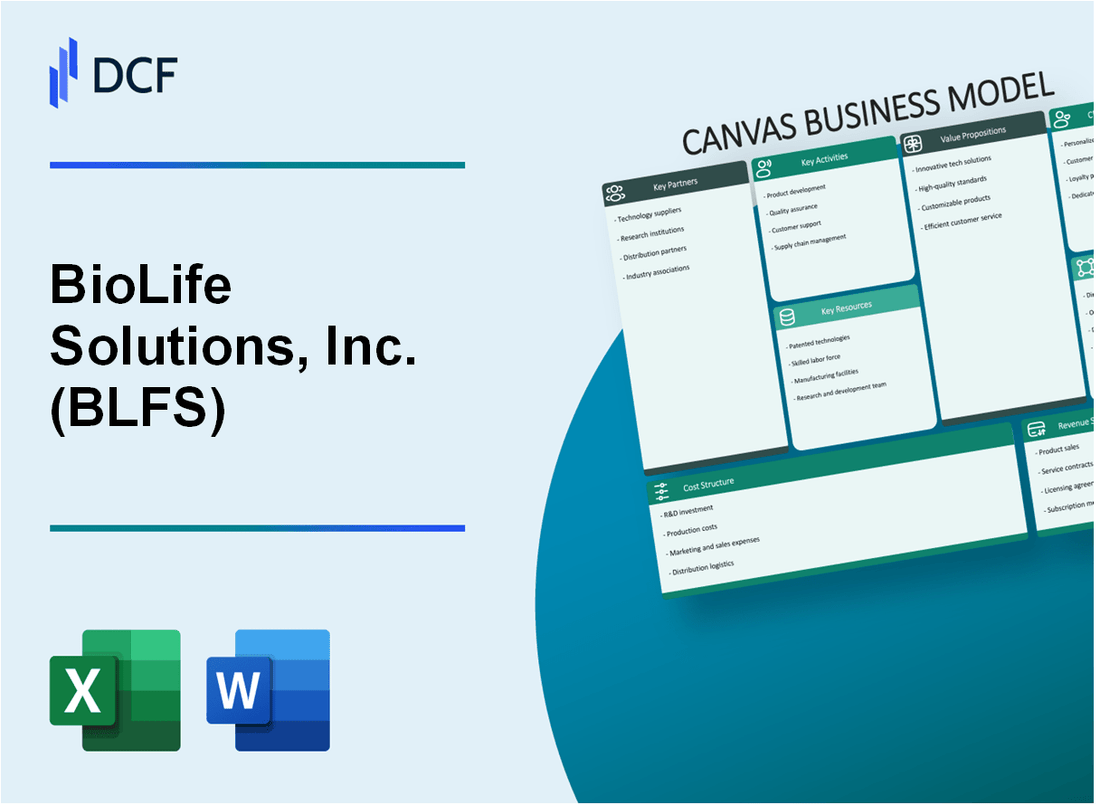
BioLife Solutions, Inc. (BLFS): Business Model Canvas [Dec-2025 Updated] |
Fully Editable: Tailor To Your Needs In Excel Or Sheets
Professional Design: Trusted, Industry-Standard Templates
Investor-Approved Valuation Models
MAC/PC Compatible, Fully Unlocked
No Expertise Is Needed; Easy To Follow
BioLife Solutions, Inc. (BLFS) Bundle
You're digging into the financials of BioLife Solutions, Inc. (BLFS) now that they've sharpened their focus post-2024 divestitures to be a pure-play cell processing powerhouse. Honestly, the core engine is about de-risking the cell and gene therapy (CGT) supply chain with high-quality, cGMP-compliant biopreservation media like CryoStor, which drives their projected $95.0 million to $96.0 million revenue for 2025. With an adjusted gross margin hitting 64% in Q3 2025, their model hinges on embedded supplier relationships and proprietary IP, but understanding the cost structure-like $11.501 million in G&A in Q1 2025-is key to valuing this growth story. Dive below to see the full nine blocks of how they plan to capture this market.
BioLife Solutions, Inc. (BLFS) - Canvas Business Model: Key Partnerships
You're looking at the network that keeps BioLife Solutions, Inc. at the center of the cell and gene therapy (CGT) supply chain. These aren't just names on a slide; they are the channels and collaborators that turn proprietary media into recurring revenue.
Global distributors for biopreservation media and tools
The distribution network is a key component for reaching the broader market, complementing direct sales efforts. For the second quarter of 2025, the split showed that approximately 40% of Biopreservation Media (BPM) revenue was generated through distribution channels.
Cell and gene therapy (CGT) developers in clinical trials
The adoption by therapy developers drives the core business volume. BioLife Solutions, Inc. has established itself as the default partner for many programs. As of the third quarter of 2025, their biopreservation media was being used in roughly 250 ongoing commercially sponsored clinical trials. Furthermore, as of June 30, 2025, the media was embedded in 16 unique commercial CGTs. The company's CellSeal vials and human Platelet Lysate (hPL) products were also supporting over 35 commercially sponsored clinical trials in the U.S. at that time.
Here's a quick look at the scale of adoption:
| Metric | Value as of Mid-2025 | Context |
| Ongoing Commercially Sponsored Trials Using BPM | Approximately 250 | Reflecting broad clinical use across phases |
| Unique Commercial CGTs Embedding BPM | 16 | Represents products that have achieved commercial approval |
| BPM Revenue Share via Distribution | 40% | Q2 2025 data, showing channel reliance |
Strategic investment in Pluristyx, Inc. for iPSC products
BioLife Solutions, Inc. actively invests to secure adjacency into new technologies. In July 2025, the company purchased $2 million of convertible notes in Pluristyx, Inc., a developer of induced pluripotent stem cell (iPSC) based products. This strategic move also secured a board observer seat and certain rights related to any potential future acquisition of Pluristyx, Inc. This follows a similar playbook used for prior investments in Sexton and PanTHERA.
Contract Manufacturing Organizations (CMOs) for production scale-up
BioLife Solutions, Inc. partners with leading Contract Development and Manufacturing Organizations (CDMOs) to enhance their biopreservation and cell processing capabilities. These partnerships focus on providing advanced tools, regulatory support, and process optimization strategies to ensure quality, consistency, and scalability for therapy developers moving toward commercial production.
- Partnering with CDMOs to enhance biopreservation capabilities.
- Providing regulatory support for process optimization.
- Focusing on solutions for commercial production scale-up.
Academic and research institutions for early-stage technology adoption
Early-stage technology integration is evident through acquisitions that bring in novel platforms. BioLife Solutions, Inc. acquired Canada-based PanTHERA CryoSolutions in April 2025 to integrate its IRI cryopreservation technology. This move directly supports the growing global demand for advanced cell cryopreservation equipment and strengthens the core biopreservation portfolio.
Finance: draft 13-week cash view by Friday.
BioLife Solutions, Inc. (BLFS) - Canvas Business Model: Key Activities
You're looking at the core engine of BioLife Solutions, Inc. (BLFS) as of late 2025, post-divestiture of the evo cold chain logistics business. The key activities are now laser-focused on their high-value, recurring revenue franchises.
Manufacturing proprietary biopreservation media like CryoStor
Manufacturing cGMP-grade media is central. BioLife Solutions' biopreservation media, which includes CryoStor® and HypoThermosol®, are foundational tools. These are formulated with optimized, serum-free components to deliver consistent performance across many cell types. As of October 2025, BioLife's biopreservation media are utilized in approximately 250 ongoing commercially sponsored programs. This manufacturing activity directly feeds the Cell Processing platform revenue, which hit $25.4 million in the third quarter of 2025, marking a 33% increase year-over-year.
Research and development (R&D) of novel cryopreservation solutions
R&D is heavily focused on integrating and advancing new protection technologies. A major recent push involves the technology acquired from PanTHERA CryoSolutions. This includes developing next-generation molecules designed to be combined with BioLife's existing cryopreservation products. These next-generation formulations are expected to launch within 18 months of the April 2025 acquisition, aiming to provide superior outcomes, use lower concentrations of DMSO, and reduce the need for liquid nitrogen in storage and logistics.
Sales and marketing to CGT developers globally
The sales and marketing effort targets the global cell and gene therapy (CGT) market, emphasizing cross-selling across the product portfolio. The momentum here is strong, reflected in the raised guidance for the core business. For the full year 2025, the Cell Processing platform revenue guidance was raised to $93.0 million to $94.0 million, representing year-over-year growth of 26% to 28%. Total 2025 revenue guidance, adjusted for the evo sale, is now $95.0 million to $96.0 million.
Here's a quick look at the Q3 2025 performance that drove this activity:
| Metric | Value (Q3 2025) |
| Total Revenue | $28.1 million |
| Cell Processing Revenue | $25.4 million |
| Year-over-Year Cell Processing Growth | 33% |
| Adjusted EBITDA Margin | 28% |
| Cash, Cash Equivalents, and Marketable Securities (Sep 30, 2025) | $98.4 million |
Regulatory support, including managing Master File cross references
Regulatory acceptance is a key barrier to switching for customers, and BioLife Solutions supports this through documentation. The company's biopreservation media, like CryoStor®, are supported by U.S. FDA Master Files. This regulatory documentation is a significant component of the obstacles to switching for customers, alongside technical support and supply consistency. While the exact current count of cross-references isn't specified in the latest investor materials, the Master Files have been cross-referenced numerous times for use in regenerative medicine clinical trials.
Integrating acquired technologies like PanTHERA CryoSolutions
Integrating PanTHERA CryoSolutions, acquired in April 2025, is a critical activity to enhance the product portfolio with novel Ice Recrystallization Inhibitor (IRI) technology. This acquisition followed a strategic partnership that began in 2020, which included a $2 million USD investment from BioLife Solutions and Casdin Capital into PanTHERA. PanTHERA's first-generation GMP-compliant KryoAegis™ product launched in March 2024. The integration adds scientific capabilities to the management team and strengthens the consumables focus. The GAAP net loss for Q2 2025 was $15.8 million, largely due to a one-time $15.5 million IPR&D expense related to the PanTHERA acquisition.
The core operational metrics for the Cell Processing segment in Q3 2025 were:
- GAAP Gross Margin: 62%
- Non-GAAP Adjusted Gross Margin: 64%
- GAAP Net Income: $0.6 million
- GAAP EPS: $0.01
BioLife Solutions, Inc. (BLFS) - Canvas Business Model: Key Resources
You're looking at the core assets that power BioLife Solutions, Inc.'s position as a pure-play cell processing company following the October 2025 divestiture of its evo cold chain logistics subsidiary. These resources are what enable the high-quality growth they reported through the third quarter of 2025.
Proprietary biopreservation media (CryoStor, HypoThermosol) IP.
The intellectual property around the CryoStor and HypoThermosol platform of solutions is highly valued across biobanking, drug discovery, and regenerative medicine markets. These proprietary freeze media products are serum-free and protein-free, fully defined formulations designed to reduce cell damage and death during preservation. Dr. Aby J. Mathew, Executive Vice President and Chief Scientific Officer, is noted as one of the developers of this platform. The company's commitment to IP expansion was highlighted by a portfolio update in late 2022, which included 43 submitted patent applications and 148 issued patents globally at that time.
The media is used in approximately 250 ongoing commercially sponsored biopreservation media applications as of Q3 2025.
Cell Processing tools portfolio (CellSeal vials, Signata).
The success of the broader cell processing tools portfolio, which includes items like CellSeal vials, is reflected in the segment's financial performance. Cell Processing revenue for the third quarter of 2025 reached \$25.4 million, marking a year-over-year increase of 33%. This segment is the primary driver of BioLife Solutions, Inc.'s total revenue, which was \$28.1 million in Q3 2025.
Here's a look at the segment performance as of the latest reported quarter:
| Metric | Q3 2025 Value | Year-over-Year Change |
| Cell Processing Revenue | \$25.4 million | 33% increase |
| Total Revenue | \$28.1 million | 31% increase |
| Adjusted EBITDA Margin | 28% | Up from 23% in Q3 2024 |
The company raised its full-year 2025 Cell Processing revenue guidance to between \$93.0 million and \$94.0 million.
Manufacturing facilities for high-margin consumables.
BioLife Solutions, Inc. operates under stringent quality systems, adhering to standards like ISO 13485:2003 and 21 CFR Part 820 for Good Manufacturing Practices (GMP). The company completed the validation of its second current Good Manufacturing Practice (cGMP) clean room manufacturing suite. This expansion effectively doubled manufacturing capacity to over 140,000 Liters per year, providing redundant capacity. Furthermore, in November 2025, the company opened the Aby J. Mathew Center for Biopreservation Excellence within its newly expanded Bothell headquarters, which includes 4,500 square feet of state-of-the-art conference and laboratory space.
Cash and marketable securities totaling $98.4 million as of Q3 2025.
The balance sheet remains solid, which is key for funding operations and strategic focus. As of September 30, 2025, BioLife Solutions, Inc. reported cash, cash equivalents, and marketable securities totaling \$98.4 million. This figure was reported prior to the receipt of \$25.5 million from the sale of the evo Cold Chain Logistics business in October 2025. The GAAP gross margin for Q3 2025 was 62%, with an adjusted gross margin of 64%.
Experienced R&D team focused on CGT workflow solutions.
The scientific team is deeply involved in protecting the integrity of living cells throughout the cell and gene therapy (CGT) workflow. The focus areas for the experts include:
- Streamlining workflows from R&D through commercial production.
- Optimizing cryopreservation protocols.
- Enhancing process efficiency and maintaining cellular viability.
- Developing closed-system manufacturing solutions that are automation ready.
- Providing regulatory support, including Master File Letter requests for IND and BLA submissions.
Dr. Aby J. Mathew, EVP and CSO, continues to support all advanced discussions for Biopreservation Media customers, clinical, and commercial development.
BioLife Solutions, Inc. (BLFS) - Canvas Business Model: Value Propositions
De-risking the CGT supply chain by maintaining cell viability.
The foundational value proposition centers on protecting cell viability and function across the entire lifecycle: manufacturing, freezing, storage, and transport of sensitive biological materials. This is achieved through foundational tools like the biopreservation media portfolio, which includes CryoStor® and HypoThermosol®. The company's media are now embedded in 16 commercially approved therapies as of late 2025. Furthermore, this core technology supports approximately 250 ongoing commercially sponsored clinical trials in the U.S..
High-quality, cGMP-compliant bioproduction media.
BioLife Solutions supplies media products manufactured under cGMP (current Good Manufacturing Practice) standards, which is critical for regulatory compliance in cell and gene therapy (CGT) commercialization. The focus is on optimized, serum-free components designed for consistent performance across various cell types and processing conditions. For customers with an approved commercial therapy, approximately 40% of total Biopreservation Media (BPM) revenue originated from this segment in Q1 2025.
Integrated, end-to-end cell processing tools and services.
The company provides a suite of tools and services that complement the media, forming an integrated cell processing platform. This segment is the primary driver of revenue growth. You can see the financial scale of this platform below:
| Metric | Q3 2025 Value | Year-over-Year Growth (vs Q3 2024) |
| Cell Processing Revenue | $25.4 million | 33% |
| Full-Year 2025 Cell Processing Revenue Guidance (Post-Divestiture) | $93.0 million - $94.0 million | 24% - 26% over 2024 |
| Adjusted EBITDA Margin (Q3 2025) | 28% of revenue | Expansion from 20% in Q2 2024 |
The acquisition of PanTHERA CryoSolutions enhances this offering with proprietary ice recrystallization inhibitor technology, though management does not expect material revenue from PanTHERA in 2025.
Embedded solutions in 16 commercially approved therapies.
The market penetration is evidenced by the number of commercial therapies relying on the company's solutions. As of the Q2 2025 report, the biopreservation media was embedded in 16 approved therapies. This adoption rate provides a high degree of revenue inevitability, as much of the growth is baked in from this established commercial base. The top 20 customers accounted for approximately 80% of BPM revenue in Q1 2025, showing significant concentration in high-value accounts.
Simplified logistics for sensitive biological materials.
Logistics simplification was a key component, historically supported by the evo cold chain logistics subsidiary. However, BioLife Solutions completed the divestiture of this subsidiary in early October 2025 to reshape the company into a pure-play cell processing entity. The value proposition now centers more tightly on the core cell processing tools and media, which still ensure viability during transport. The remaining platforms, including the Thaw platform, have a 2025 revenue guidance range of $9 million - $10 million.
The core value proposition is now focused on the following elements:
- Maintaining cell integrity during storage and transport.
- Providing cGMP-grade media for commercial products.
- Supporting over 250 active clinical trials.
- Driving 24% - 26% growth in the core Cell Processing segment for FY2025.
- Achieving an adjusted EBITDA margin of 28% in Q3 2025.
Finance: draft 13-week cash view by Friday.
BioLife Solutions, Inc. (BLFS) - Canvas Business Model: Customer Relationships
You're looking at how BioLife Solutions, Inc. (BLFS) locks in its value with customers, and honestly, it's all about deep integration and sticky consumables. The relationship starts way upstream, often involving a high-touch, consultative sales approach right when a cell and gene therapy (CGT) developer is figuring out their process. This isn't just selling a product; it's about becoming part of their scientific workflow. As of mid-2025, their biopreservation media is embedded in 16 approved therapies and actively supports over 250 clinical trials, with 30+ of those trials being in Phase III.
This consultative entry point naturally leads to an embedded supplier relationship with recurring media orders. Once their media is specified in a clinical protocol or, even better, an approved commercial process, switching costs become very high. This is where the recurring revenue engine kicks in. Management has been very clear that they are focusing on these commercial customers to drive growth, especially after the strategic divestiture of the evo Cold Chain business to focus on core competencies. The sales channel breakdown for the Biopreservation Media Platform (BPM) in Q2 2025 shows this direct relationship strength:
| Sales Channel | Revenue Contribution (Q2 2025) |
|---|---|
| Direct Sales Force | 60% of BPM Revenue |
| Distribution Partners | 40% of BPM Revenue |
The reliance on a few key partners is a defining feature of this relationship structure, which is why maintaining those ties is critical. You see this in the concentration metrics: the long-term contracts with top 20 customers who drive 80% of BPM revenue. While this concentration provides excellent near-term visibility and revenue predictability, it's also the most important risk to watch, as any shift with one of those major players could have an outsized impact.
To support these deep relationships, BioLife Solutions, Inc. provides extensive regulatory and technical support for Master File cross-referencing. This is crucial for customers moving from clinical to commercial manufacturing, as it helps them navigate the necessary documentation with agencies like the FDA. Historically, the company has helped partners optimize biopreservation protocols and integrated products like CellSeal Vials to solve specific customer challenges. This level of service solidifies the partnership beyond just the material itself. The structure of the sales team reflects this need for expertise:
- Direct sales force penetration for BPM revenue reached 60% in Q2 2025.
- The team includes technical application specialists to aid in workflow integration.
- Focus is on cross-selling the broader cell processing tools portfolio.
The direct sales force and technical application specialists are the boots on the ground executing this strategy. They are tasked with not just securing the initial media order but expanding adoption across the customer's entire cell processing workflow. Finance: draft 13-week cash view by Friday.
BioLife Solutions, Inc. (BLFS) - Canvas Business Model: Channels
You're looking at how BioLife Solutions, Inc. (BLFS) gets its critical biopreservation media and tools to the cell and gene therapy (CGT) market as of late 2025. The channel strategy is clearly bifurcated, leaning heavily on direct engagement for the largest accounts.
The core of the revenue generation, specifically from the Biopreservation Media (BPM) franchise, shows a distinct split in how sales are executed. This split is important because BPM is the engine, making up approximately 85% of the Q2 2025 cell processing revenue, which itself was $23.0 million in Q2 2025.
The direct sales team focuses on the biggest players. The top 20 customers were responsible for about 80% of the BPM revenue as of Q2 2025. Furthermore, roughly 40% of the total BPM revenue in Q2 2025 came from those 16 customers that already had an approved commercial therapy.
Here is a breakdown of the channel structure and associated metrics:
| Channel | Revenue Contribution (BPM) | Primary Customer Focus | Relevant 2025 Metric/Data Point |
|---|---|---|---|
| Direct Sales Team | 60% | Major biopharma and CGT customers (Top 20 account for ~80% of BPM revenue) | FY 2025 Cell Processing Revenue Guidance: $93.0 million to $94.0 million |
| Specialized Life Science Distributors | 40% | Smaller labs and accounts; no weakness observed in Q2 or H2 2025 forecasts | Q3 2025 Total Revenue: $28.1 million |
| E-commerce Platform | Not explicitly quantified (Implied in smaller/R&D orders) | Smaller research and development orders | Cash and marketable securities: $100.2 million (as of Q2 2025 end) |
| Industry Visibility | N/A (Marketing/Branding) | Investors and Industry Stakeholders | Management participation in 6 major investor conferences in Nov/Dec 2025 |
The e-commerce platform is the mechanism for smaller, likely early-stage or non-core research orders, which contrasts with the high-touch, direct sales approach for commercial and late-stage clinical customers. The company is definitely using its presence at industry events to maintain visibility; for instance, management was set to present at the Stephens Annual Investment Conference and the Jefferies Global Healthcare Conference in November 2025.
To give you a sense of the scale based on Q3 2025 Cell Processing revenue of $25.4 million, and assuming the 60/40 split applies to the BPM portion (which is ~85% of that total), the approximate dollar contribution to BPM revenue for that quarter would look like this:
- Direct Sales (60% of BPM): Approximately $12.95 million based on Q3 2025 Cell Processing revenue.
- Distributor Sales (40% of BPM): Approximately $8.64 million based on Q3 2025 Cell Processing revenue.
The company's overall FY 2025 total revenue guidance, adjusted for the evo cold chain logistics subsidiary sale, is set between $95.0 million and $96.0 million. The adjusted gross margin for the full year 2025 is anticipated to be in the mid-60s percentage range.
BioLife Solutions, Inc. (BLFS) - Canvas Business Model: Customer Segments
You're looking at the core users of BioLife Solutions, Inc. (BLFS) products, the ones whose precious cargo-cells and gene therapies-depend on their specialized media and tools. This segment is highly concentrated, which is typical for a specialized supplier in a niche, high-growth market like cell and gene therapy (CGT).
The largest customer groups are clearly those with therapies already approved for commercial sale and the clinical developers pushing candidates through late-stage trials. BioLife Solutions, Inc. has established itself as the default partner across the development spectrum.
Here's a breakdown of the key customer segments as of late 2025, grounded in the latest reported figures:
- Cell and gene therapy (CGT) developers (largest segment). This group drives significant recurring revenue, as their success translates directly into sustained media consumption.
- Biopharmaceutical companies with approved commercial therapies. These customers provide the most durable revenue stream. In the first quarter of 2025, this group alone accounted for approximately 40% of total Biopreservation Media (BPM) revenue. By the third quarter of 2025, revenue from customers with commercially approved therapies was up 33% year-over-year, contributing to a 33% increase in overall Cell Processing revenue for that quarter.
- Academic and government research institutions. While not always the largest revenue driver, this segment represents the pipeline. BioLife Solutions, Inc. supports this by processing U.S. FDA Master File cross references, hitting a cumulative total of 782 as of the first quarter of 2025.
- Contract Development and Manufacturing Organizations (CDMOs). These organizations act as crucial intermediaries, using BioLife Solutions, Inc. products in their manufacturing services for various CGT clients.
- Customers with over 250 ongoing clinical trials using BioLife media. As of the third quarter of 2025, the company's biopreservation media was utilized in approximately 250 ongoing commercially sponsored clinical trials in the U.S., representing a market share of more than 70%.
To give you a clearer picture of the concentration and embedded nature of the customer base, look at the revenue drivers for the core Cell Processing platform, which is the bulk of the business:
| Metric | Data Point (as of Q2/Q3 2025) | Source Period |
| Total Ongoing Commercially Sponsored U.S. Clinical Trials Using BPM | Approximately 250 | Q3 2025 |
| Market Share in Commercially Sponsored U.S. Clinical Trials | More than 70% | Q2/Q3 2025 |
| Commercial CGTs with Embedded BPM | 16 unique CGTs | Q3 2025 |
| BPM Revenue from Customers with Approved Commercial Therapies | Approximately 40% | Q1 2025 |
| BPM Revenue from Established Commercial Customers & Late-Stage Programs | More than half | Q3 2025 |
| Top 20 Customers' Share of BPM Revenue | Approximately 80% | Q2 2025 |
The reliance on a relatively small group of top customers is definitely something to watch. The top 20 customers accounted for roughly 80% of BPM revenue in the second quarter of 2025. That's a high degree of dependence, so customer retention is key. Still, the fact that commercial customers are driving such strong growth-with Cell Processing revenue guidance for the full year 2025 set between $93.0 million and $94.0 million-shows the stickiness of their product once it's specified into a therapy's manufacturing process. If onboarding takes 14+ days, churn risk rises, but here, the specification is for the life of the therapy.
BioLife Solutions, Inc. (BLFS) - Canvas Business Model: Cost Structure
You're looking at the core expenses that drive the operations for BioLife Solutions, Inc. (BLFS) as of late 2025. The cost structure is heavily influenced by the specialized nature of their biopreservation media and the regulatory environment they operate in.
High cost of goods sold (COGS) for manufacturing proprietary media is a key factor, though the GAAP gross margin for the first quarter of 2025 remained steady at 63% of revenue, with non-GAAP adjusted gross margin at 66%. Given the Q1 2025 total revenue was $23.9 million, the GAAP Cost of Goods Sold (COGS) was approximately $8.843 million ($23.9 million revenue (1 - 0.63)). This reflects the expense of producing specialized, high-quality media.
Operating expenses are significant, reflecting the investments needed to support a growing, regulated business. Here is a breakdown of the key components based on Q1 2025 figures:
| Expense Category | Q1 2025 Amount (USD Millions) | Notes |
| Total GAAP Operating Expenses | $25.2 | Reported GAAP operating expenses for Q1 2025. |
| General and Administrative (G&A) | $11.501 | As specified for Q1 2025. |
| Sales and Marketing (S&M) and Other OpEx | Approx. $11.495 | Calculated as Total GAAP OpEx less specified G&A and R&D. |
| Research and Development (R&D) | $2.204 | As specified for Q1 2025. |
Significant general and administrative (G&A) expenses were cited at $11.501 million for Q1 2025. This covers the overhead required to manage a publicly traded company in the life sciences sector, including corporate functions and compliance infrastructure.
The company maintains ongoing R&D investment for new product development, with a figure of $2.204 million noted for Q1 2025. Management also flagged approximately $1M incremental R&D spend in 2025 specifically tied to integrating the PanTHERA CryoSolutions acquisition. This investment focuses on next-generation solutions, like combining IRI technology with CryoStor for potential -80°C logistics capability.
Sales and marketing (S&M) costs are embedded within the operating expenses, calculated here to be around $11.495 million for Q1 2025 based on the provided figures. These costs are necessary to support the global distribution of their biopreservation media (BPM) and cell processing tools, especially given that the top 20 customers represented approximately 80% of BPM revenue in Q1 2025.
Finally, inventory management and quality control for cGMP compliance are inherent cost drivers. Maintaining compliance with current Good Manufacturing Practice (cGMP) standards requires rigorous testing, documentation, and facility upkeep, which directly impacts COGS and operational overhead. The company's focus on having its media embedded in 17 unique commercial therapies as of Q1 2025 mandates this high level of quality assurance spending.
- Customers with approved commercial therapies represented approximately 40% of total BPM revenue in Q1 2025.
- The company raised its full-year 2025 Cell Processing revenue guidance to $93.0 million - $94.0 million as of November 2025.
- Adjusted EBITDA margin expanded to 24% of revenue in Q1 2025, up from 14% in Q1 2024.
Finance: draft 13-week cash view by Friday.
BioLife Solutions, Inc. (BLFS) - Canvas Business Model: Revenue Streams
The revenue streams for BioLife Solutions, Inc. are centered on its pure-play cell processing business following the divestiture of the evo cold chain logistics subsidiary for \$25.5 million in cash.
Sales of Biopreservation Media (BPM) like CryoStor represent the core recurring revenue component. This is a key driver, as the company emphasized strong demand from customers with commercially approved therapies. In the third quarter of 2025, a biopreservation media sales order of approximately \$1.3 million was shipped in Q3 instead of the anticipated Q4.
Sales of Cell Processing Tools, which are reported together with BPM under the Cell Processing platform, also contribute significantly. The company's biopreservation media is used in approximately 250 ongoing commercially sponsored clinical trials in the U.S.
The updated full-year 2025 financial outlook reflects strong momentum in the core business. BioLife Solutions projects 2025 total revenue between \$95.0 million and \$96.0 million, representing a 27% to 29% growth rate on a like-for-like basis compared to 2024 continuing operations revenues.
The Cell Processing platform revenue guidance for 2025 was raised to a range of \$93.0 million to \$94.0 million, indicating growth of 26% to 28% year-over-year.
Profitability metrics underscore the high-value nature of these revenue streams. The adjusted gross margin for core products in the third quarter of 2025 was reported at 64%. This contributed to an adjusted EBITDA margin of 28% of revenue in Q3 2025, up from 23% in Q3 2024.
Here's a look at the key revenue and margin figures from the third quarter of 2025 and the revised full-year guidance:
| Metric | Q3 2025 Actual Amount | FY 2025 Guidance Range |
| Total Revenue | \$28.1 million | \$95.0 million to \$96.0 million |
| Cell Processing Platform Revenue | \$25.4 million | \$93.0 million to \$94.0 million |
| Adjusted Gross Margin | 64% | Mid-60% range expected |
| Adjusted EBITDA Margin | 28% | Continued expansion expected |
The revenue composition for the third quarter of 2025 shows the heavy reliance on the Cell Processing segment:
- Cell Processing revenue accounted for 33% growth year-over-year in Q3 2025.
- Total Q3 2025 revenue of \$28.1 million represented a 31% increase year-over-year.
- GAAP gross margin for Q3 2025 was 62%.
- GAAP net income for Q3 2025 was \$621,000, or \$0.01 per share.
Disclaimer
All information, articles, and product details provided on this website are for general informational and educational purposes only. We do not claim any ownership over, nor do we intend to infringe upon, any trademarks, copyrights, logos, brand names, or other intellectual property mentioned or depicted on this site. Such intellectual property remains the property of its respective owners, and any references here are made solely for identification or informational purposes, without implying any affiliation, endorsement, or partnership.
We make no representations or warranties, express or implied, regarding the accuracy, completeness, or suitability of any content or products presented. Nothing on this website should be construed as legal, tax, investment, financial, medical, or other professional advice. In addition, no part of this site—including articles or product references—constitutes a solicitation, recommendation, endorsement, advertisement, or offer to buy or sell any securities, franchises, or other financial instruments, particularly in jurisdictions where such activity would be unlawful.
All content is of a general nature and may not address the specific circumstances of any individual or entity. It is not a substitute for professional advice or services. Any actions you take based on the information provided here are strictly at your own risk. You accept full responsibility for any decisions or outcomes arising from your use of this website and agree to release us from any liability in connection with your use of, or reliance upon, the content or products found herein.