

|
Carrier Global Corporation (CARR): Business Model Canvas [Dec-2025 Updated] |
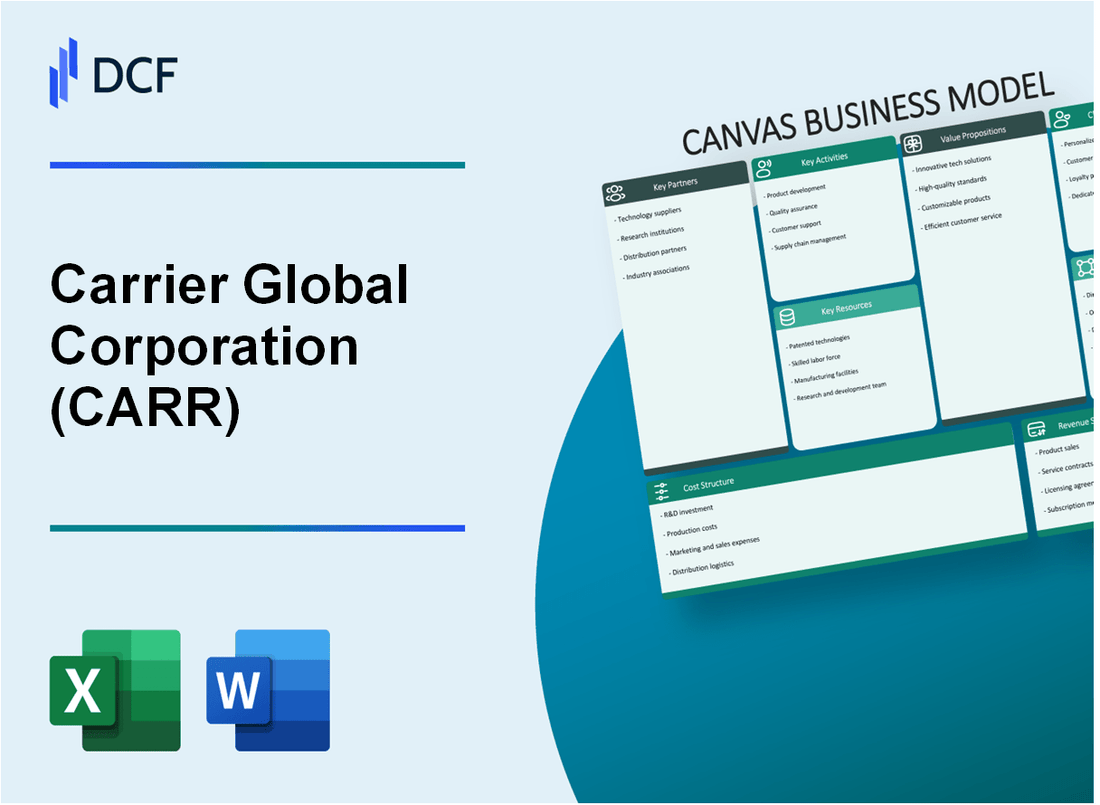
Fully Editable: Tailor To Your Needs In Excel Or Sheets
Professional Design: Trusted, Industry-Standard Templates
Investor-Approved Valuation Models
MAC/PC Compatible, Fully Unlocked
No Expertise Is Needed; Easy To Follow
Carrier Global Corporation (CARR) Bundle
You're digging into the new operating model for Carrier Global Corporation after they streamlined their portfolio, and honestly, the story is now all about owning the climate transition, from heat pumps in Europe to high-density cooling for data centers. As someone who has modeled companies through major shifts, I can tell you this Business Model Canvas lays out exactly how they plan to hit their projected $22.0 billion in sales for 2025 by leaning hard into electrification and high-margin aftermarket services. If you want to see the nine building blocks-from their key partnerships with ZutaCore to their reliance on the Viessmann distribution network-that power this massive industrial pivot, read on below.
Carrier Global Corporation (CARR) - Canvas Business Model: Key Partnerships
You're looking at the backbone of Carrier Global Corporation's operations, the relationships that make their strategy work. This isn't just about buying parts; it's about deep, strategic alignment across technology, distribution, and energy infrastructure.
Technology partnership with ZutaCore for direct-to-chip liquid cooling
Carrier Ventures, the company's venture group, led an investment and technology partnership with ZutaCore in February 2025. This move targets the critical cooling needs of data centers, a market segment Carrier is actively pursuing. The global data center cooling market is projected to reach $20 billion by 2029, with liquid cooling specifically expected to grow at a 39% CAGR over that period. This partnership integrates ZutaCore's waterless liquid cooling technology with Carrier's climate and energy expertise.
Strategic alliances with U.S. utilities for integrated battery heat pump solutions
Carrier Energy is actively engaging with utilities and the Electric Power Research Institute (EPRI) to test how homes can function as flexible Distributed Energy Resources (DERs). The goal is to use next-generation HVAC systems, which pair variable-speed heat pumps with battery storage, to reduce peak demand on the grid. Carrier estimates it has approximately 30 million HVAC units installed in North American homes, representing over 100 GW of potential flexible demand that could be leveraged for grid support at scale.
Global network of independent HVAC distributors and dealers (Americas)
Carrier maintains its market presence in the Americas through a vast network of independent partners. The company states its local parts and distribution centers form part of the largest HVAC distribution network in North America. This network is crucial for servicing the installed base, which supports aftermarket growth that Carrier targets for double-digit expansion in 2025. For instance, Carrier's Climate Solutions Americas segment saw Commercial sales up 45% in Q2 2025.
European direct-to-installer network via the Viessmann acquisition
The January 2024 completion of the Viessmann Climate Solutions acquisition significantly bolstered Carrier's European footprint, particularly in the Residential and Light Commercial (RLC) space. This integration brought a differentiated, direct-to-installer channel model. Before the acquisition, Viessmann Climate Solutions' model included access to more than 75,000 installers in 25 countries, with some reports citing relationships with 80,000 individual installers. The segment Carrier entered, European heat pumps, was projected to grow from $5 billion to $15 billion by 2027. Viessmann Climate Solutions contributed 12,000 team members to the Carrier family.
Long-term component suppliers for compressors and electronic controls
Managing the supply chain for core components like compressors and electronic controls is vital, especially given the company's focus on high-growth areas like data centers and electrification. Carrier uses the SAP Ariba Network to exchange key business documents, such as purchase orders and invoices, with its suppliers. This digital platform standardizes interactions across Carrier Corporation, Carrier Transicold, Carrier Commercial Services, UTEC, and Automated Logic.
Here's a look at the scale of some of these partnership-driven segments as of late 2025 financial reporting:
| Partnership/Segment | Metric | Value/Data Point |
|---|---|---|
| ZutaCore Technology Investment | Projected Liquid Cooling Market Size (2029) | $20 billion |
| U.S. Utility Alliances | Estimated Carrier HVAC Units in North American Homes | 30 million |
| U.S. Utility Alliances | Potential Flexible Demand from Installed Base | Over 100 GW |
| Viessmann Acquisition (European Installers) | Pre-Acquisition Installer Network Size (Reported Range) | 75,000 to 80,000 |
| Viessmann Acquisition (European Heat Pumps) | Projected Market Size Growth (by 2027) | From $5 billion to $15 billion |
| Financial Context (Q3 2025) | Total Company Net Sales | $5,579 million |
| Financial Context (Q3 2025) | Climate Solutions Americas Commercial Sales Growth (Q2 2025 YoY) | Up 45% |
The structure relies on these external relationships to execute its strategy:
- Partnering with ZutaCore for high-density data center cooling solutions.
- Collaborating with utilities to manage grid load via smart HVAC systems.
- Maintaining the largest North American distribution network for equipment sales.
- Integrating Viessmann's direct-to-installer channel across Europe.
- Standardizing supplier interactions via the SAP Ariba Network platform.
Finance: review Q4 2025 supplier payment cycle efficiency against Ariba Network benchmarks by next Tuesday.
Carrier Global Corporation (CARR) - Canvas Business Model: Key Activities
You're looking at the core engine room of Carrier Global Corporation right now, focusing on what they actually do to generate revenue and drive that post-acquisition strategy forward. It's all about making, selling, servicing, and now, integrating that massive European heat pump business.
Manufacturing and assembly of high-efficiency HVAC and refrigeration equipment
Carrier Global Corporation's manufacturing activity centers on producing advanced climate and energy solutions. This includes high-efficiency HVAC systems and cold chain equipment. The company's focus is clearly shifting toward electrification and smart systems, which requires significant capital deployment in production capabilities.
For instance, in 2025, Carrier announced a substantial $1 billion commitment toward U.S. manufacturing, innovation, and workforce development, which includes building a state-of-the-art facility to support production, like battery assemblies for Home Energy Management Systems (HEMS). This activity supports their broader portfolio, which is geographically balanced with 50% of the business in the Americas as of late 2025.
Research and Development (R&D) in sustainable and smart climate technologies
R&D is a major operational focus, directly tied to their sustainability commitments. Carrier Global Corporation has been investing heavily to lead in electrification and digitalization trends. Since 2020, the company has invested $1.6 billion in sustainable R&D, putting them on track to meet their $4 billion commitment by 2030.
The actual spend reflects this priority. Research and development expenses for the twelve months ending September 30, 2025, totaled $627M, showing a 4.33% increase year-over-year. These investments are aimed at creating solutions that help customers avoid environmental impact; since 2020, their technologies have helped customers avoid more than 490 million metric tons of greenhouse gas emissions.
Key R&D outputs are showing up in specific verticals:
- Data center revenue is projected to double to $1 billion in 2025.
- BluEdge™ Command Centers, powered by AI, saved customers $19 million and 600 million kWh in energy in 2024 alone.
Integration and synergy realization of the Viessmann Climate Solutions business
The integration of Viessmann Climate Solutions, completed in 2024, fundamentally reshaped Carrier Global Corporation's operational scope, particularly in European heat pumps and residential systems. This integration is a core activity driving margin improvement and portfolio differentiation.
The financial impact was immediate; in the full year 2024, Adjusted operating profit increased 34%, driven in part by the addition of Viessmann Climate Solutions. Management is actively realizing cost benefits from this merger. Carrier Global Corporation expects to achieve $200 million in cost synergies by the end of 2026, leveraging integrated supply chains and multi-brand strategies. Still, the European residential and light commercial segment saw flat sales in Q2 2025, though heat pump unit sales were up over 50%.
Aftermarket service, maintenance, and parts distribution (double-digit growth focus)
Servicing installed equipment is a high-margin, recurring revenue activity that Carrier Global Corporation has explicitly targeted for accelerated growth. They are driving this through proactive service models and digital tools.
The commitment to this area is clear: management has driven continued double-digit aftermarket growth. This focus is paying off with concrete results:
- Total company aftermarket sales grew 13% in Q2 2025.
- The company expects this business, which represents about 40% of the portfolio, to continue growing at a double-digit pace per year into 2026.
Developing digital platforms like Viessmann One Base and Carrier Abound Solutions
Digital platform development is key to enhancing customer value propositions, especially around efficiency and control. This operational area supports both new equipment sales and the aftermarket service model.
The Abound™ connected solutions and the Lynx® digital ecosystem give building operators real-time control. This digital push is essential for their commercial HVAC segment, which saw sales up 45% in the Americas in Q2 2025. The focus on integrated systems, including Home Energy Management System (HEMS) sales in the U.S. and Europe, is a stated 2025 priority.
Here's a quick look at some of the key financial results that underpin these activities for the nine months ending September 30, 2025, compared to the prior year:
| Metric | Period Ending September 30, 2025 (YTD) | Period Ending September 30, 2024 (YTD) |
| Total Net Sales | $16,919M | $17,346M |
| Operating Profit | $1,805M | $2,207M |
| Adjusted Operating Profit | $2,408M | $3,042M |
| Net Cash Flows from Operating Activities | $1,768M | $2,104M |
| Free Cash Flow | $1,369M | $1,607M |
Finance: draft 13-week cash view by Friday.
Carrier Global Corporation (CARR) - Canvas Business Model: Key Resources
You're looking at the core assets Carrier Global Corporation (CARR) relies on to execute its strategy, especially after the big portfolio moves. Honestly, these aren't just line items; they are the engines driving their focus on intelligent climate and energy solutions.
The foundation rests on iconic global brands that carry significant market recognition and trust across different segments. These names are the direct link to the customer and the installer base.
- Carrier
- Viessmann (Crucial for the European heating market)
- Automated Logic (Key for building management systems)
- Carrier Transicold (Dominant in transport refrigeration)
Carrier Global Corporation's commitment to innovation is physically represented in its Intellectual Property (IP) and patents, particularly in the rapidly evolving heat pump and refrigerant technology space. This IP is what allows them to meet new regulatory demands and capture premium segments. For example, the Carrier Air-to-Water Heat Pump with Integrated Domestic Hot Water (AWHP with DHW) boasts a Coefficient of Performance (COP) of up to 4.9. Furthermore, their Infinity Variable-Speed Ultimate Cold Heat Pump is engineered to maintain 100% heating capacity down to 0 degrees Fahrenheit. The Opti-V heat pump series offers a cooling SEER2 rating as high as 29.7 and an HSPF2 rating up to 12.2. This technological lead is supported by a transition to low-global-warming-potential (GWP) refrigerants like R-32 and R-454B.
The physical backbone is the global manufacturing footprint and supply chain network. To support the pivot toward electrification, Carrier Global Corporation announced plans to invest an additional $1 billion over five years to expand U.S. manufacturing facilities, including a new site dedicated to producing components for heat pumps and battery assemblies.
Financially, the expected cash generation is a critical resource for capital deployment and shareholder returns. Management projected $2.4 billion to $2.6 billion in Free Cash Flow (FCF) for the full year 2025. This projection is underpinned by strong early-year performance, with Q1 2025 FCF reaching $420 million and Q3 2025 FCF at $224 million.
Here's a quick look at the financial context for capital deployment:
| Metric | Projected Full Year 2025 Value | Reported Q1 2025 Value | Reported Q3 2025 Value |
| Projected/Reported Free Cash Flow (FCF) | $2.4 billion to $2.6 billion | $420 million | $224 million |
| Share Repurchases Year-to-Date (YTD) | N/A | $1.3 billion (Q1 YTD) | $2.4 billion (Q3 YTD) |
Finally, the company's capacity for complex, high-value solutions relies on specialized engineering talent focused on electrification and AI-enabled cooling. This expertise is evident in the strong performance of the Commercial HVAC segment in the Americas, which saw growth of about 30% in Q3 2025, driven by data center demand. The focus on digital platforms like Automated Logic and Nlyte DCIM also requires this specialized skill set to create recurring service revenue streams.
Carrier Global Corporation (CARR) - Canvas Business Model: Value Propositions
You're looking at the core offerings Carrier Global Corporation is pushing to the market as of late 2025, focusing on where they deliver distinct value to customers.
Sustainability: Solutions for decarbonization and energy transition (e.g., heat pumps).
Carrier Global Corporation is positioning its portfolio to meet aggressive environmental targets, including a commitment to achieve carbon neutrality in its own operations by the year 2030. This value proposition is heavily supported by the integration of Viessmann Climate Solutions, particularly in Europe, where heat pumps are a major focus.
- Carrier chillers within the QuantumLeap suite utilize sustainable refrigerants with a Global Warming Potential (GWP) of approximately 1.
- The company is supporting C40 Cities with a three-year U.S. $1.05 million grant to promote sustainable cooling solutions in buildings.
Intelligent Systems: Digital building automation and energy management (Viessmann One Base).
The value here is shifting from equipment sales to recurring revenue via digital platforms like the Viessmann One Base, which creates a system-and-software lock-in. This digital layer, combined with physical assets, helps customers manage energy use intelligently. The strength of the underlying business supporting this is evident in recent performance metrics.
| Metric | Value (as of Q3 2025) |
| Commercial HVAC Sales Growth (Americas, Q2 2025) | 45% |
| Commercial HVAC Sales Growth (Americas, Q3 2025) | 30% |
| Total Company Aftermarket Sales Growth (Q2 2025) | 13% |
The focus on digital platforms, including Automated Logic automation and Nlyte DCIM, creates a base for regular service and subscriptions, which is a key part of the new business model.
Data Center Cooling: High-density, energy-efficient thermal management (QuantumLeap™).
Carrier is addressing the massive thermal demands of AI-driven computing with its QuantumLeap suite, offering an integrated 'chip to chiller' approach. This provides operators with solutions that maximize performance and energy efficiency in demanding environments. The market opportunity is substantial, and Carrier is scaling up to meet it.
- QuantumLeap solutions are reported to be 30% more efficient than prior generations of products.
- The global data center cooling market is projected to reach $20 billion by 2029.
- Carrier plans to double its commercial HVAC manufacturing capacity in North America by the end of 2025.
The platform includes liquid cooling via a Coolant Distribution Unit designed for direct-to-chip applications, enabling higher rack densities critical for AI workloads.
Cold Chain Reliability: Electrified transport refrigeration (Vector® eCool system).
For the cold chain, the value is in electrification, reliability, and sustainability for transporting temperature-sensitive goods like food and medicine. The Vector® eCool system is Carrier's all-electric offering in this space.
| Market/Product Metric | Value/Projection |
| Global Refrigerated Trailer Market Size (2024 Est.) | USD 7.24 billion |
| Global Refrigerated Trailer Market Projection (2030) | USD 10.32 billion (CAGR 6.3% from 2025-2030) |
| Estimated Additional Cost of Vector eCool Unit | Approximately USD 30,000 |
| Fleet Operators Using Telematics/IoT (Estimate) | Over 55% |
The adoption of electric-powered units is gaining momentum, driven by environmental regulations, even with the higher initial capital outlay for systems like the Vector eCool.
Compliance with the 2025 A2L refrigerant replacement cycle in the U.S..
Carrier is ready for the mandatory replacement cycle in the U.S. for A2L-compatible systems, which is slated for 2025-2026. This readiness provides a clear value proposition to channel partners and end-users who need to transition their equipment to meet regulatory requirements without service disruption. The company's full-year 2025 sales are expected to be around $22 billion, supported in part by this regulatory-driven demand.
- The company's Q3 2025 adjusted EPS was $0.67, showing profitability even amid market shifts.
- The company expects full-year 2025 adjusted EPS of approximately $2.65.
This proactive product readiness helps customers avoid compliance risks and potential operational downtime.
Carrier Global Corporation (CARR) - Canvas Business Model: Customer Relationships
You're looking at how Carrier Global Corporation keeps its customers engaged and coming back for more, especially after that big Viessmann integration. It's not just about selling units; it's about the long tail of service and digital connection. Honestly, the numbers show a clear pivot to recurring revenue streams.
Dedicated direct sales teams for large commercial and industrial clients
For your biggest customers, Carrier leans on dedicated teams. This approach is clearly paying off in the commercial space. For instance, in the third quarter of 2025, Commercial HVAC sales in the Americas grew by a strong 30%. Considering the full-year 2025 sales projection is around $22.0 billion, that commercial segment growth is a significant driver of stability. This direct relationship is key for securing large, complex installations where the upfront sale is just the beginning.
Digital self-service platforms for installers and end-users (e.g., Viessmann One Base)
Carrier is pushing digital tools to make life easier for the people installing and using their equipment. The Viessmann portfolio brought in the innovative One Base digital platform, designed for home energy optimization. Beyond that, the digital service infrastructure is showing tangible results. Carrier's BluEdge™ Command Centers, which use AI-driven insights, handled more than 10,000 proactive service requests every month as of May 2025. They also support over 12,000 service technician calls monthly, speeding up repairs. If onboarding takes 14+ days, churn risk rises, so this digital speed is defintely important.
Long-term service contracts and aftermarket support for recurring revenue
The aftermarket business is the engine for predictable income. In the first quarter of 2025, global aftermarket sales saw an 8% rise. This segment is crucial because it commands better pricing power; it contributes approximately 30% to Carrier Global Corporation's total revenues and delivers about 20% higher margins compared to new equipment sales. That margin difference really moves the needle on overall profitability.
| Aftermarket Metric (as of mid-2025) | Value/Amount | Context |
| Contribution to Total Revenues | 30% | Aftermarket segment revenue share |
| Margin Premium over New Equipment | 20% higher | Relative profitability |
| Global Sales Growth (Q1 2025) | 8% | Year-over-year growth rate |
| Estimated Customer Cost Savings (2024) | More than $19 million | From BluEdge Command Centers |
High-touch, consultative selling for complex data center cooling projects
For specialized, high-stakes environments like hyperscale data centers, the relationship shifts to deep consultation. Carrier is capitalizing on this by supporting a growing global commercial HVAC backlog driven by data center acceleration. This requires a consultative approach, blending product sales with advanced digital services like those bolstered by the ZutaCore and STL investments. The focus here is on delivering real-time operational optimization, not just hardware.
Finance: draft 13-week cash view by Friday.
Carrier Global Corporation (CARR) - Canvas Business Model: Channels
You're looking at how Carrier Global Corporation gets its products and services into the hands of customers, which is a mix of old-school distribution and modern direct engagement. Here's the breakdown of their channel strategy, grounded in the latest available figures.
Large, established independent wholesale distributor network (Americas HVAC).
Carrier Global Corporation leverages its extensive physical footprint to push product through established partners. Their local parts and distribution centers form part of what they describe as the largest HVAC distribution network in North America. While a precise count of independent wholesale distributors isn't public, the scale of this channel is implied by the overall market presence and the company's focus on this area.
Direct sales force for Commercial HVAC and Transport Refrigeration customers.
For the big commercial and industrial deals, Carrier relies on a dedicated, specialized sales force. This direct engagement is crucial for complex solutions. Here's a look at the scale of that team and the revenue it drives, based on recent reporting:
| Sales Channel Category | Number of Representatives (as of 2023) | Annual Direct Sales Revenue (2022) |
| Commercial HVAC Sales | 687 | $4.2 billion |
| Industrial Solutions Sales | 560 | $3.1 billion |
| Total Direct Sales Force (Approximate) | 1,247 | $8.3 billion (Global Direct Sales, 2022) |
The total B2B sales channels generated approximately $7.3 billion in annual revenue from direct commercial client interactions. Also, Commercial HVAC Americas sales grew 30% in Q3 2025, and data center revenue is on track to double to nearly $1 billion in 2025.
Direct-to-installer channel for Residential and Light Commercial (RLC) in Europe.
In Europe, the Residential and Light Commercial segment faces headwinds, but specific product lines show strength. For instance, in Q3 2025, heat pump sales saw growth of approximately +15% in Europe overall. However, the overall Europe RLC business is expected to be down mid-single digits for the full year 2025, reflecting soft market conditions, with some key markets like Germany at approximately 15-year lows.
Aftermarket parts and service network.
The service and aftermarket side is a key growth vector for Carrier Global Corporation, with management projecting double-digit aftermarket growth in 2025. This is supported by digital engagement, as Linx paid subscriptions reached approximately 210,000 in Q3 2025, up 40% year-over-year. The infrastructure supporting this includes:
- Technical support infrastructure with 3,642 certified technicians across 58 countries.
- Annual maintenance service contracts generating $1.9 billion in recurring revenue.
The company is definitely focused on expanding this recurring revenue stream, which helps buffer against new equipment sales volatility.
Carrier Global Corporation (CARR) - Canvas Business Model: Customer Segments
You're looking at the core customer base for Carrier Global Corporation as of late 2025, right after they've completed a major portfolio cleanup. The numbers show a clear split: the commercial side is booming, while the residential market, especially in the Americas, is taking a real hit. Honestly, the company's full-year 2025 sales guidance is sitting around $22 billion, with adjusted earnings per share expected near $2.65, so they are navigating some choppy waters by leaning hard on their strengths.
The HVAC businesses, which make up about 85% of the total revenue base, are where the action is, but the performance varies wildly by customer type.
Commercial HVAC: Hyperscale data centers, commercial buildings, and infrastructure
This is the engine room right now. The focus here is on high-efficiency systems for large-scale projects, especially those feeding the digital economy. You saw this strength clearly in the Americas, where Commercial sales within the Climate Solutions Americas (CSA) segment grew an incredible 30% in the third quarter of 2025. Management specifically called out continued strength in the data center pipeline and backlog, which is a huge tailwind supporting this growth.
- Commercial sales in CSA grew by 45% in Q2 2025.
- Total company orders were up high-single-digits sequentially as of Q1 2025.
- Backlogs increased over 15% sequentially in Q1 2025.
European Residential & Light Commercial (RLC): Homeowners and small businesses, driven by heat pump demand
The European market, primarily covered by the Climate Solutions Europe (CSE) segment, shows a different picture. While they are pushing heat pumps, the segment faced volume headwinds. In the first quarter of 2025, CSE segment sales declined 10%, with organic sales down 7%. This was largely due to a low-double-digit decline in the Residential and Light Commercial categories, even though Commercial sales managed a mid-single-digit increase.
To be fair, the margin pressure was significant; the CSE segment operating margin decreased 390 basis points in Q1 2025, driven by that lower volume and mix.
North American Residential HVAC: Home builders and replacement market
This is the segment feeling the most pain from the current economic cycle. In the Americas, Residential sales were down about 30% in the third quarter of 2025. That steep drop was fueled by a roughly 40% decline in volume, though pricing and regulatory mix-up helped offset some of that loss. This weakness was the primary driver behind the overall company adjusted operating profit decline of 21% in Q3 2025.
Even in Q4 2024, North America Residential was up double-digits organically, so the drop-off in 2025 is a sharp reversal driven by destocking and housing market softness.
Transport Refrigeration: Global cold chain logistics for food and pharmaceuticals
This segment, Carrier Transicold (CST), is undergoing a structural shift following the divestiture of Commercial Refrigeration in Q4 2024. The segment's reported sales declined 20% due to that exit. However, looking at the core business organically, sales actually increased 6% in Q3 2025. The Container business within this segment was a standout performer, showing 50% growth.
Here's a quick look at how the segments stacked up in Q3 2025, based on the latest available segment operating profit figures:
| Segment Description (Proxy) | Q3 2025 Net Sales (Millions USD) | Q3 2025 Organic Sales Change | Q3 2025 Segment Operating Profit (Millions USD) |
|---|---|---|---|
| Commercial HVAC (Part of CSA/CSE) | Data not explicitly broken out for Commercial only | Americas Commercial: Growth reported | Data not explicitly broken out for Commercial only |
| Residential & Light Commercial (RLC - Americas) | Implied in CSA sales decline | Americas Residential: Down roughly 30% (Volume down 40%) | Implied in CSA margin change |
| European RLC (CSE Segment) | Data not explicitly broken out for RLC only | Organic Sales: Down 7% (Q1 2025) | Segment operating margin decreased 390 basis points (Q1 2025) |
| Transport Refrigeration (CST) | Data not explicitly broken out for Q3 2025 | Organic Sales: Up 6% (Q3 2025) | Segment operating margin increased 80 basis points (Q3 2025) |
Finance: draft 13-week cash view by Friday.
Carrier Global Corporation (CARR) - Canvas Business Model: Cost Structure
You're looking at the expense side of Carrier Global Corporation's operations as of late 2025, which is heavily influenced by its portfolio transformation and the shift toward high-growth, high-tech climate solutions. Honestly, the cost structure reflects a company managing significant debt while pouring capital into future-proofing its technology.
High cost of goods sold (COGS) due to raw materials and component procurement.
The core of Carrier Global Corporation's costs remains tied to manufacturing the physical products-HVAC units, refrigeration systems, and components. Given the scale of operations, with Q3 2025 Net Sales at approximately $5.6 billion, the associated COGS is substantial, driven by the procurement of specialized raw materials and electronic components necessary for advanced, energy-efficient equipment.
Significant R&D investment for electrification and digital innovation.
Carrier Global Corporation is spending heavily to align with electrification and digitalization trends. Research and development expenses for the twelve months ending September 30, 2025, totaled $627 million. This investment is strategic, supporting innovations like the Home Energy Management System (HEMS) and QuantumLeap™ AI chillers. Furthermore, the company announced a $1 billion commitment over five years, starting in 2025, to expand U.S. manufacturing and accelerate R&D, including liquid cooling for data centers.
The company's commitment to sustainable R&D since 2020 has reached $1.6 billion, with a target of exceeding a $4 billion commitment by 2030.
Sales, General, and Administrative (SG&A) costs for a global distribution network.
Maintaining a sales and service footprint across the Americas, Europe, and Asia requires significant fixed and variable SG&A spending. This covers everything from managing global supply chains to supporting the sales force that services commercial HVAC backlogs and aftermarket demand. While specific 2025 SG&A dollar amounts aren't isolated here, this cost category scales with the ~$22 billion in expected full-year 2025 sales guidance.
Debt servicing costs on total debt of approximately $11.44 billion as of mid-2025.
Servicing the debt load is a major financial cost. As of mid-2025, the approximate total debt was cited around $11.44 billion. More precisely, total debt stood at $11.916 billion as of the third quarter of 2025, with long-term obligations making up about $11.336 billion of that total. This debt level, which represented 44% of total capitalization as of the first quarter of 2025, dictates substantial interest expense payments.
Manufacturing and labor costs for a global production footprint.
Beyond raw materials, the direct costs of running a global production footprint are significant. This includes factory overhead, depreciation, and the wages for the global labor force. The $1 billion U.S. investment announced in May 2025 is specifically earmarked to create 4,000 jobs in production, research, development, and field services over five years, indicating a planned increase in direct labor and facility-related costs to support domestic manufacturing capacity for heat pumps and battery assemblies.
Here are the key financial figures that define the scale of Carrier Global Corporation's cost base as of late 2025:
| Cost/Metric Category | Financial Figure (2025 Data) | Reference Period/Context |
| Total Debt (Approximate) | $11.44 billion | Mid-2025 |
| Total Debt (Reported) | $11.916 billion | Third Quarter 2025 |
| Long-Term Debt | $11.336 billion | Quarter Ending September 30, 2025 |
| Total Debt to Total Capitalization | 44% | First Quarter 2025 |
| Research & Development Expenses | $627 million | Twelve Months Ending September 30, 2025 |
| Sustainable R&D Investment Since 2020 | $1.6 billion | Cumulative |
| U.S. Investment in Manufacturing/R&D | $1 billion | Five-Year Commitment Announced 2025 |
| Net Sales (Guidance) | ~$22 billion | Full Year 2025 Expectation |
| Net Sales (Reported) | $5.6 billion | Third Quarter 2025 |
The major components driving the expense profile are:
- High procurement costs for specialized raw materials and components.
- Debt servicing obligations on over $11 billion in total debt.
- Capital expenditure supporting the $1 billion U.S. manufacturing and R&D push.
- Operating costs associated with the global footprint supporting ~$22 billion in annual sales.
Carrier Global Corporation (CARR) - Canvas Business Model: Revenue Streams
You're looking at the money-making engine for Carrier Global Corporation as of late 2025, which is heavily centered on climate and energy solutions following major portfolio shifts.
The official full-year 2025 reported sales guidance Carrier Global Corporation is targeting is approximately $22.0 billion. This figure was updated following Q3 2025 results, down from an earlier projection of $23.0 billion. For context, the Trailing Twelve Months (TTM) revenue as of November 2025 was reported around $22.46 billion, and the nine months ended September 30, 2025, generated $16.910 billion in net sales.
The core revenue streams flow from equipment sales across its primary product lines. This includes Commercial HVAC, Residential HVAC, and the remaining Transport Refrigeration units, though the latter has been significantly impacted by divestitures. The company is actively moving away from lower-margin businesses, so the mix is changing fast. Honestly, the Residential market has been a headwind, with volumes down about 30% in the Americas during Q3 2025.
The real strength is showing up in the high-margin Aftermarket Services, which covers parts, repairs, and maintenance contracts. You saw total company aftermarket sales increase by 13% in the second quarter of 2025. Carrier Global Corporation projects double-digit aftermarket growth for the full year 2025, which helps offset the cyclical nature of equipment sales.
For Software and Digital Subscriptions, which includes building management systems and energy optimization platforms, the direct revenue contribution isn't broken out as clearly in the top-line guidance. However, management emphasizes accelerating growth through system solutions, which implies a growing reliance on recurring digital revenue streams to complement the hardware sales.
Revenue from the Climate Solutions Americas segment (CSA) is definitely a major contributor to the overall top line, though its performance is mixed. For example, in Q2 2025, CSA sales were up 14% overall, but by Q3 2025, the segment saw an 8% sales decline. This volatility is key to watch; Commercial HVAC sales in the Americas surged 45% in Q2 2025, but that was followed by a steep 30% drop in Residential sales in Q3 2025.
Here's a quick look at how the segments performed in the third quarter of 2025 compared to the prior year:
| Segment | Q3 2025 Net Sales Change (%) | Q3 2025 Organic Sales Change (%) | Key Driver/Context |
|---|---|---|---|
| Climate Solutions Americas (CSA) | (8%) | (8%) | Strong Commercial HVAC growth (up 30% in Americas) offset by Residential decline. |
| Climate Solutions Europe (CSE) | 4% | (3%) | Surface-level increase masked underlying organic sales shrink. |
| Climate Solutions Transportation (CST) | Not explicitly stated | Not explicitly stated | Impacted by the Commercial Refrigeration divestiture. |
You should also note the impact of portfolio changes on the segment reporting. The divestiture of the Commercial Refrigeration business in Q4 2024 created a sales headwind of about $750 million versus the prior year for the full-year 2025 outlook. This exit is why the Transportation segment saw sales decline by 25% in Q2 2025, even as its operating margin improved by 340 basis points due to shedding that lower-margin business.
To summarize the key revenue drivers and performance indicators from the recent quarters:
- Commercial HVAC sales in the Americas grew 45% in Q2 2025.
- Total company aftermarket sales grew 13% in Q2 2025.
- Q2 2025 total company organic sales growth was 6%.
- Q3 2025 total company net sales were $5.6 billion.
- The company expects adjusted EPS of approximately $2.65 for the full year 2025.
Finance: draft 13-week cash view by Friday.
Disclaimer
All information, articles, and product details provided on this website are for general informational and educational purposes only. We do not claim any ownership over, nor do we intend to infringe upon, any trademarks, copyrights, logos, brand names, or other intellectual property mentioned or depicted on this site. Such intellectual property remains the property of its respective owners, and any references here are made solely for identification or informational purposes, without implying any affiliation, endorsement, or partnership.
We make no representations or warranties, express or implied, regarding the accuracy, completeness, or suitability of any content or products presented. Nothing on this website should be construed as legal, tax, investment, financial, medical, or other professional advice. In addition, no part of this site—including articles or product references—constitutes a solicitation, recommendation, endorsement, advertisement, or offer to buy or sell any securities, franchises, or other financial instruments, particularly in jurisdictions where such activity would be unlawful.
All content is of a general nature and may not address the specific circumstances of any individual or entity. It is not a substitute for professional advice or services. Any actions you take based on the information provided here are strictly at your own risk. You accept full responsibility for any decisions or outcomes arising from your use of this website and agree to release us from any liability in connection with your use of, or reliance upon, the content or products found herein.