

|
The Cato Corporation (CATO): ANSOFF MATRIX [Dec-2025 Updated] |
Fully Editable: Tailor To Your Needs In Excel Or Sheets
Professional Design: Trusted, Industry-Standard Templates
Investor-Approved Valuation Models
MAC/PC Compatible, Fully Unlocked
No Expertise Is Needed; Easy To Follow
The Cato Corporation (CATO) Bundle
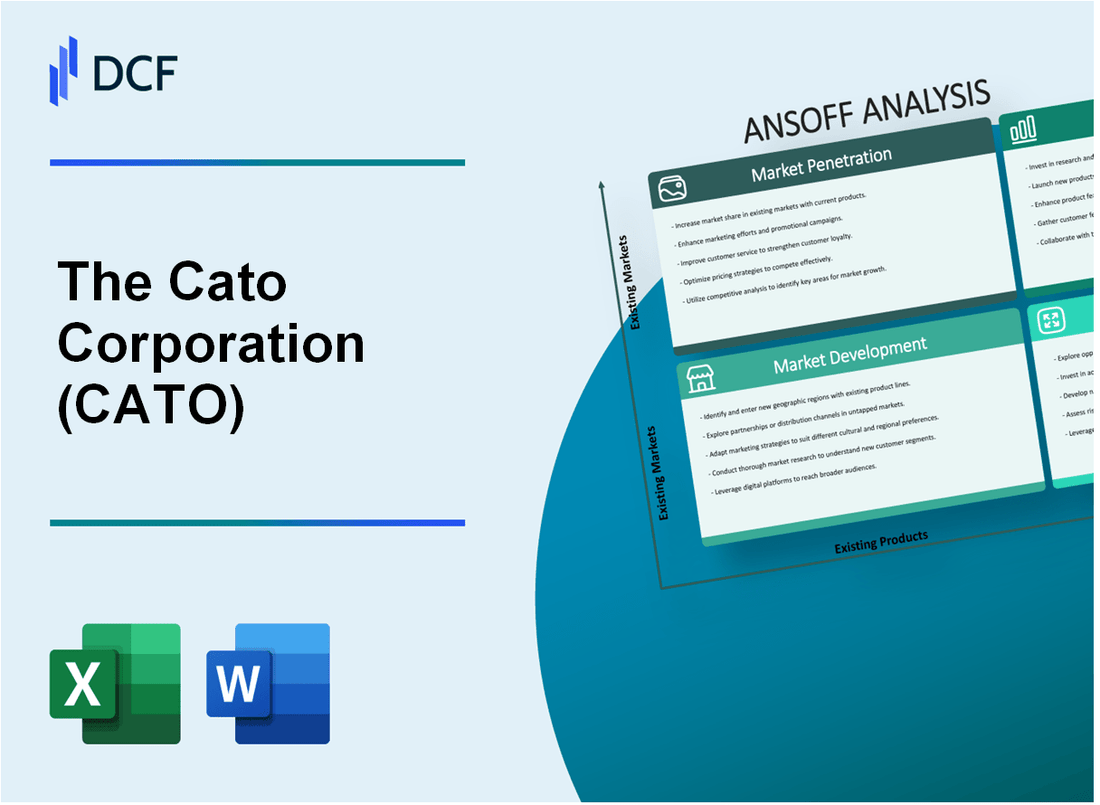
You're looking for clear growth vectors for The Cato Corporation, and after digging into their current standing-like that solid 32.0% Q3 gross margin-I've mapped out exactly where they can put their chips. For the near term, it's all about maximizing the 1,101 existing stores through better loyalty programs and aggressive promotions, which is defintely the safest bet. But to really move the needle, you need to watch the expansion plans, such as opening those 15 new stores in 2025 or introducing that affordable work-from-home apparel line. The real high-risk, high-reward moves, like acquiring a children's retailer or launching a credit card, are down in the Diversification quadrant, and you'll want to see the full breakdown below before making any big calls.
The Cato Corporation (CATO) - Ansoff Matrix: Market Penetration
You're looking at how The Cato Corporation can squeeze more revenue out of its current customer base and store footprint, which is the essence of market penetration. The recent performance gives you a clear starting point for this strategy.
The immediate goal is to push that recent success further. The Cato Corporation posted a 10% increase in same-store sales for the third quarter ended November 1, 2025. To build on that, you need to make loyalty programs irresistible, aiming for a growth rate beyond that 10% mark in the coming period.
Operationally, you must ensure inventory is perfectly matched to demand across the existing footprint. As of November 1, 2025, The Cato Corporation operated 1,101 stores across 31 states. Optimizing the flow means getting the right product to those 1,101 locations without excess carrying costs.
The external environment demands a sharp focus on value. Management noted they believe the fourth quarter will be challenging due in part to the slowdown in employment growth. This means the value proposition-new fashions every week at low prices every day-must be promoted aggressively to maintain customer traffic against this economic headwind.
You have the financial flexibility to support these efforts. The gross margin improved significantly in Q3 2025. Here's the quick math on that margin improvement:
| Metric | Q3 2025 Result | Q3 2024 Result | Change |
| Gross Margin | 32.0% of sales | 28.8% of sales | +3.2 percentage points |
| SG&A as % of Sales | 37.1% of sales | 40.0% of sales | -2.9 percentage points |
| SG&A Expense (Dollars) | $57.0 million | $57.9 million | Reduction of $0.9 million |
Leveraging that improved 32.0% Q3 gross margin is key. You can fund deeper, short-term price promotions to drive immediate transaction volume, knowing your cost structure is temporarily leaner thanks to lower freight and occupancy costs as a percentage of sales.
For the digital side, while specific marketing spend figures aren't detailed here, the strategy requires driving higher conversion rates on the existing e-commerce platform. This means every dollar spent on digital marketing needs to work harder to capture the existing customer base online, especially as you manage the physical footprint, which saw a net reduction of 16 stores year-to-date as of November 1, 2025 (down from 1,167 a year prior).
To execute this, consider these immediate focus areas:
- Target loyalty tiers with exclusive early access to new arrivals.
- Reduce out-of-stock instances in the top 20% of SKUs by location.
- Run a 'Value Guarantee' promotion tied to competitor pricing checks.
- Increase mobile site load speed by at least 15%.
- Reallocate savings from the 40 corporate positions eliminated in February 2025 to in-store visual merchandising.
Finance: draft the Q4 2025 inventory receipt schedule by Monday.
The Cato Corporation (CATO) - Ansoff Matrix: Market Development
You're looking at how The Cato Corporation (CATO) can grow by taking its existing value-priced fashion model into new geographic areas or new customer segments. This is Market Development, and for The Cato Corporation (CATO), the numbers show a business actively managing its physical footprint while planning targeted expansion.
The current physical footprint as of February 1, 2025, stood at 1,117 stores across 31 states. This network is principally concentrated in the southeastern United States. For instance, looking at a snapshot of store distribution, Texas held 143 locations, representing about 16% of the total US stores, while North Carolina had 84 stores, accounting for approximately 10%.
The near-term store development strategy for 2025 balances growth with optimization. The plan is to open up to 15 new stores while simultaneously closing up to 50 underperforming locations as leases expire. This net reduction in stores follows a pattern from 2024, where the company opened only one store while permanently closing 62 locations. This focus on efficiency comes as the company navigates a challenging economic environment, having reported full-year 2024 sales of $642.1 million and a net loss of $18.1 million.
Targeting the Hispanic consumer segment would involve a deep dive into product assortment and marketing spend. For context, total advertising expenditures for the full fiscal year 2024 were approximately 0.8% of retail sales. Furthermore, credit and layaway sales represented 6% of total retail sales in fiscal 2024, indicating a segment of the existing customer base that responds to specific financing options.
Launching a dedicated international e-commerce site would test demand outside the current 31-state domestic footprint. The existing e-commerce site, www.catofashions.com, already serves as a key channel, and the company's second quarter ended August 2, 2025, showed a positive trend with sales increasing 5% to $174.7 million and same-store sales rising 9% for that quarter.
Piloting a small-format store concept for dense urban areas outside the current southeastern focus requires capital allocation insight. The company reported cash reserves rising to $31.3 million in one period, which could fund such pilots, though management remains cautious due to uncertainty regarding tariffs and potential negative impacts on product acquisition costs.
Here are the key operational metrics related to the current footprint and 2025 plans:
| Metric | Value/Amount | Date/Period |
| Total Stores Operated | 1,117 | As of February 1, 2025 |
| Total States Operated In | 31 | As of February 1, 2025 |
| Planned New Stores Opening (2025) | Up to 15 | Fiscal Year 2025 Plan |
| Planned Store Closures (2025) | Up to 50 | Fiscal Year 2025 Plan |
| Stores Opened (2024) | 1 | Fiscal Year 2024 Actual |
| Stores Permanently Closed (2024) | 62 | Fiscal Year 2024 Actual |
| Total Retail Sales | $642.1 million | Fiscal Year Ended February 1, 2025 |
| Advertising Expenditure as % of Retail Sales | 0.8% | Fiscal Year 2024 |
| Q2 2025 Sales | $174.7 million | Quarter Ended August 2, 2025 |
| Q2 2025 Same-Store Sales Increase | 9% | Quarter Ended August 2, 2025 |
The execution of this Market Development strategy hinges on several factors:
- Maintaining the 9% same-store sales increase seen in the second quarter of 2025.
- Successfully offsetting the planned closure of up to 50 locations with the opening of up to 15 new ones.
- Ensuring new market entries, particularly in the Midwest, can match the performance of established states like Texas (143 stores).
- Effectively managing product costs, given that the company sources 98% of its apparel from overseas and faces tariff pressures.
The Cato Corporation (CATO) - Ansoff Matrix: Product Development
You're looking at how The Cato Corporation can grow by introducing new products, which is the Product Development quadrant of the Ansoff Matrix. Given the recent turnaround, focusing on product mix is key. We need to see how new offerings can build on the momentum seen in the latest reporting period.
The initial focus is on a new private-label line targeting the work-from-home demographic. This is important because the full fiscal year 2024 saw total sales drop to $642.1 million, with same-store sales declining 3.1% on a comparable 52-week basis. Introducing a focused, value-driven private label helps secure margin and customer loyalty when discretionary spending is under pressure, as noted by management following the fiscal 2024 results.
Next, expanding the accessories category is a clear path, especially since the latest results show strong underlying performance. For the third quarter ended November 1, 2025, same-store sales increased by a healthy 10%. This category is typically high-margin, and capitalizing on this positive trend is logical. The year-to-date gross margin for the nine months ended November 1, 2025, improved to 34.5% of sales, up from 33.3% in the prior year period, suggesting margin-accretive products are working.
Developing a premium capsule collection under the Versona brand aims to capture a higher price point. This contrasts with the overall fiscal 2024 gross margin, which settled at 32.0% of sales, down from 33.7% the year prior due to freight and markdown pressures. The recent Q3 2025 gross margin recovery to 32.0% (up from 28.8% in Q3 2024) shows cost control is helping, but a premium line needs to command a significantly higher margin percentage to justify the development cost.
Offering an in-store personal styling consultation service is a service-based product development aimed at increasing the average transaction value. The Cato Corporation operated 1,117 fashion specialty stores as of February 1, 2025. In the nine months ended November 1, 2025, the company achieved net income of $5.0 million, reversing the $4.0 million net loss from the comparable period in 2024, showing that improved operational leverage, partly from better SG&A management (down to 34.2% of sales year-to-date from 35.5%), is possible.
Finally, integrating a small, curated men's accessories section offers a cross-shopping convenience. The company's total sales for the nine months ended November 1, 2025, reached $496.8 million, a 2% increase over the prior year's nine-month sales of $486.8 million. This small addition could help drive incremental sales per customer across the existing store base, which saw a year-to-date same-store sales increase of 6%.
Here's a quick look at the margin and sales context for these product-focused initiatives:
| Metric | Fiscal Year 2024 (Ended Feb 1, 2025) | Nine Months Ended Nov 1, 2025 | Q3 Ended Nov 1, 2025 |
|---|---|---|---|
| Total Sales (Millions USD) | $642.1 | $496.8 | $153.7 |
| Gross Margin (% of Sales) | 32.0% | 34.5% | 32.0% |
| Same-Store Sales Change | -3.1% (52-week comparable) | +6% (Year-to-date) | +10% (Quarterly) |
The Cato Corporation (CATO) - Ansoff Matrix: Diversification
You're looking at how The Cato Corporation (CATO) can move beyond its core value apparel business, which saw retail sales of $642.1 million in fiscal 2024, down from $700.3 million in fiscal 2023. The company operated 1,117 stores as of February 1, 2025, a reduction from 1,178 stores a year prior.
Diversification, in this context, means entering new markets or product categories entirely. Here's a look at potential moves based on existing assets and market realities.
Acquire a Small, Complementary Value-Priced Children's Apparel Retailer
Entering the children's segment would mean tapping a new demographic while keeping the value proposition. This is a market adjacency play, leveraging the existing supply chain structure for non-adult apparel sourcing. The Cato Corporation's total revenues for fiscal 2024 were $649.8 million.
Launch a Financial Services Product, Like a Branded Credit Card
The existing finance-related income stream is already a small, established part of the business. In fiscal 2024, credit card sales represented 3.4% of retail sales, and credit and layaway sales together accounted for 6% of retail sales. Credit revenue itself was $2.7 million, or 0.4% of total revenue for the year.
The bad debt expense, net of recovery, for the credit portfolio was 3.9% of credit sales in fiscal 2024. Expanding this could mean offering a higher-tier card or a separate financing product for larger purchases, though the overall revenue contribution is small relative to the $642.1 million in retail sales.
Develop a Third-Party Logistics (3PL) Service
The Cato Corporation has experience managing its own distribution network, having noted improvements in its Distribution Center (DC) efficiency which helped slow sales decline in Q4 of fiscal 2024. The company operates a campus that includes its corporate offices and distribution center, which underwent renovation and reconfiguration. The strategy here is to monetize excess capacity. The company plans to close up to 50 underperforming stores in 2025 while opening up to 15 new ones, suggesting a potential shift in internal logistics needs.
Enter the Home Goods or Decor Market Under a New Value Brand
This move leverages the established supply chain for non-apparel items, similar to how they handle accessories. The company sources merchandise from approximately 620 suppliers, with the top 100 vendors accounting for the majority of purchases. A new value brand in home goods could utilize the existing vendor relationships and the distribution network that handled $642.1 million in retail sales in fiscal 2024.
Establish a Fast-Fashion Rental Subscription Service
Tapping the circular economy model is a significant departure, but it could appeal to a younger, more environmentally conscious segment of the market. This would require a completely different operational setup than the current brick-and-mortar focus, where the company operated 1,117 stores at the start of 2025. The company's e-commerce sales were less than 5% of total sales in fiscal 2024, indicating a lower current digital penetration to build upon.
Here's a snapshot of recent financial performance to ground these strategic considerations:
| Metric | Fiscal Year 2024 (Ended Feb 1, 2025) | Six Months Ended August 2, 2025 (Interim) |
|---|---|---|
| Total Revenues | $649.8 million | $346.751 million (Six Months 2025) |
| Retail Sales | $642.1 million | $343.072 million (Six Months 2025) |
| Net Income (Loss) | ($18.1 million) Loss | $10.141 million (Six Months 2025) |
| Number of Stores Operated | 1,117 (as of Feb 1, 2025) | 1,101 (as of Aug 2, 2025) |
| Credit Card Sales (% of Retail Sales) | 3.4% | Not explicitly stated for interim period |
| Cash & Short-term Investments | $77.7 million (as of Feb 1, 2025) | $90.775 million ($34.225M Cash + $56.550M ST Inv. as of Aug 2, 2025) |
The recent interim results for the first six months of fiscal 2025 show a slight positive turn in profitability, with net income reaching $10.141 million, compared to $11.069 million in the same period last year, while retail sales were up 0.3% to $343.072 million.
The company's selling, general, and administrative (SG&A) expenses were 36.0% of sales in fiscal 2024. Any new venture would need to manage its operating costs carefully, especially given the recent corporate job eliminations in February 2025.
Considerations for these diversification paths include:
- Acquisition target valuation in children's apparel.
- Regulatory hurdles for expanding financial product offerings.
- The utilization rate of the existing distribution center capacity.
- Sourcing complexity for non-apparel merchandise lines.
- The capital expenditure required for a rental inventory model.
Finance: draft 13-week cash view by Friday.
Disclaimer
All information, articles, and product details provided on this website are for general informational and educational purposes only. We do not claim any ownership over, nor do we intend to infringe upon, any trademarks, copyrights, logos, brand names, or other intellectual property mentioned or depicted on this site. Such intellectual property remains the property of its respective owners, and any references here are made solely for identification or informational purposes, without implying any affiliation, endorsement, or partnership.
We make no representations or warranties, express or implied, regarding the accuracy, completeness, or suitability of any content or products presented. Nothing on this website should be construed as legal, tax, investment, financial, medical, or other professional advice. In addition, no part of this site—including articles or product references—constitutes a solicitation, recommendation, endorsement, advertisement, or offer to buy or sell any securities, franchises, or other financial instruments, particularly in jurisdictions where such activity would be unlawful.
All content is of a general nature and may not address the specific circumstances of any individual or entity. It is not a substitute for professional advice or services. Any actions you take based on the information provided here are strictly at your own risk. You accept full responsibility for any decisions or outcomes arising from your use of this website and agree to release us from any liability in connection with your use of, or reliance upon, the content or products found herein.