

|
Cantaloupe, Inc. (CTLP): 5 FORCES Analysis [Nov-2025 Updated] |
Fully Editable: Tailor To Your Needs In Excel Or Sheets
Professional Design: Trusted, Industry-Standard Templates
Investor-Approved Valuation Models
MAC/PC Compatible, Fully Unlocked
No Expertise Is Needed; Easy To Follow
Cantaloupe, Inc. (CTLP) Bundle
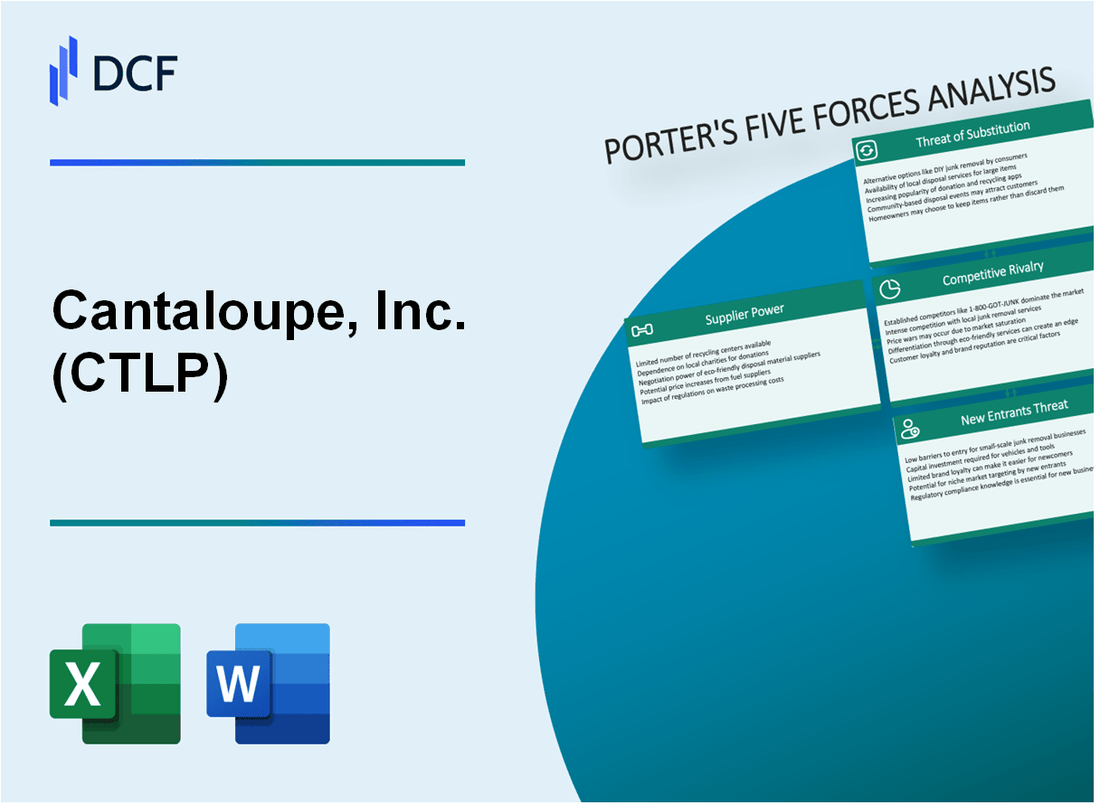
You're assessing Cantaloupe, Inc. (CTLP) right now, trying to figure out the business's real strength ahead of that planned $848 million acquisition by 365 Retail Markets. Honestly, the unattended retail tech space is a tough neighborhood; competitive rivalry is high, and suppliers have real leverage, controlling about 83% of critical tech components from just a few sources. Still, Cantaloupe, Inc. has built a decent lock-in with its integrated platform and a massive installed base of over 1.27 million active devices, which is defintely why the merger is happening-it's about buying scale to manage that pressure. Below, I map out the Five Forces to show you precisely where the leverage lies, from customer demands to the low threat of new entrants, so you can see the true competitive health of Cantaloupe, Inc. going into late 2025.
Cantaloupe, Inc. (CTLP) - Porter's Five Forces: Bargaining power of suppliers
You're looking at the supply side of Cantaloupe, Inc. (CTLP)'s business, and honestly, it's a classic area for concern in any hardware-enabled tech firm. When you provide end-to-end solutions that include IoT technology, you're tied to the physical world, and that means suppliers have a seat at the table.
A concentrated supplier market for critical components definitely creates leverage for those few players. Cantaloupe, Inc. has noted in filings that supply chain disruptions and inflationary pressure are real risks that could hurt financial performance. This suggests that if a key supplier for their card readers or IoT modules decides to raise prices or slow output, Cantaloupe, Inc. doesn't have a dozen alternatives ready to step in without friction. The reliance on a limited base of primary technology providers inherently increases switching costs; moving to a new vendor for specialized hardware or software integration isn't like swapping office supply companies.
To be fair, Cantaloupe, Inc.'s scale does offer some counter-leverage in volume purchasing. They are a global technology leader, and as of the second quarter of fiscal year 2025, they were supporting 1.27 million active devices. That's a significant volume commitment that gives their procurement team something to negotiate with. Still, the power dynamic hinges on how specialized those components are.
Here's a quick look at the operational scale Cantaloupe, Inc. brings to those supplier negotiations as of the quarter ending December 31, 2024:
| Metric | Value (Q2 FY2025) | Context |
|---|---|---|
| Total Revenue | $73.7 million | Quarterly top-line performance. |
| Active Devices | 1.27 million | Base for hardware/IoT component demand. |
| Active Customers | 32,909 | Customer base size for service contracts. |
| Total Dollar Volumes of Transactions | $843.1 million | Scale of payment processing activity. |
The bargaining power of suppliers is a constant balancing act. If the critical components-say, the microprocessors or secure payment modules-are proprietary or have long lead times, the supplier's power rises. Cantaloupe, Inc. must actively monitor and evaluate manufacturing partners to keep that risk in check, especially given their stated goal of accommodating expected growth. Finance: draft a sensitivity analysis on a 10% component cost increase by next Tuesday.
Cantaloupe, Inc. (CTLP) - Porter's Five Forces: Bargaining power of customers
Power is moderate due to high customer switching costs for the integrated platform, Cantaloupe ONE. This platform bundles hardware and high-margin Software as a Service (SaaS) into a flat monthly rate, which includes a full hardware warranty and management software access. This structure often involves an initial commitment period, such as the 36-month commitment period associated with the program, creating significant lock-in.
Cantaloupe serves over 34,115 active customers as of the end of the third quarter of fiscal year 2025, compared to 30,670 in the third quarter of fiscal year 2024, an increase of 11.2%. This large base dilutes the impact of any single customer loss. The total active devices stood at 1.26 million at the end of Q3 2025. To be fair, the sheer volume of their operations-processing more than a billion transactions every year across over a million active locations-means customer retention is paramount.
Customers, especially large enterprise accounts, which the structure suggests account for 60% of devices, demand continuous feature updates and competitive transaction fees. The high margin on the software component, with Subscription fees Adjusted Gross Margin reaching 90.7% in Q3 2025, suggests Cantaloupe, Inc. has pricing power in that segment, but transaction fee gross margins, at 24.8% in Q3 2025, are a key area where fee competitiveness matters.
Here's a quick look at the scale and financial context influencing customer leverage:
| Metric | Value (as of late 2025 data) | Period/Context |
| Active Customers | 34,115 | End of Q3 Fiscal Year 2025 |
| Active Devices | 1.26 million | End of Q3 Fiscal Year 2025 |
| Subscription Revenue (Q2 2025) | $20.7 million | Second Quarter Fiscal Year 2025 |
| Transaction Fees Revenue (Q2 2025) | $44.4 million | Second Quarter Fiscal Year 2025 |
| Subscription Adj. Gross Margin | 90.7% | Third Quarter Fiscal Year 2025 |
| Cantaloupe ONE Commitment | 36-month | Standard Term |
The structure of the Cantaloupe ONE program is designed to directly counter customer power by increasing the cost of exit. You are essentially trading the upfront capital expenditure for a multi-year service contract. This bundling strategy, which includes hardware replacement under warranty, makes it defintely harder for a customer to simply swap out a single component for a competitor's offering. The lock-in is contractual, not just technological.
The pressure points from the customer side center on the transaction fee component, which is the largest revenue stream by volume. Consider the transaction fee revenue growth versus subscription revenue growth:
- Subscription fees grew 10.3% year-over-year in Q3 2025.
- Transaction fees grew 10.0% year-over-year in Q3 2025.
- Total dollar volumes of transactions grew 15.5% year-over-year in Q2 2025.
If transaction volumes grow faster than transaction fee revenue, it suggests pricing pressure or a shift in the mix toward lower-fee transactions, which is a direct result of customer negotiation. Finance: draft 13-week cash view by Friday.
Cantaloupe, Inc. (CTLP) - Porter's Five Forces: Competitive rivalry
Rivalry is high in the fragmented unattended retail technology market. You're looking at a space where technology adoption, especially for cashless payments, is accelerating, but the players are numerous and often specialized. This fragmentation means Cantaloupe, Inc. faces pressure from multiple angles, forcing continuous investment in its integrated platform.
Key public competitors include Nayax (NYAX) and Crane NXT (CXT), offering similar integrated solutions. To be fair, the competitive landscape isn't just about direct payment processors. Nayax, for instance, is noted as a direct competitor operating across 40 verticals, which is significantly wider than Cantaloupe, Inc.'s focus on about 8 verticals as of early 2025. Crane NXT (CXT) presents a different kind of rivalry, possessing a broader product portfolio that isn't purely focused on the same unattended commerce niche.
Cantaloupe, Inc. holds an estimated 30-35% U.S. market share in payment processing, making it a clear target. This level of market concentration in a key service area naturally draws attention from rivals looking to consolidate or gain share through superior offerings or aggressive pricing. The company serves over 32,000 customers operating 1.23 million active devices, processing over $3 billion in annual transaction volume.
The pending merger with 365 Retail Markets for $848 million aims to drastically reduce rivalry and gain scale. This transaction, valued at approximately $848 million in an all-cash deal, is designed to combine Cantaloupe, Inc.'s payment processing and software services with 365 Retail Markets' self-checkout technology. The deal, expected to close in the second half of 2025, offers Cantaloupe, Inc. shareholders $11.20 per share, representing a 34% premium to the unaffected closing stock price on May 30, 2025. This move effectively takes Cantaloupe, Inc. private and is expected to create a larger entity better positioned against remaining competitors.
Here's the quick math on the scale shift this merger represents in terms of device footprint, which is a key metric in this industry:
| Entity | Devices (Approximate) | Annual Transaction Volume (Approximate) |
| Cantaloupe, Inc. (Pre-Merger) | 1.23 million | Over $3 billion |
| 365 Retail Markets (Pre-Merger) | 80,000 | Over $1 billion |
| Combined Entity (Post-Merger Estimate) | About 1.34 million globally | Significantly over $4 billion |
The combined company is projected to have about 1.34 million devices globally. This consolidation is a direct response to the high rivalry, aiming to achieve scale benefits and cross-sell opportunities.
Looking at Cantaloupe, Inc.'s recent operational focus, its revenue mix shows where the competitive battle for margin is fought:
- Transaction fees: 58% of revenue
- Subscription fees: 28% of revenue
- Equipment sales: 14% of revenue
The push toward higher-margin subscription revenue, like the Cantaloupe ONE program, is a strategic action to defend profitability against rivals who might compete aggressively on transaction processing rates. For the trailing twelve months ending September 30, 2025, Cantaloupe, Inc.'s revenue totaled $312.57 million.
Cantaloupe, Inc. (CTLP) - Porter's Five Forces: Threat of substitutes
The threat of substitutes for Cantaloupe, Inc. (CTLP) is moderate but definitely increasing as general payment technology evolves across the unattended retail space. You see this pressure from alternatives that don't require Cantaloupe, Inc.'s specific hardware or software stack.
Direct mobile payment apps, like Apple Pay or Google Pay, represent a clear path for consumers to bypass proprietary payment hardware entirely. While Cantaloupe, Inc.'s platform is designed to handle these digital methods, the underlying technology evolution means any new, frictionless mobile wallet gaining traction is a substitute for the established card-tap or proprietary app interaction on a micro-market kiosk. The platform's scale, processing $852.4 million in total dollar volumes in Q3 Fiscal Year 2025 alone, shows the sheer volume of transactions that could potentially be diverted by superior, non-integrated mobile solutions.
Traditional retail setups and self-checkout kiosks found in standard grocery or convenience stores serve as a substitute for the micro-market concept itself. If a consumer chooses to shop at a traditional store with a full checkout lane instead of an unattended micro-market, that is a substitution of the entire service delivery model. Cantaloupe, Inc. is focused on the unattended sector, where it has 34,115 active customers and 1.26 million active devices as of the end of Q3 2025.
Cash remains a persistent, albeit diminishing, substitute, even though cashless transactions clearly dominate the platform's scale. The company handles more than a billion transactions annually, which is a strong indicator of digital payment adoption. Still, for smaller, low-value purchases, the friction of pulling out a wallet for a card or phone can sometimes be less than the perceived friction of a digital-only terminal, keeping cash in play as a substitute in some locations.
Here's a quick look at the dollar volume growth across recent quarters, which gives you a sense of the underlying market movement Cantaloupe, Inc. is navigating:
| Fiscal Quarter End Date | Total Dollar Volumes (Millions USD) | Year-over-Year Growth in Dollar Volume |
| September 30, 2024 (Q1 FY2025) | $826.7 | 14.1% |
| December 31, 2024 (Q2 FY2025) | $843.1 | 15.5% |
| March 31, 2025 (Q3 FY2025) | $852.4 | 11.1% |
The increasing adoption of digital methods is clear from the transaction fees, which were $44.0 million in Q3 2025, up 10.0% year-over-year. This growth in digital payment revenue suggests that while substitutes exist, Cantaloupe, Inc.'s platform is successfully capturing the shift away from cash. The full-year 2025 revenue guidance was projected to be between $302 million and $308 million.
You should watch for these specific substitute pressures:
- Adoption rate of non-integrated mobile wallets.
- Growth in traditional self-checkout market share.
- Consumer preference shifts in high-traffic venues.
- Competitors offering lower-cost, non-cloud-based payment hardware.
Finance: draft a sensitivity analysis on a 5% shift in transaction mix towards non-CTLP mobile payments by end of Q4.
Cantaloupe, Inc. (CTLP) - Porter's Five Forces: Threat of new entrants
The threat of new entrants for Cantaloupe, Inc. remains low, you can see that clearly when you look at the sheer scale of operations required to be a meaningful competitor in this space. Honestly, it's not just about having a good payment terminal; it's about the entire ecosystem.
New entrants face high initial capital requirements for R&D and hardware deployment. While a small-time operator might start a few vending machines for as little as $5,000 to $15,000, building a platform that can service over a million devices and handle the complexity Cantaloupe, Inc. manages requires investment orders of magnitude larger. Furthermore, the technology stack itself is a hurdle.
Consider the required technological sophistication. A new entrant must immediately build out capabilities to handle the proliferation of Alternative Payment Methods (APMs), like digital wallets and QR codes, while maintaining strict compliance with evolving security standards like PCI PTS v.6. This isn't trivial software development; it's mission-critical infrastructure.
Cantaloupe's FY2025 revenue guidance of up to $322 million demonstrates the scale needed to compete effectively. Any new player needs to raise significant capital just to approach that revenue run rate through scale, let alone the R&D spend required to match Cantaloupe, Inc.'s existing feature set.
The need for a vast, established network of over 1.27 million active devices is a major barrier. This installed base, confirmed at the end of the second quarter of Fiscal Year 2025, represents years of sales, installation, and relationship building with operators. A new entrant has zero devices and zero established service contracts.
Here's a quick look at the scale Cantaloupe, Inc. has already achieved, which a new entrant must replicate:
| Metric | Value (as of latest reported data in FY2025) |
| FY2025 Total Revenue Guidance (Upper End) | $322 million |
| Active Devices (End of Q2 FY2025) | 1.27 million |
| Active Customers (End of Q1 FY2025) | 32,338 |
The technological complexity is compounded by the need for deep integration and service coverage. A new competitor must not only deploy hardware but also build out the necessary support infrastructure to manage that fleet.
The barriers to entry are therefore high due to:
- High capital needed for scale and R&D.
- The established network size of 1.27 million devices.
- The necessity of robust, compliant payment processing.
- The need to match a revenue scale targeting $322 million.
If onboarding takes 14+ days, churn risk rises, which is a complexity a new entrant will struggle with immediately.
Finance: draft 13-week cash view by Friday.
Disclaimer
All information, articles, and product details provided on this website are for general informational and educational purposes only. We do not claim any ownership over, nor do we intend to infringe upon, any trademarks, copyrights, logos, brand names, or other intellectual property mentioned or depicted on this site. Such intellectual property remains the property of its respective owners, and any references here are made solely for identification or informational purposes, without implying any affiliation, endorsement, or partnership.
We make no representations or warranties, express or implied, regarding the accuracy, completeness, or suitability of any content or products presented. Nothing on this website should be construed as legal, tax, investment, financial, medical, or other professional advice. In addition, no part of this site—including articles or product references—constitutes a solicitation, recommendation, endorsement, advertisement, or offer to buy or sell any securities, franchises, or other financial instruments, particularly in jurisdictions where such activity would be unlawful.
All content is of a general nature and may not address the specific circumstances of any individual or entity. It is not a substitute for professional advice or services. Any actions you take based on the information provided here are strictly at your own risk. You accept full responsibility for any decisions or outcomes arising from your use of this website and agree to release us from any liability in connection with your use of, or reliance upon, the content or products found herein.