
|
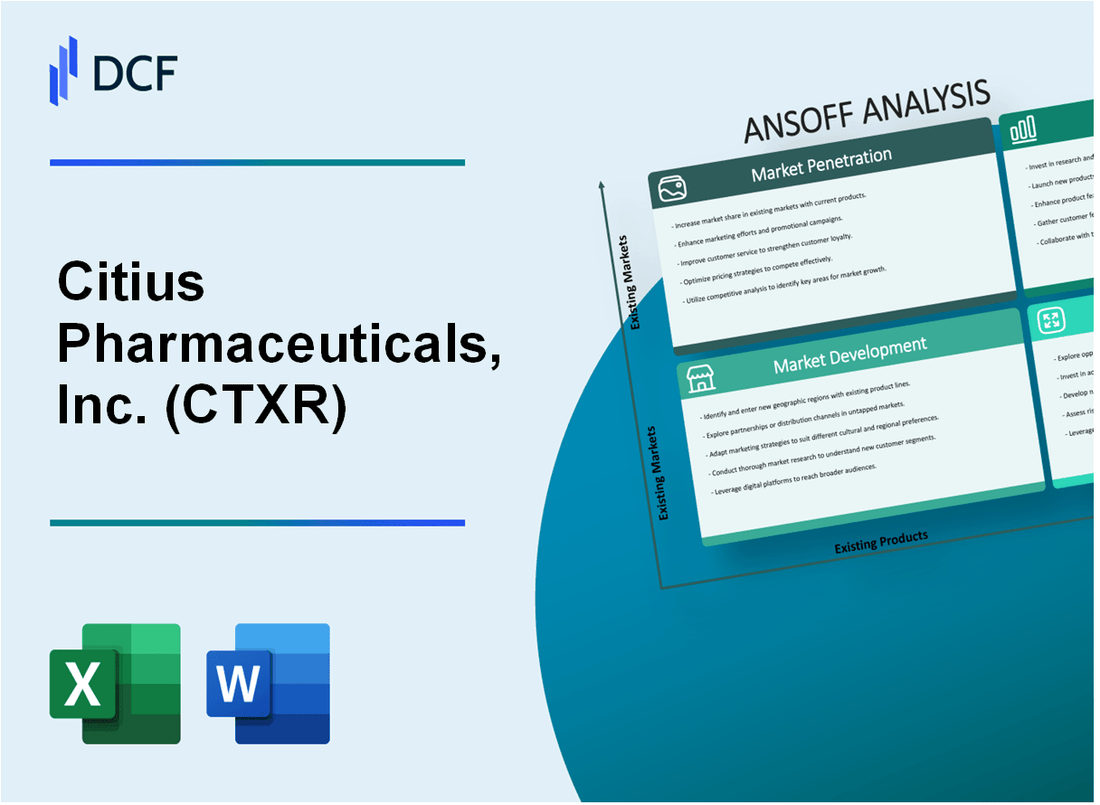
Citius Pharmaceuticals, Inc. (CTXR): ANSOFF MATRIX [Dec-2025 Updated] |
Fully Editable: Tailor To Your Needs In Excel Or Sheets
Professional Design: Trusted, Industry-Standard Templates
Investor-Approved Valuation Models
MAC/PC Compatible, Fully Unlocked
No Expertise Is Needed; Easy To Follow
Citius Pharmaceuticals, Inc. (CTXR) Bundle
You're looking at Citius Pharmaceuticals, Inc. as they make that tough pivot from a pure development story to actually selling products in late 2025, especially after posting an $11.5 million net loss in Q2 2025, even with that recent $16.5 million equity injection. As your analyst, I've mapped out exactly how they plan to use their core assets-LYMPHIR, Mino-Lok, and Halo-Lido-across four clear growth paths, from aggressively pushing LYMPHIR in the U.S. to exploring new markets and products. This Ansoff Matrix isn't just theory; it's the actionable blueprint for turning R&D spend into shareholder returns, so let's dive into the specific moves they need to nail right now.
Citius Pharmaceuticals, Inc. (CTXR) - Ansoff Matrix: Market Penetration
You're preparing for the commercial liftoff of LYMPHIR, which means the focus now shifts entirely to capturing market share in the existing, approved indication for relapsed or refractory cutaneous T-cell lymphoma (CTCL). This is the lowest-risk quadrant of the Ansoff Matrix, but execution has to be flawless, especially given the capital structure.
The primary goal is to maximize LYMPHIR's U.S. launch, targeted for Q4 2025, to capture share of the estimated $400 million addressable market. Some analyses place the market potential as high as $500 million per annum, but the management estimate you should work from is the $400 million figure. You've already invested approximately $90 million in development and pre-commercial efforts leading up to this point. The company has built up inventory, reporting finished goods of $8,962,493 and work-in-progress of $8,246,474 as of June 30, 2025, totaling $17,208,967, which is enough to cover 12 to 18 months of projected demand based on the drug's 60-month shelf life. This inventory build is a critical step before revenue generation.
To ensure you hit the ground running, the strategy involves several concrete actions:
- Utilize the AI platform integration to precisely target high-volume CTCL prescribers and cancer centers.
- Secure rapid inclusion of LYMPHIR on major hospital formularies and payer reimbursement lists.
- Deploy the specialized field sales team to drive adoption among oncologists and hematologists.
- Offer patient assistance programs to reduce out-of-pocket costs and improve access to LYMPHIR.
Regarding market access, securing the right coding and guideline placement was paramount. The Centers for Medicare & Medicaid Services (CMS) assigned a unique, permanent J-Code, J9161, which became effective on April 1, 2025. This code is essential for streamlining billing and reimbursement across commercial and government payers. Furthermore, LYMPHIR received an NCCN Category 2A recommendation, which signals a uniform consensus among oncology and hematology experts that the drug is appropriate for CTCL patients, directly influencing treatment protocols and payor coverage decisions.
Here's a quick look at the financial positioning supporting this launch phase, based on the fiscal third quarter 2025 results ending June 30, 2025:
| Metric | Value (Citius Pharma) | Value (Citius Oncology) |
| Gross Financings Q3 2025 | $12.5 million | $9 million (July 2025) |
| June 2025 Offering (Direct) | $6 million | N/A |
| Cash and Equivalents (June 30, 2025) | $6.1 million | $112 (as of June 30, 2025) |
| Net Loss Q3 2025 | $9.2 million | $5.4 million |
| R&D Expenses Q3 2025 | $1.6 million | $0.938 million |
The transition to a commercial organization is reflected in the operating expense shift; R&D expenses for Citius Pharmaceuticals decreased year-over-year to $1.6 million for the quarter ended June 30, 2025, from $2.8 million in the prior year period. General and Administrative (G&A) expenses were $4.4 million for the same quarter. Honestly, with cash on hand at $6.1 million as of June 30, 2025, before the July financing, the runway was tight, making those recent capital raises absolutely necessary to fund the initial sales push.
Citius Pharmaceuticals, Inc. (CTXR) - Ansoff Matrix: Market Development
You're looking at how Citius Pharmaceuticals, Inc. plans to grow by taking its existing, approved, or late-stage products into new geographic territories or new patient populations. This is the Market Development quadrant of the Ansoff Matrix, and for Citius Pharmaceuticals, Inc., it centers on two key assets: LYMPHIR and Mino-Lok.
Expanding LYMPHIR Beyond the U.S. and Japan
For LYMPHIR, which received FDA approval in August 2024 for relapsed or refractory cutaneous T-cell lymphoma (CTCL), the market development strategy focuses on establishing a footprint in major territories outside the initial U.S. launch, planned for the second half of 2025. The initial U.S. addressable market for CTCL is estimated to exceed $400 million. To begin this international expansion, Citius Pharmaceuticals, Inc. is using Named Patient Programs (NPPs) to serve patients urgently needing treatment while building relationships with treatment centers.
This initial international push involves securing distribution partners in key regions. For instance, an exclusive distribution agreement was signed with Integris Pharma S.A. to cover specific European and Balkan countries:
- Greece
- Cyprus
- Malta
- Bulgaria
- Romania
- Croatia
- Serbia
- Albania
- Bosnia Herzegovina
- Kosovo
- Montenegro
- North Macedonia
This NPP strategy is a tactical step toward broader commercialization rights licensing in major European Union countries and Canada, outside the current U.S. and Japan markets.
Exploring New Indications for LYMPHIR
A key part of developing the market for LYMPHIR involves exploring new uses for the drug. Remember, denileukin diftitox received regulatory approval in Japan back in 2021 for both relapsed or refractory CTCL and peripheral T-cell lymphoma (PTCL). This existing approval for PTCL provides a clinical precedent for Citius Pharmaceuticals, Inc. to initiate a Phase 4 study to explore its use in PTCL within the U.S. market, which represents a new indication for the FDA-approved product.
Commercializing Mino-Lok in the Global Market
Mino-Lok, the antibiotic lock solution designed to salvage catheters in patients with catheter-related bloodstream infections (CRBSIs), is positioned for a massive market opportunity post-FDA approval. Citius Pharmaceuticals, Inc. is actively looking to partner with a global pharmaceutical company to commercialize Mino-Lok in the estimated $1.8 billion worldwide market post-FDA approval. The company completed its pivotal Phase 3 trial for Mino-Lok in 2023, meeting primary and secondary endpoints. Following a constructive Type C meeting, the FDA provided actionable guidance supporting a pathway to a future New Drug Application (NDA) submission.
The company is also planning to seek regulatory approval for Mino-Lok in high-incidence regions like China or India, leveraging its existing designations, such as Qualified Infectious Disease Product (QIDP) and Fast Track status, to potentially expedite market entry in these territories.
Financial Capacity to Support Market Development
Executing these market development strategies requires capital. Citius Pharmaceuticals, Inc. and its majority-owned subsidiary, Citius Oncology, have been actively raising funds to support the LYMPHIR commercialization efforts and advance Mino-Lok. Here are some recent financing activities to fund these initiatives:
| Financing Event | Amount | Date/Period | Purpose Context |
|---|---|---|---|
| Registered Direct Offering (Citius Pharma) | $6.0 million | June 2025 | Fund commercialization activities and corporate operations |
| Gross Proceeds (Citius Oncology) | $9 million | July 2025 | Facilitate LYMPHIR pre-launch initiatives |
| Gross Financings (Citius Pharma) | $12.5 million | Fiscal Third Quarter 2025 (ended June 30, 2025) | General funding support |
The company is definitely focused on transitioning to a commercial-stage enterprise, so these capital raises are defintely critical to executing the international and indication expansion plans outlined here.
Citius Pharmaceuticals, Inc. (CTXR) - Ansoff Matrix: Product Development
You're looking at the core of Citius Pharmaceuticals, Inc.'s (CTXR) growth engine here-taking what's in the lab and clinical trials and pushing it toward the patient. This is Product Development in action, moving from existing platforms into new market spaces or improving current assets.
For Mino-Lok, the focus is on finalizing the New Drug Application (NDA) submission. The Phase 3 Trial was a success, meeting both primary and secondary endpoints, which is a huge milestone. Citius Pharmaceuticals, Inc. is actively engaged with the FDA to outline the next steps following constructive guidance, which includes preparing a submission reflecting clinical efficacy, safety data, and in-vitro data to support the future NDA filing. This is the critical bridge from successful trial to market access for this anti-infective lock solution.
Advancing CITI-002 (Halo-Lido) targets the hemorrhoids space. While the Phase 2b trial concluded in 2023, the market opportunity is substantial. Self-reported prevalence for hemorrhoids reaches approximately 10 million cases annually in the US. The US hemorrhoids treatment market size was projected to be $323.53 Million in 2025, and the global market was estimated at $1.17 billion in 2025. The North American market held a 44.66% share in 2024, driven by high prevalence and advanced infrastructure. The plan here is to move this topical formulation into a pivotal Phase 3 trial to confirm efficacy for this large patient pool.
For LYMPHIR, the focus shifts post-approval. The targeted immunotherapy received FDA approval in August 2024 for relapsed or refractory cutaneous T-cell lymphoma (CTCL). Management estimated the initial market for LYMPHIR currently exceeds $400 million. The product development effort now centers on commercial execution, but any future work on new formulations or delivery methods would aim to improve patient convenience or administration for this oncology asset.
The investment in future pipeline assets is also clear. Citius Pharmaceuticals, Inc. allocated $3.8 million to Research and Development (R&D) expenses during the fiscal second quarter of 2025, which ended March 31, 2025. A portion of this budget is earmarked for preclinical studies supporting next-generation anti-infective lock solutions, ensuring the pipeline doesn't stop with Mino-Lok.
Here's a quick look at some of the key figures driving these product development efforts:
| Product/Metric | Financial/Statistical Figure | Reporting Period/Context |
| Q2 2025 R&D Expense | $3.8 million | Quarter ended March 31, 2025 |
| LYMPHIR Initial Market Estimate | Over $400 million | As of June 2025 |
| US Hemorrhoid Annual Cases (Self-Reported) | Approximately 10 million | Annual estimate |
| US Hemorrhoids Treatment Market Projection | $323.53 Million | 2025 Estimate |
| Global Hemorrhoids Treatment Market Value | $1.17 billion | 2025 Estimate |
| Mino-Lok Phase 3 Trial Status | Met primary and secondary endpoints | Completed |
The pipeline advancement relies on several key activities and milestones:
- Complete Mino-Lok NDA submission preparation following FDA Type C meeting guidance.
- Advance CITI-002 (Halo-Lido) into pivotal Phase 3 trial targeting the hemorrhoid market.
- Secure additional capital to fund ongoing development and commercialization activities.
- LYMPHIR commercial launch planned for the fourth quarter of 2025.
- Q3 2025 R&D expenses were $1.6 million.
Citius Pharmaceuticals, Inc. (CTXR) - Ansoff Matrix: Diversification
You're looking at how Citius Pharmaceuticals, Inc. can move beyond its current focus to build a more resilient revenue base, which is critical when you see net losses widening. Honestly, after reporting a net loss of $11.5 million for the quarter ended March 31, 2025, and a subsequent net loss of $9.2 million for the quarter ended June 30, 2025, the push for diversification is more than just strategy; it's about survival until LYMPHIR™ commercialization gains traction.
Here's the quick math on the capital situation: As of June 30, 2025, Citius Pharmaceuticals had $6.1 million in cash and cash equivalents, but you know that cash runway is tight given the burn rate. The company has been actively raising capital, securing net proceeds of $16.5 million from equity issuance over the nine months ending June 30, 2025, plus another expected gross raise of approximately $6.0 million in October 2025. Still, new revenue streams are the best hedge.
Let's map out the diversification avenues based on your outline, grounding this in what Citius Pharmaceuticals has on the books:
- Advance the CTx001 proprietary subcutaneous infusion platform into a new therapeutic area, like autoimmune disease.
- Explore strategic alternatives for the NoveCite stem cell program, including a potential out-licensing deal or spin-off.
- Acquire a commercial-stage, non-oncology product to generate immediate revenue and offset the Q2 2025 net loss.
- Establish a joint venture in a high-growth emerging market to develop and commercialize a non-core asset.
Regarding the NoveCite stem cell program, which focuses on induced mesenchymal stem cell (i-MSC) therapy for acute respiratory distress syndrome (ARDS), the company has been evaluating its future. As far back as May 2022, Citius Pharmaceuticals indicated it would evaluate alternatives to optimize the value of this asset. Given the pre-clinical stage of the program and the immediate need to fund the LYMPHIR™ launch, exploring an out-licensing deal or spin-off for NoveCite becomes a clear financial lever to conserve capital or bring in non-dilutive funding.
The push for an acquisition of a commercial-stage, non-oncology product directly addresses the recurring losses. For instance, Citius Pharmaceuticals reported R&D expenses of $1.6 million for the quarter ended June 30, 2025. An acquisition could immediately shift that dynamic by introducing product sales, which would be a stark contrast to the $9.2 million net loss reported for that same quarter. The company's pipeline does include non-oncology assets like Halo-Lido for hemorrhoids, which completed a Phase 2b trial in 2023, but this is an internal asset, not an acquisition for immediate revenue.
To give you a snapshot of the assets that could be candidates for out-licensing, JV, or acquisition focus, here's what the pipeline looks like, excluding the primary oncology focus of LYMPHIR™:
| Asset | Indication | Latest Development Status Mentioned | Potential Strategic Action |
|---|---|---|---|
| NoveCite i-MSCs | Acute Respiratory Distress Syndrome (ARDS) | Pre-clinical stage; strategic alternatives evaluation ongoing | Out-licensing or Spin-off |
| Halo-Lido (CITI-002) | Hemorrhoids | Phase 2b trial completed in 2023 | Commercialization or Out-licensing |
| Mino-Lok | Catheter-Related Bloodstream Infections (CRBSI) | Phase 3 trial met endpoints in 2023; engaging with FDA | Partnership for Commercialization |
The need for immediate revenue generation, as implied by the goal to offset the $11.5 million Q2 2025 net loss, makes the acquisition route a high-priority diversification tactic. While Citius Oncology is the focus for LYMPHIR™, which management estimated had an initial market exceeding $400 million, any non-oncology commercial product would provide revenue diversification away from the single oncology asset. The company's stated use of the October 2025 offering proceeds includes supporting the commercial launch of LYMPHIR™ and development initiatives for all product candidates, suggesting capital allocation across the board, but a revenue-generating acquisition would change the cash flow profile significantly.
Establishing a joint venture in an emerging market for a non-core asset, like perhaps Mino-Lok or Halo-Lido outside the U.S., is a classic way to share development/commercialization costs and access new patient pools without a full capital outlay. For example, Citius Oncology was already looking at international markets for LYMPHIR™ through licensing partnerships as of January 2025. Applying that partnership model to a non-oncology asset could be a lower-risk diversification step. Finance: draft 13-week cash view by Friday.
Disclaimer
All information, articles, and product details provided on this website are for general informational and educational purposes only. We do not claim any ownership over, nor do we intend to infringe upon, any trademarks, copyrights, logos, brand names, or other intellectual property mentioned or depicted on this site. Such intellectual property remains the property of its respective owners, and any references here are made solely for identification or informational purposes, without implying any affiliation, endorsement, or partnership.
We make no representations or warranties, express or implied, regarding the accuracy, completeness, or suitability of any content or products presented. Nothing on this website should be construed as legal, tax, investment, financial, medical, or other professional advice. In addition, no part of this site—including articles or product references—constitutes a solicitation, recommendation, endorsement, advertisement, or offer to buy or sell any securities, franchises, or other financial instruments, particularly in jurisdictions where such activity would be unlawful.
All content is of a general nature and may not address the specific circumstances of any individual or entity. It is not a substitute for professional advice or services. Any actions you take based on the information provided here are strictly at your own risk. You accept full responsibility for any decisions or outcomes arising from your use of this website and agree to release us from any liability in connection with your use of, or reliance upon, the content or products found herein.