
|
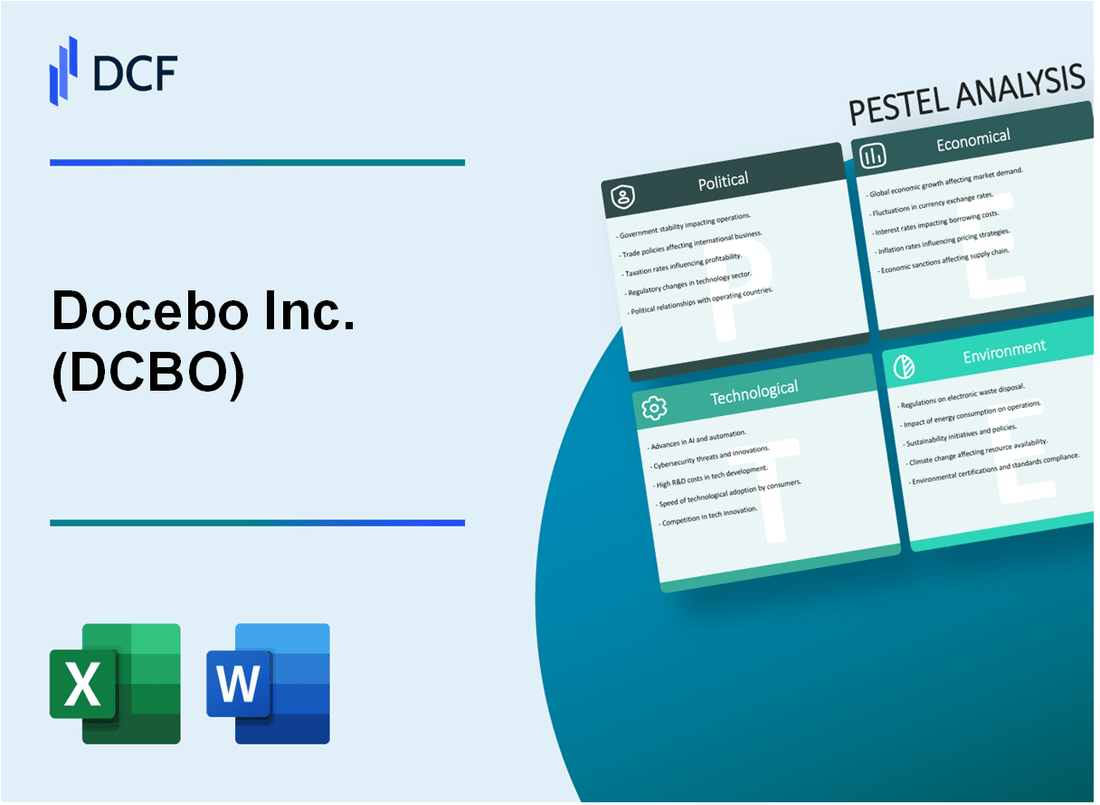
Docebo Inc. (DCBO): PESTLE Analysis [Nov-2025 Updated] |
Fully Editable: Tailor To Your Needs In Excel Or Sheets
Professional Design: Trusted, Industry-Standard Templates
Investor-Approved Valuation Models
MAC/PC Compatible, Fully Unlocked
No Expertise Is Needed; Easy To Follow
Docebo Inc. (DCBO) Bundle
Docebo Inc. (DCBO) is making an aggressive, high-stakes pivot to an 'AI-First' platform, and you need to understand the macro-level risks and tailwinds driving that move. The 2025 narrative is a balancing act: strong projected revenue growth of 11.40% and an 18.0% Adjusted EBITDA margin target are fantastic, but they ride on the back of navigating complex new global AI laws and securing key government contracts. Let's cut straight to the PESTLE analysis so you can see where the real action is.
The Political landscape for Docebo Inc. is a game of compliance and access. Securing FedRAMP certification is a huge deal because it defintely opens the door to new US federal and SLED (State, Local, and Education) contracts, which are sticky, high-value accounts.
But, still, global economic uncertainty and ongoing geopolitical conflicts create real volatility in international sales, especially when dealing with complex procurement and compliance rules for government entities. You need to watch those trade policies; they're a minor headwind for global operations, but they can complicate things fast.
The near-term economics look solid, but you have to look beyond the top-line number. Management is projecting total revenue growth for fiscal year 2025 at 11.40%, which shows steady top-line momentum. Plus, the focus on efficiency is clear: the Adjusted EBITDA margin target for FY2025 is 18.0%. Here's the quick math: that margin improvement suggests better unit economics, not just growth.
However, foreign currency exchange rate fluctuations impact reported revenue and operating expenses due to the global presence, so watch the dollar strength. Also, the risk of client churn, particularly among large enterprise accounts, is the one thing that can slow that Annual Recurring Revenue (ARR) growth down quickly.
Sociologically, the tailwinds are strong because the market needs what Docebo Inc. sells. The massive corporate demand for upskilling and reskilling is driving enterprise Learning Management System (LMS) adoption. The shift to hybrid and remote work isn't going away, so companies absolutely need scalable, cloud-based learning platforms for employee enablement; a simple, essential requirement.
L&D departments are prioritizing soft skills training, like leadership development, in 2025. That aligns perfectly with the market growth in microlearning modules, which is projected at a 9.7% CAGR from 2025 to 2033. It's all about bite-sized, relevant content now.
This is where the future is being built. Docebo's central 'AI-First' platform strategy is the core driver, moving them beyond just traditional LMS (Learning Management System) features. New AI-powered products like AI Creator and AI Virtual Coaching automate content creation and experiential learning, which is a massive time-saver for clients.
The launch of Harmony, an L&D agentic marketplace, aims to connect the broader learning tech ecosystem, which could create a strong network effect. This aggressive move is fueled by a huge market opportunity: the global LMS market is projected to grow at a robust 19.4% CAGR through 2030. That's a powerful incentive for innovation.
The biggest near-term risk sits right here in the Legal column. The lack of clarity on emerging global AI laws creates regulatory uncertainty for all those new AI-driven features. What this estimate hides is the potential cost of re-engineering features if a major jurisdiction, say the EU, drops a strict new law.
Plus, compliance with varying international data privacy regulations (like GDPR, the European Union's General Data Protection Regulation) is critical for their multinational client base. Issues in the use of AI in the platform could result in reputational harm or liability if not managed well. On the positive side, FedRAMP authorization provides a clear competitive legal advantage for securing those US federal government contracts we talked about earlier.
As a software-as-a-service (SaaS) provider, Docebo Inc. has a relatively low direct climate-related risk exposure, but ESG (Environmental, Social, and Governance) reporting is becoming a standard expectation for public companies. The focus on tracking Scope 1, 2, and 3 emissions aligns with growing stakeholder demand for transparency, even for a company that doesn't manufacture anything.
They show an early commitment to minimizing their footprint, with 80% of offices using a Green Energy Supplier Policy (based on 2021 data). This is less about immediate risk and more about long-term investor appeal and brand reputation. It doesn't change a decision today, but it will matter in five years.
Next Step: Portfolio Manager: Model the impact of a 10% reduction in international sales due to geopolitical volatility on the 18.0% Adjusted EBITDA target by end of next week.
Docebo Inc. (DCBO) - PESTLE Analysis: Political factors
The political landscape for Docebo Inc. in 2025 presents a clear duality: a significant opportunity driven by US government certification, balanced against the persistent, low-level drag of global geopolitical friction and currency volatility. Your key takeaway here is that compliance is now a direct, measurable revenue driver.
FedRAMP certification secures new US federal and SLED (State, Local, and Education) contracts.
The single most important political catalyst for Docebo in 2025 was achieving the Federal Risk and Authorization Management Program (FedRAMP) Moderate Authority to Operate (ATO) in April/May 2025. This is the government's gold standard for cloud security, essentially unlocking the entire U.S. federal market, which is a massive new addressable market for the company's AI-powered learning platform.
This certification immediately translated into tangible wins, validating the multi-year investment in security compliance. These early victories are crucial because they establish a track record for future, larger engagements. The management team had originally expected these federal wins to materialize later, so securing them early is a defintely positive signal.
- Secured expansion with the U.S. Department of Energy.
- Won a major deal with the Air Force Cyber Academy via a partner, Deloitte.
- Added State, Local, and Education (SLED) customers, including Wisconsin's Department of Public Instruction, Temple University, and the City of Sugar Land, Texas.
Global economic uncertainty and geopolitical conflicts create volatility in international sales.
While the U.S. public sector is a clear growth engine, Docebo's global footprint-with a significant portion of its sales coming from the Rest of World segment-exposes it to macro-political and economic instability. The ongoing conflicts in the Middle East and Europe, coupled with US-China decoupling, create a pervasive sense of global uncertainty that can slow down enterprise purchasing decisions outside of North America.
More concretely, geopolitical shifts manifest as currency volatility, which directly impacts the reported revenue. For instance, in Q2 and Q3 of 2025, the weakening of the U.S. dollar relative to foreign currencies provided a positive impact of approximately 1 to 2 percentage points on subscription revenue growth. This is a double-edged sword: it boosts reported numbers when the dollar is weak, but it's a constant, unpredictable factor you must account for in your sales forecasts.
Here's the quick math on the scale of the business, based on our $241.7 million full-year 2025 revenue estimate, which is driven by the management's 11.40% growth guidance:
| Metric | Value (USD Millions) | Notes |
|---|---|---|
| 2024 Full-Year Total Revenue | $216.93 million | Baseline for 2025 growth. |
| 2025 Full-Year Total Revenue (Est.) | $241.7 million | Based on 11.40% growth guidance. |
| 2024 North America Revenue | $164.02 million | The primary market, now bolstered by FedRAMP. |
| 2024 Rest of World Revenue | $52.91 million | Exposed to geopolitical and currency volatility. |
Trade policies and tariff-related uncertainty remain a minor headwind for global operations.
As a Software-as-a-Service (SaaS) provider, Docebo is largely insulated from the direct impact of tariffs on physical goods, such as the 25% duties on steel or the threatened 10% to 20% tariffs on all foreign countries discussed in 2025. The real risk here is indirect: a global trade war, which CEOs globally rank as a top geopolitical risk for 2025, dampens overall corporate spending.
The political rhetoric around trade, especially between the US, EU, and China, creates a climate of caution. This can delay large, multi-year enterprise software contracts, particularly in Europe and Asia, where nearly 50% of C-suite executives cited US-EU-China tensions as a high-impact issue in a 2025 survey. For a company focused on enterprise sales, a cautious CFO is a headwind, even if no tariff is directly applied to a line of code.
Sales to government entities introduce complex procurement and compliance challenges.
The FedRAMP success is an opportunity, but it also locks the company into a higher, more complex level of compliance. Selling to government entities, particularly the U.S. federal government, requires a specialized approach that differs significantly from commercial sales.
The compliance burden is immense, requiring continuous monitoring and adherence to hundreds of rigorous security controls-it's not a one-time audit. This mandates a distinct, secure platform (Docebo's LearnGov solution) and a reliance on systems integrator partners, like Deloitte, to navigate the complex procurement cycles and long sales timelines. This complexity adds significant operational cost and risk compared to a standard commercial sale, but the payoff is access to a stable, large-scale public sector budget.
Docebo Inc. (DCBO) - PESTLE Analysis: Economic factors
You're looking for a clear picture of Docebo Inc.'s economic footing in late 2025, and the data shows a company prioritizing profitable growth over hyper-growth, a smart move in a volatile macro environment. The core takeaway is that while top-line growth is moderating, operational efficiency is sharply improving, but you defintely need to watch enterprise client retention.
Projected total revenue growth for fiscal year 2025 is 11.40%, indicating steady top-line momentum.
Docebo Inc. is projecting a total revenue growth of 11.40% for the full fiscal year 2025, based on the company's most recent revised financial guidance. This figure reflects a strategic shift from the higher growth rates seen in prior years, focusing instead on sustainable expansion and margin improvement. The subscription revenue growth, which is the higher-quality revenue stream, is expected to be slightly stronger at 11.75% for the same period. This momentum is supported by the continued adoption of its AI-powered learning platform, especially within the mid-market segment, which has shown robust performance.
Here's the quick math on recent performance and guidance:
| Metric (as of Q3 2025 Guidance) | Fiscal Year 2025 Projection | Q3 2025 Actual |
|---|---|---|
| Total Revenue Growth (YoY) | 11.40% | 11% |
| Subscription Revenue Growth (YoY) | 11.75% | 10% |
| Adjusted EBITDA Margin | 18.0% | 20.1% |
Adjusted EBITDA margin target for FY2025 is 18.0%, showing improved operational efficiency.
The company has set an Adjusted Earnings Before Interest, Taxes, Depreciation, and Amortization (EBITDA) margin target of 18.0% for the full fiscal year 2025. This is a significant indicator of improved operational leverage and disciplined cost management. To be fair, Docebo has already demonstrated an ability to exceed this, reporting an Adjusted EBITDA margin of 20.1% in the third quarter of 2025, which was earlier than anticipated. This focus on profitability, alongside growth, is a key metric for software-as-a-service (SaaS) investors in the current economic climate, showing the business model is maturing and scaling efficiently.
Foreign currency exchange rate fluctuations impact reported revenue and operating expenses due to global presence.
As a global entity, Docebo's reported financial results are subject to foreign currency exchange rate volatility, as transactions occur in various currencies but are reported in U.S. dollars. In the third quarter of 2025, the weakening of the U.S. dollar relative to foreign currencies provided a positive impact of approximately 1 percentage point on reported total revenue growth. Conversely, earlier in the year, the initial FY2025 guidance assumed a negative impact of approximately 1.5% due to a strengthening U.S. dollar, which affects revenue from international clients and operating expenses paid in local currencies.
This currency risk is real, and it affects the true underlying growth rate (constant currency). For example, the Annual Recurring Revenue (ARR) was negatively impacted by $0.2 million in Q3 2025 due to foreign exchange effects, illustrating how currency movements can chip away at key financial metrics.
Risk of client churn, especially among large enterprise accounts, can slow Annual Recurring Revenue (ARR) growth.
The primary economic risk to Docebo's growth narrative is the potential for client churn, particularly within its large enterprise and OEM (Original Equipment Manufacturer) customer base. This risk directly impacts Annual Recurring Revenue (ARR), which stood at $235.6 million as of September 30, 2025. The company is actively managing the wind-down of a major OEM partnership, Dayforce, and the roll-off of the AWS contract, which is expected to result in a $4 million hit to ARR by the end of the year.
This is why the Net Dollar Retention Rate (NDR), a measure of revenue expansion from existing customers, dropped to 100% as of December 31, 2024, down from 104% a year prior. What this estimate hides is the underlying strength in the core business: excluding the largest OEM customer, ARR actually increased by approximately 14.0% year-over-year in Q3 2025, showing solid organic growth outside of those specific churn events. Still, the anticipated temporary decline in retention metrics next quarter due to the AWS downgrade is a near-term headwind.
Finance: Track NDR excluding the top 5 enterprise accounts for a cleaner view of core business health by the next quarter's end.
Docebo Inc. (DCBO) - PESTLE Analysis: Social factors
You're looking for a clear map of the social currents driving Docebo Inc.'s growth, and the takeaway is simple: the shift in corporate culture toward continuous, flexible learning is creating a massive, non-negotiable demand for enterprise Learning Management Systems (LMS). This isn't just a nice-to-have; it's an operational necessity tied directly to talent retention and productivity.
Strong corporate demand for upskilling and reskilling drives enterprise Learning Management System (LMS) adoption.
The global skills gap is the single biggest catalyst for LMS adoption right now. In 2025, a vast majority of organizations-over 83% of businesses globally-are already using LMS platforms to deliver employee training. For large organizations, this adoption rate is even higher, reaching 98%. This means the market is less about convincing companies to buy an LMS and more about replacing legacy systems with a modern, AI-powered platform like Docebo's. Honestly, upskilling is now a core strategic pillar; 89% of Learning and Development (L&D) professionals agree that proactively building employee skills is essential for navigating the future of work.
Here's the quick math on the enterprise learning environment:
- LMS Adoption: 98% in large organizations.
- L&D Focus: 89% of L&D pros prioritize proactive skill-building.
- Docebo's Traction: Q1 2025 saw a major North American hotel and resort company select Docebo for an Employee Experience use case specifically for upskilling, reskilling, and onboarding of its 50,000 staff worldwide.
The shift to hybrid and remote work necessitates scalable, cloud-based learning platforms for employee enablement.
The post-pandemic workplace is settled on a hybrid model; over 70% of employees prefer hybrid or fully remote arrangements. This structural change killed the old classroom training model. You need a cloud-based solution that works anywhere, anytime. That's why the cloud-based LMS segment is projected to grow with a strong 24.6% Compound Annual Growth Rate (CAGR) from 2021-2029. A key part of this is mobile access, which 80% of businesses now prioritize for their learning solutions. Docebo's platform, with its mobile capabilities, directly addresses this need for a decentralized workforce, ensuring staff can access training in the flow of work, even on the floor of a hotel property or a remote manufacturing site.
Focus on soft skills training, like leadership development, is a top priority for L&D in 2025.
As AI and automation handle more technical tasks, the value of uniquely human skills-often called soft skills-skyrockets. In 2025, L&D leaders are doubling down on these 'power skills.' A significant 91% of L&D professionals agree that human skills like communication, teamwork, and critical thinking are increasingly important. Leadership development, in particular, is a key focus area, as new leaders must manage diverse, distributed teams. This is a massive opportunity for Docebo because its AI Virtual Coaching, a scenario-based simulator, is designed to deliver the immersive, experiential training needed to build these complex soft skills in a remote environment.
The shift in training priority is clear:
| L&D Priority Area (2025) | Relevance to Docebo |
|---|---|
| Soft Skills / Human Skills | 91% of L&D professionals see this as increasingly important. |
| Leadership Development | Top priority for soft skills training. |
| Adaptive Thinking / Digital Fluency | Essential for a workforce where 40% of jobs are expected to be impacted by automation by 2025. |
Market growth in microlearning modules, projected at a 14.37% CAGR from 2025 to 2032, aligns with product strategy.
Employees are busy, so the demand for short, on-demand learning-microlearning-is soaring. This format is a perfect fit for the modern attention span and the learning-in-the-flow-of-work trend. The microlearning market is projected to grow from $3.38 billion in 2025 to $8.64 billion by 2032, exhibiting a robust CAGR of 14.37%. This growth trajectory is critical because microlearning is highly effective: it can improve knowledge retention by up to 80%. Docebo is defintely aligned here, leveraging its AI Creator and AI Video Presenter tools to automate the rapid creation of this bite-sized content, making it a central part of the platform's offering.
Docebo Inc. (DCBO) - PESTLE Analysis: Technological factors
Docebo's technological position is strong, anchored by a deliberate pivot to an 'AI-First' platform strategy that moves the company beyond the limitations of a traditional Learning Management System (LMS). This shift is not just an add-on; it's a foundational change that leverages artificial intelligence (AI) to automate and personalize the entire corporate learning lifecycle.
The company's focus on AI is a key differentiator in a competitive market. This strategy is directly contributing to its financial performance, as seen in the Q3 2025 results, where total revenue increased by 10% to $61.1 million (adjusted for currency fluctuation), with subscription revenue hitting $58.0 million. This growth is a clear signal that the market is responding to their innovation strategy.
Central 'AI-First' platform strategy drives innovation, moving beyond traditional LMS features
The core of Docebo's technological advantage is its commitment to being an AI-First learning platform, a roadmap unveiled at Docebo Inspire 2025 in April. This strategy aims to redefine learning through automation, intelligence, and immersive experiences, transforming the platform into a learning partner rather than just a content repository. This positioning is defintely critical for securing large enterprise clients; for example, Amazon Health recently selected Docebo for a new unified learning system, citing its AI-driven personalization and flexibility as key factors.
Here's a quick look at the financial leverage of this strategy:
| Metric (Fiscal Year 2025 Data) | Value | Significance |
|---|---|---|
| Q3 2025 Total Revenue | $61.1 million | 11% increase year-over-year, demonstrating solid top-line expansion. |
| Q2 2025 Annual Recurring Revenue (ARR) | $233.1 million | Reflects strong, consistent revenue from subscription-based services. |
| FY 2025 Total Revenue Growth Guidance | 11.40% | Management's confidence in continued expansion, supported by AI product adoption. |
New AI-powered products like AI Creator and AI Virtual Coaching automate content and experiential learning
Docebo has launched several AI-powered products that directly address the time and cost challenges of corporate learning and development (L&D). AI Creator, for instance, is now available to all platform customers, enabling any user to generate high-quality learning content like structured courses and interactive assessments. This drastically reduces the time-to-value for learning programs.
Another major innovation is AI Virtual Coaching, a scenario-based AI simulator that shifts training from passive consumption to immersive, experiential engagement. This tool enables employees to practice real-life, company-specific situations using AI agents, providing instant, personalized feedback on clarity, confidence, and tone. It makes personalized coaching scalable, cutting reliance on costly, time-bound human resources.
- AI Creator: Autonomously produces structured courses and assessments.
- AI Virtual Coaching: Provides scenario-based, real-time skill practice with AI agents.
- AI Neural Search: Modernizes content discovery with natural, conversational queries.
The launch of Harmony, an L&D agentic marketplace, aims to connect the broader learning tech ecosystem
The announcement of Harmony, an L&D agentic marketplace and co-pilot, is a strategic move to become the connective tissue of the entire enterprise learning tech stack. Harmony is designed to use Generative AI (Gen AI) to automate complex instructional design and learning administration tasks, driving significant efficiency gains and return on investment (ROI) for large-scale operations. It is a strategic evolution, moving Docebo from a platform to a learning partner.
Harmony will eventually extend its capabilities beyond the native Docebo ecosystem, enabling automation across third-party LMSs, HRIS platforms, and authoring tools. This open, agent-based architecture positions Docebo as the orchestration layer for the future of enterprise learning, a capability that competitors will struggle to match quickly.
The global LMS market is projected to grow at a robust 19.4% CAGR through 2030, fueling opportunity
Docebo's technological push is perfectly timed to capitalize on the rapid expansion of the overall Learning Management System (LMS) market. The global LMS market is projected to grow at a robust 19.4% Compound Annual Growth Rate (CAGR) through 2030. This macro trend, coupled with the urgent need for scalable, AI-powered solutions to address workforce upskilling and data-driven training, provides a massive tailwind for the company. The corporate LMS market alone is valued at an estimated $9.57 billion. The company's focus on enterprise clients, with 68% of its nearly 4,000 global customers based in the U.S., ensures they are targeting the most lucrative segment of this expanding market.
What this estimate hides is that companies without a strong AI integration will likely see their growth stall, so Docebo's AI-First strategy is not just about growth, but about survival and market share capture.
Next Step: Review the Legal factors, specifically around data privacy regulations like CCPA and GDPR, as Docebo's AI strategy relies heavily on user data.
Docebo Inc. (DCBO) - PESTLE Analysis: Legal factors
Lack of clarity on emerging global AI laws creates regulatory uncertainty for new AI-driven features
The rapid integration of Artificial Intelligence (AI) into the Docebo platform, which is a core part of its strategy, runs headlong into a fragmented and uncertain global regulatory environment. This lack of clear, unified AI legislation is a major legal risk. For instance, the European Union's AI Act is setting a global benchmark, but its full impact is still evolving, creating a compliance challenge for new features like AI-powered content generation.
Honestly, the biggest near-term risk here isn't a fine right now, but the potential for a complete feature redesign later. In the US, the patchwork of state-level data privacy and AI laws, with federal efforts like the American Privacy Rights Act (APRA) stalled in 2025, means Docebo must navigate dozens of different requirements. You have to build your AI to the strictest global standard, or you're defintely setting yourself up for expensive rework.
Compliance with varying international data privacy regulations (e.g., GDPR) is critical for its multinational client base
As a global Software-as-a-Service (SaaS) provider, Docebo acts as a data processor for its multinational clients, making strict adherence to international data privacy laws non-negotiable. This is especially true for the European Union's General Data Protection Regulation (GDPR), which governs how personal data of EU citizens is handled, and the growing number of comprehensive state laws in the US, such as the California Consumer Privacy Act (CCPA).
The financial stakes for non-compliance are massive. In 2023, the EU imposed approximately €2.1 billion in GDPR fines, and the average total cost of a data breach across all industries reached $4.88 million in 2024. Docebo mitigates this by using mechanisms like the Standard Contractual Clauses (SCCs) for international data transfers, as detailed in its Data Processing Addendum.
- GDPR: Requires valid legal basis and Data Protection Impact Assessments (DPIA) for AI use.
- US State Laws: A growing number of state laws necessitate a complex, multi-jurisdictional compliance framework.
- Financial Risk: A single data breach could cost millions and severely damage brand trust.
Issues in the use of AI in the platform could result in reputational harm or liability if not managed well
Docebo's own financial disclosures for the 2025 fiscal year consistently list 'issues in the use of AI in our platform and potential resulting reputational harm or liability' as a key risk factor. This isn't theoretical; it's a known vulnerability. The risk comes from AI features generating biased content, making discriminatory decisions in automated processes, or simply failing to meet user expectations.
To be fair, this is an industry-wide concern. A study based on S&P 500 company filings through August 2025 showed that reputational risk is the most frequently cited AI concern, disclosed by 38% of companies. For a learning platform that directly impacts employee and partner development, any perceived bias or error in AI-driven content or recommendations could instantly erode customer trust and lead to contract terminations.
FedRAMP authorization provides a competitive legal advantage for securing US federal government contracts
In a clear legal and competitive win, Docebo achieved FedRAMP Moderate Authorization for its LearnGov platform in the second quarter of 2025. FedRAMP (Federal Risk and Authorization Management Program) is a mandatory, standardized security assessment for all cloud services used by US federal agencies. This authorization confirms Docebo's adherence to hundreds of rigorous security and privacy controls defined by the Federal Government.
Here's the quick math on the opportunity: Management estimates this authorization opens up a total addressable market of approximately $2.7 billion in the U.S. federal and SLED (State, Local, and Education) markets. While the revenue impact is expected to accelerate in 2026, the authorization itself is the legal key that unlocks the door now. This is a huge competitive moat against non-compliant competitors.
| Metric | Value (2025) | Significance to Legal Factor |
| Total Revenue (Q3 2025) | $61.6 million | Context for the scale of operations requiring compliance. |
| FY 2025 Total Revenue Growth Guidance | 11.40% | Indicates growth that must be managed alongside rising compliance complexity. |
| FedRAMP Market Opportunity | $2.7 billion | Competitive advantage gained from achieving the FedRAMP Moderate legal standard in Q2 2025. |
| Average Cost of a Data Breach (2024) | $4.88 million | Financial risk benchmark underscoring the criticality of data privacy compliance. |
Docebo Inc. (DCBO) - PESTLE Analysis: Environmental factors
You might look at Docebo Inc., a software-as-a-service (SaaS) provider, and think environmental factors are a non-issue, but that view is outdated. While the direct climate-related risk is low-we're talking about servers, not smokestacks-investor and regulatory pressure is forcing even cloud-native companies to quantify their footprint and commit to clear, near-term goals.
The core challenge for Docebo is managing its indirect emissions, specifically those from its cloud infrastructure and employee activities, which fall under Scope 3. The good news is that the company has set a firm, ambitious target: a goal of 'net zero' emissions by December 31, 2030. This commitment is a critical signal to institutional investors who are increasingly screening for ESG (Environmental, Social, and Governance) performance.
Low Direct Climate-Related Risk Exposure
As a SaaS business, Docebo's operational risk from physical climate events is relatively low, and management confirms the underlying business faces 'relatively low levels of climate-related risk exposure.' This is a significant advantage over manufacturing or logistics firms. The environmental focus shifts almost entirely to energy consumption and the supply chain.
Their strategy reflects this reality: they use Amazon Web Services (AWS) as their strategic cloud infrastructure partner, and they explicitly consider Greenhouse Gas (GHG) emissions as a selection criterion for their data center service providers. This is a smart move, as it outsources a large portion of the Scope 2 emissions (indirect emissions from purchased electricity) to a provider that has its own large-scale renewable energy commitments.
Focus on Tracking Scope 1, 2, and 3 Emissions Aligns with Stakeholder Demand
The market is defintely demanding transparency, and Docebo is responding by actively tracking and reporting its Scope 1, 2, and 3 emissions. This tracking is the first step in identifying where the biggest optimization opportunities lie. Here's the quick math on their reported environmental footprint, based on the latest publicly available figures:
| Metric | Value (MT CO2e) | Notes |
|---|---|---|
| Total Emissions (MT CO2e) | 636.0 | Most recently reported total emissions (Metric Tons of CO2 equivalent). |
| Net Zero Goal Deadline | N/A | Targeted for December 31, 2030. |
| 2025 Reporting Goal | N/A | Goal to align ESG reporting with TCFD and SASB guidelines by December 31, 2025. |
The total reported emissions of 636.0 MT CO2e are small, but the real value is the commitment to measure and report them. For a company expected to hit a total revenue growth of 9.0% to 10.0% for the fiscal year ending December 31, 2025, keeping emissions intensity flat or declining is the true test of operational efficiency.
Green Energy Commitment and ESG Reporting
Docebo showed an early commitment to minimizing its footprint through its office policies. While the latest figures are from 2021, they provide a baseline for their internal operations:
- 80% of offices had adopted a Green Energy Supplier Policy.
- 44% of the company's electricity use was derived from renewable sources.
This is a solid foundation. The next step for the analyst community is to see the updated figures for 2024 and 2025 to ensure the commitment scaled with the company's growth. What this estimate hides is the potential increase in Scope 3 emissions from a larger, more distributed workforce and increased cloud usage as Annual Recurring Revenue (ARR) continues to grow, which was $225.1 million as of March 31, 2025.
The move toward formal ESG reporting is now a standard expectation for public companies, especially in the US and Canada. Docebo's goal to align its reporting with the Task Force on Climate-related Financial Disclosures (TCFD) and the Sustainability Accounting Standards Board (SASB) by the end of 2025 is crucial. This is not just a compliance exercise; it's a direct response to the due diligence requirements of large institutional investors like BlackRock, who use these frameworks to assess long-term risk and capital allocation.
Disclaimer
All information, articles, and product details provided on this website are for general informational and educational purposes only. We do not claim any ownership over, nor do we intend to infringe upon, any trademarks, copyrights, logos, brand names, or other intellectual property mentioned or depicted on this site. Such intellectual property remains the property of its respective owners, and any references here are made solely for identification or informational purposes, without implying any affiliation, endorsement, or partnership.
We make no representations or warranties, express or implied, regarding the accuracy, completeness, or suitability of any content or products presented. Nothing on this website should be construed as legal, tax, investment, financial, medical, or other professional advice. In addition, no part of this site—including articles or product references—constitutes a solicitation, recommendation, endorsement, advertisement, or offer to buy or sell any securities, franchises, or other financial instruments, particularly in jurisdictions where such activity would be unlawful.
All content is of a general nature and may not address the specific circumstances of any individual or entity. It is not a substitute for professional advice or services. Any actions you take based on the information provided here are strictly at your own risk. You accept full responsibility for any decisions or outcomes arising from your use of this website and agree to release us from any liability in connection with your use of, or reliance upon, the content or products found herein.