

|
Eventbrite, Inc. (EB): PESTLE Analysis [Nov-2025 Updated] |
Fully Editable: Tailor To Your Needs In Excel Or Sheets
Professional Design: Trusted, Industry-Standard Templates
Investor-Approved Valuation Models
MAC/PC Compatible, Fully Unlocked
No Expertise Is Needed; Easy To Follow
Eventbrite, Inc. (EB) Bundle
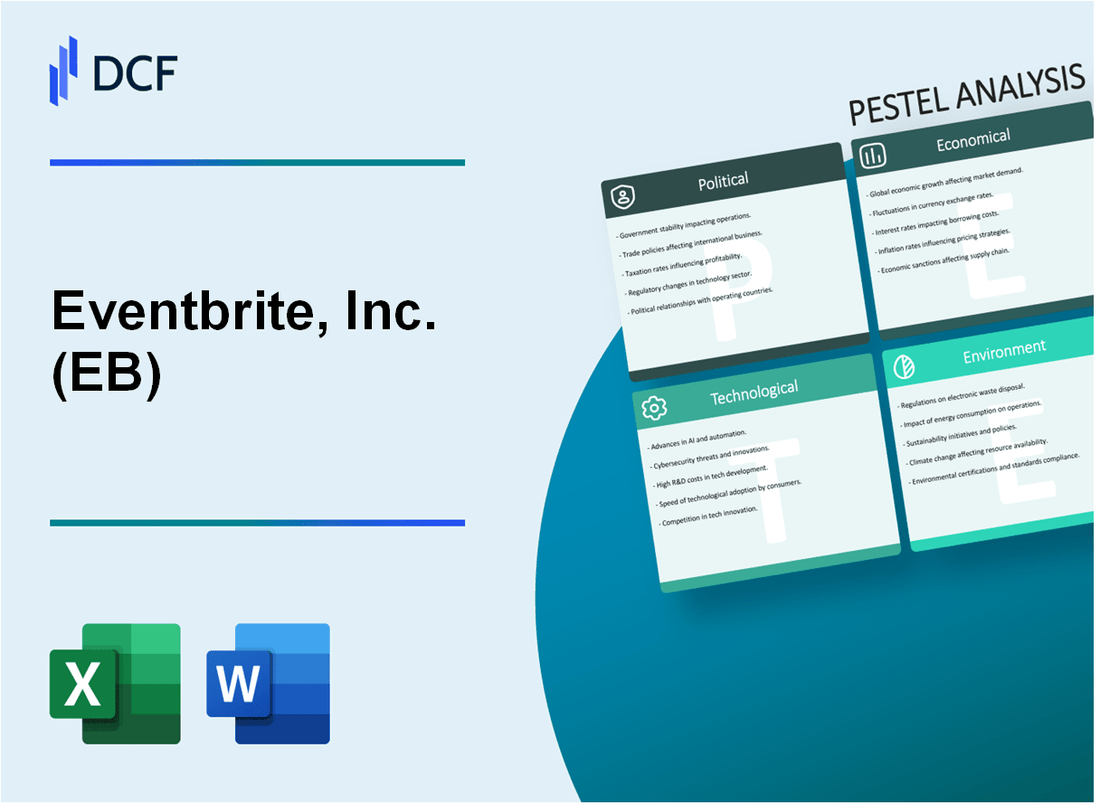
You're looking for a clear, actionable breakdown of the forces shaping Eventbrite, Inc. (EB) right now, and honestly, the landscape is shifting fast. After two decades in this business, including my time analyzing companies like BlackRock, I can tell you that the real value lies in mapping near-term risks to clear actions. Here's the PESTLE analysis-Political, Economic, Sociological, Technological, Legal, and Environmental-that matters for Eventbrite's 2025 outlook.
You need to know where Eventbrite is heading, and the 2025 landscape is a mix of regulatory landmines and massive opportunity. We're seeing political heat on ticket fees, economic caution despite strong consumer demand for experiences, and a technological race against giants like TikTok to capture the booming creator economy. With Eventbrite's projected 2025 Net Revenue estimated at $300 million, the company is on a solid growth path, but that number is highly sensitive to how they navigate the push for sustainability and the complex new data privacy laws. Let's break down the six forces that will defintely determine their next move.
Political Factors: Regulatory Heat and Geopolitical Risk
The biggest near-term risk for Eventbrite stems from increased political scrutiny on ticketing practices. Governments in the US and the EU are pushing for greater transparency, specifically targeting hidden fees and ticket resale practices. This means Eventbrite must proactively adapt its fee structure or risk legislative caps that could compress margins. Also, geopolitical instability directly impacts cross-border events; if a creator or attendee can't travel easily, that revenue is gone. On the flip side, government funding and tax incentives for cultural events offer a clear opportunity to boost platform volume, so Eventbrite needs to be defintely tracking those local programs.
Economic Factors: Inflation, Interest Rates, and Discretionary Spending
The economic picture is a balancing act. Inflationary pressures are pushing up event operating costs-venue rental, security, marketing-which translates directly into higher ticket prices. This is happening while high interest rates are making capital expenditure more expensive for Eventbrite and tightening corporate event budgets. Still, consumer discretionary spending on experiences remains strong post-pandemic. Here's the quick math: Eventbrite's projected 2025 Net Revenue is estimated at $300 million, a solid growth trajectory that hinges on consumers continuing to prioritize that local concert or class over buying more goods. If recession fears spike, that spending is the first to get cut.
Sociological Factors: The Creator Economy and Hybrid Events
The sustained demand for in-person experiences is a massive tailwind, especially for smaller, local events-Eventbrite's sweet spot. Plus, the rise of the creator economy is driving more individual organizers to the platform, treating event hosting as a primary income stream. This means Eventbrite's product needs to be more focused on the creator's business needs, not just ticketing. We also see shifting demographics demanding greater accessibility and inclusivity in event formats. Hybrid event models (combining in-person with virtual access) are defintely becoming a permanent fixture, so the platform needs to seamlessly support both to capture the full market.
Technological Factors: AI, Web3, and Social Competition
Technology is a double-edged sword. Eventbrite faces stiff competition from integrated platforms like TikTok and Instagram, which are becoming powerful event discovery and ticketing channels. To counter this, the company must invest heavily in AI for personalized event recommendations and dynamic pricing, which can boost conversion rates by 5% to 10%. Also, the integration of Web3 technologies for non-fungible token (NFT) ticketing and fan engagement is moving from niche to mainstream. What this estimate hides is the continuous need for platform security upgrades to protect creator and attendee data, which is a non-negotiable, high-cost investment.
Legal Factors: Data Privacy and Transparency Laws
The legal landscape is getting more complex and costly. Eventbrite operates across many regions, meaning it must comply with complex, evolving data privacy regulations like the CCPA in California and the GDPR in the EU. Non-compliance risks massive fines. New legislation targeting ticketing fees and hidden charges demands greater transparency, forcing a potential re-architecture of the checkout process. Also, intellectual property and copyright compliance for content used in virtual and recorded events is a growing liability. Finally, accessibility laws like the ADA require compliant digital and physical event experiences, which is a continuous legal requirement.
Environmental Factors: The Push for Sustainable Events
Environmental, Social, and Governance (ESG) pressure is no longer just for public relations; it's a core business factor. Attendees and creators are increasingly demanding sustainable, low-carbon events. This means Eventbrite needs to add features that allow event organizers to track and report on their sustainability metrics. Furthermore, Eventbrite's own operational carbon footprint and ESG reporting requirements are under scrutiny from investors. A simple, clear action is encouraging organizers to use digital-only ticketing to reduce paper waste, but the bigger challenge is providing tools to measure and offset event-level emissions.
Eventbrite, Inc. (EB) - PESTLE Analysis: Political factors
Increased Scrutiny on Ticket Resale and Pricing Transparency in the US and EU
The political climate is defintely pushing for greater consumer protection in ticketing, which is a structural shift for the entire industry. This is a net positive for Eventbrite, Inc. (EB) because your model is less reliant on predatory secondary market practices compared to primary ticketing giants.
In the US, the House of Representatives passed the Transparency in Charges for Key Events Ticketing (TICKET) Act in April 2025, moving to mandate all-in pricing-meaning the total ticket price, including all fees, must be shown upfront. Plus, an Executive Order in March 2025 directed the Federal Trade Commission (FTC) to ramp up enforcement of the BOTS Act (Better Online Ticket Sales Act of 2016) and target deceptive resale practices. This bans speculative ticketing, where a reseller sells a ticket they don't yet own.
Across the pond, the UK has gone further, banning ticket resale for profit and capping resale at the original face value. This European pressure sets a precedent for the EU, forcing platforms to minimize service fees on any resale. The clear action here is to fully embrace and advertise your transparent, all-in pricing model as a core competitive advantage against competitors facing major regulatory headaches.
Geopolitical Instability Impacting Cross-Border Event Attendance and Creator Travel
Geopolitical tensions-driven by conflicts in the Middle East, the Russia-Ukraine war, and rising US-China trade friction-are directly chilling the global events market. This uncertainty translates to measurable drops in international event attendance and business travel, a key segment for Eventbrite's larger conference and professional event creators.
Here's the quick math on the impact:
- Global travel industry growth for 2025 is projected at a conservative 2-5%, a significant reduction from earlier forecasts of 6-9%.
- Inbound international business travel to the US is reported to be down by as much as 10%.
- Survey data from May 2025 showed that 43% of event professionals were projecting declines in attendance due to the political climate, with 39% already reporting actual declines.
This means you need to prioritize local and regional events that rely on domestic attendance, and you should be helping creators in your US and Western European core markets mitigate passport and visa anxiety for their international attendees. The risk is real, so focus on local density.
Government Funding and Tax Incentives for Cultural and Live Events
The government support landscape for your creators is a mixed bag in 2025, shifting from emergency pandemic relief to targeted, long-term incentives, but with new compliance risks.
The biggest near-term risk for your US-based creators is the 'claw back' of federal pandemic aid. As of July 2025, the Small Business Administration (SBA) began demanding repayment of the $16.25 billion Shuttered Venue Operators Grant (SVOG) funds from over 200 businesses, citing ineligibility or overpayment. That sudden debt obligation is a major liquidity shock for independent venues and promoters, a core Eventbrite customer base.
Conversely, in the EU, new VAT rules effective January 1, 2025, allow member states to apply reduced Value-Added Tax (VAT) rates to live-streamed cultural and educational events. This can make virtual events more competitive, but it also creates a compliance burden as VAT must now be charged based on the customer's location, not the event organizer's. Plus, the EU's Creative Europe program is maintaining its support with an increased budget of almost €340 million for 2025, signaling continued political prioritization of the arts.
Here is a summary of the fiscal impact on your creator base:
| Region | Policy/Program (2025 FY) | Impact on Creators | Value/Amount |
|---|---|---|---|
| US (Federal) | Shuttered Venue Operators Grant (SVOG) | Risk of repayment/liquidity shock for venues. | $16.25 billion total program, 200+ repayment demands. |
| US (Local Example) | Austin Live Music Fund | Direct, localized financial support for artists and venues. | $4.8 million program budget for 2025. |
| EU | New VAT Rules (Directive 2022/542) | Compliance burden, but potential for reduced VAT on virtual events. | Effective January 1, 2025. |
| EU | Creative Europe Programme | Continued, stable funding for cultural organizations. | Almost €340 million budget for 2025. |
Varying COVID-19 Related Public Health Mandates Still Affecting Large Gatherings
The political landscape for public health has shifted from mandatory restrictions to localized advisories, but the risk of disruption still exists. Formal, blanket mandates are largely gone, but local politics still matter.
For example, in Los Angeles County, COVID-19 prevention regulations for the workplace officially expired on February 3, 2025. That's a clear move away from government-enforced capacity limits.
However, during a September 2025 COVID wave in California, local health officials were still strongly recommending that residents consider masking in indoor public settings. This shift from a legal mandate to a public health advisory means the risk is now one of public sentiment and voluntary cancellation, not regulatory closure. You need to provide creators with flexible refund and cancellation policies that account for this persistent, low-level public health risk.
Eventbrite, Inc. (EB) - PESTLE Analysis: Economic factors
Projected 2025 Net Revenue is estimated at $300 million, a solid growth trajectory.
The core economic outlook for Eventbrite, Inc. (EB) remains focused on delivering profitable growth, despite a challenging macroeconomic backdrop. The company's own updated guidance for the full fiscal year 2025 net revenue is in the range of $290 million to $293 million, reflecting a disciplined approach to operations. However, a solid market projection for the year estimates Net Revenue at $300 million, which signals continued demand for its platform and tools like Eventbrite Ads, which saw 38% year-over-year growth in the third quarter of 2025. This growth trajectory is not defintely as fast as some software peers, but it's a sign of a resilient business model focusing on the high-margin creator economy.
Here's a quick look at the financial position underpinning this projection:
| Metric | Q2 2025 Result | Full-Year 2025 Outlook (Updated Nov 2025) |
|---|---|---|
| Net Revenue | $73 million (down 14% YoY) | $290 million to $293 million |
| Adjusted EBITDA Margin | 8.8% | 8% to 9% |
| Operating Expenses Reduction (YoY) | 16% | Significant reductions cited |
| Debt Outstanding (as of Aug 2025) | $176 million | N/A |
Inflationary pressures increasing event operating costs and ticket prices.
Inflation is hitting Eventbrite's core customer base-the event creators-hard, and that pressure is translating directly into higher ticket prices for consumers. For 2025, rising vendor costs are cited as a top challenge by event professionals. The cost of putting on an event is skyrocketing, particularly for key line items like food and beverage (F&B) and audio/video (AV) services, where industry forecasts anticipate up to a 50% increase in costs.
This creates a tricky dynamic for Eventbrite:
- Higher ticket prices can dampen attendance, slowing the growth of paid ticket volume.
- Creators may cut back on event frequency or shift to lower-cost venues.
- Eventbrite's own cost of operations, especially for labor and technology infrastructure, is also subject to these same inflationary forces.
Consumer discretionary spending on experiences remains strong but is sensitive to recession fears.
The good news is that the structural shift favoring experiences over material goods continues to be a tailwind. Americans are prioritizing making memories, with 58% saying they would rather spend money on experiences, a trend particularly strong with Millennials (61%) and Gen Z. This is a massive, long-term opportunity for Eventbrite, whose platform is built entirely around these shared moments.
But, you still have to be a realist. Global consumer sentiment is still poorer than it was in early 2020, and recession fears are a real concern. Only 7% of event professionals are not concerned about a recession's potential impact on the industry. This means while people want experiences, they are becoming highly selective, trading down in some categories while splurging on others that offer high perceived value. Eventbrite must focus on helping creators demonstrate that high value to keep spending resilient.
High interest rates affect corporate event budgets and Eventbrite's capital expenditure.
The sustained high interest rate environment in the US Federal Reserve's effort to curb inflation has a dual impact. First, it raises the cost of capital for Eventbrite itself, though the company has been proactive in managing this risk by reducing its debt. Eventbrite significantly improved its balance sheet, with debt outstanding decreasing 33% year-over-year in Q2 2025, reducing the total to $176 million by August 7, 2025. This financial discipline is crucial for navigating a high-rate environment.
Second, high rates pressure corporate event budgets, a key segment for Eventbrite's larger creators. When borrowing costs are high, companies tighten their belts, and marketing or internal events are often the first to see cuts or increased scrutiny. Event professionals cite 'increasing costs' (70%) and 'lower budget' (31%) as their biggest challenges for 2025. This forces Eventbrite to double down on offering tools that clearly demonstrate a measurable Return on Investment (ROI) for corporate event organizers.
Eventbrite, Inc. (EB) - PESTLE Analysis: Social factors
The social landscape for Eventbrite is defined by a powerful, post-pandemic desire for real-world connection and a democratization of event creation, moving away from large, impersonal gatherings. This shift is a major tailwind, but it demands that Eventbrite's platform prioritizes niche, local, and highly accessible experiences.
You're seeing a clear bifurcation in the market: mega-events are recovering, but the real growth engine for a platform like Eventbrite is the local, community-focused event. This is where the social trends map directly to the company's core strength, but it requires continuous investment in tools for the individual creator.
Sustained demand for in-person experiences post-pandemic, especially smaller, local events.
Despite the rise of digital options, in-person events remain the gold standard for social connection. The global events industry is projected to reach a value of $1.34692 trillion in 2025, reflecting a Compound Annual Growth Rate (CAGR) of 9.7% from 2024. Event organizers are certainly recognizing this sustained demand, with 86.4% planning to maintain or increase the number of in-person events in 2025 compared to 2024.
The key is the shift to local and niche. Over 41% of event planners have indicated they would only attend an in-person event if it was local, and 64% of organizers believe attendees will be looking for more niche events this year. This preference for community-driven, smaller gatherings directly aligns with Eventbrite's long-tail marketplace model, offering a significant opportunity for ticket volume growth outside of the major concert and sports segments.
Rise of the creator economy, driving more individual event organizers to the platform.
The creator economy is fueling a new class of micro-organizers-individuals and small businesses turning their passions into ticketed experiences. Eventbrite is positioned to capture this segment, as evidenced by its Q2 2025 results showing over 168,000 paid creators on the platform. This creator base is critical, even though the number of paid creators declined 5% year-over-year in Q2 2025, the rate of decline has been improving sequentially.
The platform is actively making it easier for these creators to launch events. For instance, the use of Eventbrite's AI-powered Lineup Tool is reported to have reduced event setup time by 30%, a major factor in democratizing event creation. Also, the demand for skill-building and networking is strong: the number of networking events on the platform grew 33% year-on-year, but demand still outweighs supply, creating a clear opportunity gap.
Shifting demographics demand greater accessibility and inclusivity in event formats.
Younger demographics, particularly Gen Z and Millennials, are driving a social shift toward experiences that offer personal growth and transformation. 72% of 21- to 35-year-olds feel positively toward events that offer meaningful, transformative experiences. They are also demonstrating a strong willingness to pay, with 36% of Gen Z planning to spend more money on events in 2025.
This demographic also values social and environmental consciousness. Eventbrite's alignment with sustainability, for example, is a strong social factor, as 81% of attendees are willing to pay for eco-friendly events. This focus on experience quality, not just scale, is where the platform wins.
| Social Trend Metric (2025 Data) | Value/Amount | Strategic Implication for Eventbrite |
|---|---|---|
| Global Events Market Value | $1.34692 trillion (Projected) | Confirms a massive, growing addressable market for experiences. |
| Organizers Planning to Increase In-Person Events | 86.4% | Strong confidence in the core product; focus shifts to platform tools over market recovery. |
| Event Planners Expected to Adopt Hybrid Formats | 78% | Hybrid is the new standard, requiring continuous investment in seamless virtual integration. |
| Gen Z Planning to Increase Event Spending | 36% | Prioritize marketing and event discovery tools for this high-value, experience-seeking demographic. |
| Eventbrite Paid Creators (Q2 2025) | Over 168,000 | The platform's base of micro-organizers is large, but creator retention and growth are still a focus. |
Hybrid event models (in-person plus virtual) are defintely becoming a permanent fixture.
The initial pandemic pivot to virtual events has settled into a permanent hybrid model-a combination of in-person and digital access (hybrid event models). This is driven by the social need for greater reach and accessibility. The virtual events market is projected to reach $236.69 billion in 2025, and a significant 78% of event planners are expected to adopt hybrid formats this year.
This is not a temporary fix; 70% of event planners expect hybrid models to be a lasting format. For Eventbrite, this means the platform must excel at facilitating two distinct but connected experiences-the in-person social connection and the virtual accessibility-to maintain its competitive edge. The ability to collect and analyze data across both formats is a key value proposition (Value-Added-Services, or VAS) for organizers.
- Hybrid models increase audience size without larger venues.
- Virtual event market value is strong at $236.69 billion in 2025.
- Accessibility and inclusivity are key drivers for hybrid adoption.
The challenge is making the virtual experience as engaging as the physical one. If you fail to bridge the gap between the two audiences, you risk devaluing the entire event.
Eventbrite, Inc. (EB) - PESTLE Analysis: Technological factors
Competition from integrated platforms like TikTok and Instagram for event discovery and ticketing
The primary technological challenge for Eventbrite is the shift in event discovery away from traditional search and marketplace models toward social media platforms. You see this most clearly with TikTok and Instagram, which are becoming the first stop for users, especially Gen Z, looking for things to do. To counter this, Eventbrite has smartly shifted its strategy from just being a destination to being a distribution engine.
In 2025, Eventbrite launched a significant ticketing integration with TikTok, allowing event organizers to promote events and sell tickets directly on the platform. This move eliminates the friction of the old 'link in bio' model, streamlining the purchase process. This is crucial because data shows that 30% of Gen Z use TikTok specifically to discover live experiences, which is a massive, high-intent audience. The platform also updated its 'Share on Social' feature, letting creators post directly to Instagram, TikTok, and LinkedIn with just a few clicks. This integration strategy is a necessary defense against social platforms that could otherwise become direct competitors by building their own native ticketing tools.
Increased investment in AI for personalized event recommendations and dynamic pricing
Eventbrite is positioning Artificial Intelligence (AI) not just as a feature, but as the core engine for creator success and consumer discovery. The company is integrating AI-powered tools into its platform to help event creators save time and, most importantly, sell more tickets. This is about moving from simple keyword search to a more personalized, intuitive experience.
The company's 2026 product roadmap is already set to introduce AI-powered recommendations throughout the event creation process, which will leverage unique insights from millions of events to help organizers craft listings that drive higher ticket sales. This is the real value-add: smarter tools that help the organizer. A key 2025 partnership with the AI-powered analytics platform Listener.com helps podcast hosts unify their audience data, combining Eventbrite ticketing and revenue data with listener insights from platforms like Apple and Spotify to identify top fans and route tours effectively.
Here's the quick math on the focus: while the company is maintaining firm financial discipline, with operating expenses decreasing 16% year-over-year to $55.4 million in Q2 2025, the strategic investment in AI remains a priority for future growth.
Need to integrate with Web3 technologies for non-fungible token (NFT) ticketing and fan engagement
The Web3 (decentralized internet) movement, particularly non-fungible token (NFT) ticketing, represents a long-term technological opportunity and a potential disruptor for the ticketing industry. While Eventbrite has not announced a native, platform-wide NFT ticketing product in 2025, its strategy is currently focused on facilitating the ecosystem.
The platform is actively hosting major Web3 events, such as the 'NFT.NYC 2025' conference in June 2025, demonstrating its role as a key venue for the Web3 community. This shows Eventbrite is monitoring the trend closely and capturing the event volume from this emerging technology. The challenge is that Web3 ticketing promises to reduce fraud and create new fan engagement channels (like digital collectibles), but it requires a complex, costly integration. Eventbrite must decide when to move from hosting Web3 events to fully integrating a Web3 ticketing solution to avoid being outflanked by a niche, crypto-native competitor.
Continuous platform security upgrades to protect creator and attendee data
In the digital economy, security isn't a feature; it's a prerequisite. Eventbrite maintains a continuous upgrade cycle to protect the sensitive data of its 92 million average monthly active users.
The company's security posture is built on a foundation of rigorous compliance and encryption:
- Encryption: All credit card information is encrypted using strong industry-standard cryptographic protocols like AES and TLS.
- Security Certificates: The website and APIs are secured by a 256-bit SSL certificate issued by Digicert.
- Compliance: Eventbrite is PCI-DSS compliant (Payment Card Industry Data Security Standard) and complies with the Massachusetts Privacy Law (201 CMR 17).
This commitment is reflected in their policies; the Eventbrite Privacy Policy was last updated on January 27, 2025, ensuring compliance with evolving global data protection laws. They also maintain a detailed Incident Response plan and 24x7 monitoring of security systems. This is a defintely non-negotiable cost of doing business, and a failure here would instantly erode the trust that underpins their marketplace model.
| Technological Factor | 2025 Strategic Action | Key Metric / Value |
|---|---|---|
| Social Media Competition | TikTok Ticketing Integration | 30% of Gen Z use TikTok for event discovery. |
| AI & Personalization | Listener.com Partnership & 2026 AI Roadmap | AI-powered tools integrated for creators. |
| Web3 & NFT Ticketing | Hosting Major Web3 Events | Eventbrite hosts NFT.NYC 2025. |
| Platform Security | Continuous Compliance & Monitoring | Privacy Policy updated January 27, 2025. |
Eventbrite, Inc. (EB) - PESTLE Analysis: Legal factors
Complex, evolving data privacy regulations (e.g., CCPA, GDPR) across operating regions.
The global nature of Eventbrite's marketplace means data privacy compliance is a major, ongoing cost center, not a one-time fix. With 27% of the company's 2024 net revenue coming from outside the United States, the General Data Protection Regulation (GDPR) in the European Union and the California Consumer Privacy Act (CCPA) are critical legal risks. These regulations require continuous investment in data mapping, consent management, and security infrastructure, which is buried within the company's operating expenses.
The financial risk is quantifiable by the penalties. For instance, in 2025, the California Privacy Protection Agency (CPPA) increased its administrative fine amounts for CCPA violations. A single intentional violation can now cost up to $7,988, up from $7,500, while general violations are up to $2,663 each, a defintely material risk given the millions of user accounts. The company must constantly update its Data Processing Addendums (DPAs) to manage its dual role as both a data 'Business' and a 'Service Provider' for its event organizers.
New legislation targeting ticketing fees and hidden charges, demanding greater transparency.
Regulatory and competitive pressure for 'all-in pricing' transparency is directly impacting Eventbrite's revenue model in 2025. The company proactively eliminated its 'organizer fees,' a strategic move that addresses the trend but creates a significant financial headwind. Here's the quick math on the near-term impact:
The elimination of those high-margin organizer fees is expected to result in an approximately $20 million revenue headwind for the full fiscal year 2025 compared to 2024. Despite this, the full-year 2025 net revenue is still projected to be in the range of $290 million to $293 million, showing the core ticketing and advertising revenue streams are resilient. Still, the underlying US fee structure remains complex, which keeps the company exposed to future transparency laws.
- US Service Fee: 3.7% of ticket price + $1.79 per sold ticket.
- Payment Processing Fee: An additional 2.9% of the total order.
- Action: Must shift from a complex, multi-layered fee structure to a clearly advertised, all-in model to mitigate legislative risk.
Intellectual property and copyright compliance for content used in virtual and recorded events.
As Eventbrite supports a growing number of virtual and recorded events, its exposure to intellectual property (IP) and copyright infringement claims rises. The platform acts as an intermediary, but it can still be drawn into disputes between event organizers and third-party rights holders, particularly concerning music licensing and video content. This legal volatility is reflected in financial statements, though not always as a cost.
For example, the company reported a Net Loss of $2.1 million in Q2 2025, a swing from the prior year's net income, which had included a net benefit of $8.3 million due to a legal settlement gain recognized in June 2024. This shows how quickly legal events, both positive and negative, can materially impact the bottom line. The Terms of Service attempt to limit Eventbrite's liability for user-generated content to a maximum of $100 if no tickets were purchased, but this is often tested in court.
Accessibility laws (ADA) requiring compliant digital and physical event experiences.
The Americans with Disabilities Act (ADA) and similar state laws pose a persistent legal threat, primarily concerning the digital accessibility of the Eventbrite website and mobile applications. Non-compliance with Web Content Accessibility Guidelines (WCAG) 2.1 standards is a common trigger for lawsuits.
The cost of non-compliance is two-fold: legal fees and mandated remediation costs. While specific 2025 compliance spending is not itemized, the general risk is high. ADA website lawsuits against large companies often settle for between $5,000 and $20,000 per case, but class action settlements can exceed $6 million in damages and fees, as seen in other digital accessibility cases in 2024. Eventbrite must ensure its platform, which is the gateway to event access, is fully compliant to avoid costly injunctions that require extensive, court-mandated platform overhauls.
Here is a summary of key legal financial exposures:
| Legal Risk Area | 2025 Financial Impact / Exposure | Basis of Amount |
|---|---|---|
| Ticketing Transparency (Fee Headwind) | Approx. $20 million (Revenue Headwind) | Elimination of Organizer Fees (FY 2025 Outlook) |
| Data Privacy (CCPA Fine Exposure) | Up to $7,988 per intentional violation | Updated 2025 CCPA fine amount (Effective Jan 1, 2025) |
| Legal Volatility (Net Income Impact) | $8.3 million (Legal Settlement Gain) | Gain recognized in June 2024, showing legal events' material impact on Net Income/Loss |
| Digital Accessibility (ADA Lawsuit Range) | $5,000 to $20,000 (Typical settlement range) | General settlement range for ADA website lawsuits in 2024/2025 |
The biggest immediate legal challenge is managing the revenue transition while ensuring the platform's code base meets evolving global standards for privacy and accessibility. That's a tough, expensive mandate.
Next step: Legal and Product teams should finalize a quarterly budget for WCAG 2.1 compliance audits by the end of the year.
Eventbrite, Inc. (EB) - PESTLE Analysis: Environmental factors
Growing pressure from attendees and creators for sustainable, low-carbon events.
The demand for sustainable event practices is no longer a niche trend; it's a mainstream expectation that directly impacts Eventbrite's core creator base and its $295 million to $310 million net revenue forecast for the 2025 fiscal year.
Event organizers are feeling the heat, with 73% citing sustainability as a top priority for their events in 2025. Attendees are also voting with their wallets and preferences: approximately 60% prefer eco-friendly event options, and a significant 55% are willing to pay more for them. This creates a clear market opportunity for Eventbrite to integrate tools that help creators capitalize on this willingness to pay.
The industry is moving fast, so Eventbrite must provide more than just digital tickets.
Need for the platform to track and report on event organizers' sustainability metrics.
While Eventbrite excels at sales and marketing analytics, the platform currently shows a strategic gap in providing creators with robust, in-platform tools to track their event's environmental footprint. The core business model is a marketplace for events, but the events themselves generate significant Scope 3 emissions-everything from attendee travel to venue energy use and waste.
To be fair, the platform provides educational guides on sustainable event planning, but a quantitative, automated tracking feature is what the market now demands. Event organizers need to easily calculate metrics like:
- Event-specific carbon emissions (travel, energy).
- Waste diversion rates (recycle/compost).
- Sustainable supplier sourcing percentages.
Without this data, Eventbrite risks losing larger, more sophisticated event organizers who require detailed ESG reporting to meet their own corporate or regulatory mandates. The platform's existing analytics dashboards, while strong for ticket sales, need to evolve to incorporate environmental data.
Eventbrite's own operational carbon footprint and ESG reporting requirements.
Eventbrite, as a Software-as-a-Service (SaaS) company, has a comparatively small direct operational footprint, but its indirect impact is substantial. They have been proactive in managing their direct emissions:
| Metric | Value (Year) | Significance |
|---|---|---|
| Scope 1 & 2 Emissions Status | 100% Carbon Neutral (2022, 2023) | Achieved via carbon credits and Energy Attribute Certificates. |
| Workplace Emissions Reduction | 70% Reduction (Annual) | Driven by the company's remote-first workforce model. |
| Calculated Scope 3 GHG Emissions (Market-Based) | 13,096 MTCO2e (2023) | Represents the vast majority of the company's total footprint, primarily from the supply chain. |
| Upright Project Net Impact Ratio | 50.9% | Indicates an overall positive sustainability impact, but notes negative contributions in GHG Emissions and Waste. |
Here's the quick math: Eventbrite's biggest environmental challenge is not its offices (Scope 1 and 2), but its supply chain and the events it enables (Scope 3). The 13,096 metric tons of CO2e from Scope 3 emissions in 2023 is the number to watch. This is where the company's true environmental leverage-and risk-lies, requiring a shift from simply offsetting their own operations to actively reducing the footprint of the events they power.
Encouraging organizers to use digital-only ticketing to reduce paper waste.
The platform's core product, digital ticketing, is its most powerful environmental advantage. This is a clear win-win for sustainability and operational efficiency. The industry standard shows that the use of digital tickets and registration can reduce paper waste by up to 90%.
Eventbrite facilitates this massive reduction by processing a huge volume of transactions. In a prior reporting period, the platform supported the sale of 280 million digital tickets annually. This scale inherently eliminates millions of pounds of potential paper waste, which is a major selling point to eco-conscious creators and attendees. The company must continue to push its mobile app and QR code check-in features to ensure paperless adoption remains near 100% for all events on the platform.
Next step: Product team should draft a spec for a simple 'Carbon Footprint Estimator' tool for creators by the end of Q4 2025.
Disclaimer
All information, articles, and product details provided on this website are for general informational and educational purposes only. We do not claim any ownership over, nor do we intend to infringe upon, any trademarks, copyrights, logos, brand names, or other intellectual property mentioned or depicted on this site. Such intellectual property remains the property of its respective owners, and any references here are made solely for identification or informational purposes, without implying any affiliation, endorsement, or partnership.
We make no representations or warranties, express or implied, regarding the accuracy, completeness, or suitability of any content or products presented. Nothing on this website should be construed as legal, tax, investment, financial, medical, or other professional advice. In addition, no part of this site—including articles or product references—constitutes a solicitation, recommendation, endorsement, advertisement, or offer to buy or sell any securities, franchises, or other financial instruments, particularly in jurisdictions where such activity would be unlawful.
All content is of a general nature and may not address the specific circumstances of any individual or entity. It is not a substitute for professional advice or services. Any actions you take based on the information provided here are strictly at your own risk. You accept full responsibility for any decisions or outcomes arising from your use of this website and agree to release us from any liability in connection with your use of, or reliance upon, the content or products found herein.