
|
Editas Medicine, Inc. (EDIT): ANSOFF MATRIX [Dec-2025 Updated] |
Fully Editable: Tailor To Your Needs In Excel Or Sheets
Professional Design: Trusted, Industry-Standard Templates
Investor-Approved Valuation Models
MAC/PC Compatible, Fully Unlocked
No Expertise Is Needed; Easy To Follow
Editas Medicine, Inc. (EDIT) Bundle
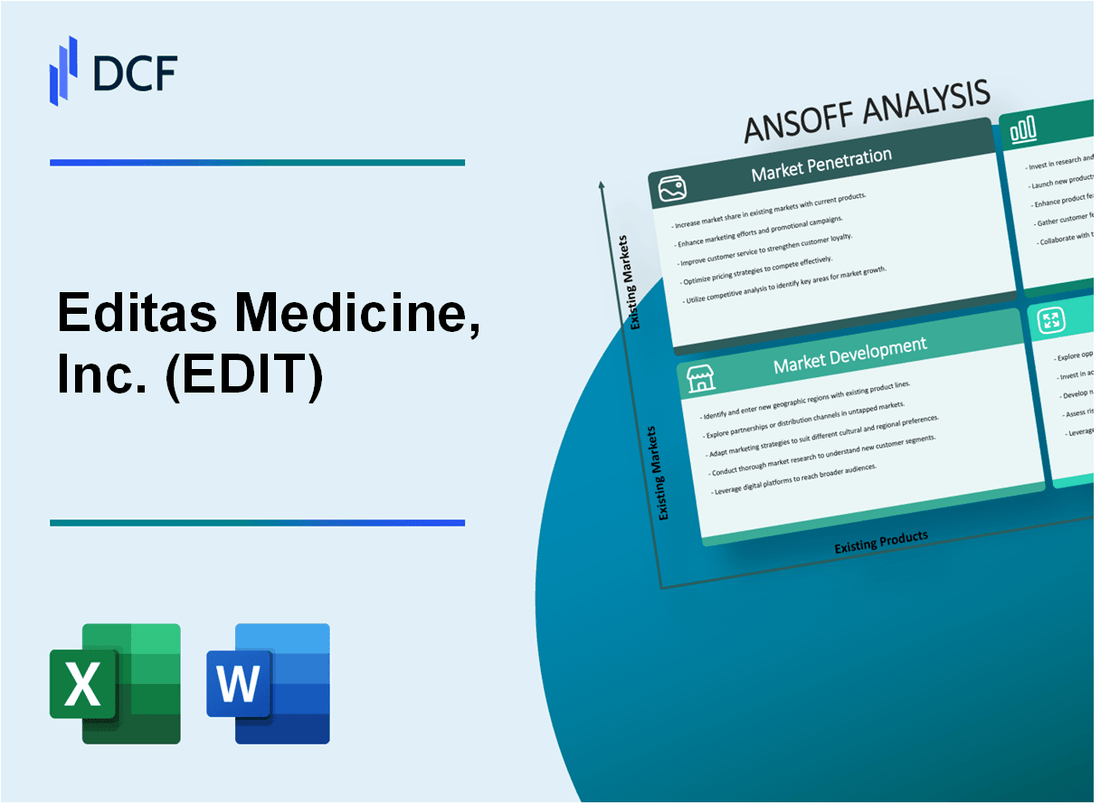
You're looking for a clear, actionable breakdown of Editas Medicine, Inc.'s growth options, and the Ansoff Matrix is defintely the right framework for a clinical-stage biotech right now. I've mapped out their strategy, grounded in their Q3 2025 financials and the pivot toward in vivo (inside the body) gene editing; they are managing R&D spending of $19.8 million while sitting on a $165.6 million cash reserve and pulling in $7.5 million from partnerships. This isn't abstract; we're breaking down four distinct paths-Market Penetration, Market Development, Product Development, and Diversification-that show exactly how they plan to move from preclinical data to potential curative therapies. Keep reading to see the specific actions tied to each quadrant that will drive their next phase.
Editas Medicine, Inc. (EDIT) - Ansoff Matrix: Market Penetration
You're looking to drive growth by selling more of your existing core assets into the markets you already know. For Editas Medicine, Inc., that means aggressively pushing the lead candidate, EDIT-401, into the hypercholesterolemia space where you've established preclinical proof-of-concept.
The immediate focus is on the clinical timeline. You need to accelerate everything to hit that late-$\mathbf{2026}$ human proof-of-concept goal for EDIT-401. This is critical because the preclinical data is compelling; in non-human primate studies, a single dose of EDIT-401 achieved a $\mathbf{\ge 90\%}$ mean reduction in LDL-C within $\mathbf{48}$ hours. That dwarfs the $\mathbf{40-60\%}$ mean reduction seen with current standard of care therapies. Also, the durability shown in mouse models over a $\mathbf{3}$-month study supports the one-time curative therapy narrative you'll take to payers.
Here's a quick look at where the numbers stood as of the third quarter of $\mathbf{2025}$:
| Metric | Value (Q3 2025 or Latest) | Context |
|---|---|---|
| Collaboration Revenue (3 Months Ended 9/30/2025) | $7.5 million | Primarily from a milestone under the BMS agreement. |
| R&D Expenses (3 Months Ended 9/30/2025) | $19.8 million | Decreased from $47.6 million in Q3 2024 due to reni-cel discontinuation. |
| EDIT-401 Preclinical LDL-C Reduction | $\ge 90\%$ | In non-human primates after a single dose. |
| IND/CTA Submission Target | Mid-2026 | To support the end-of-$\mathbf{2026}$ human proof-of-concept goal. |
| Cash Runway Estimate (Post Q3 2025) | Into Q3 2027 | Supported by $\mathbf{\$165.6}$ million in cash, cash equivalents, and marketable securities as of September 30, 2025. |
To maximize the $\mathbf{\$7.5}$ million Q3 $\mathbf{2025}$ collaboration revenue, you must push hard on securing the next set of milestones from the Bristol Myers Squibb partnership. Remember, that $\mathbf{\$7.5}$ million was a significant jump from the $\mathbf{\$0.1}$ million seen in the same period in $\mathbf{2024}$, showing the value of those existing agreements when milestones hit. You need to translate the preclinical success of EDIT-401 into tangible, near-term payments from your partners.
On the spending side, the decision to focus R&D spending, which totaled $\mathbf{\$19.8}$ million in Q3 $\mathbf{2025}$, solely on high-potential, core in vivo programs is a clear market penetration move. This focus is made possible because you discontinued the reni-cel program in December $\mathbf{2024}$, which helped slash R&D expenses by $\mathbf{\$27.9}$ million year-over-year for the quarter. Every dollar saved from that discontinued program should now be directed toward advancing EDIT-401 through the IND/CTA submission planned for mid-$\mathbf{2026}$.
You also need to start laying the groundwork for the commercial phase now, even though you're still in the clinic. Strategically engaging US payers early is non-negotiable for future one-time curative therapies. You'll need to build the value story around durability and the $\mathbf{\ge 90\%}$ LDL-C reduction versus chronic $\mathbf{40-60\%}$ reductions from existing drugs. This early dialogue helps shape reimbursement expectations for a therapy that, by design, is meant to be administered once.
- Achieve $\mathbf{\ge 6}$-fold mean increase in LDLR protein in NHP liver.
- Identify and disclose an additional target cell type or tissue by the end of $\mathbf{2025}$.
- Maintain the $\mathbf{2.77}$ current ratio to ensure liquidity.
- Leverage the $\mathbf{\$25.1}$ million net loss in Q3 $\mathbf{2025}$ as evidence of continued heavy investment in the lead asset.
Finance: draft the $\mathbf{13}$-week cash view incorporating the $\mathbf{\$17.3}$ million in expected proceeds from the ATM facility after September $\mathbf{30}$, $\mathbf{2025}$, by Friday.
Editas Medicine, Inc. (EDIT) - Ansoff Matrix: Market Development
You're looking at how Editas Medicine, Inc. can take its existing pipeline assets and push them into new geographic territories, which is the core of Market Development. This isn't about inventing a new therapy; it's about expanding the reach of what you already have data on. Here's the quick math on the current state supporting this move.
The lead candidate, EDIT-401, has a clear international regulatory target date. Editas Medicine is on track to submit an Investigational New Drug (IND) or Clinical Trial Application (CTA) for EDIT-401 by mid-2026. This submission is planned to cover both the US IND and CTAs in key European markets simultaneously. The preclinical data supporting this global push shows a $\ge 90\%$ mean reduction of LDL-C in non-human primates, which compares favorably to standard of care therapies demonstrating a $40\%-60\%$ mean reduction.
To support these global efforts, the financial foundation needs to hold. As of September 30, 2025, Editas Medicine, Inc. reported cash, cash equivalents, and marketable securities totaling \$165.6 million. This position, combined with expected proceeds, extends the operational runway into the third quarter of 2027. This runway is critical for funding the international regulatory and clinical site activation costs associated with market development.
For existing programs like EDIT-301 (reni-cel), which was developed for $\beta$-hemoglobinopathies, the strategy shifts to leveraging past data, even though the program was discontinued. The EDITHAL trial for Transfusion-Dependent Beta Thalassemia (TDT) had an estimated completion date of December 2025. Furthermore, the FDA had previously granted EDIT-301 an Orphan drug designation (2022) and a Rare Pediatric Disease (RPD) designation (2020). This history of securing rare disease designations in the US is a template for seeking similar status abroad.
The current business structure already shows a reliance on international collaboration, which sets a precedent for future expansion. For the three months ended September 30, 2025, collaboration and other research and development revenues increased to \$7.5 million. This revenue was primarily attributable to a milestone achieved under the collaboration agreement with Bristol-Myers Squibb (BMS) in the third quarter of 2025.
The regulatory landscape in target markets is dense, but precedent exists for expedited review. The US Food and Drug Administration (FDA) is expecting to approve between 10 to 20 cell and gene therapies per year by 2025. For securing market access in the EU, a product with Orphan Drug Designation is entitled to a ten-year marketing exclusivity period.
Here is a summary of the key data points relevant to the Market Development strategy:
| Metric | Program/Date | Value/Status |
| CTA/IND Submission Target | EDIT-401 | Mid-2026 |
| Human Proof-of-Concept Target | EDIT-401 | End of 2026 |
| Preclinical Efficacy | EDIT-401 (NHP) | $\ge 90\%$ mean LDL-C reduction |
| Cash Position (9/30/2025) | Financial | \$165.6 million |
| Cash Runway Guidance | Financial | Into Q3 2027 |
| Collaboration Revenue (Q3 2025) | Financial | \$7.5 million |
| FDA Orphan Drug Designation | EDIT-301 | 2022 |
| EU Orphan Exclusivity Period | Regulatory | Ten years |
The immediate actions required to execute this market development plan involve specific regulatory and operational milestones:
- Initiate Clinical Trial Application (CTA) submissions in key European markets for EDIT-401 alongside the US IND by mid-2026.
- Leverage existing US clinical data for EDIT-301 to inform international site selection for rare disease programs.
- Target international centers of excellence for gene therapy to expand the patient pool for rare disease programs.
- Secure regulatory designations, such as Orphan Drug status, in the EU and Japan to streamline future commercialization efforts.
You need to map out the specific jurisdictions for the EDIT-401 CTA submissions now, given the mid-2026 deadline. Finance: draft 13-week cash view by Friday.
Editas Medicine, Inc. (EDIT) - Ansoff Matrix: Product Development
You're looking at the core of Editas Medicine, Inc.'s future growth, which is heavily weighted toward new products developed internally. This is the Product Development quadrant of the Ansoff Matrix, where the company is betting on its in vivo gene editing platform to create novel therapies.
The financial foundation supporting this is the $165.6 million in cash, cash equivalents, and marketable securities Editas Medicine, Inc. held as of September 30, 2025. This liquidity, combined with retained payments from the Vertex Pharmaceuticals license agreement, is expected to fund operations into the third quarter of 2027.
Advancing In Vivo Development Candidates
Editas Medicine, Inc. was on track to declare two in vivo development candidates by mid-2025. One candidate targets hematopoietic stem cells (HSCs), and the other targets a liver indication. The company selected EDIT-401 as its lead candidate for in vivo gene editing. The path forward for the lead program includes an Investigational New Drug (IND) or Clinical Trial Application (CTA) submission targeted for mid-2026, with initial in vivo human proof-of-concept data anticipated by the end of 2026.
| Development Milestone | Target Cell Type | Targeted Completion/Data Point |
| Declare Development Candidate | Liver Target | Mid-2025 |
| Declare Development Candidate | Hematopoietic Stem Cells (HSCs) | Mid-2025 |
| IND/CTA Submission (Lead Program) | N/A | Mid-2026 |
| Initial Human Proof-of-Concept Data | N/A | End of 2026 |
Proprietary Platform and Gene Upregulation Therapy
The development relies on the proprietary Cas12a and targeted lipid nanoparticle (tLNP) delivery platform to execute a differentiated gene upregulation therapy. This strategy aims to increase the level of a target protein. For the liver program, EDIT-401, preclinical studies in non-human primates (NHPs) showed a $\ge 90\%$ LDL-C reduction within 48 hours of a single dose. This therapy is aimed at the cardiometabolic market, projected to be $10.8 billion. For HSCs, preclinical data showed effective delivery and meaningful levels of editing of the HBG1/2 promoter in NHPs after a single dose of tLNP.
The core technology components include:
- Proprietary Cas12a enzyme.
- Targeted Lipid Nanoparticle (tLNP) delivery system.
- Gene upregulation editing strategy.
- Exclusive license to Broad Institute's Cas12a patent estate.
Pipeline Expansion Beyond Core Focus
Editas Medicine, Inc. is actively working to expand its therapeutic reach beyond the initial focus on cardiometabolic (like EDIT-401) and hematologic diseases (HSCs). The company was on track to establish and disclose a third, undisclosed target cell type/tissue by year-end 2025. This expansion leverages the 'plug 'n play' delivery capability demonstrated in humanized mice to extrahepatic cell types.
Allogeneic Cell Therapy Platform Leveraging BMS Expertise
The development of an allogeneic (off-the-shelf) cell therapy platform is being advanced through the collaboration with Bristol Myers Squibb (BMS). A key validation point was the acceptance of the first IND/CTA for the CD19 HD Allo CAR T program, which triggered a milestone payment to Editas Medicine, Inc.. This marks the first clinical use of Editas' in-house technology in the allogeneic CAR-T setting for autoimmune disease treatment. The extended partnership covers research, development, and commercialization of both autologous and allogeneic alpha-beta T cell medicines.
The scope of the BMS collaboration includes:
- 13 different programs opted into by BMS.
- Targeting 11 gene targets to date.
- Two programs currently in IND-enabling studies.
- Four programs in the late-stage discovery phase.
The agreement structure entitles Editas Medicine, Inc. to potential future milestone payments and tiered royalties based on net sales for any resulting products.
Editas Medicine, Inc. (EDIT) - Ansoff Matrix: Diversification
Cash, cash equivalents, and marketable securities as of September 30, 2025 totaled $165.6 million.
For the three months ended September 30, 2025, Collaboration and other research and development revenues were $7.5 million.
The Company expects its current cash position, plus $17.3 million in proceeds from sales of common stock under its ATM facility after September 30, 2025, and retained license payments from Vertex Pharmaceuticals, to fund operations into the third quarter of 2027.
| Metric | Value as of September 30, 2025 | Comparative Value (December 31, 2024) |
| Cash, Cash Equivalents, Marketable Securities | $165.6 million | $269.9 million |
| Net Loss (3 Months Ended) | $25.1 million | $62.1 million (Q3 2024) |
| R&D Expenses (3 Months Ended) | $19.8 million | $47.6 million (Q3 2024) |
The core CRISPR technology platform is licensed from the Broad Institute's Cas12a patent estate and the Broad Institute and Harvard University's Cas9 patent estates for human medicines.
The pursuit of new collaborations for large-market areas is evidenced by the existing relationship with Bristol Myers Squibb (BMS) focused on T-cell medicines:
- Bristol Myers Squibb has opted into 13 different programs across 11 gene targets to date.
- Two programs are currently in investigational new drug (IND)-enabling studies.
- Four programs are in the late-stage discovery phase.
Vertical integration through acquisition of complementary technology, like manufacturing or delivery, would be financed by the extended cash runway extending into the third quarter of 2027.
Establishing a new business unit for research tools and services is supported by the recent revenue figures:
- Collaboration and other research and development revenues for the three months ended September 30, 2025 were $7.5 million.
- Full Year 2023 Collaboration and other research and development revenues reached $78.1 million.
Exploration into new therapeutic areas outside of genetic disorders, such as in vivo therapies for metabolic conditions, is focused on EDIT-401:
- EDIT-401 demonstrated ≥90% mean LDL cholesterol (LDL-C) reduction in non-human primates.
- The Company is on track to submit an IND or clinical trial application (CTA) for EDIT-401 by mid-2026.
- Initial in vivo human proof-of-concept data for EDIT-401 is targeted for the end of 2026.
General and administrative expenses for the three months ended September 30, 2025 were $12.3 million.
Disclaimer
All information, articles, and product details provided on this website are for general informational and educational purposes only. We do not claim any ownership over, nor do we intend to infringe upon, any trademarks, copyrights, logos, brand names, or other intellectual property mentioned or depicted on this site. Such intellectual property remains the property of its respective owners, and any references here are made solely for identification or informational purposes, without implying any affiliation, endorsement, or partnership.
We make no representations or warranties, express or implied, regarding the accuracy, completeness, or suitability of any content or products presented. Nothing on this website should be construed as legal, tax, investment, financial, medical, or other professional advice. In addition, no part of this site—including articles or product references—constitutes a solicitation, recommendation, endorsement, advertisement, or offer to buy or sell any securities, franchises, or other financial instruments, particularly in jurisdictions where such activity would be unlawful.
All content is of a general nature and may not address the specific circumstances of any individual or entity. It is not a substitute for professional advice or services. Any actions you take based on the information provided here are strictly at your own risk. You accept full responsibility for any decisions or outcomes arising from your use of this website and agree to release us from any liability in connection with your use of, or reliance upon, the content or products found herein.