

|
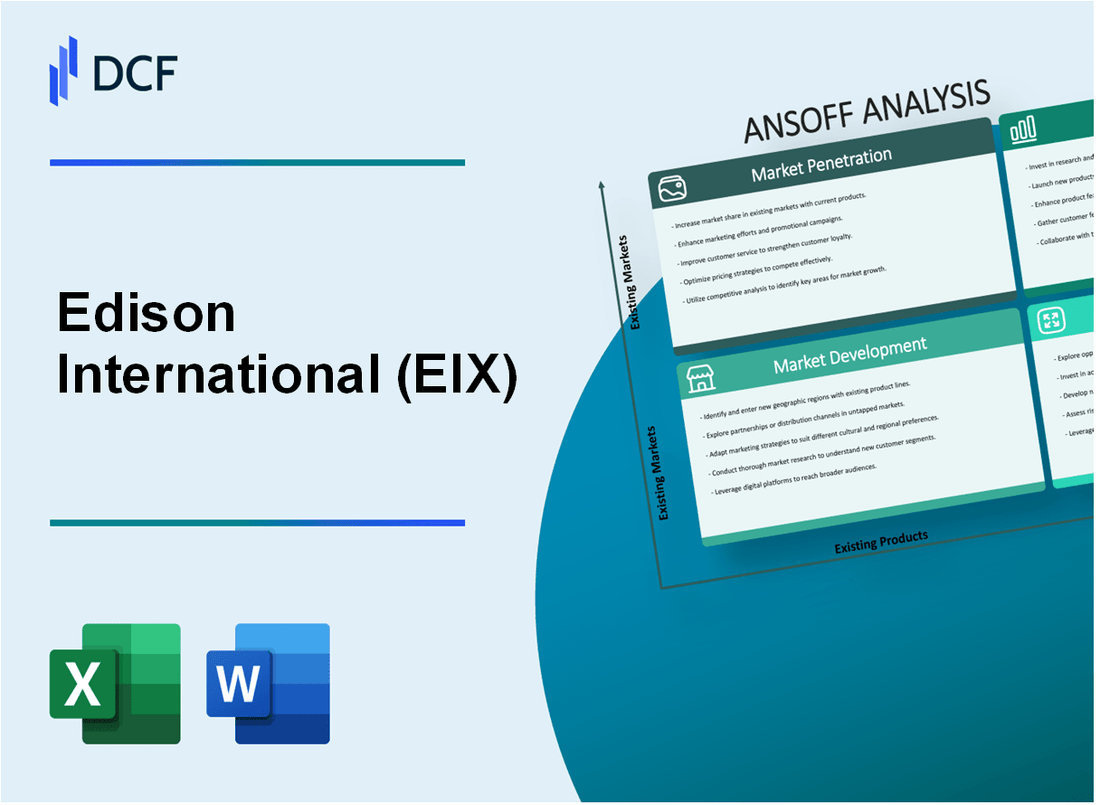
Edison International (EIX): ANSOFF MATRIX [Dec-2025 Updated] |
Fully Editable: Tailor To Your Needs In Excel Or Sheets
Professional Design: Trusted, Industry-Standard Templates
Investor-Approved Valuation Models
MAC/PC Compatible, Fully Unlocked
No Expertise Is Needed; Easy To Follow
Edison International (EIX) Bundle
You're staring down Edison International's massive $28 billion to $29 billion capital program through 2028 and need to know exactly how that money translates into tangible growth, right? Honestly, the Ansoff Matrix is the perfect lens for this, especially when we anchor everything to Southern California Edison's authorized $9.664 billion revenue requirement for 2025. We're going to break down their strategy into four clear lanes: digging deeper into the existing service area, taking their expertise to new markets, developing new grid tech like advanced charging, and even making some bold, non-regulated bets-it's a defintely comprehensive plan to fund safety and capture that expected load growth. Let's see where the real returns are hiding in those four quadrants below.
Edison International (EIX) - Ansoff Matrix: Market Penetration
Market Penetration for Edison International centers on deepening its presence within its existing service territory by increasing the volume of electricity sold and the utilization of its grid infrastructure. This strategy relies heavily on regulatory support and successful execution of mandated and voluntary customer programs.
A core component of this strategy involves accelerating grid hardening efforts to ensure reliability, which directly supports increased load. While specific authorization figures vary by proceeding, post-wildfire rebuilding plans for Altadena and Malibu alone include an estimated cost between $860 million and $925 million to underground approximately 153 circuit miles of distribution lines. Furthermore, Edison International is planning to underground less than 1,000 miles of wires in high-risk fire zones through 2028.
Driving increased sales volume through electrification is paramount to capturing future revenue. Edison International expects to capture significant demand from this shift, forecasting a cumulative load growth of approximately 35% by 2035. Electric vehicle adoption is already a major factor, accounting for about a third of current load growth.
The financial underpinning for these necessary investments is the expected growth in the regulated asset base. Edison International projects an annual rate base growth averaging between 7% and 8% through 2028. This growth funds essential safety and reliability projects.
To manage the increased load and optimize grid utilization, increasing customer adoption of Time-of-Use (TOU) rates is a key action. Southern California Edison (SCE) previously transitioned 2.3 million residential customers to TOU rate plans. The California Public Utilities Commission (CPUC) approved a final decision in September 2025 for the 2025 Test Year base revenue requirement, setting it at $9.664 billion. This revenue requirement supports the necessary operational scale and investment.
The following table summarizes key financial and operational metrics relevant to this market penetration strategy:
| Metric | Value/Projection | Timeframe/Context |
| Authorized 2025 Base Revenue Requirement | $9.664 billion | 2025 Test Year (CPUC Decision) |
| Projected Annual Rate Base Growth | 7% to 8% | Through 2028 |
| Expected Load Growth | 35% | By 2035 |
| Residential Customers on TOU Rates (Historical Transition) | 2.3 million | Transition started Nov 2021 |
| Wildfire Rebuild Undergrounding Cost Estimate (Altadena/Malibu) | $860 million to $925 million | Specific post-fire rebuilding effort |
Specific actions supporting market penetration include:
- Accelerate grid hardening with the $2.213 billion authorized for undergrounding to improve reliability.
- Drive residential and commercial electrification programs to capture 35% load growth expected by 2035.
- Increase customer adoption of Time-of-Use (TOU) rates to optimize grid utilization and manage peak demand.
- Leverage the 7-8% annual rate base growth through 2028 to fund essential safety and reliability projects.
- Enhance digital customer service to improve satisfaction and justify the $9.664 billion 2025 base revenue requirement.
The growth in core EPS is also targeted, with Edison International leadership projecting 5% to 7% annual growth through 2028, underpinned by that strong rate base growth.
Edison International (EIX) - Ansoff Matrix: Market Development
Expand the non-regulated Trio (formerly Edison Energy) advisory services beyond the current 30+ countries.
Trio, an indirect, wholly-owned, non-utility subsidiary of Edison International, currently does business in 30+ countries. The firm has a team of 450+ subject matter experts.
Target new Federal Energy Regulatory Commission (FERC) transmission projects outside California, starting with the $4 billion in opportunities beyond 2028.
Edison International projects at least $4 B in additional investment opportunities beyond 2028, which includes new FERC transmission projects scheduled to begin in 2029. The company's overall capital expenditure forecast through 2028 is between $28 B and $29 B.
Offer energy management and sustainability advisory services to large commercial clients in new US regions.
Trio partners with over 100+ clients listed in the Fortune 500 and Global Fortune 500. Edison International's market capitalisation was approximately $21.5 B as of October 2025.
Pursue strategic partnerships with utilities in other states to export SCE's wildfire mitigation expertise.
Southern California Edison (SCE) is part of an International Wildfire Risk Management Consortium (IWRMC) that expanded to 18 current utility members since its formation in 2020. SCE submitted its 2026-2028 Wildfire Mitigation Plan (WMP), anticipating an investment of $6.2 billion over the three years.
Secure new global contracts for offsite renewable procurement, building on Trio's existing international reach.
Trio advised on 920 MW of renewable energy power purchase agreements in 2024. The total amount of offsite and onsite renewable energy procured by Trio is 13+ GW.
Key Metrics for Market Development Strategy
| Metric Category | Unit/Entity | Value/Amount |
| Trio Global Reach | Countries of Operation | 30+ |
| Trio Client Base | Fortune 500/Global Fortune 500 Clients | 100+ |
| Trio Renewable Procurement (2024) | MW Advised | 920 MW |
| EIX Future FERC Investment | Value Beyond 2028 | $4 B |
| SCE WMP Investment (2026-2028) | Total Investment | $6.2 billion |
Edison International reaffirmed its 2025 Core EPS guidance range of $5.94-$6.34. The long-term Core EPS growth target is 5%-7% through 2028.
- Trio team size: 450+ subject matter experts.
- SCE 2022-2023 Transmission Plan investment: $7.3 billion.
- Total renewable energy procured by Trio: Over 12,600 MW.
- SCE 2024 Core EPS: $4.93.
Edison International (EIX) - Ansoff Matrix: Product Development
You're looking at the hard numbers behind Edison International (EIX)'s push for new offerings, which is really about modernizing the grid to handle massive electrification. This isn't just maintenance; it's developing new capabilities to manage the energy future.
The foundation for these new products rests on a substantial capital commitment. Edison International is projecting a total capital investment of $28-$29 billion across the 2025-2028 period. A staggering 97% of that spending is allocated directly to transmission, distribution, and generation capacity. The CPUC approved 91% of Southern California Edison (SCE)'s proposed capital investments in the 2025 General Rate Case (GRC).
The expected revenue growth tied to this investment is clear. SCE's base revenue was expected to be authorized at $10.27 billion for 2025 through 2028, up from $8.4 billion in 2024, representing an increase of 23% or $1.9 billion. The company affirmed its 2025 Core EPS guidance of $5.94-$6.34 and is confident in delivering 5-7% Core EPS growth from 2025 to 2028. For the third quarter of 2025, core earnings were $901 million, or $2.34 per share.
The need for these product developments is driven by mandated clean energy goals and load growth.
- Edison International (EIX)'s goal is to deliver 100% carbon-free power to SCE customers by 2045.
- Forecasted load growth from electrification is projected to hit 35% by 2035 and 80% by 2045.
- EV adoption currently drives about a third of the company's load growth.
- In 2023, SCE delivered 52% carbon-free power to customers.
Developing advanced distribution management systems (ADMS) to integrate customer-owned Distributed Energy Resources (DERs) is part of this modernization. This is supported by the overall capital plan and the need to manage increasing complexity.
Rolling out new smart charging programs and infrastructure directly addresses the EV load. Edison International has over $800 million of approved funding for EV charging programs, plus over $1 billion in incentives.
Developing new energy storage solutions is critical for meeting the 2045 carbon-free goal. SCE has installed or procured about 8.8 GW of storage capacity, with about 3.7 GW currently online. SCE commissioned about 310 MW and is commissioning an additional 225 MW of utility-owned storage. California-wide, it is projected that 30+ GW of utility-scale storage will be needed by 2045.
New cybersecurity products for grid control systems are implicitly funded by the overall infrastructure investment, as the cybersecurity of critical information technology systems for grid control is listed as an important factor that could cause different results.
Offering bundled energy efficiency and demand response services to commercial customers is a function of the non-regulated business, Trio (formerly Edison Energy), which provides integrated sustainability and energy advisory services to large commercial, industrial, and institutional organizations.
Here are the key financial and operational metrics underpinning these product development efforts:
| Metric Category | Value/Target | Period/Context |
| Total Capital Investment Projection | $28-$29 billion | 2025-2028 |
| Capital Allocation to Grid/Generation | 97% | Of total 2025-2028 capital |
| 2025 Core EPS Guidance Range | $5.94-$6.34 | 2025 Fiscal Year |
| Core EPS Growth Target | 5-7% | 2025 to 2028 |
| Q3 2025 Core EPS | $2.34 per share | Third Quarter 2025 |
| Approved GRC Capital Investment | 91% | Of SCE's proposed capital in 2025 GRC |
| Projected Utility Storage Needed | 30+ GW | California-wide by 2045 |
| Current Utility-Owned Storage Online | ~3.7 GW | As of February 2025 update |
| Approved EV Program Funding | Over $800 million | Plus over $1 billion in incentives |
Finance: review the capital allocation breakdown for the next quarter against the $28-$29 billion plan by end of week.
Edison International (EIX) - Ansoff Matrix: Diversification
You're looking at how Edison International (EIX) might push beyond its regulated California utility base, which is a classic Diversification move in the Ansoff Matrix. This means moving into new markets with new offerings, which naturally carries a different risk profile than just upgrading the existing grid.
The current regulated path is substantial, with Edison International anticipating capital expenditures between $28 B and $29 B from 2024 to 2028. Still, management sees at least $4 B in additional investment opportunities beyond 2028, which is where these diversification plays fit in. For context, the utility reported third-quarter 2025 operating revenues of $5.75 B and narrowed its full-year 2025 core EPS guidance to $5.95-$6.20 per share. The long-term core EPS growth target remains 5% to 7% CAGR through 2028.
Technology Partnerships and Software Commercialization
For developing grid-edge software, Edison International is already building relationships. Southern California Edison (SCE) launched the Intelligent Grid Collaboration with NVIDIA to develop AI-based solutions for issues like enhancing interconnection of customer loads. This shows an internal capability in advanced grid technology, which is a necessary precursor to external commercialization. Furthermore, SCE's Advanced Waveform Anomaly Recognition (AWARE) system, which uses AI and machine learning, won the 97th Edison Award in June 2025, validating the technology's effectiveness in proactive fault management.
Regarding commercializing internal technologies, the historical context for advanced metering is significant. SCE's original Edison SmartConnect advanced metering plan projected total capital costs of approximately $1.3 billion for deploying 5.3 million smart meters. The future opportunity is explicitly mentioned, as Edison International sees at least $4 B in investment opportunities beyond 2028, including advanced metering technologies.
Non-Regulated Business Ventures
Launching a new, non-regulated microgrid-as-a-service business outside California would be a true market development/diversification step. While specific revenue targets for a hypothetical microgrid business aren't public, the focus on non-regulated growth is supported by Edison International's existing structure. The company has subsidiaries like EDISON ESI, which markets services, products, information, and copyrighted materials to third parties on behalf of SCE. This structure provides a potential vehicle for non-utility service delivery.
For investing in new, non-utility clean generation assets, the company's existing investment portfolio shows a precedent. Edison International's plan assets include investments in private equity and venture capital funds with investment strategies focused on clean and information technology. This suggests an established appetite for allocating capital outside the core regulated utility business.
Venture Capital Arm Establishment
Establishing a dedicated venture capital arm aligns with existing investment activities. Edison International's retirement plan assets already include investments in venture capital funds. The investment strategies for these funds have included sectors like clean and information technology. More directly, Edison International has previously helped fund a battery management venture's Series B round, indicating direct engagement in funding early-stage, climate-relevant technology companies.
Here's a quick look at some of the key figures related to the regulated base and investment outlook:
| Metric | Value/Range | Timeframe/Context |
| Total Capex Forecast | $28 B to $29 B | 2024 to 2028 |
| 2025 Capital Expenditure | $6.8 B | Reduced by $700 M from previous plan |
| Long-Term Core EPS Growth Target | 5% to 7% | 2025 to 2028 |
| Investment Opportunities Beyond 2028 | At least $4 B | Includes advanced metering technologies |
| Historical AMI Capital Cost (SCE) | Approximately $1.3 billion | Edison SmartConnect plan (Filed 2007) |
| Q3 2025 Operating Revenues | $5.75 billion | Reported |
The potential for commercializing internal tech is underscored by the scale of past projects and future needs. The utility is working to meet California's goal for power to be carbon-free by 2045, which requires significant grid evolution.
- Improve "forward radar" to anticipate customer technology adoption.
- Integrate new tools and grid planning processes.
- Accelerate industry development, testing, piloting, and deployment of critical grid technologies.
- Focus on automation using machine learning and artificial intelligence for grid flexibility.
If onboarding takes 14+ days for new technology partners, churn risk rises, so speed in these external ventures is defintely key.
Disclaimer
All information, articles, and product details provided on this website are for general informational and educational purposes only. We do not claim any ownership over, nor do we intend to infringe upon, any trademarks, copyrights, logos, brand names, or other intellectual property mentioned or depicted on this site. Such intellectual property remains the property of its respective owners, and any references here are made solely for identification or informational purposes, without implying any affiliation, endorsement, or partnership.
We make no representations or warranties, express or implied, regarding the accuracy, completeness, or suitability of any content or products presented. Nothing on this website should be construed as legal, tax, investment, financial, medical, or other professional advice. In addition, no part of this site—including articles or product references—constitutes a solicitation, recommendation, endorsement, advertisement, or offer to buy or sell any securities, franchises, or other financial instruments, particularly in jurisdictions where such activity would be unlawful.
All content is of a general nature and may not address the specific circumstances of any individual or entity. It is not a substitute for professional advice or services. Any actions you take based on the information provided here are strictly at your own risk. You accept full responsibility for any decisions or outcomes arising from your use of this website and agree to release us from any liability in connection with your use of, or reliance upon, the content or products found herein.