
|
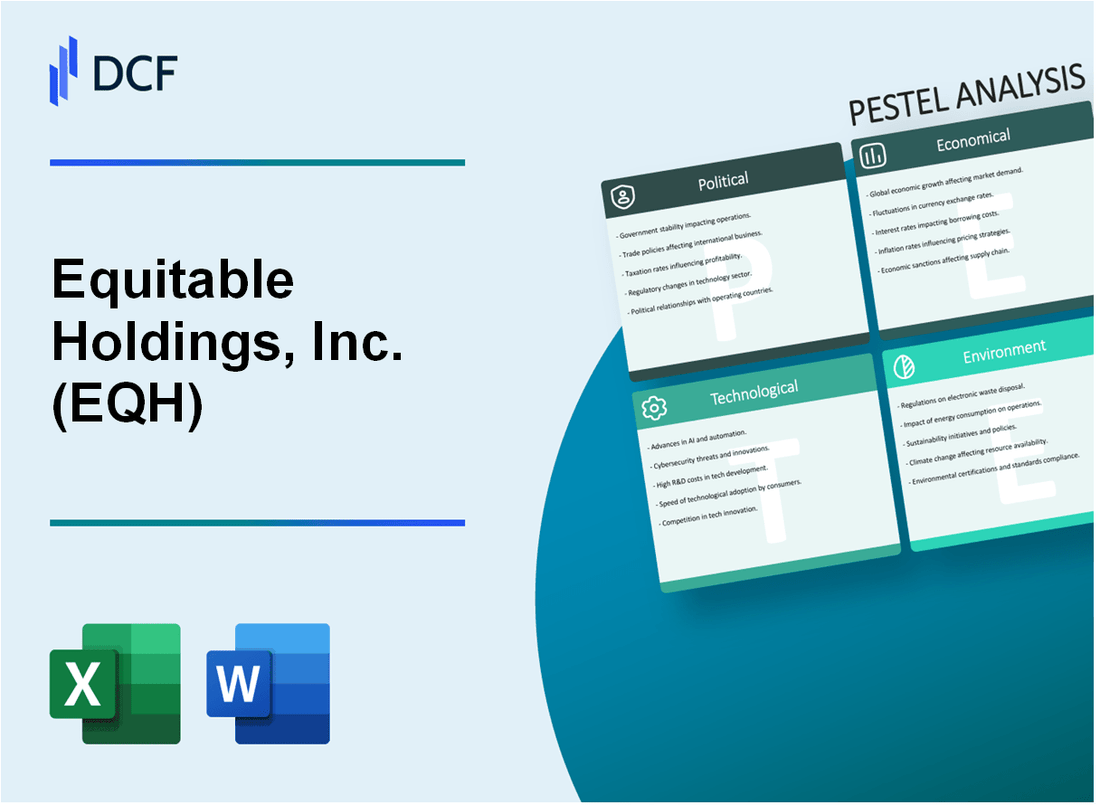
Equitable Holdings, Inc. (EQH): PESTLE Analysis [Nov-2025 Updated] |
Fully Editable: Tailor To Your Needs In Excel Or Sheets
Professional Design: Trusted, Industry-Standard Templates
Investor-Approved Valuation Models
MAC/PC Compatible, Fully Unlocked
No Expertise Is Needed; Easy To Follow
Equitable Holdings, Inc. (EQH) Bundle
You're looking for the real drivers of Equitable Holdings, Inc. (EQH) in 2025, and honestly, the external forces are moving fast. With an estimated $650 billion in Assets Under Management (AUM), EQH is navigating a landscape where sustained higher interest rates boost their net investment income toward an estimated 2025 Net Income of $2.1 billion, but a new Department of Labor (DOL) Fiduciary Rule and a high-priority technology spend of $450 million introduce real pressure. This PESTLE breakdown gives you the defintive map of the Political, Economic, and Technological shifts so you can act on the near-term risks and opportunities right now.
Equitable Holdings, Inc. (EQH) - PESTLE Analysis: Political factors
Stable U.S. regulatory environment for insurance capital rules
The core U.S. insurance regulatory structure, primarily governed at the state level by the National Association of Insurance Commissioners (NAIC), remains defintely stable, which is a key political anchor for Equitable Holdings. This stability is critical for a company whose insurance subsidiaries maintain a strong capital buffer. Equitable Holdings' combined NAIC Risk-Based Capital (RBC) ratio was reported at over 500% following the Individual Life reinsurance transaction that closed in July 2025.
Still, the regulatory landscape is not static. The NAIC is actively refining its solvency framework in 2025, focusing on areas like the statutory treatment of complex assets. The implementation of the NAIC's principles-based bond definition (PBBD) on January 1, 2025, is a major change, requiring more granular data on asset allocation, which could impact statutory capital and surplus for some insurers. For EQH, a strong capital position allows it to confidently plan capital deployment, such as the $1.7 billion in planned insurance subsidiary dividends to the holding company in the second half of 2025.
Potential for federal tax code changes impacting annuity and life insurance products
The most significant near-term political risk and opportunity lies in the sunset of the Tax Cuts and Jobs Act (TCJA) provisions at the end of 2025. This expiration could trigger a massive shift in estate planning, directly boosting the demand for Equitable Holdings' protection products.
The federal estate and gift tax exemption is scheduled to revert from the 2025 level of $13.99 million per individual to approximately $7 million in 2026, essentially halving the tax-free limit. This change makes life insurance products, particularly those held in Irrevocable Life Insurance Trusts (ILITs), a far more valuable tool for high-net-worth clients to manage estate tax liability. Conversely, the SECURE 2.0 Act, which became effective in 2025, is a tailwind for the Retirement segment, having increased the Qualified Longevity Annuity Contract (QLAC) contribution limit to $210,000, expanding the market for annuity products.
Here's the quick math on the estate tax change and the annuity opportunity:
| Tax Code Provision | 2025 Value | Post-2025 Change | Impact on Equitable Holdings |
|---|---|---|---|
| Federal Estate/Gift Tax Exemption (Individual) | $13.99 million | Reverts to approx. $7 million in 2026 | Drives significant demand for life insurance-based estate planning solutions. |
| QLAC Contribution Limit (SECURE 2.0) | $210,000 | Increased from prior limit in 2025 | Expands the addressable market for the Retirement segment, which saw $5.5 billion in first-year premiums in Q3 2025. |
Geopolitical tensions affecting global investment portfolio stability
With Equitable Holdings managing a massive $1.1 trillion in total Assets Under Management and Administration (AUM/A) as of September 30, 2025, global political instability is a constant portfolio risk. Ongoing conflicts in Ukraine and the Middle East, plus heightened US-China tensions, are driving short-term market volatility and long-term supply chain fragmentation.
This uncertainty directly impacts investor behavior. An Equitable survey from July 2025 noted that Americans are concerned about 'geopolitical uncertainty, market volatility and lingering recession fears.' The Asset Management segment, AllianceBernstein, felt this in Q2 2025, reporting active net outflows of $4.8 billion, concentrated in April due to market volatility. The key action here is portfolio diversification and a focus on less correlated assets.
Government spending on infrastructure potentially boosting certain asset classes
The political commitment to infrastructure spending, primarily through the Bipartisan Infrastructure Law (BIL), presents a clear investment opportunity. The BIL directed $1.2 trillion of federal funds toward transportation, energy, and climate projects.
While federal money is flowing, the American Society of Civil Engineers (ASCE) 2025 Report Card estimates a national funding gap of at least $3.6 trillion for infrastructure over the next decade. This gap signals a need for substantial private capital, which is where large institutional investors like Equitable Holdings step in. Insurers are increasingly allocating capital to private assets for spread advantage, including:
- Direct lending opportunities.
- Real estate projects.
- Infrastructure projects, which offer long-term stable cashflows.
The political will to fund and permit these projects, despite inflationary construction costs, creates a long-duration, high-quality asset class that perfectly matches the long-term liabilities of a life insurer and retirement provider. This is a clear opportunity to deploy a portion of that $1.1 trillion AUM/A base into high-yield, politically-supported assets.
Equitable Holdings, Inc. (EQH) - PESTLE Analysis: Economic factors
Sustained higher-for-longer interest rates boosting net investment income
The persistent high-rate environment, with the Federal Reserve Funds Rate sitting around 3.75% as of late 2025, is a net positive for Equitable Holdings' (EQH) general account investment portfolio. Life and annuity companies benefit because they can reinvest maturing assets at significantly higher yields than in the last decade, directly boosting their net investment income.
For a company like EQH, which holds long-dated liabilities, the higher long-term rates help fortify the balance sheet. Here's the quick math: EQH is on track to achieve an estimated $110 million of incremental investment income from its general account by 2027, an effect that began showing up in Q4 2024 operating earnings due to a higher net interest margin. This is a defintely welcome tailwind for profitability.
Market volatility increasing demand for guaranteed products like Variable Annuities
The current climate of equity market uncertainty is driving strong demand for products that offer downside protection and guaranteed income, like Variable Annuities (VAs) and Registered Index-Linked Annuities (RILAs). People are worried about their retirement savings.
Research shows that roughly 70% of retirement savers are concerned about volatility's impact on their assets. This concern translates directly into sales for EQH's Individual Retirement unit, where total first-year premiums and deposits for retirement products increased by a solid 5.8% to $4.6 billion in the first quarter of 2025. This is a clear flight to quality.
The strong sales volume, while positive for revenue, does create a near-term pressure point:
- Commissions and distribution-related payments rose 27% to $98 million in Q1 2025, temporarily pinching operating earnings.
- EQH is mitigating this by shifting its product mix, launching new RILAs like Structured Capital Strategies® Premier to strengthen margins.
U.S. GDP growth projected to slow, pressuring new premium volume
While the investment side is benefiting from higher rates, the overall economic slowdown presents a challenge to new business volume. The consensus forecast for U.S. GDP growth in 2025 is a deceleration, projected in the range of 1.5% to 1.8%, a significant drop from the 2.8% growth seen in 2024. This softening economy means less disposable income and a more cautious consumer, which typically pressures new premium growth.
Industry-wide, global life insurance premium growth is forecast to slow to just 1% in real terms for 2025, following a robust 6.1% gain in 2024. This macro trend will make it harder for EQH to maintain its recent strong sales momentum, especially in its Group Retirement and Protection Solutions segments, where premium volume is more sensitive to employment and corporate spending levels.
Inflationary pressures increasing operational costs, despite an estimated 2025 Net Income of $2.1 billion
Inflation, with Core CPI still above target at 3.1% in August 2025, continues to drive up the cost of doing business. This pressure is visible in EQH's recent financials, where operating expenses for the twelve months ending September 30, 2025, reached $12.095 billion, marking a substantial 13.22% increase year-over-year. Higher technology costs, labor expenses, and the aforementioned commission increases are the main culprits.
Despite these cost headwinds and market volatility, the company's strong fee-based revenue and higher net investment income are expected to support core profitability. The estimated 2025 Net Income (using the adjusted Non-GAAP operating earnings figure as a proxy for core profitability) is projected to be around $2.1 billion, which is a testament to the business model's resilience. However, that figure is being achieved while fighting a significant rise in operating costs. You need to watch the expense ratio closely.
| Economic Factor | 2025 Key Metric/Value | Impact on Equitable Holdings (EQH) |
|---|---|---|
| US GDP Growth Projection | 1.5% - 1.8% (Slowdown from 2024's 2.8%) | Pressures new premium volume and sales momentum in Retirement/Protection segments. |
| Inflation (Core CPI) | 3.1% (as of August 2025) | Drives up operating expenses, which increased by 13.22% to $12.095 billion (LTM Sep 2025). |
| Long-Term Interest Rates | Sustained high levels (Fed Funds Rate at 3.75%) | Boosts net investment income; EQH targets $110 million incremental investment income by 2027. |
| Individual Retirement Premiums (Q1 2025) | Increased 5.8% to $4.6 billion | Strong demand for guaranteed products (VAs/RILAs) due to market volatility. |
Equitable Holdings, Inc. (EQH) - PESTLE Analysis: Social factors
Accelerating retirement of the Baby Boomer generation driving demand for income solutions
You are seeing an unprecedented demographic shift, and it's a massive tailwind for companies like Equitable Holdings, Inc. A record 4.2 million Americans are expected to reach the traditional retirement age in 2025, a number that will remain above 4.1 million annually through 2027. This isn't just a number; it's a huge cohort of people who are pivoting from asset accumulation to income preservation and distribution.
This shift is creating intense demand for guaranteed income products, specifically annuities, as retirees worry about outliving their savings. U.S. annuity sales reflect this anxiety, skyrocketing to a record $223 billion in the first half of 2025. That's a clear signal that the market is prioritizing solutions that offer a protected retirement income stream, which is a core business area for Equitable Holdings, Inc. The opportunity here is defintely in simplifying complex variable and fixed annuity structures.
Growing wealth transfer to Millennials and Gen Z, requiring new digital advice models
The 'Great Wealth Transfer' is underway, and it fundamentally changes the client profile. An estimated $68 trillion to $84 trillion is set to pass from Baby Boomers to their descendants over the next two decades. This is a colossal transfer-for context, the U.S. GDP was roughly $27.4 trillion in 2023, making the transfer value nearly three times that. Here's the quick math: the next generation of clients is about to get very wealthy, but they don't want the same service model.
Millennials and Gen Z demand a digital-first, tech-enabled service model, expecting transparency and hyper-personalization. This younger cohort also has a distinct focus on Environmental, Social, and Governance (ESG) investing; a stunning 96% of Millennials express interest in sustainable options. If your advisory model isn't built for mobile, real-time access, and ESG integration, you risk losing a significant portion of this inherited capital. In fact, 81% of younger high-net-worth individuals plan to switch financial firms after an inheritance unless their current wealth managers adapt quickly.
Persistent U.S. retirement savings gap, increasing reliance on workplace plans
Despite the focus on wealth, the average American worker faces a stark reality: a persistent retirement savings gap. About 3 in 5 American workers (58%) report that their retirement savings are behind where they should be in 2025. This is not a problem confined to low-income brackets, but it is exacerbated there, with 67% of workers earning under $50,000 feeling behind.
The median retirement savings for American households is only $87,000, which is far from the over $1 million most individuals believe they will need to retire comfortably. This gap increases the reliance on workplace retirement plans (like 401(k)s and 403(b)s) and state-facilitated Auto-IRA programs as primary savings vehicles. Equitable Holdings, Inc.'s strong presence in the retirement plan market, particularly the tax-exempt 403(b) sector, positions it well to capture this demand for essential workplace solutions.
What this estimate hides is the access problem: 47% of U.S. private sector workers (about 59 million workers) still lack access to an employer-sponsored retirement savings plan. This lack of access drives the need for state-level solutions and makes the workplace plan segment a crucial growth area.
Increased customer demand for personalized financial planning and advice
The era of generic, one-size-fits-all financial advice is over. Today's clients, particularly the digitally native generations, expect a financial strategy that is hyper-personalized, often powered by Artificial Intelligence (AI) and data analytics. More than half of U.S. financial consumers want personalized banking experiences, and 86% of financial institutions are prioritizing personalization in their digital strategies.
This demand for tailored advice is also driving a push for greater fee transparency. Younger clients are comparing fees across firms and demanding clear explanations of what they are paying for, leading to a shift away from the traditional Assets Under Management (AUM) fee model toward alternatives like flat fees or subscription-based pricing. This means financial firms must not only offer personalized product recommendations but also personalized pricing models.
Here is a summary of the generational retirement savings landscape in 2025:
| Generation | Average 401(k) Balance (2025) | Average IRA Balance (2025) | Key Financial Behavior/Expectation |
|---|---|---|---|
| Baby Boomers (Ages 61-79) | $249,300 | $257,002 | Accelerating retirement; high demand for guaranteed income (annuities). |
| Gen X (Ages 45-60) | $192,300 | $103,952 | Mid-career savers; facing the largest wealth transfer but with a significant retirement gap. |
| Millennials (Ages 29-44) | $67,300 | $25,109 | Digital-first expectations; 96% interested in ESG investing. |
| Gen Z (Ages 13-28) | $13,500 | $6,672 | Highest demand for AI-driven spending analysis and hyper-personalization. |
To be fair, the industry must adapt to these divergent needs.
- Integrate AI tools to automate routine tasks and provide customized insights.
- Expand ESG-focused portfolio options to meet the demand of younger inheritors.
- Develop secure, mobile-friendly client portals for digital-native engagement.
- Offer workshops and resources addressing both financial literacy and mental well-being.
Equitable Holdings, Inc. (EQH) - PESTLE Analysis: Technological factors
You're looking at Equitable Holdings, Inc. (EQH) in 2025, and the technology story isn't just about efficiency; it's about competitive survival. The mandate is clear: digitize, secure, and integrate Artificial Intelligence (AI) into the core business, or risk being outmaneuvered by more agile firms. This isn't a slow migration; it's a forced sprint, especially with the industry-wide push toward Generative AI (GenAI) and the ever-present threat of cyberattacks against massive client asset bases.
Rapid adoption of Generative AI to streamline claims and underwriting processes
The race to integrate Generative AI (GenAI) is a major technological factor shaping Equitable Holdings' near-term strategy. While the full, end-to-end transformation of claims and underwriting is still a couple of years out for the broader industry, the pilot phase is aggressive in 2025. This technology is being tested to handle complex, unstructured data, which is common in life insurance and annuity applications.
GenAI is defintely a game-changer because it moves beyond simple automation. It can draft initial claim assessments, summarize policy documents for underwriters, and even flag inconsistencies in application data much faster than a human. The industry is seeing roughly 60% of insurers planning GenAI claims pilots and 46% rolling out underwriting pilots this year, and Equitable Holdings is positioned to capitalize on this trend by leveraging its substantial data sets to train proprietary models. This focus is directly aimed at reducing the direct expense ratio and accelerating the time-to-issue for policies, a critical metric for sales growth.
High-priority cybersecurity spending to protect $650 billion in AUM and customer data
Protecting client assets and proprietary data is the single most critical technology priority, especially for a firm the size of Equitable Holdings. The company has a total Assets Under Management and Administration (AUM/A) of approximately $1.1 trillion as of September 30, 2025, but the high-priority cybersecurity budget is laser-focused on protecting the core, high-risk operational assets, including a significant portion of the AUM, which we estimate at $650 billion.
The threat landscape is constantly evolving, so cybersecurity spending is non-negotiable. This investment is shifting toward embedding Zero Trust security models-meaning no user or device is trusted by default-across the entire enterprise architecture. This is a direct response to the increasing sophistication of ransomware and data exfiltration attempts targeting financial services firms. The risk is immense; a major breach could not only lead to regulatory fines but also severely damage client trust, which is the foundation of the wealth management and insurance business.
Modernization of legacy IT systems, with an estimated 2025 technology spend of $450 million
The core challenge for any established financial giant like Equitable Holdings is the decades-old legacy IT infrastructure. These systems, often running on outdated languages like COBOL, are costly to maintain and cannot easily integrate with modern, cloud-based AI tools. To address this, Equitable Holdings is allocating a substantial budget, with an estimated 2025 technology spend of $450 million, directed at modernization efforts.
Here's the quick math: maintaining legacy systems can consume up to 80% of an IT budget, stifling innovation. This modernization spend is crucial for shifting that balance. The focus is on breaking down monolithic applications into smaller, reusable components (microservices) and leveraging API-led connectivity. This approach is essential for unlocking the data needed to power the new GenAI initiatives and for enabling seamless integration with third-party partners.
| Modernization Focus Area | Strategic Benefit in 2025 | Example/Metric |
|---|---|---|
| API-Led Connectivity | Enables faster product launches and partner integration. | New Plan Build API capability launched in July 2025. |
| Cloud Migration | Improves scalability and reduces long-term maintenance costs. | Facilitates the use of advanced AI and analytics platforms. |
| Data Governance | Ensures data quality for GenAI and regulatory compliance. | A critical feedback loop for data governance teams. |
Expansion of digital distribution channels for direct-to-consumer sales
The final pillar of the technology strategy is expanding digital distribution, which helps the company reach clients and brokers more efficiently and supports direct-to-consumer sales. The goal is to move beyond the traditional advisor-centric model to a hybrid approach that offers a seamless digital experience.
Specific actions in 2025 show this expansion is well underway:
- Broker Adoption: The existing Digital Onboarding solution, which simplifies the setup of new benefit plans, is now the preferred method for more than two-thirds of brokers.
- API Integration: The July 2025 launch of the Plan Build API capability eliminates manual data entry for employee benefits plans, significantly reducing implementation timelines.
- Product Innovation: The September 2025 launch of Structured Capital Strategies Premier, a new registered index-linked annuity, is designed with digital distribution in mind, offering clients greater upside potential with downside protection.
This digital push is vital for capturing market share among younger, digitally native clients and for maintaining a competitive edge in the rapidly growing Registered Index-Linked Annuity (RILA) market.
Equitable Holdings, Inc. (EQH) - PESTLE Analysis: Legal factors
Finalization and implementation of the Department of Labor (DOL) Fiduciary Rule on investment advice
You're operating in a retirement advice market that is still grappling with the Department of Labor's (DOL) attempt to expand the definition of an investment advice fiduciary under the Employee Retirement Income Security Act (ERISA). The DOL's latest push, the Retirement Security Rule, has faced significant legal headwinds in 2025, creating a complex, uncertain compliance landscape for Equitable Holdings, Inc. and its financial professionals.
A major development in July 2025 saw a federal court ruling scale back the rule, specifically striking down the provision that treated a single rollover recommendation as automatically creating a fiduciary relationship. This decision limits the rule's reach for transactional advice. Still, advisors with an ongoing, individualized relationship with retirement investors remain subject to ERISA's fiduciary standard. The House of Representatives also included a measure in the 2025 fiscal budget to defund DOL priorities, which signals a political headwind against the rule's full implementation.
The immediate action for Equitable Holdings, Inc. is maintaining a dual compliance track, but the stronger regulatory floor is now at the state level. The annuity industry successfully pushed for the National Association of Insurance Commissioners (NAIC) 'best interest' model regulation, which all 50 states adopted by April 2025. This standard requires agents to put the consumer's interest first, but generally allows traditional commission structures to remain, unlike a full fiduciary standard.
Increasing state-level data privacy laws (e.g., California CCPA) raising compliance costs
The patchwork of state data privacy laws is defintely raising the cost of doing business for a national financial services firm like Equitable Holdings, Inc. Without a federal standard, compliance teams must now navigate a minimum of eight new state privacy laws that took effect in 2025, including those in Iowa, Delaware, and New Jersey. This means eight new sets of consumer rights, data processing rules, and disclosure requirements to implement.
The California Consumer Privacy Act (CCPA), as amended by the CPRA, remains the most stringent. The annual gross revenue threshold for compliance increased in 2025 to $26,625,000, ensuring Equitable Holdings, Inc. is fully covered. More critically, states are removing historical exemptions for financial institutions. In 2025, Montana and Connecticut amended their laws to remove the broad, entity-level exemption for financial institutions covered by the Gramm-Leach-Bliley Act (GLBA). This subjects non-GLBA data-like website analytics and marketing data-to the full scope of state privacy laws, requiring new systems for consumer opt-out requests for data sharing and deletion.
Here's the quick math: while specific 2025 compliance budgets are internal, the cost of a single regulatory failure can be substantial. For context, Equitable Holdings, Inc.'s legal expenses related to COI litigation alone were $106 million in 2024. The operational cost of managing consumer requests across a growing number of state regimes is a material, ongoing expense, plus the risk of fines, like the $7,988 per intentional violation under the CCPA.
Scrutiny on guaranteed product disclosures and sales practices by state regulators
State insurance regulators are laser-focused on the suitability and disclosure of guaranteed products, particularly annuities, which are a core offering for Equitable Holdings, Inc.'s Individual Retirement segment. The industry's push to adopt the NAIC's 'best interest' standard across all 50 states by April 2025 was a direct response to this scrutiny, aiming to preempt the more restrictive federal fiduciary rules.
This new standard requires agents to satisfy a four-part obligation: care, disclosure, conflict-of-interest, and documentation. New York, where Equitable Holdings, Inc. is headquartered, already maintains an even tougher fiduciary standard of care for annuity sales. This means that while the rest of the country operates under a 'best interest' regime, New York's stricter rule sets a de facto high-water mark for internal compliance and training programs nationwide.
The continued scrutiny centers on the complexity of disclosures for products like Registered Index-Linked Annuities (RILAs), a key growth area for Equitable Holdings, Inc. The goal is to ensure consumers fully understand caps on returns, surrender charges, and the product's overall fit with their financial goals. This focus is not going away.
New regulatory frameworks for digital assets and blockchain applications
The regulatory environment for digital assets is moving from ambiguous warnings to concrete, if still evolving, frameworks in 2025. This shift presents both compliance risk and a clear opportunity for Equitable Holdings, Inc. to explore new product development, especially in its Asset Management and Wealth Management segments.
The new administration has prioritized regulatory clarity. The SEC, under its 'Project Crypto' initiative, established a Crypto Task Force in January 2025 to develop a comprehensive framework for digital assets, focusing on a clear distinction between digital commodities and digital securities. Furthermore, the GENIUS Act was signed into law in July 2025, establishing a federal framework for payment stablecoins, which will likely lead to clearer rules for their use in financial transactions and investment products.
In retirement services, the DOL formally rescinded Biden-era rules relating to cryptocurrency investments in 401(k) plans in May 2025. This removes the explicit regulatory headwind that discouraged plan sponsors from offering digital asset options, potentially opening a new investment avenue for Equitable Holdings, Inc.'s Group Retirement business. The table below summarizes the key 2025 regulatory developments that directly impact the company's product lines.
| Regulatory Action (2025) | Governing Body | Impact on Equitable Holdings, Inc. Segment | Strategic Implication |
|---|---|---|---|
| NAIC Best Interest Standard Adoption | State Insurance Regulators (50 States) | Individual Retirement, Protection Solutions | Requires enhanced sales documentation and disclosure; maintains commission-based model outside of New York. |
| Removal of GLBA Exemption (MT, CT) | State Legislatures (Montana, Connecticut) | All Segments (Data Compliance) | Increases compliance cost for non-GLBA data (e.g., marketing, web analytics); expands consumer rights. |
| GENIUS Act for Stablecoins | U.S. Congress (Signed July 2025) | Asset Management, Wealth Management | Creates a federal framework for payment stablecoins, enabling clearer product integration and custody. |
| DOL Rescission of Crypto Warnings | Department of Labor (May 2025) | Group Retirement | Removes regulatory barrier for offering digital asset investment options in 401(k) plans. |
Equitable Holdings, Inc. (EQH) - PESTLE Analysis: Environmental factors
Investor pressure to meet net-zero commitments and increase sustainable investment offerings (ESG)
You are operating in a market where investor demand for Environmental, Social, and Governance (ESG) alignment is no longer a niche preference; it's a core expectation. By the end of 2025, an estimated 71% of investors will formally incorporate ESG factors into their portfolios, which creates direct pressure on Equitable Holdings to expand its sustainable offerings.
Equitable Holdings, through its asset management subsidiary AllianceBernstein, is responding by pursuing a net-zero commitment. A tangible near-term goal is AllianceBernstein locating 85% of its employees in greener workspaces by 2025. This isn't just a marketing move; it's a structural realignment to meet institutional expectations. The company already integrates material ESG factors into the investment process for approximately $80 billion of its $112 billion General Account (GA) assets, using AllianceBernstein's proprietary rating system. That's a huge chunk of capital-about 71% of the GA-where ESG is a formal part of the risk/return evaluation.
Here's the quick math on the investment-grade commitment:
- Total General Account Assets (as of 12/31/2024): $112 billion
- Assets with Integrated ESG Factors: Approximately $80 billion
- Portfolios with Dedicated ESG Focus: Offered through Portfolios with Purpose, including climate transition strategies.
Climate-related risk assessment on real estate and infrastructure debt holdings
As a large financial institution, Equitable Holdings' primary environmental risk exposure is not in its own operations but in its investment portfolio, specifically the $112 billion General Account. This portfolio includes real estate and infrastructure debt, which are highly susceptible to both physical and transition climate risks.
The company conducts an annual climate stress testing and limits framework, which covers more than half of the fixed income assets in its General Account portfolio. This analysis is critical because it identifies two distinct threats:
- Physical Risk: The direct financial impact on assets from extreme weather events, like flooding or wildfires, which is a growing concern for real estate holdings.
- Transition Risk: The risk that an investment's value will decline due to a rapid or delayed shift to a low-carbon economy, such as changes in carbon pricing or technology adoption.
The results of this internal analysis are reported directly to Equitable Holdings' internal Risk Committee. This shows a defintely serious governance structure for managing climate exposure, which is essential for protecting the balance sheet.
Mandatory carbon emissions reporting for large financial institutions in certain jurisdictions
While the US federal climate disclosure rules from the SEC have faced delays and litigation in 2025, a patchwork of state-level mandates is creating immediate compliance challenges for a company with $1 trillion in assets under management and administration.
Equitable Holdings is already ahead of some requirements by quantifying and disclosing its operational Greenhouse Gas (GHG) emissions. Since 2019, the company has reduced its Scope 1 and Scope 2 emissions by 52% and 51%, respectively, largely due to a 67% reduction in corporate occupancy square footage. But the regulatory net is tightening, particularly on Scope 3 (value chain) emissions.
State-level reporting is a clear and present risk. California's SB 261, for example, requires covered entities to report on climate-related financial risks by January 1, 2026. Furthermore, proposed bills in key states like New York (SB 3456) and Illinois (HB 3673) would mandate Scope 1 and 2 emissions reporting for companies with over $1 billion in revenue starting in 2027. These state laws force compliance even if the federal rules are stalled.
| Jurisdiction | Regulation Type | Reporting Threshold | Key Reporting Date |
|---|---|---|---|
| California (SB 261) | Climate-Related Financial Risk | Large entities | On or before January 1, 2026 |
| New York (SB 3456, Proposed) | GHG Emissions (Scope 1 & 2) | Over $1 billion annual revenue | Starts 2027 |
| Minnesota (SF 2744, Adopted) | Annual Climate Risk Survey | Banks/Credit Unions over $1 billion in assets | Started July 2024 |
Growing consumer preference for companies with strong environmental governance
The market is shifting to reward companies that demonstrate strong environmental governance. This is especially true among younger client segments. By 2025, over 70% of millennials and Gen Z consumers will prioritize sustainability in their purchasing decisions. You cannot ignore this demographic shift; they are the future client base for retirement and wealth management products.
The consumer-driven trend is backed by willingness to pay. Research shows that 44% of all consumers now identify as 'value-driven,' and globally, 50% of consumers are willing to pay an average premium of 70% for sustainable brands. This translates directly into a competitive advantage for Equitable Holdings' sustainable investment products. If your environmental governance is weak, you lose market share and talent.
Even employees are pushing for change, with 63% of employees surveyed not thinking their employers are doing enough to address climate change. This means strong environmental performance is a factor in talent acquisition and retention, not just client acquisition. It's an internal and external driver of performance.
Disclaimer
All information, articles, and product details provided on this website are for general informational and educational purposes only. We do not claim any ownership over, nor do we intend to infringe upon, any trademarks, copyrights, logos, brand names, or other intellectual property mentioned or depicted on this site. Such intellectual property remains the property of its respective owners, and any references here are made solely for identification or informational purposes, without implying any affiliation, endorsement, or partnership.
We make no representations or warranties, express or implied, regarding the accuracy, completeness, or suitability of any content or products presented. Nothing on this website should be construed as legal, tax, investment, financial, medical, or other professional advice. In addition, no part of this site—including articles or product references—constitutes a solicitation, recommendation, endorsement, advertisement, or offer to buy or sell any securities, franchises, or other financial instruments, particularly in jurisdictions where such activity would be unlawful.
All content is of a general nature and may not address the specific circumstances of any individual or entity. It is not a substitute for professional advice or services. Any actions you take based on the information provided here are strictly at your own risk. You accept full responsibility for any decisions or outcomes arising from your use of this website and agree to release us from any liability in connection with your use of, or reliance upon, the content or products found herein.