
|
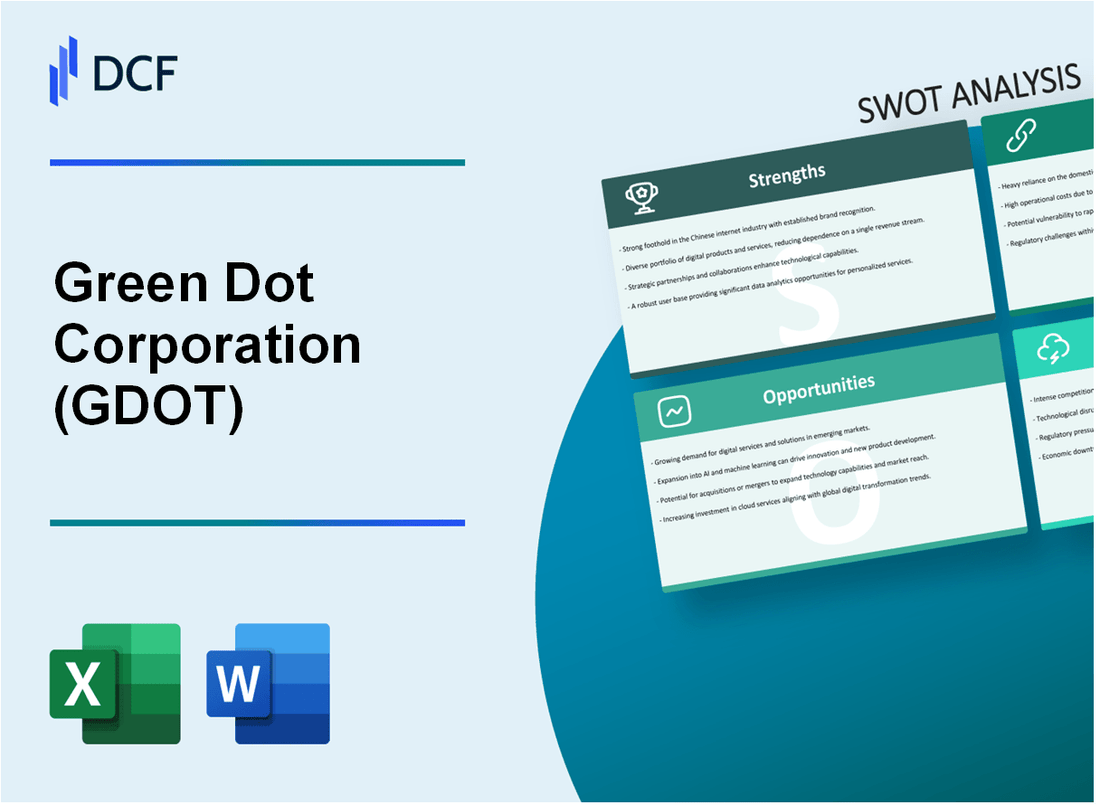
Green Dot Corporation (GDOT): SWOT Analysis [Nov-2025 Updated] |
Fully Editable: Tailor To Your Needs In Excel Or Sheets
Professional Design: Trusted, Industry-Standard Templates
Investor-Approved Valuation Models
MAC/PC Compatible, Fully Unlocked
No Expertise Is Needed; Easy To Follow
Green Dot Corporation (GDOT) Bundle
You're trying to figure out if Green Dot Corporation (GDOT) can truly pivot from its legacy prepaid card business to a high-growth FinTech player. The answer, looking at the 2025 numbers, is that the company has a massive structural advantage-owning a bank charter and a distribution network of over 90,000 retail locations-but it's defintely weighed down by a declining core market. The strategic battle for Green Dot isn't about survival; it's about flawlessly executing its shift to the Banking-as-a-Service (BaaS) model, which is the only path to offsetting rising customer acquisition costs and intense competition from neo-banks.
Green Dot Corporation (GDOT) - SWOT Analysis: Strengths
You're looking for the bedrock of Green Dot Corporation's (GDOT) business, and honestly, it boils down to two things: a bank charter and a distribution network that most fintechs only dream of. These aren't just abstract advantages; they are concrete, regulatory, and logistical moats that drive their entire business model, especially the high-growth Banking-as-a-Service (BaaS) segment.
Owns a bank charter, reducing regulatory friction and cost
Green Dot Bank is a state-chartered member bank of the Federal Reserve System, and Green Dot Corporation is a bank holding company. This is a massive, defintely underestimated strength. It means they don't have to partner with a third-party bank to issue products or hold deposits, unlike most fintechs. This in-house capability cuts down on regulatory friction, streamlines compliance, and ultimately allows them to move faster and capture more of the profit margin.
The regulatory classification is strong, too. As of September 30, 2024, both Green Dot Corporation and Green Dot Bank were categorized as well capitalized under applicable regulatory standards, which signals stability and compliance to both partners and regulators.
Massive retail distribution via 90,000+ locations like Walmart
The Green Dot Network (GDN) is a physical asset that digital-only companies can't replicate easily. It provides cash access and deposit capabilities at more than 90,000 retail distribution locations nationwide, which is more than all remaining bank branches in the U.S. combined.
This network is crucial for the unbanked and underbanked consumer segment, allowing them to load cash onto prepaid or debit cards. The anchor relationship with Walmart, a key driver of operating revenues, provides unparalleled shelf space and consumer touchpoints for the Walmart MoneyCard program and other products.
Established Banking-as-a-Service (BaaS) platform with major partners
Green Dot's Banking-as-a-Service (BaaS) platform, now branded as Arc by Green Dot, is a proven, single-source embedded finance solution. It allows major consumer and technology brands to offer bank-issued financial products under their own name. This B2B segment is where the growth is, with B2B Services revenue up 41% in the fourth quarter of 2024.
Here's a quick look at the caliber of partners trusting Green Dot's platform to power their financial products:
- Apple: Powers Apple Cash digital wallet, their largest BaaS partner by revenue.
- Amazon: Supports Amazon Flex for driver payments.
- Intuit: Integrates with products like Quickbooks.
- Dayforce: Serves as the U.S. banking provider for the Dayforce Wallet on-demand pay solution.
- Varo, Clip Money, DolFintech: New partner wins announced in early 2025, reflecting increasing demand.
Strong liquidity position, total assets over $5.5 billion in 2024
The company maintains a strong balance sheet, which is vital for a bank holding company. As of September 2025, Green Dot's total assets stood at approximately $5.76 Billion USD. This asset base provides a solid foundation for regulatory capital requirements and supports the scale of its money movement operations.
Liquidity remains healthy, with unencumbered cash at the holding company reported at approximately $78 million as of September 30, 2025. This cash position gives them operational flexibility and the capital to invest in the BaaS platform's continued expansion.
High-volume money movement infrastructure is proven and stable
Green Dot has spent decades building and stabilizing the technology to handle massive transaction volumes. This is a core competency. The platform's reliability is evidenced by the fact that third-party partner volumes are growing double digits and now account for approximately 70% of total transactions in the Money Movement Services segment.
This high-volume processing capability is a clear competitive differentiator (moat) for the BaaS business, as partners need a system they can trust to handle millions of daily payments and money transfers without fail. The stability is the product.
| Key Financial/Operational Strength Metric | Value (2024/2025 Fiscal Year Data) | Source/Context |
|---|---|---|
| Total Assets (as of Sep 2025) | $5.76 Billion USD | Latest reported balance sheet figure. |
| Retail Distribution Locations | 90,000+ | Green Dot Network size, exceeding all U.S. bank branches. |
| B2B Services Revenue Growth (Q4 2024) | Up 41% | Reflects strong momentum in the BaaS segment. |
| 3rd Party Volume Share of Money Movement Transactions | ~70% | Indicates high utilization and reliance by BaaS partners. |
| Regulatory Capital Status (as of Sep 2024) | Well Capitalized | Green Dot Bank & Corporation status under regulatory standards. |
Green Dot Corporation (GDOT) - SWOT Analysis: Weaknesses
Heavy reliance on the legacy prepaid card business, a declining market
Green Dot Corporation's Consumer Services segment, which is the core of its legacy prepaid card and retail-focused business, is a clear drag on overall performance. While the broader U.S. prepaid card market is projected to reach approximately $749.46 billion by 2025, Green Dot's performance in this segment is declining, which highlights a major structural weakness.
The numbers from the 2025 fiscal year are stark. The Consumer Services segment revenue was down 5% in Q1 2025 and continued to decline, showing a 9% year-over-year drop in Q3 2025. This revenue erosion is tied directly to customer churn, as Consumer Services active accounts were down 7% in Q1 2025 and a further down 9% in Q3 2025. Your core business is shrinking, plain and simple.
- Consumer Services revenue: Down 9% (Q3 2025 YoY).
- Consumer Services active accounts: Down 9% (Q3 2025 YoY).
- This segment's profit was down 19.5% in Q3 2025.
High operating expenses relative to FinTech competitors
The company is struggling to translate top-line growth from its B2B segment into consolidated profitability because its operating expenses are simply too high. For the first nine months of 2025, total operating revenues increased by 23% (reaching $1.56 billion), but total operating expenses surged 18%, outpacing the revenue growth needed to drive positive net income.
Here's the quick math: total operating expenses for Q3 2025 alone were over $527 million, which resulted in an operating loss of approximately $32.8 million for the quarter. This cost structure is not nimble enough to compete with leaner, cloud-native FinTechs. Plus, you have to factor in one-time hits; for instance, the company recorded about $19.9 million in restructuring and other charges in Q3 2025, primarily related to exiting operations in China.
What this estimate hides is the ongoing investment in compliance and technology modernization, which is necessary but keeps the expense line elevated. This led to a consolidated net loss of over $52 million for the first nine months of 2025.
Frequent executive and strategy turnover creates instability
The leadership instability at Green Dot is a major systemic risk that makes long-term strategy execution defintely difficult. Since the founder's departure at the end of 2019, the company has cycled through multiple chief executives, creating a perception of strategic drift just as the market accelerated its shift to mobile banking.
The most recent change saw George Gresham exit as CEO in March 2025, leading to Board Chairperson William Jacobs stepping in as Interim CEO in March 2025-the third person to hold the CEO title since late 2019. This turnover is not just a personnel issue; it's a strategy issue, evidenced by the Board initiating a formal strategic review (exploring a sale or other alternatives) in March 2025, right after the CEO change.
| Executive Role | Individual | Appointment Date (Approx.) | Instability Indicator |
|---|---|---|---|
| CEO/Interim CEO | William Jacobs | March 2025 | Interim appointment, second time in this role since 2020. |
| Previous CEO | George Gresham | October 2022 | Exited in March 2025 after a short tenure. |
| Pre-Gresham CEO | Dan Henry | 2020 | Fired in October 2022. |
Limited brand recognition outside of the prepaid/unbanked segment
Green Dot's brand equity is heavily concentrated in the retail prepaid card space, serving the unbanked and underbanked consumer. This is a powerful position in a specific niche, but it becomes a weakness when trying to pivot to the high-growth Banking-as-a-Service (BaaS) market. The brand lacks the broad recognition and trust associated with larger financial institutions or the 'cool factor' of challenger banks.
The company implicitly acknowledged this limitation by launching the 'Arc' brand in February 2025 to specifically market its BaaS platform. This move was necessary because the legacy Green Dot brand had 'limited marketing and business development resources' and lacked the separate identity needed to attract major B2B partners. When you have to create a new brand just to sell your new product, your old brand is a liability in that new market.
Customer acquisition costs are rising against neo-bank free offerings
The rise of neo-banks like Chime and Varo, which offer largely free, mobile-first bank accounts, has fundamentally disrupted Green Dot's traditional customer acquisition model. These competitors, often flush with venture capital, are willing to sustain high customer acquisition costs (CAC) to gain market share, a strategy Green Dot cannot easily replicate as a public, regulated bank holding company focused on profitability.
This competitive pressure forces Green Dot to choose between expensive marketing or losing customers. In the Q3 2025 results, the company disclosed that the Consumer Services direct channel saw declines in active accounts because it moderated its marketing spend in recent quarters. This moderation is a direct, defensive response to an unsustainable CAC environment. The result is a continued decline in the most valuable customers, with Consumer Services direct deposit active accounts (the most profitable cohort) down 10% year-over-year in Q3 2025.
Green Dot Corporation (GDOT) - SWOT Analysis: Opportunities
The biggest opportunity for Green Dot Corporation is to fully monetize its unique asset: the bank charter, which provides a regulatory advantage and a platform for embedded finance (Banking-as-a-Service, or BaaS). Your focus should be on scaling the B2B segment's explosive growth and strategically cross-selling higher-margin products into the existing, engaged customer base.
Expand BaaS Partnerships Globally and Into New Industry Verticals
The B2B Services segment is the clear growth engine, and its momentum is strong, with segment revenue up 23% in the second quarter of 2025. The BaaS division alone is projected to see growth in the low 30% range for the full fiscal year 2025, a massive tailwind. This growth comes from both existing partners and a solid backlog of new launches. This is where the company's 'Arc by Green Dot' platform-its single-source embedded finance solution-shines. We are seeing major technology companies choosing Green Dot, which validates their platform.
The opportunity is to push beyond core FinTech and into new verticals like the 'Beyond the Rack' (BTR) initiative, which embeds financial services directly into a retailer's digital ecosystem. Honestly, the platform is ready; you just need to keep signing the deals.
- Sign new partners in e-commerce, gig economy, and wealth management.
- Leverage the B2B active account growth of 10% (Q2 2025) to show platform scalability.
- Pursue international expansion, which is a stated area of focus.
Cross-Sell New High-Margin Products (e.g., Credit, Lending) to Existing Base
Green Dot has millions of active accounts, and the remaining customers, even in the shrinking Consumer Services segment, have a 'more attractive and engaged financial profile.' This is a perfect setup for cross-selling. The average direct deposit card is active for a long 15 to 18 months, confirming a high lifetime value (LTV) customer base that trusts the platform with their primary cash flow.
The low-hanging fruit is Early Wage Access (EWA) through the rapid! paycard business, which is already being sold to non-pay card customers and business partners, including one of Green Dot's largest retailers. Plus, the existing infrastructure supports secured credit card accounts, meaning the regulatory and technical rails for credit are already in place. Here's the quick math: even a modest credit product penetration into the existing base could significantly boost revenue per user, shifting the mix away from lower-margin interchange fees.
Increase Direct Deposit Customer Base for Higher Lifetime Value
While the Consumer Services segment's direct deposit active accounts have been under pressure, declining by 9% in Q2 2025, the opportunity lies in reversing this trend. Direct deposit customers are the most valuable because they are the most sticky, with the longest tenure. They represent approximately 25% of the Consumer Services segment's total active accounts, so growing this cohort is defintely a priority.
The GO2bank brand is the vehicle for this reversal, especially with new partnerships like the one with PLS, which is helping to moderate the decline in the retail channel. A successful push here would not only stabilize the Consumer segment but also provide a massive, stable pool of primary bank customers for the high-margin products mentioned above.
Utilize Excess Cash Flow to Acquire Smaller, Innovative FinTech Firms
Green Dot has the financial flexibility to be an acquirer, or at least a strategic investor. As of September 30, 2025, the company had approximately $78 million in net unencumbered cash at the holding company. This is not a war chest for a mega-deal, but it's enough for a series of tuck-in acquisitions of smaller, innovative FinTechs with superior technology or niche customer bases that can be quickly integrated into the Arc platform.
What this estimate hides is the potential for a larger 'Corporate Transaction' itself. The Board's strategic review, announced in March 2025, and the interim CEO's incentive of a $1.75 million cash bonus for a sale suggest that the company could be acquired by a larger entity looking for an instant bank charter and a modern BaaS platform. While the prompt asks about Green Dot acquiring, the strategic review creates an opportunity for shareholders regardless of which side of the M&A table the company ends up on.
Benefit from Regulatory Tailwinds Favoring Chartered Banks Over Non-Bank FinTechs
The single most powerful, structural opportunity is Green Dot's status as a registered bank holding company with a bank charter and over $4 billion in customer deposits. This charter is a massive barrier to entry for non-bank FinTechs, which face increasing regulatory scrutiny and compliance costs.
The regulatory environment, especially after the passage of the GENIUS Act in July 2025, is starting to favor chartered institutions. This Act, which addresses stablecoin issuance and other digital asset activities, is pushing major FinTech players like Stripe, PayPal Holdings, Inc., Block, Inc., and Circle Internet Group, Inc. to seek bank charters or similar designations. Green Dot already has this, giving them a significant advantage in speed-to-market and compliance for new, high-growth financial products.
This regulatory moat is a key differentiator, providing product, funding, and scale advantages that pure-play FinTechs simply cannot match without a multi-year, multi-million-dollar regulatory effort. It's a core competitive advantage that will only grow in value as regulation tightens.
| Opportunity Area | 2025 Financial/Metric Data | Actionable Insight |
|---|---|---|
| BaaS/B2B Growth | B2B Services Revenue Growth: +23% (Q2 2025) | Prioritize resources to BaaS; B2B is the primary revenue driver. |
| BaaS/B2B Outlook | BaaS Division Revenue Growth: Expected in the low 30% range (Full Year 2025) | Accelerate new partner launches from the existing backlog. |
| High-Margin Cross-Sell | Average Direct Deposit Tenure: 15-18 months | Launch a secured credit product pilot to the direct deposit base for higher LTV capture. |
| Cash for M&A | Cash at Holding Company: Approximately $78 million (as of Sep 30, 2025) | Identify and acquire a small, innovative FinTech with superior lending technology. |
| Regulatory Moat | Customer Deposits: Over $4 billion | Actively market the bank charter as a compliance advantage to new BaaS partners, especially those in the digital asset space following the GENIUS Act. |
Finance: Draft a 12-month capital allocation plan by Friday, prioritizing BaaS platform investment and a small-to-mid-size FinTech acquisition target.
Green Dot Corporation (GDOT) - SWOT Analysis: Threats
Intense competition from well-funded neo-banks (e.g., Chime, Varo)
The most immediate and material threat to Green Dot's legacy Consumer Services segment comes from digitally native competitors, or neo-banks, that have raised billions in venture capital to offer permanently fee-free accounts. Chime, the market leader, demonstrates this scale, with an estimated user base of over 18 million in 2025, significantly outpacing Green Dot's active accounts, which declined by 5% year-over-year in the Consumer Services segment in Q2 2025.
These rivals directly attack Green Dot's revenue model by eliminating or minimizing the very fees Green Dot historically relied on. For example, Chime offers its SpotMe feature, which provides up to a $200 fee-free overdraft, a direct counter to the traditional overdraft revenue stream. This competitive pressure is a primary driver of the long-term secular decline in Green Dot's Consumer segment revenue, forcing the company to pivot aggressively to its Banking-as-a-Service (BaaS) platform for growth.
- Chime's 2025 IPO valuation reached $11 billion, showing deep investor confidence.
- Neo-banks offer fee-free overdrafts up to $200, undercutting GDOT's legacy model.
- GDOT Consumer Services active accounts were down 5% YoY in Q2 2025.
Regulatory risk tied to overdraft fees and consumer protection laws
While the threat of an immediate, catastrophic regulatory blow has been temporarily averted, the underlying political risk remains high. The Consumer Financial Protection Bureau (CFPB) finalized a rule in late 2024 that would have capped overdraft fees at a maximum of $5 for large financial institutions (those with $10 billion or more in assets), with the goal of saving consumers up to $5 billion annually.
However, this specific rule, set to take effect in October 2025, was overturned by Congress and signed into law under the Congressional Review Act (CRA) in 2025. To be fair, the political will to target 'junk fees' hasn't gone away. The nullification only means the regulatory landscape is unstable, and future action-either from the CFPB or a future Congress-could still force fee caps, which would disproportionately hurt Green Dot's Consumer segment profitability, even if its bank charter technically falls below the largest bank threshold for some rules. The constant threat forces Green Dot to keep its own fees low, which compresses margins anyway.
Walmart, a key partner, could reduce its reliance on Green Dot over time
The Walmart MoneyCard program is a foundational part of Green Dot's business, historically accounting for as much as 27% of its operating revenue. The good news is the partnership was extended in May 2025 until January 31, 2033, with an automatic one-year renewal option. But this extension came at a cost, including a $70 million one-time, non-refundable incentive payment to RNBW, a party to the agreement, and a joint fintech accelerator, TailFin Labs, LLC.
The real threat is the shift in power. Walmart is actively building its own financial services ecosystem. This means Green Dot's role is increasingly one of a regulated utility (the bank charter and BaaS platform), which subjects it to margin pressure and greater control from its largest partner. The risk is not a sudden termination but a slow, continuous erosion of the partnership's profitability as Walmart demands more favorable economic terms and co-opts Green Dot's technology to power its own branded offerings.
Economic downturn disproportionately affects its lower-to-moderate income customer base
Green Dot's core consumer market is the underbanked and unbanked population-an addressable market of over 75 million consumers with annual incomes below $50,000. This segment is highly sensitive to macroeconomic shifts like inflation, job losses, and rising interest rates.
Here's the quick math: when this customer base is under financial stress, they rely less on their Green Dot accounts for direct deposit and transaction volume, or they switch to zero-fee alternatives. This is already visible in the Q2 2025 results, where Consumer Services direct deposit active accounts were down 9% year-over-year. A sustained economic downturn would accelerate this decline, simultaneously reducing interchange revenue (from fewer transactions) and increasing credit losses on products like the Secured Card, hitting the company on two fronts.
Cybersecurity threats to the BaaS platform could severely damage trust
Green Dot's strategic pivot to Banking-as-a-Service (BaaS) is its primary growth engine, with the B2B segment expected to grow in the low 30% range for the full year 2025. However, this high-growth segment introduces a massive, non-financial risk: a systemic cybersecurity failure.
The BaaS model means Green Dot is the regulated bank behind dozens of other fintech brands. A security breach on its core platform would not only damage the Green Dot brand but also the brands of every partner it serves, causing a cascade of partner churn. A Green Dot-commissioned survey in late 2024 found that security and data breaches were a top concern for 49% of prospective BaaS clients, and compliance and security issues were cited by 39% of senior decision-makers in a September 2025 survey. A major incident could defintely halt the BaaS momentum entirely.
| Threat Category | 2025 Quantitative Impact/Metric | Nature of Risk |
| Neo-Bank Competition | Chime's 2025 valuation of $11B - $18.2B; GDOT Consumer Active Accounts down 5% YoY (Q2 2025). | Loss of primary account relationships and core fee revenue. |
| Regulatory Risk | CFPB goal of saving consumers $5 billion in fees; rule overturned in 2025, but political pressure remains. | Future fee caps or compliance costs eroding Consumer segment margins. |
| Walmart Partnership | Partnership extended to 2033; initial cost included $70 million payment to RNBW. | Margin compression and increasing control/influence from the largest partner. |
| Economic Downturn | Consumer Direct Deposit Active Accounts down 9% YoY (Q2 2025); target market <$50K annual income. | Reduced transaction volume and higher credit losses from economically sensitive customers. |
| BaaS Cybersecurity | 49% of prospective BaaS clients cite security/data breaches as a top concern. | Systemic failure leading to mass partner churn and brand destruction. |
What this estimate hides is the execution risk. The BaaS opportunity is massive, but it requires flawless technology delivery and sales execution. If onboarding takes 14+ days for a new partner, the churn risk rises, and the opportunity shrinks. We need to see the GDOT team deliver on at least three major BaaS deals in the first half of 2026 to confirm the pivot is working.
Next Step: Finance: Model a scenario where BaaS revenue hits 60% of total revenue by Q4 2026, and assess the impact on operating margin by Friday.
Disclaimer
All information, articles, and product details provided on this website are for general informational and educational purposes only. We do not claim any ownership over, nor do we intend to infringe upon, any trademarks, copyrights, logos, brand names, or other intellectual property mentioned or depicted on this site. Such intellectual property remains the property of its respective owners, and any references here are made solely for identification or informational purposes, without implying any affiliation, endorsement, or partnership.
We make no representations or warranties, express or implied, regarding the accuracy, completeness, or suitability of any content or products presented. Nothing on this website should be construed as legal, tax, investment, financial, medical, or other professional advice. In addition, no part of this site—including articles or product references—constitutes a solicitation, recommendation, endorsement, advertisement, or offer to buy or sell any securities, franchises, or other financial instruments, particularly in jurisdictions where such activity would be unlawful.
All content is of a general nature and may not address the specific circumstances of any individual or entity. It is not a substitute for professional advice or services. Any actions you take based on the information provided here are strictly at your own risk. You accept full responsibility for any decisions or outcomes arising from your use of this website and agree to release us from any liability in connection with your use of, or reliance upon, the content or products found herein.