
|
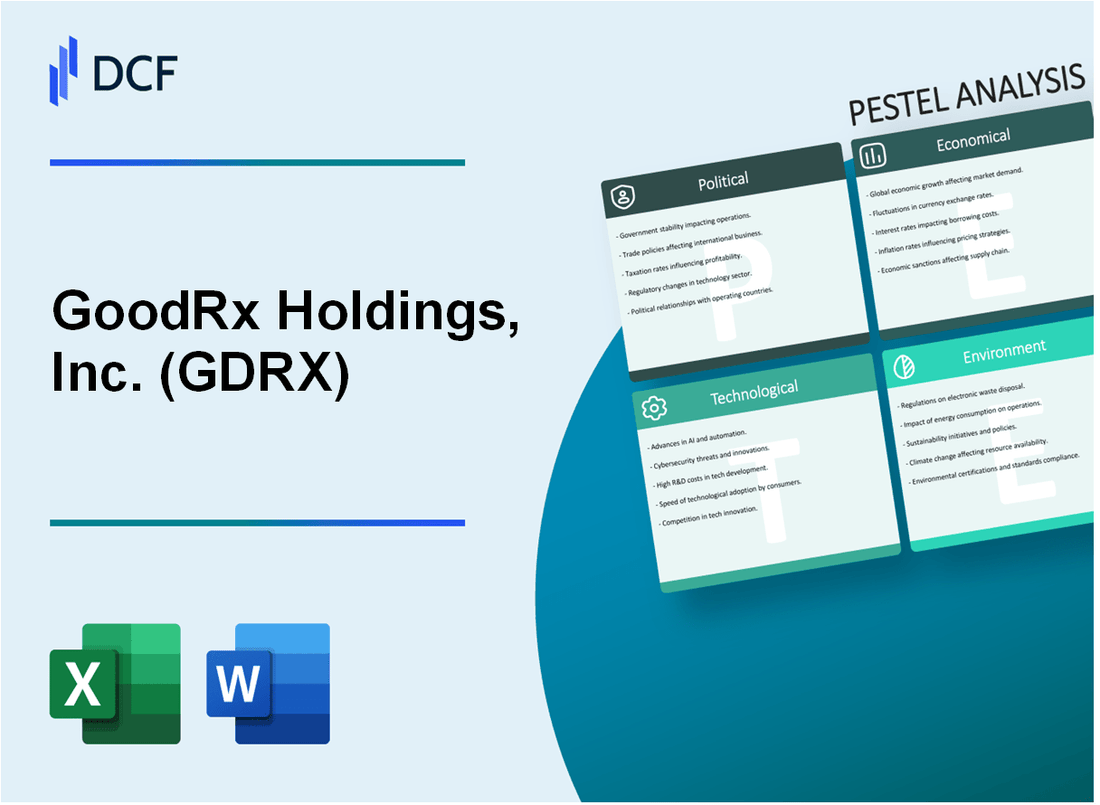
GoodRx Holdings, Inc. (GDRX): PESTLE Analysis [Nov-2025 Updated] |
Fully Editable: Tailor To Your Needs In Excel Or Sheets
Professional Design: Trusted, Industry-Standard Templates
Investor-Approved Valuation Models
MAC/PC Compatible, Fully Unlocked
No Expertise Is Needed; Easy To Follow
GoodRx Holdings, Inc. (GDRX) Bundle
You need a clear-eyed view of GoodRx Holdings, Inc. as we head into late 2025, and the short answer is: sustained growth hinges entirely on aggressive diversification away from its core discount card business. The company is projected to hit about $775 million in annual revenue for 2025, supported by a steady user base near 7.5 million monthly active consumers, but that success is highly exposed to political scrutiny and legal challenges in the opaque drug pricing ecosystem. Political pressure on Pharmacy Benefit Managers (PBMs) defintely creates a structural long-term advantage for GoodRx Holdings, Inc., but near-term volatility is a real risk, so the strategic pivot to Gold subscriptions and telehealth is critical. Let's dig into the PESTLE factors to map out the clear actions you should take.
GoodRx Holdings, Inc. (GDRX) - PESTLE Analysis: Political factors
Increased federal scrutiny on Pharmacy Benefit Managers (PBMs) and their rebate practices
The political environment in 2025 is characterized by an aggressive, bipartisan federal crackdown on Pharmacy Benefit Managers (PBMs), the corporate intermediaries that manage prescription drug benefits. This scrutiny, which is a key risk factor for GoodRx Holdings, Inc. (GDRX), aims to dismantle the opaque rebate system that has long governed drug pricing.
In May 2025, the administration issued Executive Order 14297, which explicitly targets the PBM rebate ecosystem, demanding transparency and directing federal agencies to enforce pricing reforms across all federal health programs. A bipartisan legislative effort, the PBM Reform Act of 2025 (H.R. 4317), introduced in July 2025, seeks to ban spread pricing in Medicaid and, critically, requires PBMs to pass 100% of manufacturer rebates to plan sponsors. This legislation also proposes to delink PBM compensation from a drug's price in Medicare Part D.
The Federal Trade Commission (FTC) is also actively involved, with PBM investigations being a top priority as of May 2025, focusing on significant price markups that the Big 3 PBMs have imposed on specialty generic drugs. For GoodRx, whose core prescription transaction revenue fell approximately 9% year-over-year in Q3 2025, this PBM disruption creates both a headwind for its traditional model and a strong tailwind for its Manufacturer Solutions segment.
Potential for new legislation mandating greater prescription drug price transparency
The political drive toward price transparency directly challenges the information asymmetry that GoodRx was founded to solve, yet simultaneously creates new partnership opportunities. A major regulatory breakthrough is an HHS final rule taking effect on October 1, 2025, which grants doctors and patients real-time access to prescription drug price information, including out-of-pocket costs, through certified health IT systems. This means millions of Americans will be able to compare prices before leaving the doctor's office.
On the state level, the trend is also accelerating. As of April 2025, approximately 23 states have enacted drug price transparency laws, and 12 states have established Prescription Drug Affordability Boards (PDABs) to review and potentially cap the cost of specific medications. Furthermore, CMS Administrator Dr. Mehmet Oz indicated in June 2025 that CMS plans to issue a rule by the end of 2025 requiring health insurers and PBMs to disclose the net prices of drugs. This shift toward a more transparent, direct-to-consumer (D2C) pricing model is a key reason why GoodRx's management raised its Pharma Manufacturer Solutions revenue outlook to approximately 35% year-over-year growth for the full year 2025. That's a clear map of risk to opportunity.
Impact of the Inflation Reduction Act (IRA) on Medicare drug negotiations and pricing
The Inflation Reduction Act (IRA) of 2022 continues to reshape the pharmaceutical market, with 2025 being a critical implementation year. The IRA's Medicare Drug Price Negotiation Program is progressing, with negotiated prices for the initial 10 high-cost drugs announced in August 2024, set to become effective on January 1, 2026. In January 2025, the Centers for Medicare & Medicaid Services (CMS) selected an additional 15 drugs for negotiation, with new prices taking effect in 2027.
This negotiation process, while not directly impacting the cash-pay market where GoodRx operates, lowers the benchmark for drug pricing overall. Additionally, the IRA's Inflation Rebate Program, which penalizes manufacturers for price increases exceeding inflation, is becoming active, with CMS planning to begin invoicing manufacturers for rebates in late 2025. For Medicare Part B enrollees, the program already resulted in reduced cost-sharing for 64 prescription drugs as of the first quarter of 2025. This political action compresses the high-end drug costs, which could reduce the need for a discount card for some Medicare patients, but GoodRx is countering this by expanding its D2C affordability programs with manufacturers.
State-level efforts to cap out-of-pocket costs for common medications
The most material cap on out-of-pocket costs in 2025 is a federal one, stemming from the IRA, which significantly reduces the financial burden for Medicare Part D beneficiaries. Starting in 2025, the annual out-of-pocket maximum for covered Part D prescriptions is capped at $2,000, a dramatic drop from the effective cap of approximately $3,300 to $3,800 in 2024. This change also eliminates the Part D 'donut hole,' or coverage gap, for good.
Here's the quick math: a Medicare patient with high drug costs who previously hit the $3,800 out-of-pocket ceiling now only pays up to $2,000. That's a minimum savings of $1,800 for those with the highest costs. This new cap directly reduces the population of Medicare beneficiaries who are most likely to seek out a discount card like GoodRx to cover their catastrophic spending. However, since GoodRx discounts do not count toward the Medicare Part D spending threshold, the platform's utility remains for prescriptions that are not covered by a plan or where the GoodRx price is lower than the Part D copay, especially for the initial deductible of $590 in 2025.
The table below summarizes the key political shifts impacting GoodRx's operating environment in 2025:
| Political/Regulatory Action | Effective Date (2025) | Key Metric/Value | Impact on GoodRx (GDRX) |
|---|---|---|---|
| Medicare Part D Out-of-Pocket Cap (IRA) | January 1, 2025 | Max OOP: $2,000 (down from ~$3,800 in 2024) | Reduces a core pain point for high-cost Medicare users, potentially lowering the need for GoodRx for catastrophic spending. |
| HHS Real-Time Price Transparency Rule | October 1, 2025 | Patients and doctors get real-time price/OOP cost data. | Increases competition but validates GoodRx's core value proposition; favors its API-driven D2C solutions. |
| PBM Reform Act of 2025 (H.R. 4317) | Introduced July 2025 | Mandates 100% rebate pass-through; bans spread pricing in Medicaid. | Disrupts the traditional PBM-centric pricing model, accelerating the shift toward transparent, direct-to-consumer programs that GoodRx's Manufacturer Solutions segment is built to operationalize. |
| GDRX Pharma Manufacturer Solutions Revenue (Projected) | Full Year 2025 | Growth: ~35% Year-over-Year | Shows the company's successful pivot to capitalize on the D2C trend driven by these political pressures. |
GoodRx Holdings, Inc. (GDRX) - PESTLE Analysis: Economic factors
Analyst consensus projects 2025 annual revenue near $775 million.
You need to know where the money is going, and honestly, the analyst consensus for GoodRx Holdings, Inc.'s 2025 revenue is a bit of a mixed signal. The original analyst figure of $775 million is actually on the low side now. Management is holding firm, projecting full-year 2025 revenue will fall between $810 million and $840 million, which represents a modest 2% to 6% growth over 2024's revenue of $792.3 million.
The company's performance is heavily front-loaded, with Q3 2025 revenue coming in at $196.0 million. Here's the quick math: the core Prescription Transactions revenue is slowing, but the Pharma Manufacturer Solutions segment is accelerating, growing by 54.4% year-over-year in Q3 2025 to hit $43.37 million. That shift is what's keeping the top-line guidance up, but it also signals a fundamental change in their business model's revenue mix.
| Financial Metric (Q3 2025) | Amount | YoY Change | Insight |
|---|---|---|---|
| Total Revenue | $196.0 million | +0.4% | Essentially flat growth. |
| Prescription Transactions Revenue | $127.29 million | -9.3% | Core business faces significant headwinds. |
| Pharma Manufacturer Solutions Revenue | $43.37 million | +54.4% | The primary growth driver in 2025. |
| Adjusted EBITDA | $66.28 million | Not provided, but margin is 33.8% | Strong margin despite revenue pressure. |
High inflation pressures consumers to seek prescription cost savings aggressively.
The persistent inflation in the US economy is actually a tailwind for GoodRx's core mission, even if it's a headwind for the consumer's wallet. When the cost of everything from gas to groceries goes up, people get aggressive about saving money on non-discretionary items like medication. We saw over 250 branded drugs take price hikes in early 2025, with a median increase of 4.5%. That's a huge problem for the uninsured and those with high-deductible health plans (HDHPs).
This economic pressure drives more consumers to seek out the cash-pay discount model, which is GoodRx's bread and butter. The company is leaning into this by expanding its offerings, including new direct-to-consumer pricing for high-demand drugs like Ozempic and Wegovy, starting at an introductory cash price of $199 per month. It's a classic counter-cyclical play: the worse the drug pricing crisis gets, the more relevant GoodRx becomes.
- Inflation fuels demand for prescription savings.
- Rising drug prices (median 4.5% increase in early 2025) stress consumer budgets.
- GoodRx's value proposition is amplified in a high-cost environment.
Intense competition from PBM-owned discount cards and new market entrants.
Competition is defintely the most immediate economic risk. The Prescription Benefit Manager (PBM) giants like CVS Health, Cigna, and UnitedHealth Group are not sitting still; they've launched their own discount programs to claw back market share. This is a direct hit to GoodRx's transaction revenue, which dropped by over 9% in Q3 2025.
This decline is explicitly linked to 'volume reduction in one of our integrated savings programs with one of our PBM partners,' plus the broader impact of retail pharmacy bankruptcies, like Rite Aid's. The PBMs have the power to steer consumers, and when they push their own discount cards, it cuts off the supply of transactions for GoodRx. Plus, new direct-to-consumer players are emerging, forcing GoodRx to continually prove its value as the best price aggregator, not just a single-source discount provider.
Rising interest rates increase the cost of capital for new strategic investments.
The Federal Reserve's 'higher-for-longer' stance on interest rates in 2025 has a tangible impact on capital-intensive tech companies like GoodRx. This environment makes it more expensive for the company to finance new strategic investments, like expanding its telehealth services or acquiring new technology platforms.
GoodRx is not debt-free. As of September 30, 2025, the company carried total outstanding debt of $496.3 million. Here's the reality: higher interest rates mean a larger portion of operating cash flow goes toward debt servicing, which reduces the free cash flow available for growth initiatives, share repurchases (they bought back $61.6 million in Q3 2025), or M&A. The rising cost of capital forces management to be ruthlessly selective about which projects meet the required internal rate of return, slowing the pace of innovation that requires external financing.
GoodRx Holdings, Inc. (GDRX) - PESTLE Analysis: Social factors
Growing consumer demand for digital health tools and price comparison shopping
The core social factor driving GoodRx's business is the American consumer's acute financial pain when buying prescription drugs, which has led to a massive shift toward digital price transparency tools. This isn't a minor trend; it's a necessary survival strategy for many households. By 2025, 42% of people reported making at least one change to how they managed their prescriptions due to cost, a significant jump from 34% in 2024. This includes riskier behaviors like 20% rationing their medications. The market for digital health solutions is booming because of this need, with the global digital healthcare market projected to grow at a 27.7% Compound Annual Growth Rate (CAGR) from 2024 to 2030. In 2025, 75% of consumers used a non-traditional resource to afford medication, and discount programs like GoodRx were specifically utilized by 43% of respondents.
Here's the quick math: Consumers are actively seeking alternatives to the opaque insurance model, and GoodRx is positioned squarely in that gap. The healthcare transparency market, which GoodRx dominates, is expected to reach $11.9 billion by 2026. This demand is why the company's Pharma Manufacturer Solutions revenue surged 54% year-over-year in Q3 2025, as it becomes a key partner for drug makers offering direct-to-consumer pricing.
High health-tech literacy drives adoption among the core user base
The consumer base is defintely becoming more comfortable with health-tech, which lowers the friction for GoodRx's adoption. This growing digital literacy is evident in the broader Digital Therapeutics (DTx) market, which is estimated to be around $9.2 billion in 2025 and is expanding rapidly. GoodRx capitalizes on this by offering increasingly complex, yet easy-to-use, digital products beyond simple discount codes. The success of their new direct-to-consumer pricing programs for major brand-name drugs, such as the one for Ozempic/Wegovy priced at $499 per month, demonstrates that users are willing and able to engage with sophisticated digital access solutions.
This high literacy allows GoodRx to expand its platform offerings into areas like telehealth and condition-specific subscriptions, which require a higher degree of digital engagement than just printing a coupon. The company launched a new condition-specific subscription product for erectile dysfunction in June 2025, with a weight-loss subscription product in the pipeline. This diversification is a direct response to a consumer base that is digitally fluent and actively managing their healthcare via apps and online platforms.
Focus on chronic care management and medication adherence programs
Chronic care management is a critical social need that GoodRx is now addressing, and it's a huge market. Approximately 60% of adults in the U.S. have at least one chronic disease, and these conditions account for a staggering 91% of all prescriptions filled. The social problem is clear: cost directly impacts adherence for this massive patient group. In 2025, 13% of Americans with prescriptions stopped taking a medication entirely due to cost, a significant increase from 8% in 2024.
GoodRx's strategy is to position its platform as a solution to this non-adherence crisis, which is a major driver of poor health outcomes and high costs in the US system. By focusing on condition-specific subscriptions and manufacturer solutions that lower the cost barrier, they are directly targeting the core issue. This is a smart move because improving medication adherence can lead to a 25% reduction in hospitalization and a 35% reduction in emergency department visits for patients in chronic care management programs.
Monthly active consumers are projected to hold steady near 7.5 million
While the overall social demand for GoodRx's service is high, the near-term reality is that the core Monthly Active Consumers (MACs) metric faced headwinds in 2025. The MACs metric, which counts unique consumers using a GoodRx code for a prescription discount, has been under pressure due to broader retail pharmacy landscape changes, including the impact of Rite Aid store closures.
The company reported a decline in MACs in Q3 2025, which contributed to a 9% decrease in Prescription Transactions Revenue to $127.3 million. For context, the company exited Q2 2025 with over 6 million prescription-related consumers (MACs plus subscribers). Despite the decline in the core MAC metric, the company's full-year 2025 revenue guidance is still projected to be at least $792 million, with Adjusted EBITDA forecasted between $265 million and $275 million. This indicates that while the volume of coupon users is challenging, the company is successfully driving higher-value revenue from its Subscription and Pharma Manufacturer Solutions segments.
| Key Social/Consumer Metric (2025 Fiscal Year) | Value/Projection | Implication for GoodRx |
|---|---|---|
| % of Americans making a change to prescription management due to cost | 42% (up from 34% in 2024) | Increased urgency and market size for price-saving tools. |
| % of Americans using a prescription discount program (like GoodRx) | 43% | High social acceptance and reliance on the core product. |
| Digital Healthcare Market CAGR (2024-2030) | 27.7% | Strong tailwind for all digital health offerings. |
| Q3 2025 Prescription Transactions Revenue | $127.3 million (down 9% YoY) | MAC decline is materially impacting the core revenue stream. |
| Q3 2025 Pharma Manufacturer Solutions Revenue Growth | 54% YoY (to $43.4 million) | High consumer adoption of new, complex direct-to-consumer digital programs. |
GoodRx Holdings, Inc. (GDRX) - PESTLE Analysis: Technological factors
Continued investment in Artificial Intelligence (AI) for real-time prescription price optimization.
The core of GoodRx Holdings, Inc.'s technology is its ability to aggregate and optimize prescription drug prices in real-time, a capability that relies heavily on advanced algorithms and machine learning (a form of Artificial Intelligence, or AI). This technology is essential for generating savings, which reached an estimated cumulative total of over $17 billion for users in 2024, with users saving an average of 83% on retail prescription prices.
The platform acts as a real-time market-intelligence engine, constantly processing data from thousands of pharmacies and Pharmacy Benefit Managers (PBMs) to find the best coupon. This is not a static database; it's a dynamic pricing system. In 2025, the company continued to invest in transparency tools, such as the Prescription Cost Tracker launched in 2024, which helps consumers understand the complex factors driving the average out-of-pocket cost of $16.26 per prescription.
Here's the quick math on the platform's reach:
| Metric | Latest Available Data (2024/2025) | Significance |
|---|---|---|
| Estimated Cumulative User Savings | Over $17 billion | Validates the scale and efficiency of the pricing engine. |
| Average User Savings on Retail Price | 83% | Core value proposition enabled by AI-driven optimization. |
| 2025 Full-Year Revenue Guidance | $810 million to $840 million | The revenue floor relies on the platform's pricing technology. |
Expansion of telehealth services integration within the GoodRx Holdings, Inc. platform.
Telehealth services are a major growth vector, moving GoodRx from a coupon platform to a full-service digital health solution. The most significant expansion in late 2025 was the launch of 'GoodRx for Weight Loss' in November 2025, a specialized telemedicine subscription service focused on GLP-1 medications like Ozempic and Wegovy. This move integrates virtual consultation, prescription, and fulfillment into a single, seamless user experience.
The pricing model for this new service is aggressive, aiming for rapid adoption: an introductory rate of $39 per month is offered through January 2026, with the standard price rising to $119 per month starting February 1, 2026. This new offering, plus the October 2025 launch of a men's hair loss subscription starting as low as $16 per month, shows a clear strategic push into recurring revenue from digital care.
Still, the subscription segment faces headwinds. The Q3 2025 earnings report showed that total Subscription revenue decreased 3% year-over-year to $20.7 million, driven by a decrease in the number of subscription plans. The new weight loss and hair loss subscriptions are a direct technological effort to reverse this decline.
Need for robust data security and privacy protocols (HIPAA compliance).
The need for robust data security and privacy protocols, particularly adherence to the Health Insurance Portability and Accountability Act (HIPAA), remains a critical technological risk. Honestly, this is a non-negotiable area for a health-tech company.
GoodRx has taken steps to address past issues, including achieving the HiTrust i1 certification for its drug savings platform residing with Amazon Web Services (AWS) in early 2025. However, the company's history of privacy violations creates a persistent need for vigilance and investment. The Federal Trade Commission (FTC) took an enforcement action in 2023, resulting in a $1.5 million civil penalty and a permanent ban on sharing user health data with third parties for advertising purposes.
Furthermore, in December 2024, GoodRx agreed to pay a $25 million settlement to resolve a class action lawsuit over the unauthorized disclosure of consumer health information. This financial and reputational cost highlights the absolute necessity of airtight data governance. The technological challenge is maintaining a high-growth, data-driven platform while ensuring zero-tolerance for privacy breaches.
- $25 million: Class action settlement for privacy violations (Dec 2024).
- $1.5 million: FTC civil penalty for Health Breach Notification Rule violation (2023).
- HiTrust i1: Security certification achieved in 2025.
Platform scalability to handle rapid growth in the Gold subscription service.
Platform scalability is paramount, especially as GoodRx pivots to more complex, end-to-end services like the new weight loss subscription. While the overall Subscription revenue was $20.7 million in Q3 2025, the new initiatives demand a platform that can handle a surge in high-touch services, not just coupon lookups.
The technological challenge is twofold:
- Transaction Volume: The platform must maintain its real-time pricing engine while processing a high volume of prescription transactions, which totaled $127.3 million in revenue for Q3 2025.
- Service Complexity: New offerings, like GoodRx for Weight Loss, require integrating virtual consultations, prescription generation, and home delivery logistics, which is a much more demanding technical stack than the original coupon service.
Management's decision to maintain the full-year 2025 revenue guidance of $810 million to $840 million suggests confidence in the platform's ability to scale and support new revenue streams. The ability to quickly roll out a complex GLP-1 service in November 2025, complete with transparent pricing and fulfillment options, shows the underlying technology is defintely flexible and scalable. The risk is that a sudden, massive influx of users for a high-demand service could strain the infrastructure, leading to a poor user experience and increased churn, especially as they try to reverse the recent decline in subscription plans.
GoodRx Holdings, Inc. (GDRX) - PESTLE Analysis: Legal factors
You're looking at GoodRx Holdings, Inc. (GDRX) and the legal landscape is defintely a high-stakes area right now. The company operates at the intersection of healthcare, technology, and advertising, which means it faces a complex and rapidly evolving regulatory environment. The biggest risks stem from ongoing litigation over its core business model and the intense, post-settlement scrutiny on its data privacy practices.
Ongoing litigation risk related to PBM contract disputes affecting pricing data access
The company is facing significant legal challenges to its core prescription discount business model from independent pharmacies. As of late 2024 and early 2025, GoodRx and several major Pharmacy Benefit Managers (PBMs) like CVS Caremark, Express Scripts, MedImpact Healthcare Systems, and Navitus Health Solutions are defendants in at least three class action lawsuits filed by independent pharmacies. These lawsuits allege anticompetitive behavior and price fixing.
The crux of the dispute centers on GoodRx's 'Integrated Savings Program' (ISP), launched in 2023. Plaintiffs claim this program uses GoodRx's proprietary algorithms to share real-time pricing data among competing PBMs, effectively manipulating and suppressing the reimbursement rates paid to independent pharmacies for generic drugs. One lawsuit, filed by Keaveny Drug, Inc., estimated that the PBMs could have underpaid pharmacies by approximately $35 million in 2024 alone due to this alleged scheme. This litigation threatens the stability of the pricing data access that underpins GoodRx's value proposition.
| Legal Risk Area | Status (2025) | Financial/Operational Impact |
|---|---|---|
| PBM Price-Fixing Lawsuits | At least 3 class actions filed (late 2024/early 2025) | Alleged underpayment to pharmacies of ~$35 million in 2024; threatens Integrated Savings Program (ISP) revenue. |
| FTC Health Data Privacy | Consent Order in effect (from 2023) | $1.5 million civil penalty paid; permanent ban on sharing health data for advertising. |
| Consumer Class Action | Settlement agreed upon (late 2024) | $25 million settlement to resolve consumer claims over data sharing. |
| Telehealth Prescribing Rules | Federal DEA waivers extended to December 31, 2025 | Near-term risk of disruption if in-person exam requirements for controlled substances return in 2026. |
Strict Federal Trade Commission (FTC) enforcement on health data privacy and sharing practices
The Federal Trade Commission (FTC) has already set a clear, expensive precedent for GoodRx. The agency's 'first-of-its-kind' enforcement action in February 2023 resulted in a stipulated order and a civil penalty of $1.5 million for violating the FTC Act and the Health Breach Notification Rule (HBNR). This action stemmed from the company's deceptive sharing of users' sensitive health information-such as medication searches and health conditions-with third-party advertisers like Meta and Google without user consent.
This settlement also imposed a permanent ban on GoodRx disclosing user health data to third parties for advertising purposes. Plus, the company must now obtain affirmative, express consent (not manipulative dark patterns) for any future disclosure of health information, even for non-advertising purposes. Following the FTC action, a consumer class action lawsuit over the same unauthorized data sharing led to a further, much larger settlement. GoodRx agreed to pay $25 million in late 2024 to resolve these claims.
Compliance with evolving state-level regulations for telehealth and prescription fulfillment
The regulatory environment for GoodRx's telehealth services remains a patchwork of state and federal rules, creating a significant compliance burden. The most critical near-term deadline is the sunset of the federal Drug Enforcement Administration (DEA) flexibilities. These temporary rules, which allowed providers to prescribe Schedule II-V controlled substances via telemedicine without an initial in-person evaluation, have been extended through December 31, 2025. If this waiver expires, it could force a major operational pivot for GoodRx's telehealth platform, potentially requiring in-person visits for certain prescriptions.
On the state side, the trend is mixed:
- Interstate Licensure: States are increasingly joining compacts like the Interstate Medical Licensure Compact (IMLC), which helps streamline cross-state practice for providers, but this is not universal.
- Prescribing Rules: Specific state laws continue to evolve. For example, starting in 2025, health plans in California must cover at least one FDA-approved medication-assisted treatment for opioid use disorder without prior authorization, which could simplify prescription fulfillment for GoodRx's providers in that state.
- Data Security: The state-level focus on harmonizing privacy and consent rules with federal standards is ongoing, adding complexity to a multi-state operation.
Scrutiny over advertising claims and consumer consent for data use
The scrutiny over advertising claims is directly tied to the privacy enforcement actions. The FTC's core allegation was that GoodRx's advertising claims about protecting user privacy were deceptive. The company publicly asserted it would 'never provide advertisers or any other third parties with any information that reveals a personal health condition,' but the FTC found it was doing the opposite.
The legal fallout from this deception is clear and costly, totaling $26.5 million in combined penalties and settlements from the FTC and the class action. The key takeaway for GoodRx is the permanent injunction that prohibits the sharing of health data for advertising. This means the company must maintain a strict, auditable separation between its user data and its marketing/advertising functions for the next 20 years to comply with the FTC order.
Here's the quick math on the privacy fallout:
- FTC Civil Penalty: $1.5 million.
- Consumer Class Action Settlement: $25 million.
- Total Direct Financial Impact: $26.5 million.
The real action is the operational overhaul required to meet the new, high bar for 'Affirmative Express Consent' (explicit user agreement, not hidden in terms) set by the FTC. This is a permanent cost of doing business now.
Action: Finance should model the potential cost and operational impact of a full return to in-person exam requirements for controlled substances after the December 31, 2025 DEA deadline.
GoodRx Holdings, Inc. (GDRX) - PESTLE Analysis: Environmental factors
Minimal direct environmental footprint as a primarily digital service company.
You need to be a realist about GoodRx Holdings, Inc.'s environmental footprint. As a pure-play technology platform, its direct operational impact is defintely minimal, especially when compared to pharmaceutical manufacturers or brick-and-mortar hospital systems. The company's primary environmental exposure comes from its corporate offices and cloud computing, which are generally low-intensity.
Here's the quick math: GoodRx does not operate a manufacturing plant, nor does it run a fleet of delivery vehicles. This is a crucial distinction. However, this low direct footprint also means the company has not prioritized formal environmental disclosure. As of late 2025, GoodRx does not report any carbon emissions data (Scope 1, 2, or 3) and has no publicly documented climate pledges or reduction targets.
Focus on digital-first operations reduces paper usage in the prescription process.
The true environmental opportunity for GoodRx is in its indirect impact-the systemic efficiencies it brings to the broader US healthcare system. By facilitating digital prescription confirmation and online payment through its new e-commerce experience, the company directly supports the shift away from paper-based transactions.
This is more than just saving a few sheets of paper. Outdated US regulations still require an estimated 90 billion sheets of paper annually for pharmaceutical prescribing information alone, which translates to a massive environmental cost. GoodRx's digital platform helps bypass the need for many paper-based steps at the pharmacy counter, contributing to a reduction in:
- Wood consumption equivalent to over 10 million trees per year.
- Greenhouse gas emissions equivalent to 8.5 billion pounds of CO₂.
- Solid waste generation of 585 million pounds annually.
The core business model is inherently 'green' by substituting paper and physical processes with software.
Increasing investor pressure for transparent Environmental, Social, and Governance (ESG) reporting.
The near-term risk here is a mismatch between market expectation and corporate disclosure. By 2025, institutional investors are no longer satisfied with a simple 'we're a tech company, so we're clean' narrative; they demand structured, transparent ESG data. The lack of reported carbon emissions data from a Nasdaq-listed company creates a clear disclosure gap.
Investors, especially those complying with new mandates like the EU's Corporate Sustainability Reporting Directive (CSRD), are increasingly using a company's ESG score as a baseline requirement for capital allocation. GoodRx's non-disclosure puts it at a disadvantage in ESG-focused funds.
| Factor | GoodRx Status (2025) | Investor Expectation (2025) | Strategic Implication |
| Carbon Emissions (Scope 1, 2, 3) | Not reported | Mandatory for institutional investors to assess portfolio risk | Risk of exclusion from ESG-mandated funds. |
| Climate Pledges/Targets | None publicly documented | Expected 2030 interim and 2050 net-zero goals | Perceived lack of long-term business resilience. |
| ESG Reporting Focus | Primarily Social (Affordability, Access) | Demand for integrated E, S, and G metrics | Need to formalize and quantify the 'E' component. |
Opportunity to promote sustainable medication use through digital adherence tools.
This is the most compelling environmental opportunity, though it sits at the intersection of 'E' and 'S' (Social). Medication non-adherence-patients not taking their medicine as prescribed-is an ecological problem because it leads to massive pharmaceutical waste. Non-adherence is estimated to account for up to 50% of all discarded medications.
GoodRx's core mission of improving affordability and access directly boosts adherence. Since its inception, the company has helped consumers fill at least 184 million prescriptions that they likely would have otherwise abandoned due to cost [cite: 18 (from first search)]. By making these prescriptions affordable, GoodRx is not just improving health outcomes; it is preventing the environmental burden of unused, expired drugs.
The financial impact is clear, too: non-adherence was associated with a cumulative expense of approximately $529 billion in the U.S. in 2016 (a proxy for the scale of waste). GoodRx's tools, which have helped save the healthcare system over $5 billion since 2012 by preventing over 927,000 ER visits and hospitalizations, are a quantifiable reduction in healthcare resource waste. That's a powerful, pro-sustainability narrative that needs to be formally included in their ESG pitch.
Finance: draft a sensitivity analysis on PBM revenue changes by Friday.
Disclaimer
All information, articles, and product details provided on this website are for general informational and educational purposes only. We do not claim any ownership over, nor do we intend to infringe upon, any trademarks, copyrights, logos, brand names, or other intellectual property mentioned or depicted on this site. Such intellectual property remains the property of its respective owners, and any references here are made solely for identification or informational purposes, without implying any affiliation, endorsement, or partnership.
We make no representations or warranties, express or implied, regarding the accuracy, completeness, or suitability of any content or products presented. Nothing on this website should be construed as legal, tax, investment, financial, medical, or other professional advice. In addition, no part of this site—including articles or product references—constitutes a solicitation, recommendation, endorsement, advertisement, or offer to buy or sell any securities, franchises, or other financial instruments, particularly in jurisdictions where such activity would be unlawful.
All content is of a general nature and may not address the specific circumstances of any individual or entity. It is not a substitute for professional advice or services. Any actions you take based on the information provided here are strictly at your own risk. You accept full responsibility for any decisions or outcomes arising from your use of this website and agree to release us from any liability in connection with your use of, or reliance upon, the content or products found herein.