

|
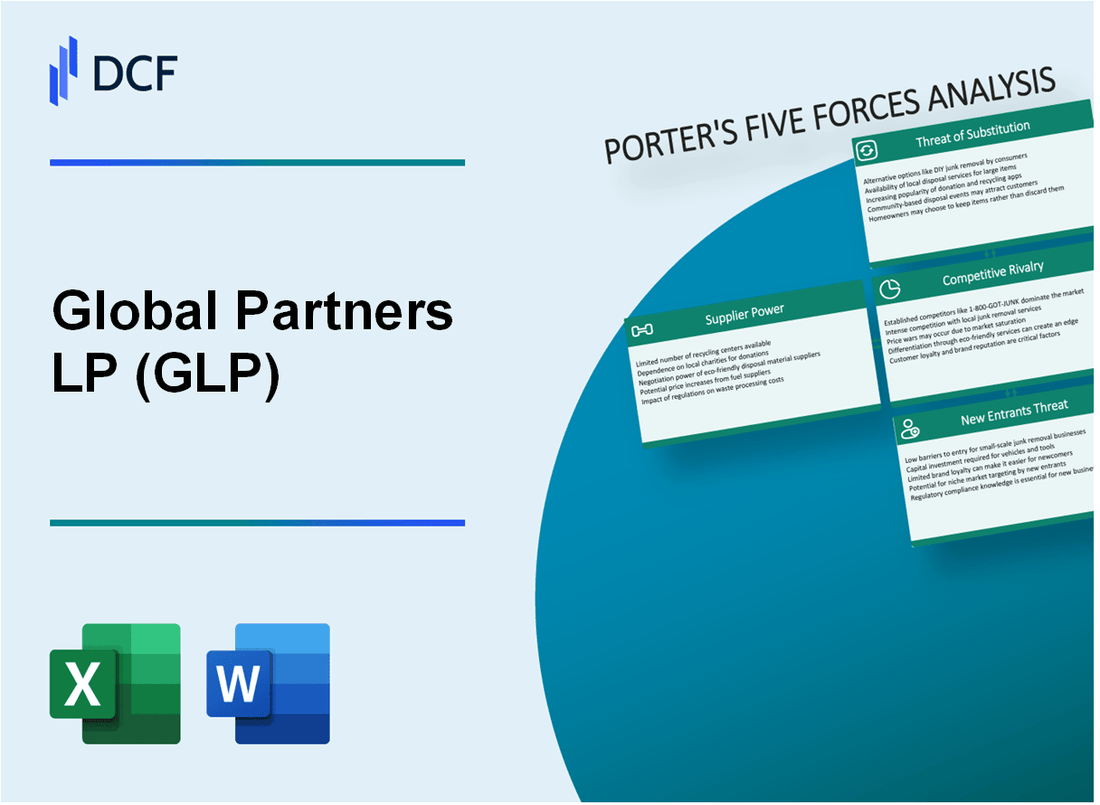
Global Partners LP (GLP): 5 FORCES Analysis [Nov-2025 Updated] |
Fully Editable: Tailor To Your Needs In Excel Or Sheets
Professional Design: Trusted, Industry-Standard Templates
Investor-Approved Valuation Models
MAC/PC Compatible, Fully Unlocked
No Expertise Is Needed; Easy To Follow
Global Partners LP (GLP) Bundle
You're digging into the competitive moat around Global Partners LP right now, trying to see past the noise of commodity price swings to the real structural risks and advantages as we close out 2025. Honestly, the picture is complex: while the barrier to entry is incredibly high-look at the $305.8 million paid for those 25 Motiva terminals-the long-term threat from substitutes like EVs is definitely growing, even with the recent federal EV tax credit change in July 2025. We need to map out exactly where the pressure points are, because even as a market leader moving 2.0 billion gallons in Q2 2025, the power held by their concentrated suppliers and large wholesale customers, who drove $3.1 billion in Q2 sales, dictates the margin reality. Let's break down the five forces to see if their integrated model is truly built to last.
Global Partners LP (GLP) - Porter's Five Forces: Bargaining power of suppliers
You're looking at the supplier landscape for Global Partners LP, and honestly, it presents a classic tension between commodity market concentration and your own significant infrastructure scale. The suppliers of the core products-gasoline, distillates, and crude oil-are major, integrated refiners, which inherently gives them leverage.
The market structure itself leans toward supplier power because the inputs are essentially commodities. We see this supplier concentration reflected in Global Partners LP's own asset history; for instance, the company has strategically acquired assets from large players like ExxonMobil Oil Corporation, Motiva Enterprises LLC, and Gulf Oil Limited Partnership to secure supply options and storage capacity.
This supplier power is actively being tested by industry consolidation. Refinery closures directly reduce the available supply pool, thereby increasing the leverage of the remaining producers. For example, the permanent shuttering of the LyondellBasell Houston refinery was completed in Q1 2025, marking a significant reduction in domestic motor fuel production capacity. Furthermore, rival refiners like Phillips 66 planned to cease production at their Los Angeles refinery by the end of 2025, adding further pressure to regional supply availability.
Global Partners LP definitely fights back against this supplier concentration through its own scale and network flexibility. The Partnership operates or maintains dedicated storage at 55 liquid energy terminals as of its Q3 2025 update, with an approximate storage capacity of 21.8 million barrels reported in Q2 2025. This extensive, geographically diverse network, spanning from Maine to Florida and into the U.S. Gulf States, offers sourcing flexibility, allowing Global Partners LP to pivot between pipeline, marine, and rail assets to secure the best input costs.
Input cost volatility is the major financial lever suppliers hold. Crude oil price swings directly dictate Global Partners LP's cost of goods sold. For context on recent volatility, the Brent crude oil price traded in a narrow range during the third quarter of 2025, averaging $70/b in July, dropping to an average of $67/b in August, and settling at $68/b in September. While the company's Wholesale segment product margin was $93.6 million in Q1 2025, indicating strong performance partly due to favorable market conditions, this margin is constantly exposed to the underlying commodity price movements. To be fair, Global Partners LP generally has mechanisms to pass these input cost fluctuations through to its customers, which mitigates the direct margin impact, but the constant negotiation and procurement against volatile benchmarks remain a key supplier dynamic.
Here is a quick look at the market context influencing supplier power:
| Metric | Value/Period | Source Context |
|---|---|---|
| Global Partners LP Terminals | 55 (as of late 2025) | Represents sourcing flexibility and mitigation scale. |
| LyondellBasell Houston Refinery Closure | Completed in Q1 2025 | Reduces overall refined product supply. |
| Brent Crude Price (July 2025 Avg) | $70/b | Illustrates input cost volatility. |
| Brent Crude Price (September 2025 Avg) | $68/b | Illustrates input cost volatility. |
| Wholesale Segment Product Margin (Q1 2025) | $93.6 million | Shows performance against input costs. |
The key takeaways regarding supplier power for Global Partners LP are:
- Suppliers are concentrated refiners like Marathon and ExxonMobil.
- Refinery closures, like LyondellBasell's in Q1 2025, tighten supply.
- Global Partners LP's 55 terminals offer defintely needed sourcing flexibility.
- Crude oil price volatility dictates input costs, which are generally passed on.
Finance: review the Q4 2025 procurement contracts for any material changes in supplier pricing terms by next Tuesday.
Global Partners LP (GLP) - Porter's Five Forces: Bargaining power of customers
For Global Partners LP, the bargaining power of customers varies significantly across its operating segments. You need to look at the wholesale side separately from the retail consumer side to get a clear picture of the pressure they exert.
Wholesale Segment Power: Moderate-to-High
The power is definitely moderate-to-high in the wholesale segment. This area drove $3.1 billion in sales for Global Partners LP in the second quarter of 2025. In this business-to-business environment, fuel is largely treated as a commodity. This means large commercial and wholesale customers face relatively low switching costs because the product itself-gasoline, distillates, or renewable fuels-is largely undifferentiated at the point of transaction, often priced off benchmarks like the NYMEX. Honestly, if a competitor can deliver the same volume at a better price basis, a large buyer will move. Fuel distributors in this space often see profit margins as thin as 3-4 cents per gallon.
However, Global Partners LP has built specific defenses against this power:
- Global Partners LP operates or maintains dedicated storage at 54 liquid energy terminals.
- These terminals feature connectivity to strategic rail, pipeline, and marine assets.
- Recent strategic investments, like the $212.3 million acquisition of four terminals in 2024, are explicitly intended to leverage this scale.
This integrated terminal network creates high switching costs for customers who have structured their logistics around Global Partners LP's specific storage and delivery points. If a customer's entire supply chain relies on drawing product from a specific Global terminal, the cost and complexity of re-routing that supply become substantial.
Retail Customer Power: Low
For the individual consumer buying fuel at a Global Partners LP-supplied station, their power is much lower. While price transparency is high in the digital age, the consumer's decision is heavily constrained by location. You know that in retail gasoline markets, location and convenience often trump minor price differences. In fact, studies suggest that even with price disclosure, stations near highways can maintain higher prices if closer alternatives, like truck stops, are not within a short distance, perhaps 5 kilometers.
The financial impact of perfect price shopping for an individual is also relatively small. For a typical consumer, the annual savings from switching from the highest to the lowest price in a local market might only range from $16 to $70 per year. This low potential saving means the consumer is less motivated to exert high bargaining power.
Here's a quick comparison of the customer bases:
| Customer Segment | Primary Driver of Power | Relevant Financial/Scale Data |
|---|---|---|
| Wholesale/Commercial Buyers | Fuel is a commodity; low product switching costs | Wholesale Segment Sales: $3.1 billion (Q2 2025) |
| Wholesale/Commercial Buyers | High switching costs due to integrated logistics | Network Size: 54 liquid energy terminals |
| Retail Consumers (Individual) | Geographic convenience and travel time costs | Retail Sites: 1,553 sites in portfolio (Q2 2025) |
| Retail Consumers (Individual) | Low financial incentive to search intensely | Estimated annual savings from switching: $16 to $70 |
The power dynamic is clearly bifurcated. Global Partners LP must manage large, sophisticated wholesale buyers with competitive pricing and logistical integration, but it can rely on the convenience factor to keep individual retail customers locked in, despite the transparency of street prices.
Global Partners LP (GLP) - Porter's Five Forces: Competitive rivalry
You're looking at the competitive landscape for Global Partners LP in late 2025, and the rivalry in refined product distribution, particularly across the Northeast and Mid-Atlantic, is definitely a defining feature. This market segment is structurally fragmented, meaning there isn't one single dominant player controlling the flow of gasoline and diesel.
The competition isn't just local mom-and-pop operations; Global Partners LP faces established, large-scale entities. Competitors include other major distributors and integrated energy players like World Kinect Corporation, which operates with a global supply network across air, land, and sea. This mix of regional specialists and broader energy service providers keeps the pressure on pricing and service delivery.
Rivalry intensity stems from two core issues: low product differentiation and the heavy capital requirements of the business. Gasoline and diesel are essentially commodities; you can only differentiate so much on the pump. So, competition often boils down to price and logistics efficiency. Furthermore, the infrastructure-terminals, storage, and distribution networks-requires massive fixed costs. When volumes dip, those fixed costs hit margins hard, which is why every gallon matters.
Global Partners LP's scale is significant, but the tight margins are a constant reality. For the second quarter of 2025, the Partnership reported a total distribution volume of 2.0 billion gallons. That volume establishes Global Partners LP as a major force, but look closely at the segment breakdown; margins remain tight, as evidenced by the Q2 2025 financial results.
Here's a quick look at the volume breakdown for Q2 2025 compared to the prior year:
| Segment | Q2 2025 Volume (Gallons) | Q2 2024 Volume (Gallons) |
|---|---|---|
| Total Volume | 2.0 billion | 1.6 billion |
| Wholesale Segment | 1.5 billion | 1.1 billion |
| GDSO Segment | 382.4 million | 407.0 million |
| Commercial Segment | 141.9 million | 119.5 million |
Even with the overall volume increase, the margin pressure is visible when you check the earnings. For Q2 2025, net income was $25.2 million, down from $46.1 million in Q2 2024. Adjusted EBITDA also saw a compression, landing at $98.2 million in Q2 2025 versus $121.1 million the year before. This financial performance underscores that moving 2.0 billion gallons doesn't automatically translate to wider profitability when the market is this competitive.
To maintain its position, Global Partners LP relies on its physical footprint, which represents a barrier to entry for smaller players, but it also shows where they are actively managing the competitive field:
- Operates or maintains dedicated storage at 54 liquid energy terminals.
- Owns, operates, and/or supplies approximately 1,700 retail locations across key regions.
- The retail site count was strategically reduced to 1,553 sites at the end of Q2 2025, down 42 from the prior year to optimize the portfolio.
- The Partnership declared a Q2 2025 cash distribution of $0.7500 per unit, or $3.00 per unit annualized, showing a commitment to unitholders despite tight margins.
The need to constantly manage the asset base-like the recent divestment of 42 sites-is a direct response to the high fixed-cost environment and the drive to compete effectively on efficiency against integrated rivals.
Global Partners LP (GLP) - Porter's Five Forces: Threat of substitutes
The long-term threat of substitution for Global Partners LP is structurally high, driven by the global energy transition away from traditional petroleum products toward electric vehicles (EVs) and renewable fuels. This transition directly targets the core of Global Partners LP's traditional business model, which relies heavily on the distribution of gasoline and distillates.
To frame the current environment, consider the financial pressures Global Partners LP faced in the third quarter of 2025, which underscore the need for diversification away from legacy fuels. You can see the comparison to the prior year:
| Metric (Q3 2025 vs. Q3 2024) | Q3 2025 Actual | Q3 2024 Actual | Change |
|---|---|---|---|
| Net Income | $29 million | $45.9 million | Decrease |
| EBITDA | $97.1 million | $119.1 million | Decrease |
| Distributable Cash Flow (DCF) | $53.0 million | $71.1 million | Decrease |
| GDSO Segment Product Margin | $218.9 million | $237.7 million | Decrease |
| Wholesale Segment Product Margin | $78.0 million | $71.1 million | Increase |
The industry context for declining fossil fuel demand is clear. For instance, the International Energy Agency (IEA) noted that its forecast for global liquid fuels consumption growth in 2025 was reduced by 120,000 barrels per day (kbd), largely due to upward revisions in historical data, signaling a general deceleration in demand growth that impacts distributors like Global Partners LP. This projected decline forces a strategic pivot.
The near-term threat from substitution is, perhaps, slightly reduced by recent policy shifts. You saw Congress eliminate the $7,500 federal EV tax credit for new vehicles at the end of September 2025. This removal of a major purchase incentive is projected by some analysts to slow EV adoption significantly; for example, one joint study projected EV registrations could fall by 27% without the credit. Ford CEO Jim Farley predicted the EV sales market share could drop from a record 10% to 12% down to 5% after the incentive expired. While this might temporarily temper the speed at which gasoline demand erodes, it does not stop the long-term trend.
Global Partners LP is actively mitigating this substitution threat by leaning into the energy transition. The company is focused on expanding its distribution of distillates and, critically, renewable fuels, leveraging its extensive terminal network. The Wholesale segment, which saw its product margin rise to $78.0 million in Q3 2025 from $71.1 million in Q3 2024, is being fueled by the growth and scale of this terminal network, which supports the distribution of these lower-carbon solutions.
The company's commitment to unitholders remains, as evidenced by the announced quarterly cash distribution of $0.7550 per unit for the third quarter of 2025. However, the path forward requires continued execution on diversification, especially as the Gasoline Distribution and Station Operations (GDSO) segment saw its product margin fall to $218.9 million from $237.7 million year-over-year.
Here are the key areas where Global Partners LP is positioning itself against substitution:
- Focus on renewable fuels distribution.
- Growth in Wholesale segment margin to $78.0 million.
- Operating 25 U.S. convenience-store chains by store count (CSP 2025 Top 202).
- Mitigating retail fuel volume pressure with new loyalty platform.
Global Partners LP (GLP) - Porter's Five Forces: Threat of new entrants
The threat of new entrants for Global Partners LP in the liquid energy terminal and distribution business is decidedly low. This is primarily because the industry demands extremely high capital requirements to establish the necessary terminal and retail infrastructure. You simply cannot start this business on a shoestring budget; the physical assets alone create a massive barrier to entry.
Consider the sheer scale of investment required. Building a new liquid energy terminal is not a quick venture; it is a multi-year, multi-million-dollar undertaking, often pushing into the hundreds of millions depending on scale and location. Furthermore, these projects are immediately subject to significant regulatory hurdles, which add time and cost before a single drop of product can be handled. For context on large-scale energy infrastructure, even related projects like the expansion of the Cameron liquefied natural gas export terminal in Louisiana have developers needing an extension until March 2033 to complete the work. In Alaska, proposed LNG import infrastructure projects are estimated to cost $500 million or more or run into the hundreds of millions of dollars.
Global Partners LP's own recent history clearly demonstrates the cost of entry, even through acquisition, which is often faster than greenfield development. The purchase of 25 liquid energy terminals from Motiva Enterprises LLC for $305.8 million in cash is a perfect example. This single transaction, which closed in late 2023, immediately increased Global Partners LP's total storage capacity by approximately 85% to 18.3 million barrels. This shows that acquiring an established, mid-sized network costs hundreds of millions of dollars instantly.
To give you a clearer picture of the scale of existing assets and the cost of maintaining and growing them, look at the numbers as of mid-to-late 2025:
| Metric | Value / Amount | Source Context |
|---|---|---|
| Total Liquid Energy Terminals (Q2 2025) | 54 | Global Partners LP operational count |
| Total Storage Capacity (Q2 2025) | 21.8 million barrels | Global Partners LP storage capacity |
| Motiva Terminal Acquisition Cost | $305.8 million | Cash purchase price for 25 terminals (2023) |
| Gulf Oil Terminal Acquisition Cost | $215 million | Cost for four terminals (prior to 2025) |
| 2025 Full-Year Expansion CapEx Guidance (Excl. Acquisitions) | $40 million to $50 million | Primarily for gasoline stations and terminal investments |
| 2025 Full-Year Maintenance CapEx Guidance | $45 million to $55 million | Required ongoing investment |
Beyond the initial capital outlay, new entrants face significant non-financial barriers that Global Partners LP has already navigated. These include the complex environmental permitting process and securing established connectivity to critical logistics networks. Global Partners LP's acquired assets, for instance, have direct connections to major refined product pipelines like Colonial, Plantation, Enterprise, Explorer, and Magellan. A new player would need years and substantial legal/engineering resources to secure similar rights-of-way and interconnections, which are often already locked up by incumbents like Global Partners LP.
The barriers to entry can be summarized by the required components for a competitive footprint:
- High upfront capital for land acquisition and tank construction.
- Securing multi-year, minimum throughput agreements with anchor tenants.
- Navigating complex federal and state environmental permitting.
- Establishing critical connectivity to established pipeline and rail networks.
The cost of entry via M&A, as shown by the $305.8 million Motiva deal, sets a high floor for any competitor looking to leapfrog the development timeline. Still, the company's own planned capital expenditure for 2025-between $85 million and $105 million for maintenance and expansion combined, excluding acquisitions-shows the continuous, substantial investment needed just to maintain and incrementally grow existing operations.
Disclaimer
All information, articles, and product details provided on this website are for general informational and educational purposes only. We do not claim any ownership over, nor do we intend to infringe upon, any trademarks, copyrights, logos, brand names, or other intellectual property mentioned or depicted on this site. Such intellectual property remains the property of its respective owners, and any references here are made solely for identification or informational purposes, without implying any affiliation, endorsement, or partnership.
We make no representations or warranties, express or implied, regarding the accuracy, completeness, or suitability of any content or products presented. Nothing on this website should be construed as legal, tax, investment, financial, medical, or other professional advice. In addition, no part of this site—including articles or product references—constitutes a solicitation, recommendation, endorsement, advertisement, or offer to buy or sell any securities, franchises, or other financial instruments, particularly in jurisdictions where such activity would be unlawful.
All content is of a general nature and may not address the specific circumstances of any individual or entity. It is not a substitute for professional advice or services. Any actions you take based on the information provided here are strictly at your own risk. You accept full responsibility for any decisions or outcomes arising from your use of this website and agree to release us from any liability in connection with your use of, or reliance upon, the content or products found herein.