
|
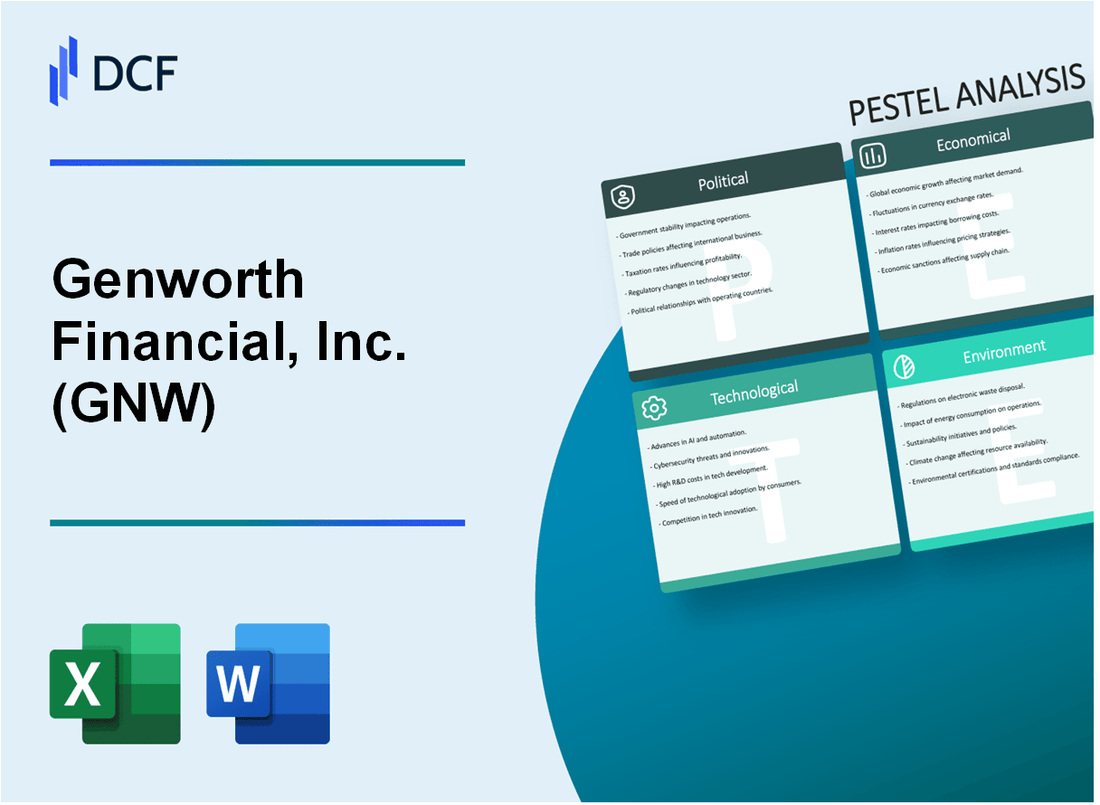
Genworth Financial, Inc. (GNW): PESTLE Analysis [Nov-2025 Updated] |
Fully Editable: Tailor To Your Needs In Excel Or Sheets
Professional Design: Trusted, Industry-Standard Templates
Investor-Approved Valuation Models
MAC/PC Compatible, Fully Unlocked
No Expertise Is Needed; Easy To Follow
Genworth Financial, Inc. (GNW) Bundle
You're looking for a clear, actionable breakdown of Genworth Financial, Inc.'s (GNW) operating environment, and honestly, the picture is complex but manageable. The direct takeaway is this: GNW's fate is still largely tied to its closed block of Long-Term Care (LTC) insurance, meaning regulatory approvals for rate increases and interest rate movements are the biggest levers. Everything else-technology, ESG, political noise-is secondary to the core mission of stabilizing that legacy business, but we defintely need to map out the full risk spectrum.
Genworth Financial, Inc. (GNW) - PESTLE Analysis: Political factors
State insurance regulators control critical LTC premium rate increase approvals.
The core political risk for Genworth Financial, Inc.'s legacy Long-Term Care (LTC) business remains the state-by-state regulatory process for In-Force Rate Actions (IFAs), which are essential for stabilizing the older, underpriced policies. Honestly, this isn't a single political environment; it's a patchwork of 50 separate political negotiations with state insurance commissioners.
The Multi-Year Rate Action Plan (MYRAP) is the company's lifeline here, and the regulatory approvals continue to deliver value. For example, in the third quarter of 2025, Genworth Financial secured $44 million in gross incremental premium approvals. This is a critical cash flow component, but it's a constant, slow grind. The estimated net present value (NPV) achieved from all IFAs since 2012 has reached approximately $31.8 billion, showing the immense financial impact of favorable regulatory decisions over time.
The new CareScout Insurance venture, Genworth Financial's re-entry into the LTC market, is also politically sensitive. As of the third quarter of 2025, the company had secured regulatory approvals to sell its new stand-alone LTC product in 29 states, with a goal of reaching at least 30 to launch sales. This state-level approval process is the defintely the most immediate political hurdle for their growth strategy.
Federal policy shifts on healthcare funding indirectly affect public perception of private LTC.
While the private LTC market is primarily state-regulated, federal policy on public healthcare spending creates a massive indirect political and economic effect. Medicaid, the largest payer for long-term services and supports (LTSS), is constantly under threat from federal budget proposals.
In early 2025, Congress was considering proposals that would significantly cut federal funding for Medicaid. Here's the quick math: a reduction in Medicaid funding would shift a greater financial burden onto states, potentially forcing them to cut services or enrollment. This would, in turn, increase public awareness of the LTC funding crisis, which could boost demand for private insurance like Genworth Financial's new CareScout product. But still, it also risks destabilizing the entire care provider ecosystem that private insurance relies on.
The political gridlock also affects quality of care. A potential federal government shutdown, as seen in October 2025, would suspend most Centers for Medicare & Medicaid Services (CMS) survey and certification activities for nursing homes, focusing only on the most serious incidents. This suspension of oversight for thousands of facilities is a political failure that erodes public trust in the entire long-term care infrastructure, both public and private.
Government-backed mortgage insurance (MI) business is sensitive to housing policy changes.
Genworth Financial's mortgage insurance business, operated through its subsidiary Enact, is highly sensitive to the political and regulatory environment of the U.S. housing finance system. Enact's primary competitors are the Government-Sponsored Enterprises (GSEs), Fannie Mae and Freddie Mac. These entities operate under a public mission, and their pricing and business practices can be influenced by social housing policy rather than a purely profit-maximizing motive.
This means a political decision to advance a social housing goal-say, by lowering the GSEs' mortgage insurance prices-could put Enact at a competitive disadvantage. Enact remains a strong performer, delivering adjusted operating income of $134 million in Q3 2025, but its profitability is constantly mapped against the political decisions made in Washington, D.C. The fact that Enact's PMIERs (Private Mortgage Insurer Eligibility Requirements) sufficiency ratio was a strong 165% in Q1 2025 shows they are well-capitalized to meet regulatory requirements, but that doesn't shield them from a politically-driven pricing war with the GSEs.
Potential for federal or state task forces to address the national LTC funding crisis.
With federal gridlock on a comprehensive LTC solution, states have become the primary laboratories for policy innovation, creating new political risks and opportunities for Genworth Financial. At least 41 states are actively working on legislative actions to support the Long-Term Services and Supports (LTSS) workforce, including raising wages and tying Medicaid rates to direct care pay. This is a political positive for the care system, but it also increases the cost of care, which ultimately pressures private LTC premiums.
A more direct political threat is the emergence of state-run insurance programs. Washington State's 'WA Cares' Fund, for instance, is a mandatory, state-run LTC insurance program funded by a 0.58% payroll deduction. While benefits don't start until July 1, 2026, this model creates a public-sector competitor that could displace a portion of the private market, especially for lower-to-middle-income consumers. This state-level political action is a major strategic consideration.
| Political/Regulatory Factor (2025) | Impact on Genworth Financial Segment | Key Metric/Value |
|---|---|---|
| State LTC Premium Rate Approvals (MYRAP) | Legacy LTC Stabilization | Q3 2025 Gross Incremental Premium Approvals: $44 million |
| New LTC Product State Approvals (CareScout) | LTC Growth Platform Launch | Approvals in 29 states as of Q3 2025 |
| Federal Medicaid Funding Proposals | Indirect LTC Market Demand/Cost | Proposals to cut Medicaid funding for LTSS |
| GSE Competition (Housing Policy) | Mortgage Insurance (Enact) Profitability | Q3 2025 Enact Adjusted Operating Income: $134 million |
| State-Level LTC Funding Initiatives (e.g., WA Cares) | LTC Market Competition/Cost of Care | WA Cares payroll deduction: 0.58% |
The political environment is a double-edged sword: slow, favorable progress on legacy LTC rate hikes is stabilizing the balance sheet, but new state-level public programs and federal policy instability in housing and healthcare create clear near-term risks.
Next Step: Strategy Team: Model the long-term impact of a mandatory state-run LTC program (like WA Cares) on new CareScout sales projections by the end of the quarter.
Genworth Financial, Inc. (GNW) - PESTLE Analysis: Economic factors
Low or volatile interest rates pressure investment returns on the massive LTC float.
The core challenge for Genworth Financial, Inc.'s legacy Long-Term Care (LTC) business is the performance of its investment portfolio, which must support billions in future claims. While the environment is improving from the ultra-low rates of the past decade, volatility still creates risk. In the third quarter of 2025, Genworth's consolidated net investment income, net of taxes, was $631 million, a slight decrease from the prior quarter's $634 million, but still up year-over-year due to higher income from limited partnerships. This is a massive float.
Still, the portfolio's fixed-income assets, which comprised $45.7 billion or 75% of the total portfolio as of Q2 2025, show the lingering impact of past rate movements. The unrealized loss position on these fixed maturities was $3.0 billion as of June 30, 2025. Here's the quick math: a sustained rise in rates is good for future portfolio yield, but it creates near-term mark-to-market losses on existing bonds. Conversely, an unexpected drop in rates would hurt future investment income, which is defintely a risk for a long-duration liability business like LTC.
- Q3 2025 Net Investment Income: $631 million.
- Unrealized Loss on Fixed Maturities (Q2 2025): $3.0 billion.
- Enact Q3 2025 Net Investment Income: $68 million, up from $62 million prior year.
Inflation risk increases the cost of future LTC claims, widening the LTC deficit.
The cost of long-term care services-home health, assisted living, and nursing home care-is highly sensitive to inflation, especially wage inflation for caregivers. This directly increases the severity of future LTC claims, widening the gap between premiums collected and benefits paid. To be fair, Genworth is aggressively managing this through its Multi-Year Rate Action Plan (MYRAP) and new product design.
The company continues to see pressure from benefit utilization and rising claims, but it is taking action. The MYRAP secured $44 million of gross incremental premium approvals in Q3 2025 alone, contributing to an estimated net present value of $31.8 billion achieved since 2012. Plus, the new CareScout product, launched in October 2025, addresses this risk by capping maximum benefits, with one new policy design limiting benefits to $250,000 to ensure sustainability and manage the long-term inflation exposure that plagued older policies.
Housing market stability directly impacts the performance of the US Mortgage Insurance segment.
The US Mortgage Insurance segment, Enact, is Genworth's primary source of profitability and capital return, so its performance is a direct reflection of the US housing and mortgage markets. Despite high mortgage rates, Enact's results remain strong, driven by low unemployment and favorable credit performance. In Q3 2025, Enact's adjusted operating income was $134 million, and it distributed $110 million in capital returns to Genworth. That's a strong cash engine.
However, the macro-economic signals show clear headwinds. The average 30-year fixed-rate mortgage was around 6.79% in Q2 2025, which has suppressed purchase activity. Existing home sales were flat year-over-year in Q2 2025, and single-family housing starts were down 6% year-over-year. A sharp economic downturn or a significant correction in home prices would immediately increase mortgage defaults and claim payments, directly impacting Enact's profitability and its ability to return capital.
| Enact Key Metric | Q3 2025 Value | Context |
| Adjusted Operating Income | $134 million | Primary driver of Genworth's consolidated net income. |
| Capital Returns to Genworth | $110 million | Funds Genworth's share repurchases and strategic investments. |
| Primary Insurance In-Force | $272.3 billion | Up 2% from the prior-year quarter. |
Economic downturns could slow down state approvals for necessary LTC premium increases.
The political and social dimensions of economics are critical here. State insurance regulators, who must approve the LTC premium increases (In-Force Rate Actions, or IFAs), are sensitive to the financial strain these increases place on consumers, especially during an economic downturn or recession. While Genworth has been successful with its MYRAP, securing $44 million in gross incremental premium approvals in Q3 2025, this process is not guaranteed.
A severe economic contraction would likely increase political pressure on state insurance commissioners to slow down or reject large rate hike requests, even if they are actuarially justified. This delay would directly impair the self-sustainability goals of the legacy LTC business, forcing Genworth to absorb higher losses for a longer period. The company's strategy is to manage the U.S. life insurance companies as a closed system, but that system relies heavily on the continued, timely approval of these IFAs.
Genworth Financial, Inc. (GNW) - PESTLE Analysis: Social factors
Aging US population drives demand for LTC solutions, but affordability is a major barrier.
The demographic shift in the United States creates a massive, undeniable market for Long-Term Care (LTC) solutions. By 2025, the US population aged 65 and older is projected to reach approximately 62.7 million, representing 18.6% of the total population. This is the core market for Genworth Financial, Inc. (GNW), as roughly 70% of adults turning 65 will need some form of long-term care during their lifetime. The demand is not the problem; the price is.
The median cost of care in 2025 puts it out of reach for many middle-income families. For example, the estimated median cost for an assisted living facility is $5,900 per month, while a private room in a nursing home is estimated at $10,965 per month. The reality is stark: over half of middle-income seniors are projected to lack the financial means to afford conventional senior living and care by 2029. This affordability gap is the single biggest headwind for the entire industry.
| Median Monthly LTC Cost (2025 Estimate) | Annual Cost Equivalent (2025 Estimate) |
|---|---|
| Assisted Living Facility: $5,900 | $70,800 |
| Private Nursing Home Room: $10,965 | $131,580 |
Public perception of the LTC industry remains poor due to past premium hikes and complexity.
Honesty, the LTC insurance industry has a trust problem it needs to fix. Carriers, including Genworth Financial, Inc., have had to pursue multiple rounds of premium rate increases on legacy policies to stabilize their finances, which has understandably eroded consumer confidence. This unpredictable pricing, coupled with the inherent complexity of the policies, deters new buyers.
The result is a market where demand is high, but confidence is low. A recent survey showed that while 74% of consumers think they will need LTC someday, only 33% feel confident about their current plans. This lack of confidence stems directly from the 'complex policies' and the fear of future, unaffordable premium hikes. GNW's new products must defintely be designed to rebuild this trust from the ground up.
Shifting family structures mean fewer informal caregivers, increasing reliance on paid services.
The traditional model of family members providing care is under immense strain, pushing demand toward paid services. The estimated value of unpaid family care in the US is a staggering $2.5 trillion in 2025, which shows how vital-and how strained-this informal system is. As the Baby Boomers age, the number of family caregivers is increasing (up 32% from 2011 to 2022 to 24.1 million), but so is the burden.
For those caring for older adults with dementia, the average weekly care hours jumped nearly 50%, from 21.4 hours to 31.0 hours between 2011 and 2022. That's a full-time job on top of everything else. Consequently, nearly half of caregivers report at least one negative financial impact from their responsibilities, forcing families to seek professional, paid care sooner.
- Family caregivers providing care: 24.1 million (as of 2022).
- Average weekly hours for dementia caregivers: 31.0 hours (as of 2022).
- Percentage of caregivers reporting negative financial impact: Nearly 50%.
Increased consumer financial literacy demands simpler, more transparent insurance products.
Today's consumers are more financially literate and demand transparency in all financial products, especially insurance. They want personalized products, transparent pricing, and frictionless digital experiences. The old, rigid LTC policies simply don't cut it anymore.
The industry response is a shift toward hybrid products-combining life insurance or annuities with LTC benefits-to address the major consumer concern of 'use it or lose it.' Genworth Financial is directly addressing this with its CareScout subsidiary. They are rolling out an 'innovative hybrid LTC design that pairs a minimum LTC benefit with low-cost equity funds for accumulation.' Plus, they launched a fee-based service called Care Plans for $250, which provides a virtual evaluation and personalized care plan to help families navigate the complexity with clarity. This is a smart, concrete action to meet the demand for simplicity and transparency. Finance: prioritize marketing spend on the Care Plans service to capture the clarity-seeking segment by Friday.
Genworth Financial, Inc. (GNW) - PESTLE Analysis: Technological factors
Technology is not just a support function for Genworth Financial; it's a critical component for stabilizing the legacy Long-Term Care (LTC) business and launching the new, more sustainable CareScout platform. The strategic shift involves heavy investment in digital tools and advanced analytics to fix past actuarial errors and drive operational efficiency. This is a defintely necessary pivot.
Use of predictive analytics is crucial for accurately modeling future LTC claim severity and frequency.
The core problem with the legacy LTC block was flawed actuarial modeling. Genworth Financial is now using its subsidiary, CareScout, to build a data-driven, predictive model for its new insurance products. This is critical because the new CareScout Care Assurance product, approved in 37 states as of late 2025, must be priced correctly from day one. The company is leveraging decades of claims data-having paid over 370,000 LTC claims-to refine its assumptions on how long people will need care and the true cost of that care.
The success of the CareScout Quality Network is measured by its ability to manage claim costs. Genworth Financial projects this network will drive $1 billion to $1.5 billion in LTC claim savings over time. This saving is a direct output of better predictive modeling that steers policyholders toward high-quality, cost-effective care options, such as in-home health aides, which have an estimated 2025 median annual charge of $82,530, compared to the much higher cost of a private nursing home room.
| Technological Initiative | 2025 Financial/Operational Metric | Strategic Impact |
|---|---|---|
| CareScout Insurance Investment | Initial capital invested: $85 million | Funds development of new, accurately-priced LTC products. |
| CareScout Services Investment | Expected 2025 investment: $45 million to $50 million | Drives network expansion and data collection for predictive models. |
| CareScout Quality Network Coverage | Covers 90% of the U.S. aged 65-plus census population (Q1 2025) | Provides a massive data set for real-time cost and quality analysis. |
Digital platforms are necessary to streamline the complex, paper-heavy LTC claims process.
The claims process for legacy LTC policies is notoriously complex and paper-intensive. Genworth Financial is using digital platforms to shift the customer experience and reduce manual effort. The CareScout platform allows policyholders to check their claim status, sign up for paperless communication, and track payments online.
The company is also expanding its digital ecosystem through acquisitions. The planned acquisition of the senior living platform Seniorly for $20 million in Q4 2025 is a clear move to digitize the care-finding and advisory process. This move integrates a network of over 3,000 senior living communities directly into Genworth Financial's digital offerings, making the entire claims-to-care journey more efficient.
Investment in cybersecurity is paramount to protect sensitive health and financial data.
Protecting the vast amounts of sensitive health and financial data (Protected Health Information or PHI) associated with its LTC policyholders is a non-negotiable risk. The company's 2025 Form 10-K explicitly identifies the risk of 'cyber incidents or other failures, disruptions or security breaches' as a significant operational risk.
While a specific 2025 dollar figure for total cybersecurity spend isn't public, the strategic focus is clear: The Data Security and Cybersecurity Program (DSCP) is integrated into the broader risk management framework, with control expectations aligned to the National Institute of Standards and Technology (NIST) standards. For context, global security spending is expected to grow by 12.2% in 2025, with the financial services sector being one of the biggest spenders, underscoring the industry pressure to invest heavily.
Automation can reduce the high administrative costs associated with servicing the closed LTC block. That's an easy win.
The legacy U.S. Life Insurance segment, which includes the closed LTC block, is managed as a standalone, runoff business with no capital injections. Therefore, reducing administrative expense (SG&A) through automation is the most direct path to improving its financial stability.
Genworth Financial is actively consolidating its technology footprint to achieve this. They initiated a multi-year project to consolidate five legacy administration platforms to enable better service and address system obsolescence risks. Plus, they converted their contact center to a cloud-based platform, which includes intelligent routing and self-service integrations, resulting in a reduction in call handle times and an increase in first-call resolutions. This kind of back-office automation is what keeps the closed block sustainable.
- Consolidate legacy platforms to reduce maintenance costs.
- Implement cloud-based contact center for faster service resolution.
- Automate claims triage with virtual evaluations for new products.
Genworth Financial, Inc. (GNW) - PESTLE Analysis: Legal factors
Multi-state legal challenges and class-action lawsuits related to past LTC premium rate increases.
You need to understand that Genworth Financial's legacy Long-Term Care (LTC) business is still a significant legal headwind, even as the company pivots to new products. The core of the issue is the multi-state litigation and class-action lawsuits stemming from the multi-year rate action program designed to stabilize the older, underpriced LTC policies.
This isn't just a regulatory headache; it costs real money and management focus. For example, Genworth Financial has agreed to a class-action settlement of up to $24.5 million to resolve claims that it withheld information about rate increases from LTC policyholders. Another settlement concerning Cost of Insurance (COI) increases on universal life policies resulted in a $25 million fund for a class of over 13,400 plaintiffs.
The company is also actively fighting state regulators who deny rate increases, as seen in the New Jersey and Massachusetts cases. Massachusetts regulators, for instance, argued a requested rate hike of 161% was 'unjust, unfair and inequitable.' The company's success in getting approvals is critical, though, with the estimated net present value (NPV) achieved from in-force rate actions (IFAs) since 2012 reaching approximately $31.8 billion through September 30, 2025.
Here's the quick math on recent rate action progress:
| Metric (Through Q3 2025) | Amount/Value | Context |
|---|---|---|
| Estimated NPV from IFAs (Since 2012) | Approximately $31.8 billion | Total value of approved rate increases |
| Q3 2025 Gross Incremental Premium Approvals | $44 million | New premium approvals in the quarter |
| Choice 2 LTC Policies in One Settlement | 220,000 policies | Policies covered by a court-approved premium increase settlement |
Stringent state-level solvency and capital requirements for insurance companies.
For an insurance holding company, capital is the lifeblood, and state regulators are the gatekeepers. The primary measure is the Risk-Based Capital (RBC) ratio, which dictates how much capital an insurer must hold relative to its risk profile. Genworth Financial's U.S. life insurance companies maintain a strong position, with an RBC ratio of 303% as of September 30, 2025. This gives them a buffer, but it's a number regulators watch like a hawk.
To be fair, managing this capital is a constant balancing act. The company is investing heavily in its new growth platform, CareScout Insurance, which required an $81 million capital investment in Q3 2025 alone to support its launch and meet regulatory capital requirements. This investment is a necessary legal and financial action to launch a new, less-risky LTC product, Care Assurance, and to diversify away from the legacy block.
The holding company's liquidity is also key, sitting at $254 million in cash and liquid assets at the end of Q3 2025. This cash is essential for servicing debt and funding strategic initiatives, but a portion of it is often held for future obligations, including regulatory capital mandates. You can't just spend it.
Evolving privacy regulations, such as CCPA and potential federal standards, impact data handling.
The legal landscape for data handling is changing fast, and for a financial services company with massive amounts of sensitive personal information, this is a major compliance risk. The California Consumer Privacy Act (CCPA) and its amendments are the current benchmark in the US.
The new regulations approved by the California Privacy Protection Agency (CPPA) in 2025 are particularly impactful. They introduce new, rigorous requirements for Automated Decision-Making Technology (ADMT), which is definitely used in underwriting and claims processing. Compliance now requires a pre-use notice to the consumer, a right to access and appeal the ADMT decision, and a clear opt-out mechanism.
Plus, given Genworth Financial's 2024 revenue of $7.3 billion, the company will be subject to mandatory annual independent cybersecurity audits under the new CCPA regulations, with the first certification due as early as April 1, 2028. This is a costly, long-term compliance program.
- Conduct mandatory Privacy Risk Assessments for high-risk data processing.
- Implement new consumer rights for Automated Decision-Making Technology (ADMT).
- Prepare for annual independent cybersecurity audits (starting by April 1, 2028).
Regulatory scrutiny on the fair treatment of policyholders during claims and rate actions.
The constant tension between Genworth Financial's need for actuarially justified rate hikes and the state regulators' mandate to protect consumers defines this regulatory environment. The lawsuits over rate actions are essentially a proxy for regulatory scrutiny on policyholder fairness.
When state departments of insurance reject a rate increase-like the New Jersey Department of Banking and Insurance denying a requested 142% increase on one policy cohort-it signals a clear regulatory focus on preventing excessive or unfairly discriminatory premiums. The lawsuits over 'partial disclosures' in rate increase notices further underscore the legal risk around transparency and fair dealing.
Genworth Financial's strategic move to launch CareScout Insurance and its new Care Assurance product in October 2025 is a direct, actionable response to this scrutiny. By offering a low-risk, stand-alone LTC product, and expanding the CareScout Quality Network to over 2,330 matches year-to-date through September 30, 2025, the company is attempting to demonstrate a commitment to policyholder value and quality of care, which should defintely help mitigate future regulatory risk.
Next step: Legal and Compliance should draft a memo outlining the new ADMT compliance requirements and the associated internal audit plan by the end of Q1 2026.
Genworth Financial, Inc. (GNW) - PESTLE Analysis: Environmental factors
You're looking at Genworth Financial, Inc. (GNW) and trying to map the environmental risks. The direct impact is small, honestly, but the indirect exposure through their massive mortgage insurance (MI) portfolio and investment holdings is defintely something to watch, especially as climate-related financial disclosures become non-negotiable.
Limited direct environmental impact, but climate change affects real estate value in the MI portfolio.
Genworth's core business-long-term care (LTC) and life insurance-has a low direct environmental footprint, mostly limited to office operations. They're making progress, reporting a reduction in Scope 1 and 2 greenhouse gas emissions in 2024.
The real risk, however, is indirect, sitting in the Mortgage Insurance portfolio of their subsidiary, Enact Holdings, Inc. (Enact). As of the first quarter of 2025, Enact's primary insurance in-force (IIF) stood at a substantial $268 billion. Climate change impacts-like rising sea levels and increased frequency of extreme weather-threaten property values and drive up homeowners' insurance premiums. This creates a clear credit risk for Enact, because higher insurance costs push borrowers toward mortgage delinquency, which is exactly what MI covers. The average primary loan size in the portfolio was approximately $279 thousand at the end of 2024.
Here's the quick math on the MI portfolio exposure:
| Metric | Value (as of Q1 2025) | Risk Implication |
|---|---|---|
| Primary Insurance In-Force (IIF) | $268 billion | The total exposure base for climate-related credit risk. |
| Average Primary Loan Size | Approx. $279 thousand | Mortgage delinquency risk rises as insurance costs soar. |
| Direct GHG Emissions (Scope 1 & 2) | Reduced in 2024 | Low operational risk, high indirect financial risk. |
Growing investor and stakeholder pressure for clear Environmental, Social, and Governance (ESG) reporting.
Investor pressure for transparent ESG reporting is a major factor, and Genworth is responding. They conduct regular outreach to their stockholders, including the top 20 investors who represent about 60% of shares outstanding, with sustainability being a key discussion point. They align their disclosures with the Sustainability Accounting Standards Board (SASB) framework and publish a Task Force on Climate-Related Financial Disclosures (TCFD) Report.
The market trend confirms this focus: over half of companies surveyed in a September 2025 PwC report indicated they are facing growing pressure for sustainability data from stakeholders. Genworth's commitment to these frameworks is purely a necessity for maintaining institutional investor confidence.
Focus on the 'S' (Social) in ESG, emphasizing fair treatment of aging policyholders.
For Genworth, the 'S' in ESG is arguably the most material factor, given their massive Long-Term Care (LTC) insurance book, which serves over a million policyholders. Their strategy centers on their CareScout platform, which is designed to improve the aging experience.
- CareScout Network Coverage: They achieved over 95% home care coverage of the aged 65-plus census population in the US by Q3 2025.
- LTC Rate Actions: The Multi-Year Rate Action Plan (MYRAP) is a critical social-financial issue, aimed at stabilizing the LTC business but requiring policyholders to pay higher premiums. This plan has generated approximately $31.8 billion in estimated net present value from in-force rate actions (IFAs) since 2012, as of Q3 2025.
The social challenge is balancing the financial stability gained from these rate actions (the $31.8 billion) with the empathetic treatment of their aging policyholders, which is the core of their social license to operate.
Need to disclose and manage physical and transition risks related to investment portfolio assets.
Genworth's balance sheet exposes them to both physical and transition risks through its investment portfolio. Their fixed maturity securities portfolio, which is 97% investment grade, comprised 75% of total invested assets and cash as of September 30, 2025. This portfolio generated $565 million in taxable fixed maturity investment income in Q3 2025.
Transition risk is the key here: the potential for losses from the shift to a lower-carbon economy, which could devalue assets in carbon-intensive industries. The Genworth Board's Risk Committee oversees emerging risks like climate risk and is actively implementing an internal Investments ESG scoring system to assess and manage these exposures. They need to keep showing they are actively de-risking this large asset base.
Finance: draft 13-week cash view by Friday.
Disclaimer
All information, articles, and product details provided on this website are for general informational and educational purposes only. We do not claim any ownership over, nor do we intend to infringe upon, any trademarks, copyrights, logos, brand names, or other intellectual property mentioned or depicted on this site. Such intellectual property remains the property of its respective owners, and any references here are made solely for identification or informational purposes, without implying any affiliation, endorsement, or partnership.
We make no representations or warranties, express or implied, regarding the accuracy, completeness, or suitability of any content or products presented. Nothing on this website should be construed as legal, tax, investment, financial, medical, or other professional advice. In addition, no part of this site—including articles or product references—constitutes a solicitation, recommendation, endorsement, advertisement, or offer to buy or sell any securities, franchises, or other financial instruments, particularly in jurisdictions where such activity would be unlawful.
All content is of a general nature and may not address the specific circumstances of any individual or entity. It is not a substitute for professional advice or services. Any actions you take based on the information provided here are strictly at your own risk. You accept full responsibility for any decisions or outcomes arising from your use of this website and agree to release us from any liability in connection with your use of, or reliance upon, the content or products found herein.