

|
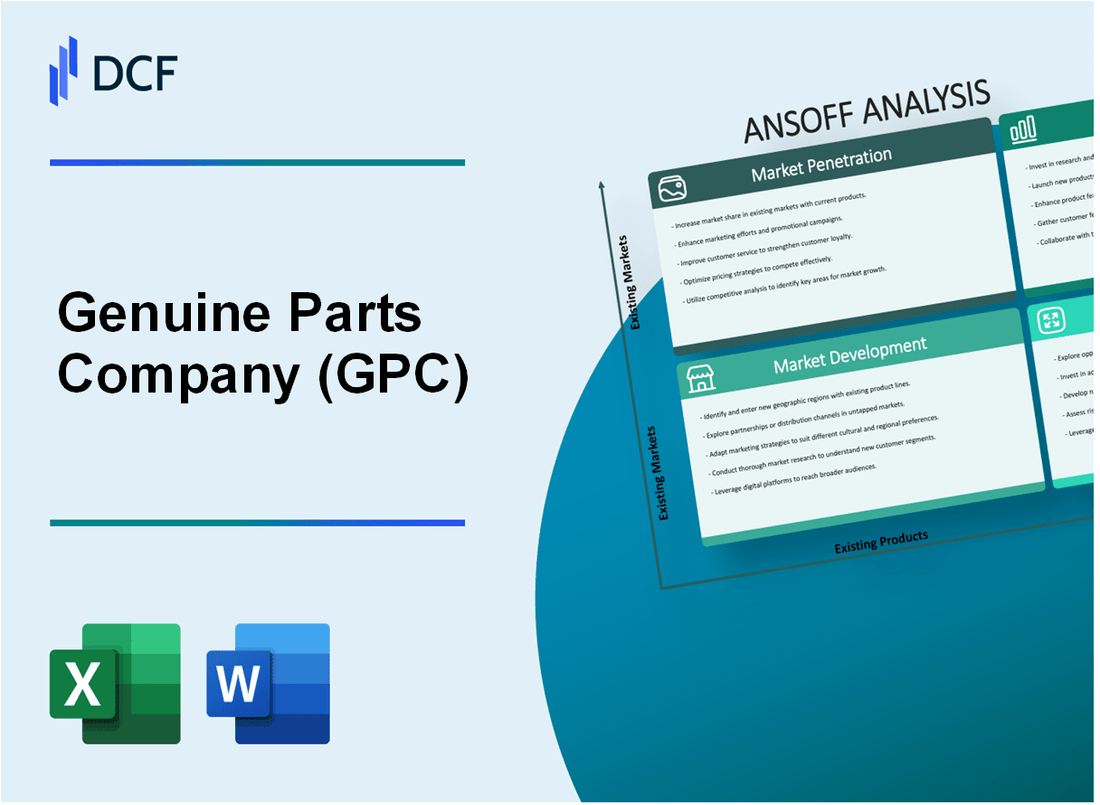
Genuine Parts Company (GPC): ANSOFF MATRIX [Dec-2025 Updated] |
Fully Editable: Tailor To Your Needs In Excel Or Sheets
Professional Design: Trusted, Industry-Standard Templates
Investor-Approved Valuation Models
MAC/PC Compatible, Fully Unlocked
No Expertise Is Needed; Easy To Follow
Genuine Parts Company (GPC) Bundle
As a seasoned analyst who's seen a few market cycles, I know you need to cut through the noise to see the real growth levers for Genuine Parts Company. The latest numbers from their Q3 2025 report show they hit $6.26 billion in revenue, beating expectations, even if adjusted EPS was a hair light. That top-line strength, coupled with a raised full-year sales guidance to 3-4% growth, tells us the core business is solid, but the real question is where they go next. This Ansoff Matrix lays out exactly how Genuine Parts Company can translate that operational momentum into aggressive, yet calculated, expansion-from doubling down on NAPA loyalty to exploring entirely new segments like heavy-duty truck parts-giving you a clear, actionable map of their near-term opportunities and risks below.
Genuine Parts Company (GPC) - Ansoff Matrix: Market Penetration
Drive higher sales volume in North American Automotive (NAPA) stores through loyalty programs.
Genuine Parts Company celebrated NAPA's 100-year anniversary in 2025, a milestone supporting existing customer engagement efforts. The company's U.S. Automotive sales grew 4% in the first quarter of 2025. For the third quarter of 2025, Global Automotive sales were $4.0 billion, up 5.0% year-over-year. The overall 2025 total sales growth guidance was updated to 3% to 4% as of the third quarter report. The company is focused on sales effectiveness using data to drive solution-based commercial strategies.
Increase average order value by cross-selling industrial supplies to existing automotive customers.
The two main segments show distinct performance, which hints at cross-segment opportunities or challenges. In the first nine months of 2025, total sales were $18.3 billion. The Global Industrial sales for the third quarter of 2025 were $2.3 billion, showing a 4.6% increase year-over-year. This compares to the Global Automotive sales of $4.0 billion in the same period. The company's strategy includes investing in existing and new capabilities to create a better customer experience across both segments.
Optimize pricing and promotional strategies to capture greater share from independent repair shops.
Market penetration relies on capturing more share from existing customer types, like independent repair shops. In the third quarter of 2025, comparable sales growth for the Global Automotive segment was 1.6%. This followed a slight decline in comparable sales in the first quarter of 2025. The company's Q1 2025 gross margin improved by 120 basis points to 37.1%, partly attributed to pricing initiatives. The overall 2025 full-year guidance for Automotive segment comparable sales growth was set between flat and up 2% as of the February 2025 outlook. The Q3 2025 Global Automotive Segment EBITDA Margin reached 8.4%, an increase of 10 basis points from the prior year period.
Expand private-label product offerings to improve margin and customer retention.
Strategic sourcing initiatives and pricing actions contributed to an adjusted gross margin expansion of 70 basis points in the full year 2024 results, a trend supporting private-label margin goals for 2025. The company is targeting gross margin expansion of 40 to 60 basis points for the full year 2025. The Q1 2025 adjusted diluted EPS was $1.75, with a full-year guidance range of $7.75 to $8.25, which was later tightened to $7.50 to $7.75 for Q3 2025 reporting. The company's 2025 estimated capital expenditures are budgeted between $400 million and $450 million.
Invest in digital tools to streamline B2B ordering for commercial customers.
Genuine Parts Company launched a modernized B2B platform, NAPA ProLink, developed with Google. NAPA B2B e-sales are reportedly growing at a mid-single digit rate. This digital focus is also strong in the Industrial segment, where Motion's ecommerce sales now represent 40% of that division's total sales. This 40% penetration is up more than 10 percentage points since the start of 2024. The company lists enhancing data and digital capabilities as a key technology strategic investment priority.
Here's a quick look at the recent Automotive Parts Group performance:
| Metric | Q1 2025 Value | Q3 2025 Value | Year-over-Year Change (Q3 vs Q3 2024) |
| Global Sales | $3.7 billion | $4.0 billion | 5.0% Increase |
| Comparable Sales Growth | Negative 0.8% (Net) | 1.6% Increase | 1.6% Increase |
| Segment EBITDA Margin | 7.8% | 8.4% | 10 basis points Expansion |
Key strategic investments for Genuine Parts Company in 2025 include:
- Estimated $400M - $450M in FY2025 Capital Expenditures.
- Reaffirming the dividend for the 69th consecutive year.
- Targeting 40 to 60 basis points of gross margin expansion for FY2025.
- Anticipated cost savings from restructuring efforts between $100 million and $125 million in 2025.
Genuine Parts Company (GPC) - Ansoff Matrix: Market Development
Market Development for Genuine Parts Company (GPC) centers on taking existing, proven business models-the Automotive Parts Group and the Industrial Parts Group-and introducing them to new geographic territories. This strategy relies on the established scale of the business, which reported total sales of $24.061B for the twelve months ending September 30, 2025, with Nine Months 2025 sales reaching $18.3 billion.
Accelerate expansion of the Industrial Parts Group into underserved regions of Europe and Australasia.
The Industrial Parts Group, which posted Q3 2025 sales of $2.3 billion, currently serves North America and Australasia. The Automotive Parts Group already has a significant footprint across 10 European nations, including Germany, France, and the U.K.. This existing European infrastructure provides a clear pathway for the Industrial Parts Group to enter these markets, aiming for a comparable Industrial sales growth rate to the Automotive segment's Q3 2025 growth of 5.0%. The Industrial segment's EBITDA margin of 12.6% in Q3 2025 sets the financial benchmark for new market profitability.
Target emerging markets in Latin America and Southeast Asia for the Automotive Parts Group via joint ventures.
The Automotive Parts Group, with Q3 2025 global sales at $4.0 billion, can use joint ventures to navigate the complexities of emerging markets like those in Latin America (where Brazil and Chile are noted operating countries) and Southeast Asia. Success in the broader Asia Pacific region supports this approach; Q2 2025 saw Asia Pacific total sales increase by approximately 13%. This JV approach mitigates upfront capital risk while allowing GPC to deploy its established commercial programs, such as the NAPA AutoCare network, into these new territories.
Introduce GPC's established e-commerce platform model to newly acquired international markets.
The digital model is a proven growth driver. For the Industrial segment (Motion), e-commerce penetration reached 40% of sales by Q2 2025, a significant increase of over 10% since early 2024. This digital capability, which helps streamline logistics and reduce operational costs, must be rapidly deployed in any new European or emerging market entry. The overall company is focused on digital transformation, with NAPA B2B e-sales growing at a mid-single-digit rate in Q1 2025.
Leverage existing distribution networks in Canada to introduce a broader industrial product line.
Genuine Parts Company already operates its Industrial Parts Group in Canada. The strategy here is to use the existing Canadian distribution network, which supported an estimated $1.1B in sales in 2018, to push a wider array of Motion's industrial products, such as automation, conveyance, and fluid power equipment. This leverages existing infrastructure to increase the average revenue per location, supporting the company's overall 2025 full-year guidance for Industrial segment total sales growth of approximately 2% to 3%.
Here is a snapshot of the business segments underpinning this Market Development drive:
| Metric | Q3 2025 Amount | Year-over-Year Change (Q3 2025 vs Q3 2024) | Key Geographic Footprint |
| Automotive Parts Group Sales | $4.0 billion | 5.0% increase | U.S., Canada, Mexico, Australasia, 10 European Countries |
| Industrial Parts Group Sales | $2.3 billion | 4.6% increase | U.S., Canada, Mexico, Australasia |
| Total GPC Sales | $6.3 billion | 4.9% increase | 17 Countries |
| Industrial Segment EBITDA Margin | 12.6% | Up 30 basis points | N/A |
The Market Development focus is supported by ongoing efficiency measures, with GPC targeting $200 million in annualized cost savings by 2026 through restructuring efforts. The company realized $33 million in savings in Q2 2025 alone.
- Industrial segment e-commerce penetration: 40% of sales.
- Asia Pacific comparable sales growth (Q2 2025): Approximately 5%.
- Restructuring benefits expected in 2025: $100 million to $125 million.
- Total GPC teammates supporting global operations: More than 63,000.
Genuine Parts Company (GPC) - Ansoff Matrix: Product Development
You're looking at how Genuine Parts Company (GPC) is building new offerings to drive growth beyond just selling more of what they already have. This is about developing new parts, tools, and service bundles for existing and new customer bases.
The financial reality supporting this is that the company is actively managing costs while investing. Genuine Parts Company anticipates generating between $100 million and $125 million in additional savings from its global restructuring initiative in 2025, with an expected $200 million annualized in 2026. These savings provide the necessary capital buffer to fund the development and launch of these new product lines.
The Industrial Parts Group, which posted sales of $2.3 billion in the second quarter of 2025 (up 0.7% year-over-year), is a key area for product enhancement, especially through digital integration.
Enhancing Service Offerings with Advanced Tools
Introducing advanced diagnostic and calibration tools is a direct response to the increasing complexity of modern vehicle systems. While specific dollar amounts for this tool rollout aren't public, the financial context shows where digital investment is already paying off. For the Industrial Parts Group, which includes Motion Industries, e-commerce sales now represent 40% of the division's total sales. This is a significant jump, up more than 10 percentage points since the start of 2024, showing a clear customer adoption of digitally enhanced product access and support.
Developing Electric Vehicle (EV) Maintenance and Repair Parts
Developing a comprehensive line of electric vehicle (EV) maintenance and repair parts is crucial as the fleet turns over. The Automotive Parts Group, which generated global sales of $3.9 billion in the second quarter of 2025 (a 5.0% increase), is the primary segment facing this transition. Investment in new EV-specific parts is a necessary product development to maintain the Automotive Parts Group's segment EBITDA margin, which stood at 8.6% in Q2 2025.
Expanding Industrial Automation and Fluid Power Components
Genuine Parts Company is expanding its Industrial Parts Group offerings in automation and fluid power components to capture growth in critical infrastructure sectors. The Industrial Parts Group saw its sales reach $2.3 billion for the nine months ended September 30, 2025, with a segment EBITDA margin of 12.6% for that same period. This segment's focus on industrial recovery supports the push for more specialized components.
Here's a look at the segment performance backdrop for these product investments:
| Metric | Q2 2025 Amount | Year-over-Year Change | Segment EBITDA Margin (Q2 2025) |
| Automotive Parts Group Global Sales | $3.9 billion | 5.0% increase | 8.6% |
| Industrial Parts Group Sales | $2.3 billion | 0.7% increase | 12.8% |
Creating New Service Contracts for Fleet Maintenance
The creation of new service contracts bundling parts and technical support targets the commercial and fleet customer base. This service development aims to lock in recurring revenue streams, which is important given the overall company guidance for full-year 2025 revenue growth is now projected between 3% and 4%.
Launching a Sustainable Parts Line
Launching a sustainable parts line, including remanufactured and recycled components, aligns with the company's stated environmental priorities in its 2025 Sustainability Report. This product extension is a direct response to growing environmental demand from customers and stakeholders.
The strategic focus on new products and services is reflected in the overall financial targets:
- Full-Year 2025 Revenue Growth Guidance: 3% to 4%.
- Full-Year 2025 Adjusted Diluted EPS Guidance: $7.50 to $7.75.
- Restructuring Savings Goal for 2025: $100 million to $125 million.
- Industrial E-commerce Sales Penetration: 40% of total Motion sales.
This product development strategy is designed to enhance the overall value proposition, which is critical as the company works toward its full-year adjusted diluted EPS target of $7.50 to $7.75.
Genuine Parts Company (GPC) - Ansoff Matrix: Diversification
You're looking at how Genuine Parts Company (GPC) can expand beyond its core automotive and industrial parts distribution by entering entirely new markets or customer segments. This is the most aggressive move on the Ansoff Matrix, carrying higher risk but potentially higher reward. We need to ground this in the numbers we see from their existing scale and their recent moves into adjacent, but distinct, customer bases.
The company's current scale is significant, with total sales for the third quarter of 2025 reaching $6.3 billion. The Automotive Parts Group brought in $4.0 billion, while the Industrial Parts Group posted sales of $2.3 billion in that same quarter. For the first nine months of 2025, total sales were $18.3 billion. This massive base provides the capital and infrastructure to attempt these diversification plays.
Here's a look at how the outlined diversification strategies map to potential action, using the data we have on GPC's existing footprint and market entry:
- Acquire a specialized logistics or supply chain technology firm to optimize global distribution.
- Enter the heavy-duty truck and off-highway equipment parts market, a new customer segment.
- Invest in a B2C home improvement or hardware retail chain, leveraging distribution expertise.
- Form a strategic partnership to offer vehicle telematics and predictive maintenance software.
Entering the Heavy-Duty Truck and Off-Highway Segment
This strategy targets a new customer segment-fleet operators and major repair facilities-which is a clear diversification from the existing professional service provider and DIY automotive base. Genuine Parts Company has already established a foothold here with the creation of the Heavy Vehicle Parts Group USA. The estimated size of the heavy-duty aftermarket replacement parts market in the U.S. is substantial, pegged at $15-$20 billion annually. To support this, GPC's Canadian heavy-duty business already operates with 3 distribution centers and 80 stores, providing a template for the U.S. rollout. This move is supported by the acquisition benefits seen in the core business; for instance, acquisitions contributed a 2.3% benefit to the Global Automotive sales growth in Q3 2025.
Leveraging Digital Expertise in New B2C Retail
While a direct investment in a B2C home improvement or hardware retail chain is a new market, GPC's Industrial Parts Group shows a strong capability in digital sales, which could transfer. In Q2 2025, e-commerce accounted for 40% of the Industrial Parts Group's sales. This digital penetration helped the Industrial Parts Group achieve a segment EBITDA margin of 12.6% in Q3 2025. The company's overall global footprint, with over 10,700 locations across 17 countries, provides a ready-made infrastructure for a national retail chain, even if the product mix changes.
Strategic Moves in Software and Technology
Offering vehicle telematics and predictive maintenance software moves GPC into a value-added solutions space, which complements their existing parts distribution. The Industrial Parts Group already demonstrates digital maturity, with its market share reaching 6.11% in Q2 2025, partly due to GenAI-powered tools. This suggests an internal capability to integrate complex digital offerings. For context on the financial impact of operational improvements, the Industrial segment's EBITDA margin improved by 30 basis points year-over-year in Q3 2025.
Financial Context for Diversification Investment
Any major diversification requires capital allocation. For the first nine months of 2025, Genuine Parts Company generated $511 million in cash flow from operations. The company is projecting full-year 2025 adjusted diluted EPS in the range of $7.50 to $7.75. The success of their current strategy, which includes acquisitions, is reflected in the updated full-year 2025 revenue growth guidance of 3% to 4%.
The following table summarizes key financial metrics that underpin the capacity for such expansion:
| Metric | Value (Q3 2025) | Context |
|---|---|---|
| Total Sales | $6.3 billion | Quarterly revenue snapshot. |
| Automotive Segment Sales | $4.0 billion | Core business revenue source. |
| Industrial Segment Sales | $2.3 billion | Second core business revenue source. |
| Automotive EBITDA Margin | 8.4% | Profitability benchmark for the largest segment. |
| Industrial EBITDA Margin | 12.6% | Profitability benchmark for the industrial segment. |
| Heavy-Duty Parts Market Size (Est.) | $15-$20 billion | Potential market size for the new customer segment. |
| Industrial E-commerce Sales Share | 40% | Digital capability for new B2C or software plays. |
The path for Genuine Parts Company in diversification relies on applying its existing distribution muscle and growing digital proficiency to new, large markets like heavy-duty parts, where the addressable market is estimated to be between $15 billion and $20 billion.
Finance: draft 13-week cash view by Friday.
Disclaimer
All information, articles, and product details provided on this website are for general informational and educational purposes only. We do not claim any ownership over, nor do we intend to infringe upon, any trademarks, copyrights, logos, brand names, or other intellectual property mentioned or depicted on this site. Such intellectual property remains the property of its respective owners, and any references here are made solely for identification or informational purposes, without implying any affiliation, endorsement, or partnership.
We make no representations or warranties, express or implied, regarding the accuracy, completeness, or suitability of any content or products presented. Nothing on this website should be construed as legal, tax, investment, financial, medical, or other professional advice. In addition, no part of this site—including articles or product references—constitutes a solicitation, recommendation, endorsement, advertisement, or offer to buy or sell any securities, franchises, or other financial instruments, particularly in jurisdictions where such activity would be unlawful.
All content is of a general nature and may not address the specific circumstances of any individual or entity. It is not a substitute for professional advice or services. Any actions you take based on the information provided here are strictly at your own risk. You accept full responsibility for any decisions or outcomes arising from your use of this website and agree to release us from any liability in connection with your use of, or reliance upon, the content or products found herein.