
|
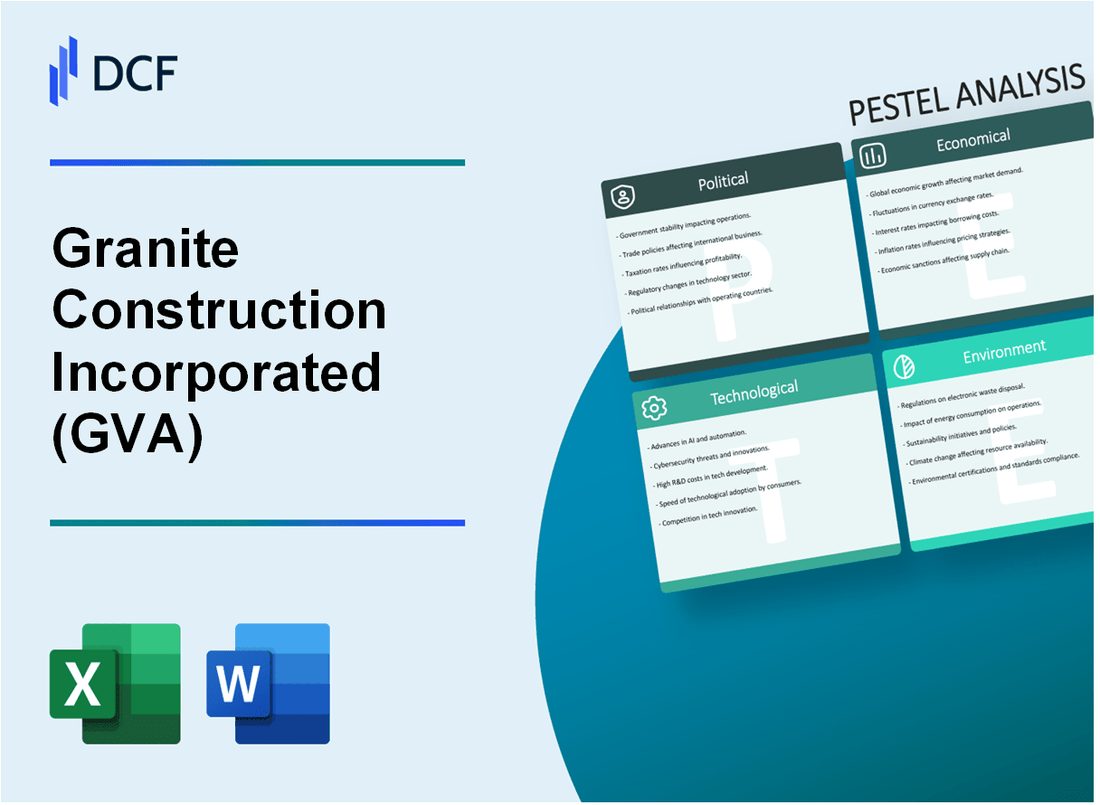
Granite Construction Incorporated (GVA): PESTLE Analysis [Nov-2025 Updated] |
Fully Editable: Tailor To Your Needs In Excel Or Sheets
Professional Design: Trusted, Industry-Standard Templates
Investor-Approved Valuation Models
MAC/PC Compatible, Fully Unlocked
No Expertise Is Needed; Easy To Follow
Granite Construction Incorporated (GVA) Bundle
You're digging into Granite Construction Incorporated (GVA) right now, trying to see past the headlines to where the real money is made and where the next snag might be. Honestly, with their FY 2025 revenue guidance sitting between $4.35 billion and $4.45 billion and a solid push for an Adjusted EBITDA margin of 11.50% to 12.50%, the macro picture looks stable thanks to federal funding, but the ground-level fight against inflation and labor shortages is intense. I've broken down the Political, Economic, Sociological, Technological, Legal, and Environmental factors so you can map your next move against their reality; check out the specifics below.
Granite Construction Incorporated (GVA) - PESTLE Analysis: Political factors
IIJA funding provides a multi-year tailwind for the $6.1 billion project backlog.
The political commitment to infrastructure spending, primarily through the Infrastructure Investment and Jobs Act (IIJA), is the single largest tailwind for Granite Construction Incorporated. This federal funding is a multi-year revenue stabilizer, with CEO Kyle Larkin noting that IIJA spending remains below 50% of its expected disbursement as of the fiscal second quarter of 2025, suggesting a long runway for project opportunities. The company's Committed and Awarded Projects (CAP) backlog reached a record high of approximately $6.1 billion in the second quarter of 2025, up from $5.3 billion at the end of 2024. This robust backlog provides clear revenue visibility, supporting the company's revised 2025 revenue guidance of $4.35 billion to $4.55 billion.
Here's the quick math: with a backlog of $6.1 billion against a full-year revenue target of $4.35 billion to $4.55 billion, a significant portion of the next 12-18 months of work is already secured by public-sector contracts.
Public sector dominance offers revenue stability, insulating from private market dips.
Granite's business model is inherently insulated from the volatility of the private construction market because of its heavy reliance on public funding. Approximately 75% of the company's Construction segment revenue is derived from public dollars, primarily from federal and state transportation agencies. This high percentage of public work provides a stable, counter-cyclical revenue stream, which is defintely a key advantage when private commercial or residential construction slows down. State transportation budgets, which are heavily supported by IIJA funds, are near record levels across Granite's operating footprint, further solidifying this stability.
The stability of this public funding is a core component of the investment thesis:
- 75% of Construction revenue is publicly funded.
- Public-sector projects account for roughly $2.5 billion of the CAP backlog.
- State transportation budgets are at near-record highs, supported by IIJA.
CEO notes no significant project delays from the change in federal administration.
Despite the change in the federal administration and reports of some project disruptions in the broader industry, Granite's leadership has maintained a confident outlook. CEO Kyle Larkin stated in May 2025 that the company has 'not experienced any delays' on federally funded work due to the change in administration. This suggests that the core, formula-based funding mechanisms of the IIJA are largely insulated from immediate political shifts, even as the new administration oversees the disbursement of remaining competitive grants.
Still, the political environment introduces new risks that require careful management:
- Tariffs: The CEO noted that tariffs were a source of uncertainty and could lead to cost increases for equipment and parts in the coming months.
- Regulatory Changes: The new administration's focus on deregulation may streamline some federal environmental review processes, potentially reducing compliance costs, but state-level policies may remain stricter, creating multi-state compliance challenges.
Potential for a follow-on infrastructure law is a long-term opportunity.
The political will for continued infrastructure investment extends beyond the 2026 sunset of the IIJA. The CEO has expressed confidence that the current level of funding will continue 'well beyond the IIJA,' with a belief that there is 'tremendous support' in Washington to maintain and improve the nation's infrastructure. Congressional discussions are already underway in 2025 to write the next surface transportation and infrastructure law, which would follow the IIJA. This potential follow-on legislation represents a significant long-term opportunity, ensuring a healthy bidding environment for Granite through 2030 and possibly beyond.
The political landscape is setting up a decade-long cycle of public spending:
| Political Factor | Near-Term Impact (2025) | Long-Term Opportunity (2026+) |
|---|---|---|
| IIJA Funding Status | Below 50% of funds disbursed, securing near-term CAP. | Remaining funds to be spent well after 2026 sunset. |
| Federal Administration Change | No significant project delays reported by CEO. | Potential for a narrower focus on traditional projects (highways/bridges) in future laws. |
| Follow-on Legislation | Congress is actively working on the next surface transportation law. | Sustained public market through 2030 and beyond, ensuring a robust bid pipeline. |
Granite Construction Incorporated (GVA) - PESTLE Analysis: Economic factors
The economic picture for Granite Construction Incorporated (GVA) in late 2025 is one of cautious revenue recalibration paired with strong underlying profitability, largely thanks to its Materials segment execution.
Revenue Guidance Narrows Despite Strong Backlog
You've seen the headlines: Granite Construction narrowed its full-year 2025 revenue guidance to a range of $4.35 billion to $4.45 billion. Honestly, this isn't a sign of weakness, but rather a reflection of project timing shifts that management expects to resolve in a busy fourth quarter and into 2026. What this estimate hides is the sheer volume of work already secured; the Committed and Awarded Projects (CAP) metric hit a record $6.3 billion, which gives us excellent visibility. This backlog suggests the underlying demand for infrastructure and civil work remains robust, even if the final 2025 revenue tally shifts slightly.
Profitability Metrics Are Outperforming Expectations
The real story here is margin expansion, which is defintely a positive signal. Management raised the full-year Adjusted Earnings Before Interest, Taxes, Depreciation, and Amortization (EBITDA) margin guidance to between 11.50% and 12.50% for 2025, up from the prior 11.25% to 12.25% range. This move shows confidence in their ability to manage costs and execute high-margin work. The vertically integrated Materials segment is the engine driving this; through the first nine months of 2025, this segment delivered a cash gross profit margin of 29%. That's a massive improvement from 18% just in fiscal year 2022, showing their strategy to own the supply chain is paying off handsomely.
Materials Segment Strength and Cost Management
The Materials segment's success is rooted in both volume and pricing power for aggregates and asphalt products. For Q3 2025 alone, the segment's gross profit margin expanded significantly to 25.2%. This operational leverage is crucial because, to be fair, persistent inflation and supply chain friction continue to put pressure on both material inputs and skilled labor costs across the entire construction industry. Granite's ability to push pricing and capture higher margins in its own materials business helps offset these external economic headwinds better than competitors who rely solely on third-party suppliers.
Key 2025 Economic & Operational Benchmarks
Here's the quick math on where Granite stands against its updated outlook:
| Metric | Previous FY 2025 Guidance | Updated FY 2025 Guidance | Q3 YTD 2025 Performance Highlight |
| Revenue | $4.35B to $4.55B | $4.35B to $4.45B | Q3 Revenue: $1.43B |
| Adjusted EBITDA Margin | 11.25% to 12.25% | 11.50% to 12.50% | Q3 Adjusted EBITDA Margin: 15.0% |
| Materials Cash GP Margin | N/A | N/A | 29% (9 Months YTD) |
If onboarding new project teams takes longer than expected in Q4, the high end of that revenue guidance might slip, which could compress the final margin number. What this estimate hides is the exact impact of any new, large-scale public works funding that might accelerate project starts beyond current projections.
Finance: draft 13-week cash view by Friday
Granite Construction Incorporated (GVA) - PESTLE Analysis: Social factors
You're looking at how people and societal trends are shaping the playing field for Granite Construction Incorporated (GVA) right now, in 2025. The biggest social headwind remains the persistent difficulty in finding enough skilled hands to do the work.
Industry-wide labor shortages remain a key constraint on project execution
Honestly, the labor crunch isn't going away; it's just shifting. For 2025, the entire U.S. construction industry is projected to need approximately 439,000 net new workers just to keep up with anticipated demand, though this gap is slightly smaller than in previous years. This shortage constrains how fast Granite Construction can execute its backlog, especially with major infrastructure spending continuing under the Infrastructure Investment and Jobs Act (IIJA).
What this estimate hides is the localized intensity. While overall construction spending growth is slowing to under 3% in 2025 due to higher rates weighing on some sectors, massive regional projects-think new semiconductor plants and data centers-are sucking up available skilled labor nearby. If Granite Construction is bidding on a project near one of these megaprojects, staffing up becomes a real headache, no matter how good their pay is.
Here's the quick math on the labor pool:
- Estimated net new workers needed in 2025: 439,000.
- Total construction payroll workers in the U.S. (as of late 2024): 8.3 million.
- Median construction worker age: Under 42 (first time since 2011).
Focus on safety is a defintely competitive edge, with a 2024 incident rate below the industry average
Safety is where Granite Construction can really shine, and it's not just about compliance; it's about winning work. A strong safety record becomes a tangible competitive advantage when owners are choosing partners for complex, high-value projects, especially those using Best Value Procurement, which made up about 42% of GVA's committed and awarded projects (CAP) at one point.
The numbers back up their focus. While the general construction industry's Total Recordable Incident Rate (TRIR) was reported at 2.3 in 2023, Granite Construction has historically maintained a much lower rate, cited at 1.2. That difference is huge in terms of risk management and operational continuity. To be fair, safety performance is always a moving target, but their commitment is recognized; they won the 2024 R.E.A.L. Safety Award for over 1,000,000 man-hours.
Compare their performance against industry benchmarks:
| Metric | Granite Construction (Reported Rate) | Construction Industry Average (Approximate/2023) |
| Incident Rate (General) | 1.2 | 3 to 4 |
| TRIR (Total Recordable Incident Rate) | Below 2.3 (Implied) | 2.3 (2023 BLS Data) |
Strategic shift to 'home markets' strengthens local relationships and human capital sourcing
You've seen the internal pivot: Granite Construction has fully implemented its strategy to focus exclusively on its defined 'home markets'. This isn't just a geographic preference; it's a strategy deeply tied to social capital. In these home markets, GVA claims to have strong, established relationships with local owners and regulators, which helps smooth project delivery.
Crucially, this focus helps with the labor issue we just discussed. By concentrating resources, GVA believes its reputation as a reliable, safety-focused employer makes it the employer of choice in those specific regions. They are backing this up with capital expenditures and bolt-on acquisitions to vertically integrate, ensuring reliable local supply chains, which also helps attract and retain local talent. If onboarding takes 14+ days, churn risk rises, so local familiarity matters a lot.
Finance: draft 13-week cash view by Friday.
Granite Construction Incorporated (GVA) - PESTLE Analysis: Technological factors
You're looking at how GVA is using new tools to get better project outcomes, and honestly, the tech investment is where the rubber meets the road in modern infrastructure. My take, based on what I see coming out of their 2025 reports, is that they are actively trying to digitize the job site to drive margins up, even if the shift in project mix takes time.
Investing in New Equipment and Plant Upgrades
Granite Construction Incorporated is putting serious capital to work to modernize its fleet and materials production. For the 2025 fiscal year, the company has outlined a capital expenditure (CapEx) plan that includes investing approximately $130 million specifically for new equipment and plant upgrades. This isn't just maintenance; this is about deploying newer, more efficient machinery that can handle higher throughput or reduce fuel consumption per ton of material moved. To be fair, some guidance suggested CapEx could be between $140 million and $160 million for 2025, but the $130 million figure is the target for core equipment and plant improvements. This investment directly supports the Materials segment's focus on automation and reserve expansion, which they see as key to long-term growth. Here's the quick math: If this spend translates to even a 1% improvement in construction gross profit margin, as management has targeted for 2025, that's a meaningful boost to the bottom line on their expected revenue base.
Increasing Adoption of Building Information Modeling (BIM) and Drone Surveying
The push for precision on site is real, and it hinges on digital tools. Granite Construction Incorporated has established a Construction Technology Center of Excellence strategy to learn and deploy the best technologies. This means moving beyond paper plans to integrated digital workflows. They are actively using tools like drones for rapid surveying and site monitoring, which drastically cuts down on time and risk compared to manual methods. The real power comes when this aerial data integrates with Building Information Modeling (BIM) platforms. BIM is essentially a smart 3D model that contains all the project data, helping teams catch clashes before they happen in the dirt. What this estimate hides is the internal training cost required to get every field team proficient with these systems, but the ROI, often seen within a year in the industry, makes it a necessary expense.
The technological deployment focuses on several key areas:
- Deploying drones for high-resolution mapping.
- Integrating drone data with BIM software.
- Using GPS systems like Trimble's EarthWorks for machine guidance.
- Leveraging real-time data for quality checks.
Prioritizing Collaborative Project Delivery Over Traditional Low-Bid Methods
You noted the focus on collaborative delivery, and that's a strategic pivot away from the old way of doing things. Traditional low-bid (or Bid-Build) contracts put all the risk on the contractor once the design is set. Granite is actively favoring methods where they partner earlier, like Construction Manager/General Contractor (CM/GC) or Design-Build. For instance, their selection for the I-290 Drainage Improvement Project in Illinois is under IDOT's first CM/GC contract, which emphasizes early contractor involvement. Still, the numbers show the journey isn't over. Looking at their Committed and Awarded Projects (CAP) mix as of Q1 2025, the traditional Bid-Build method still accounted for 54% of the CAP value, while Best Value Procurement-which includes Design-Build and other collaborative models-made up 40%. The goal is clearly to grow that 40% share, as these methods help mitigate dispute risks that plagued them on older, fixed-price Design-Build megaprojects. This shift is about securing better risk-sharing agreements from the start.
Here is a look at the project delivery mix based on Q1 2025 CAP value:
| Procurement Method | CAP Value Percentage | Approximate Value (Based on $5.7B CAP) |
| Bid-Build Procurement | 54% | $3.078 Billion |
| Best Value Procurement | 40% | $2.28 Billion |
| Design-Build (Specific Mention) | 4% | $0.228 Billion |
| Other Categories | 2% | $0.114 Billion |
Finance: draft 13-week cash view by Friday.
Granite Construction Incorporated (GVA) - PESTLE Analysis: Legal factors
You're navigating a business where the government is a primary client, which means the legal and regulatory landscape isn't just background noise; it's a core operational cost. For Granite Construction Incorporated, this reliance on public works contracts-from federal highways to state bridges-creates a defintely heavy compliance burden. You have to manage everything from Federal Acquisition Regulations (FAR) to specific state environmental mandates. Honestly, this isn't new, but the scrutiny remains high.
Heavy regulatory compliance burden due to reliance on federal and state public works contracts
Because a significant portion of Granite Construction Incorporated's work involves federal and state agencies, adherence to rules like FAR is non-negotiable. This covers everything from labor standards to ethical conduct when bidding. While the company has internal structures, like the Audit/Compliance Committee, to oversee this, past issues show the risk is real. For instance, reports indicate a history of environmental violations, with the total sum of fines connected to at least 40 such violations since 1992 exceeding $1.4 million. Furthermore, Granite Construction Incorporated settled with the SEC in 2022 for $12 million related to financial reporting fraud.
The legal team needs to keep a tight leash on field operations, as even small errors can escalate. Here are the key compliance areas that demand constant attention:
- Adherence to Federal Acquisition Regulations (FAR).
- Strict compliance with OSHA and labor laws.
- Managing environmental permits and discharge rules.
- Ensuring accurate cost charging on government work.
State-level transportation funding, like California's SB-1, provides dedicated, stable revenue streams
The good news is that the legal framework supporting infrastructure spending often creates predictable revenue for Granite Construction Incorporated. Take California's Senate Bill 1 (SB-1), for example. This legislation is designed to provide dedicated, long-term funding for transportation projects, which directly feeds your backlog. While the full 2025 allocation isn't isolated here, the projected 10-year revenue stream shows the scale of this dedicated funding, with annual figures ranging from $1,432 million up to $7,263 million across the projection period. This stability helps you plan capital expenditures, like the anticipated $140 million to $160 million in 2025 CapEx.
Collaborative contracting methods are used to mitigate project risk and reduce claims/disputes
To fight back against the inherent risk of large, complex projects, Granite Construction Incorporated is leaning into smarter contracting. They actively partner with owners during the design phase to minimize construction risks, which helps keep disputes and claims low. This strategy seems to be working; in the second quarter of 2025, gross profit was boosted by favorable claim settlements. Using these collaborative methods, often called 'best value' contracting alongside traditional bid-build, is a direct legal risk management tool, aiming to deliver projects on time and budget, which is what owners-and the law-really want to see.
Here's a quick look at Granite Construction Incorporated's recent financial scale against this legal backdrop:
| Metric (As of Latest 2025 Data) | Value | Context |
|---|---|---|
| 2024 Total Revenue | $4,007.6 million | Full Year 2024 Performance |
| Q2 2025 Net Income | $72 million | Quarterly Profitability |
| Record Committed and Awarded Projects (CAP) | $6.1 billion | Backlog as of Q2 2025 |
| Historical Environmental Fines (Total since 1992) | Over $1.4 million | Represents compliance cost history |
If onboarding new project teams takes longer than 14 days, the risk of quality control lapses-and subsequent legal exposure-rises sharply.
Finance: draft 13-week cash view by Friday.
Granite Construction Incorporated (GVA) - PESTLE Analysis: Environmental factors
You're looking at how Granite Construction Incorporated (GVA) is managing the growing environmental pressures, which, frankly, are becoming non-negotiable, especially when chasing big public works contracts.
Here's the takeaway: Granite is actively positioning its environmental stewardship as a key differentiator, not just a compliance chore. This focus on sustainability is now central to their strategy, which they call 'Sustainability Value Add,' because clients, particularly government agencies, are demanding it before they even look at the price tag. Granite's continued No. 1 ranking in Highways on Engineering News-Record's (ENR) 2025 Top Contractors List shows this strategy is resonating with the market leaders.
Sustainability as a Competitive Edge in Public Bidding
Sustainability is no longer optional; it's a core competitive advantage for winning public sector bids. Globally, public procurement spending is responsible for an estimated 15% of all greenhouse gas (GHG) emissions, meaning governments are using their purchasing power to drive decarbonization in sectors like construction.
For Granite Construction Incorporated, this means integrating environmental performance directly into their business development. The company's 2024 Sustainability Report, released in April 2025, emphasizes this focus on creating value through environmental stewardship.
Key areas where this translates into a competitive edge include:
- Meeting Green Public Procurement (GPP) criteria.
- Demonstrating lower embodied carbon in materials.
- Showing clear progress on internal emission reduction goals.
Commitment to Recycled Material Usage
Your initial thought about a 30% recycled material target is a good benchmark, but Granite's actual reported performance in their 2024 Sustainability Report shows a more measured, yet improving, commitment in their asphaltic concrete (AC) production. This is a concrete metric that public sector clients scrutinize.
Here is the recent trend for recycled input materials in AC production:
| Metric | 2022 Data | 2023 Data | 2024 Data |
|---|---|---|---|
| Recycled Content Input in Total AC Production | 19.05% | 18.21% | 19.07% |
What this estimate hides is that while the percentage is below 30%, the absolute tonnage of recycled material used is likely increasing as overall production volumes change. Still, the 19.07% figure for 2024 is the number you need to use for current discussions.
GHG Emissions Tracking and Decarbonization Efforts
Granite Construction Incorporated is actively working to reduce its GHG emissions, understanding that the industry must adapt to climate change impacts. They established a 2023 baseline to track progress, which is standard practice for aligning with frameworks like the Global Reporting Initiative (GRI).
We can see the starting point for one key area-employee business travel-which registered estimated CO2 emissions of 22,041 Metric Tons in 2023. The company is focused on building a foundation for more effective decarbonization efforts in operations. Furthermore, Granite committed $28 million companywide in 2024 to improve energy efficiency specifically at their materials facilities. That's a tangible investment in reducing their operational footprint.
Increased Scrutiny on Environmental Impact
The pressure on construction firms regarding their environmental footprint is definitely increasing from both the public and private sectors. This scrutiny is forcing companies like Granite to be more transparent, as evidenced by their detailed 2024 Sustainability Report.
This external pressure manifests in several ways:
- Client requirements for lower-carbon bids.
- Regulatory shifts favoring sustainable materials.
- Higher expectations for corporate accountability.
To be fair, this scrutiny is a double-edged sword: it raises compliance costs but also rewards leaders like Granite who are already investing in cleaner practices. If onboarding takes 14+ days longer due to new environmental review processes, project timelines get stretched.
Finance: draft 2025 capital expenditure breakdown showing the $28 million energy efficiency investment by Friday.
Disclaimer
All information, articles, and product details provided on this website are for general informational and educational purposes only. We do not claim any ownership over, nor do we intend to infringe upon, any trademarks, copyrights, logos, brand names, or other intellectual property mentioned or depicted on this site. Such intellectual property remains the property of its respective owners, and any references here are made solely for identification or informational purposes, without implying any affiliation, endorsement, or partnership.
We make no representations or warranties, express or implied, regarding the accuracy, completeness, or suitability of any content or products presented. Nothing on this website should be construed as legal, tax, investment, financial, medical, or other professional advice. In addition, no part of this site—including articles or product references—constitutes a solicitation, recommendation, endorsement, advertisement, or offer to buy or sell any securities, franchises, or other financial instruments, particularly in jurisdictions where such activity would be unlawful.
All content is of a general nature and may not address the specific circumstances of any individual or entity. It is not a substitute for professional advice or services. Any actions you take based on the information provided here are strictly at your own risk. You accept full responsibility for any decisions or outcomes arising from your use of this website and agree to release us from any liability in connection with your use of, or reliance upon, the content or products found herein.