

|
W.W. Grainger, Inc. (GWW): 5 FORCES Analysis [Nov-2025 Updated] |
Fully Editable: Tailor To Your Needs In Excel Or Sheets
Professional Design: Trusted, Industry-Standard Templates
Investor-Approved Valuation Models
MAC/PC Compatible, Fully Unlocked
No Expertise Is Needed; Easy To Follow
W.W. Grainger, Inc. (GWW) Bundle
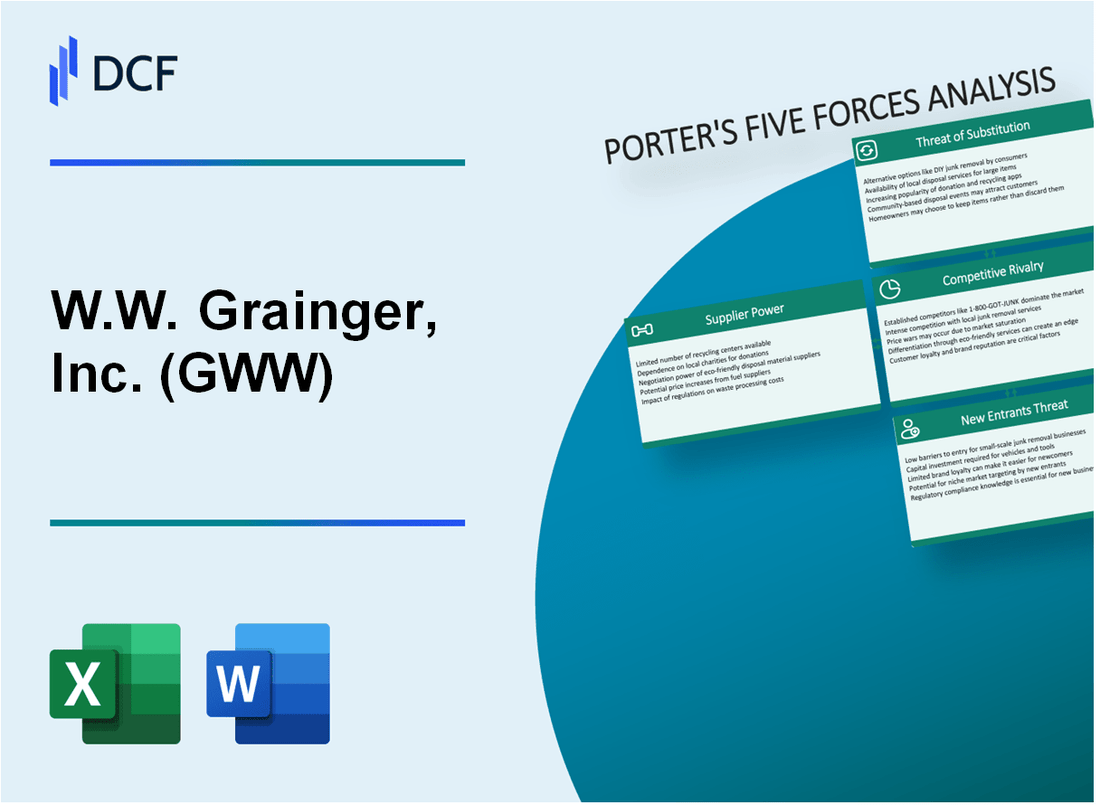
You're assessing a giant like W.W. Grainger, Inc. (GWW) as it heads toward a projected $17.8 billion to $18.0 billion revenue range for 2025, but you know that top-line number doesn't tell the whole story when digital disruption is squeezing margins down to that 38.6%-38.9% gross range. While the company's scale-sourcing from 4,500 suppliers and serving over 4.5 million customers-gives it serious staying power, the real question is how sustainable that leading 7% U.S. MRO market share is against rivals like Fastenal and the ever-present threat of Amazon Business. To get a clear, actionable view of the strategic risks and advantages right now, you need to see the full picture, so I've mapped out the five critical forces shaping W.W. Grainger, Inc.'s competitive environment below.
W.W. Grainger, Inc. (GWW) - Porter's Five Forces: Bargaining power of suppliers
When you look at W.W. Grainger, Inc.'s ability to manage its supply base, you see a deliberate strategy to keep supplier power in check. Honestly, for a distributor this large, supplier leverage is always a key risk, but W.W. Grainger, Inc. has built structural advantages to mitigate it.
Sourcing from a vast network definitely helps diffuse risk. As of the latest full-year data context, W.W. Grainger, Inc. works with more than 5,000 primary suppliers globally, which provides significant diversification against any single source failing or demanding unfavorable terms. This scale means you aren't overly reliant on just a few players for your core product mix. Also, W.W. Grainger, Inc. serves over 4.5 million customers worldwide, and that volume gives it serious clout when negotiating costs.
To be fair, the relationship isn't just transactional; W.W. Grainger, Inc. cultivates long-term strategic partnerships with key manufacturers. These deep ties help secure favorable allocation and pricing, especially when supply chains get tight. Still, even with these relationships, the external environment in 2025 put clear pressure on margins, showing that suppliers still hold some sway over input costs.
The impact of external cost pressures, particularly tariffs and inventory valuation methods, was clearly visible in the 2025 financial results. W.W. Grainger, Inc. lowered its full-year 2025 gross margin outlook to a range between 38.6% and 38.9% due to these factors. This contrasts with the Q2 2025 reported gross margin of 38.5% and the Q1 2025 margin of 39.7%. The LIFO (Last-In, First-Out) accounting method, in particular, created a headwind, which in Q2 2025 alone impacted operating margins by 50 basis points.
Here's a quick look at how those key margin metrics stacked up during the year, showing the supplier-driven cost pass-through dynamics:
| Period | Reported Gross Margin | Reported Operating Margin | Key Headwind Mentioned |
|---|---|---|---|
| Q1 2025 | 39.7% | 15.6% | N/A (Favorable mix/funding noted) |
| Q2 2025 | 38.5% | 14.9% | Tariff-related inflation & LIFO |
| FY 2025 Guidance (Narrowed) | 38.6%-38.9% | 14.7%-15.1% (Adjusted) | Tariff timing and LIFO valuation |
W.W. Grainger, Inc.'s high-volume buying power is a major counter-force. With quarterly sales hovering around $4.6 billion to $4.7 billion in mid-2025, the sheer scale of procurement allows the company to demand economies of scale that smaller distributors simply can't access. This volume helps W.W. Grainger, Inc. absorb some cost volatility, though the 2025 margin compression shows that supplier pricing power, especially when amplified by global trade issues, can still squeeze profitability.
The bargaining power of suppliers is managed through a few levers W.W. Grainger, Inc. actively pulls:
- Diversification across more than 5,000 primary suppliers.
- Leveraging massive annual sales volume, such as $4.6 billion in Q2 2025 revenue.
- Strategic partnerships to secure product allocation.
- Implementing pricing actions, like the September 2025 cycle, to pass through 2% to 2.5% incremental run-rate costs in the High-Touch segment.
Finance: draft a sensitivity analysis on the impact of a 100-basis point increase in COGS on the remaining 2025 gross margin guidance by next Tuesday.
W.W. Grainger, Inc. (GWW) - Porter's Five Forces: Bargaining power of customers
The bargaining power of customers for W.W. Grainger, Inc. is generally considered moderate, largely due to the company's massive, diversified customer base which dilutes the leverage of any single buyer. W.W. Grainger, Inc. serves more than 4.5 million active customers worldwide, a scale that significantly limits the power of any one account to dictate terms. As a characteristic of this broad base, no single customer accounted for over 2% of total revenue in the most recent full fiscal year data available, which was $17.2 billion in 2024 revenue.
W.W. Grainger, Inc. strategically manages this power dynamic through its dual business model, which is designed to address distinct customer needs and, consequently, different levels of price sensitivity across its customer base. The two primary models are High-Touch Solutions N.A. and Endless Assortment. For instance, in the third quarter of 2025, the High-Touch Solutions North America segment represented approximately 78% of total sales, while the Endless Assortment segment accounted for the remainder of the core business.
Large High-Touch customers, which form the core of the revenue base, exert their power not primarily through price shopping for commodity items, but through demands for integrated service offerings. These customers require significant value-added services that go beyond simple product delivery. This is reflected in the segment's focus on deep relationships and specialized support, even as the company manages cost pressures, such as implementing tariff-related pricing actions expected to drive 2% to 2.5% incremental run-rate pricing in this segment.
The demands from these larger, relationship-driven customers often center on:
- Value-added services integration.
- Technical support expertise.
- Inventory management solutions.
- Reliable, on-time delivery performance.
Conversely, the Endless Assortment segment, which includes Zoro.com and MonotaRO.com, faces a different kind of customer pressure. This segment is inherently more exposed to high price transparency because its value proposition is centered on a streamlined, easy-to-use online relationship with access to a vast product catalog. The strong growth in this area-sales increased 18.2% in Q3 2025-suggests W.W. Grainger, Inc. is effectively competing, but the underlying customer base in this channel is highly sensitive to competitor pricing, which is readily available online.
Here is a quick look at the scale and performance difference between the two primary models as of the third quarter of 2025, which helps illustrate the dual approach to customer management:
| Metric | High-Touch Solutions N.A. | Endless Assortment |
| Q3 2025 Sales (Reported) | $3.6 billion | $935 million |
| Q3 2025 Sales Growth (Reported YoY) | 3.4% | 18.2% |
| Q3 2025 Operating Margin | 17.2% | 9.8% |
| Primary Value Proposition | Value-added MRO solutions, technical support | Streamlined, transparent online purchasing |
The overall revenue scale W.W. Grainger, Inc. is targeting for the full year 2025, between $17.8 billion and $18.0 billion, confirms that the company's ability to manage the diverse price expectations across its customer base-from the service-heavy High-Touch client to the price-conscious online user-is central to mitigating buyer power. If onboarding for large accounts takes longer than expected, churn risk rises, even if the overall customer count remains high.
W.W. Grainger, Inc. (GWW) - Porter's Five Forces: Competitive rivalry
You're looking at W.W. Grainger, Inc.'s competitive standing in late 2025, and the rivalry force is definitely intense. The Maintenance, Repair, and Operations (MRO) space is fragmented, but W.W. Grainger, Inc. still holds a leading position, claiming an estimated 7% share of the North American B2B supply market as of its 2025 guidance discussions. Still, that leadership is constantly tested by established, broad-line rivals.
Competition from peers like Fastenal Company and MSC Industrial Supply Co. is fierce, especially as they push their own digital and on-site solutions. For instance, Fastenal Company reported third-quarter 2025 net sales of $2.13 billion, with an operating profit of $441.5 million and an operating margin of 20.7% for that quarter. MSC Industrial Supply Co., on the other hand, reported a revenue decrease of 0.84% year-over-year for its quarter ending May 31, 2025. It's a constant battle for share and margin control. Here's a quick look at how these key rivals stack up on recent reported metrics:
| Metric | W.W. Grainger, Inc. (GWW) | Fastenal Company (FAST) | MSC Industrial Supply Co. (MSM) |
|---|---|---|---|
| Latest Reported Operating Margin | 15.2% (Q3 2025) | 20.7% (Q3 2025) | Not explicitly reported for latest quarter |
| Latest Reported Revenue | $4.7 billion (Q3 2025) | $2.13 billion (Q3 2025) | Revenue down 0.84% YoY (Q ending May 31, 2025) |
| Latest Reported Gross Margin | 38.6% (Q3 2025) | 45.3% (Q3 2025) | Not explicitly reported for latest quarter |
The digital MRO space is where the rivalry with Amazon Business is really escalating. You see W.W. Grainger, Inc. actively adjusting its pricing models to counter the pressure from e-commerce giants. This competition forces W.W. Grainger, Inc. to lean heavily on its value-added services and digital transformation to maintain customer stickiness, even as it faces margin headwinds from tariffs and inventory accounting.
However, the company's ability to command pricing power is still evident in its financial outlook. Management's full-year 2025 guidance for the operating margin is set in a range of 14.7% to 15.1%. This target, which follows a reported operating margin of 14.9% in Q2 2025 and 15.2% in Q3 2025, suggests W.W. Grainger, Inc. believes it can manage cost pass-throughs and maintain profitability despite the competitive environment and macroeconomic factors like tariffs. The focus remains on execution across its segments:
- High-Touch Solutions segment sales grew 3.4% in Q3 2025.
- Endless Assortment segment sales rose 18.2% on a reported basis in Q3 2025.
- Zoro U.S. saw 17.8% growth in Q3 2025.
- MonotaRO achieved 12.6% growth in local days, local constant currency in Q3 2025.
Finance: draft the Q4 2025 margin forecast sensitivity analysis by next Tuesday.
W.W. Grainger, Inc. (GWW) - Porter's Five Forces: Threat of substitutes
Amazon Business surpassed $35 billion in gross merchandise sales by 2022 and is building out its AB Restock inventory replenishment offering, including internet-connected vending machines. Competitors like W.W. Grainger, Inc. have digital transactions making up more than half of their total sales.
The industrial e-commerce market is projected to grow to $130 billion by 2025.
Customers have the option to develop in-house Maintenance, Repair, and Operations (MRO) capabilities, bypassing traditional distributors. Simple MRO products face greater substitution risk and price sensitivity, which is reflected in margin performance.
Here are some relevant figures from the late 2025 environment:
| Metric | Value (Late 2025 Data Point) |
|---|---|
| W.W. Grainger, Inc. 2025 Revenue Guidance (High End) | $18.0 billion |
| W.W. Grainger, Inc. Q3 2025 Sales | $4.657 billion |
| W.W. Grainger, Inc. Endless Assortment Segment Q2 2025 Growth (YoY) | 19.7% |
| Amazon Business Gross Merchandise Sales (by 2022) | $35 billion |
| W.W. Grainger, Inc. Gross Profit Margin (Q3 2025) | 38.6% |
The pressure from substitutes is evident when you look at the growth dynamics across W.W. Grainger, Inc.'s segments. The Endless Assortment segment, which includes Zoro, is showing significant digital momentum.
- Endless Assortment segment sales growth in Q2 2025 was 19.7%.
- High-Touch Solutions N.A. segment growth in Q2 2025 was 2.5%.
- W.W. Grainger, Inc.'s adjusted diluted Earnings Per Share (EPS) for Q2 2025 was $9.97.
- W.W. Grainger, Inc. capital expenditures for 2025 are expected between $450 million and $550 million.
- W.W. Grainger, Inc. share repurchases for 2025 are projected between $1,150 million and $1,250 million.
The company's revised full-year 2025 diluted EPS guidance is $38.50-$40.25. This reflects management addressing macroeconomic risks like tariffs and cost inflation.
W.W. Grainger, Inc. (GWW) - Porter's Five Forces: Threat of new entrants
When you look at the barriers to entry in the industrial supply distribution space, W.W. Grainger, Inc.'s position is formidable. New entrants don't just need a website; they need massive infrastructure and deep pockets to even attempt to compete on a national scale. This is definitely a sector where scale matters more than almost anything else.
High capital expenditure is a key barrier; $625 million to $675 million CapEx planned for FY2025.
The sheer investment required to build out the necessary operational footprint immediately screens out most potential competitors. For fiscal year 2025, W.W. Grainger, Inc. has planned capital expenditures (CapEx) in the range of $625 million to $675 million. This level of ongoing investment in property, plant, and equipment-largely focused on supply chain modernization-is a hurdle that only well-capitalized entities can clear without taking on unsustainable leverage. You can see this spending is not just maintenance; it's strategic expansion.
Extensive physical distribution network is costly to replicate (3.5 million square feet added).
The physical network is the backbone of next-day delivery promises, which customers now expect as standard. W.W. Grainger, Inc. is actively increasing this barrier by adding approximately 3.5 million square feet to its network space. This expansion, which represents a more than 35 percent increase in overall warehouse space from the start of 2023, is designed to enhance network operations and support next-day delivery capabilities. Replicating this density of high-throughput, strategically located facilities, complete with the necessary automation, represents a multi-billion dollar, multi-year undertaking for any new player.
To give you a sense of the scale W.W. Grainger, Inc. operates at, which new entrants must contend with, look at these figures:
| Metric | Value/Period | Source Context |
|---|---|---|
| FY2025 Planned CapEx Range | $625 million to $675 million | FY2025 Guidance |
| Distribution Space Added | 3.5 million square feet | Recent network expansion |
| 2024 Revenue | $17.2 billion | Full Year 2024 Result |
| Total Customers Served (Worldwide) | More than 4.5 million | Company description |
New entrants cannot match Grainger's economies of scale from vast purchasing volume.
The company's massive revenue base-reaching $17.2 billion in 2024-translates directly into superior purchasing power. When you buy millions of units across millions of SKUs, your per-unit cost is inherently lower than a startup buying in smaller batches. This volume advantage allows W.W. Grainger, Inc. to negotiate better terms with suppliers, which is critical for margin defense, especially when facing external cost pressures like tariffs. A new entrant would have to achieve similar sales velocity just to get to the negotiating table on equal footing, which is a classic chicken-and-egg problem in this industry.
Established customer relationships and technical expertise create high switching costs.
For the industrial customer, MRO (maintenance, repair, and operating) procurement is about minimizing downtime, not just price shopping. Industrial procurement professionals highly value long-term, dependable supplier relationships. W.W. Grainger, Inc. has cultivated relationships with over 4.5 million customers worldwide, built on reliability in product quality and supplier performance. Furthermore, the access to technical support and integrated inventory management services acts as a sticky layer. Even when W.W. Grainger, Inc. implements pricing adjustments, management notes they are having 'very good conversations with our customers,' suggesting the value proposition beyond price is well-understood and accepted. If onboarding a new supplier means risking operational continuity or losing access to specialized support, the perceived cost of switching is extremely high.
The threat from new entrants remains low due to these structural barriers.
Finance: draft 13-week cash view by Friday.
Disclaimer
All information, articles, and product details provided on this website are for general informational and educational purposes only. We do not claim any ownership over, nor do we intend to infringe upon, any trademarks, copyrights, logos, brand names, or other intellectual property mentioned or depicted on this site. Such intellectual property remains the property of its respective owners, and any references here are made solely for identification or informational purposes, without implying any affiliation, endorsement, or partnership.
We make no representations or warranties, express or implied, regarding the accuracy, completeness, or suitability of any content or products presented. Nothing on this website should be construed as legal, tax, investment, financial, medical, or other professional advice. In addition, no part of this site—including articles or product references—constitutes a solicitation, recommendation, endorsement, advertisement, or offer to buy or sell any securities, franchises, or other financial instruments, particularly in jurisdictions where such activity would be unlawful.
All content is of a general nature and may not address the specific circumstances of any individual or entity. It is not a substitute for professional advice or services. Any actions you take based on the information provided here are strictly at your own risk. You accept full responsibility for any decisions or outcomes arising from your use of this website and agree to release us from any liability in connection with your use of, or reliance upon, the content or products found herein.