
|
Hilton Grand Vacations Inc. (HGV): ANSOFF MATRIX [Dec-2025 Updated] |
Fully Editable: Tailor To Your Needs In Excel Or Sheets
Professional Design: Trusted, Industry-Standard Templates
Investor-Approved Valuation Models
MAC/PC Compatible, Fully Unlocked
No Expertise Is Needed; Easy To Follow
Hilton Grand Vacations Inc. (HGV) Bundle
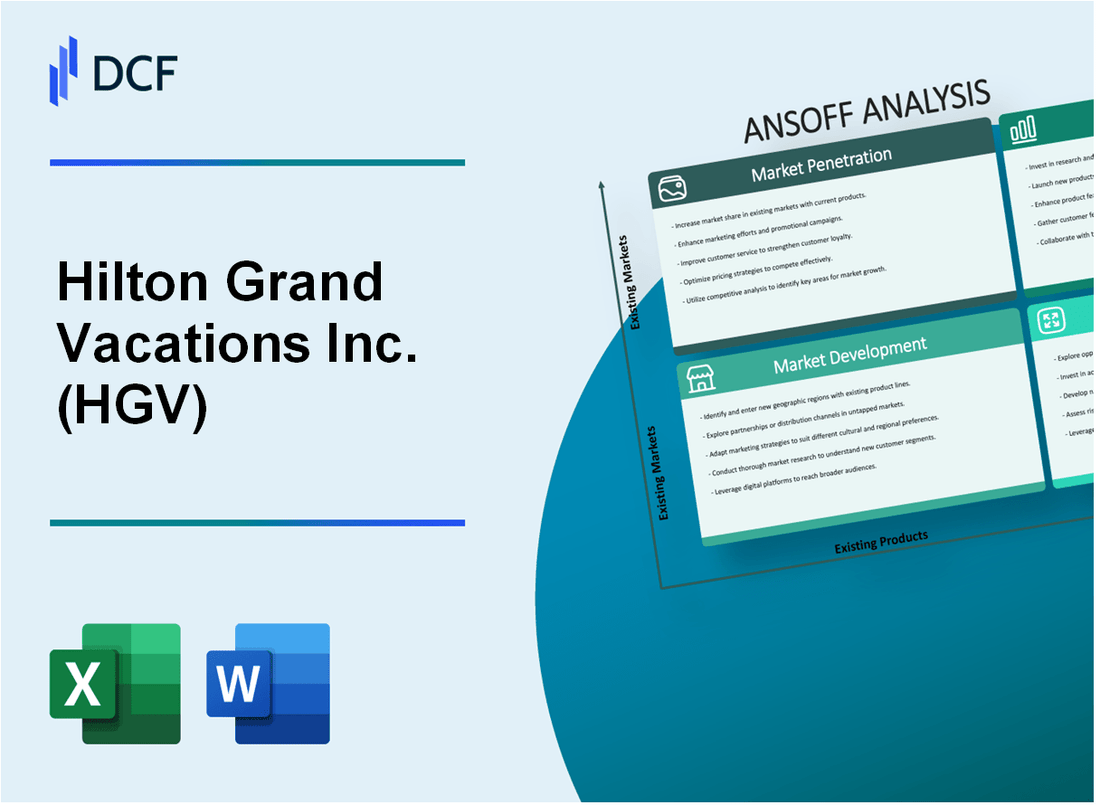
You're looking for a clear-eyed view of Hilton Grand Vacations Inc.'s growth path, and honestly, their 2025 playbook, mapped out across the Ansoff Matrix, shows they aren't leaving any stone unturned. We see them pushing hard on Market Penetration-aiming to boost Volume per Guest (VPG) beyond that 14.7% Q3 2025 rate and cross-sell to the 200,000 members from the Bluegreen integration. But the real story is the forward-looking moves: targeting the 45%+ millennial buyer segment in new markets, launching lower-cost vacation ownership intervals (VOIs), and even exploring non-timeshare ventures like luxury rental management. This isn't just maintenance; it's a comprehensive strategy to secure future revenue, so let's break down exactly where Hilton Grand Vacations Inc. is placing its bets for the next decade.
Hilton Grand Vacations Inc. (HGV) - Ansoff Matrix: Market Penetration
The focus here is on increasing sales within the existing customer base and market segments for Hilton Grand Vacations Inc. (HGV).
Volume per Guest (VPG) performance in the third quarter of 2025 showed a year-over-year increase of 14.7%. The actual VPG achieved was $3,900. Consolidated tour growth for the quarter was 1.9%, or 2%.
Driving higher conversion within the existing member base involves leveraging the engaged segment, which stood at nearly 722,000 members at the end of the quarter. The HGV Max program is a key driver for this penetration.
- HGV Max members surpassed 250,000.
- 70,000 members were added to HGV Max over the trailing 12 months.
- New buyer mix remained steady at 27% of contract sales in the quarter.
Marketing spend optimization is viewed against the reported financial outcomes. Net income attributable to stockholders for Q3 2025 was $25 million. There was approximately $7 million in additional marketing expense during Q3. Real estate sales and marketing expense represented 46% of contract sales for the period.
| Metric | Q3 2025 Value | Comparison to Q3 2024 |
| Reported Contract Sales | $907 million | Increase of 16.7% |
| Net Income Attributable to Stockholders | $25 million | Decrease from $29 million |
| Adjusted EBITDA Attributable to Stockholders | $245 million | Decrease from $303 million |
| Real Estate Sales & Marketing Expense | 46% of Contract Sales | Improvement of 300 basis points |
Cross-selling new points to members acquired via the Bluegreen integration is progressing, with integration milestones achieved.
- Run-rate cost synergies reached $94 million toward the $100 million target.
- Nearly 30,000 legacy Bluegreen members are now enrolled in the HGV Max program.
Attractive financing options are supported by recent capital market activity. Hilton Grand Vacations Inc. completed a $400 million securitization of timeshare loans in August 2025 through Hilton Grand Vacations Trust 2025-2. The financing business generated a profit margin of 59%, or 62% excluding amortization items.
| Note Class | Approximate Amount | Coupon Rate |
| Class A Notes | $210.4 million | 4.54% |
| Class B Notes | $125.0 million | 4.73% |
| Class C Notes | $64.6 million | 5.12% |
| Overall Weighted Average Coupon Rate | 4.69% | Overall Advance Rate: 96% |
Proceeds from the $400 million issuance, net of fees, will be used to pay down debt and for other general corporate purposes.
Hilton Grand Vacations Inc. (HGV) - Ansoff Matrix: Market Development
You're looking at how Hilton Grand Vacations Inc. (HGV) plans to grow by taking its existing vacation ownership products into new markets, which is the essence of Market Development. This strategy relies heavily on the successful integration of past moves and aggressive pursuit of new customer segments and locations.
The foundation for this expansion is partly built on the recent integration of Bluegreen Vacations Holding Corporation, which immediately expanded the footprint. The acquisition brought in assets across 14 new geographies. This immediately supports the goal of accelerating expansion into new areas.
The focus on new buyer demographics is critical, as the market is clearly shifting. For 2025, the data shows that millennials and younger Gen X consumers now account for over 45% of new timeshare purchases. Furthermore, the average age of a new timeshare buyer in 2025 has dropped to 39, indicating a successful pivot toward a younger customer base that values experience.
To drive tour flow, opening new sales centers in non-resort urban centers is a key action. While specific new center counts aren't public, the overall sales momentum is tracked. For the third quarter of 2025, Hilton Grand Vacations Inc. reported total contract sales of $907 million, which was an increase of 16.7% compared to the third quarter of 2024. This suggests that tour flow initiatives, whether in new or existing markets, are driving volume.
The pipeline of future business remains substantial, providing a runway for continued development. As of September 30, 2025, the estimated value of the Company's total contract sales pipeline stood at $14.1 billion at current pricing. This pipeline fuels the development and launch of new projects, including those internationally.
International market development is also being supported by capital market activities. For instance, in the second quarter of 2025, Hilton Grand Vacations Inc. completed a timeshare securitization in Japan valued at ¥9.519 billion, which helps fund growth and manage capital structure, indirectly supporting the launch of new projects there.
The leverage of the core Hilton brand is an ongoing, massive asset. The Hilton Honors loyalty program is reported to have approximately 200 million members, with one new member enrolling every 1.06 seconds, providing a vast, pre-qualified network for sourcing new members globally, even if HGV's direct attribution percentage isn't explicitly broken out.
Here's a quick look at some of the supporting financial and operational metrics from the third quarter of 2025:
| Metric | Amount/Value (Q3 2025) | Comparison/Context |
| Total Contract Sales | $907 million | Up 16.7% vs. Q3 2024 |
| Total Revenues | $1.300 billion | Affected by a net deferral of $99 million |
| Total Contract Sales Pipeline | $14.1 billion | As of September 30, 2025 |
| Adjusted EBITDA Attributable to Stockholders | $245 million | Affected by a net deferral of $57 million |
| Shares Repurchased (Q3 2025) | 3.3 million shares | For $150 million |
The Market Development strategy involves several interconnected actions to drive top-line growth:
- - Accelerate expansion into the 14 new geographic markets gained from the Bluegreen acquisition.
- - Target the millennial and younger Gen X demographic, which represents over 45% of new timeshare buyers in 2025.
- - Open new sales centers in high-tourism, non-resort urban centers to increase tour flow, supporting Q3 2025 contract sales of $907 million.
- - Complete and launch new projects in international markets like Japan and Hawaii to recognize deferred revenue; a ¥9.519 billion securitization was completed in Japan in Q2 2025.
- - Leverage the Hilton brand's global loyalty network, which has approximately 200 million members, to source new members internationally.
The successful execution of these market development plays is intended to convert the large pipeline into recognized revenue. For context on revenue recognition timing, total revenues for Q3 2025 were $1.300 billion, which was impacted by a net deferral of $99 million related to Sales of Vacation Ownership Intervals under construction.
Hilton Grand Vacations Inc. (HGV) - Ansoff Matrix: Product Development
You're looking at how Hilton Grand Vacations Inc. (HGV) can build new offerings on its existing business foundation. This is about developing new products for the current base of nearly 724K dedicated members, a base that grew significantly from 524K in 2023, showing strong adoption of the points system and the Diamond Resorts integration. The goal here is to enhance the value proposition across the board.
For attracting younger buyers, the focus shifts to lower entry points. While specific new product pricing isn't public, the existing structure shows the cost of entry for new benefits. For instance, the HGV Max program carries an annual Club Due of $299, which is an addition to standard maintenance fees. The company's overall financial health supports new product investment, with full-year 2025 Adjusted EBITDA guidance reiterated between $1.125 billion and $1.165 billion.
Expanding HGV Ultimate Access involves building on successful experiential offerings. Current events, like private concerts or celebrity meet-and-greets, are valued between $500-$1,500, though members pay a minimum experience fee of $99 per event to attend. The 2025 calendar already features events like those with artists such as Starship, Katharine McPhee, and Joey Fatone. To support this, the Resort Operations and Club Management segment generated $406 million in revenue in the third quarter of 2025.
The development of a fully digital, blockchain-based points trading platform speaks to operational efficiency and member flexibility. Current flexibility features within the HGV Max program allow members to save points to use next year or borrow from the next year's bank. Furthermore, members can convert HGV ClubPoints to Hilton Honors Points, which is a key digital integration point already in place, offering access to over 7,500 Hilton hotels with a reported 10% discount off rack rates for HGV Max members.
Creating new HGV Max loyalty tiers to include non-timeshare travel benefits is a natural extension of existing structures. The current six tiers-Member, Preferred, Preferred+, Premier, Premier+, and Centum+-already dictate benefits like the number of complimentary Guest Certificates, ranging from one to six annually based on tier. Higher tiers already grant automatic Hilton Honors status up to Diamond. The Open Season Credit, available to eligible HGV Max Members, ranges from $250 up to $1,000 annually, based on tier, for use on rental reservations.
Launching a fee-for-service product line for third-party property management leverages existing operational scale. The Resort Operations and Club Management segment in Q3 2025 produced an Adjusted EBITDA of $159 million, representing a profit margin of 39.2%. This segment already manages resorts in the HGV and Diamond networks and properties developed by third parties. Total contract sales for HGV in Q3 2025 reached $907 million, with a portion of this volume sourced through fee-for-service agreements with those third-party developers.
Here is a look at the financial scale supporting these product development initiatives:
| Metric | Value (Q3 2025 or Latest Available) | Context |
| Total Contract Sales | $907 million | Q3 2025 figure, up 16.7% YoY. |
| Total Revenues | $1.300 billion | Q3 2025 reported revenue. |
| Resort Operations & Club Management Revenue | $406 million | Q3 2025 segment revenue. |
| Resort Operations & Club Management Adj. EBITDA Margin | 39.2% | Q3 2025 profit margin for this segment. |
| HGV Max Annual Club Dues | $299 | Annual fee for the HGV Max program. |
| Ultimate Access Experience Fee (Minimum) | $99 | Fee paid by members to attend exclusive events. |
| Open Season Credit (Max Tiered Benefit) | Up to $1,000 annually | Benefit available to eligible HGV Max members based on tier. |
| Total Club Members (2024) | 724K | Represents the existing customer base for new products. |
- Introduce new, lower-cost, shorter-term vacation ownership intervals (VOIs) for younger buyers.
- Expand the HGV Ultimate Access experience packages beyond current concert and event offerings.
- Develop a fully digital, points trading platform for enhanced member flexibility.
- Create new HGV Max loyalty tiers that offer non-timeshare travel benefits and services.
- Launch a new fee-for-service product line focused solely on property management for third-party developers.
The overall business performance in Q3 2025 saw Adjusted EBITDA attributable to stockholders at $245 million. The company is actively managing its capital structure, having repurchased 3.3 million shares for $150 million during the third quarter alone, with $531 million remaining on the 2025 Repurchase Plan. This financial capacity underpins the ability to invest in these new product lines.
Finance: draft Q4 2025 product development budget allocation by next Wednesday.Hilton Grand Vacations Inc. (HGV) - Ansoff Matrix: Diversification
You're looking at the aggressive growth path, moving Hilton Grand Vacations Inc. (HGV) into entirely new markets and product categories. This is where the existing customer base and brand equity are used to enter unfamiliar territory, which carries the highest risk but also the highest potential reward. Consider the scale: HGV reported total revenues of $1.300 billion for the third quarter of 2025, with full-year Adjusted EBITDA guidance set between $1.125 billion and $1.165 billion, excluding deferrals and recognitions. This financial engine provides the capital base for such expansion.
Here are the specific diversification vectors you outlined, grounded with relevant industry financial context:
- - Establish a separate, non-timeshare luxury rental management business in key resort areas.
- - Develop experiential travel products, like guided outdoor adventures, leveraging the Bass Pro Shops partnership.
- - Acquire a small, non-hospitality travel technology company to integrate new booking capabilities.
- - Invest in a fractional ownership model for private jets or yachts, targeting the high-income customer base.
- - Launch a branded residential real estate division separate from the core VOI product.
The financial implications of these moves are best viewed against current segment performance and external market data. For instance, HGV's core Resort Operations and Club Management segment generated $406 million in revenue in Q3 2025, with an Adjusted EBITDA margin of 39.2%. The Real Estate Sales and Financing segment brought in $789 million in revenue for the same period, with a lower Adjusted EBITDA margin of 23.3%.
Consider the potential margins for the proposed new businesses:
| Diversification Area | Relevant Industry Financial Metric | Data Point |
|---|---|---|
| Luxury Rental Management | Net Profit Margin (Well-Managed Luxury) | Ranges from 15% to 35% |
| Experiential Travel (Outdoor Adventures) | Average Profit Margin (Bespoke/Luxury) | Can achieve 25% to 40% or higher |
| Travel Technology Acquisition | Enterprise Value to Revenue (EV/Revenue) Multiple (Median) | 3x |
| Fractional Ownership (Jets) | Upfront Cost for 1/16th Share (on $16M Jet) | Approximately $1 million |
| Branded Residential Real Estate | Average Brand Premium over Unbranded Residences | Currently 33 percent |
For the technology acquisition, the median Enterprise Value to EBITDA multiple in the travel retail and marketing technology sector is 11x. If HGV were to acquire a small, high-growth booking capability firm, the valuation might lean toward the higher end of the EV/Revenue range, which goes up to 15x for scalable platforms.
The fractional ownership model, while capital-intensive, targets a market segment where activity is robust. Fractional jet departures in North America hit record levels in 2024, surpassing corporate flight departments for the first time. For a high-end jet, the annual operating expenses for a fractional share covering 50 hours of travel are estimated around $325,000, in addition to the initial share purchase.
Launching a branded residential division capitalizes on the prestige factor. The sector has seen a global growth of 180% in the last decade. For luxury hotel brands, the management or licensing fee charged to developers typically falls between 3.5% and 6% of the Gross Development Value (GDV). This dual-market approach balances upfront sales revenue with recurring hospitality cash flow.
The existing HGV Max membership base, which stands at >250k members as of Q3 2025, provides a ready-made, high-engagement audience to test any of these new luxury or experiential offerings. The company has already realized $94 million in run-rate cost synergies from the Bluegreen integration, nearing the $100 million goal, showing capability in integrating new business lines.
Disclaimer
All information, articles, and product details provided on this website are for general informational and educational purposes only. We do not claim any ownership over, nor do we intend to infringe upon, any trademarks, copyrights, logos, brand names, or other intellectual property mentioned or depicted on this site. Such intellectual property remains the property of its respective owners, and any references here are made solely for identification or informational purposes, without implying any affiliation, endorsement, or partnership.
We make no representations or warranties, express or implied, regarding the accuracy, completeness, or suitability of any content or products presented. Nothing on this website should be construed as legal, tax, investment, financial, medical, or other professional advice. In addition, no part of this site—including articles or product references—constitutes a solicitation, recommendation, endorsement, advertisement, or offer to buy or sell any securities, franchises, or other financial instruments, particularly in jurisdictions where such activity would be unlawful.
All content is of a general nature and may not address the specific circumstances of any individual or entity. It is not a substitute for professional advice or services. Any actions you take based on the information provided here are strictly at your own risk. You accept full responsibility for any decisions or outcomes arising from your use of this website and agree to release us from any liability in connection with your use of, or reliance upon, the content or products found herein.