

|
IDT Corporation (IDT): PESTLE Analysis [Nov-2025 Updated] |
Fully Editable: Tailor To Your Needs In Excel Or Sheets
Professional Design: Trusted, Industry-Standard Templates
Investor-Approved Valuation Models
MAC/PC Compatible, Fully Unlocked
No Expertise Is Needed; Easy To Follow
IDT Corporation (IDT) Bundle
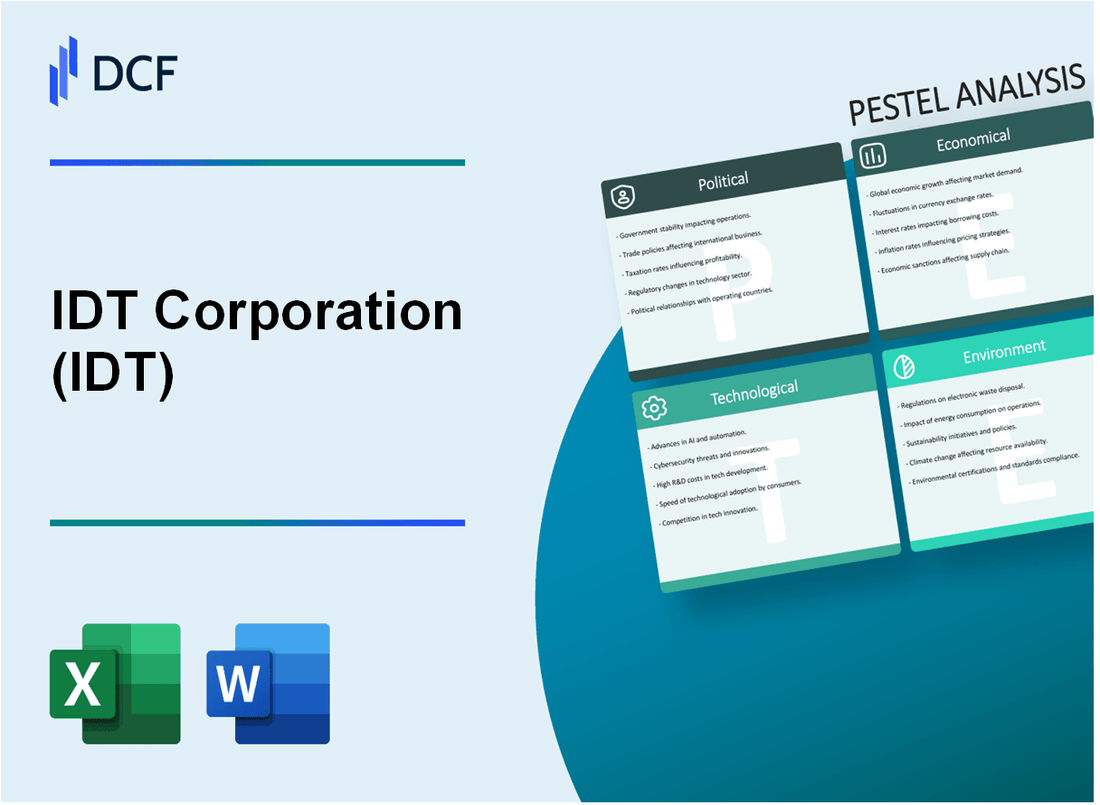
IDT Corporation sits at a fascinating crossroad in 2025, where the growth of its fintech arm, BOSS Money, is directly battling global regulatory friction and technological commoditization. You need to understand how the push for financial inclusion among immigrant populations-a major sociological tailwind-is being met with stricter Anti-Money Laundering (AML) and Know Your Customer (KYC) laws, significantly increasing compliance costs. While the company projects a 2025 revenue around $1.55 billion, the real story is how they manage foreign exchange volatility and the relentless pressure from 5G on their legacy long-distance business. Let's defintely break down the six macro-forces defining their next move.
IDT Corporation (IDT) - PESTLE Analysis: Political factors
Increased scrutiny on cross-border money transfer (remittance) for Anti-Money Laundering (AML) compliance
The regulatory environment for IDT's BOSS Money (Fintech segment) is tightening significantly in 2025, driven by global efforts to combat illicit finance. You need to understand that the cost of compliance is now a major operational expense, not just a back-office function. New guidelines from the Financial Action Task Force (FATF) emphasize enhanced National Risk Assessments (NRA) and beneficial ownership transparency, forcing a modernization of systems or the risk of stiff fines. The launch of the European Anti-Money Laundering Authority (AMLA) in mid-2025 will harmonize and likely strengthen AML standards across the European Union, a key region where IDT operates.
For a high-volume remittance player like BOSS Money, which reported a total revenue of $139.8 million in fiscal year 2025, the shift to real-time transaction monitoring is a major compliance stress test. Batch screening simply won't cut it anymore. The uneven enforcement of the FATF Travel Rule, which requires sharing originator and beneficiary data with counterparties, creates a complex compliance landscape. You have to apply full controls even when some of your global partners aren't defintely compliant yet, which adds friction to the transfer process.
- Compliance Cost Driver: Demand for AI-driven solutions to reduce false positives in real-time screening.
- Regulatory Headwind: Stricter sanctions screening for cross-border transfers.
- European Oversight: AMLA's mid-2025 launch means harmonized, stricter EU standards.
US-China trade tensions still impact global telecom infrastructure and pricing for international calls
While IDT's traditional voice business (BOSS Revolution calling) is declining-with calling revenues plunging 21% in the fourth quarter of fiscal year 2025-the geopolitical friction between the U.S. and China still impacts the underlying infrastructure. This isn't about your monthly bill, but about the capital expenditure (CapEx) needed to maintain and upgrade the global voice network (IDT Global). The U.S. imposition of a 104% tariff on Chinese optical fiber products in 2025, for example, sends shockwaves through the entire telecom supply chain. Here's the quick math: higher tariffs on networking hardware and components mean higher costs for IDT when purchasing or replacing equipment for its international voice termination business.
This trade war environment forces a strategic shift toward supply chain diversification, a costly and time-consuming process. The resulting supply chain volatility also leads to shorter price locks on hardware quotes, making long-term CapEx planning for the Traditional Communications segment, which generated $217.4 million in Q4 2025, much harder. You're fighting a structural decline in voice revenue while simultaneously facing inflated infrastructure costs due to political policy.
Shifting immigration policies in key US and European markets affect the core customer base for BOSS Revolution
IDT's business model is fundamentally tied to the size and financial activity of immigrant communities. The BOSS Revolution ecosystem serves a base of more than eight million users, primarily in these communities. Proposed political actions in the U.S. directly threaten this core market. For instance, the 'One Big Beautiful Bill' Act, which was before the U.S. Senate in 2025, included a proposed remittance tax on money sent by non-citizens.
The most significant risk is the proposed 3.5% remittance tax on money sent from the U.S. to non-citizens abroad. An analysis by the Inter-American Dialogue warned that such a tax could lead to a 7% decrease in remittances overall. This not only hits the consumer's wallet but also pushes transactions toward less traceable, informal channels, undermining IDT's compliance efforts. Plus, the political rhetoric around deportation creates a chilling effect on new migration, which is the primary driver of long-term remittance growth for the industry. Less new migration today means less new remittance volume tomorrow.
Government-mandated telecom service fees and taxes vary widely across the 50+ countries IDT operates in
Operating in over 50 countries means IDT's Traditional Communications segment must navigate a fragmented and ever-changing global tax and fee landscape. These are non-discretionary costs that eat into the already thin margins of the voice business. The most immediate and significant regulatory burden in the U.S. is the Federal Universal Service Fund (USF) contribution.
The USF contribution factor, applied to interstate and international end-user telecom revenues, has climbed to unprecedented levels. For the first quarter of 2025, the factor was a massive 36.3% of assessable revenues. This is a direct, substantial cost that must be collected from customers and remitted. Furthermore, the Federal Communications Commission (FCC) regulatory fee factor for interstate telephone service providers in fiscal year 2025 is 0.005125 per revenue dollar. These federal and state fees, along with other mandated contributions like the Telecommunications Relay Services (TRS) fund, create a heavy administrative and financial burden.
| US Telecom Regulatory Burden (FY 2025) | Mandated Rate / Factor | Impact on IDT's Traditional Communications |
|---|---|---|
| Federal Universal Service Fund (USF) Contribution Factor | 36.3% (Q1 2025 rate) | High, non-discretionary cost on interstate/international voice revenue. |
| FCC Regulatory Fee Factor (Interstate Providers) | 0.005125 per revenue dollar | Annual fee based on assessable revenue, adding to operational overhead. |
| Proposed US Remittance Tax (One Big Beautiful Bill Act) | Up to 3.5% on money sent to non-citizens | Major risk to BOSS Money's transaction volume, potentially causing a 7% industry-wide decrease. |
IDT Corporation (IDT) - PESTLE Analysis: Economic factors
Persistent US inflation and high interest rates pressure the discretionary spending of IDT's lower-to-middle-income customer segment.
You need to remember that IDT Corporation's core customer base-the one driving the growth in BOSS Money and National Retail Solutions (NRS)-is highly sensitive to macroeconomic pressure. The Federal Reserve's sustained high-interest-rate environment, aimed at curbing inflation, is hitting this demographic hard. Honestly, their purchasing power is eroding fast.
Real consumer spending growth in the U.S. is projected to weaken to around 3.7% in 2025, down from 5.7% in 2024, with the cooling effect most visible among lower- and middle-income households. This is a problem because the cost of essentials-food, rent, and gas-is still elevated, with core inflation expected to persist near 3% through mid-2026, well above the Fed's 2% target. When a customer's budget is stretched, they cut back on discretionary services first, which includes international calling (Traditional Communications segment) and, potentially, the frequency of money transfers (remittances), even if the latter is essential. Credit card data shows real spending for lower-income consumers has been relatively flat.
Here's the quick math: higher cost of living means less disposable income for sending money home, even with a strong labor market.
Volatility in foreign exchange (FX) rates directly impacts BOSS Money's margins and pricing in key remittance corridors.
The strength of the U.S. dollar (USD) against currencies in IDT's key receiving markets is a double-edged sword. While a strong USD means more local currency for the recipient, which is a competitive advantage for BOSS Money, it also creates significant margin volatility for IDT. The company must constantly adjust its foreign exchange (FX) rates to remain competitive while protecting its gross profit per transaction.
For example, in 2025, the Latin American (LATAM) currency environment is particularly complex and volatile. Currencies like the Colombian Peso (COP) and Mexican Peso (MXN) face significant uncertainty due to domestic political and economic factors. IDT's net2phone segment already reported a negative FX impact on its Latin American operations in the first quarter of fiscal year 2025 due to the strong U.S. dollar. BOSS Money has to focus on expanding per-transaction margins, which can sometimes dampen transaction volume growth, as seen in their retail channel strategy.
This is a constant balancing act; you want to offer the best rate, but you defintely need to protect your spread.
Global economic slowdowns could reduce immigrant employment, cutting the total volume of money transfers.
Remittance volume, the lifeblood of the BOSS Money business, is directly tied to the employment and wage levels of the immigrant community in the U.S. A global economic slowdown, even a moderate one, would quickly translate into lower money transfer volumes.
S&P Global Ratings forecasts U.S. real GDP growth to slow to 2% in 2025 and 2026. A weakening job market, coupled with restrictive immigration policies, limits the number of new workers and, crucially, the income available for sending remittances. Fewer immigrants mean fewer people to send money. While the industry has shown resilience, with remittances to Latin America and the Caribbean experiencing growth, a significant slowdown in U.S. labor demand would immediately pressure IDT's transaction volume.
The reliance on a stable, employed immigrant base is a systemic risk you can't diversify away from.
The company's 2025 revenue was $1.23 billion, a slight increase driven by fintech growth.
IDT Corporation's overall financial performance for the fiscal year 2025 (ended July 31, 2025) reflects a strategic shift: a highly profitable fintech segment compensating for declines in the Traditional Communications segment. The company's consolidated revenue for FY 2025 was $1,231.5 million (or $1.23 billion), representing a modest 2% growth year-over-year. This slight increase hides the robust internal growth engine of the Fintech segment, which is the key to future valuation.
The Fintech segment, powered by BOSS Money, is the clear growth driver, showing significant gains in profitability and revenue, even as the legacy business shrinks. This bifurcated performance is a core economic reality for the company.
| Financial Metric (FY 2025) | Value | Year-over-Year Change |
|---|---|---|
| Consolidated Revenue | $1,231.5 million | +2% |
| Consolidated Adjusted EBITDA | $128.7 million | +43% |
| Fintech Segment Total Revenue (BOSS Money) | $139.8 million | +29% |
| Fintech Segment Adjusted EBITDA | $18.4 million | Increased from $1.1 million in FY 2024 |
The financial data shows the Fintech segment's Adjusted EBITDA surged over 16-fold, from $1.1 million in fiscal 2024 to $18.4 million in fiscal 2025. This massive profitability increase from the high-margin BOSS Money and NRS businesses is what's truly driving the stock's narrative, not the top-line revenue number.
- Fintech segment income from operations surged to $15.4 million in FY 2025, up from a loss of $0.1 million in FY 2024.
- BOSS Money digital revenue grew 36% to $99.0 million for the full fiscal year 2025.
Next Step: Finance team should model a 10% reduction in average remittance volume for the top three corridors (Mexico, Colombia, and Philippines) to stress-test the BOSS Money segment's gross margin for Q1 2026.
IDT Corporation (IDT) - PESTLE Analysis: Social factors
Growing digital literacy and smartphone adoption among the immigrant and unbanked populations drive BOSS Money app usage.
The increasing digital comfort of IDT's core customer base-immigrant and unbanked populations-is a primary social tailwind for the Fintech segment, particularly BOSS Money. While non-citizen immigrant status is associated with a significantly higher likelihood of being unbanked, the widespread adoption of mobile technology is bridging this gap. About 92% of Americans have at least one smartphone, creating a massive, digitally-enabled audience for app-based financial services.
This shift in user behavior is evident in BOSS Money's performance. In fiscal year 2025, the digital channel became the dominant originating source, generating over 80% of the business's remittance transactions. This digital-first strategy helped BOSS Money process over 23 million remittance transactions in FY2025. Honestly, the customer prefers the app over the counter now; it's faster and cheaper.
Strong demand for culturally-specific, low-cost communication and financial services remains a core driver for BOSS Revolution.
The fundamental need for affordable, reliable cross-border communication and money transfer services is still the bedrock of the BOSS Revolution ecosystem. This demand is intrinsically linked to the social structure of immigrant communities who maintain strong ties with their home countries.
The success of the BOSS Money remittance platform-a direct extension of the original BOSS Revolution brand-demonstrates this persistent demand. The Fintech segment, which includes BOSS Money, saw its total revenue increase by 29% to reach $154.6 million in fiscal year 2025. This growth is fueled by a product that is culturally attuned and priced to serve a demographic that often faces higher fees and less transparent services from traditional banks (the underbanked). The company is defintely leveraging the trust built over decades of providing low-cost international calling.
Demographic shifts, like the increasing size of the US Hispanic and Asian populations, expand the addressable market for IDT's services.
Major demographic changes in the US population are structurally expanding IDT's addressable market. The US Hispanic and Asian populations are the fastest-growing race-ethnic groups, and they are the primary users of IDT's core services.
Here's the quick math: the Hispanic population surpassed 65 million and the Asian population reached 20.7 million in 2023. These groups accounted for 93% of the nation's 2023-2024 population growth. By 2025, the combined Hispanic and Asian populations are projected to constitute 24% of the total US population. This sustained growth provides a long runway for customer acquisition and transaction volume increases for both BOSS Money and the NRS platform. The market is simply getting bigger every year.
| US Demographic Trend (2025 Context) | Key Metric / Value | IDT Segment Impact |
|---|---|---|
| Projected US Population (July 2025) | 342.0 million | Overall market size for all segments. |
| Hispanic Population (2023) | Over 65 million | Core customer base for BOSS Money and NRS. |
| Asian Population (2023) | 20.7 million | Secondary, high-growth customer base for BOSS Money. |
| BOSS Money FY2025 Total Revenue | $154.6 million | Quantifies successful penetration of the target demographic. |
| BOSS Money FY2025 Digital Transaction Share | Over 80% | Validates high digital literacy and smartphone adoption. |
| NRS Active Terminals (FY2025) | Over 30,000 | Indicates reach into underserved urban retail communities. |
Need for financial inclusion pushes demand for the National Retail Solutions (NRS) point-of-sale platform in underserved urban areas.
The social imperative for financial inclusion (equitable access to financial services) is a key driver for National Retail Solutions (NRS). The NRS point-of-sale (POS) platform is primarily deployed in independent convenience stores, bodegas, and other small urban retailers that serve communities with high concentrations of unbanked or underbanked residents.
These retailers act as a critical financial access point, offering services like bill pay, prepaid cards, and BOSS Money remittances directly through the NRS terminal. The platform's value proposition is strong: it helps these small businesses compete with larger chains while simultaneously serving the financial needs of their local, underserved clientele.
The demand is concrete, with NRS adding approximately 5,100 net active terminals in fiscal year 2025, bringing the total network to over 30,000 retailers. This expansion directly maps to the ongoing need for localized financial services in urban centers. The platform is a financial inclusion tool disguised as a POS system.
- NRS recurring revenue grew 27% in FY2025.
- NRS generated over $35 million in Adjusted EBITDA in FY2025.
- Unbanked status is strongly associated with race, ethnicity, and non-citizen immigrant status.
IDT Corporation (IDT) - PESTLE Analysis: Technological factors
Rapid adoption of 5G and Voice over Internet Protocol (VoIP) continues to commoditize the legacy international long-distance business.
The relentless march of high-speed networks like 5G and the pervasive use of Voice over Internet Protocol (VoIP) technology have fundamentally commoditized IDT Corporation's (IDT) legacy business. This shift is clearly visible in the performance of the Traditional Communications segment, which houses the minutes-based voice businesses.
While this segment remains a durable cash-generation engine, producing $70 million in free cash flow in fiscal year 2025, its core revenue is under structural pressure. The increasing availability of high-quality, low-cost or free calling options via apps that utilize VoIP over 5G networks forces IDT to aggressively manage costs and pivot. For fiscal year 2026, management expects the segment's gross profit and Adjusted EBITDA to decline at a single-digit percentage rate, a direct result of this market commoditization. This is a classic technology disruption: better, cheaper substitutes are shrinking the profitable lifespan of the older service.
Competition from blockchain-based remittance platforms forces IDT to defintely invest more in its own digital infrastructure.
The rise of agile, blockchain-based fintech competitors, which promise near-instant, transparent, and low-cost cross-border payments, is forcing IDT to accelerate its digital transformation. While the company's overall Technology and Development expense decreased by 7% in fiscal year 2025 due to streamlining, the focus of investment has decisively shifted to its digital platforms to counter this threat. The most significant counter-measure is the development of the BOSS Money digital wallet, a foundational technology that positions the company to provide a wider array of financial services to its customer base.
IDT is also actively evaluating how to leverage blockchain applications, including a beta launch of a digital wallet that supports stablecoins, though management notes the stablecoin integration has not had a material impact yet. This proactive investment is paying off, with the Fintech segment's income from operations surging to $15.4 million in fiscal year 2025 from a loss in the prior year, demonstrating the necessity of this digital push.
Advanced data analytics and AI are essential for fraud detection and personalized marketing across the NRS and BOSS platforms.
The sheer volume of digital transactions across the National Retail Solutions (NRS) and BOSS Money platforms makes Artificial Intelligence (AI) and advanced data analytics a non-negotiable requirement for operational efficiency, fraud prevention, and revenue growth. IDT is leaning heavily on these tools:
- BOSS Money: The business is using AI and machine learning to slash transactional costs, a critical move given the massive growth in digital transactions.
- NRS: The NRS Insights business, which leverages transaction data from over 30,000 point-of-sale (POS) terminals, is a key growth driver. This data platform is used for personalized marketing and is now signing major deals, such as an agreement with a leading coupon provider to enable digital coupons for retailers starting in calendar year 2026.
- net2phone: The cloud communications segment launched a virtual AI agent that has been well-received internally. The company is targeting for 30% or more of net2phone's sales to include one or both of its AI solutions by the end of the fiscal year.
Continuous mobile app development and feature releases are critical to maintaining market share against agile fintech competitors.
In the remittance space, the battle for market share is fought on the smartphone screen. IDT's commitment to its mobile platform is evident in the performance of its BOSS Money app, which is the dominant originating channel for the business. This focus is a direct response to the agility of fintech rivals.
The strong digital performance is built on a superior user experience, as evidenced by the 4.9 average app store rating achieved by the BOSS Money app in a 2025 customer satisfaction ranking. This focus on the digital channel has been transformative, as digital transactions now contribute 83% of all remittances, driving the segment's total revenue to $139.8 million in fiscal year 2025. New feature releases, such as the upcoming integration with WhatsApp and the deployment of a cross-border digital wallet, are crucial next steps to sustain this momentum.
Here is a snapshot of the technological shift's impact on IDT's key growth segments for fiscal year 2025:
| Segment | Key Technology Factor | FY 2025 Performance Metric | FY 2025 Value |
|---|---|---|---|
| BOSS Money (Fintech) | Digital Channel Expansion (App/AI) | Digital Revenue Growth (YoY) | 36% |
| BOSS Money (Fintech) | Digital Channel Penetration | Digital Share of Remittance Transactions | 83% |
| National Retail Solutions (NRS) | POS Platform & Data Analytics | Recurring Revenue Growth (YoY) | 22% |
| net2phone (Cloud Comm.) | AI Integration | Target of Sales with AI Solutions | 30% |
| Traditional Communications | 5G/VoIP Commoditization | Expected FY 2026 Gross Profit/EBITDA | Single-digit % decline |
The action here is clear: continue to allocate capital from the cash-generative Traditional Communications segment into the high-growth, technology-driven segments like BOSS Money and NRS. Finance needs to defintely track the ROI of the AI and digital wallet investments against customer acquisition cost (CAC) and lifetime value (LTV) for the next two quarters.
IDT Corporation (IDT) - PESTLE Analysis: Legal factors
Stricter Know Your Customer (KYC) and Bank Secrecy Act (BSA) regulations for money transmitters increase compliance costs significantly.
You need to be acutely aware of how anti-money laundering (AML) compliance is turning into a major cost center, not just a regulatory hurdle. IDT Corporation's Fintech segment, primarily BOSS Money, is a Money Services Business (MSB) and operates under the constant, heavy hand of the Bank Secrecy Act (BSA) and its Know Your Customer (KYC) requirements. This isn't just about initial onboarding; it's perpetual monitoring.
The cost of staying compliant is rising fast. For fiscal year 2025, IDT's Corporate General & Administrative (G&A) expense increased to $11.1 million from $10.5 million in FY 2024, with increased legal fees cited as a contributing factor. Plus, the company recorded a $4.0 million expense in fiscal 2025 related to the settlement of litigation, demonstrating the tangible cost of regulatory and legal risk. When you consider that BOSS Money handled over 23 million remittance transactions in FY 2025, each transaction is a potential point of failure for AML/KYC screening.
- Global AML/KYC Fines: Hit a record $4.5 billion in 2024, showing the high stakes.
- FinCEN Beneficial Ownership Rule: Entered into force in January 2025, adding a new layer of reporting complexity for corporate structure and beneficial ownership.
- Action: Invest in automated, continuous KYC (cKYC) systems to manage the 23 million annual transactions more efficiently.
Evolving state-level data privacy laws (like CCPA) and international equivalents require continuous updates to data handling protocols.
Data is currency, and the rules for handling it are a moving target. IDT's National Retail Solutions (NRS) and Fintech segments collect vast amounts of consumer and transaction data, making them prime targets for data privacy compliance. The California Consumer Privacy Act (CCPA), with its new regulations finalized in September 2025, is the bellwether for US state laws, and its requirements are getting tougher.
The updated CCPA rules, with risk assessment duties starting January 1, 2026, and new requirements for Automated Decision-Making Technology (ADMT), force a major operational overhaul. This impacts how IDT uses transaction data from its NRS point-of-sale (POS) network for advertising and how BOSS Money uses data for its digital remittance platform. You simply cannot afford to treat data privacy as a secondary IT issue anymore.
Here's the quick math: A single CCPA violation can cost a business up to $7,500 per intentional violation. Given the scale of IDT's operations, the cumulative risk is enormous.
Federal Communications Commission (FCC) oversight on telecom services, including interconnection agreements and consumer protection rules.
The Traditional Communications and net2phone segments remain under the purview of the Federal Communications Commission (FCC), which maintains strict oversight on interconnection, quality of service, and consumer protection. While IDT's focus is shifting to Fintech, the legacy telecom business still generates substantial cash-$860.2 million in revenue for the Traditional Communications segment in fiscal 2025-so regulatory compliance here is defintely non-negotiable.
A 2021 FCC warning to IDT Corporation over transmitting illegal robocalls serves as a clear reminder of the ongoing regulatory exposure and the risk of traffic blocking. More recently, the FCC has been active in 2025, proposing to modernize Telecommunications Relay Services (TRS) and addressing cybersecurity requirements for telcos, which mandates continuous monitoring and potential updates to IDT's network infrastructure and service offerings.
Licensing requirements for money services businesses (MSBs) are complex and highly fragmented across US states and international jurisdictions.
The fragmented nature of MSB licensing is a major operational friction point for BOSS Money. Unlike a single federal banking charter, IDT's money transfer business must secure and maintain separate licenses in almost every US state, plus various international jurisdictions. This is a perpetual, costly administrative burden.
IDT Payment Services, Inc. is the licensed money transmitter for most US operations, but a separate entity, IDT Payment Services of New York LLC, is required to operate in New York, demonstrating the need for state-specific legal entities and capital reserves. On the international front, BOSS Money's network extends to over 315,000 cash pick-up locations in 50 countries, each with its own set of regulatory, consumer protection, and foreign exchange rules.
This complexity creates a high barrier to entry for competitors, but it also means IDT must dedicate significant resources to a compliance team that tracks 50+ distinct regulatory regimes. The cost of non-compliance-fines, license revocation, or operational shutdown in a key market-is an existential risk.
| Regulatory Area | IDT Segment Impacted | FY 2025 Financial/Operational Data | Compliance Action/Risk |
|---|---|---|---|
| KYC/BSA (AML) | Fintech (BOSS Money) | Over 23 million remittance transactions in FY 2025; Corporate G&A increased to $11.1 million (partially legal fees). | Risk of fines (Global fines hit $4.5 billion in 2024); Mandatory FinCEN Beneficial Ownership reporting. |
| Data Privacy (CCPA) | NRS, Fintech, net2phone | NRS revenue $128.8 million in FY 2025 (data-intensive); CCPA new regulations finalized in Sept 2025. | New requirements for risk assessments (Jan 2026) and ADMT; Potential for up to $7,500 per intentional violation. |
| FCC Oversight | Traditional Communications, net2phone | Traditional Comms revenue $860.2 million in FY 2025. | Ongoing risk from robocall enforcement; Need to adapt to 2025 FCC changes on TRS and telco cybersecurity rules. |
| MSB Licensing | Fintech (BOSS Money) | Transfers to over 315,000 payout locations in 50 countries. | Need for multiple state-level licenses (e.g., IDT Payment Services of New York LLC); High administrative burden for maintaining reserves. |
IDT Corporation (IDT) - PESTLE Analysis: Environmental factors
Growing investor and public pressure for Corporate Social Responsibility (CSR) reporting on energy use and carbon footprint.
You are seeing a clear, non-negotiable shift where investors and the public expect a comprehensive view of environmental performance, not just financial results. For a company like IDT Corporation, which operates in both fintech and communications, this pressure centers on Scope 2 emissions (purchased electricity for data centers) and Scope 3 emissions (the embodied carbon in hardware and the energy use of its National Retail Solutions (NRS) point-of-sale (POS) terminals). Since IDT Corporation is a NYSE-listed entity with a Fiscal Year 2025 consolidated revenue of over $1.23 billion, the lack of a detailed, public Environmental, Social, and Governance (ESG) report is a material risk.
The market is demanding transparency. Honestly, without published metrics on energy consumption or a clear path to net-zero, you leave a gap for activist investors to exploit. The simple fact is that robust reporting is now a cost of doing business, not a nice-to-have.
Need to optimize data center energy consumption to manage operating costs and meet emerging sustainability standards.
The core of IDT Corporation's communications and fintech infrastructure is its data center and network operations, and that means power is a major operating expense. Globally, data centers are projected to account for approximately 3-4% of total global electricity consumption by 2025, so this is a sector-wide issue.
The industry benchmark for Power Usage Effectiveness (PUE)-a ratio of total facility energy to IT equipment energy-is around 1.57, but market leaders are now achieving PUEs below 1.2. The push for efficiency isn't just about public relations; it's about the bottom line, especially with the rising cost of power. Every point reduction in PUE translates directly into lower operating costs and a higher Adjusted EBITDA, which hit a record $128.7 million for IDT Corporation in Fiscal Year 2025.
Here's the quick math: lower PUE equals higher profitability.
E-waste regulations for telecom hardware and data center equipment necessitate formal, compliant disposal programs.
The hardware deployed across IDT Corporation's segments creates a significant e-waste liability that requires a formal, compliant IT Asset Disposition (ITAD) strategy. This is defintely a risk area. The National Retail Solutions (NRS) segment, for instance, added approximately 5,100 net active terminals in Fiscal Year 2025 alone, contributing to a growing network of hardware that will eventually need to be retired.
This hardware, plus the telecom equipment for net2phone's cloud communications, falls under increasingly strict state and federal electronic waste (e-waste) regulations, like those in California. You need a documented, audited process for end-of-life disposal to mitigate legal and reputational risk. What this estimate hides is the cost of non-compliance, which can be substantial.
- Manage NRS POS terminal lifecycle.
- Ensure net2phone hardware is responsibly recycled.
- Track and certify data destruction for retired assets.
Focus on paperless transactions and digital receipts aligns with environmental goals while also improving operational efficiency.
The shift to digital channels in the Fintech segment is IDT Corporation's most concrete environmental opportunity and success story. This move directly reduces paper, printing, and distribution logistics, lowering Scope 3 emissions and operational friction. The BOSS Money remittance service is leading this charge.
In Fiscal Year 2025, the digital channel was a clear driver of growth and efficiency for the Fintech segment.
| Metric (Fiscal Year 2025) | Performance | Environmental Impact |
|---|---|---|
| BOSS Money Digital Channel Remittance Volume | Over 80% of total volume | Significant paper reduction, lower logistics carbon footprint. |
| BOSS Money Digital Transactions (2Q25 YoY Growth) | Increased by 40% | Accelerating shift away from paper-intensive retail transactions. |
| NRS eWIC Adoption | Replaces laborious manual paperwork | Streamlines government benefit processing, eliminating paper vouchers. |
The move to digital receipts and transactions is a win-win: it improves the customer experience, cuts down on paper costs, and positions IDT Corporation as a forward-thinking fintech player. The business is already doing the right thing for the environment by pursuing operational efficiency.
Disclaimer
All information, articles, and product details provided on this website are for general informational and educational purposes only. We do not claim any ownership over, nor do we intend to infringe upon, any trademarks, copyrights, logos, brand names, or other intellectual property mentioned or depicted on this site. Such intellectual property remains the property of its respective owners, and any references here are made solely for identification or informational purposes, without implying any affiliation, endorsement, or partnership.
We make no representations or warranties, express or implied, regarding the accuracy, completeness, or suitability of any content or products presented. Nothing on this website should be construed as legal, tax, investment, financial, medical, or other professional advice. In addition, no part of this site—including articles or product references—constitutes a solicitation, recommendation, endorsement, advertisement, or offer to buy or sell any securities, franchises, or other financial instruments, particularly in jurisdictions where such activity would be unlawful.
All content is of a general nature and may not address the specific circumstances of any individual or entity. It is not a substitute for professional advice or services. Any actions you take based on the information provided here are strictly at your own risk. You accept full responsibility for any decisions or outcomes arising from your use of this website and agree to release us from any liability in connection with your use of, or reliance upon, the content or products found herein.